Stanza · Audio guide
Basilica di San Lorenzo in Damaso Audio Guide
A place to remember. A story to take with you.
The Minor Basilica of St. Lawrence in Damaso is a parish and titular church in central Rome, Italy. It is incorporated into the Palazzo della Cancelleria, which enjoys the extraterritoriality of the Holy See.
Download Stanza, then search for “Basilica di San Lorenzo in Damaso”.
About the tour
One guide. Your kind of visit.
The Minor Basilica of St. Lawrence in Damaso is a parish and titular church in central Rome, Italy. It is incorporated into the Palazzo della Cancelleria, which enjoys the extraterritoriality of the Holy See.
Ready when you are.
- 01Get the free Stanza app.
iOS & Android
- 02Find your guide.
“Basilica di San Lorenzo in Damaso”
- 03Download before you go.
Works offline
Audio guide / 8 narrated stops
Inside the guide
Get to know a few of the stories before you go. Open a stop to read more.
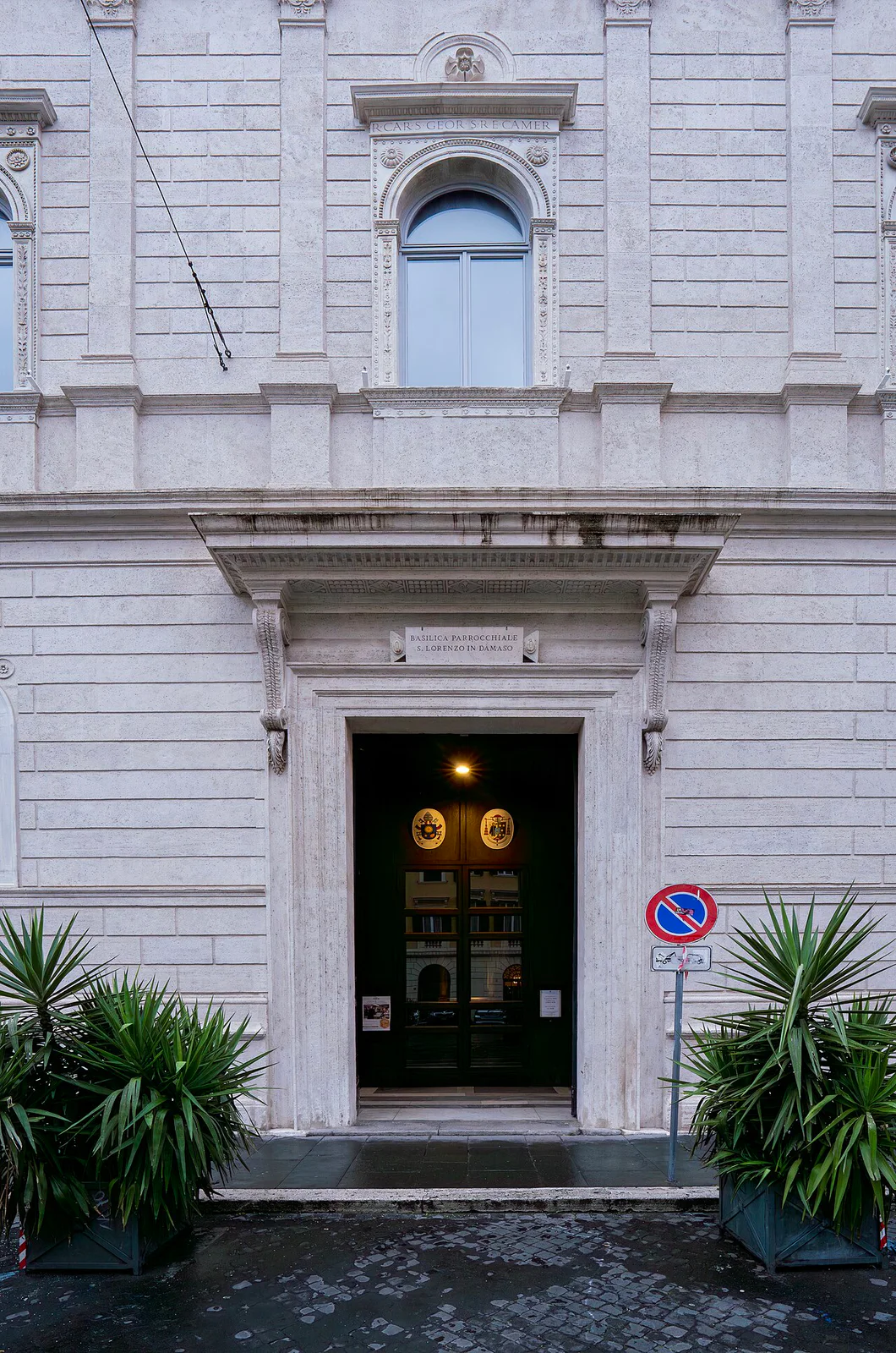
01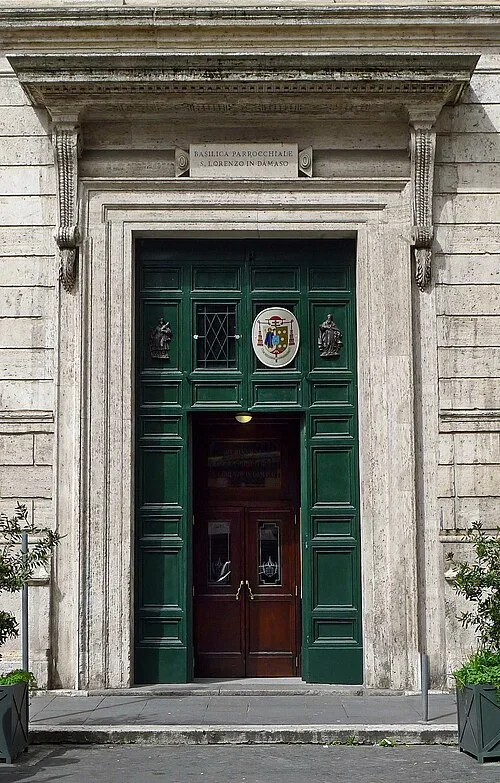 Piazza della Cancelleria and the Vignola Portal
Vignola Portal on Piazza della Cancelleria
The basilica of Saint Lawrence in Damaso has no front of its own. It is a parish church and a minor basilica, dedicated to Saint Lawrence, a deacon and martyr. Its entrance is a doorway cut into the side of a huge palace, the Palazzo della Cancelleria. Cardinal Raffaele Riario, a nephew of Pope Sixtus the Fourth, commissioned the palace. It was built between 1489 and 1513. Riario had the earlier basilica demolished, and the palace then enclosed a new one under its right wing. The palace was built of spolia, which means reused stone taken from nearby ancient Roman buildings, including the Colosseum. The doorway itself was designed by the architect Vignola. Above the green doors, a coat of arms in a round medallion sits between two small figures. A plaque above them names the building as the parish basilica of Saint Lawrence in Damaso. The palace enjoys extraterritorial status, a privilege of the Holy See, which puts it outside ordinary Italian law. The basilica sits inside that palace, so it shares the same status.
Photo: Peter1936F · CC BY-SA 3.0
02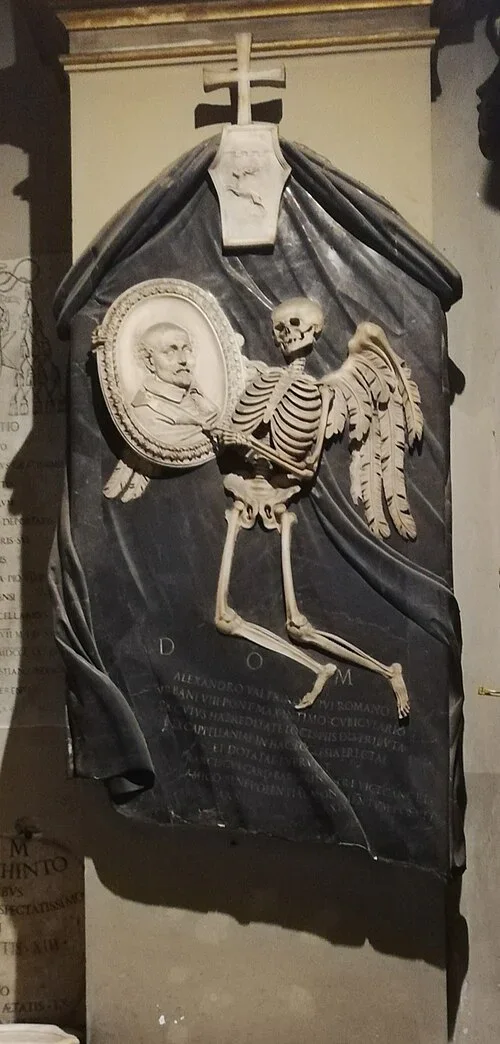 Entrance Vestibule and Bernini's Valtrini Memorial
Bernini's Memorial to Alessandro Valtrini
Bernini's memorial to Alessandro Valtrini shows Death as a skeleton in motion. Valtrini died in 1633. He served as a minister of the Pope, and he was a wealthy supporter of churches. His body stayed at the Gesù church, but three churches he had supported raised monuments to him. This basilica was one of them. Six years after his death, Bernini designed this memorial, and his workshop made it in 1639. Cardinal Francesco Barberini arranged the commission to praise Valtrini's church work. The skeleton strides forward, one feathered wing raised behind it. It holds an oval medallion with a portrait of Valtrini himself. Behind the figure, a dark cloth falls in heavy folds. Today it stands in the five-aisled vestibule that leads into the basilica. It was first set on a pillar in the left aisle, and later moved to a pillar in the entrance wall.
Photo: Bargioni · CC BY-SA 3.0
03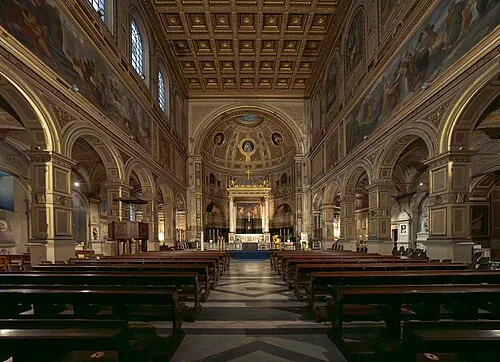 The Central Nave
The Three-Aisled Nave
Rows of square piers, joined by arches, divide the nave into three aisles. Above them, the ceiling is coffered, with sunken square panels. The interior took on its new shape near the end of the fifteenth century. Donato Bramante, the architect, is credited with that work, which the cardinal who built the palace had ordered. Other architects have been suggested, so the question is still debated. Decoration came later. In the late sixteenth century, Cardinal Alessandro Farnese, who lived in the palace, began commissioning it. In 1820 Giuseppe Valadier restored the basilica at the pope's direction, and it took on the form it has today. The most recent restoration followed a fire in 1944.
Listen in the appPhoto: Fiat 500e · CC BY 4.0
04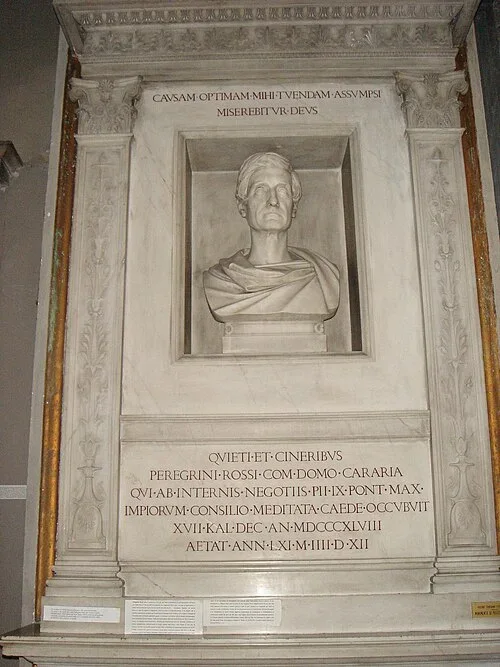 Right Aisle and the Tomb of Pellegrino Rossi
Tomb of Pellegrino Rossi by Pietro Tenerani
Pietro Tenerani sculpted the monument to Pellegrino Rossi, who served in the government of Pope Pius the Ninth. Rossi was killed in 1848 in the palace beside the basilica. The epitaph gives the date as the fifteenth of November. It says he fell to a killing that others had planned. A bust of him looks out from a niche above the Latin lettering. The epitaph also gives his age as sixty-one. His death was one of the events that brought the pope's move to the Vatican. Together with other events, it led to the annexation of the Papal States by the Kingdom of Italy.
Listen in the appPhoto: Lalupa · CC BY-SA 3.0
05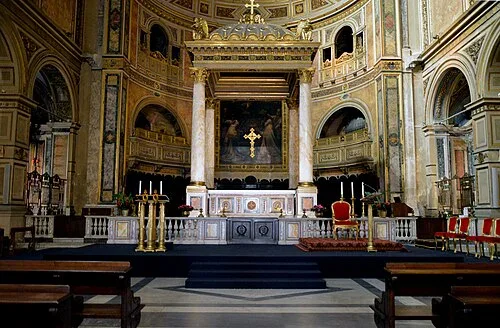 The High Altar and Papal Confessio
The High Altar and Presbytery
Tradition credits Pope Damasus the First with the first church on this site. According to that tradition, he built it in his own residence, around the year 380. The earliest clear mention of the basilica comes from a synod, a church meeting, held in 499 under Pope Symmachus. That mention uses the name Titulus Damasi, a term for an early Roman parish church. Archaeological evidence suggests the site may once have held a pagan temple. Today the high altar stands under a neoclassical canopy. Beneath it lie the relics of Pope Saint Damasus the First and Pope Saint Eutychian.
Listen in the appPhoto: Rita batacchi · CC BY-SA 4.0
06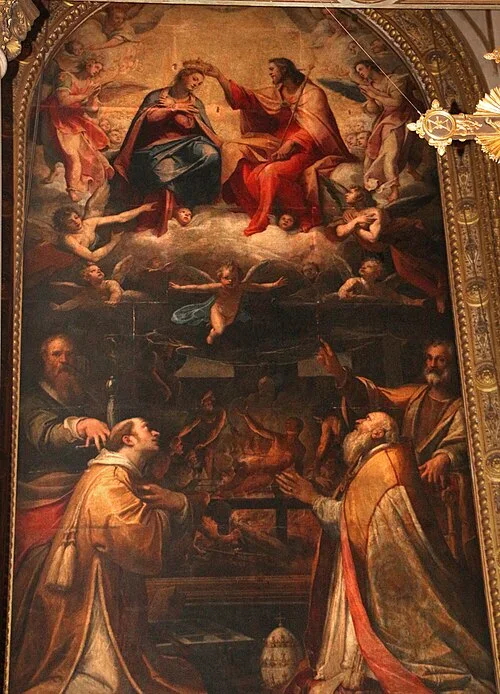 The Apse and Zuccari's Slate Masterpiece
Coronation of Mary and Saints by Federico Zuccari
Federico Zuccari painted the Coronation of Mary that fills the apse. At the top, Mary is crowned above the clouds, with angels gathered around her. Saints kneel and stand in the lower part of the painting. The painting is oil on slabs of slate, set into the masonry of the apse. Early in the nineteenth century, under French rule, the basilica was deconsecrated, which meant it lost its formal sacred status. The slabs were fixed so firmly into the wall that the painting could not be carried away.
Listen in the appPhoto: Sailko · CC BY 3.0
07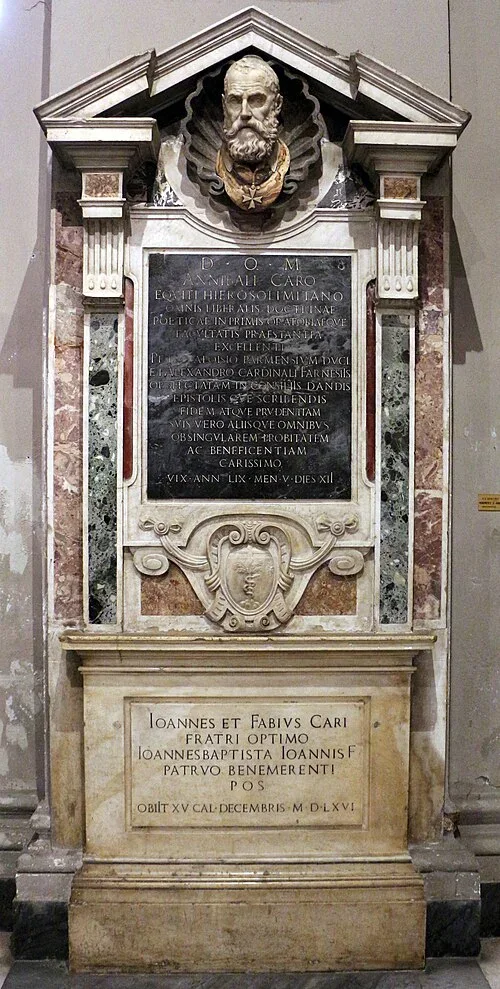 Left Aisle and the Monument to Annibal Caro
Monument to Annibale Caro by Giovanni Antonio Dosio
Relatives of Fra Annibal Caro raised this monument, as the base explains. Giovanni Antonio Dosio made it in 1566, the year Caro died. A bust of Caro sits in a shell-shaped niche above a dark tablet. Two of his brothers and a nephew are named on the base. One line calls Caro the best of brothers, and another honours him as a deserving uncle. Ciriaco d'Ancona stayed here for forty days in December of either 1424 or 1425. He was the guest of a cardinal friend, who later became pope. During that stay he began his Commentaria, which describes the still magnificent remains of antiquity and copies inscriptions. He is widely regarded as a founder of archaeology in a broad sense. A later scholar collected and published the basilica's inscriptions.
Listen in the appPhoto: Sailko · CC BY 3.0
08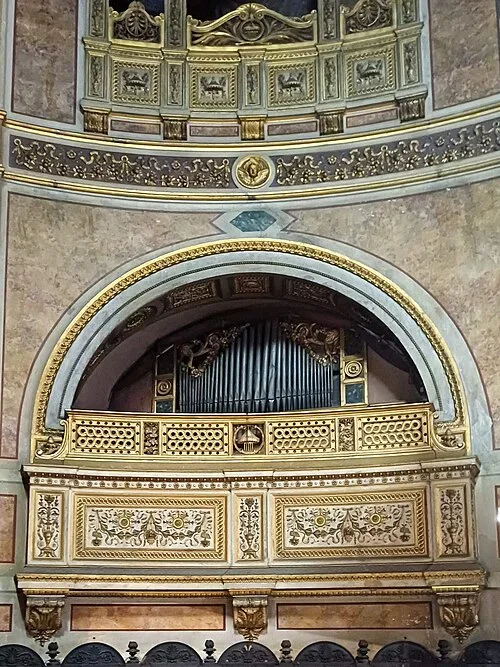 Presbytery Cantoria and Historic Pipe Organs
Priori Organ in the Presbytery Cantoria
The basilica's first organ was built in 1533 at the wish of Alessandro Farnese the Younger. A Neapolitan organ builder, Niccolò Asprelli, made it. Later, Gian Lorenzo Bernini designed a new apse for the basilica, and that first organ was sold. Two more organs then went into the upper galleries of the apse. In 1853 those galleries were judged no longer usable, so a new organ was built for a lower gallery. The gilded case in the gallery probably belongs to the organ built in 1853, the Priori organ. It still survives, though it no longer works. In 1908 a new pipe organ was built by two firms, and it was later electrified. When that work was done, tubular bells, metal tubes that sound like church bells, were added to it.
Listen in the appPhoto: Momimariani1962 · CC BY 4.0
Basilica di San Lorenzo in Damaso
Frequently asked questions
How much does the guide cost?
Free app download. Listed guide price: $0.99. Guide price shown in the app. Audio guide only. Venue admission is separate.
Can I listen without internet?
Yes. Download the guide’s audio, images, and maps in the app before your visit. Your downloaded content is then available offline.
Can I listen in my language?
This audio guide is available in 15 languages, including English.
Do I need to follow a schedule?
No. This is a self-guided experience. Choose your stops, pause whenever you like, and return to a story at your own pace.
At your own pace
Explore Basilica di San Lorenzo in Damaso.
Download Stanza, then search for “Basilica di San Lorenzo in Damaso”.
Free app download · Guide price shown in the app
Keep exploring
Nearby audio guides
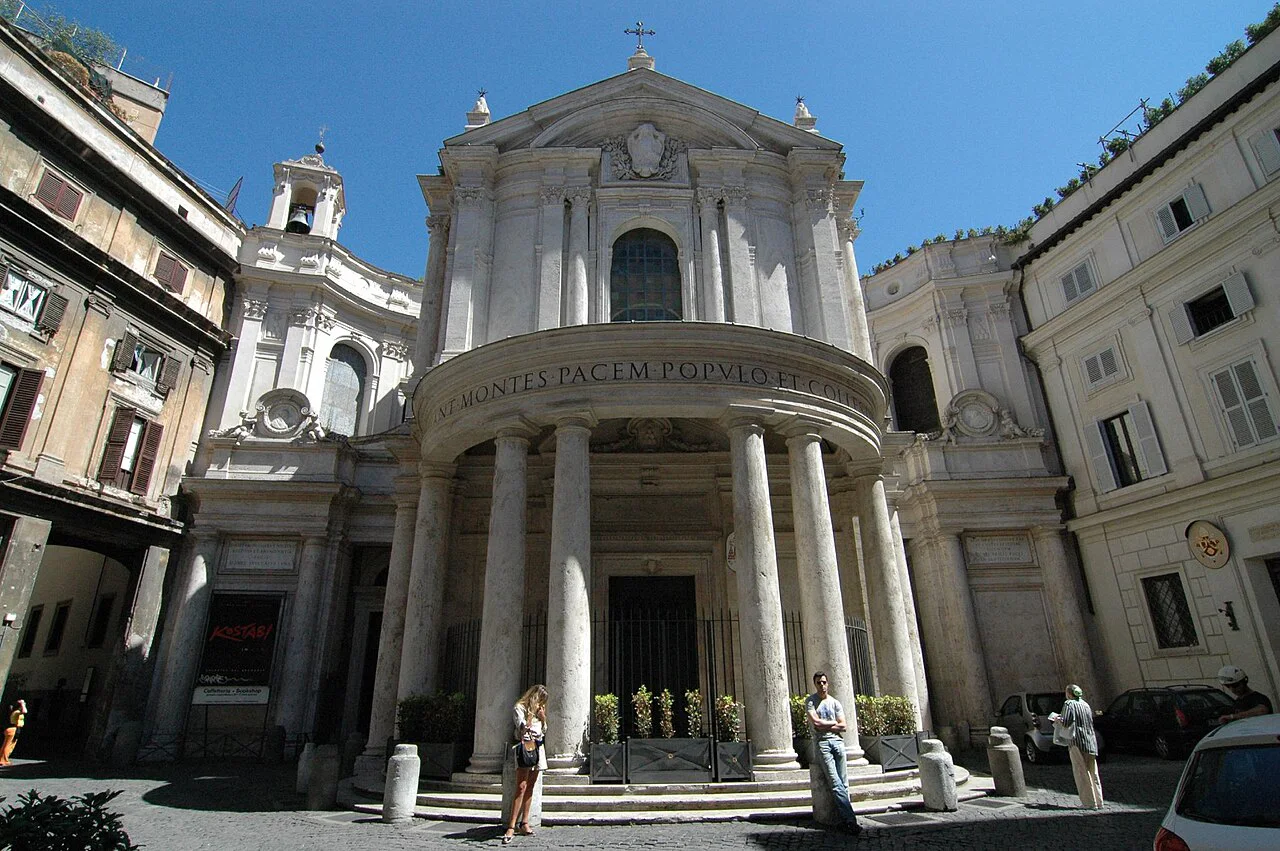
Rome · 1 km
Chiesa di Santa Maria della Pace
Content & sources
gaspa · CC BY 2.0
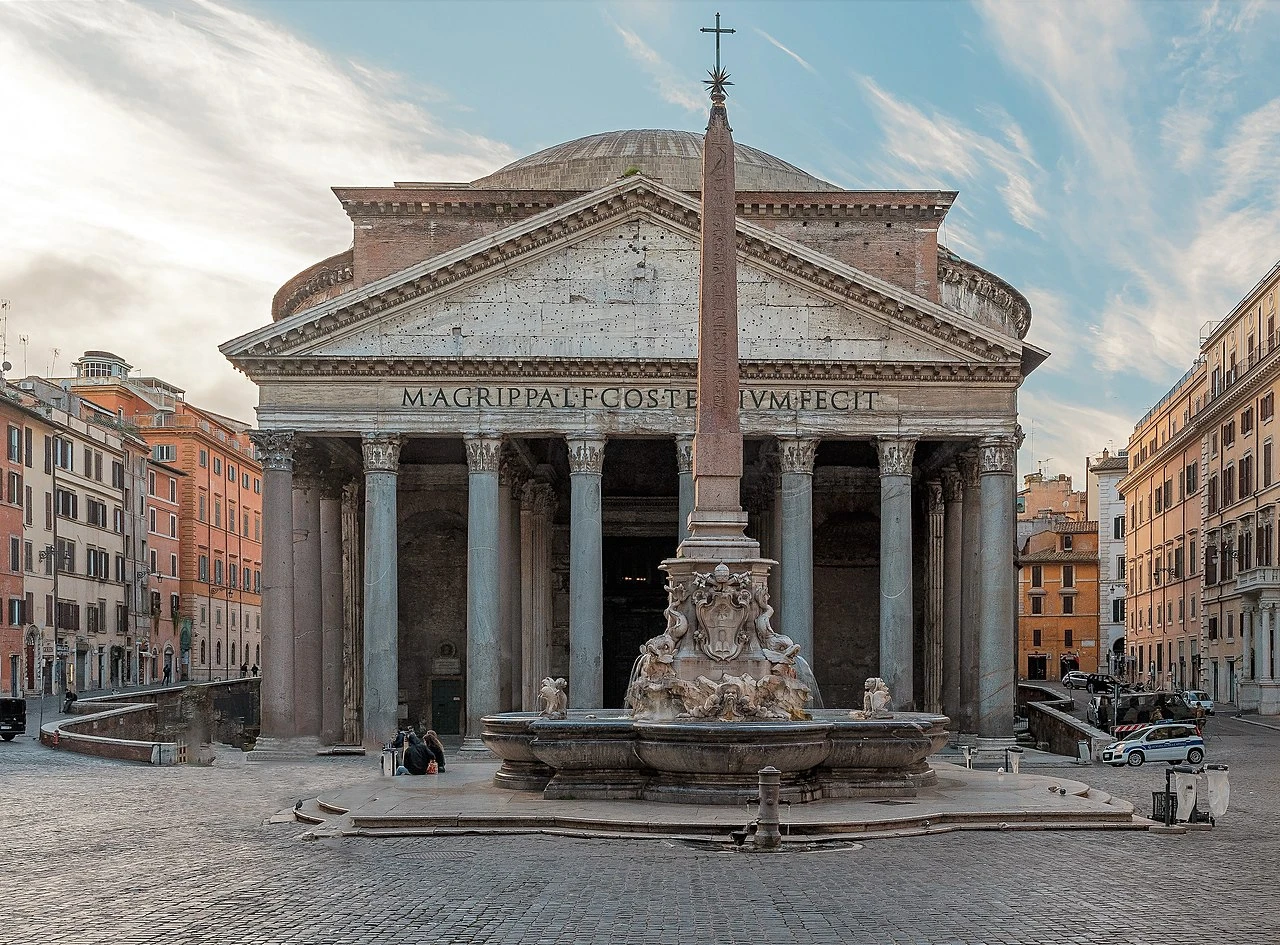
Rome · 1 km
Pantheon
Content & sources
Rabax63 · CC BY-SA 4.0
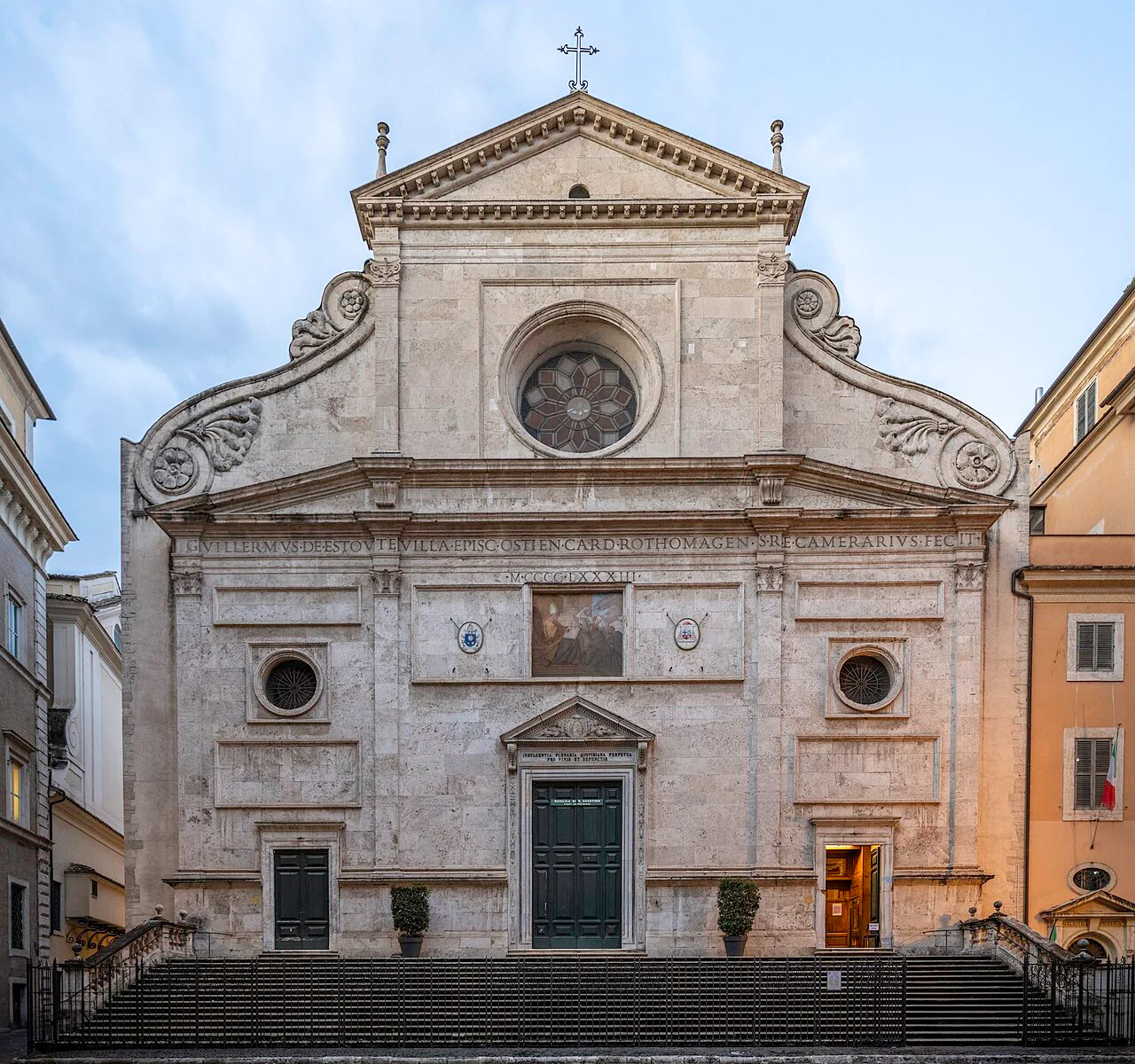
Rome · 1 km
Basilica di Sant'Agostino in Campo Marzio
Content & sources
Photo: Wilfredor · CC0
Rome · 1 km
Villa Farnesina
Content & sources
Paris Orlando · CC BY-SA 4.0