Languages
15Pantheon Audio Guide
Pantheon is a landmark in Rome, Italy. Explore it with Stanza's GPS-triggered offline audio guide — available in 15 languages.
Quick Facts
16
Stops
15
Languages
100%
Offline
📍 Rome, Italy · 41.8986°N, 12.4769°E
About Pantheon
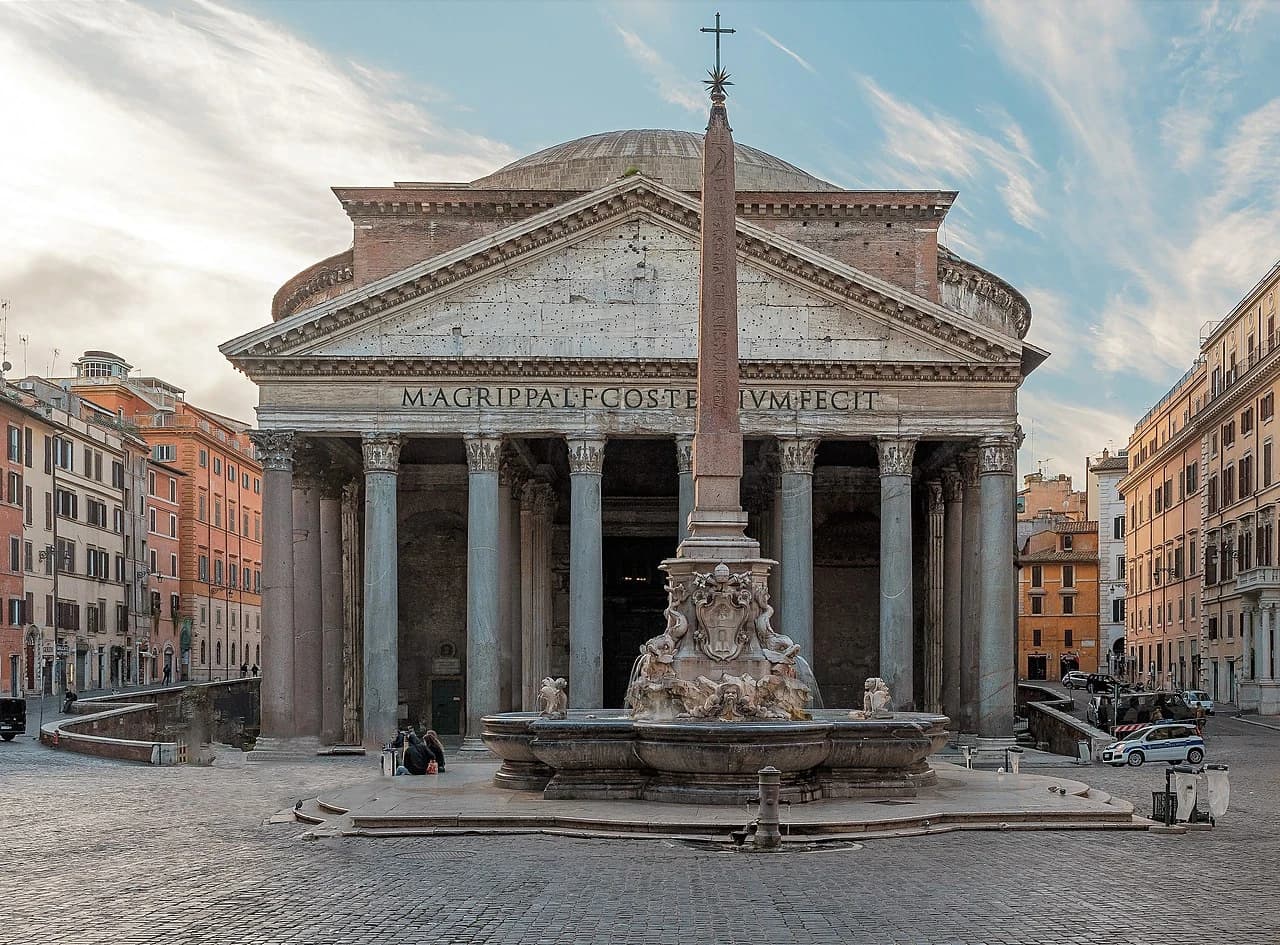
The Pantheon is a remarkably well-preserved ancient Roman building in Rome, originally constructed as a temple to all gods. It features a massive unreinforced concrete dome and now functions as a church.
Pantheon is also known as Pantheon (Rome, Italy), Santa Maria ad Martyres, Basilica of Our Lady of the Martyrs, Basilica of Santa Maria ad Martyres, and 5 other names in various languages.
This self-guided audio tour features 16 narrated stops organized across 7 sections. As a temple, Pantheon offers a unique cultural experience in the heart of Rome, Italy.
The Stanza audio guide is available in 15 languages and works entirely offline — download the complete tour including audio narration, maps, and images before your visit. As you walk through Pantheon, GPS-triggered narration plays automatically at each point of interest.
Last updated:
What you will hear
Piazza della Rotonda
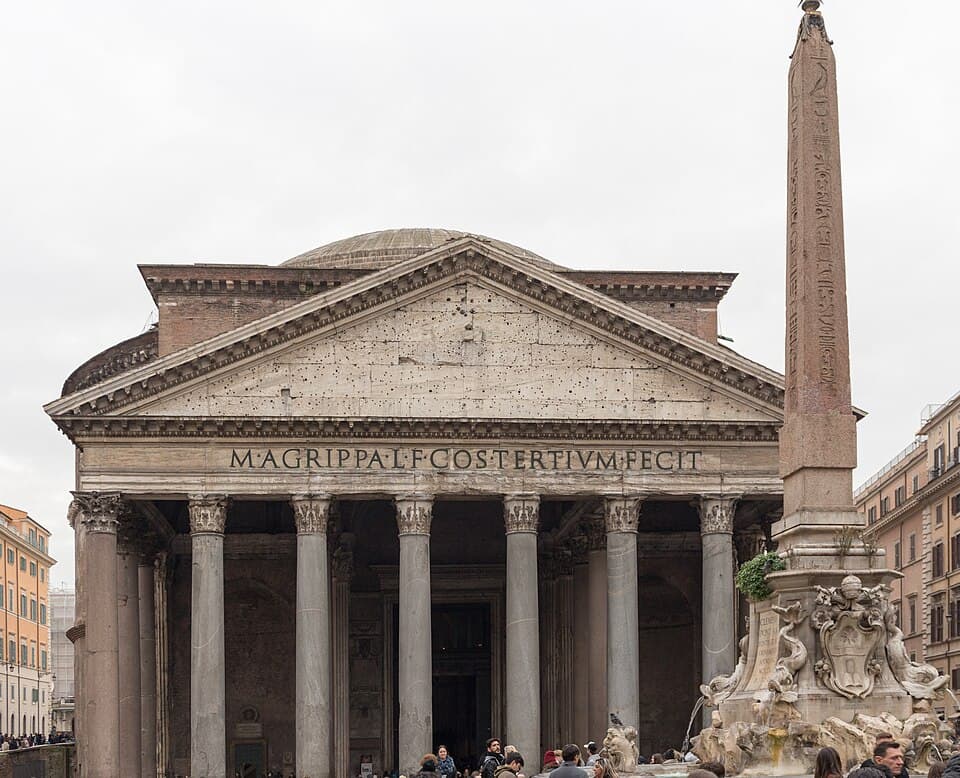
Establishes the setting and the exterior grandeur of the temple before entry. Includes the primary facade view and the Macuteo obelisk which frames the square.
The Pantheon Facade
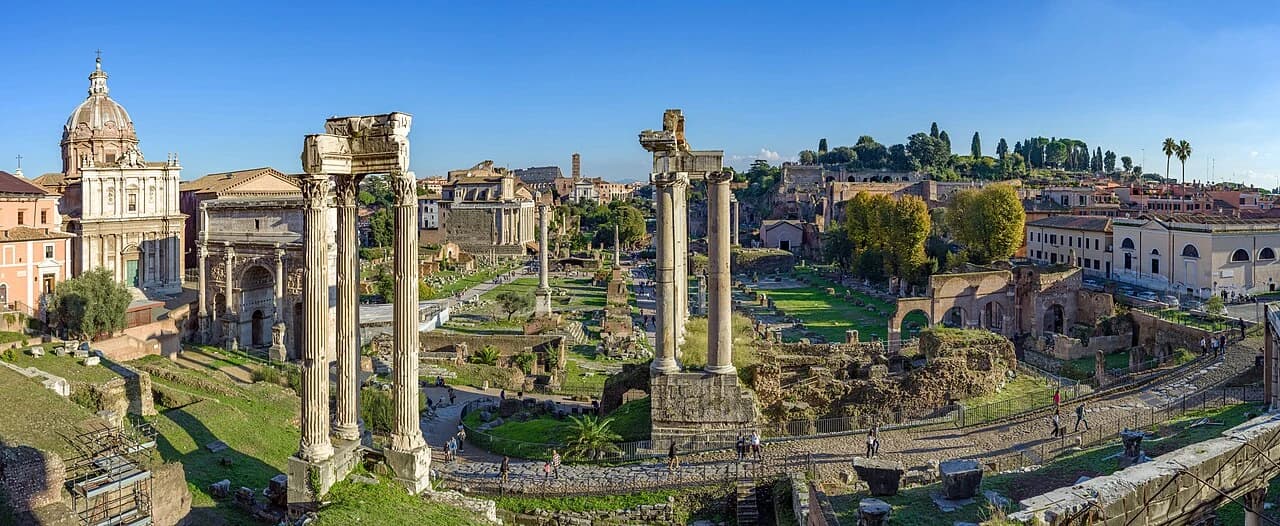
Welcome to the Piazza della Rotonda, the bustling square that provides the first clear view of the Pantheon’s iconic facade. Standing before you is perhaps the most influential building in architectural history. While the bold inscription across the front credits Marcus Agrippa from the time of Augustus in 27 BC, the building you see today is actually a masterpiece of the Imperial era. Research and brick-stamps indicate that this third version of the Pantheon was likely designed under Emperor Trajan starting around 112 AD and was completed by his successor, Emperor Hadrian, in 126 AD. This reconstruction was a massive undertaking that lasted approximately 14 years. It was intended to replace two earlier structures that had been destroyed by fire. By retaining the original founder’s name on the new building, Hadrian followed a tradition of dedicating great works to those who came before. Today, its survival is nearly miraculous, as it remains the most complete ancient structure in Rome, offering us a rare, direct link to the grandeur of the Roman Empire at its height.
The Portico and Agrippa Inscription
Focuses on the 16 monolithic Egyptian granite columns and the famous inscription. Covers the 'Barberini Bronze Theft' story and the logistical reach of the Empire.
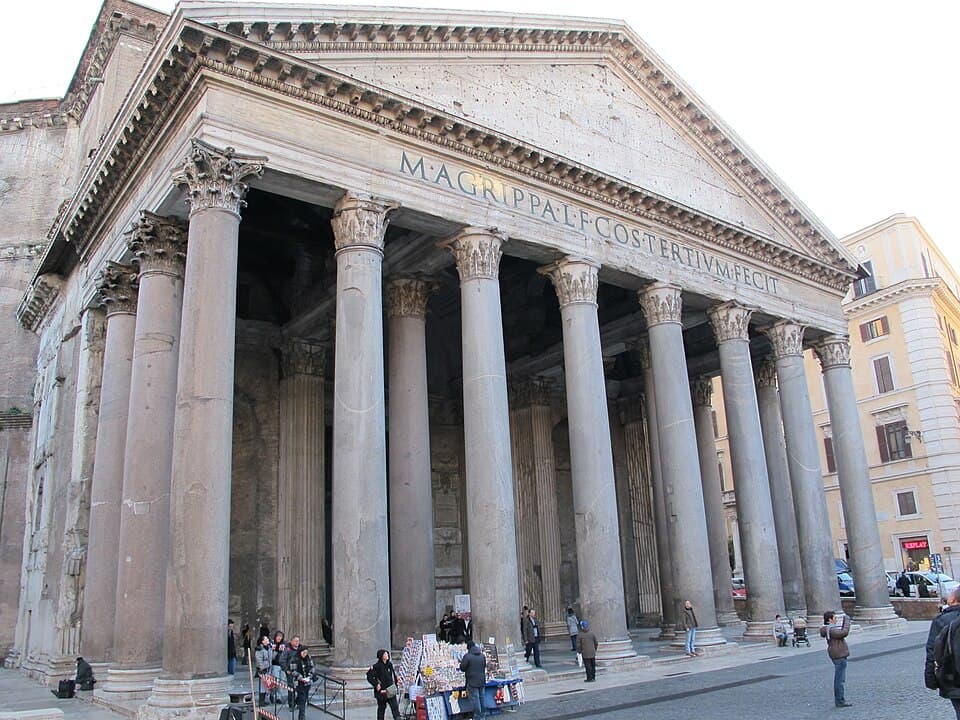
The Portico Columns
As you move toward the entrance, direct your gaze to the massive portico supported by sixteen monolithic columns. These are not built from stacked drums, as was common in many ancient temples; instead, each one is carved from a single, solid block of grey and pink Egyptian granite. Every column stands about 12 meters high and weighs approximately 60 tonnes. Consider the logistical nightmare of transporting these giants in the second century AD. They were quarried in the eastern mountains of Egypt, dragged on sledges to the Nile, floated on barges to the Mediterranean, and then shipped to the port of Ostia. From there, they were hauled up the Tiber River to this exact location. The precision required to set them upright and align them so perfectly is staggering. The use of such exotic, difficult-to-acquire materials was a deliberate choice by the Roman emperors to showcase the vast reach of their empire. Standing at their base, the sheer scale of the stone emphasizes the permanence and power that the Pantheon was designed to project.
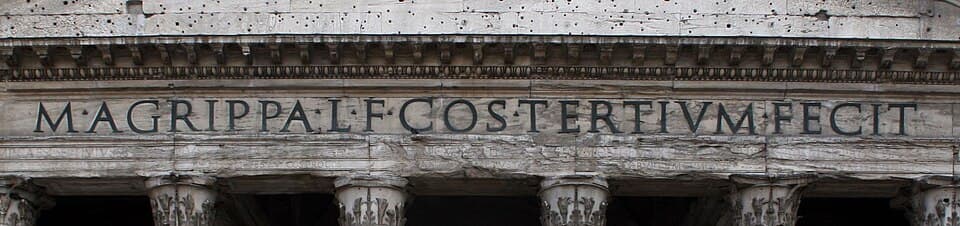
CIL VI, 896
Look closely at the large bronze lettering on the frieze, which reads: 'M·AGRIPPA·L·F·COS·TERTIVM·FECIT.' In Latin, this translates to 'Marcus Agrippa, son of Lucius, Consul for the third time, built this.' For centuries, this inscription led historians to believe that the current building was the original temple constructed during the reign of Augustus. However, we now know this text is somewhat misleading. While Marcus Agrippa did build the first Pantheon on this site, it was destroyed twice by fire. The structure you are looking at was actually the work of the Emperor Hadrian, roughly 150 years later. Rather than claiming credit for this architectural wonder, Hadrian chose to replicate the original inscription from Agrippa’s temple. This gesture of humility and respect for the founding fathers of the Empire was a hallmark of Hadrian’s reign. By preserving Agrippa's name, Hadrian linked his own legacy to the golden age of Augustus, ensuring the building felt like an eternal monument rather than a new construction.
The Ancient Bronze Doors
A dedicated stop for the massive entrance threshold, emphasizing their age and Roman engineering.
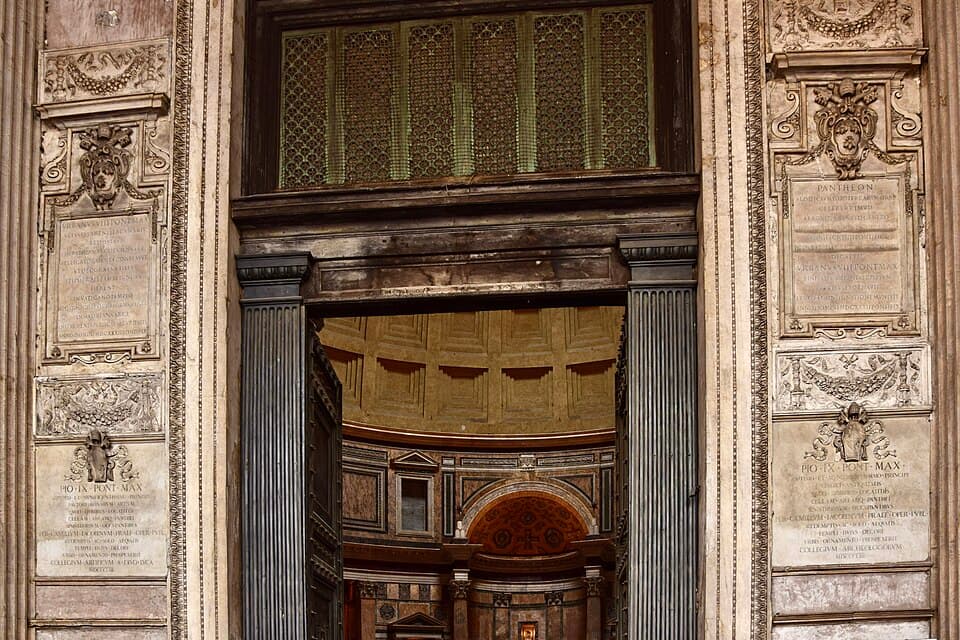
The Ancient Bronze Doors
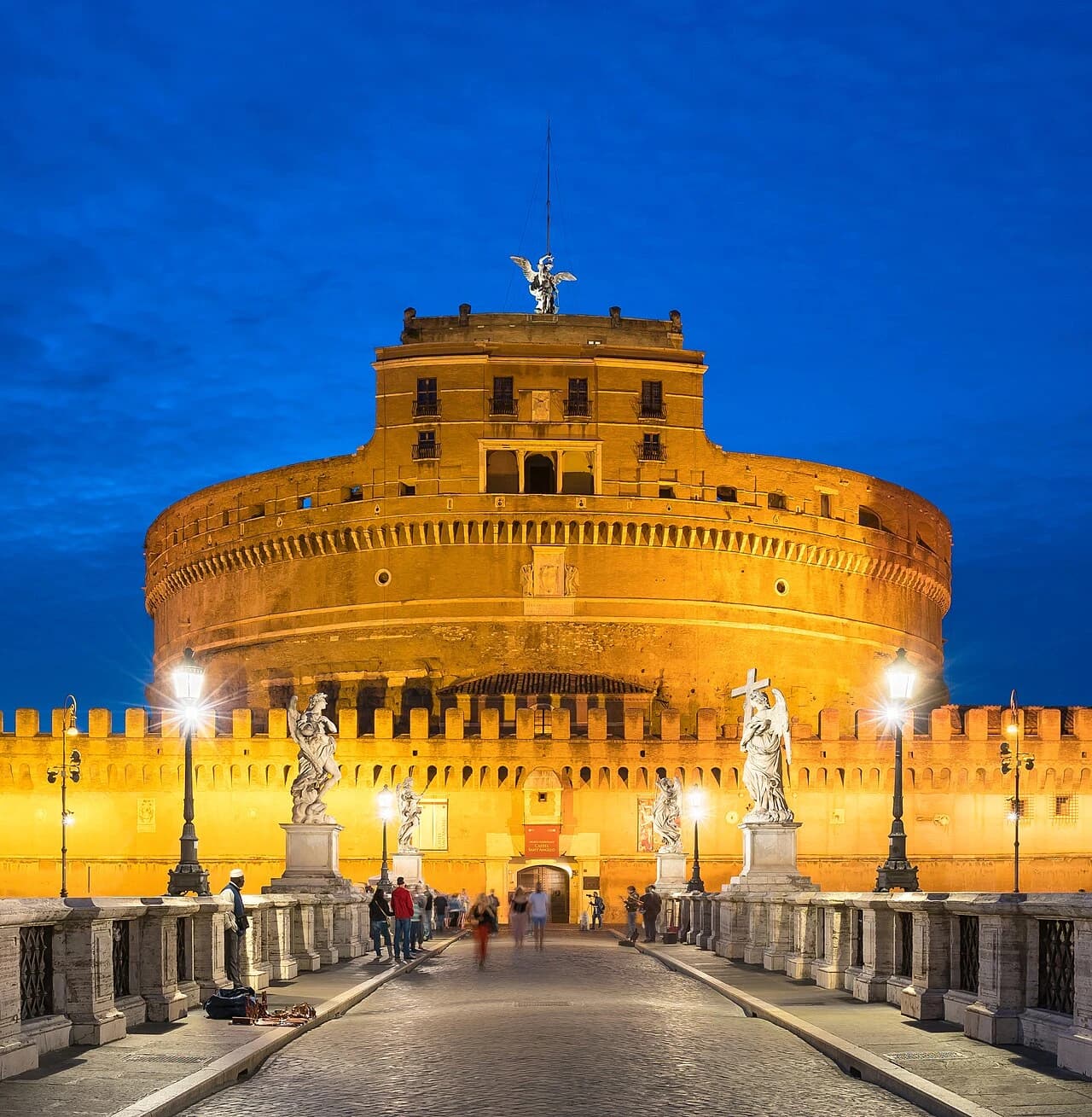
The entrance to the Pantheon is guarded by a pair of towering, dark bronze doors. These are original Roman survivors, making them some of the oldest and heaviest functional doors in the world. They are so perfectly balanced on their hinges that even today, they can be opened and closed with relative ease despite their immense weight. While the doors themselves have survived, much of the bronze that once adorned the portico above you did not. In the 17th century, Pope Urban VIII, a member of the powerful Barberini family, ordered the removal of the massive bronze girders that supported the portico's ceiling. This metal was melted down to create eighty cannons for the Castel Sant'Angelo and possibly used in the baldacchino at St. Peter's Basilica. This act of state-sponsored looting sparked outrage among Romans, leading to the famous pasquinade, or protest poem: 'Quod non fecerunt barbari, fecerunt Barberini'—meaning, 'What the barbarians did not do, the Barberini did.' These doors remain as a lonely reminder of the bronze splendor that once completely covered the temple's entrance.
The Rotunda and Engineering of the Dome
Explains the 'Perfect Geometric Harmony' of the 43.3-meter sphere and the engineering of the world's largest unreinforced concrete dome. Includes the oculus and the rose petal tradition.
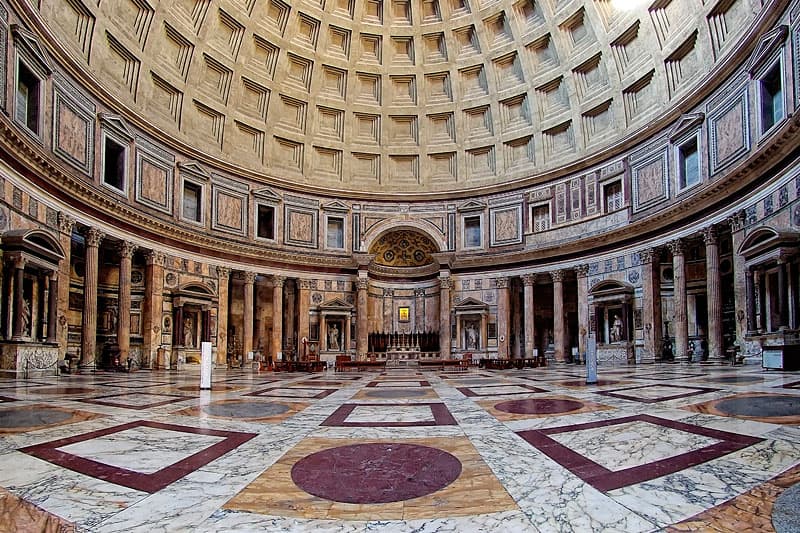
The Rotunda Interior
As you step inside, the overwhelming sense of space is the result of what architects call 'Perfect Geometric Harmony.' The interior of the Pantheon is essentially a perfect sphere contained within a cylinder. This is not just an optical illusion; the height from the marble floor to the very top of the dome is exactly 43.3 meters, which is the same as the diameter of the interior. If you were to flip the dome over, it would fit perfectly into the space below, resting its base on the floor. To the Romans, this geometry was deeply symbolic. The circular floor and the soaring dome were intended to represent the globe of the Earth and the celestial sphere of the heavens. By creating a space where the horizontal and vertical dimensions were identical, the architects achieved a sense of balance and eternity. This design ensures that no matter where you stand, you are at the center of a perfectly proportioned universe, reflecting the Roman belief in a divinely ordered world.
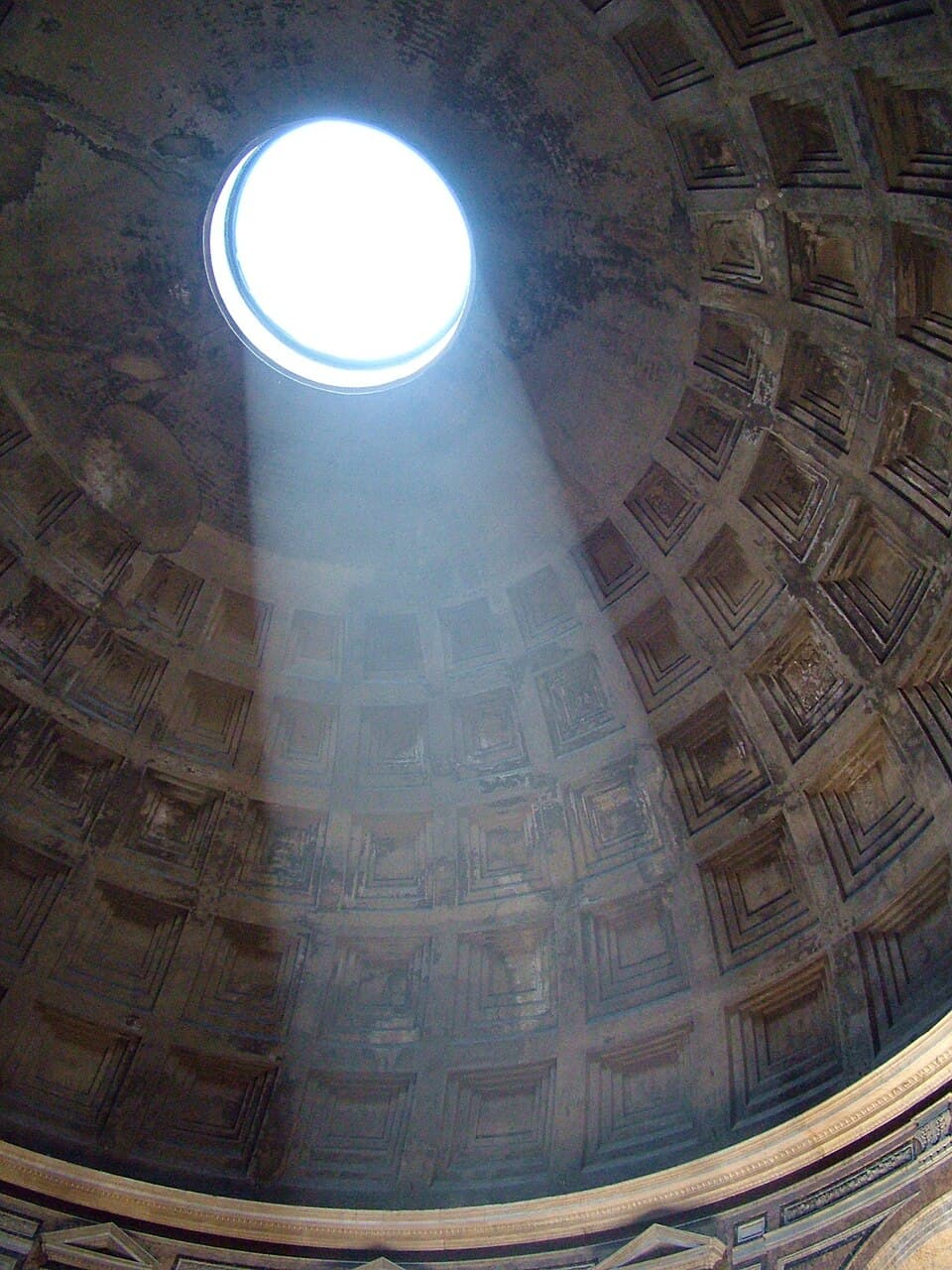
The Oculus
At the peak of the dome is the Oculus, a 9.1-meter wide opening that serves as the building's only source of natural light. The word 'oculus' is Latin for 'eye,' and it serves both a practical and a symbolic function. Structurally, it is a brilliant solution; by leaving the very center of the dome open, the architects removed weight from the weakest point of the arch, where a heavy capstone would have traditionally placed immense stress on the walls. Symbolically, the oculus connects the temple to the heavens, allowing the movement of the sun to act as a celestial spotlight that travels across the interior walls throughout the day. One of the most beautiful traditions associated with this opening occurs every year on Pentecost. After Mass, local firefighters climb to the top of the dome and drop thousands of red rose petals through the oculus. As the petals drift down into the rotunda, they symbolize the descent of the Holy Spirit. This event transforms the ancient stone space into a living, breathing monument to faith and history.
The Tomb of Raphael
Highlights the Renaissance master's burial site, fulfilling his wish to be buried in Rome's most beautiful building.
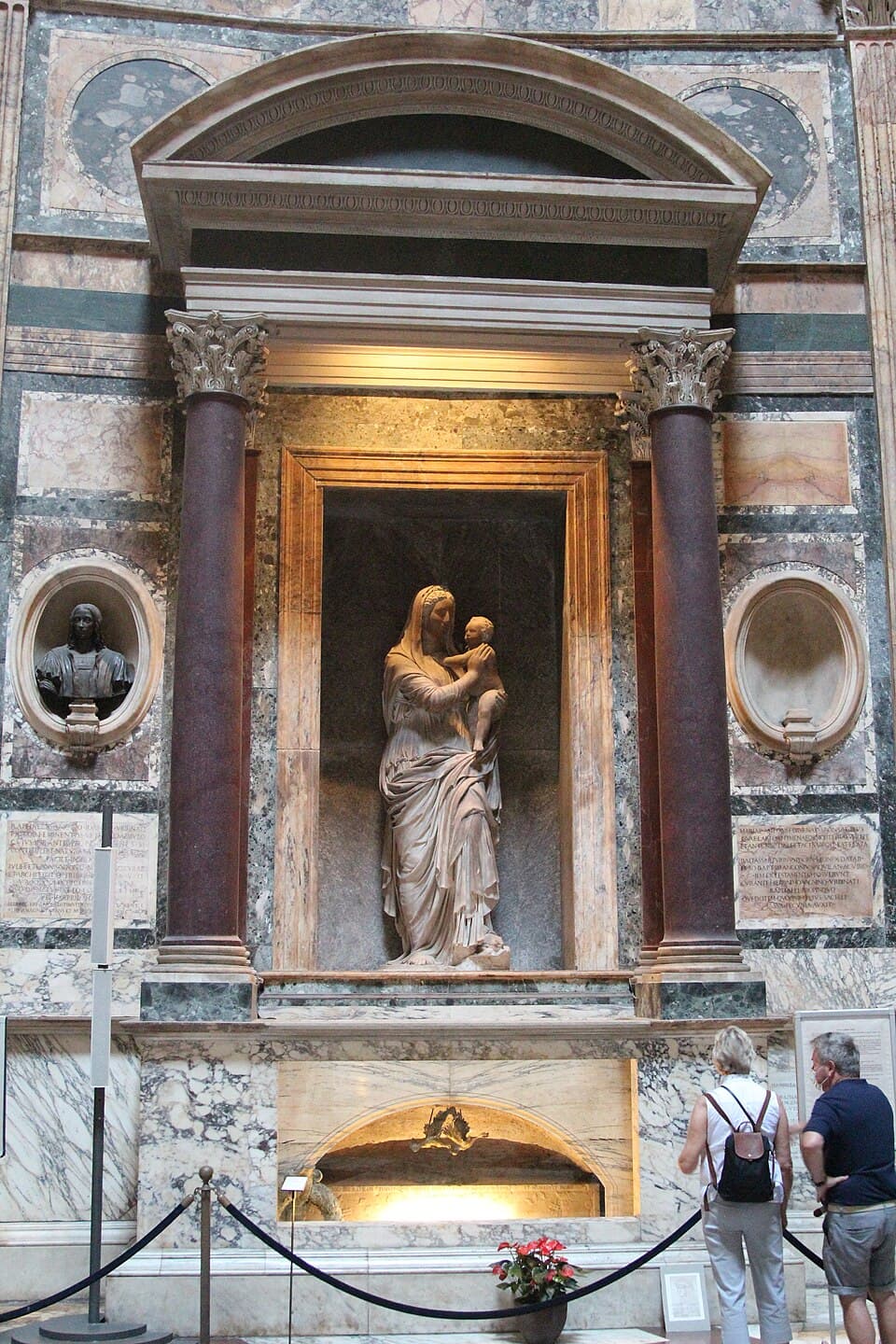
Tomb of Raphael
The Pantheon is not only a temple and a church but also a place of rest for some of Italy's most celebrated figures. Perhaps the most famous is the Renaissance master, Raphael Sanzio. Raphael held a deep, lifelong affection for the Pantheon, viewing it as the ultimate expression of architectural perfection. Such was his devotion that he requested to be buried here upon his death in 1520. His remains rest within a simple yet elegant marble sarcophagus. At the time of his death, Raphael was only 37 years old and at the height of his fame, having served as a primary artist for the Papacy. His burial here helped solidify the Pantheon’s transition from an ancient relic into a shrine of high culture and national pride. The presence of a great artist among the gods and kings emphasized the Renaissance belief in the divine nature of human creativity. As you look at the tomb, you are standing before a site of pilgrimage for art lovers from around the globe who come to pay respects to the man who defined the visual language of his era.
The High Altar and Byzantine Icon
Explains the 609 AD conversion to the Church of Santa Maria ad Martyres, which saved the building from destruction.
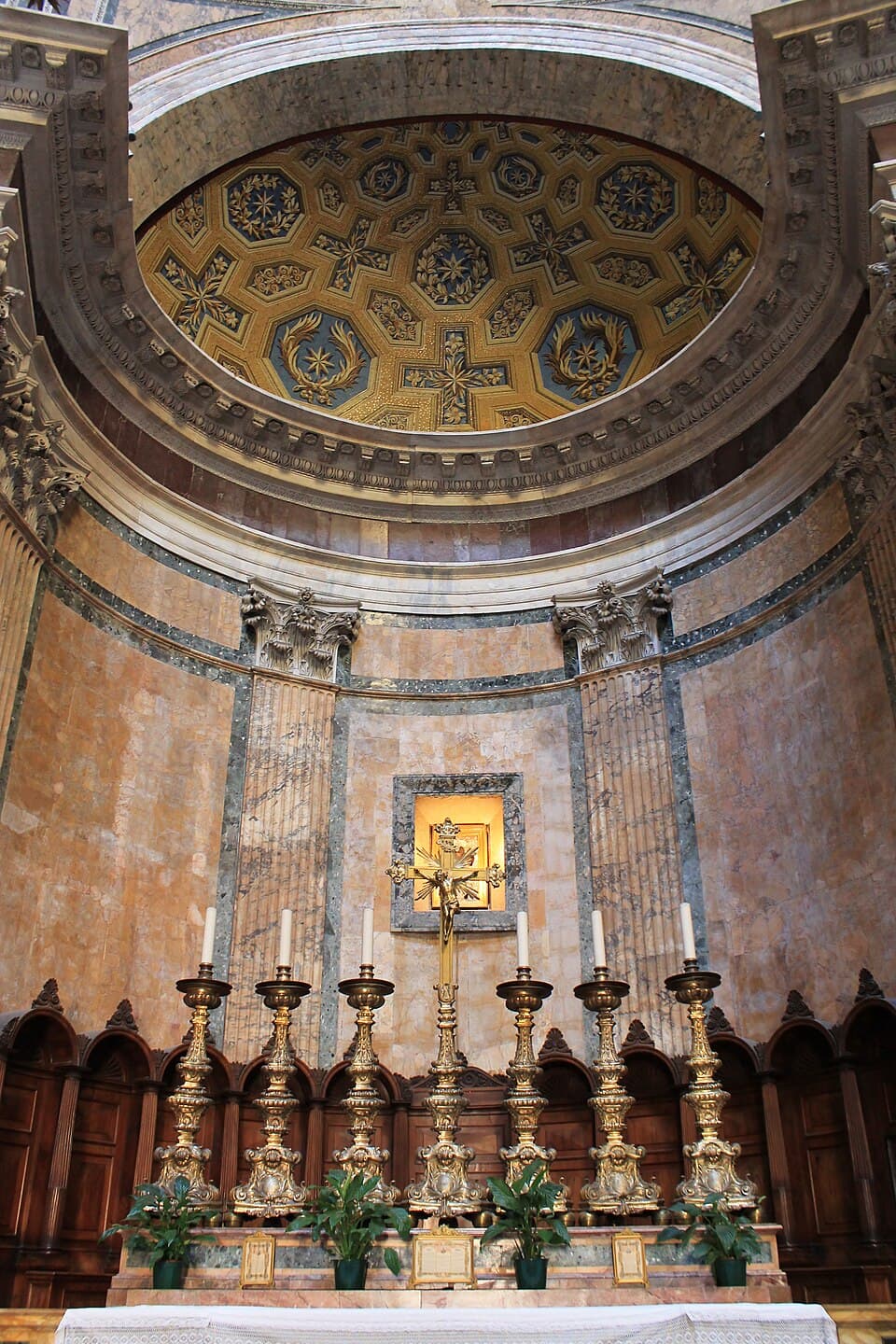
The High Altar
The Christian elements you see today, centered around the High Altar, date back to the most critical moment in the Pantheon’s history: its conversion into a church. In 609 AD, the Byzantine Emperor Phocas gave the temple to Pope Boniface IV, who dedicated it as the Church of Santa Maria ad Martyres. This act of conversion is the single reason the Pantheon was never stripped for building materials or abandoned to the elements like the nearby Colosseum or Roman Forum. Once it became a church, the building was considered sacred ground, protecting its massive walls and dome from looters. The high altar sits within the ancient Roman apse, where a statue of a pagan god once stood. Over the centuries, Christian artworks and liturgical furniture were added to the space, creating a unique layers of history where 7th-century Christian traditions meet 2nd-century Roman architecture. This synthesis allowed the building to remain a living part of the city for over two thousand years, serving continuously as a house of worship from the time of the Caesars to the present day.
The Marble Floor and Drainage System
Details the ancient Roman multi-colored marble floor and the sophisticated system designed to handle rain from the oculus.
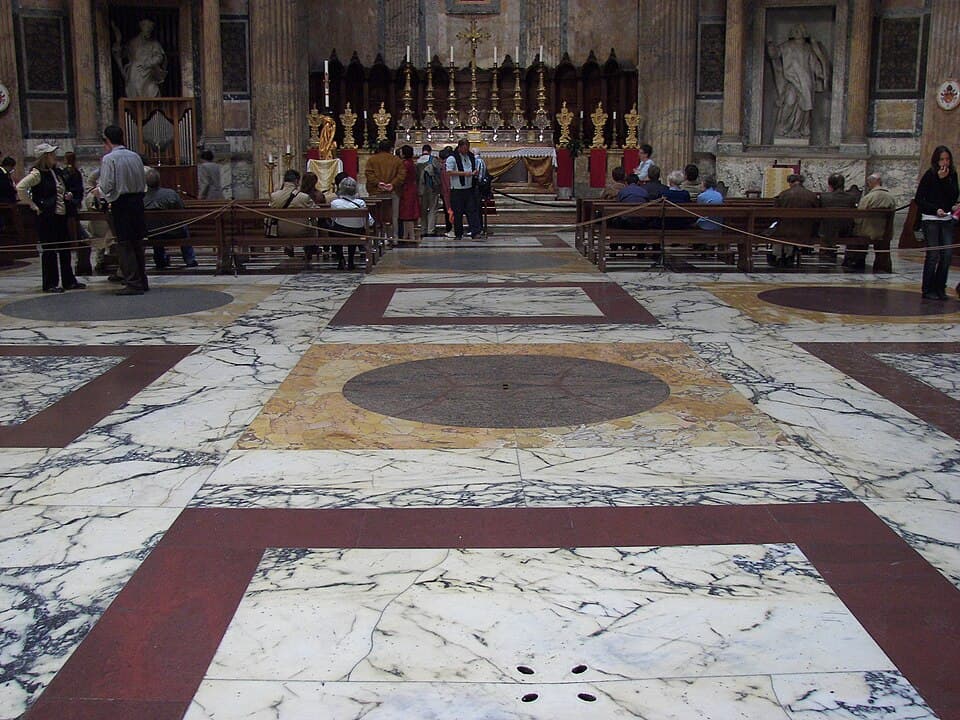
The Drainage System
A common legend suggests that because of the rising heat from candles or the sheer height of the dome, rain never actually falls through the open oculus above. However, if you visit on a stormy Roman afternoon, you will quickly see that this is simply a myth. When the clouds open up, a column of rain descends directly into the center of the rotunda, creating a mesmerizing, vertical waterfall within the ancient space. To handle this, the Roman engineers devised a solution that is as elegant as it is practical. Look closely at the floor beneath the oculus. You will notice twenty-two small, unassuming holes bored into the stone surface. These are not decorative; they are the intake valves for a sophisticated drainage system. To ensure the water reaches these points, the floor is not perfectly flat. Instead, it is slightly convex—curved subtly upward in the center—so that gravity naturally pulls any moisture away from the middle and toward these drains. Beneath your feet, these holes connect to an ancient network of pipes that channel the rainwater out of the building and into the city’s drainage system. It is a testament to the enduring quality of Roman craftsmanship that this system remains fully functional today, nearly two millennia after it was first installed. While other ancient buildings have long since succumbed to water damage and erosion, the Pantheon remains preserved, thanks in part to these twenty-two small holes and the gentle curve of the floor. This practical engineering allows the temple to exist in harmony with the weather outside.
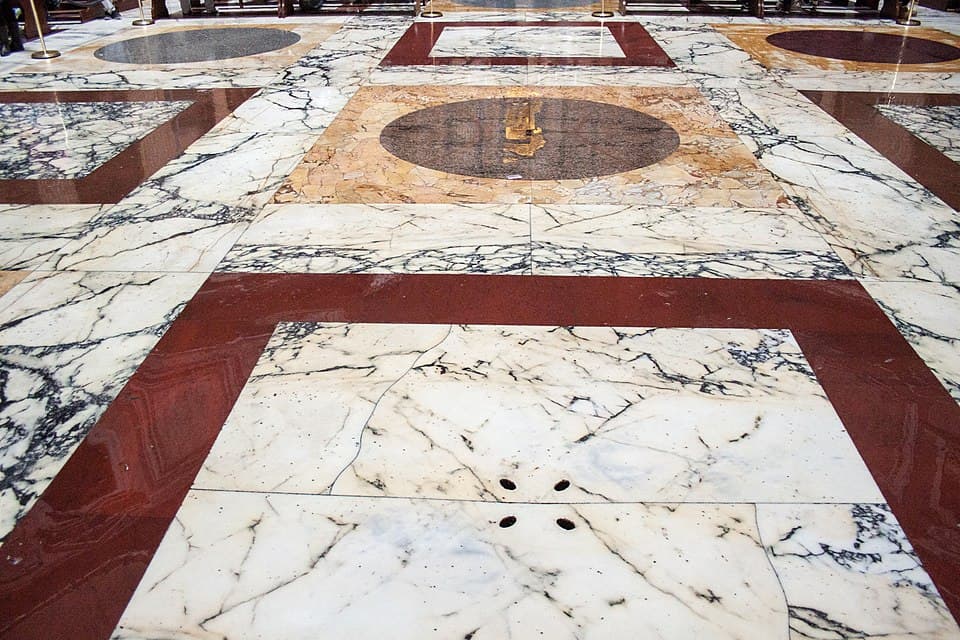
Geometric Marble Floor
While the dome above captures much of the attention, the floor beneath your feet is equally remarkable. This geometric marble floor is largely original, retaining the patterns laid down by Roman craftsmen nearly 2,000 years ago. The design is a sophisticated interplay of circles and squares, a direct visual echo of the architecture of the rotunda and the dome. The materials used here were among the most expensive in the ancient world. You can see the deep purple of Imperial Porphyry, sourced from a single remote quarry in Egypt, and the speckled grey of granite. These stones were chosen for their durability and their vibrant colors, which would have been even more striking when the building was new. By repeating the geometric motifs of the building’s overall structure, the floor helps to unify the entire space. Even the wear and tear of millions of visitors over the centuries has not dimmed the elegance of the design. It serves as a grounded reminder of the Romans' mastery of both aesthetics and engineering, providing a solid foundation for one of the world's most beautiful spaces.
Want to hear the rest?
Download the Stanza app to unlock all 16 stops and full GPS-guided navigation.
Frequently Asked Questions
How long does the Pantheon audio tour take?
The Pantheon audio guide includes 16 narrated stops. Most visitors spend 45 minutes to 1.5 hours exploring the complete tour, though you can listen at your own pace and skip or revisit any stop.
Is the Pantheon audio guide available in my language?
Stanza supports 15 languages: English, Spanish, French, German, Italian, Portuguese, Russian, Japanese, Chinese, Korean, Arabic, Hindi, Polish, Dutch, Hebrew. Check the guide in the app to confirm the languages currently available for this tour.
Can I use the audio guide offline at Pantheon?
Yes! Download the complete Pantheon tour — including all audio, maps, and images — before your visit. The Stanza app works completely offline, so you don't need WiFi or mobile data at the venue.
How much does the Pantheon audio guide cost?
The Stanza app is free to download. The current listed price for the Pantheon audio guide is $2.99; app-store region and currency may affect the final price.
How do I use the Stanza audio guide at Pantheon?
Download the free Stanza app, search for "Pantheon", and download the tour. When you arrive at the venue, the app uses GPS to detect your location and automatically plays the relevant narration as you move between points of interest — completely hands-free.
What makes the Stanza audio guide different from other Pantheon tours?
Stanza offers GPS-triggered narration that plays automatically as you walk through Pantheon — no need to manually select stops. The tour is available in 15 languages, works fully offline, and includes 16 expertly narrated stops with images and historical context.
What other audio guides are available near Pantheon?
Stanza offers multiple audio guides in Rome, Italy and nearby areas. After downloading the app, browse the map to discover all available tours near Pantheon. Each guide can be downloaded for offline use.