Stanza · Audio guide
Mausoleo di AugustoAudio guide
A place to remember. A story to take with you.
A large ancient Roman tomb located in the Campo Marzio area of Rome, Italy. It served as the burial place for the first Roman emperor Augustus and his family.
Download Stanza, then search for “Mausoleo di Augusto”.
About the tour
One guide. Your kind of visit.
A large ancient Roman tomb located in the Campo Marzio area of Rome, Italy. It served as the burial place for the first Roman emperor Augustus and his family.
Ready when you are.
- 01Get the free Stanza app.
iOS & Android
- 02Find your guide.
“Mausoleo di Augusto”
- 03Download before you go.
Works offline
Audio guide / 12 narrated stops
Inside the guide
Get to know a few of the stories before you go. Open a stop to read more.
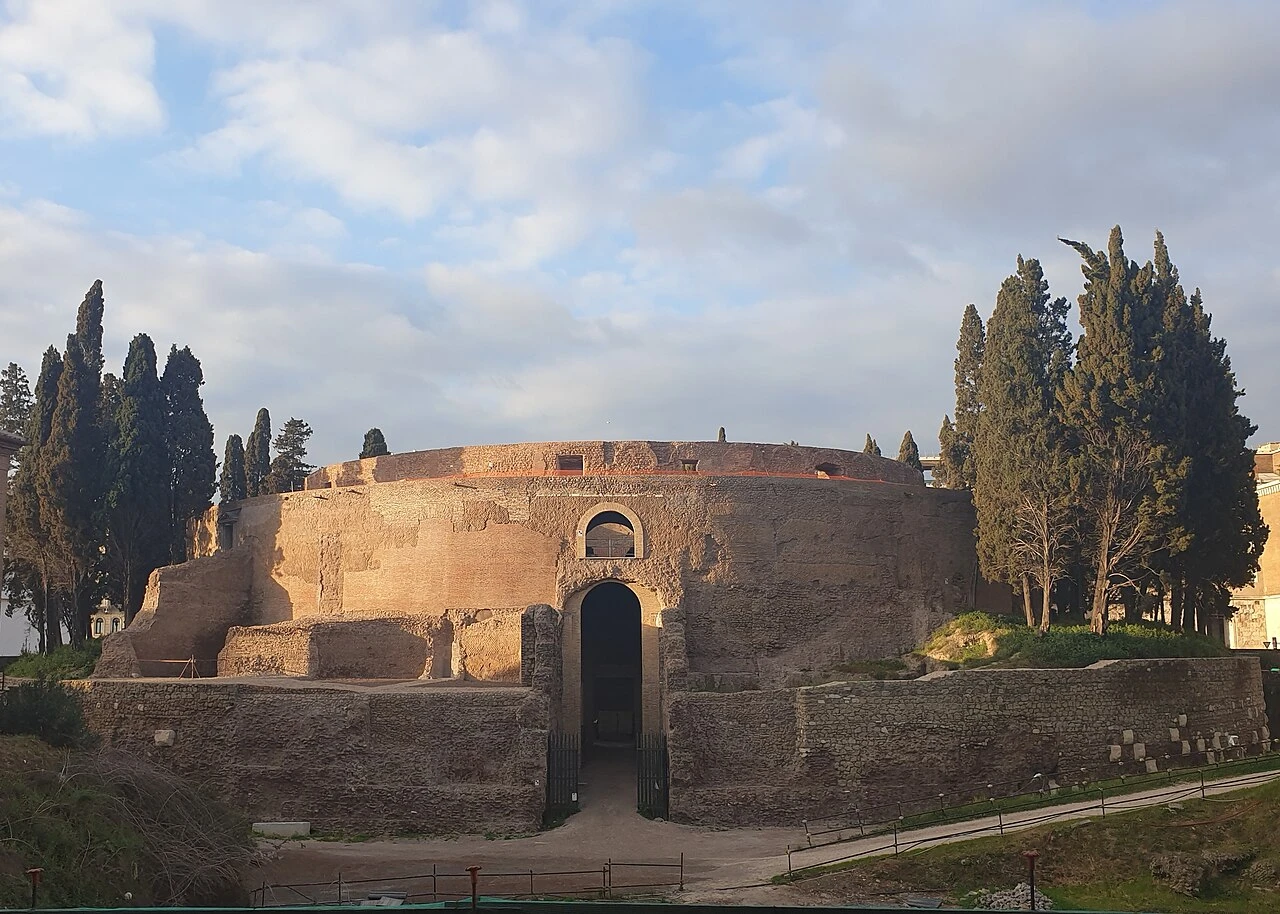
01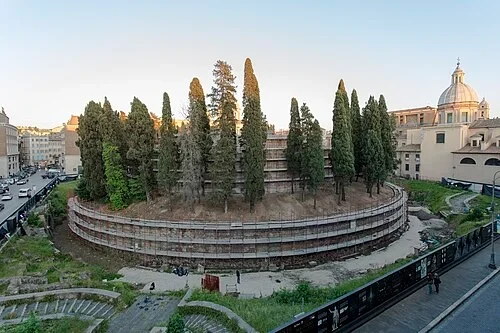 Piazza Augusto Imperatore and the Fascist LegacyThe Great Circular Tomb
Welcome to one of the most ambitious construction projects of the early Roman Empire. Standing at a staggering diameter of 87 meters, this monument was the largest circular tomb in the ancient world. Construction began in 28 BC, shortly after Augustus returned from his victory in Egypt, signaling his intention to be buried in Rome rather than the East. Notice the cypress trees planted along the top of the structure; these echo the ancient Mediterranean tradition of placing evergreens on tumulus tombs, which were earthen burial mounds. The clear, open space you see surrounding the ruins today is the Piazza Augusto Imperatore. This square is a relatively recent addition to the city's map, created in the 1930s. During that era, the government demolished the dense medieval neighborhood that had grown up around the tomb for centuries. This radical urban clearance was intended to isolate the Roman core and highlight the emperor's massive brick and stone achievement as a centerpiece of national history. It transformed the site from a hidden ruin into a prominent landmark in the heart of the city.
TIMnewsroom · CC BY 2.0
02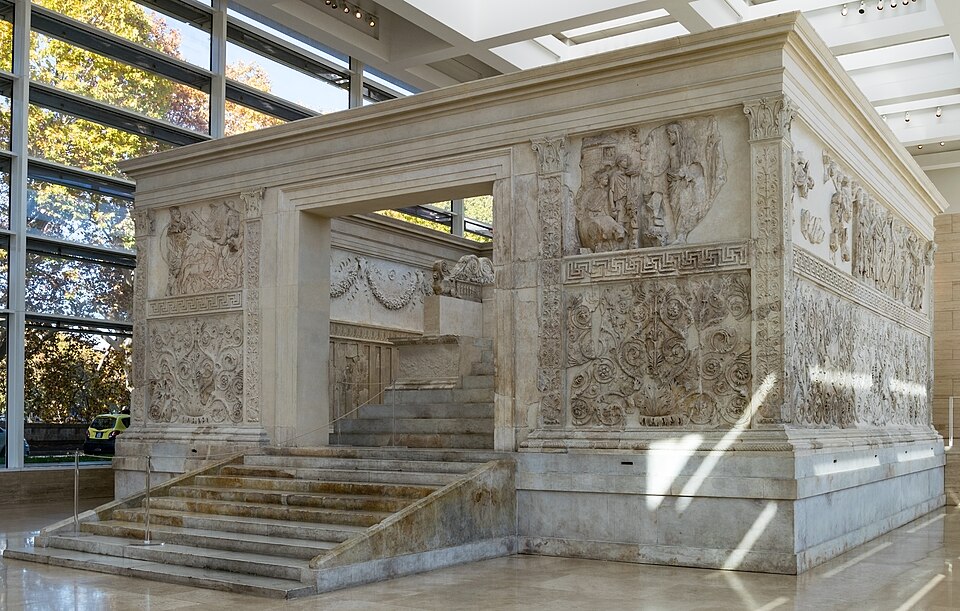 The Emperor's Final Account: The Res GestaeThe Res Gestae Relief
The text associated with this site is known as the 'Res Gestae Divi Augusti,' or 'The Deeds of the Divine Augustus.' This autobiography served as a final piece of political propaganda, meticulously listing the emperor's accomplishments. Originally, these words were inscribed on massive bronze plaques and placed right at the entrance of the Mausoleum. While those original bronze sheets were lost to time and metal-looting centuries ago, the text itself survived through copies found in distant corners of the empire. Today, a modern version of the text is displayed on the wall of the glass Ara Pacis building adjacent to the tomb. The inscription is not a humble diary; it is a list of control. Augustus details the numerous temples he restored, the massive sums of money he gave to the public, and the many wars he brought to an end to establish the Roman Peace. By placing this record at his final resting place, Augustus ensured that every visitor would know exactly how he wanted to be remembered. It remains one of the most significant historical documents for understanding how he transitioned Rome from a Republic to an Empire.
Photo: Rabax63 · CC BY-SA 4.0
03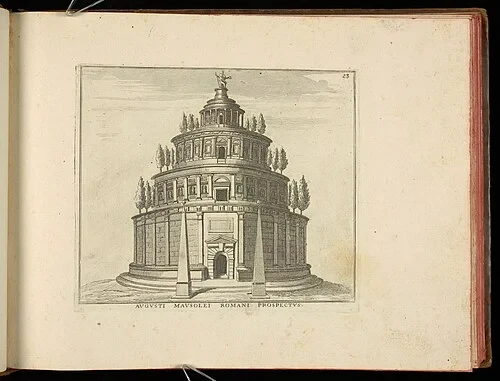 The Grand Design: Architecture of the Largest Circular TombThe Imperial Reconstruction
Historical reconstructions suggest that the Mausoleum originally appeared as a gleaming mountain of white marble, a far cry from the weathered brick shell we see today. In the first century, the structure reached a height of approximately 42 meters, making it a dominant feature of the Roman skyline. At the very summit stood a large bronze statue of Augustus, likely depicted in military or priestly attire, looking out over the city. Flanking the entrance were two towering red granite obelisks, which Augustus brought back from Egypt after his victory over Mark Antony and Cleopatra. These Egyptian monuments were powerful symbols of his conquest and the expansion of Roman territory. If you visit the Piazza del Quirinale or the Piazza dell'Esquilino today, you are actually seeing those very same obelisks; they were moved from the tomb entrance in the late 16th century to decorate other parts of the city. The original design was intended to dazzle the viewer, blending the traditional circular shape of ancient Italian graves with the opulence of Hellenistic royal monuments from the East.
Listen in the appUnknown author · Public domain
04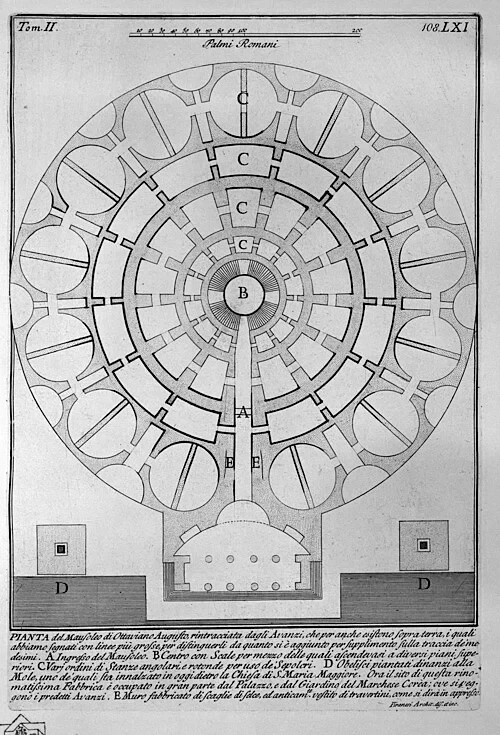 The Grand Design: Architecture of the Largest Circular TombThe Blueprint for Eternity
This architectural plan highlights the brilliant engineering required to keep such a massive structure standing for over two millennia. The blueprint consists of five concentric rings of thick masonry, which distributed the immense weight of the earth-filled tiers above. The outer ring is particularly impressive, measuring exactly 300 Roman feet in diameter. Between these walls, builders created narrow corridors and chambers that provided structural stability while also creating space for burials. At the very heart of the drawing, you can see a central pillar marked with the letter 'B.' This pillar was the structural anchor for the entire building. It extended from the foundation all the way up through the various levels to support the statue at the top. More importantly, this central core was where the ashes of Augustus himself were eventually placed. The design allowed for a hierarchy of space: the outer rings housed relatives and distinguished members of the court, while the central pillar remained the exclusive, sacred spot for the founder of the dynasty. This layout reflected the social and political structure of the empire, with everyone revolving around the central figure of the emperor.
Listen in the appGiovanni Battista Piranesi · Public domain
05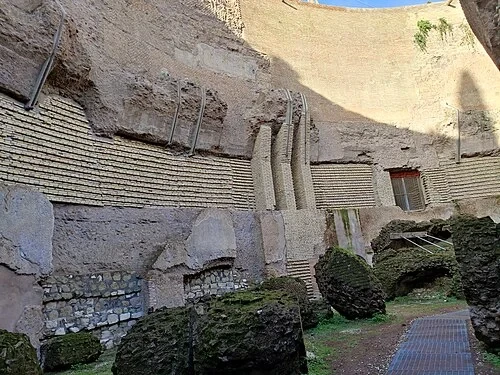 The Concentric Walls and Burial ChambersThe Restored Inner Walls
These deep inner walls have recently undergone an 11-million-euro restoration project to stabilize the ancient masonry and make the site safe for visitors. As you look at the surfaces, you can see a distinct mix of Roman brickwork and stone. Despite centuries of looting for building materials, the core of the monument remains remarkably intact. These passages were never meant to be seen by the general public in ancient times; they were the private, sacred corridors of the Julio-Claudian dynasty. For over a century, this building served as the primary burial site for Rome’s imperial family. Following Augustus, his successors including Tiberius and Claudius were laid to rest within these walls. The final emperor to be buried here was Nerva in 98 AD, after which the imperial burial tradition moved to the newer Mausoleum of Hadrian, now known as Castel Sant’Angelo. The restoration has carefully cleaned the surfaces to reveal the patterns of the 'opus reticulatum' and 'opus latericium,' the standard brick and stone techniques that allowed Roman architects to build with such incredible durability. Today, they provide a rare look into the structural bones of an imperial masterpiece.
Listen in the appPhoto: Giorgio Pietrocola · CC BY-SA 4.0
06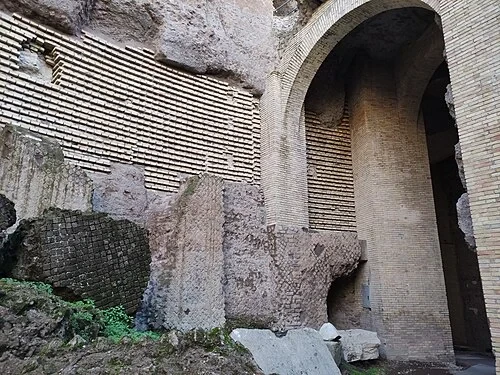 The Concentric Walls and Burial ChambersThe Burial Chamber Entrance
The scale of these arched vaults is difficult to grasp until you are standing directly beneath them. These massive brick arches were engineered to support the enormous pressure of the earth and trees that once sat atop the monument. In antiquity, the interior was a place of somber luxury. The golden urns containing the imperial ashes were kept in the innermost chambers, protected by layers of masonry. This was not a public cemetery, but a high-security dynastic vault meant to solidify the status of the ruling family. By building a structure that seemed as permanent as a natural hill, Augustus was making a political statement: his family's rule was as enduring as the city itself. The vaulted ceilings and thick walls created a cool, silent environment, a stark contrast to the busy Campus Martius that surrounded the tomb in ancient times. While the gold and marble decorations were stripped away during the Middle Ages, the sheer volume of the brickwork still communicates the power and wealth of the first emperors. These vaults are the hidden foundations of a legacy that sought to bridge the gap between human life and the eternal nature of the gods.
Listen in the appPhoto: Giorgio Pietrocola · CC BY-SA 4.0
07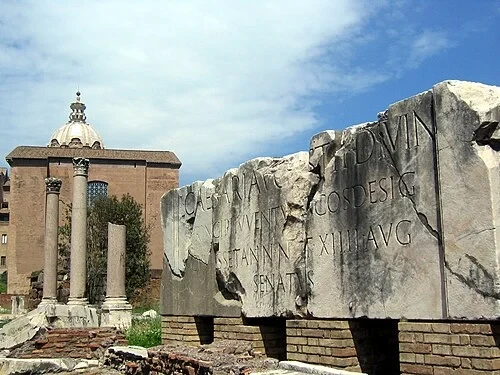 The Lost Heirs: Gaius and Lucius CaesarMemorial to the Heirs
The Mausoleum was a place of mourning long before Augustus himself was laid to rest. Some of the first residents of these chambers were his beloved grandsons, Gaius and Lucius Caesar. Augustus had adopted the boys and groomed them to be his heirs, hoping to secure a stable transition of power. Their sudden and early deaths in the first years of the new century were a devastating personal and political blow to the emperor. Their ashes were placed in prominent positions within the tomb as a public reminder of the lineage Augustus had hoped to establish. Interestingly, not all artifacts from the tomb's inhabitants stayed within these walls. The funerary urn of their relative, Agrippina the Elder, had a very different fate during the Middle Ages. It survived only because it was removed from the tomb and repurposed as a standard measure for grain in a local Roman market. You can still see that urn today in the Capitoline Museums, complete with the hollowed-out top used for measuring wheat. Such stories highlight how the grandest imperial memorials were eventually recycled into the practical, everyday life of the city that outlived them.
Listen in the appAnthony M. from Rome, Italy · CC BY 2.0
08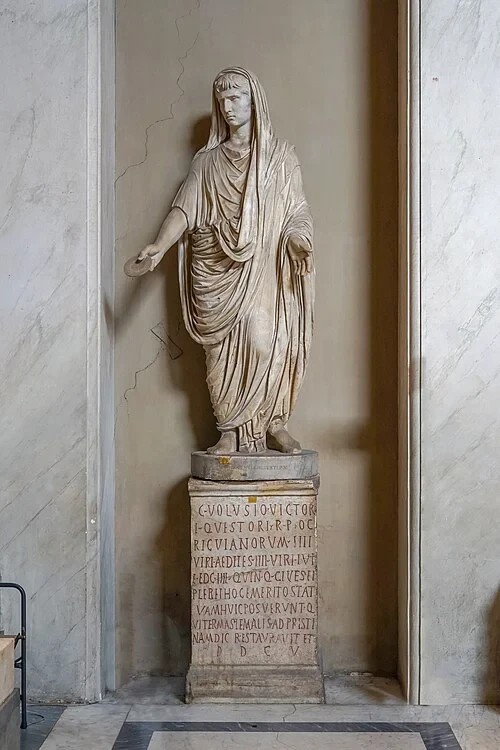 The Lost Heirs: Gaius and Lucius CaesarStatue of Gaius Caesar
This statue depicts Gaius Caesar, the eldest grandson of Augustus, in a very specific role. He is shown with his toga pulled over the back of his head, a style known in Latin as 'capite velato.' This was the standard appearance for a Roman official or priest performing a religious sacrifice. In the visual language of the time, this was pure propaganda. By depicting the young heir in this way, Augustus was telling the Roman public that his successor was pious, respectful of tradition, and spiritually prepared for leadership. It was a way to legitimize the young man's authority before he even reached full adulthood. His presence in the imperial family's burial gallery serves as a reminder of the dynastic tragedies that took place. Gaius was only twenty-three when he died from a wound sustained during a campaign in the East. His death, along with that of his brother Lucius, forced Augustus to turn to his stepson Tiberius, a choice that altered the course of Roman history. The statue captures Gaius in a moment of perpetual youth and devotion, shielding the reality of the political uncertainty caused by his early passing.
Listen in the appPhoto: Fabrizio Garrisi · CC BY-SA 4.0
09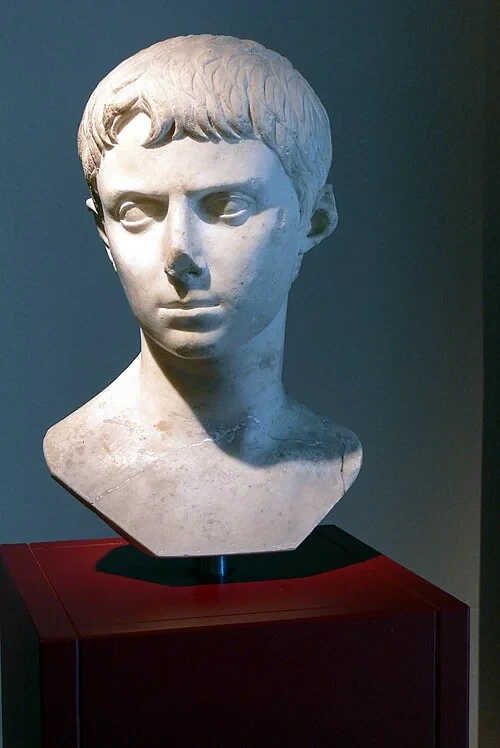 The Lost Heirs: Gaius and Lucius CaesarPortrait of Lucius Caesar
The youthful face in this portrait belongs to Lucius Caesar, the younger brother of Gaius. He died at the age of eighteen in Massalia, modern-day Marseille, while on his way to Spain for military service. Augustus used portraits like this one as tools of imperial messaging, distributing them to cities throughout the Roman world. The goal was to make the faces of his intended successors familiar and respected by citizens from Gaul to Syria. In these carvings, Lucius is always shown with idealized features, emphasizing his noble lineage and connection to his grandfather. When both Lucius and Gaius died within two years of each other, it left Augustus in a desperate position regarding the future of his empire. He was eventually forced to adopt Tiberius, a man he did not particularly like, to ensure the state did not collapse into civil war upon his own death. These portraits remain as haunting artifacts of a 'what if' in history—a visual record of the young men who were meant to lead Rome into its second century but never got the chance. Their images helped maintain the illusion of a stable, hereditary monarchy during a time of immense transition.
Listen in the appWolfgang Sauber · CC BY-SA 3.0
10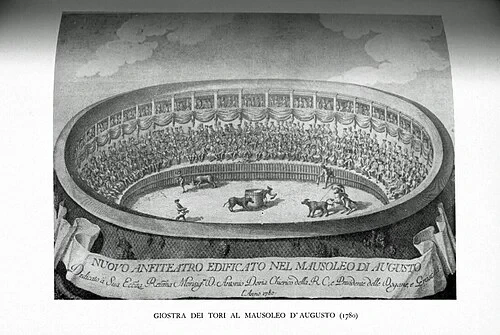 From Tomb to Theater: The Anfiteatro CorreaThe Correa Amphitheater
By the 1700s, the Mausoleum had been put to many strange uses, but none quite as lively as the 'Anfiteatro Correa.' A Spanish nobleman named Marquis Correa transformed the circular interior of the ancient ruins into a bustling amphitheater. He built wooden stands for spectators directly on top of the Roman masonry. For over a century, this site was no longer a place of quiet mourning, but a center for public entertainment. Romans flocked here to witness 'giostre della chinea,' which were elaborate festivals involving fireworks, equestrian shows, and even bullfights. Drawings from the period show the arena packed with people, with the high circular walls of the tomb providing a natural, curved backdrop for the spectacles. This transformation is a perfect example of how Rome's history is composed of layers. A site that began as a sacred imperial tomb was reclaimed by nature, then fortified as a castle, used as a garden, and eventually turned into a theater. Each era of the city’s life found a way to inhabit the massive stone shell Augustus left behind, adapting his monument to meet the tastes and needs of a very different population.
Listen in the appUnknown author · Public domain
Mausoleo di Augusto
Frequently asked questions
How much does the guide cost?
Free app download. Listed guide price: $0.99. Guide price shown in the app. Audio guide only. Venue admission is separate.
Can I listen without internet?
Yes. Download the guide’s audio, images, and maps in the app before your visit. Your downloaded content is then available offline.
Can I listen in my language?
Stanza supports 15 languages. Check the app for the languages available for this guide.
Do I need to follow a schedule?
No. This is a self-guided experience. Choose your stops, pause whenever you like, and return to a story at your own pace.
At your own pace
Explore Mausoleo di Augusto.
Download Stanza, then search for “Mausoleo di Augusto”.
Free app download · Guide price shown in the app
Keep exploring
Nearby audio guides
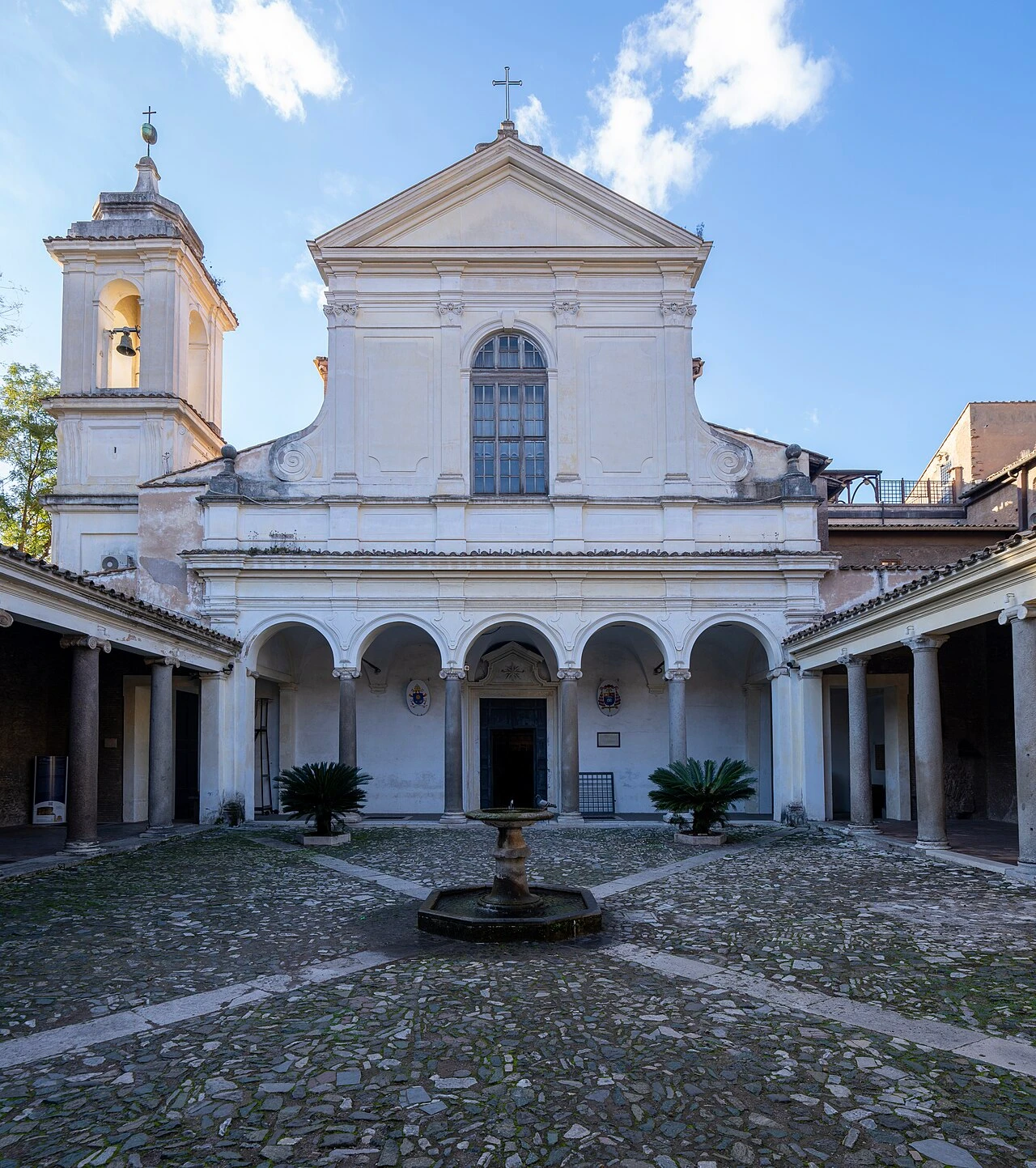
Rome
Basilica di San Clemente
Content & sources
Photo: Labicanense · CC BY-SA 4.0
Rome
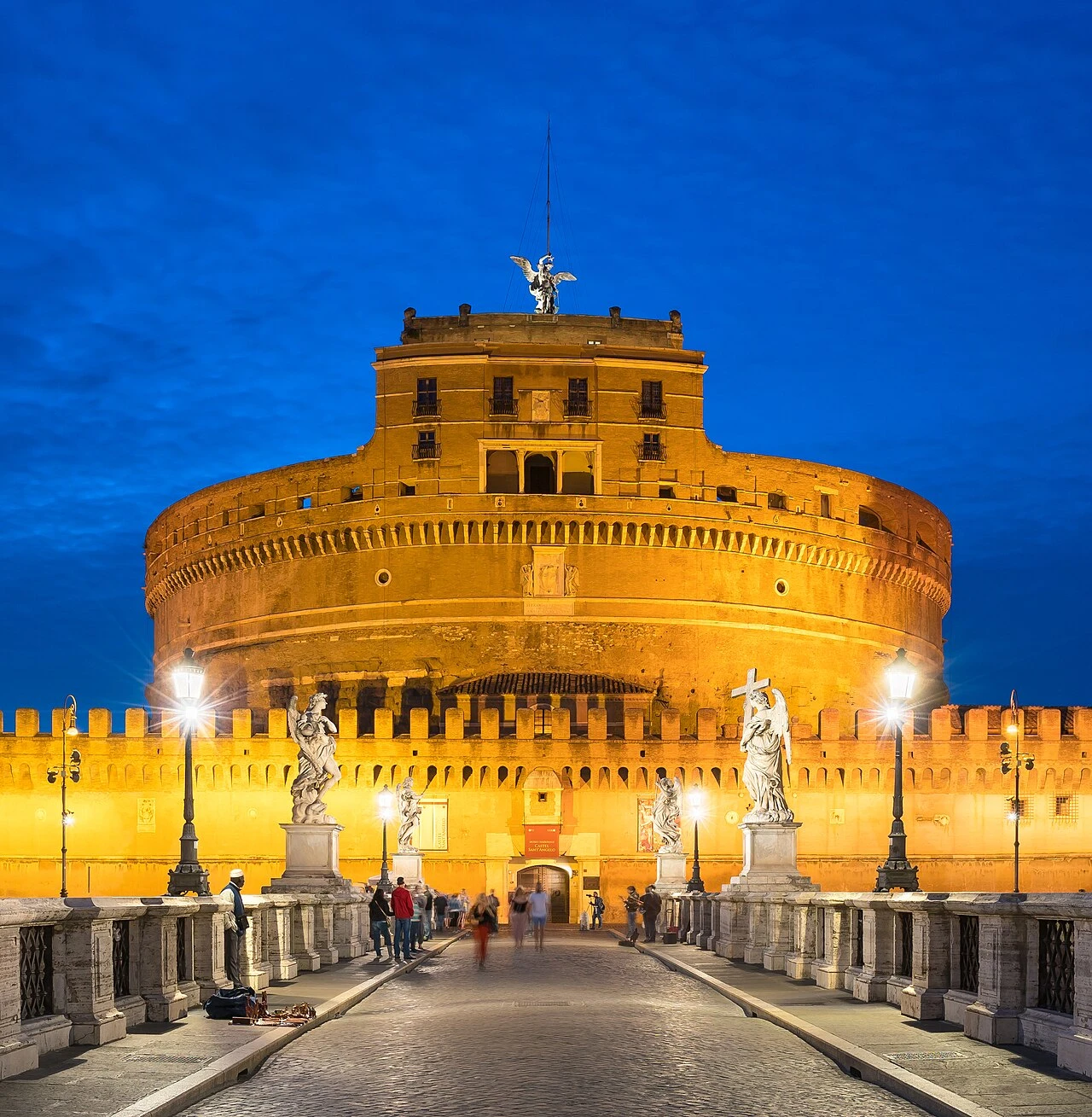
Castel Sant'Angelo
Content & sources
Thomas Wolf, www.foto-tw.de · CC BY-SA 3.0 de
Rome
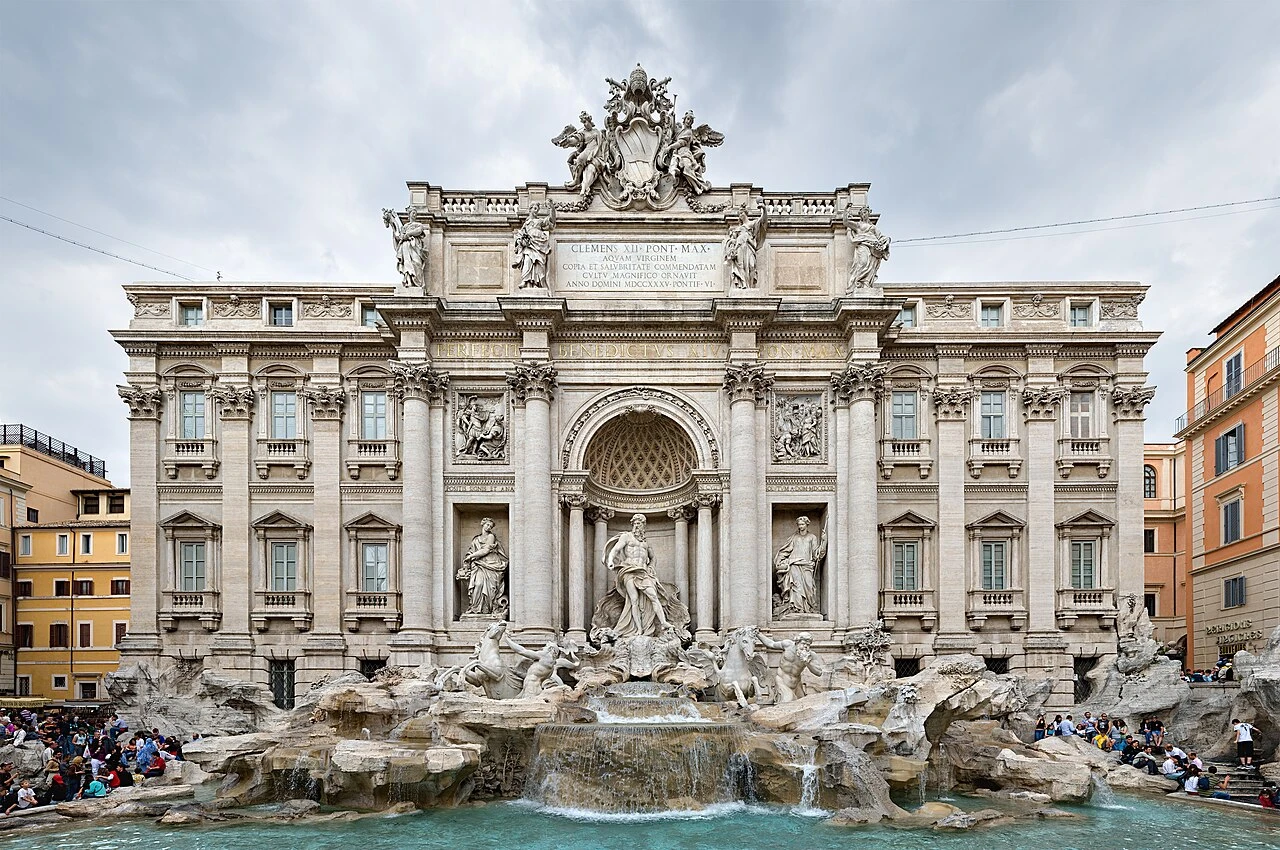
Fontana di Trevi
Content & sources
Photo: Diliff · CC BY 3.0
Rome