Languages
15Forum Romanum Audio Guide
Forum Romanum is an archaeological site in Rome, Italy. Explore it with Stanza's guided offline audio tour — narrated in 15 languages.
Quick Facts
51
Stops
15
Languages
100%
Offline
📍 Rome, Italy · 41.8922°N, 12.4852°E
About Forum Romanum
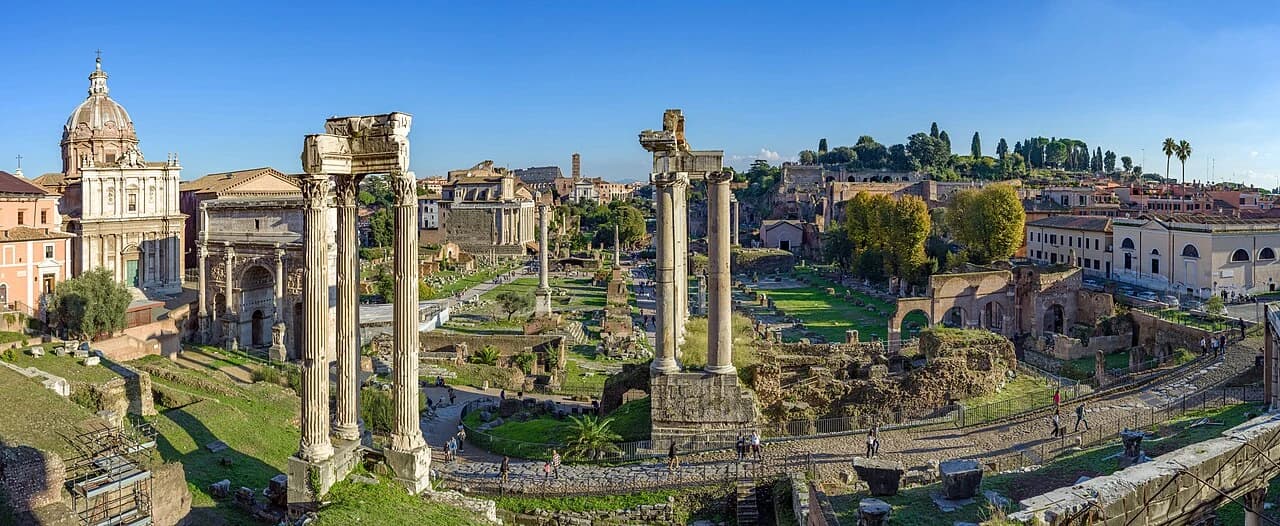
The Roman Forum was the ancient Roman center of the city, serving as a hub for public life. It stands today as a significant archaeological site and landmark in Rome, Italy.
This self-guided audio tour features 51 narrated stops organized across 10 sections. As a archaeological site, Forum Romanum offers a unique cultural experience in the heart of Rome, Italy.
The Stanza audio guide is available in 15 languages and works entirely offline — download the complete tour including audio narration, maps, and images before your visit. As you walk through Forum Romanum, GPS-triggered narration plays automatically at each point of interest.
Last updated:
What you will hear
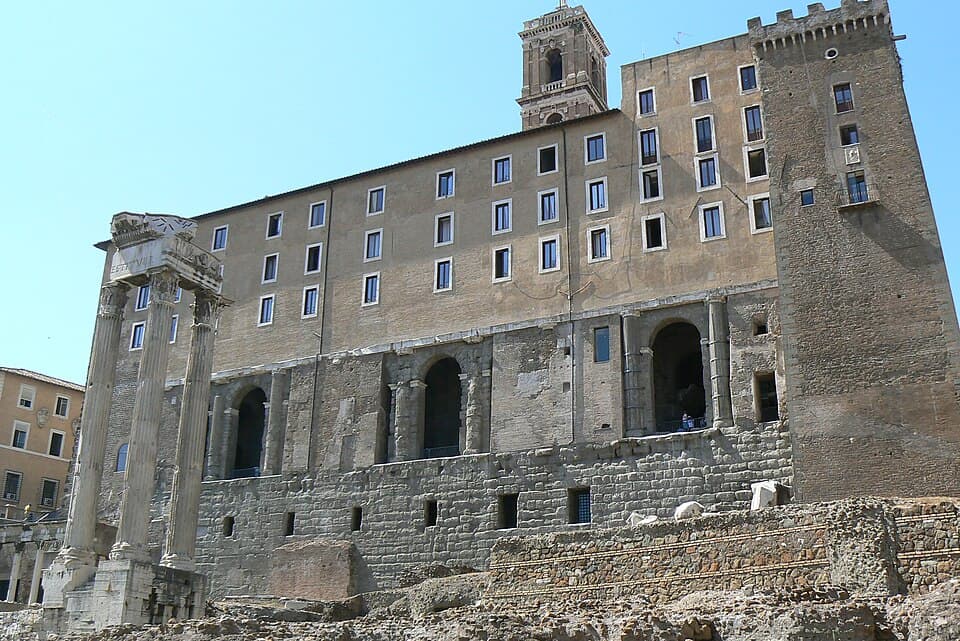
Tabularium
The massive record office of ancient Rome, forming the backdrop of the Forum and the foundation of the modern city hall.
Tabularium
Welcome to the Roman Forum. Standing tall at the end of the plaza is the Tabularium, the official records office of ancient Rome. Built in 78 BC by the order of Quintus Lutatius Catulus, this massive structure served as a monumental backdrop for the Forum, physically representing the weight and stability of Roman law. Within its walls, the empire’s most vital archives were kept, including its laws, treaties, and official decrees. As you look at the structure today, notice the heavy blocks of tufa and travertine that form its base. These ancient stones have proven so incredibly durable that they still support the modern City Hall of Rome, which was built directly on top of this Roman foundation centuries later. It was from this very spot that the vast bureaucracy of the Roman world was administered, ensuring that every corner of the empire remained connected to the legal heart of the capital.
Portico Dii Consentes
The last functional pagan shrine in the Forum, dedicated to the twelve primary gods of the Roman pantheon.
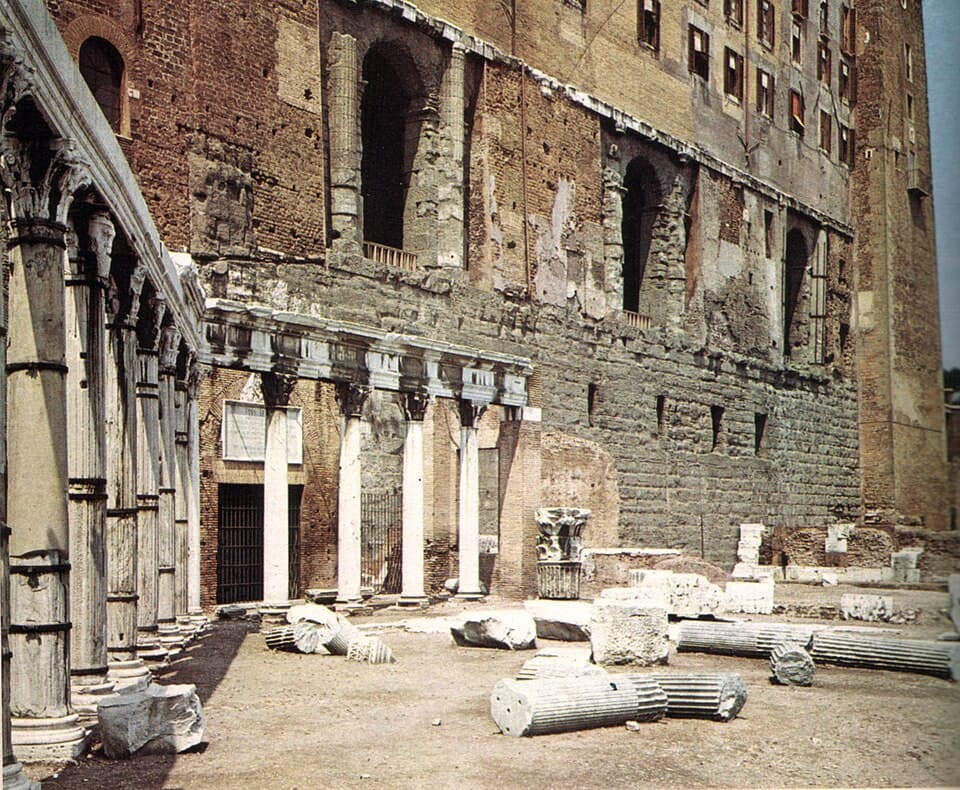
Portico Dii Consentes
Standing against the dark, imposing stones of the Tabularium is the Portico Dii Consentes. This site is remarkable as the last functional pagan shrine in the Forum, having been restored as late as 367 AD. The portico once held twelve statues of the primary Roman gods, known as the Dii Consentes, who were arranged in male-female couples. Notice the elegant Corinthian columns; their lighter color creates a striking visual contrast against the ancient tufa foundations behind them. This late restoration was a significant cultural statement by the Roman aristocracy, who sought to preserve their ancestral religious traditions even as the empire officially shifted toward Christianity. It serves as a poignant reminder of the long transition between the classical world and the Middle Ages, representing the final chapters of the ancient religious life that once pulsed through the heart of the Roman Forum.
Temple of Saturn
The most iconic ruin in the Forum, this temple served as Rome's state treasury and the site of the rowdy Saturnalia festival.
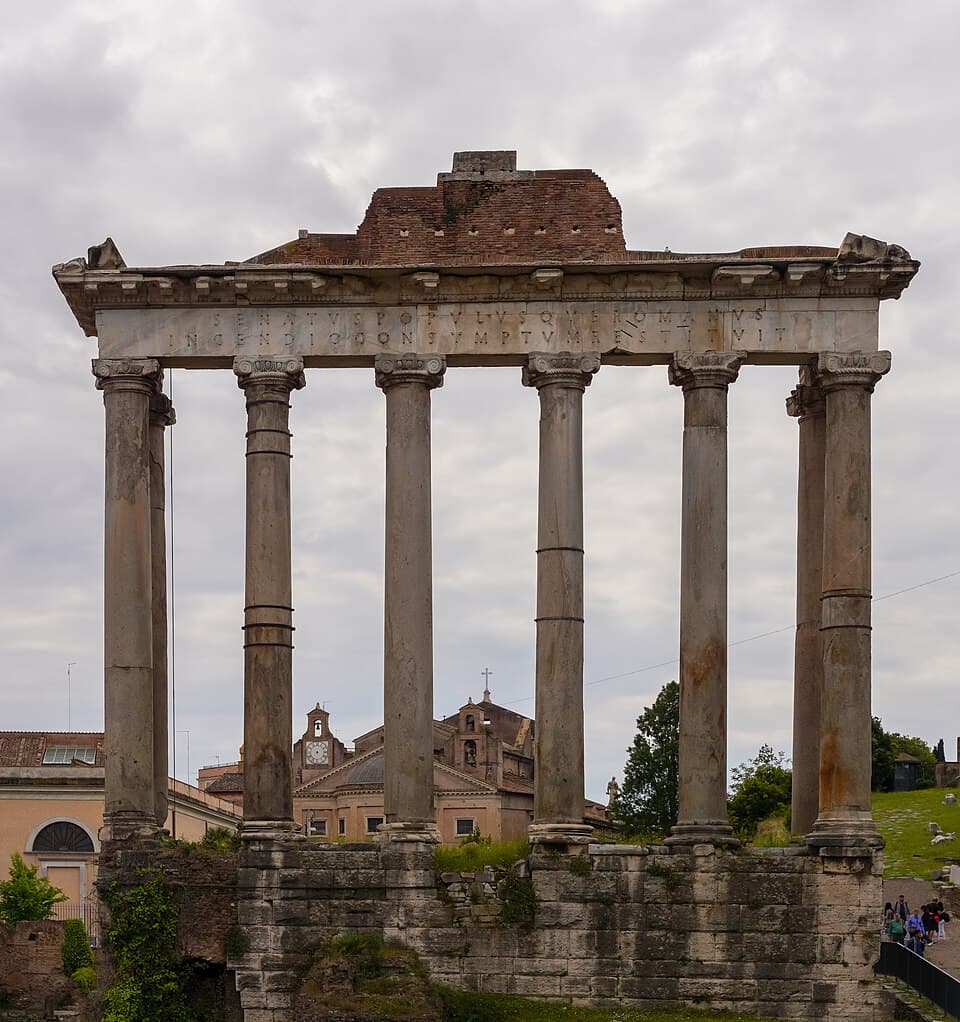
Temple of Saturn
Before you stand the iconic eight columns of the Temple of Saturn, one of the oldest sacred sites in Rome, with foundations dating back to 497 BC. Beyond its religious importance, the temple played a vital role as the State Treasury, or Aerarium. It was here, in a secure basement beneath the columns, that Rome’s gold, silver, and public records were stored. This temple was also the center of the Saturnalia, the most famous and riotous festival in the Roman calendar. Celebrated every December, the festival involved gift-giving, feasting, and the temporary reversal of social roles, where masters would serve their slaves. The temple we see today is a late rebuilding, but it stands on a spot that witnessed nearly a thousand years of Roman history. These columns remain among the most photographed and recognizable symbols of the Forum, representing the city's ancient religious and financial foundations.
Milliarium Aureum
The 'Golden Milestone' erected by Augustus, from which all distances in the Roman Empire were measured.
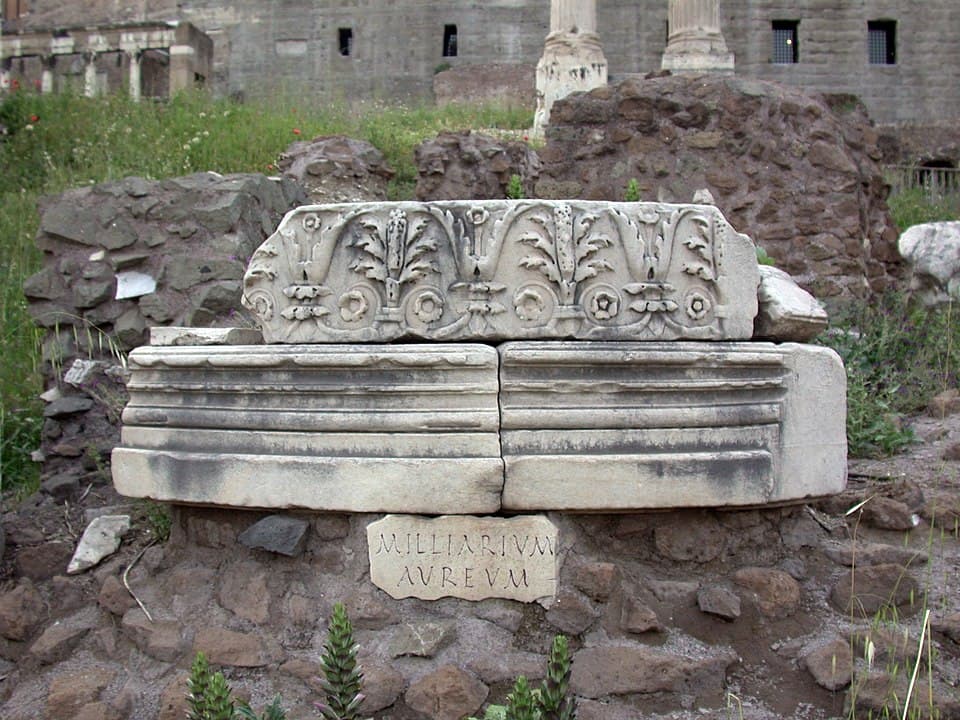
Milliarium Aureum
This marble base once supported the Milliarium Aureum, or Golden Milestone, which was erected by Emperor Augustus in 20 BC. It was a column covered in gilded bronze that listed the distances from Rome to all the major cities of the empire. This exact spot was considered the symbolic starting point for the entire Roman road network, giving birth to the famous phrase 'All roads lead to Rome.' Travelers, merchants, and soldiers departing the city would calculate their progress based on their distance from this very spot. Although the bronze is long gone, the base remains a powerful reminder of the incredible infrastructure that allowed Rome to govern and unite millions of people across three continents. It was more than just a marker; it was the heart of an interconnected world, emphasizing Rome's position as the inevitable center of civilization.
Arch of Septimius Severus (Roman Forum)
A massive white marble triumphal arch celebrating the emperor's victories over the Parthians.
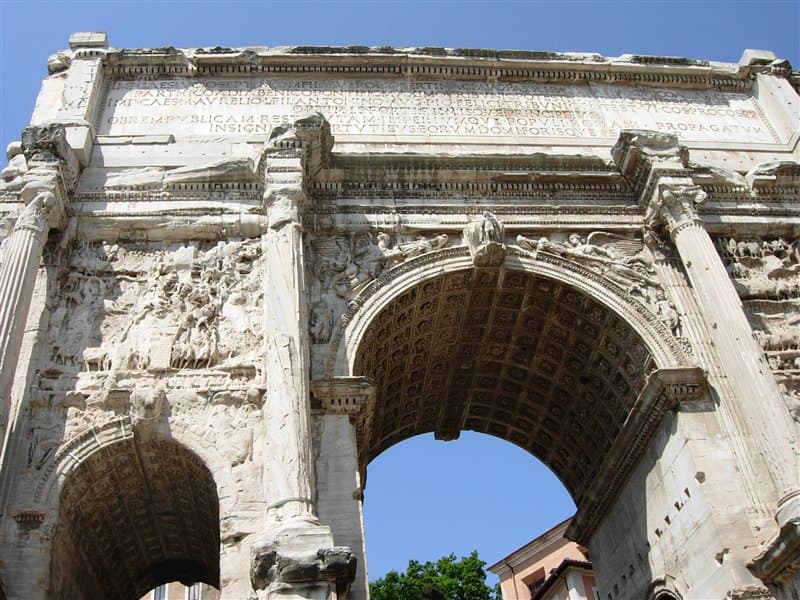
Arch of Septimius Severus
Standing before you is the massive Arch of Septimius Severus, one of the best-preserved monuments in the Forum. Built in 203 AD, it was commissioned to celebrate the military victories of Emperor Septimius Severus and his sons in the war against the Parthian Empire in the East. The arch is constructed from high-quality white marble and is covered in intricate relief panels that depict scenes from the military campaigns. Originally, these reliefs were meant to be seen in vibrant colors, making the story of the war even more vivid for the people of Rome. The arch served as a permanent piece of imperial propaganda, showcasing the emperor’s might and the expansion of Rome’s borders. Its scale and detail continue to command respect today, standing as a grand gateway to the most sacred part of the Forum and a lasting monument to an era of imperial triumph.
plutei of Trajan
Two famous marble reliefs on display inside the Curia, depicting Trajan's charitable acts and the landscape of the Forum itself.
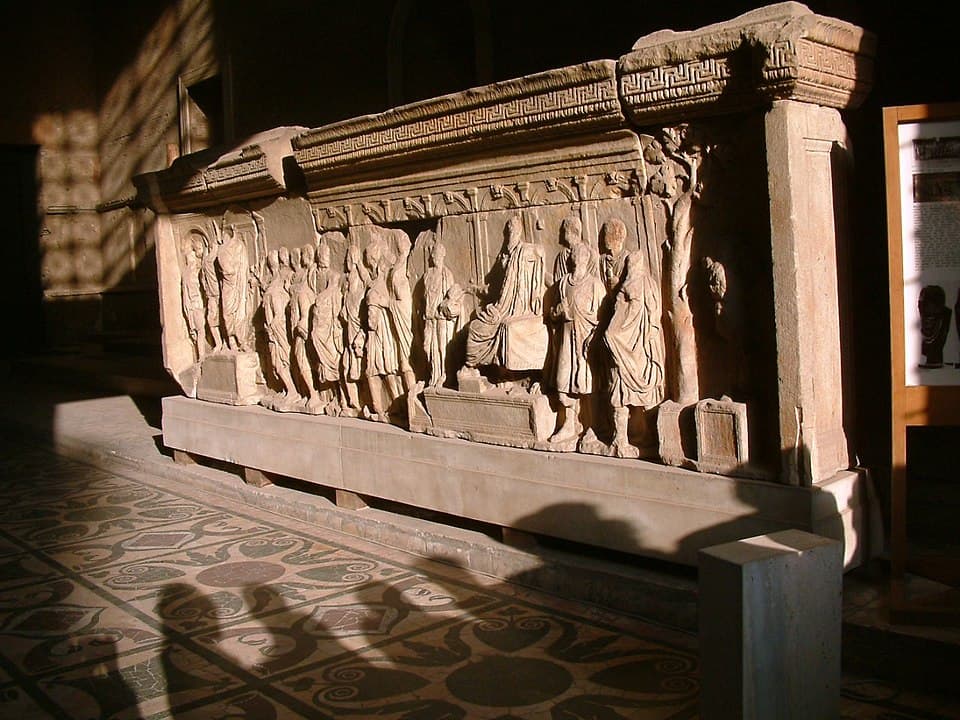
plutei of Trajan
Displayed inside the Curia are two magnificent marble panels known as the Plutei of Trajan. These reliefs originally served as a decorative balustrade or screen in the open area of the Forum, but they now offer us a vivid snapshot of life during the reign of the Emperor Trajan in the early 2nd century AD. Each panel tells a specific story of imperial benevolence and political strategy. On one relief, you can see the Emperor standing on a podium, addressing a crowd. He is shown establishing the 'Alimenta', a state-sponsored charity designed to support orphans and children of poor families across Italy, ensuring a future pool of soldiers and citizens. The second relief depicts a more dramatic event: the public burning of tax records. In a masterful stroke of populism, Trajan cancelled the debts owed to the state by many citizens. You can see officials carrying large tablets—the debt records—and piling them up to be destroyed by fire. What makes these carvings truly exceptional for historians is the background. The artist painstakingly carved the actual buildings of the Forum as they appeared at the time, including the Arch of Augustus and the Temple of Saturn. These reliefs aren't just art; they are a form of political advertisement, carved in stone to remind every Roman that their emperor was both a provider and a protector.
Lacus Curtius
A mysterious stone-paved area linked to legends of a Roman hero who sacrificed himself to save the city.
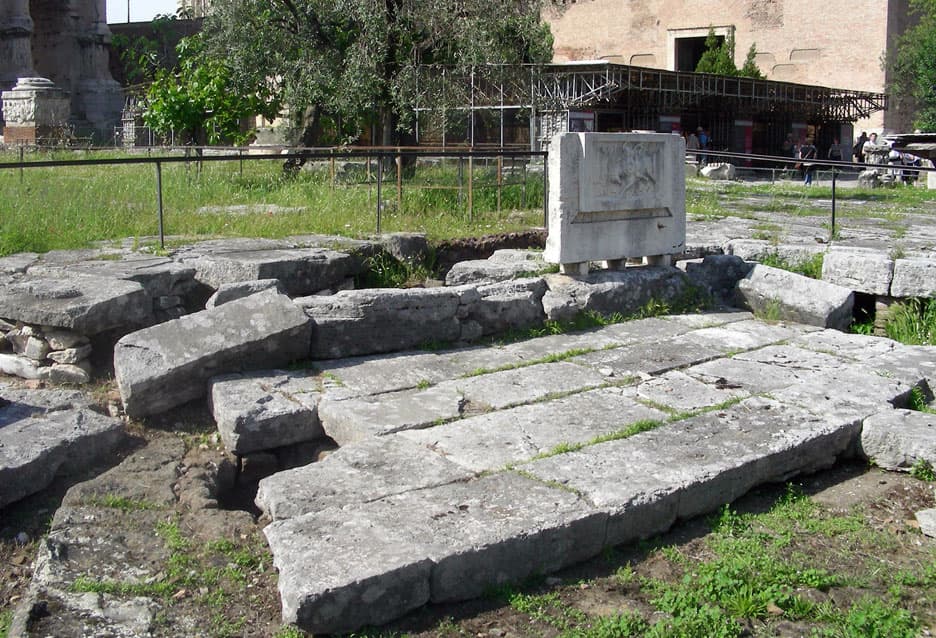
Lacus Curtius
In the center of the Forum, near the Column of Phocas, you will find a small, slightly sunken area paved with stone known as the Lacus Curtius. While it may look like a simple patch of pavement today, for the ancient Romans, it was the site of one of their most beloved and enduring legends. According to myth, in the early days of the Republic, a massive, bottomless chasm suddenly opened in the middle of the Forum. The people were terrified, and the oracles declared that the gap would only close if Rome sacrificed its most valuable possession. As the citizens debated what that might be—gold, grain, or land—a young soldier named Marcus Curtius realized the truth. He argued that Rome’s most precious asset was not its wealth, but the courage and devotion of its youth. Fully armored and mounted on his horse, he called out to the gods and plunged headlong into the abyss. The earth immediately closed over him, saving the city. For centuries afterward, Romans would toss coins into the small pool that remained there as an offering to his memory. The site became a symbol of 'pietas'—the selfless devotion to the state above one's own life. Even after the pool dried up and the area was paved over, it remained a sacred landmark, reminding every passerby of the hero who literally jumped into the earth to ensure Rome's survival.
Temple of Caesar
The spot where Julius Caesar was cremated and later deified with a temple; still a place where visitors leave flowers today.
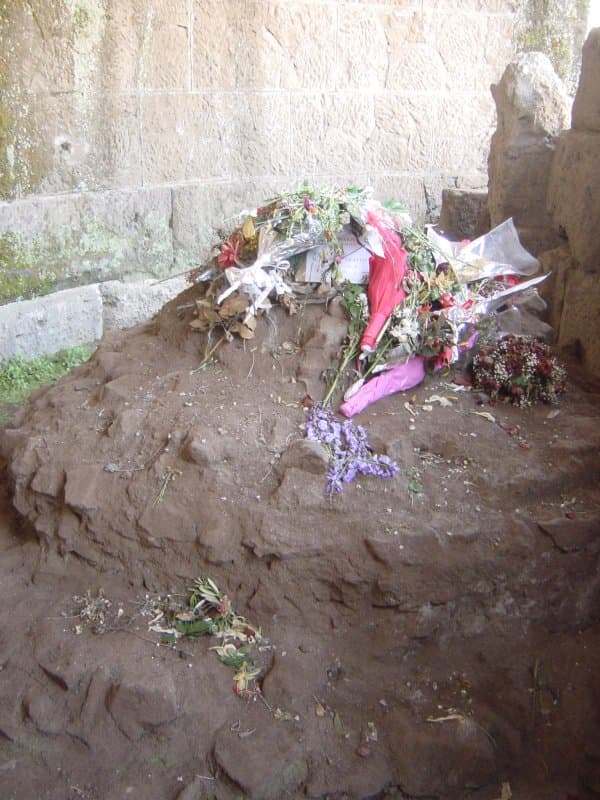
Caesar's Cremation Site
Within the ruins of the Temple of Caesar, you’ll find a small, somewhat weathered mound of earth and stones sheltered from the elements. This is the heart of the site—the remains of the altar built on the spot of Julius Caesar's funeral pyre in 44 BC. Following his assassination on the Ides of March, Caesar’s body was brought to the Forum for a public funeral. In a surge of grief and rage, the mourning crowds seized benches and wooden stalls to create a massive pyre right here. Today, it remains one of the most evocative spots in the Forum. If you look closely, you will likely see fresh flowers, coins, or notes left by modern visitors. This tradition of leaving tributes has persisted for over two thousand years, making it a living memorial to a figure whose influence still echoes through Western civilization. It is a quiet, somber space that connects the ancient stones to human memory, reminding us of the intense emotions that shaped the history of the city.
Temple of Castor and Pollux
Known for its three towering columns, this temple was dedicated to the twin sons of Jupiter who supposedly helped Rome win a key battle.
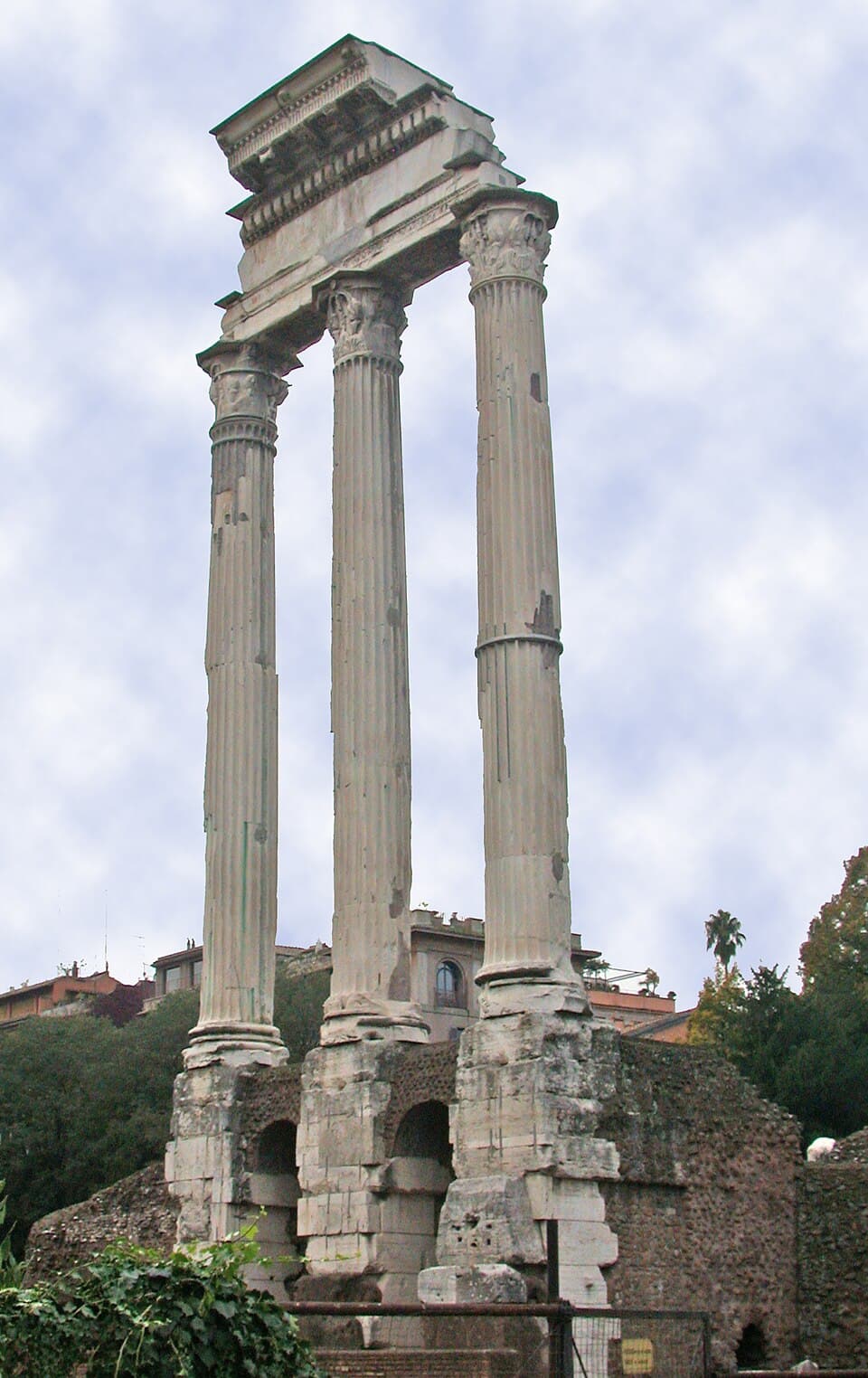
Temple of Castor and Pollux
These three towering columns, connected by a fragment of their original architrave, are one of the most recognizable landmarks in the Forum. They belong to the Temple of Castor and Pollux, the divine twin sons of Jupiter. According to legend, these brothers appeared on white horses in the Forum in 499 BC to announce a miraculous Roman victory at the Battle of Lake Regillus. They were supposedly seen watering their horses at a nearby spring before vanishing as quickly as they had arrived. Grateful for this divine intervention, the Romans dedicated a temple on the spot. Over the centuries, the temple became more than just a place of worship; it served as a meeting place for the Senate and even as an office for weights and measures. The surviving columns you see today date from a reconstruction in the early 1st century AD. Their slender proportions and intricate carvings represent the peak of Roman architectural craftsmanship during the imperial era, standing as a testament to the city's long history and mythological foundation.
Santa Maria Antiqua
One of the oldest and most important Christian churches in the Forum, famous for its incredible 6th-9th century frescoes.
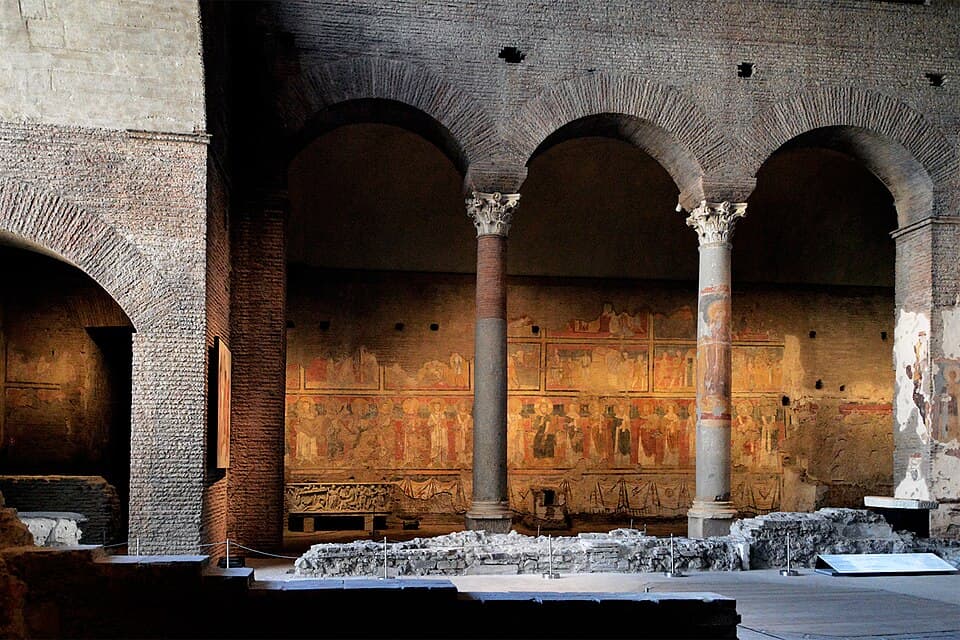
Murals of Santa Maria Antiqua
As you examine the walls of Santa Maria Antiqua, you’ll notice fragments of colorful paintings that seem to overlap one another. These are multiple layers of frescoes, with the earliest dating back as far as the 6th century. The technique of painting over older scenes was common, but here, the layers have been partially exposed, revealing a chronological history of artistic styles. The preservation of these murals is truly remarkable. When the earthquake of 847 AD buried the church, it effectively acted as a time capsule. While other early churches in Rome were modernized, renovated, or demolished over the centuries, the art here was shielded from light, moisture, and human intervention for over a thousand years. It avoided the fate of being painted over during the Renaissance or Baroque periods. Today, these faces of saints and biblical scenes provide invaluable insight into the spiritual life and aesthetic values of Rome during its transition from the ancient to the medieval world. The rich pigments and expressive figures still convey a sense of profound devotion.
Want to hear the rest?
Download the Stanza app to unlock all 51 stops and the complete guided audio tour.
Frequently Asked Questions
How long does the Forum Romanum audio tour take?
The Forum Romanum audio guide includes 51 narrated stops. Most visitors spend 45 minutes to 1.5 hours exploring the complete tour, though you can listen at your own pace and skip or revisit any stop.
Is the Forum Romanum audio guide available in my language?
Stanza supports 15 languages: English, Spanish, French, German, Italian, Portuguese, Russian, Japanese, Chinese, Korean, Arabic, Hindi, Polish, Dutch, Hebrew. Check the guide in the app to confirm the languages currently available for this tour.
Can I use the audio guide offline at Forum Romanum?
Yes! Download the complete Forum Romanum tour — including all audio, maps, and images — before your visit. The Stanza app works completely offline, so you don't need WiFi or mobile data at the venue.
How much does the Forum Romanum audio guide cost?
The Stanza app is free to download. The current listed price for the Forum Romanum audio guide is $5.99; app-store region and currency may affect the final price.
How do I use the Stanza audio guide at Forum Romanum?
Download the free Stanza app, search for "Forum Romanum", and download the tour. When you arrive at the venue, the app uses GPS to detect your location and automatically plays the relevant narration as you move between points of interest — completely hands-free.
What makes the Stanza audio guide different from other Forum Romanum tours?
Stanza offers GPS-triggered narration that plays automatically as you walk through Forum Romanum — no need to manually select stops. The tour is available in 15 languages, works fully offline, and includes 51 expertly narrated stops with images and historical context.
What other audio guides are available near Forum Romanum?
Stanza offers multiple audio guides in Rome, Italy and nearby areas. After downloading the app, browse the map to discover all available tours near Forum Romanum. Each guide can be downloaded for offline use.