Stanza · Audio guide
Ostia AnticaAudio guide
A place to remember. A story to take with you.
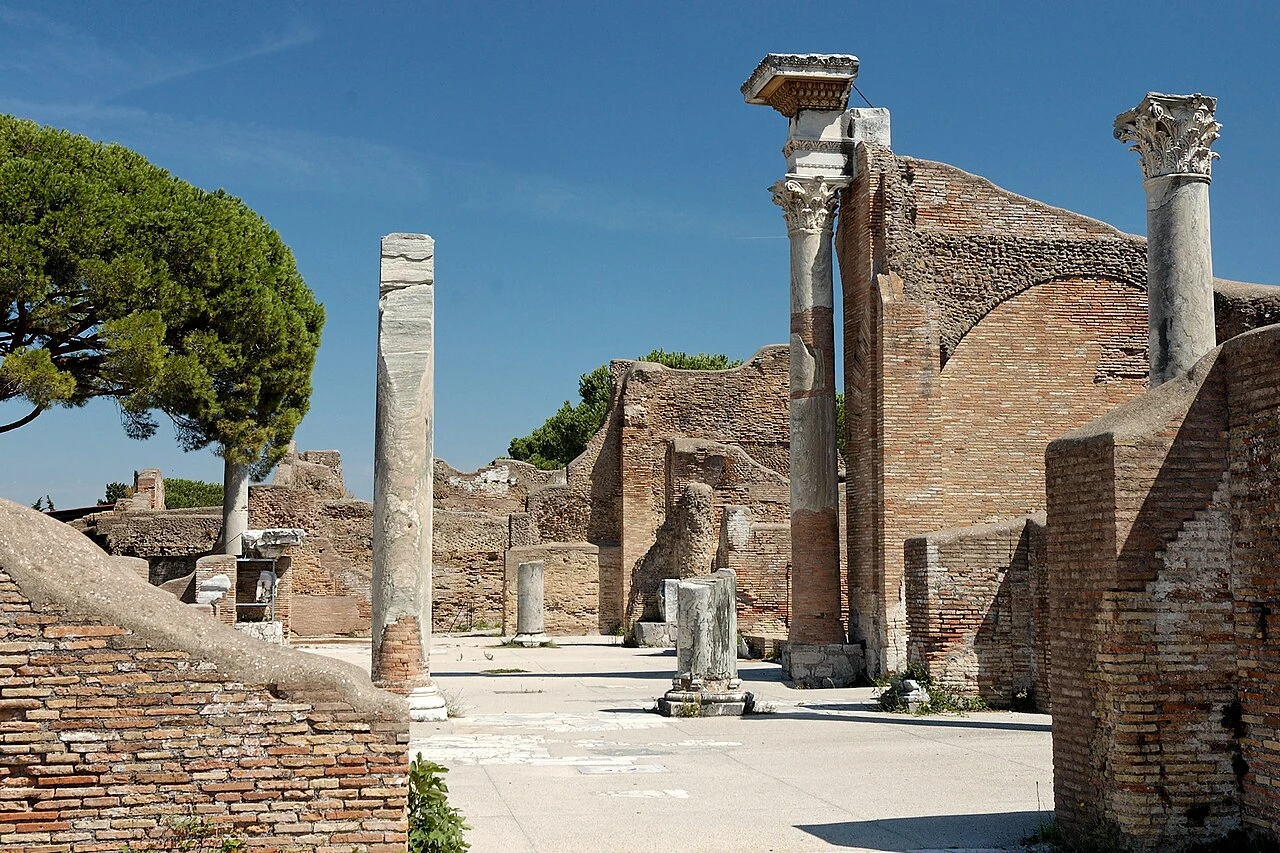
Ostia was an ancient Roman city and colony, serving as a major port for ancient Rome. It is now an extensive archaeological site featuring well-preserved ruins.
Download Stanza, then search for “Ostia Antica”.
About the tour
One guide. Your kind of visit.
Ostia was an ancient Roman city and colony, serving as a major port for ancient Rome. It is now an extensive archaeological site featuring well-preserved ruins.
Ready when you are.
- 01Get the free Stanza app.
iOS & Android
- 02Find your guide.
“Ostia Antica”
- 03Download before you go.
Works offline
Audio guide / 45 narrated stops
Inside the guide
Get to know a few of the stories before you go. Open a stop to read more.
01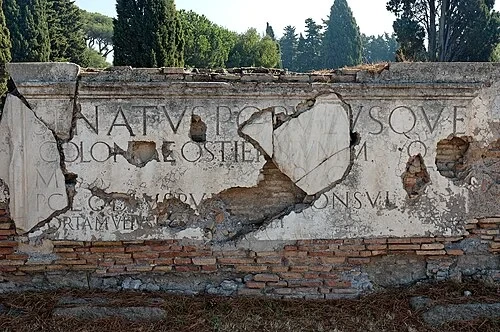 Roman Gate (Porta Romana)Roman Gate
Welcome to one of the most significant thresholds of the ancient world. This Roman Gate served as the primary entrance for those arriving from the city of Rome along the Via Ostiense. As you examine the fragments of the large inscription here, you can see the letters 'SENATVS POPVLVSQVE,' an abbreviation for 'The Senate and People of Rome.' This phrase was not just a decoration; it served as a powerful reminder of Ostia's official status as a 'Colonia.' Being a colony meant that Ostia was an extension of Rome itself, bound by the same laws and serving as a strategic military and commercial outpost. The inscription confirms the city’s direct legal and political link to the heart of the Empire. In its heyday, this gateway would have been a bustling site of customs officials, merchants, and soldiers. The presence of such formal lettering emphasized to every traveler that while they were at the coast, they were still under the direct authority and protection of the Roman state. The heavy paving stones beneath the archway carried the weight of countless wagons bringing goods from across the Mediterranean to feed the million people living in the capital.
Marie-Lan Nguyen (User:Jastrow) · CC BY 2.5
02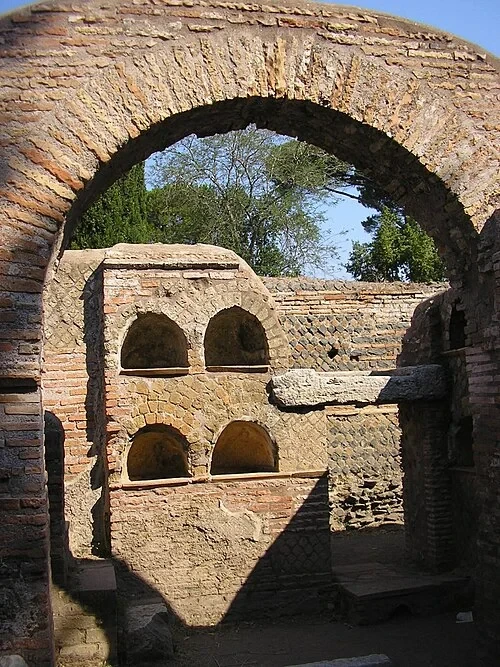 Necropolis of Via OstienseNecropolis of Via Ostiense
Walking along the road leading into the city, you pass through the local necropolis. Roman law was very specific about the separation of the living and the dead, strictly forbidding burial within the city walls for both religious and sanitary reasons. Consequently, vast cemeteries grew along the main arteries leading into every Roman town. Notice the small arched niches in these structures, known as 'columbarium,' which translates to 'pigeon houses.' These niches were designed to hold the ceramic urns containing the ashes of the deceased. Death in a crowded port city like Ostia was a communal affair. While the extremely wealthy could afford private monuments, the middle class and freedmen often belonged to burial clubs or guilds that shared these large, multi-niche tombs. This arrangement allowed for a dignified resting place at a lower cost. These structures were once highly decorated with paint and plaster, serving as a permanent record of the families and workers who built the city's prosperity. The proximity of the dead to the busy main road ensured that their names would be read aloud by passersby, keeping their memory alive in the minds of the living.
Photo: Natyss med · Public domain
03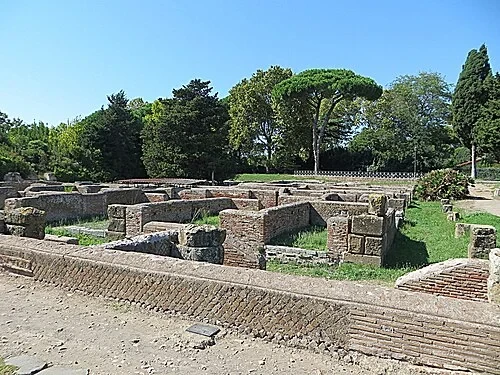 Square of Victory (Piazzale della Vittoria)Victory Square
Standing in Victory Square, you can begin to grasp the massive scale of this urban landscape. At its height in the second century, Ostia was a thriving metropolis housing approximately 50,000 people across 150 acres. Unlike Pompeii, which was famously preserved in a single moment by a volcanic eruption, Ostia experienced a much slower decline. As the mouth of the Tiber River silted up and the harbor became unreachable for large ships, the population gradually moved away, and the city was slowly reclaimed by the earth. This long process of abandonment left the buildings remarkably well-preserved, as they were eventually covered by protective layers of silt and sand rather than being looted for stone. From here, you can see the grid-like planning typical of Roman engineering, with wide streets designed to handle heavy cart traffic and large public spaces meant for social gathering. The ruins visible today represent a cross-section of Roman life, from grand temples to the cramped quarters of the working class. It is one of the best-preserved examples of an ancient Roman city in existence, offering a clear window into the daily operations of a Mediterranean trade hub.
Listen in the appMister No · CC BY 3.0
04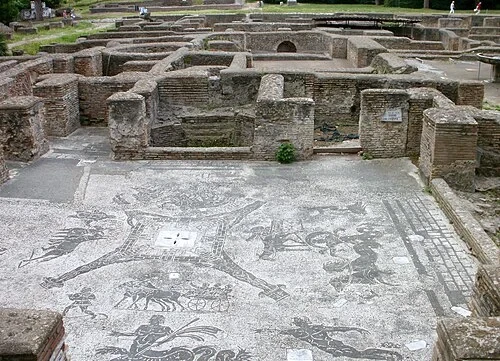 Baths of the Coachmen (Terme dei Cisiarii)Baths of the Coachmen
Transitioning from the dusty, busy main street into the Baths of the Coachmen, you encounter the Roman obsession with hygiene and social leisure. Public baths were not just places to wash; they were the community centers of the ancient world. This specific complex was utilized by the many transport workers who kept the city moving. As you look at the floors, notice the black-and-white geometric patterns made of small stone tiles. This stark, two-tone style was the signature decorative choice for 2nd-century Ostia. These mosaics served a dual purpose: they provided a durable, waterproof surface that was easy to clean, while also acting as a visual 'welcome mat' for patrons entering the various rooms of the complex. The geometric designs could be quite complex, creating optical illusions of depth or simple, repeating borders that defined the functional zones of the bathhouse. In a city where most residents lived in small apartments without running water, these public facilities provided a essential escape. Here, for a very small fee, a worker could sweat in the hot rooms, scrape off the day's grime, and catch up on the latest news with their neighbors.
Listen in the appAngela Stefanoni · CC BY 3.0
05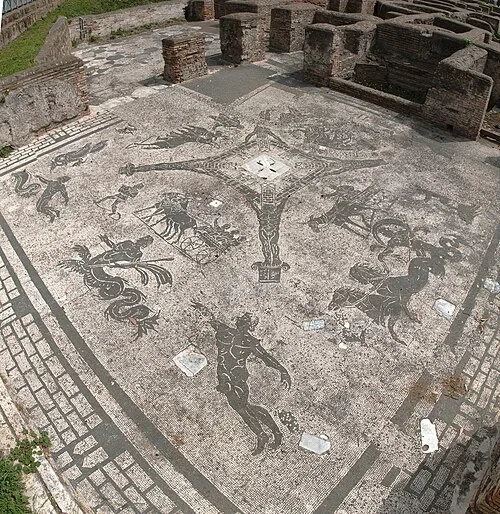 Baths of the Coachmen (Terme dei Cisiarii)The Coachmen's Mosaic
The floor of this room features a detailed mosaic depicting the 'cisiarii'—the drivers of light, two-wheeled carriages known as 'cisium.' These men provided the ancient world's equivalent of an express shuttle service, racing back and forth along the road between Ostia and Rome to transport travelers and urgent messages. The mosaic shows the mules pulling these small, fast carriages, capturing the energy and speed of the transport industry. Interestingly, some of the drivers in these mosaics are identified by name, suggesting they were well-known figures or local celebrities within their transport guild. Guilds were powerful organizations in Ostia, acting as trade unions, social clubs, and mutual-aid societies for various professions. The detail in the stone tiles even captures the harness equipment and the specific stance of the drivers as they managed their teams. These images remind us that Ostia was a city fundamentally defined by movement. The constant flow of goods and people required a highly organized and skilled workforce of drivers who spent their lives navigating the busy highway to the capital. The mosaic is a permanent tribute to the men who ensured that the connection between the port and the heart of the Empire was never broken.
Listen in the appPhoto: MatthiasKabel · CC BY-SA 3.0
06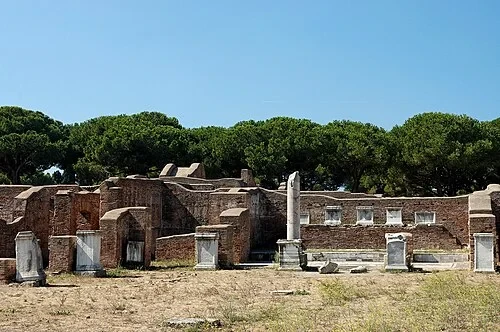 Barracks of the Firemen (Vigiles)Barracks of the Vigiles
This large complex served as the barracks for the 'Vigiles,' the combined fire and police force of ancient Rome. In a city packed with multi-story apartment blocks and massive grain warehouses, fire was a constant and terrifying threat. Most buildings featured wooden roofs and floors, and residents used open flames for both lighting and cooking, making the work of the Vigiles strategically vital for the city's survival. The central courtyard here contains a shrine where the firemen performed regular sacrifices to the Emperor. These rituals were not just religious; they were acts of political loyalty, reinforcing the bond between the paramilitary force and the head of the state. The barracks provided housing, training grounds, and storage for firefighting equipment like pumps, buckets, and ladders. Living together in these quarters allowed the Vigiles to respond instantly to the sound of an alarm. The strength of the brick walls and the organized layout of the rooms reflect the disciplined nature of this force. Their presence ensured that even in the middle of a hot, dry summer, the vital stores of grain destined for the capital remained safe from the sparks of a neighboring kitchen.
Listen in the appMarie-Lan Nguyen (User:Jastrow) · CC BY 2.5
07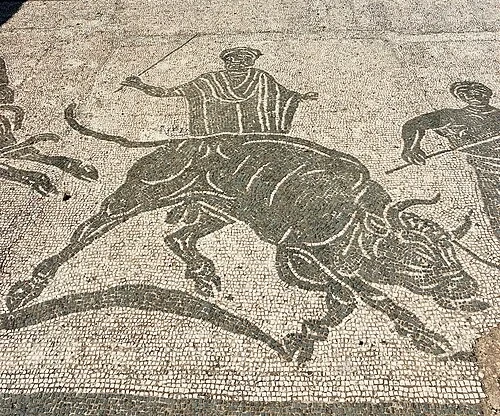 Barracks of the Firemen (Vigiles)Mosaic of the Sacrificial Bull
Inside the Barracks of the Vigiles, you can see a striking black-and-white mosaic that depicts a scene of ritual sacrifice. The central figure is shown leading a bull toward an altar. In the Roman world, such sacrifices were essential public ceremonies intended to win the favor of the gods and ensure the safety of the community. For the firemen stationed here, these rituals were specifically focused on preventing the catastrophic fires that could level entire neighborhoods. Notice the dynamic, almost cartoonish quality of the figures. The artist used small, dark stone tiles against a white background to create bold outlines and a sense of movement. This style was both cost-effective and highly visible in the dim light of indoor spaces. The bull, depicted with powerful musculature, represents the significant value of the offering being made to the divine. This mosaic served as a constant reminder to the firemen of their duty and the spiritual protection they sought for the city they guarded. The use of simple, contrasting colors was a hallmark of the 2nd-century artistic trend in Ostia, prioritizing clear storytelling over the elaborate, multicolored realism found in earlier periods. It captures a moment of high tension and sacred importance, frozen in stone beneath your feet.
Listen in the appMarie-Lan Nguyen (User:Jastrow) · CC BY 2.5
08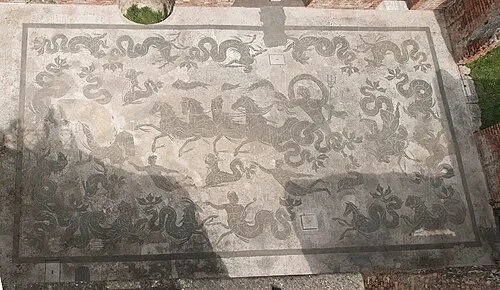 Baths of NeptuneBaths of Neptune
The Baths of Neptune contain one of the most famous examples of Roman floor decoration. The sprawling mosaic depicts the sea god Neptune, or Poseidon, standing triumphantly in his chariot. He is shown with his characteristic trident, the symbol of his power over the oceans. The god is being pulled by four 'hippocamps'—mythical creatures that are half-horse and half-fish. The artist used swirling, fluid lines of black stone tiles against a white background to mimic the churning energy of the water. This sense of movement was intentional; it reflected the power of the sea that brought Ostia its incredible wealth. As a port city, Ostia’s very existence depended on favorable winds and calm waters, making Neptune one of its most important deities. The sheer scale of the mosaic is impressive, covering the floor of a large hall where bathers would have gathered to relax. By placing such a grand image in a public space, the patrons of the baths were celebrating the source of the city's prosperity. The intricate details of the hippocamps' tails and the god's determined expression demonstrate the high level of craftsmanship available in the city during the second century.
Listen in the appUser:MatthiasKabel · CC BY-SA 3.0
09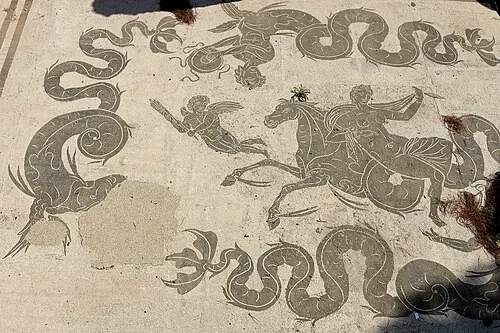 Baths of NeptuneAmphitrite and the Sea Creatures
Adjacent to the great Neptune mosaic is a companion piece featuring his wife, Amphitrite. She is depicted riding through the waves, accompanied by a lively assortment of sea monsters and Cupids riding on the backs of dolphins. These whimsical creatures, with their coiled tails and scales, reflect the Roman fascination with the mysterious depths of the Mediterranean. In the context of the bath complex, these images served as a form of high-end advertising. They evoked a sense of luxury, relaxation, and the refreshing power of water, perfectly matching the atmosphere the bath's owners wanted to create for their patrons. The presence of Cupids adds a playful, lighthearted element to the scene, suggesting that the baths were a place for enjoyment and social pleasure. The craftsmanship remains consistent with the neighboring Neptune mosaic, utilizing the same black-and-white aesthetic to create a cohesive decorative program throughout the facility. Mosaics like these transformed functional floors into gallery spaces, allowing even the average citizen to appreciate sophisticated art while going about their daily routine. The survival of such delicate tile work provides a clear idea of the visual splendor that once defined Ostia’s most popular public buildings.
Listen in the appMarie-Lan Nguyen (User:Jastrow) · CC BY 2.5
10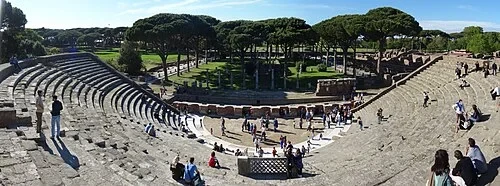 Roman Theatre of OstiaRoman Theatre of Ostia
The Roman Theatre of Ostia is one of the most prominent landmarks in the city. It was originally constructed during the reign of Augustus by his son-in-law, Agrippa—the same influential figure responsible for the original Pantheon in Rome. The structure was later expanded to accommodate approximately 4,000 spectators, reflecting the city's growing population and importance. You can see the classic semi-circular seating area, known as the 'cavea,' where citizens would sit according to their social rank. The most prominent residents occupied the lower tiers closest to the action, while those of lower status sat further up. The flat area at the base is the orchestra, and beyond it stood the large stage building, which would have been decorated with columns and statues. This theatre was the cultural heart of the city, hosting everything from Greek tragedies to local farces and political assemblies. Remarkable for its preservation, the theatre is still used for performances today, nearly two thousand years after its initial construction. The acoustics provided by the curved stone rows remain effective, allowing voices from the stage to reach the highest seats. It stands as a reminder that entertainment was a crucial component of urban life, providing a shared experience for the diverse population of this port town.
Listen in the appPhoto: Livioandronico2013 · CC BY-SA 3.0
Ostia Antica
Frequently asked questions
How much does the guide cost?
Free app download. Listed guide price: $1.99. Guide price shown in the app. Audio guide only. Venue admission is separate.
Can I listen without internet?
Yes. Download the guide’s audio, images, and maps in the app before your visit. Your downloaded content is then available offline.
Can I listen in my language?
Stanza supports 15 languages. Check the app for the languages available for this guide.
Do I need to follow a schedule?
No. This is a self-guided experience. Choose your stops, pause whenever you like, and return to a story at your own pace.
At your own pace
Explore Ostia Antica.
Download Stanza, then search for “Ostia Antica”.
Free app download · Guide price shown in the app
Keep exploring
Nearby audio guides
Rome
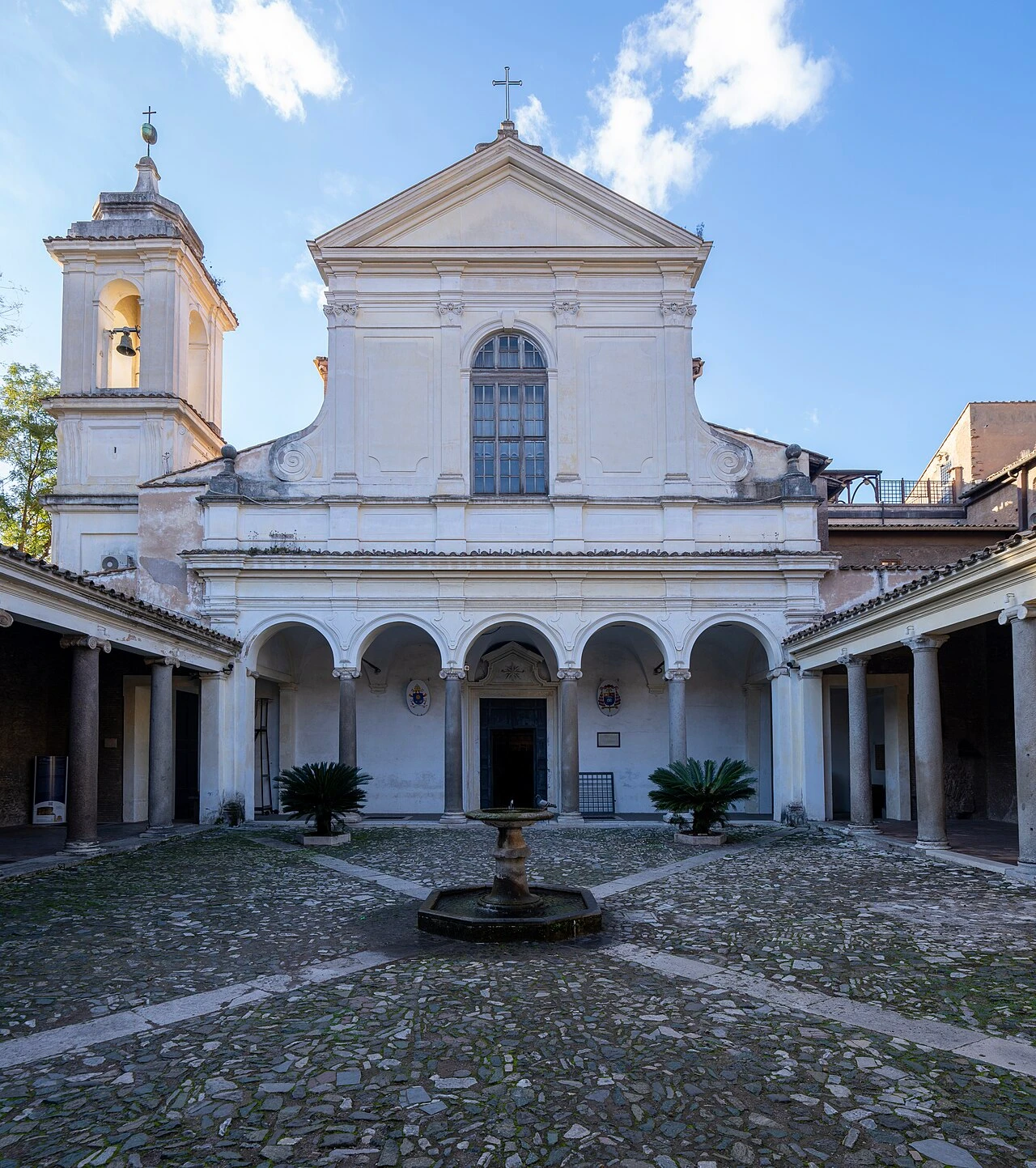
Basilica di San Clemente
Content & sources
Photo: Labicanense · CC BY-SA 4.0
Rome
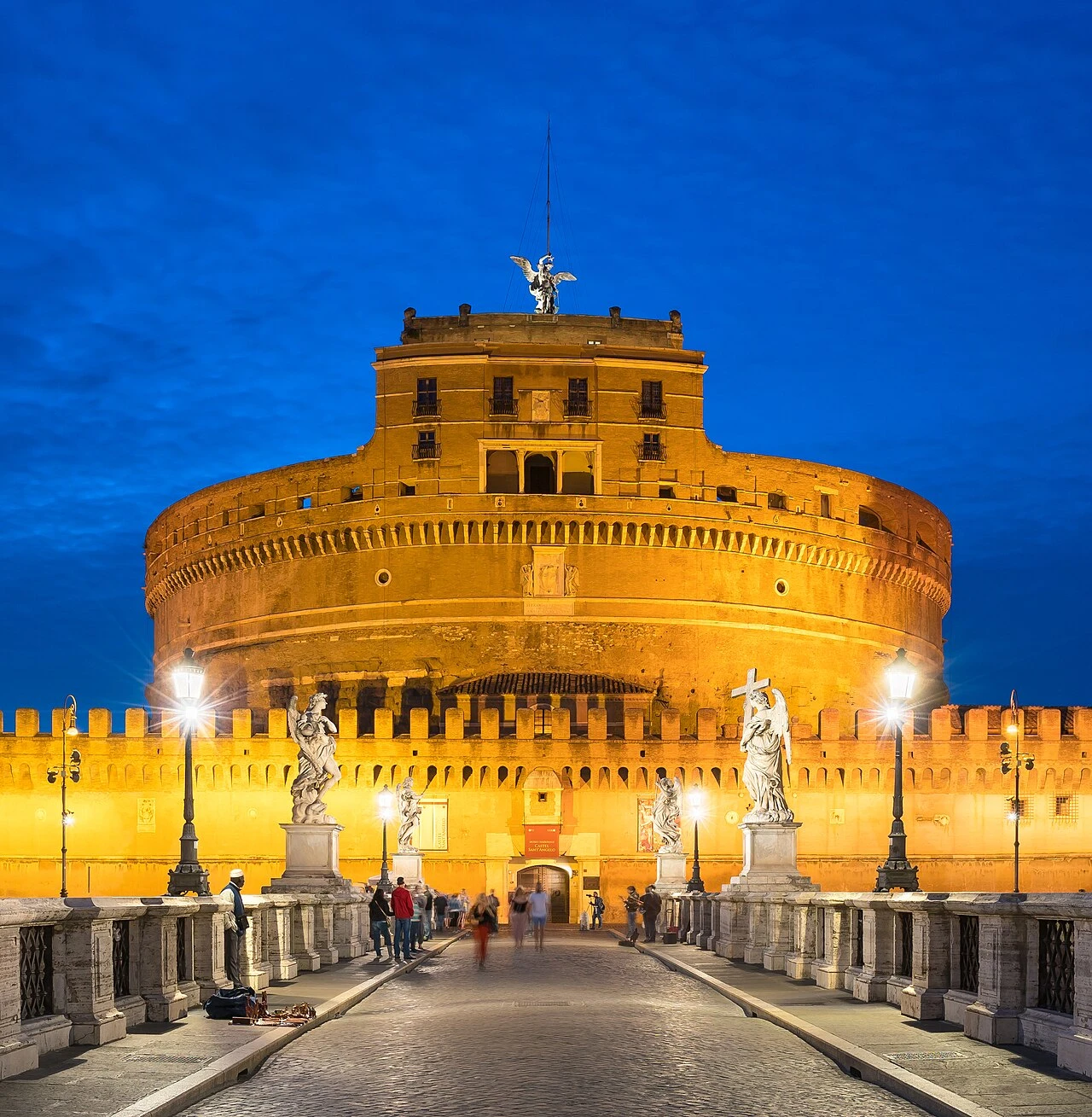
Castel Sant'Angelo
Content & sources
Thomas Wolf, www.foto-tw.de · CC BY-SA 3.0 de
Rome
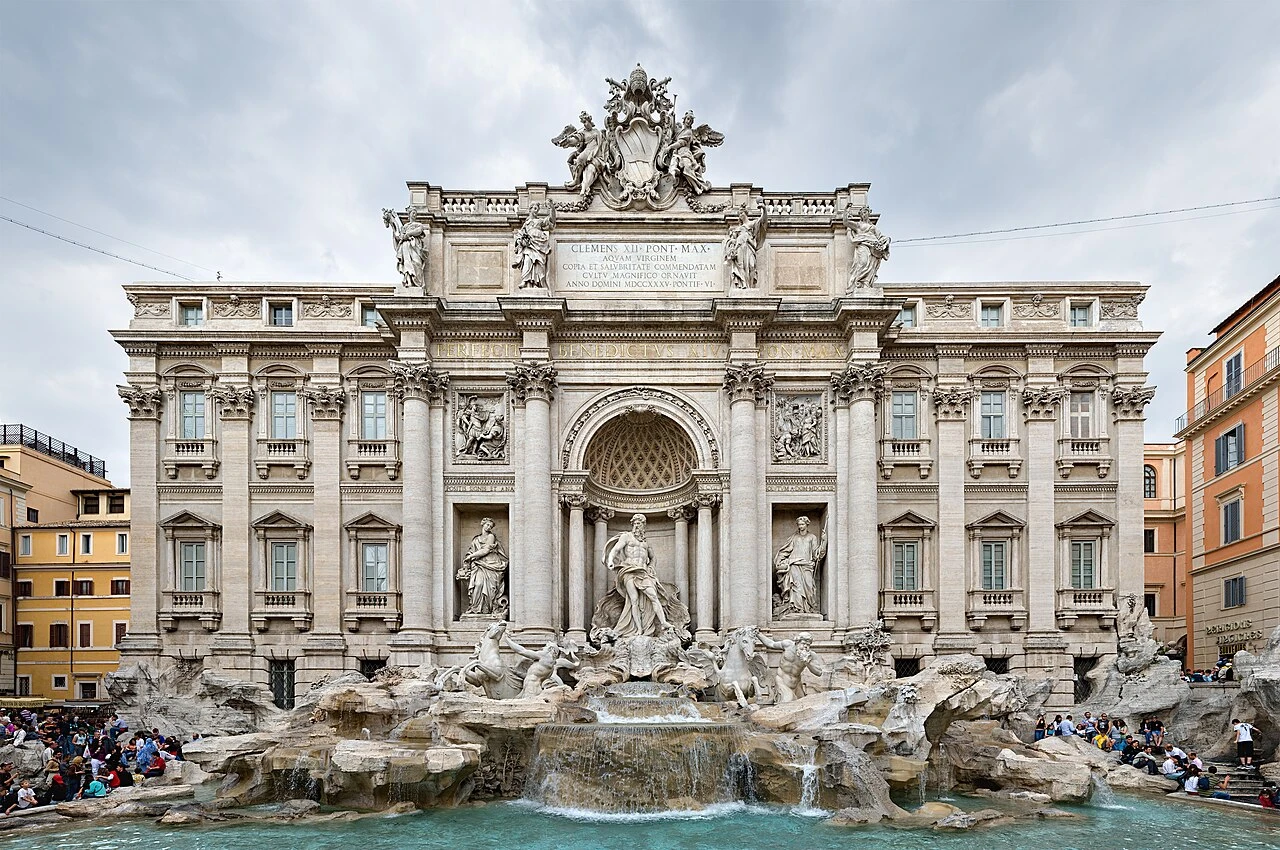
Fontana di Trevi
Content & sources
Photo: Diliff · CC BY 3.0
Rome