Stanza · Audio guide
Villa FarnesinaAudio guide
A place to remember. A story to take with you.
Villa Farnesina is a Renaissance suburban villa in Rome, Italy. Designed by Baldassarre Peruzzi, it now functions as a museum known for its exquisite frescoes by Raphael and other prominent artists.
Download Stanza, then search for “Villa Farnesina”.
About the tour
One guide. Your kind of visit.
Villa Farnesina is a Renaissance suburban villa in Rome, Italy. Designed by Baldassarre Peruzzi, it now functions as a museum known for its exquisite frescoes by Raphael and other prominent artists.
Ready when you are.
- 01Get the free Stanza app.
iOS & Android
- 02Find your guide.
“Villa Farnesina”
- 03Download before you go.
Works offline
Audio guide / 22 narrated stops
Inside the guide
Get to know a few of the stories before you go. Open a stop to read more.
01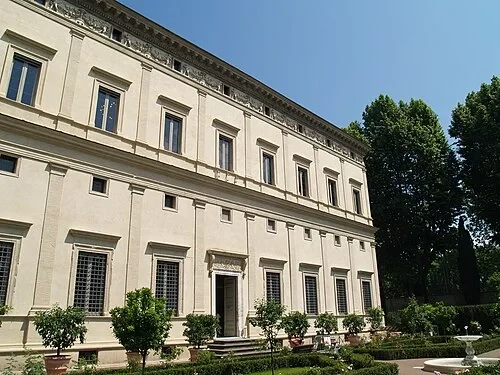 The Renaissance Suburban PrototypeThe Main Facade
Commissioned in 1506 by the immensely wealthy Sienese banker Agostino Chigi, this villa represents the first true suburban palace of the period. Unlike the fortress-like urban palaces of the time, designed with thick walls and defensive postures, Chigi desired a space dedicated to leisure, entertaining, and the display of his vast cultural interests. He entrusted the architect Baldassarre Peruzzi with the task. Peruzzi’s design is a masterclass in rhythm and proportion, featuring a facade defined by two orders of pilasters and an understated elegance. It signaled a shift in Roman architecture, moving away from heavy medieval influences toward a lighter, classical aesthetic inspired by ancient Roman country houses. This residence was not just a home, but a stage for the humanist ideals of the High Renaissance, where the lines between art, nature, and the host's wealth were intentionally blurred. Notice how the rhythmic spacing of the windows creates a sense of harmony that reflects the calm, rural atmosphere Chigi sought to create here on the banks of the Tiber.
Miguel Hermoso Cuesta · CC BY-SA 3.0
02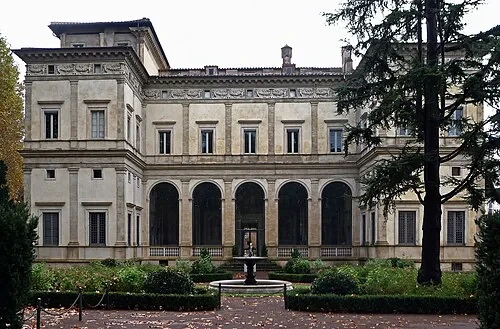 The Renaissance Suburban PrototypeThe U-Shaped Courtyard
When finalized around 1512, this layout by the architect Baldassarre Peruzzi broke with the tradition of enclosed inner courtyards. By extending two wings toward the gardens, the design created a fluid connection between the built environment and the fragrant fruit trees outside. The open arches of the loggias served as a porous boundary, allowing cool breezes and the scent of citrus to drift into the grand reception rooms. Imagine the atmosphere during one of Chigi’s legendary summer parties, where guests moved freely from the shaded pergolas of the gardens into the magnificent painted halls. This architecture was designed to celebrate the Roman climate and the pleasures of outdoor living, turning the entire property into a unified space for social interaction and intellectual exchange. The facade here reflects the internal logic of the house, harmonizing the private chambers with the public, garden-facing entertainment areas. This arrangement successfully transformed a traditional palace structure into a welcoming, open villa that prioritizes its relationship with the natural world.
Photo: Peter1936F · CC BY-SA 3.0
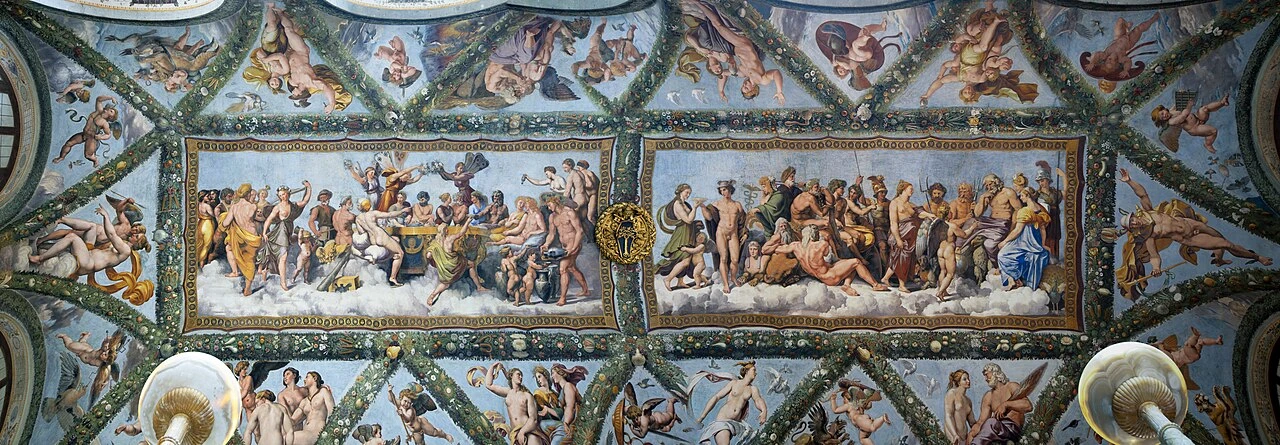
03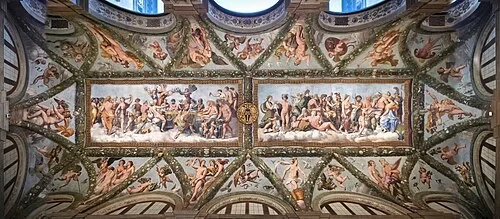 The Loggia of Cupid and PsycheLoggia of Cupid and Psyche
The entire ceiling is dedicated to the myth of Cupid and Psyche, drawn from the ancient novel 'The Golden Ass' by Apuleius. Raphael and his workshop designed the decorative scheme to look like a lush garden pergola, with tapestries appearing to be stretched across the sky. This clever arrangement blurs the line between the villa’s interior and the gardens just beyond the arches. By framing the central scenes with thick garlands of fruit and flowers, the artists created the illusion of an outdoor space that never wilts. The narrative follows the trials and eventual deification of Psyche, a story of love and the soul that resonated with the humanist spirit of the time. The choice of subject matter was particularly apt for Chigi, who used these festive rooms to entertain popes, diplomats, and royalty. Every detail, from the playful gods above to the greenery surrounding them, was carefully calculated to impress guests with the owner's taste and the sophistication of contemporary Roman art. The sheer scale of the figures ensures they are easily visible from the floor below during social gatherings.
Listen in the appPhoto: NateBergin · CC BY 4.0
04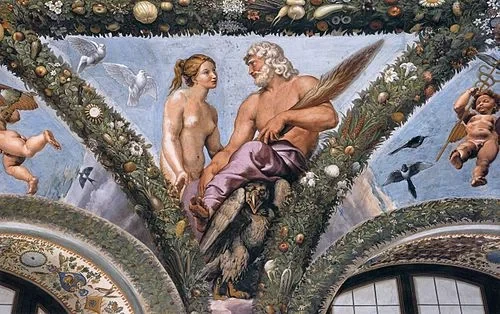 The Loggia of Cupid and PsycheVenus and Jupiter
At the heart of this divine assembly, notice the powerful figure of Jupiter being kissed by a mischievous Cupid, an intimate and slightly irreverent detail that adds a layer of playfulness to the scene. This fresco provides a perfect example of Raphael’s late stylistic development. The figures here are remarkably muscular and sculptural, possessing a heavy, monumental presence that feels significantly different from his earlier, more delicate works. The composition is crowded and energetic, with overlapping limbs and complex poses that create a sense of dynamic movement across the sky. These characteristics—muscularity, compressed space, and heightened drama—would go on to strongly influence the Mannerist movement that dominated the later sixteenth century. While Raphael provided the overall design and cartoons, the execution was largely carried out by his skilled workshop, including artists like Giulio Romano. The scene captures the pivotal moment Psyche is granted immortality, allowing her to officially join the divine ranks and wed her beloved Cupid. The rich, saturated colors of the gods' robes stand out brilliantly against the dark blue sky, drawing your eyes toward the center of the vault.
Listen in the appRaphael · Public domain
05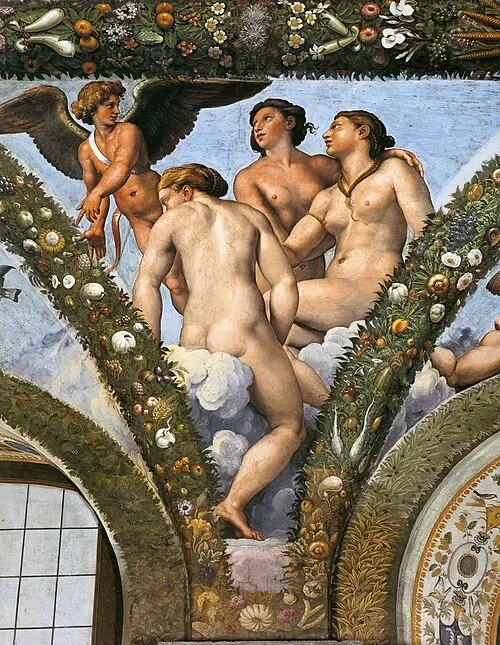 The Loggia of Cupid and PsycheCupid and the Three Graces
These figures represent Aglaia, Euphrosyne, and Thalia, the daughters of Zeus who embodied charm, beauty, and creativity. Raphael’s design focuses on the soft modeling of their skin and the graceful, interlocking nature of their poses. They are shown in a close group, their bodies twisting in harmony to create a balanced, triangular composition that is a hallmark of High Renaissance art. Notice how the light catches the curves of their figures, emphasizing their physical perfection and the fluid lines of their gestures. In classical mythology, the Graces were the constant companions of Venus, and here they symbolize the refined, harmonious atmosphere that Agostino Chigi cultivated within his villa. Their presence served as a visual reminder of the aesthetic ideals shared by the artists and their patron: a belief in the inherent connection between physical beauty and spiritual grace. The painting showcases a mastery of anatomy and a commitment to an idealized vision of humanity. The delicate treatment of their hair and the gentle expressions on their faces further enhance the scene’s sense of serenity and refined pleasure.
Listen in the appRaphael · Public domain
06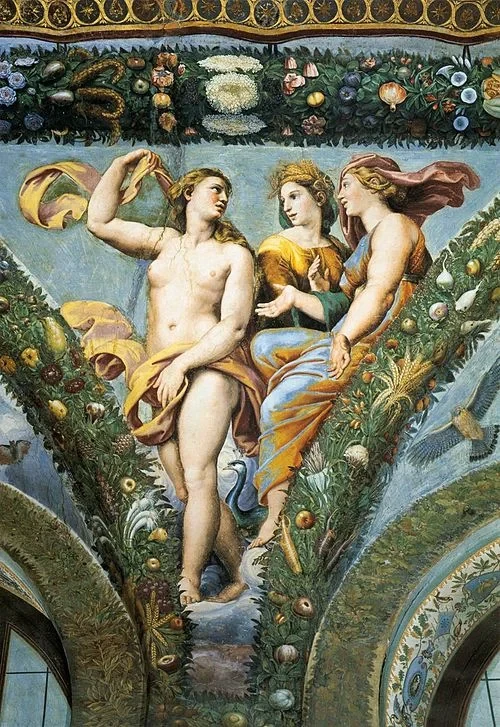 The Loggia of Cupid and PsycheBotanical Borders
These intricate borders were the work of Giovanni da Udine, a specialist in the workshop of Raphael. He meticulously painted over 170 distinct plant species, creating a rich display of biodiversity. If you examine the clusters closely, you can find rare specimens that had only recently arrived in Europe from the New World, such as maize and pumpkins. Their inclusion was a deliberate choice meant to signal Agostino Chigi’s global connections and his status as an informed participant in the Age of Discovery. The banker’s wealth allowed him to source exotic items from across the globe, and having them represented in his villa demonstrated his worldly sophistication. These garlands also reinforce the illusion of the loggia as a garden pergola, perpetually in bloom. The variety and realism of the fruits—many shown at the peak of ripeness or even slightly over-mature—add a sensory richness to the space, suggesting the abundance and fertility of the Roman countryside. The artist's attention to detail is remarkable, capturing the specific textures of rinds, petals, and leaves with scientific accuracy.
Listen in the appGiovanni da Udine · Public domain
07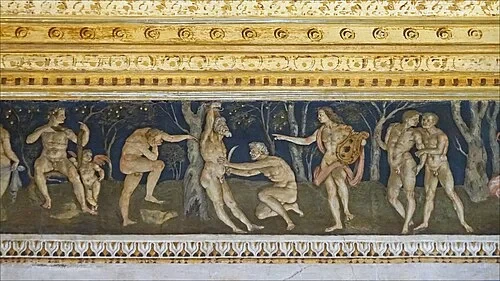 The Hall of the FriezeFrieze of Apollo and Marsyas
High on the walls, a long, continuous frieze depicts mythological scenes, beginning with the musical contest between the god Apollo and the satyr Marsyas. The myth ends tragically for Marsyas, who is flayed alive for his arrogance in challenging a deity, serving as a dark and pointed warning about human hubris. The artist, Baldassarre Peruzzi, utilized a monochromatic style intended to mimic the appearance of ancient Roman sculpture. This technique, known as 'chiaroscuro' painting, uses shades of a single color to create the illusion of three-dimensional carvings. This choice was deeply rooted in the Renaissance desire to emulate the grandeur of antiquity, making the room feel like an extension of an ancient palace. The figures are small but precisely rendered, showing a focus on narrative clarity and classical proportion. As one of the first spaces guests would see, this hall set a high-minded, intellectual tone for the visit, reminding Chigi's peers of his deep appreciation for classical literature and ancient moral philosophy. The dark background allows the light-colored figures to pop forward, enhancing the sculptural effect.
Listen in the appJean-Pierre Dalbéra from Paris, France · CC BY 2.0
08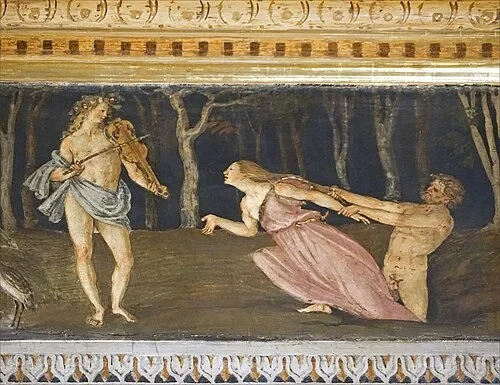 The Hall of the FriezeOrpheus in the Underworld
The narrative of the frieze continues with the tragic story of Orpheus. Here, the artist captures the moment the musician leads his wife out of the underworld, only to lose her forever when he fails the test and looks back. The composition emphasizes dynamic movement, with figures appearing to hurry along the dark background, their forms highlighted against the somber tones. The emotional weight of this failure is central to the scene, illustrating the human struggle between desire and duty. By placing these complex, tragic stories high on the walls, Peruzzi transformed the hall into a space intended for high-minded intellectual reflection. Original guests, well-versed in Ovid and Virgil, would have recognized these scenes immediately and discussed their deeper philosophical meanings during gatherings. The frieze operates like a storyboard of human virtues and vices, played out by the gods and heroes of the past. It reflects the villa’s dual purpose as both a place of luxury and a hub for the Roman humanist circle, where art was meant to provoke thought as much as it was meant to delight the eye.
Listen in the appJean-Pierre Dalbéra from Paris, France · CC BY 2.0
09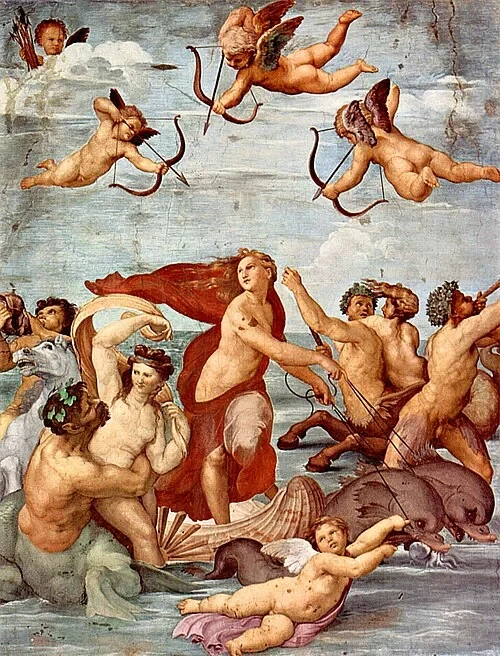 The Hall of GalateaGalatea
Painted around 1512, it shows the sea-nymph Galatea fleeing the advances of the giant Polyphemus on a chariot made of a shell, pulled by dolphins. Her pose is a celebrated example of 'contrapposto,' a complex twisting of the body where her hips and shoulders turn in opposing directions. While her chariot moves forward, she looks back over her shoulder, creating a sense of graceful, effortless motion. Raphael famously wrote that the extraordinary beauty of Galatea did not come from a single living model, but from a 'certain idea' of perfection he held in his own mind. This concept—that the artist must improve upon nature to achieve true beauty—was central to Renaissance art theory. The composition is a swirling vortex of figures, from the muscular tritons blowing conch shells to the playful cupids aiming their arrows from above. The vibrant blues of the water and sky provide a brilliant backdrop for the ivory-toned figures, showcasing Raphael's mastery of color and light. Note how the dolphins' energetic forms contrast with the nymph's serene, idealized features.
Listen in the appRaphael · Public domain
10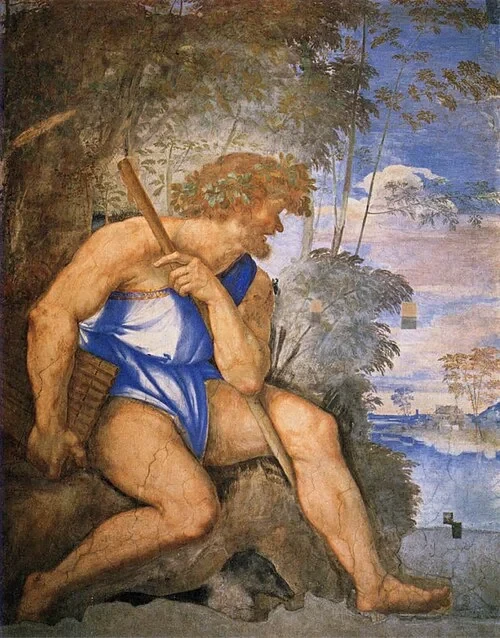 The Hall of GalateaPolyphemus
This fresco was painted by the Venetian artist Sebastiano del Piombo, and the stylistic difference from its neighbor is striking. While Raphael’s work is characterized by elegance and fluid movement, Sebastiano’s cyclops is heavy, muscular, and static. The sheer scale and exaggerated anatomy of the figure reveal the strong influence of Michelangelo, whose work Sebastiano deeply admired. In fact, Agostino Chigi brought Sebastiano from Venice to Rome specifically to introduce a new, more muscular style that could challenge Raphael’s dominance in the city. Polyphemus is shown sitting on a rocky shore, holding a set of panpipes and staring longingly toward the fleeing Galatea in the adjacent panel. The giant’s form feels weighted and earthen, creating a powerful visual tension with the airy, dynamic scene to its left. This juxtaposition offers a rare side-by-side look at the two competing artistic visions of the High Renaissance: one focused on idealized grace and the other on the dramatic, physical power of the human form. The dark, saturated tones of the cyclops' skin emphasize his connection to the rugged landscape.
Listen in the appSebastiano del Piombo · Public domain
Villa Farnesina
Frequently asked questions
How much does the guide cost?
Free app download. Listed guide price: $1.99. Guide price shown in the app. Audio guide only. Venue admission is separate.
Can I listen without internet?
Yes. Download the guide’s audio, images, and maps in the app before your visit. Your downloaded content is then available offline.
Can I listen in my language?
Stanza supports 15 languages. Check the app for the languages available for this guide.
Do I need to follow a schedule?
No. This is a self-guided experience. Choose your stops, pause whenever you like, and return to a story at your own pace.
At your own pace
Explore Villa Farnesina.
Download Stanza, then search for “Villa Farnesina”.
Free app download · Guide price shown in the app
Keep exploring
Nearby audio guides
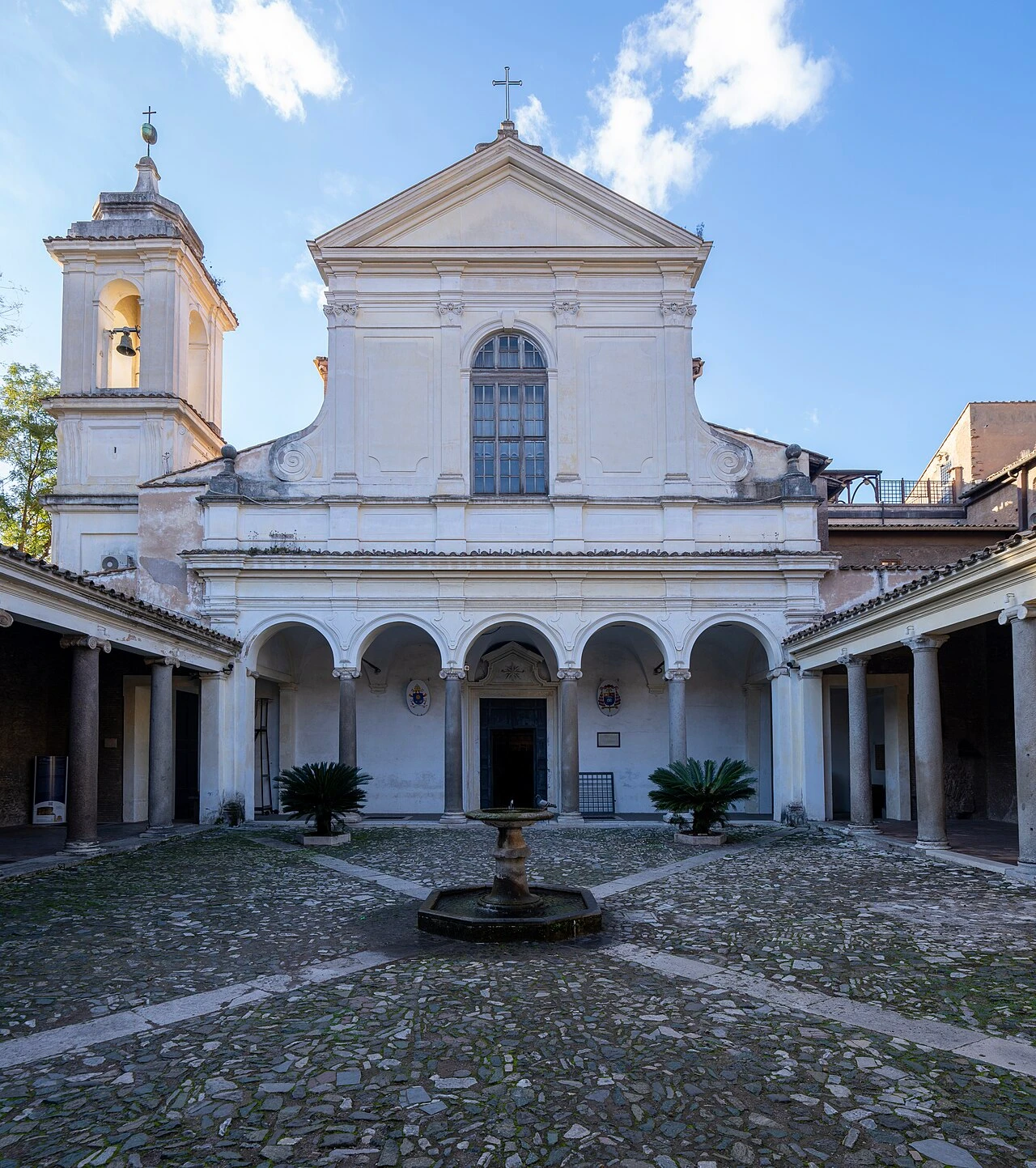
Rome
Basilica di San Clemente
Content & sources
Photo: Labicanense · CC BY-SA 4.0
Rome
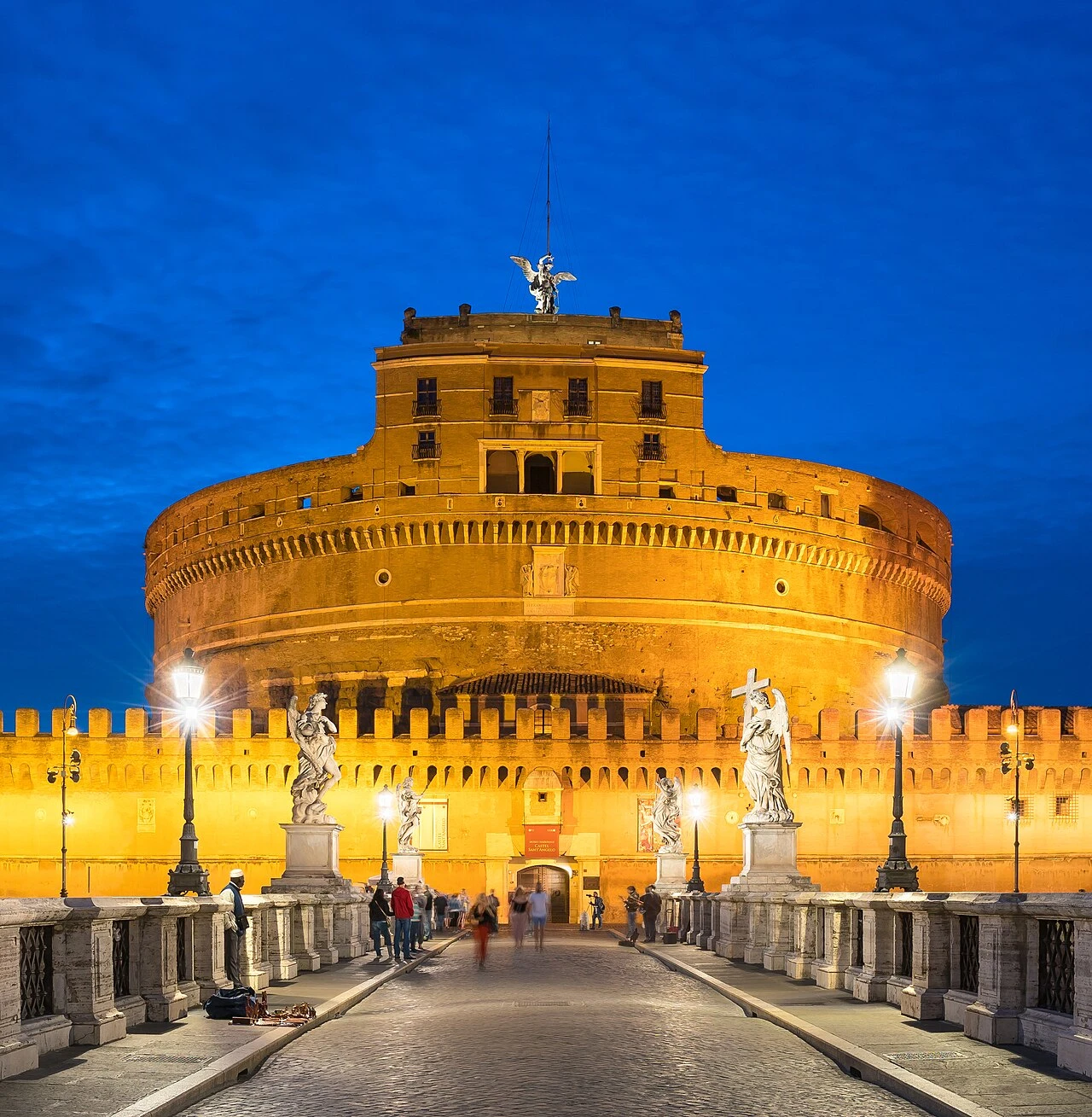
Castel Sant'Angelo
Content & sources
Thomas Wolf, www.foto-tw.de · CC BY-SA 3.0 de
Rome
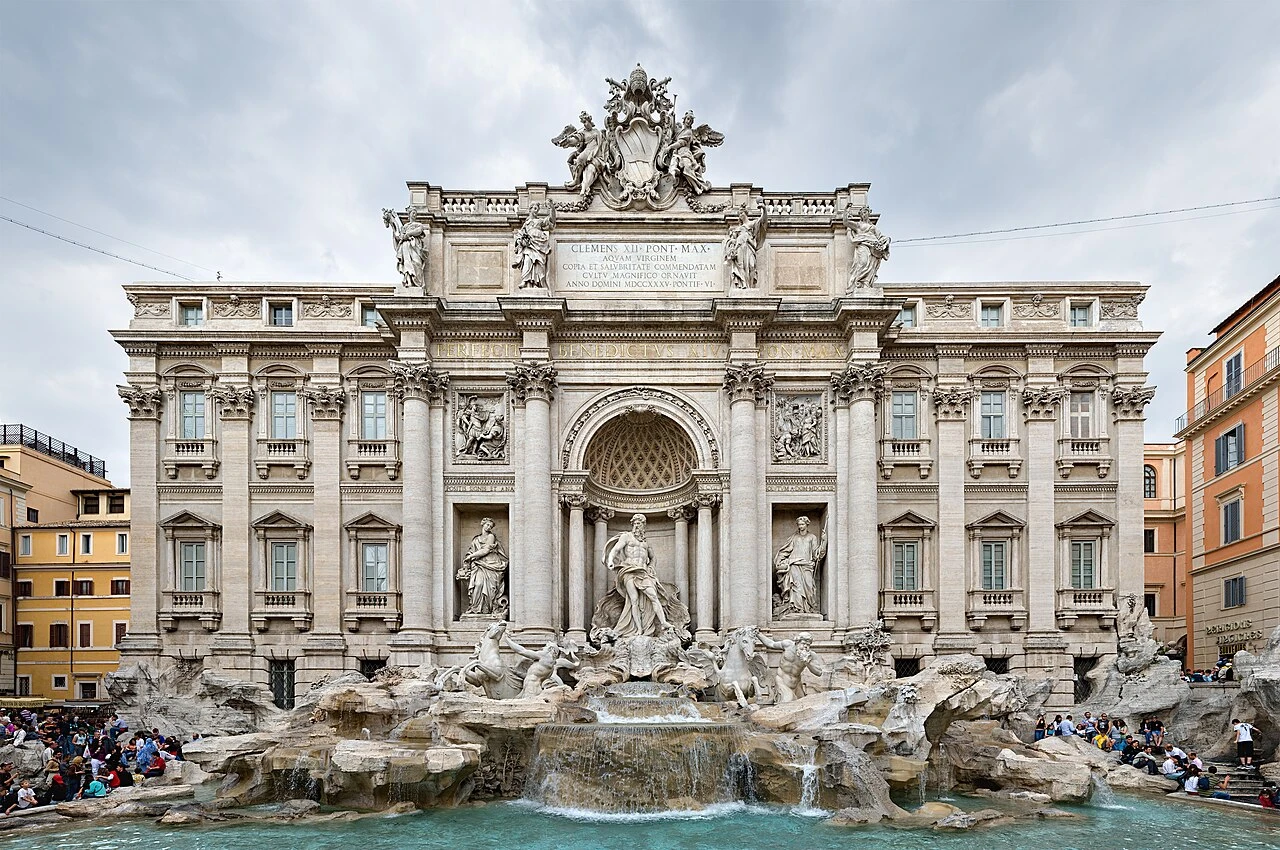
Fontana di Trevi
Content & sources
Photo: Diliff · CC BY 3.0
Rome