Stanza · Audio guide
Chiesa di Santa Maria della Pace Audio Guide
A place to remember. A story to take with you.
Santa Maria della Pace is a Catholic church located in Rome, Italy, near Piazza Navona. It is part of a conventual structure that includes the Chiostro del Bramante and is currently devoted to the people of…
Download Stanza, then search for “Chiesa di Santa Maria della Pace”.
About the tour
One guide. Your kind of visit.
Santa Maria della Pace is a Catholic church located in Rome, Italy, near Piazza Navona. It is part of a conventual structure that includes the Chiostro del Bramante and is currently devoted to the people of Chile.
Ready when you are.
- 01Get the free Stanza app.
iOS & Android
- 02Find your guide.
“Chiesa di Santa Maria della Pace”
- 03Download before you go.
Works offline
Audio guide / 9 narrated stops
Inside the guide
Get to know a few of the stories before you go. Open a stop to read more.
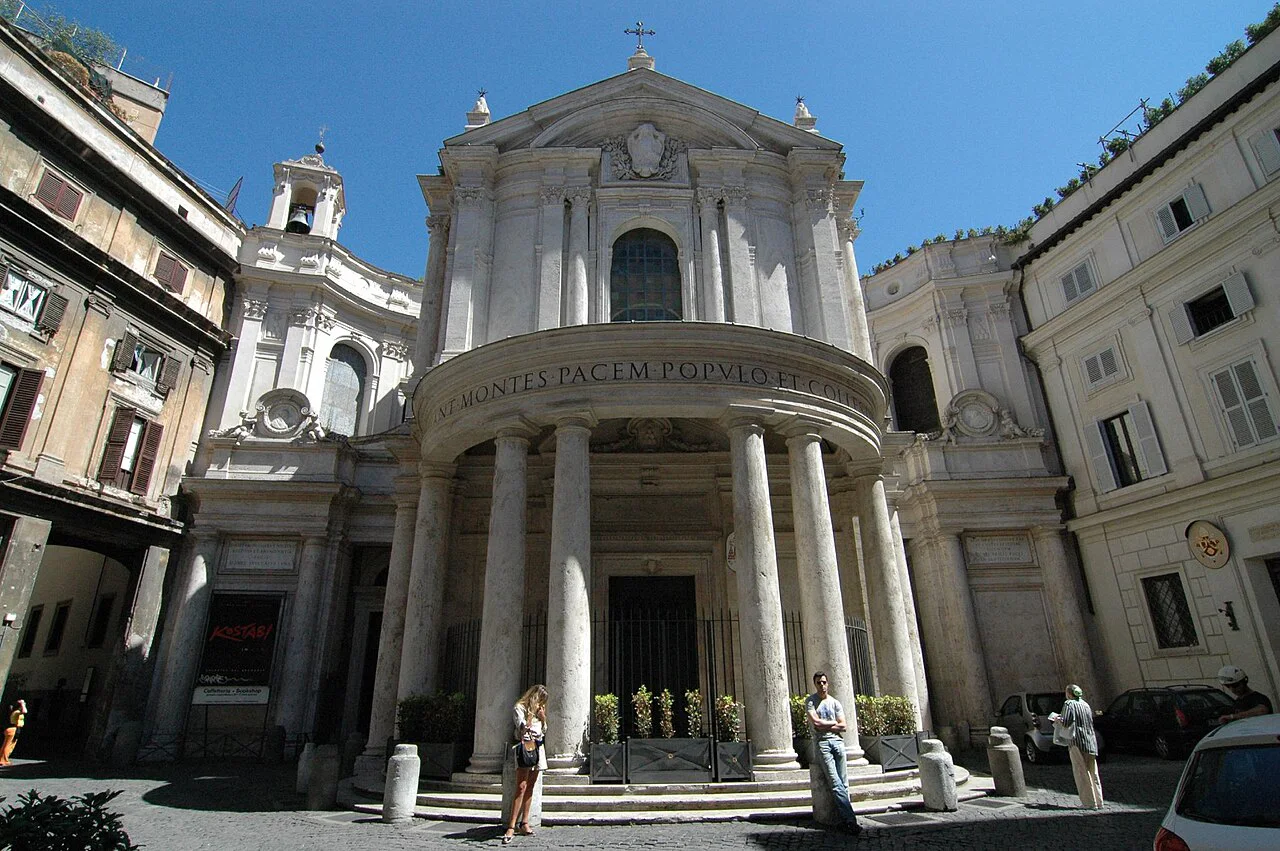
01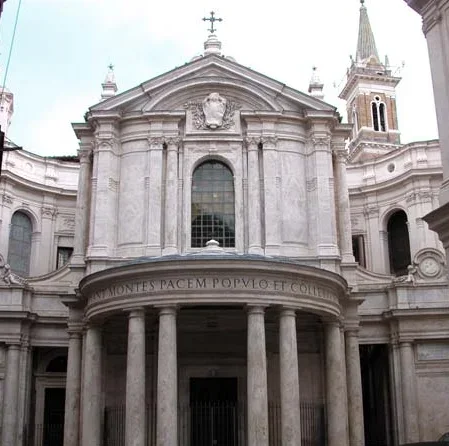 Piazza della Pace and Cortona's Theatrical Façade
Santa Maria della Pace: The Church of Peace
Welcome to Santa Maria della Pace, a small church with a large story, not far from Piazza Navona. In 1482 Pope Sixtus IV raised a new church here, dedicated to Mary as Our Lady of Peace. The vow behind it is told in full at the high altar. The name of the original designer is lost. Baccio Pontelli has been proposed, but never proved. For over a century and a half it remained a modest fifteenth-century building. Then in 1656 Pope Alexander VII handed it to Pietro da Cortona, who worked on it until 1667. Cortona demolished several houses to open up the tiny, trapezoidal piazza, and pushed the church forward to fill almost all of it. The semicircular portico juts out between two concave wings, like the front of a theatre stage. Those curving forms hide the neighbouring buildings and stretch the façade's apparent breadth. A small intervention is made to look monumental. It remains one of the great set pieces of Roman Baroque.
Photo: Justgoing · CC BY-SA 4.0
02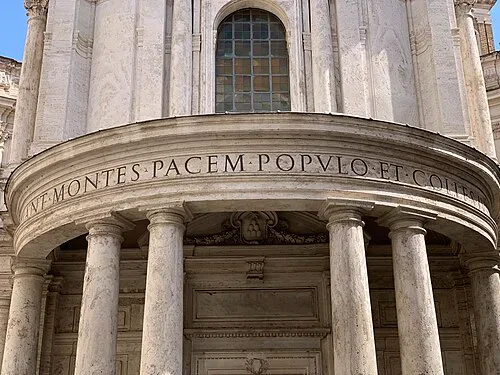 Piazza della Pace and Cortona's Theatrical Façade
The Portico Frieze and the Chigi Emblems
The curved frieze running around the portico carries a line from Psalm 72: Suscipiant montes pacem populo, et colles iustitiam. 'The mountains shall bring peace to the people; and the hills, justice.' The mountains are no accident. They point to the peaks on the coat of arms of Pope Alexander VII, born a Chigi, and to the benefits his reign was meant to bring. Oak leaves, another emblem of the Chigi family, appear on the façade as well. Cortona even had the curved travertine panels on the upper façade cut so that their graining matches across the curves, an unusual way to use that stone. A pope's patronage, written straight into the architecture.
Photo: Chabe01 · CC BY-SA 4.0
03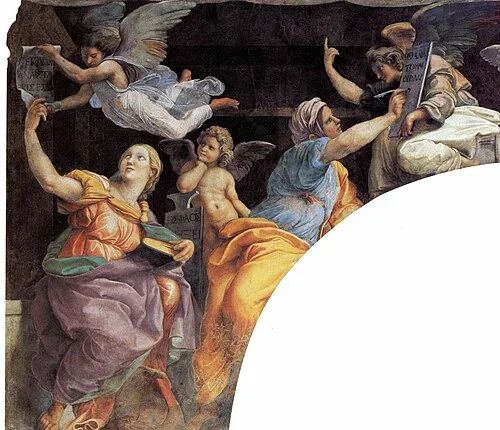 The Chigi Chapel and Raphael's Sibyls
Raphael's Sibyls in the Chigi Chapel
The Chigi name already met on the façade returns inside, at the first altar on the right. Agostino Chigi, the papal banker, paid for this chapel, and its architecture is attributed to Raphael himself. Above the arch, Raphael painted his Sibyls in 1514. Four prophetesses of the ancient world sit here, the Cumaean, the Persian, the Phrygian and the Tiburtine, each listening as an angel brings instruction from heaven. The idea joins pagan antiquity to Christian revelation, women of the old world made witnesses of what was to come. Higher up, the four Prophets were painted by Timoteo Viti after Raphael's own drawings, following the master's death. Over the altar, a bronze relief of the dead Christ carried by angels is the work of Cosimo Fancelli, who also made the two lateral saints in collaboration with Ercole Ferrata.
Listen in the appRaphael · Public domain
04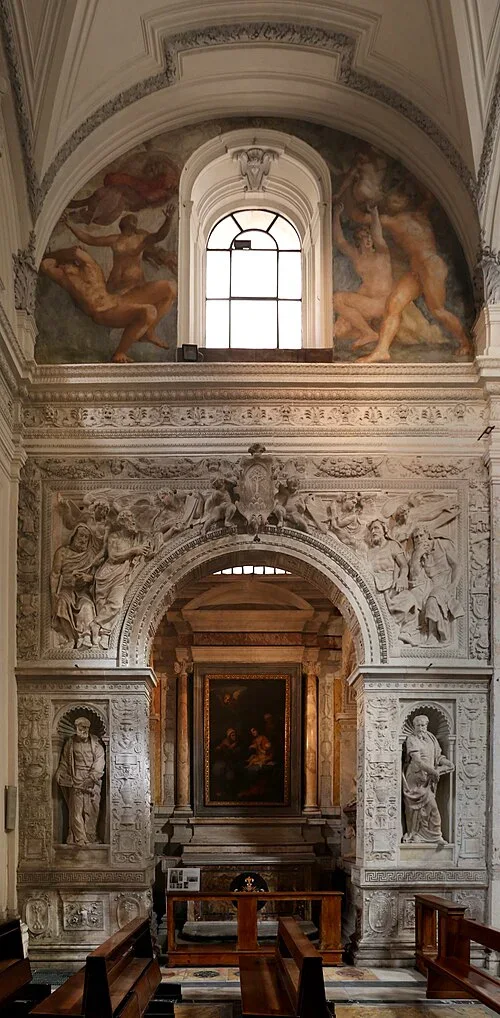 The Cesi and Ponzetti Chapels
The Cesi Chapel: Mannerist Invention
The second chapel on the right changes the mood entirely. Antonio da Sangallo the Younger designed the Cesi Chapel, and Simone Mosca covered its outer arch with very fine Renaissance carving. Into the lunettes above, Rosso Fiorentino painted two small frescoes, the Creation of Eve and the Original Sin. Their restless, muscular figures announce the Mannerist taste for invention over calm. In the niches stand Vincenzo de' Rossi's statues of Saints Peter and Paul. Reclining figures of Angelo Cesi and his wife Francesca Carduli Cesi rest on their tombs, carved around the middle of the sixteenth century. Even the sphinxes of the chapel are attributed to Mosca.
Listen in the appPhoto: Sailko · CC BY 3.0
05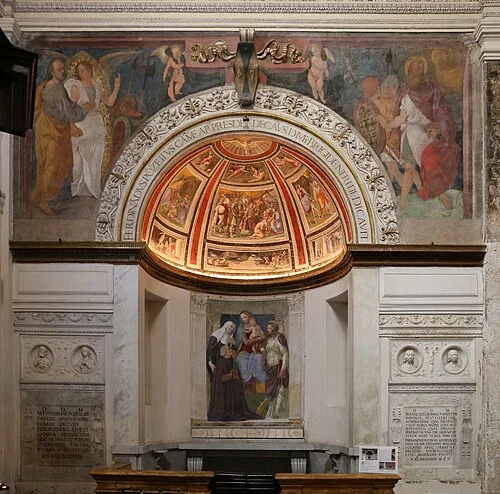 The Cesi and Ponzetti Chapels
The Ponzetti Chapel and the Children's Tomb
The first chapel on the left holds the church's most touching memorial. In November 1505, plague took Beatrice and Lavinia Ponzetti on the same day, sisters of six and eight. A solemn burial of this kind was very rare for children at the time. Their uncle, Cardinal Ferdinando Ponzetti, dean of the Apostolic Camera, set up their epitaph in deep grief. It tells that the girls were born in Naples and raised in Rome, and calls them his little souls, his delights; with them, he wrote, he lost his great consolation and hope. The same chapel glows with early Renaissance frescoes by Baldassarre Peruzzi, a man better known as an architect. His altarpiece of 1516 shows the Madonna with Saints Brigida and Catherine, and the cardinal himself kneeling among them.
Listen in the appPhoto: Sailko · CC BY 3.0
06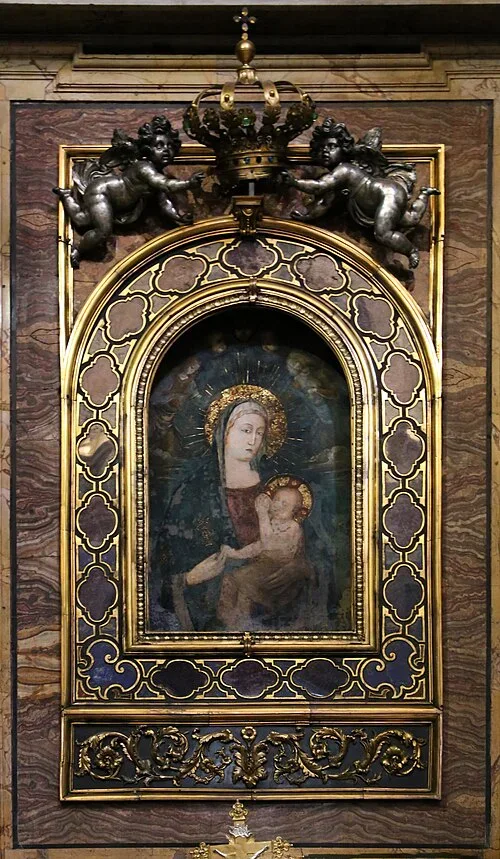 The High Altar and Octagonal Dome
The Miraculous Icon and Maderno's High Altar
The image at the high altar is the reason this church exists. It shows the Madonna holding the Child, a venerable painting set deep within a gilded frame, crowned and flanked by angels. The story goes that in 1480, in the older chapel of Sant'Andrea de Aquarizariis that stood here, this image of the Virgin was seen to bleed. Pope Sixtus IV was struck by the event. He had his own reasons to seek heaven's favour, since the Pazzi conspiracy had, in some way, touched him, and many feared it would drag Italy into war. He vowed that if peace held, he would build a great church on this spot in Mary's honour. The new church rose on the chapel's foundations. In 1614 Carlo Maderno designed the high altar expressly to enframe the icon, giving the miracle its setting.
Listen in the appPhoto: Sailko · CC BY 3.0
07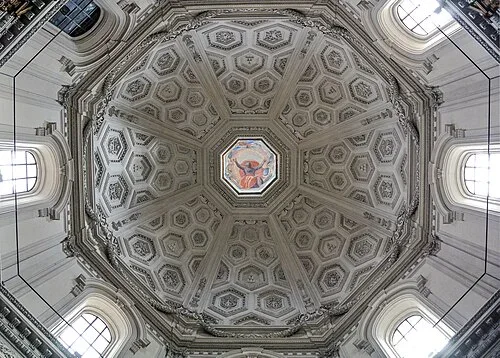 The High Altar and Octagonal Dome
The Octagonal Dome
The short nave, vaulted with a cruciform vault, leads the eye to the tribune and the cupola above. Inside the dome, Pietro da Cortona worked out a new arrangement: octagonal coffering, and a series of ribs radiating from the lantern. Combining these two kinds of dome decoration was an early experiment here. Gianlorenzo Bernini borrowed it later for his own churches at Ariccia and Castelgandolfo. Ideas moved quickly among the architects of Baroque Rome, and one dome's solution became the next architect's vocabulary.
Listen in the appPhoto: Cm9462 · CC BY-SA 4.0
08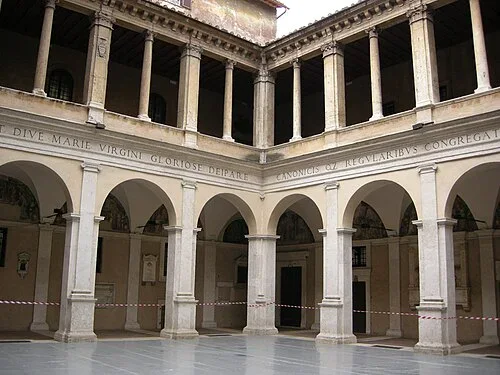 Bramante's Cloister
: The Ground Arcade
Beside the church lies the cloister that Donato Bramante built between 1500 and 1504 for Cardinal Oliviero Carafa, his first work in Rome. After the theatre of the façade, the contrast is striking. The ground floor is severe and almost bare of ornament: shallow Ionic pilasters set against an arcade of round arches, in the manner of classical Roman architecture. Bramante had come from Milan, where he had favoured rich Lombard decoration; here he stripped everything back. Sixteen piers carry the arcade, the number Vitruvius celebrated as mathematically perfect, and a square modular plan governs the whole cloister. Every bay repeats the same calm measure.
Listen in the appPhoto: Sailko · CC BY-SA 3.0
09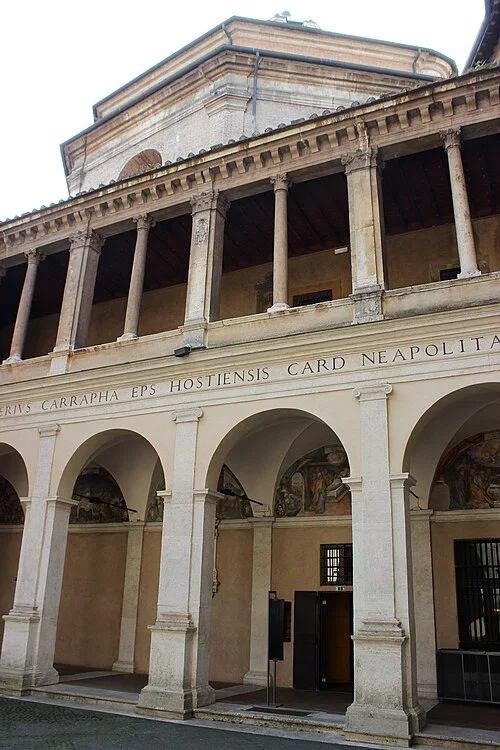 Bramante's Cloister
The Upper Loggia and the Meaning of the Pace
The upper loggia rewrites Bramante's ground-floor rules. The arcade continues vertically with the same pilasters below, but now free-standing columns stand between each arch span, doubling the rhythm of the openings. The upper level stands exactly one quarter shorter than the ground arcade, a proportion drawn from Vitruvius. Above the cloister wing, the dome of the church rises into view. The former monastery is now in secular use, with an exhibition space and a coffee bar on the upper level, and the church itself has become one of Rome's national churches, devoted to the people of Chile. A vow of peace made in 1480 gave rise to this complex, where Renaissance measure and Baroque theatre still sit side by side.
Listen in the appMiguel Hermoso Cuesta · CC BY-SA 4.0
Chiesa di Santa Maria della Pace
Frequently asked questions
How much does the guide cost?
Free app download. Listed guide price: $0.99. Guide price shown in the app. Audio guide only. Venue admission is separate.
Can I listen without internet?
Yes. Download the guide’s audio, images, and maps in the app before your visit. Your downloaded content is then available offline.
Can I listen in my language?
This audio guide is available in 15 languages, including English.
Do I need to follow a schedule?
No. This is a self-guided experience. Choose your stops, pause whenever you like, and return to a story at your own pace.
At your own pace
Explore Chiesa di Santa Maria della Pace.
Download Stanza, then search for “Chiesa di Santa Maria della Pace”.
Free app download · Guide price shown in the app
Keep exploring
Nearby audio guides
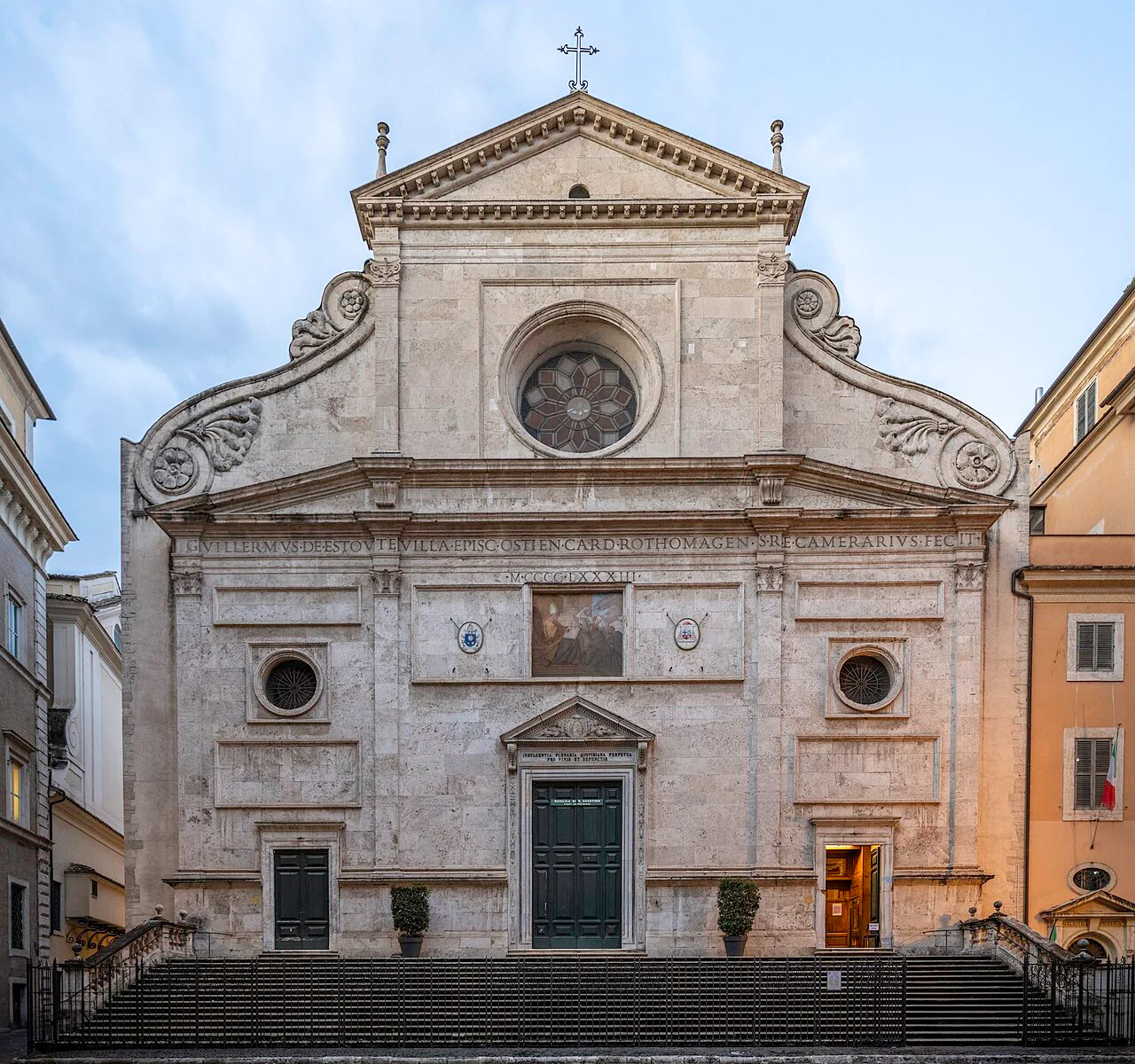
Rome · 1 km
Basilica di Sant'Agostino in Campo Marzio
Content & sources
Photo: Wilfredor · CC0
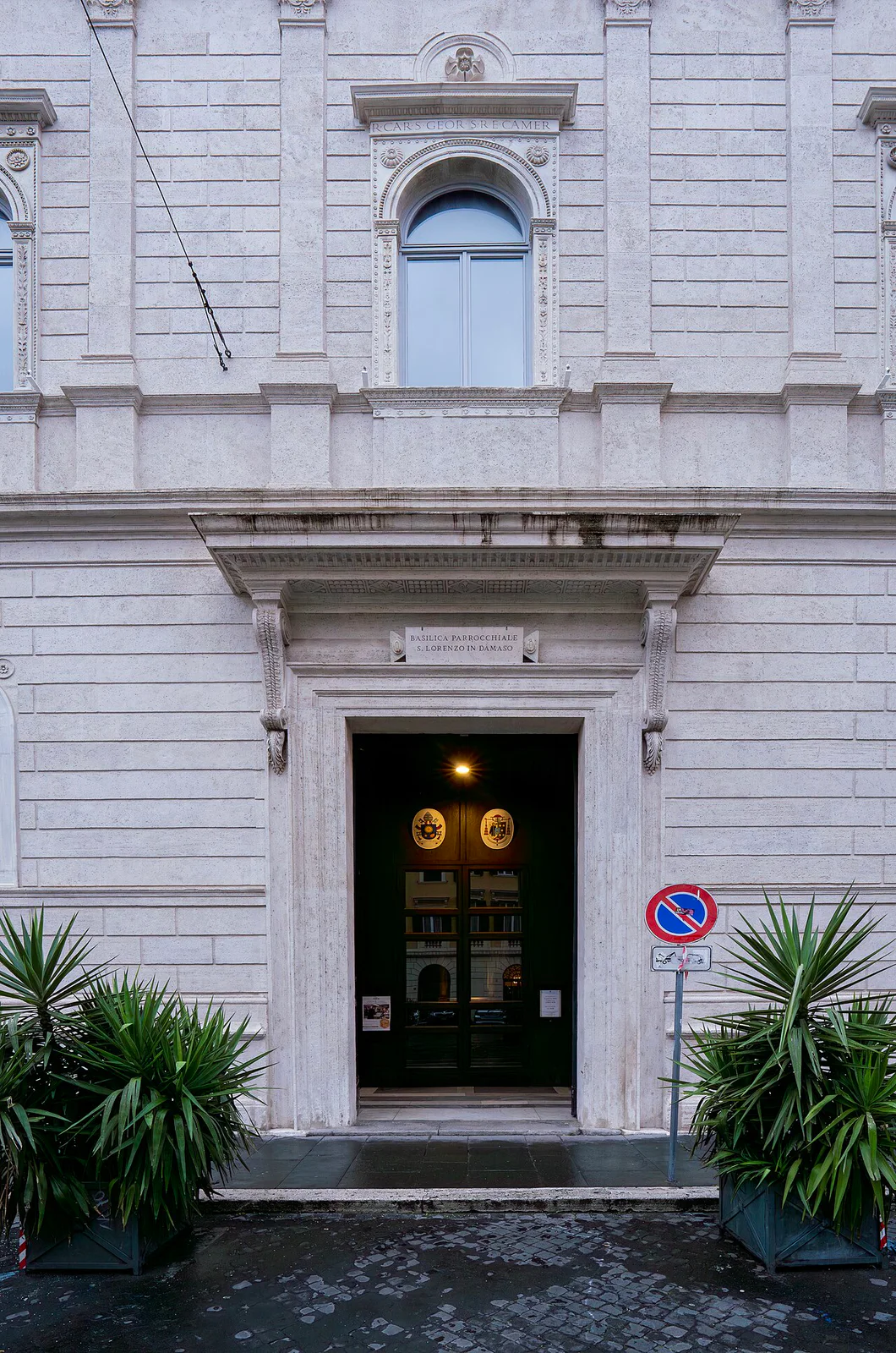
Rome · 1 km
Basilica di San Lorenzo in Damaso
Content & sources
Photo: Fiat 500e · CC BY 4.0
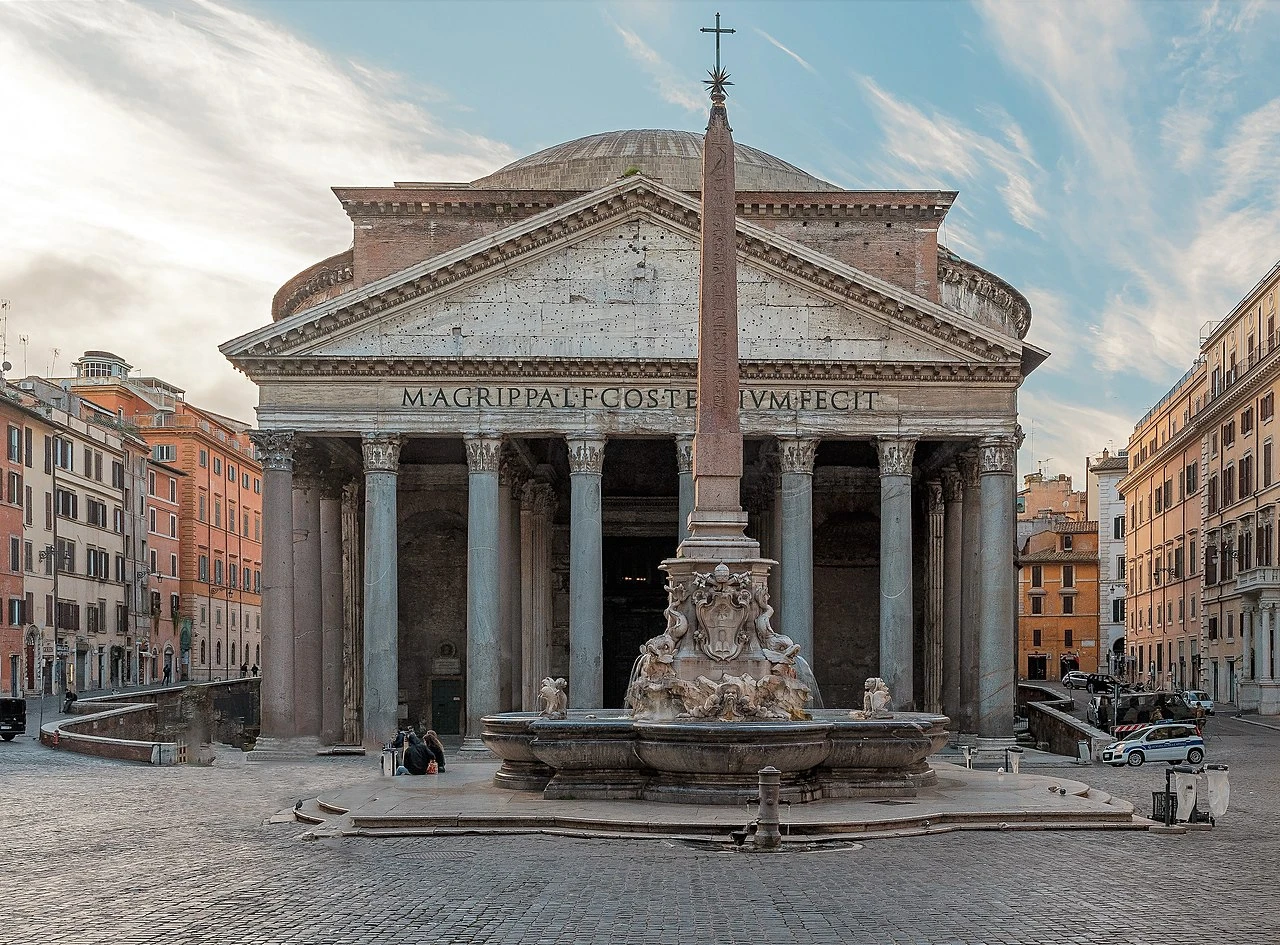
Rome · 1 km
Pantheon
Content & sources
Rabax63 · CC BY-SA 4.0
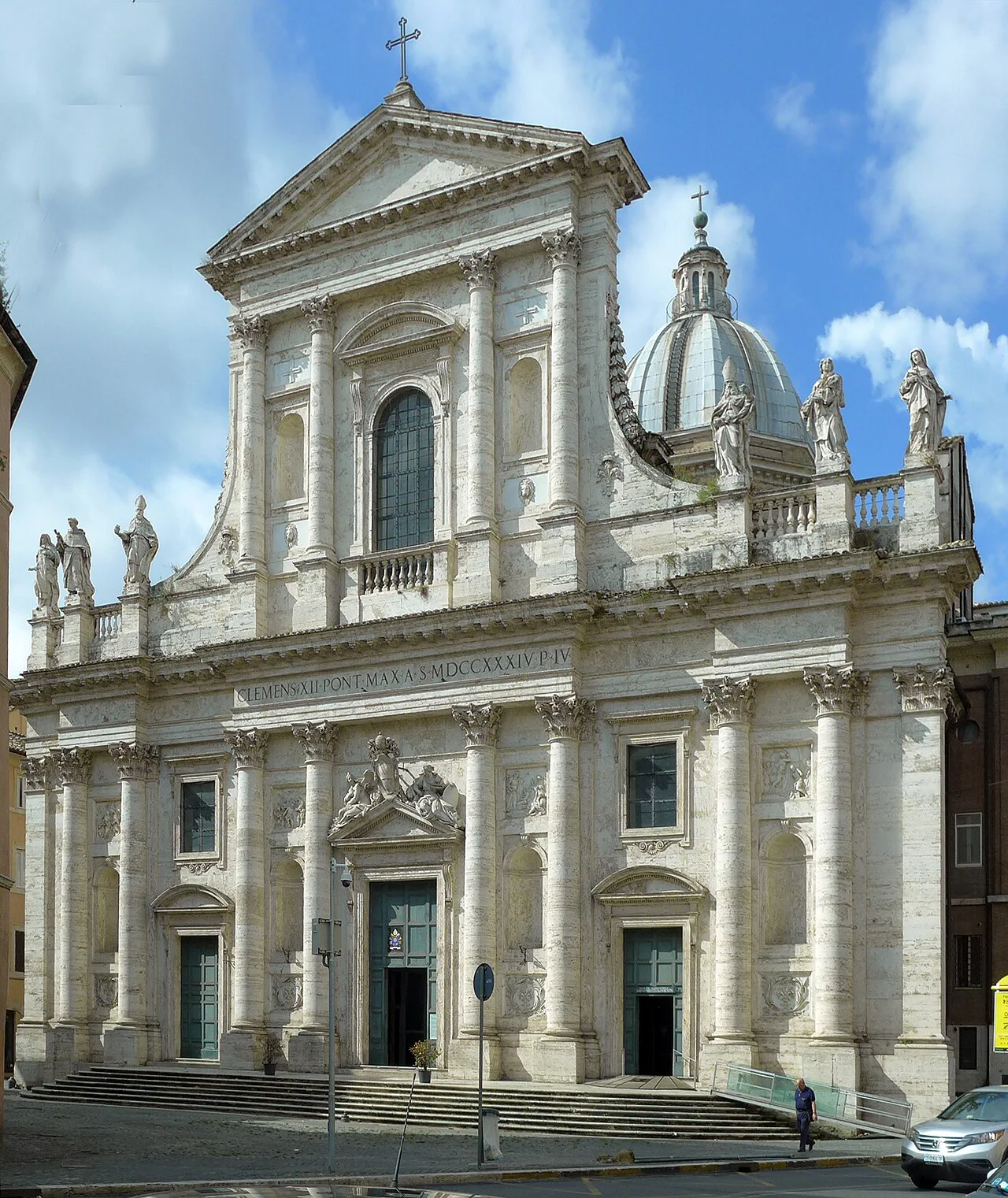
Rome · 1 km
Basilica di San Giovanni Battista dei Fiorentini
Content & sources
Photo: Peter1936F · CC BY-SA 4.0