Stanza · Audio guide
Basilica di San Paolo fuori le mura Audio Guide
A place to remember. A story to take with you.
The Papal Basilica of Saint Paul Outside the Walls is one of Rome's four major papal basilicas. It is also one of the city's Seven Pilgrim Churches and serves as the conventual church of the adjacent…
Download Stanza, then search for “Basilica di San Paolo fuori le mura”.
About the tour
One guide. Your kind of visit.
The Papal Basilica of Saint Paul Outside the Walls is one of Rome's four major papal basilicas. It is also one of the city's Seven Pilgrim Churches and serves as the conventual church of the adjacent Benedictine abbey.
Ready when you are.
- 01Get the free Stanza app.
iOS & Android
- 02Find your guide.
“Basilica di San Paolo fuori le mura”
- 03Download before you go.
Works offline
Audio guide / 13 narrated stops
Inside the guide
Get to know a few of the stories before you go. Open a stop to read more.
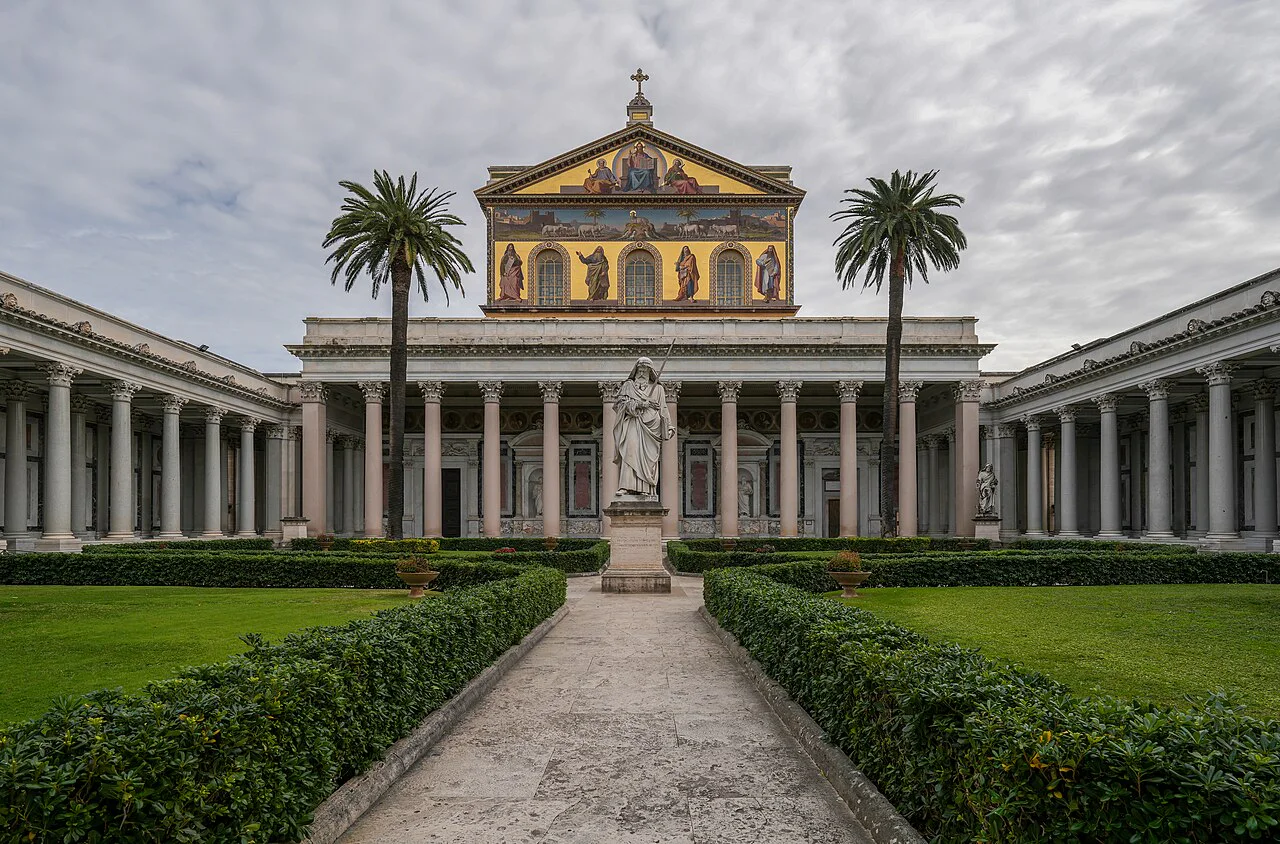
01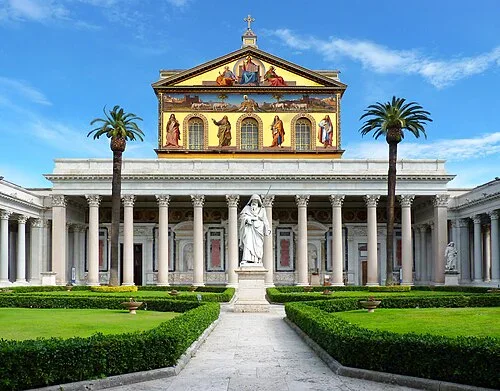 The Quadriporticus and Statue of Saint Paul
The Quadriporticus and West Facade
Welcome to the Basilica of Saint Paul Outside the Walls, one of Rome's four great papal basilicas. The name sounds strange for a church, and it is a clue. Rome's ancient Aurelian Walls ring the city, and this basilica was raised beyond them, over the burial place of Saint Paul the Apostle. Pilgrims have crossed the city to his grave since the earliest Christian centuries, and the basilica counts among Rome's Seven Pilgrim Churches. The broad courtyard here is a quadriporticus, a colonnade running on all four sides. Palms and clipped hedges fill its garden, with a colossal marble figure of Paul at the centre. Above the entrance, the facade blazes with gold mosaics of Christ and his saints. Though it lies on Italian soil, the basilica belongs to the Holy See, and Benedictine monks have kept a life of prayer here for centuries.
Photo: Justinawind · CC BY-SA 4.0
02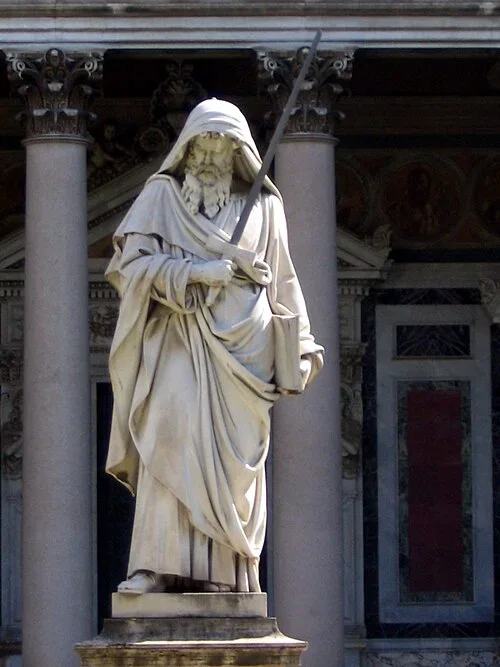 The Quadriporticus and Statue of Saint Paul
Statue of Saint Paul with Sword
The man in marble carries two things, and both tell his story. The book stands for the letters of Paul the Apostle, which spread his teaching across the young Christian world. The sword recalls his execution in Rome as a martyr. According to tradition, his followers buried him about three kilometres from the place of his death, in a burial ground along the Ostiense Way. The land belonged to a Christian woman named Lucina, and a memorial was raised over the grave. It quickly became a place of veneration. In the early fourth century, the emperor Constantine built a basilica on that very spot. Pope Sylvester consecrated it in 324, and this whole complex exists because of the grave beneath it.
Photo: Mac9 · CC BY-SA 3.0
03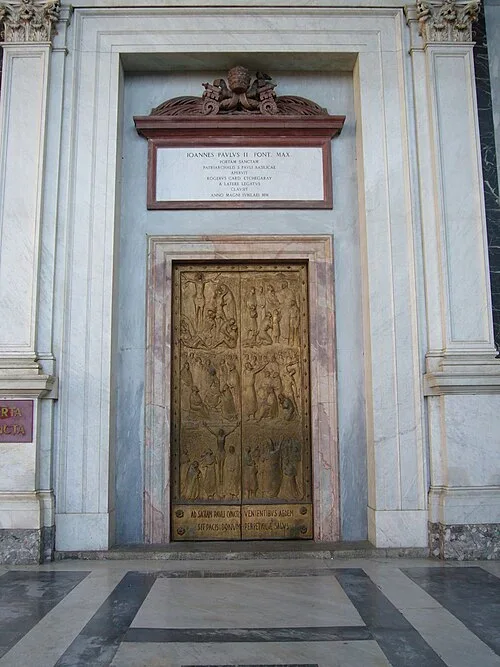 The Portico and Sacred Portals
The Holy Door
Every Jubilee, Rome's pilgrims walk from church to church, and at each of the great basilicas one door is opened for the occasion. This is the Holy Door, sealed at all other times, cast in bronze by the sculptor Enrico Manfrini for the Jubilee of 2000. Crossing its threshold is itself an act of pilgrimage. In October 2025 it opened for an unusual visitor. King Charles III of the United Kingdom, Supreme Governor of the Church of England, entered through it during his state visit to the Holy See. At an ecumenical celebration led by the abbot, Donato Ogliari, the king was made Royal Confrater of the Benedictine abbey. His throne-like stall, inscribed with the words Ut unum sint, that they may be one, will wait in the apse for him and his successors.
Listen in the appPhoto: Lalupa · CC BY-SA 3.0
04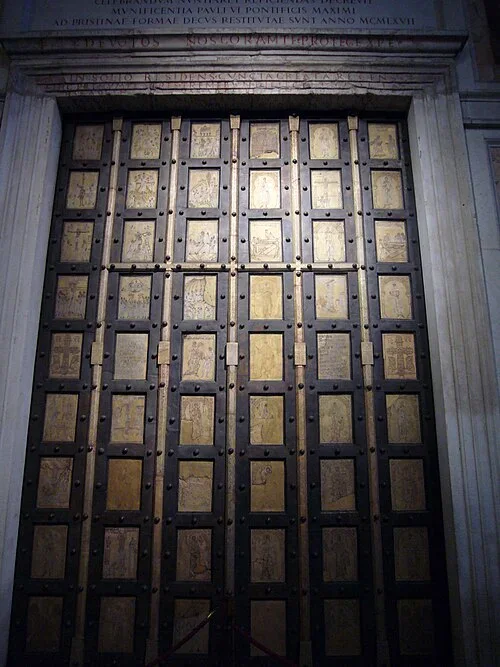 The Portico and Sacred Portals
The Byzantine Bronze Door
Behind the Holy Door hangs a far older door, and it came a very long way. It was commissioned in 1070 by Pantaleone, a rich merchant of Amalfi who lived in Constantinople, and by tradition it was cast there by Constantinopolitan artists. Fifty-six small bronze panels fill its surface, each engraved with an episode from the lives of Christ and the apostles. Pantaleone had a prayer inscribed on the doors as well, asking that the doors of life be opened to him. When fire swept through the basilica centuries later, this door was among the precious things that came through. It is one of the few medieval works still in place from the old church.
Listen in the appPhoto: Lalupa · CC BY-SA 3.0
05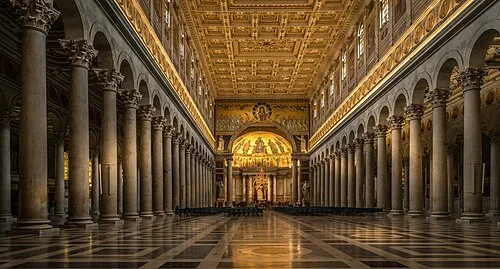 The Great Nave and Alabaster Windows
The Great Nave
Five aisles run the length of this church, lined with eighty columns of granite, and only Saint Peter's is larger in Rome. Nearly all of it is younger than it looks. On 15 July 1823, a fire broke out near the roof and burned the basilica almost completely. By the traditional account, a workman repairing the copper gutters started it; more recent studies question that explanation. What is not disputed is the loss. Alone among the churches of Rome, this building had kept its original character for 1435 years, since its great rebuilding in the late fourth century. Pope Leo XII appealed to the whole world for help with an encyclical called Ad plurimas, and rulers everywhere answered. The architects Pasquale Belli and then Luigi Poletti directed the rebuilding, which took decades. In 1854 Pope Pius IX reconsecrated the finished church in the presence of fifty cardinals.
Listen in the appHerbert Weber, Hildesheim · CC BY-SA 4.0
06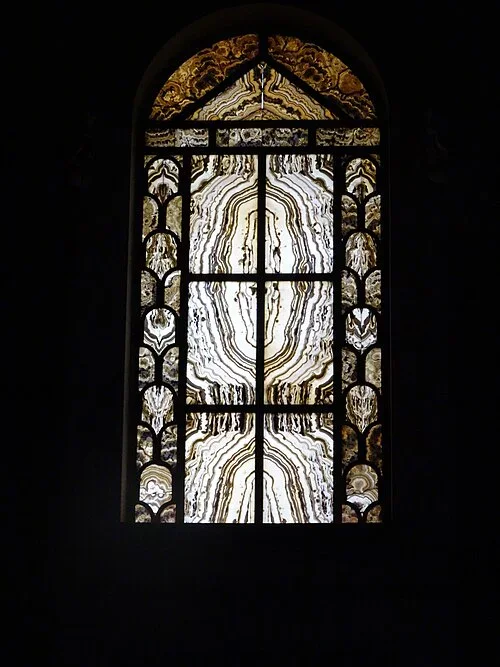 The Great Nave and Alabaster Windows
The Alabaster Window
The soft light filling the nave comes through stone, not glass. The windows may look like stained glass at first, but they are panels of translucent alabaster, thin enough to let the day shine through. They are also souvenirs of a remarkable act of diplomacy. Foreign rulers answered that appeal by sending precious materials rather than money. Muhammad Ali Pasha, the viceroy of Egypt, sent columns of alabaster. The Emperor of Russia donated malachite and lapis lazuli, which were set into the altar fronts. A church rebuilt by one pope's appeal was finished with gifts from Cairo and Saint Petersburg.
Listen in the appPhoto: Hugo DK · CC BY-SA 4.0
07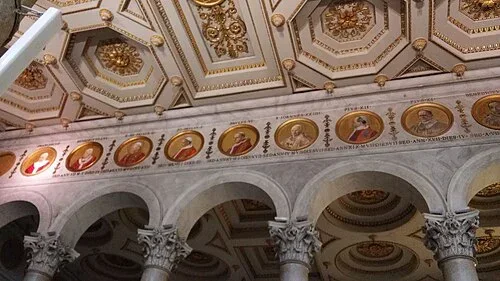 The Papal Portrait Frieze
A ribbon of round portraits runs high along the nave walls, one pope after another, all the way back to Saint Peter. In the old basilica these portraits formed a painted frieze above the columns, and at one point the series stopped with Pope Vitalian, who had reigned more than a thousand years earlier. In the eighteenth century, Pope Benedict XIV commissioned the painter Salvatore Manosilio to continue the line. After the fire, the whole sequence was recreated in mosaic, as it appears today. Then there is the legend. The story goes that when no space is left for a new medallion, Christ will return. Blank medallions were reportedly added to the series so that it never runs out.
Listen in the appPhoto: Ilamukky · CC BY-SA 4.0
08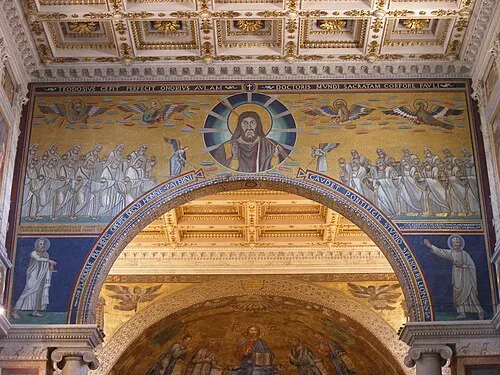 The Triumphal Arch of Galla Placidia
The Triumphal Arch Mosaic
The great arch framing the high altar carries the oldest decoration in the building. Its mosaics date from the fifth century, paid for by the empress Galla Placidia and made at the time of Pope Leo I, as an inscription in the lower section attests. They show the Apocalypse of Saint John. Christ appears at the centre, flanked by the twenty-four elders of the Apocalypse, with the flying symbols of the four Evangelists above. Peter and Paul stand at the right and left of the arch. Paul points downwards, probably towards his tomb below. The mosaics are original, though heavily reworked over the centuries, and they survived the disaster that destroyed so much around them.
Listen in the appPhoto: Dnalor 01 · CC BY-SA 3.0 at
09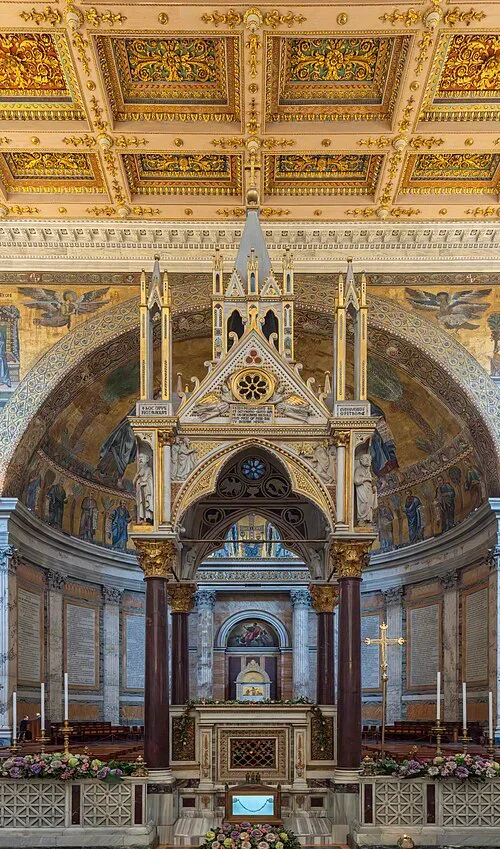 The High Altar, Ciborio, and Confession
The Ciborium and the Tomb of Saint Paul
A marble canopy rises on four columns over the high altar, carved in Gothic style by Arnolfo di Cambio in 1285 for the abbot Bartolomeo. Its red porphyry columns were replaced during the nineteenth-century restoration, but the canopy itself came through the fire largely intact. Niches at its corners hold figures of Paul, Peter, Benedict and Timothy. Beneath it, a few steps down, lies the reason for the whole basilica: a sarcophagus under a marble slab inscribed Paulo Apostolo Mart, to Paul the apostle and martyr. The slab has three holes, and a pipe runs from the round one into the tomb, a Roman custom for pouring perfumes to the dead. From 2002 to 2006, Vatican archaeologists excavated beneath the altar, after pilgrims in the Jubilee of 2000 had complained they could not visit the tomb. The sarcophagus was left in place, with one long side left visible. In 2009, Pope Benedict XVI announced that radiocarbon dating of bone fragments from inside pointed to the first or second century. Ulderico Santamaria, head of the Vatican Museums' diagnostics laboratory, urged caution: the dating, he said, neither confirms nor invalidates the relics' traditional identity.
Listen in the appPhoto: StPaul.jpg · CC BY 4.0
10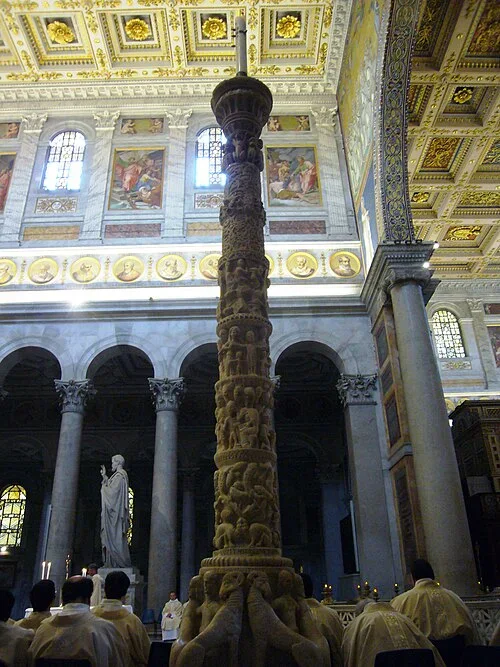 The Presbytery: Paschal Candlestick and Apse Mosaic
The Paschal Candelabrum
Near the altar rises a carved marble column taller than any man, twisted with figures and foliage from top to base. It is the paschal candelabrum, made in 1170 by Pietro Vassalletto together with Nicolò D'Angelo. Bands of scenes from the life of Jesus alternate with floral motifs up its length. Its job is liturgical: it holds the paschal candle, the great candle lit at Easter to proclaim the resurrection, which burns in the church through the season. It is another work that predated the fire and lived through it. The name Vassalletto is worth remembering here, because the family's finest work waits south of the transept.
Listen in the appPhoto: Lalupa · CC BY-SA 3.0
- 11
The Apse Mosaic
The golden Christ in glory, a thirteenth-century design recreated after the fire.
- 12
The Vassalletto Cloister
The thirteenth-century Benedictine cloister, called one of the most beautiful of the Middle Ages.
- 13
Cloister Columns and Mosaic Inlay
Columns set with glass mosaics, and fragments rescued from the destroyed basilica.
Basilica di San Paolo fuori le mura
Frequently asked questions
How much does the guide cost?
Free app download. Listed guide price: $0.99. Guide price shown in the app. Audio guide only. Venue admission is separate.
Can I listen without internet?
Yes. Download the guide’s audio, images, and maps in the app before your visit. Your downloaded content is then available offline.
Can I listen in my language?
This audio guide is available in 15 languages, including English.
Do I need to follow a schedule?
No. This is a self-guided experience. Choose your stops, pause whenever you like, and return to a story at your own pace.
At your own pace
Explore Basilica di San Paolo fuori le mura.
Download Stanza, then search for “Basilica di San Paolo fuori le mura”.
Free app download · Guide price shown in the app
Keep exploring
Nearby audio guides
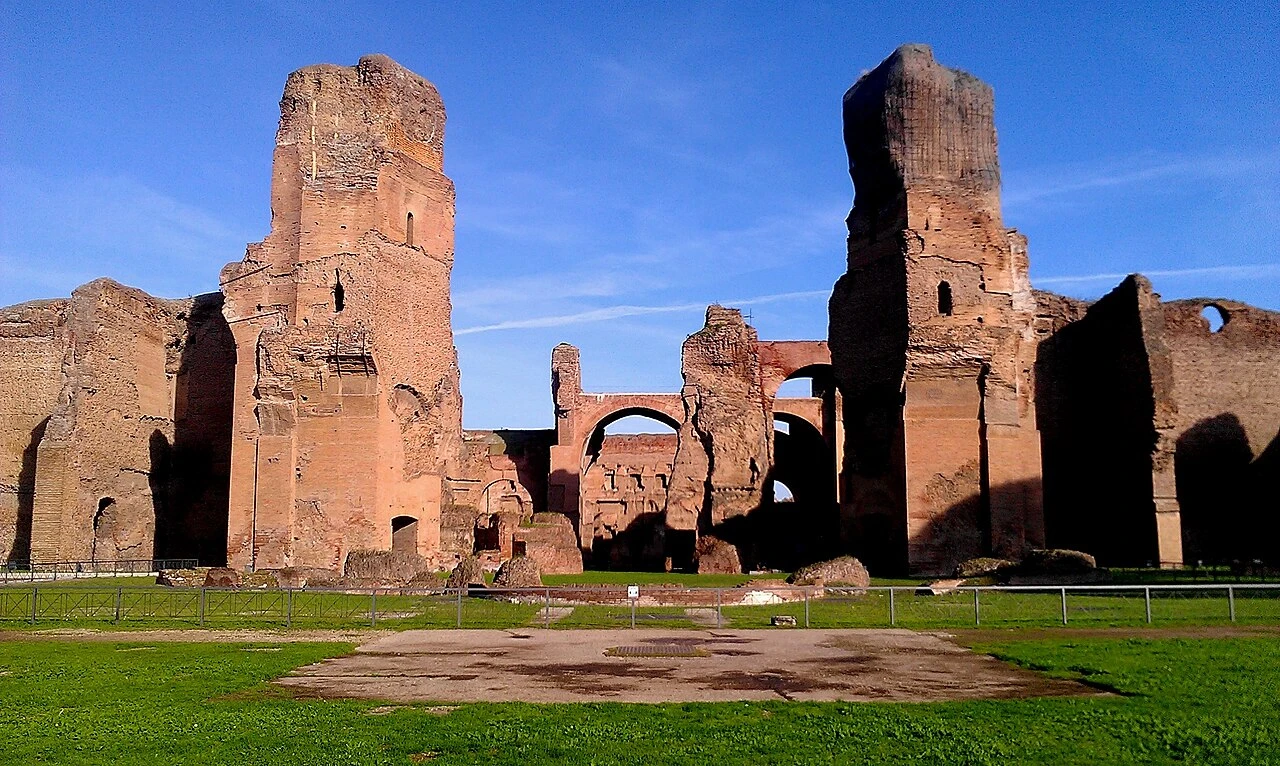
Rome · 3 km
Baths of Caracalla
Content & sources
Ethan Doyle White · CC BY-SA 4.0
Rome · 3 km
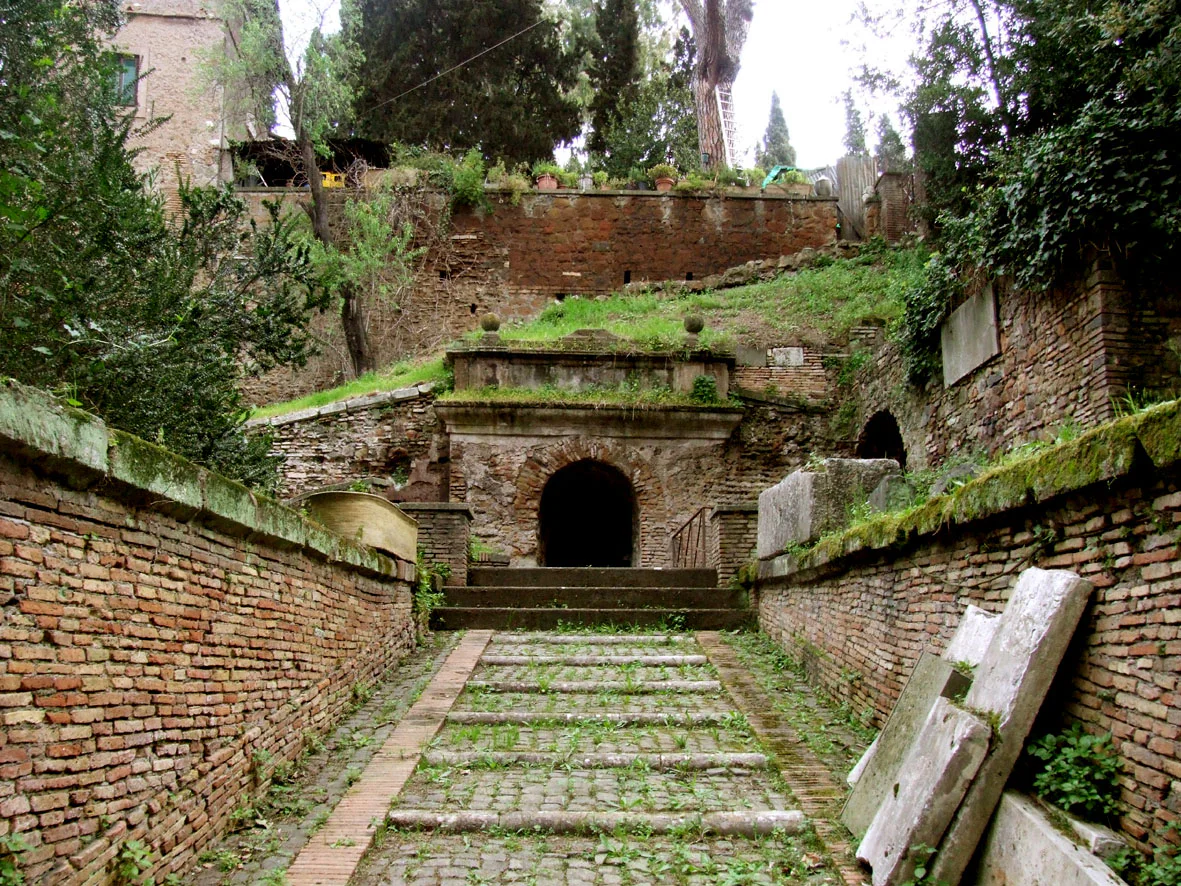
Sepolcro degli Scipioni
Content & sources
Photo: Pippo-b · CC BY-SA 3.0
Rome · 3 km
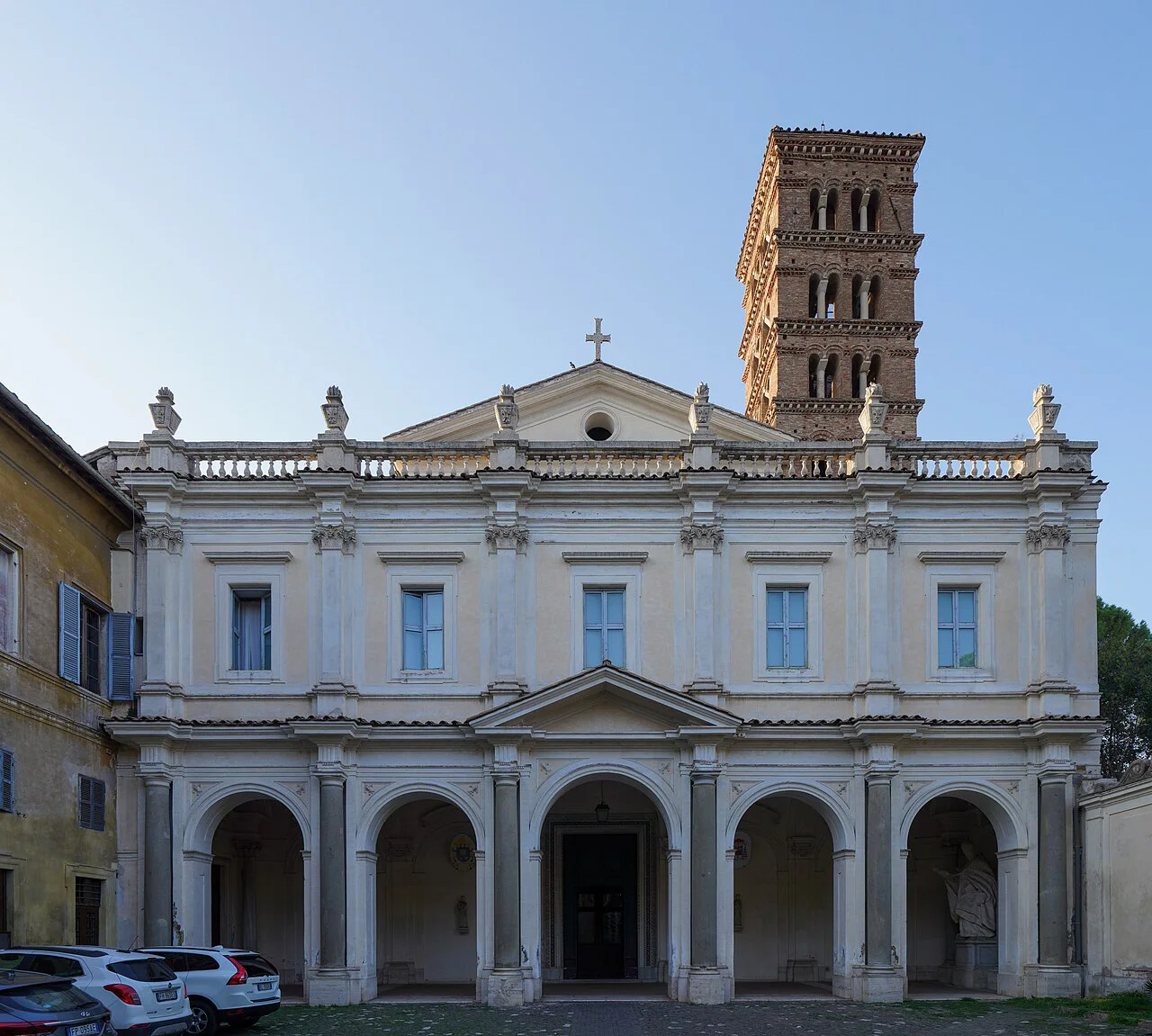
Basilica dei Santi Bonifacio e Alessio
Content & sources
Photo: Merulana · CC BY-SA 4.0
Rome · 3 km
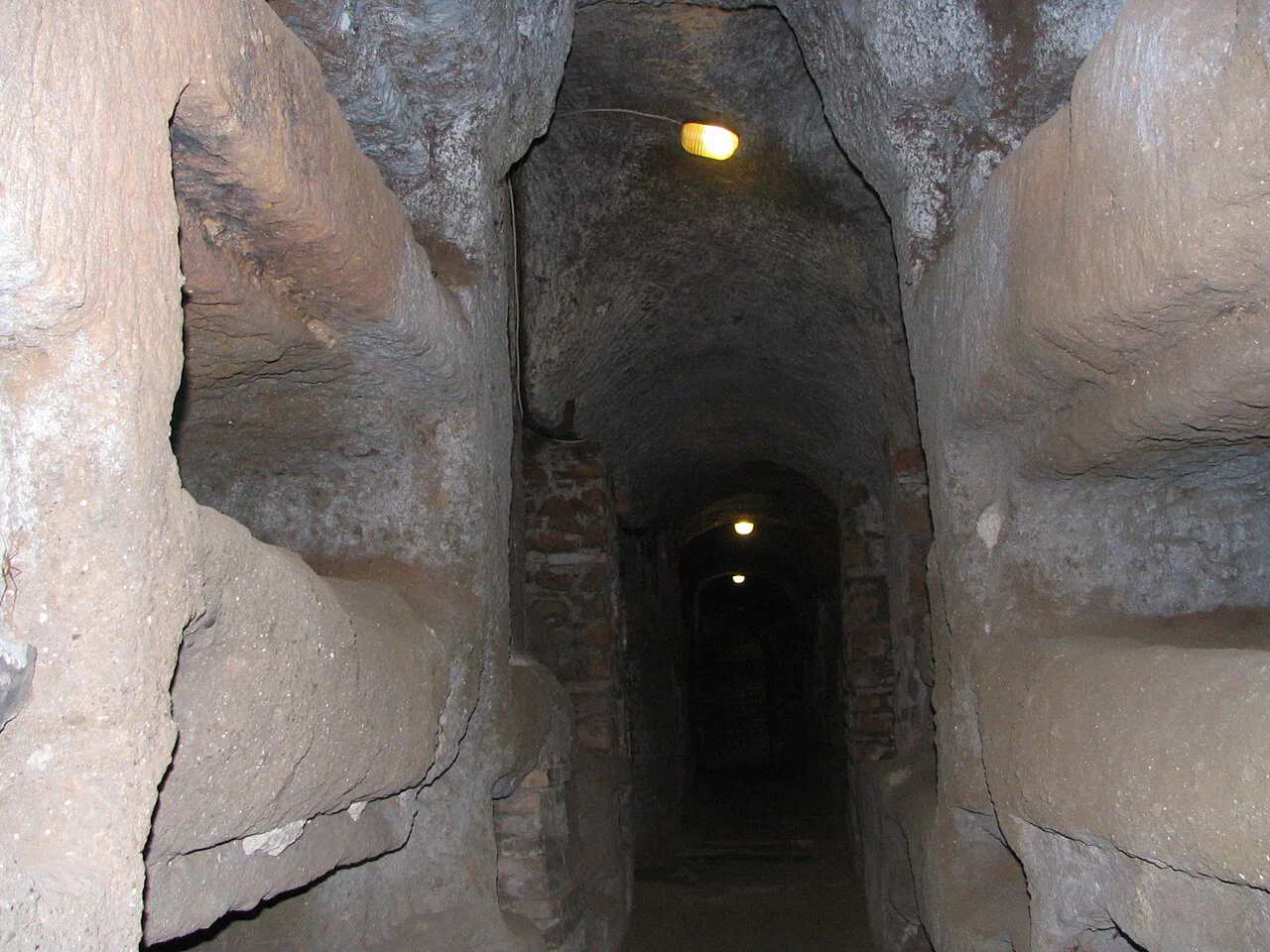
Catacombe di San Callisto
Content & sources
User GerardM on nl.wikipedia · CC BY-SA 3.0