Stanza · Audio guide
Basilica di Santa Cecilia in Trastevere Audio Guide
A place to remember. A story to take with you.
Santa Cecilia in Trastevere is a titular church and minor basilica located in Rome. It is notable for its apse mosaic, frescoes by Pietro Cavallini, Baroque sculpture, and the relics of Saint Cecilia.
Download Stanza, then search for “Basilica di Santa Cecilia in Trastevere”.
About the tour
One guide. Your kind of visit.
Santa Cecilia in Trastevere is a titular church and minor basilica located in Rome. It is notable for its apse mosaic, frescoes by Pietro Cavallini, Baroque sculpture, and the relics of Saint Cecilia.
Ready when you are.
- 01Get the free Stanza app.
iOS & Android
- 02Find your guide.
“Basilica di Santa Cecilia in Trastevere”
- 03Download before you go.
Works offline
Audio guide / 12 narrated stops
Inside the guide
Get to know a few of the stories before you go. Open a stop to read more.
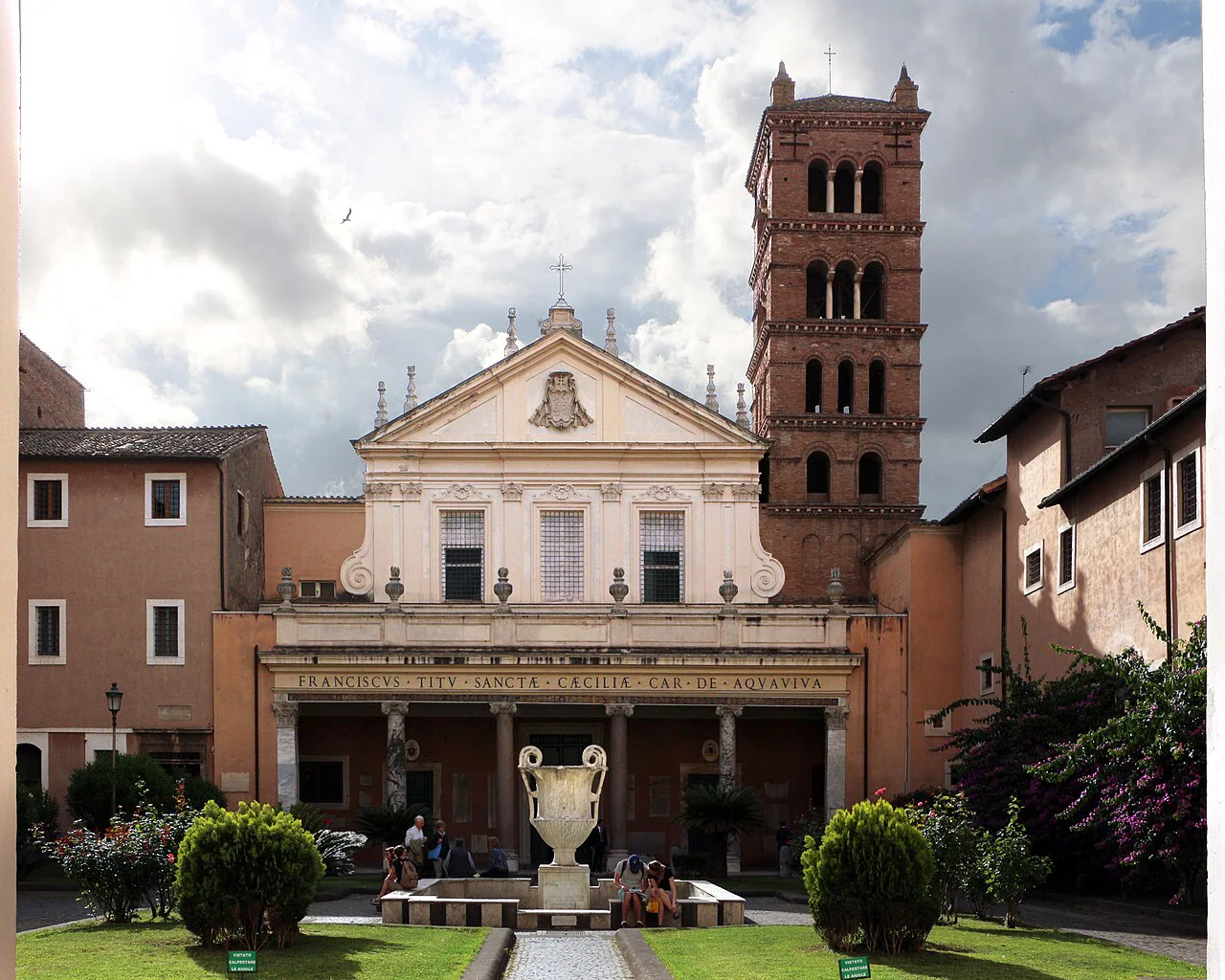
01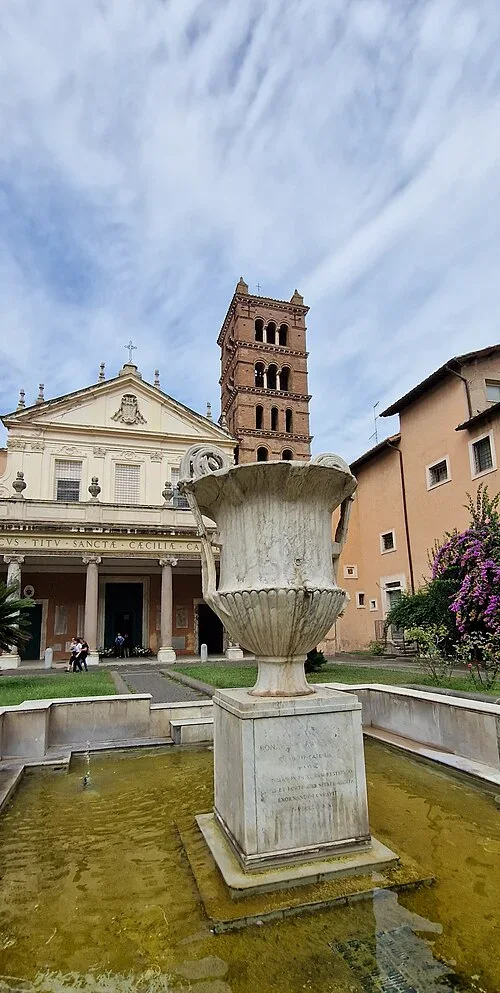 Baroque Entrance Courtyard and Pronaos
Courtyard, Facade and Bell Tower
Welcome to Santa Cecilia in Trastevere, a church that has grown over one house for nearly two thousand years. Tradition says this was the home of Cecilia, a young Roman woman put to death around the third century, and that she was buried here. By the year 499 the church on this spot was already recorded under its ancient name, the Titulus Caeciliae. The white facade was built in 1725 by Ferdinando Fuga, paid for by Cardinal Francesco Acquaviva, whose name and coat of arms are set above the entrance. Beyond it lies a quiet courtyard with columns, ancient mosaics, and a great marble water vessel carved in Roman times. The brick bell tower behind it was raised in the twelfth century under Pope Paschal II, and it leans just slightly, after all these years. One strange moment belongs to this place early on. On the twenty-second of November, 545, Pope Vigilius was celebrating Cecilia's feast day mass here when agents of the Empress Theodora seized him and carried him off.
Photo: Annatz01 · CC BY-SA 4.0
02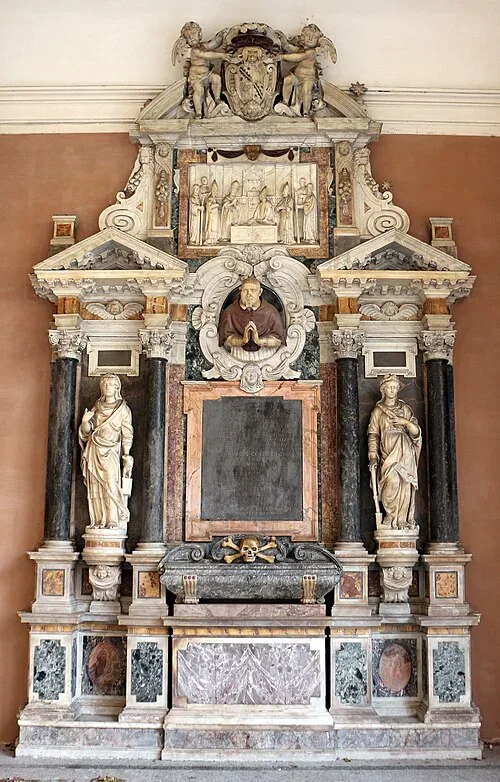 Baroque Entrance Courtyard and Pronaos
Cardinal Sfondrati's Monument
In the portico stands the tomb of Cardinal Paolo Emilio Sfondrati, carved by Girolamo Rainaldi. Sfondrati is the man behind the most famous event in this church's history. During renovations in 1599, his workers opened Cecilia's marble sarcophagus. Inside was a second chest of cypress wood, and in that chest the saint's body, still dressed in white, apparently whole, with the wounds visible at her neck. Word of it spread through Rome, and Pope Clement VIII came in person to see for himself. People called it a miracle. Sfondrati commissioned the sculptor Stefano Maderno to record exactly what had been found, and that marble figure now lies beneath the high altar inside. Sfondrati, who was the nephew of Pope Gregory XIV, led this church as its cardinal until his death in 1618.
Photo: Sailko · CC BY 3.0
03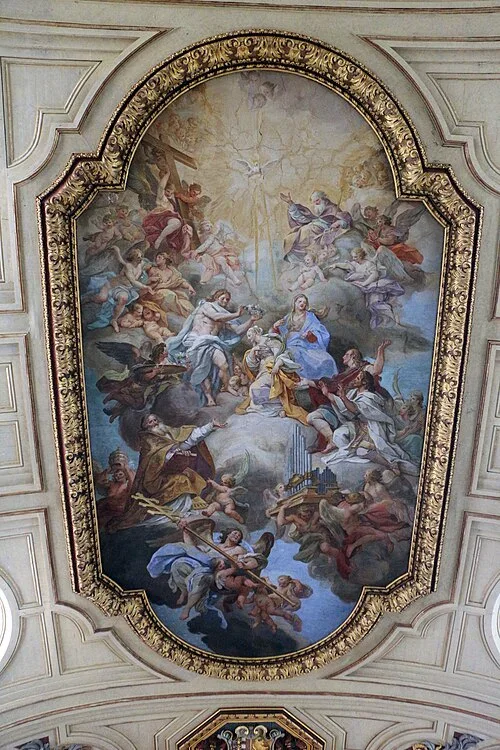 The Nave and Monumental Ceiling
The Nave Ceiling: Apotheosis of Saint Cecilia
The story of Cecilia took a musical turn, and this ceiling tells it. The fresco at the center of the nave is the Apotheosis of Saint Cecilia, painted by Sebastiano Conca around 1727. Among the crowds of figures swirling through the clouds, musical instruments appear beside the saint. That is why she is honored as the patron saint of music, and why choirs and musicians still make their way to this church. Conca's painting belongs to a wave of eighteenth-century renewal that reshaped the medieval interior. The old wooden roof beams gave way to this painted ceiling, the windows were made smaller, and the floor was replaced. Through all that change, the apse at the far end kept its ancient mosaics untouched.
Listen in the appPhoto: Sailko · CC BY 3.0
04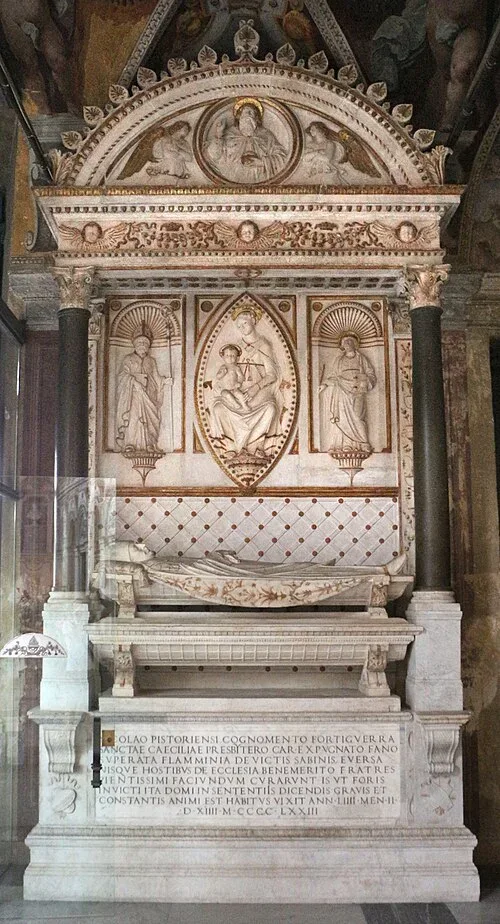 The Nave and Monumental Ceiling
A Renaissance Cardinal's Tomb
Along the nave stands a monument from an earlier century, the tomb of Cardinal Niccolò Fortiguerra, carved by Mino da Fiesole. Fortiguerra held this church as its cardinal from 1460 until his death in 1473, and the carving shows the Virgin and saints gathered around him. He belongs to a long line. Since the fifth century, a cardinal of Rome has been assigned to this church as his own title, and many of them left their mark on the building. Some of those cardinals rose to become popes; one of them, Thomas Wolsey, fell from Henry the Eighth's favor instead. Fortiguerra's marble is the Renaissance's quiet contribution to a church mostly dressed in other ages.
Listen in the appPhoto: Sailko · CC BY 3.0
05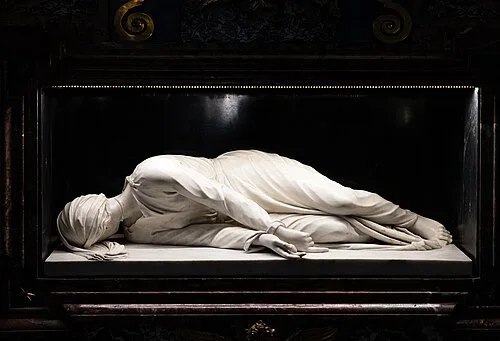 High Altar Ciborium and Maderno's Masterpiece
Maderno's Saint Cecilia
Under the high altar, in a glass case, lies the most startling work of art in this church. Stefano Maderno carved this figure of Cecilia in 1600, in white marble, stretched on her side with her head turned away. A marble slab set in the pavement nearby quotes his sworn statement: that he recorded the body just as he saw it when her tomb was opened. The sculpture shows three cuts at the neck, matching the account of her martyrdom written in the fifth century, where the executioner's axe failed to sever her head. Maderno refused to idealize any of it. He carved a dead woman, plainly and without drama, and in doing so he anticipated the great Baroque sculptors, Bernini among them, by decades. The tomb itself was opened thanks to Cardinal Sfondrati, whose monument you heard about in the portico.
Listen in the appPhoto: Sailko · CC BY 3.0
06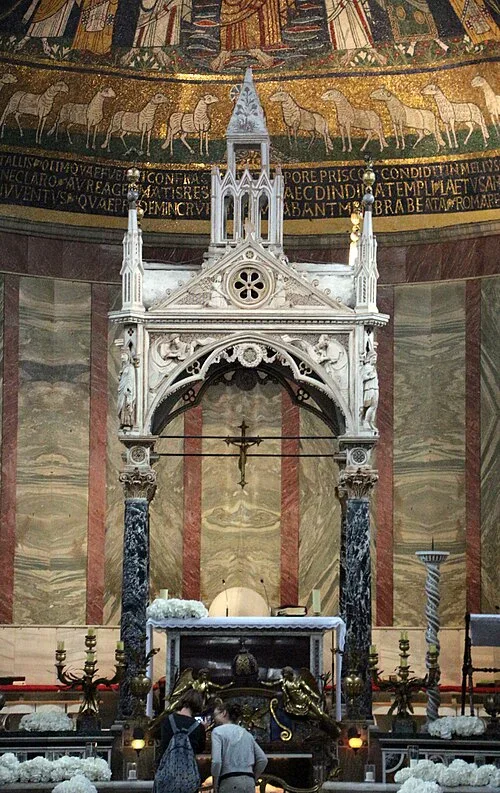 High Altar Ciborium and Maderno's Masterpiece
Arnolfo di Cambio's Gothic Ciborium
Rising over the high altar is a canopy of Gothic marble, carved in 1293 and attributed to Arnolfo di Cambio. It is called a ciborium, and its purpose is to mark and shelter the holiest point of the church. Four columns of white and black marble hold it up, and its spires and little arches carry statuettes of angels, saints, prophets and evangelists. Beneath it rest the relics of Saint Cecilia herself, along with Maderno's marble figure of her. The canopy has stood over this altar for more than seven centuries, outlasting every remodeling around it. Above it, gold light catches the mosaic in the curve of the apse, and that mosaic has its own story to tell.
Listen in the appPhoto: Sailko · CC BY 3.0
07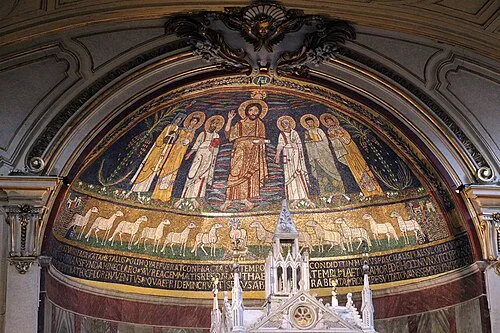 9th-Century Byzantine Apse Mosaics
The Apse Mosaic of Pope Paschal I
In the year 822, Pope Paschal I rebuilt this church from the ground up. The story goes that Cecilia came to him in a dream and revealed where she was buried. He had her remains brought here from the Catacombs of Saint Calixtus, out on the Appian Way, and gave them a new home beneath this altar. The golden mosaic in the apse celebrates that moment. Christ stands at the center, with Saints Paul, Peter, Valerian and Agatha beside him, and Cecilia herself at his right hand. Paschal is there too, holding a model of his church. His halo is square, the mark given to a living person, since the pope was still alive when the mosaic was made. Below the figures runs a frieze of lambs, moving toward Christ from either side, a thousand two hundred years old and still glowing.
Listen in the appPhoto: Sailko · CC BY 3.0
08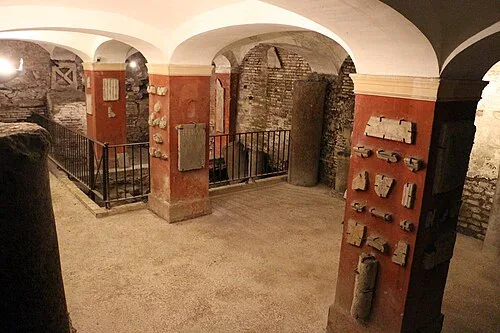 Underground Roman Archaeological Site
Beneath the Church: The Roman House
Until about 1900, only two underground spaces were known here: the crypt, and a room called the Bath. Then Cardinal Mariano Rampolla, who held this church from 1887 to 1913, decided to restore and enlarge the crypt. His workers dug trial pits beneath the floor of the church and the convent, and found far more than anyone expected. A whole complex of Roman rooms came to light, about five meters below the nave. There were walls and columns from a house of the second century before Christ, later converted into an apartment block as Trastevere filled with people. The neighborhood had been farmland in the early Republic, then grew crowded as Rome expanded. Walking through these underground rooms today means walking through the actual floors of the Roman house where, by tradition, Cecilia lived.
Listen in the appPhoto: Sailko · CC BY 3.0
09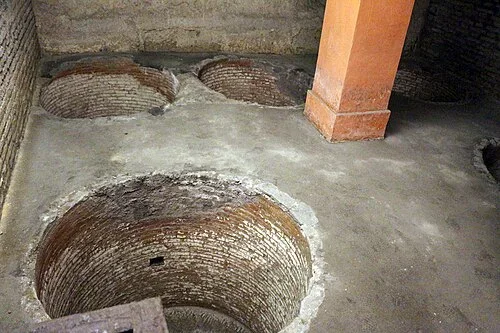 Underground Roman Archaeological Site
Storage Vats and the Legend of the Bathhouse
These deep pits were probably made for storing food, sunk into the floor of the Roman buildings here. They are the plain evidence of everyday life: grain, oil and other provisions kept cool underground, in a house or villa that later ages built over. But one room below carries a heavier story. The heated room of the old bathhouse, known as the Bath long before any excavations, is where legend places the first attempt on Cecilia's life. The story tells that she was shut into the steaming room to be suffocated, and survived there for days before she was killed by the sword. It is a tradition the site has carried for centuries, told of this place rather than proven here. What is certain is that the early Christians honored her wish, and consecrated her house as a church, as the old legend of Pope Urban I recounts.
Listen in the appPhoto: Sailko · CC BY 3.0
10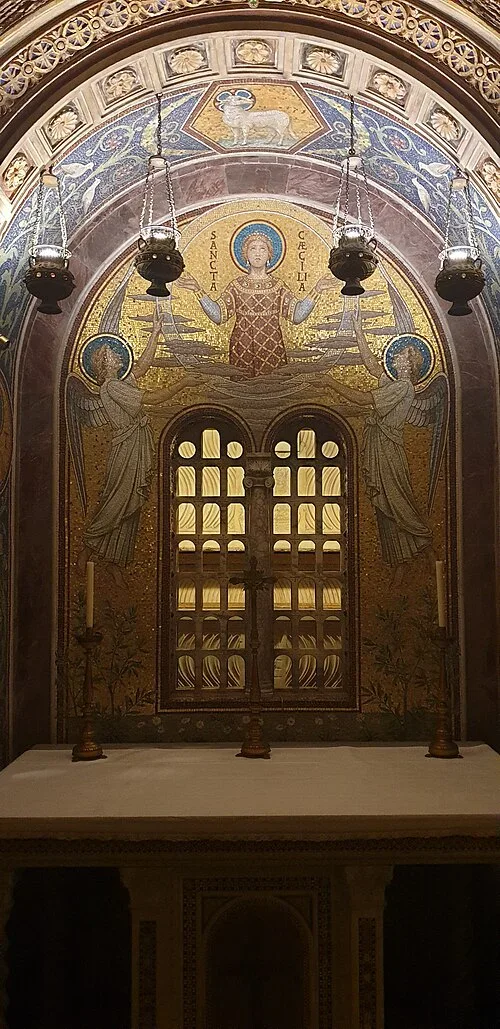 Subterranean Cosmatesque Crypt
The Crypt of the Saints
Directly beneath the high altar lies the crypt, the burial shrine of Cecilia and her husband Valerian. The decoration around their relics is in the cosmatesque style, the medieval Roman art of inlaid colored marble, though much of what glitters here belongs to a reconstruction of the early twentieth century, carried out after Cardinal Rampolla's works. Above the altar windows, a mosaic shows Cecilia with her arms open, flanked by angels, with her name spelled out beside her head. Hanging lamps burn in front of it. An older piece survives in the crypt's apse: the remains of an altar whose inscription records its dedication by Pope Gregory VII on the third of June, 1080. Nine centuries of veneration meet in this one small room.
Listen in the appMumblerJamie · CC BY-SA 2.0
- 11
Cavallini's Last Judgment
A medieval masterpiece of the Last Judgment, hidden for 176 years behind plaster.
- 12
Faces of the Apostles
The faces that changed Western painting, and a feast day that still fills the church with music.
Basilica di Santa Cecilia in Trastevere
Frequently asked questions
How much does the guide cost?
Free app download. Listed guide price: $0.99. Guide price shown in the app. Audio guide only. Venue admission is separate.
Can I listen without internet?
Yes. Download the guide’s audio, images, and maps in the app before your visit. Your downloaded content is then available offline.
Can I listen in my language?
This audio guide is available in 15 languages, including English.
Do I need to follow a schedule?
No. This is a self-guided experience. Choose your stops, pause whenever you like, and return to a story at your own pace.
At your own pace
Explore Basilica di Santa Cecilia in Trastevere.
Download Stanza, then search for “Basilica di Santa Cecilia in Trastevere”.
Free app download · Guide price shown in the app
Keep exploring
Nearby audio guides
Rome · 1 km
Basilica di San Crisogono
Content & sources
Photo: Lalupa · CC BY-SA 3.0
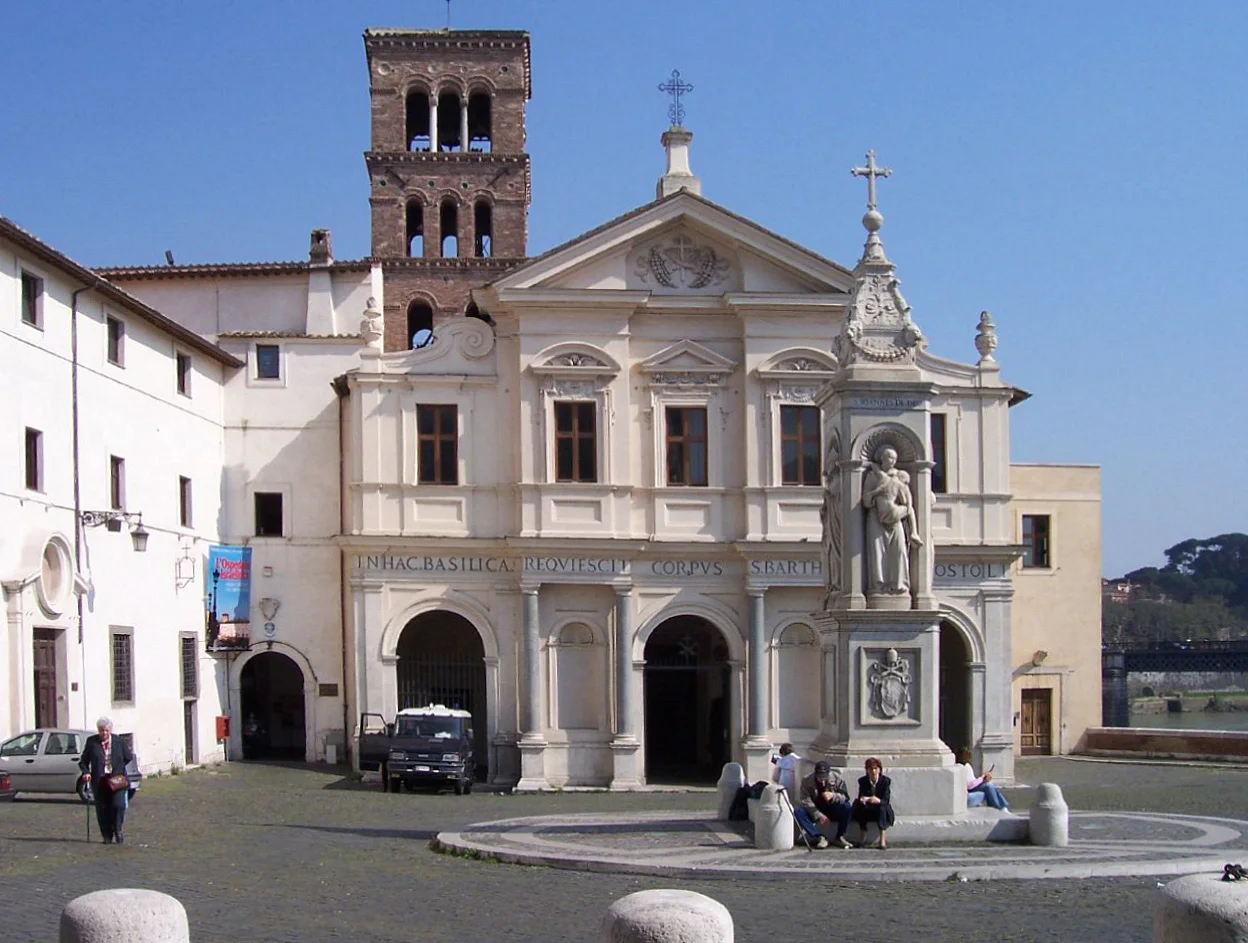
Rome · 1 km
Basilica di San Bartolomeo all'Isola
Content & sources
sonofgroucho · CC BY 2.0
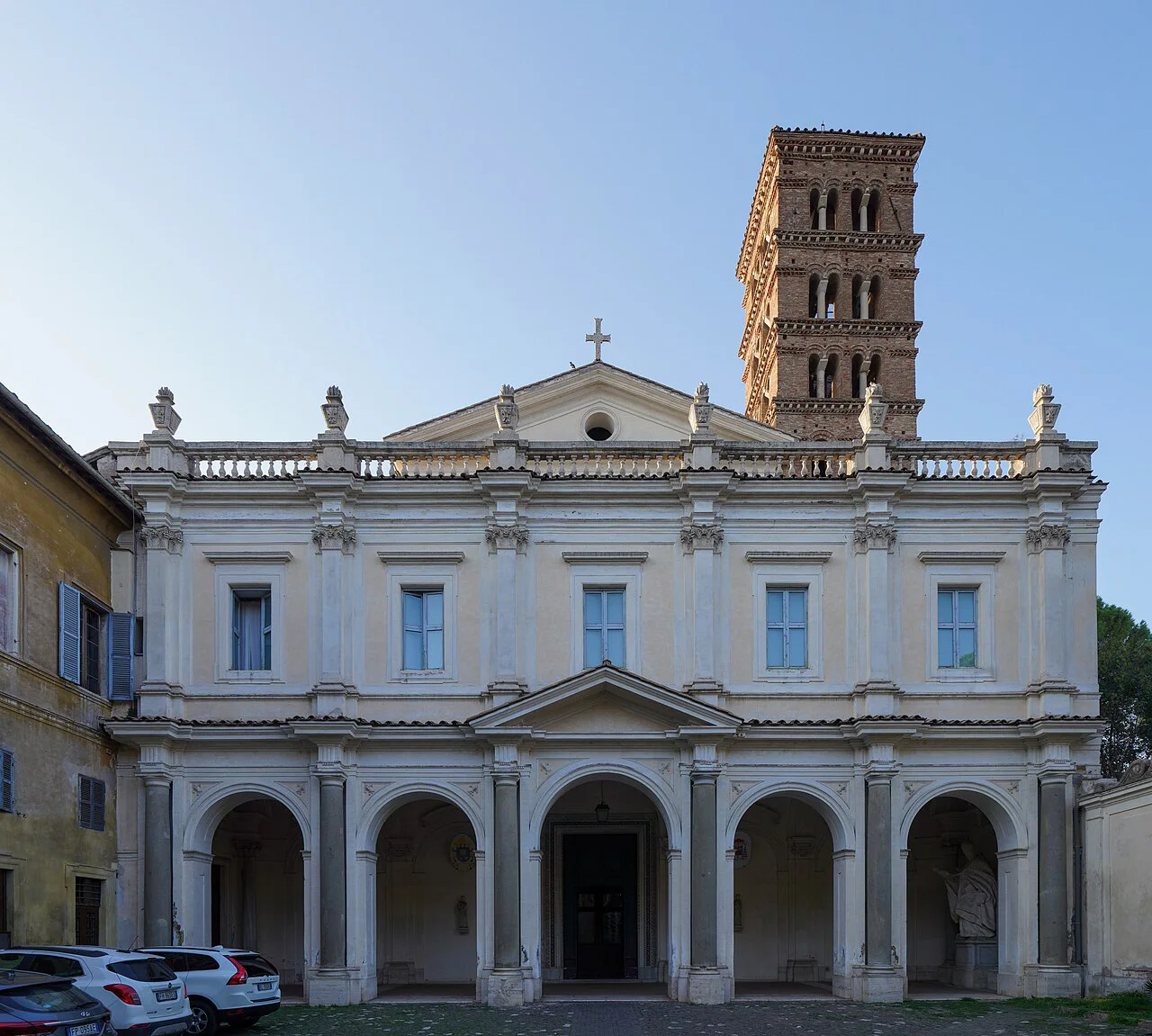
Rome · 1 km
Basilica dei Santi Bonifacio e Alessio
Content & sources
Photo: Merulana · CC BY-SA 4.0
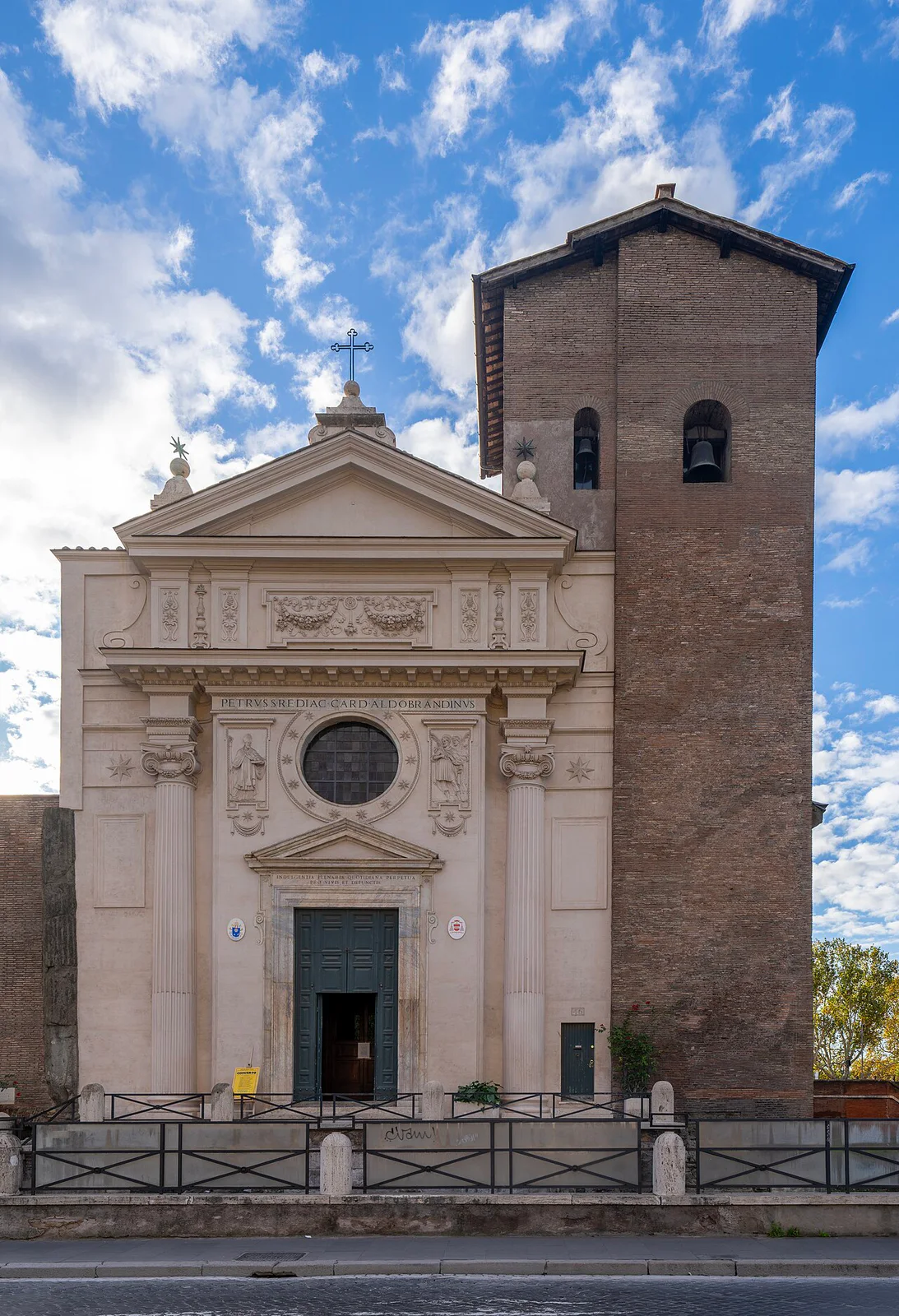
Rome · 1 km
Basilica di San Nicola in Carcere
Content & sources
Photo: Ninfamania · CC BY 4.0