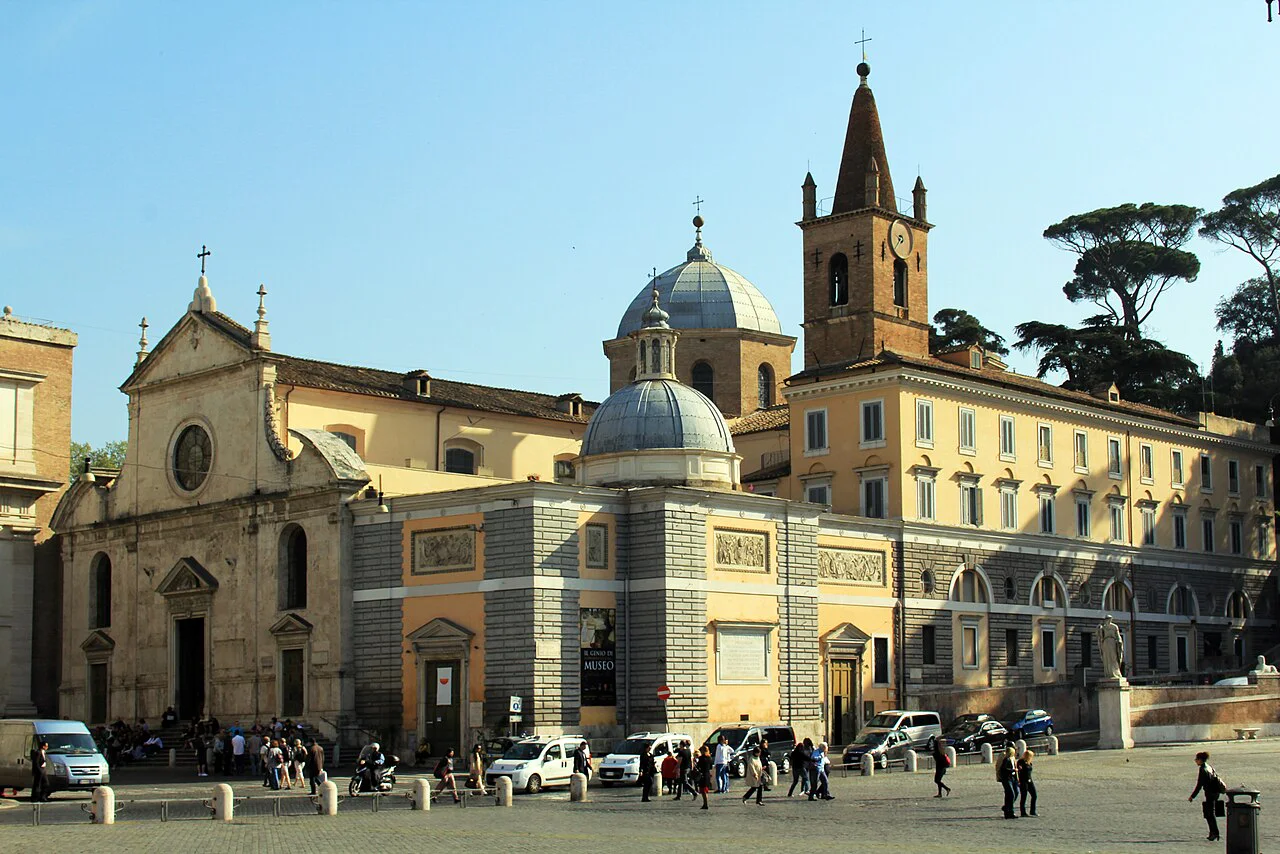
Stanza · Audio guide
Basilica di Santa Maria del Popolo Audio Guide
A place to remember. A story to take with you.
Santa Maria del Popolo is a titular church and a minor basilica in Rome run by the Augustinian order. The church contains works by several famous artists, including Raphael, Gian Lorenzo Bernini, and…
Download Stanza, then search for “Basilica di Santa Maria del Popolo”.
About the tour
One guide. Your kind of visit.
Santa Maria del Popolo is a titular church and a minor basilica in Rome run by the Augustinian order. The church contains works by several famous artists, including Raphael, Gian Lorenzo Bernini, and Caravaggio.
Ready when you are.
- 01Get the free Stanza app.
iOS & Android
- 02Find your guide.
“Basilica di Santa Maria del Popolo”
- 03Download before you go.
Works offline
Audio guide / 14 narrated stops
Inside the guide
Get to know a few of the stories before you go. Open a stop to read more.
01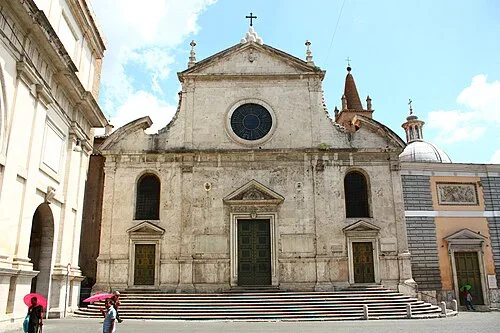 Piazza del Popolo Façade and the Nero Legend
Facade of Santa Maria del Popolo
Welcome to Santa Maria del Popolo, on the north side of Piazza del Popolo, squeezed between the city gate and the Pincian Hill. For most travellers arriving from the north along the Via Flaminia, this was the first church they met in Rome. The founding story is a legend the Augustinians loved to tell. After his suicide, Emperor Nero was buried in his family tomb at the foot of the hill. A huge walnut tree grew over the spot, so tall that no other plant surpassed it. Demons were said to haunt its branches, tormenting local people and frightening arrivals at the gate. In 1099 Pope Paschal II cleared the cursed ground and built a chapel there, dedicated to the Virgin Mary. The church you see is far younger. Pope Sixtus IV rebuilt it in the early Renaissance style between 1472 and 1477, and his Della Rovere family arms still mark the building.
Photo: M0tty · CC BY-SA 3.0
02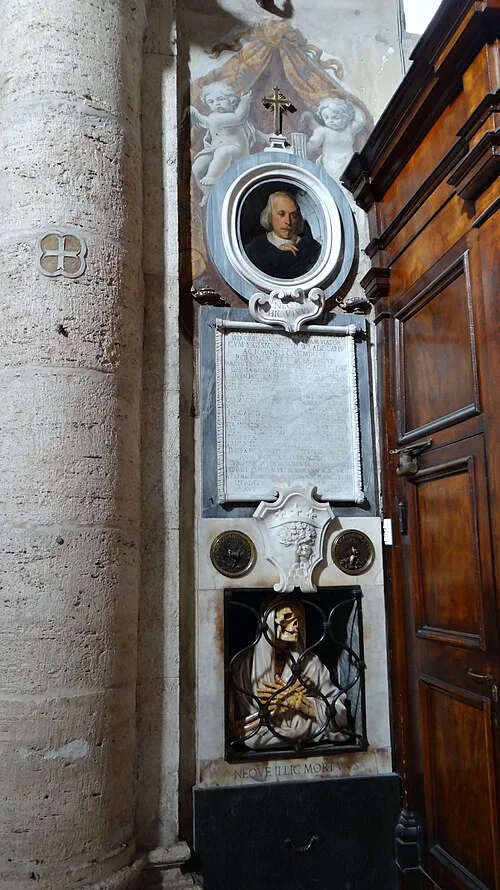 The Counterfaçade and Gisleni's Memento Mori
The Gisleni Memento Mori Monument
Giovanni Battista Gisleni was a Baroque architect and stage designer who spent decades working for the Polish royal court. He designed his own funeral monument and had it installed here in 1670, two years before he died. The lower part is the famous one. A shrouded skeleton peers out through a window behind an iron grill, bony hands clutched to its breast. In most Baroque tombs a skeleton stands for Death itself. Here it is Gisleni, shown as a decaying body on its way to resurrection, so that death becomes a symbol for life. Two bronze medallions carry the same message. One shows a cut tree sprouting new shoots with a caterpillar spinning its cocoon; the other shows the caterpillar transformed into a moth. The inscriptions read, in my nest I die, and, as a phoenix I multiply my days. Above hangs a painted canopy held by angels, with his portrait in a tondo by the Flemish painter Jacob Ferdinand Voet. The building kept growing into the late seventeenth century; the nearby Cybo Chapel was rebuilt in the 1680s to designs by Carlo Fontana.
Photo: Zello · CC BY-SA 4.0
03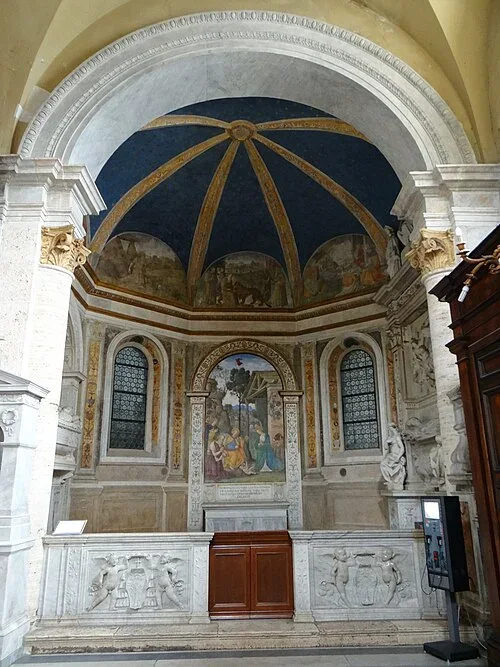 Right Aisle: The Della Rovere Chapel
Della Rovere Chapel
This chapel shows what the freshly rebuilt 1470s basilica looked like before any Baroque ornament touched it. Cardinal Domenico della Rovere, a relative of Pope Sixtus IV, furnished it from 1477. The painted decoration is attributed to Pinturicchio and his workshop, the most sought-after fresco painters of the day. Above the altar is his Adoration of the Child with Saint Jerome, considered an autograph work by his own hand. The tomb of Cardinal Cristoforo della Rovere, who died in 1478, was raised here by his brother, carved by Andrea Bregno and Mino da Fiesole. Few places in Rome keep quattrocento decoration this intact.
Listen in the appPhoto: Zello · CC BY-SA 4.0
04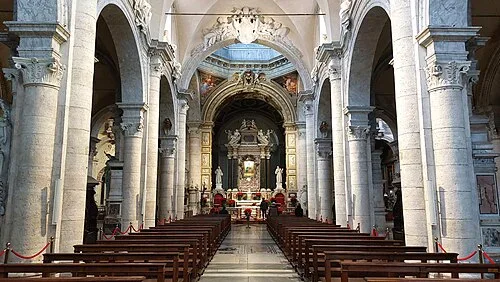 The Central Nave: Bernini's Stucco Saints and Luther's Roman Stay
The Central Nave
In the 1650s Pope Alexander VII decided the old fifteenth-century basilica needed modernizing in the contemporary Baroque taste, and he gave the job to Gian Lorenzo Bernini. In March 1658 the pope inspected the work in person, walking through the church with his architect. The campaign changed the facade, opened larger windows, added statues, frescoes and stucco, and erected a new main altar. Yet Bernini treated the Renaissance skeleton with care, keeping the original structure largely intact. The Augustinian friary attached to this church holds a quieter claim on history. Traditionally in the winter of 1510 to 1511, though even that date has been questioned, a young friar named Martin Luther spent about four weeks in Rome. His biographer Böhmer assumed he lodged in this monastery, though newer biographers dispute it. What is certain is that he visited the city's only observant Augustinian house and its famous pilgrimage church.
Listen in the appPhoto: Hugo DK · CC BY 4.0
05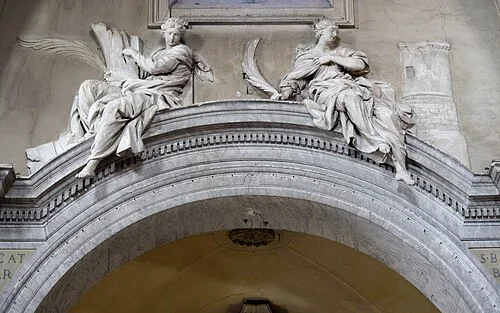 The Central Nave: Bernini's Stucco Saints and Luther's Roman Stay
Bernini's Stucco Female Saints
Perched on the arches of the nave sit pairs of female saints in white stucco, the signature detail of Bernini's transformation. He added a strong stone cornice running the length of the nave, then dressed the arches with these figures, leaving the cross-vaults above simply whitewashed. The restraint is the point. Baroque ornament was draped over the Renaissance structure without smothering it. The first pairs on each side represent medieval monastic founders and reformers. The rest are early Christian saints and martyrs, and their names are written above the arches in gilt letters on the spandrels.
Listen in the appPhoto: Zello · CC BY-SA 4.0
06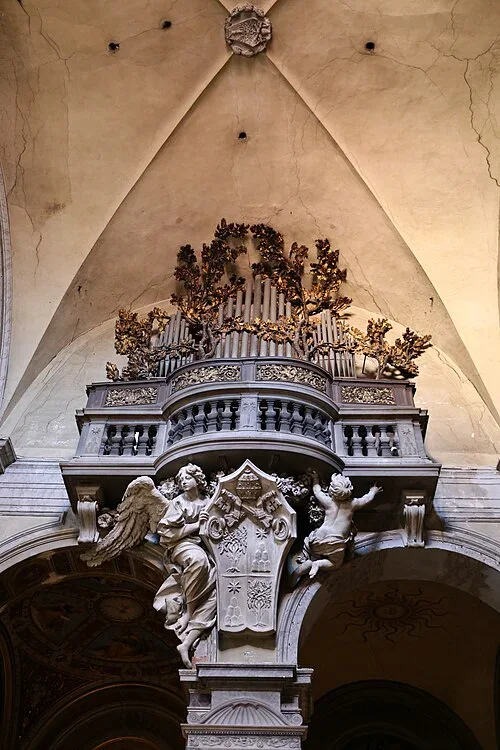 Right Transept: Bernini's Gilded Oak Organ Loft
The Gilded Oak Organ Loft
In the transept, the organ pipes do not sit in a plain case. They rise through four spreading, gnarled branches of a gilded oak tree, complete with leaves and acorns. Bernini designed the loft, and the sculptor Antonio Raggi carried it out, with stucco angels and putti below holding garlands and the arms of Pope Alexander VII. The oak is the ancient symbol of the Della Rovere family, while the side pillars bear the mountain and star of the Chigi. And there is a deliberate joke in it, aimed back at the founding legend. The evil walnut tree of Nero, the one that stood here before the chapel was built, is answered by this beneficent golden oak. A tree of nightmare replaced by a tree of praise, its branches carrying the music.
Listen in the appPhoto: Sailko · CC BY 3.0
07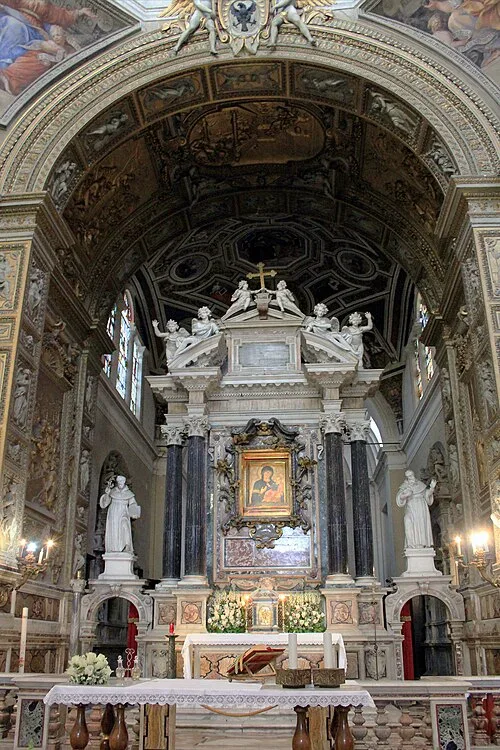 The Presbytery: High Altar Icon and Bramante's Choir
The High Altar and the Madonna del Popolo
Above the high altar sits the image that gives this church its identity: the Madonna del Popolo, Our Lady of the People. Later tradition held that the picture was painted by Saint Luke himself, though that attribution came centuries after the work. The story goes that Pope Gregory IX had it brought from the Sancta Sanctorum in the Lateran after a flood of the Tiber, probably the great flood of 1230, brought a terrible plague to the city. The pope, the cardinals, the clergy and the people of Rome carried the icon here in solemn procession, and the plague ceased. Whether or not every detail holds, the Madonna certainly became one of the most popular Marian images in Rome, drawing pilgrims to a church that was still geographically remote. In 2018 it was announced that restoration had revealed a signature on the image, identifying it as the work of Filippo Rusuti.
Listen in the appPeter1936F · CC BY-SA 3.0
08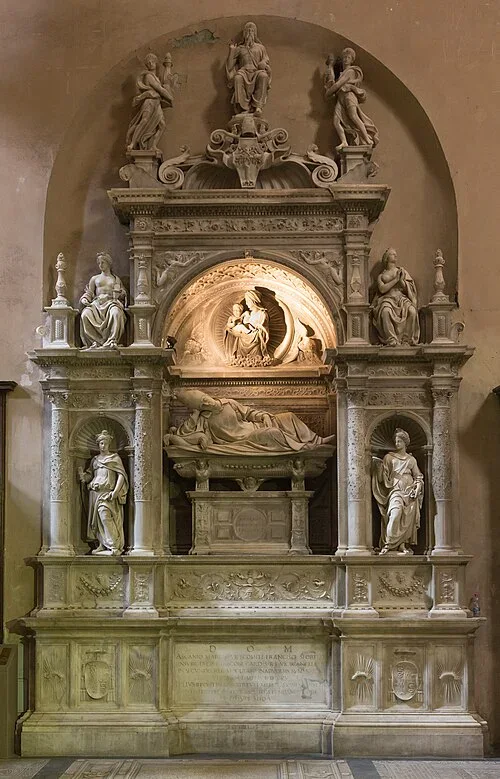 The Presbytery: High Altar Icon and Bramante's Choir
Tomb of Cardinal Ascanio Sforza in Bramante's Choir
Pope Julius II, another Della Rovere, built a spacious new choir behind the main altar between 1505 and 1510, and gave the commission to his favourite architect, Donato Bramante. The choir served the pope's dynasty as much as his devotions. Here Andrea Sansovino created two monumental cardinal tombs, and this one belongs to Ascanio Sforza, who died in 1505. Sforza had once been Julius's rival for the papal crown; in stone, the rivalry was settled. Opposite stands the tomb of Girolamo Basso della Rovere, the pope's favourite cousin, who died in 1507. Overhead, Pinturicchio painted the vault frescoes, including the Coronation of the Virgin, and the windows hold stained glass by the French artist Guillaume de Marcillat.
Listen in the appPeter1936F · CC BY-SA 3.0
09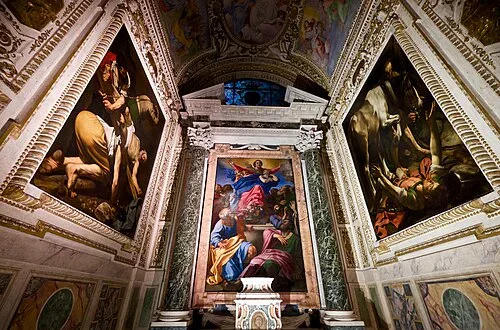 The Cerasi Chapel: Caravaggio and Carracci
The Cerasi Chapel
On 8 July 1600, Monsignor Tiberio Cerasi, Treasurer-General to Pope Clement VIII, bought the patronage right of the old Foscari Chapel in the left transept and promptly demolished it. The new chapel that replaced it was designed by Carlo Maderno between 1600 and 1601. What Cerasi got was one of the boldest ensembles in Rome. Two large canvases by Caravaggio flank the altar, and between them hangs the Assumption of the Virgin by Annibale Carracci, Rome's other leading painter. The three works were planned as a single composition in one small room, and the pairing set the two artists in quiet rivalry. The result turned a private funeral chapel into one of the high points of Western art.
Listen in the appAnnibale Carracci and Caravaggio · CC BY 2.0
10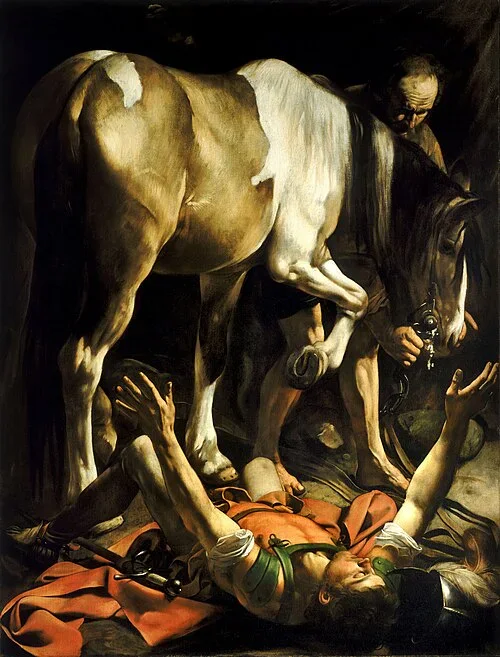 The Cerasi Chapel: Caravaggio and Carracci
Caravaggio, The Conversion on the Way to Damascus
Saul lies flat on the road to Damascus, arms flung wide across the ground. The heavenly light that struck him down is never painted; it is simply felt, blazing on his body and the horse's flank out of the surrounding dark. That darkness is Caravaggio's extreme chiaroscuro, the violent contrast of light and shadow that changed painting. And notice what dominates the frame: not the saint, but a great horse and an old groom holding its bridle. Caravaggio staged a moment of divine revelation with the humble, earthbound cast of a Roman street scene. He painted this canvas, together with its companion, in 1600 and 1601 for Cerasi's chapel. Opposite it hangs Carracci's Assumption, glowing and ordered; Caravaggio's answer is raw, close and unidealized.
Listen in the appCaravaggio · Public domain
- 11
Caravaggio, The Crucifixion of Saint Peter
Caravaggio's Crucifixion of Saint Peter: an old man's execution, rendered with unvarnished physical effort.
- 12
The Chigi Chapel Dome
Raphael designed this banker's tomb, and its golden dome mosaics waited centuries for the chapel to be finished.
- 13
Bernini, Habakkuk and the Angel
Nearly a century and a half after Raphael, Bernini finished the chapel with an angel seizing Habakkuk by the hair.
- 14
Bernini, Daniel and the Lion
Daniel calm among the lions, Bernini's closing figure, and the last word on a church six centuries in the making.
Basilica di Santa Maria del Popolo
Frequently asked questions
How much does the guide cost?
Free app download. Listed guide price: $0.99. Guide price shown in the app. Audio guide only. Venue admission is separate.
Can I listen without internet?
Yes. Download the guide’s audio, images, and maps in the app before your visit. Your downloaded content is then available offline.
Can I listen in my language?
This audio guide is available in 15 languages, including English.
Do I need to follow a schedule?
No. This is a self-guided experience. Choose your stops, pause whenever you like, and return to a story at your own pace.
At your own pace
Explore Basilica di Santa Maria del Popolo.
Download Stanza, then search for “Basilica di Santa Maria del Popolo”.
Free app download · Guide price shown in the app
Keep exploring
Nearby audio guides
Rome · 1 km
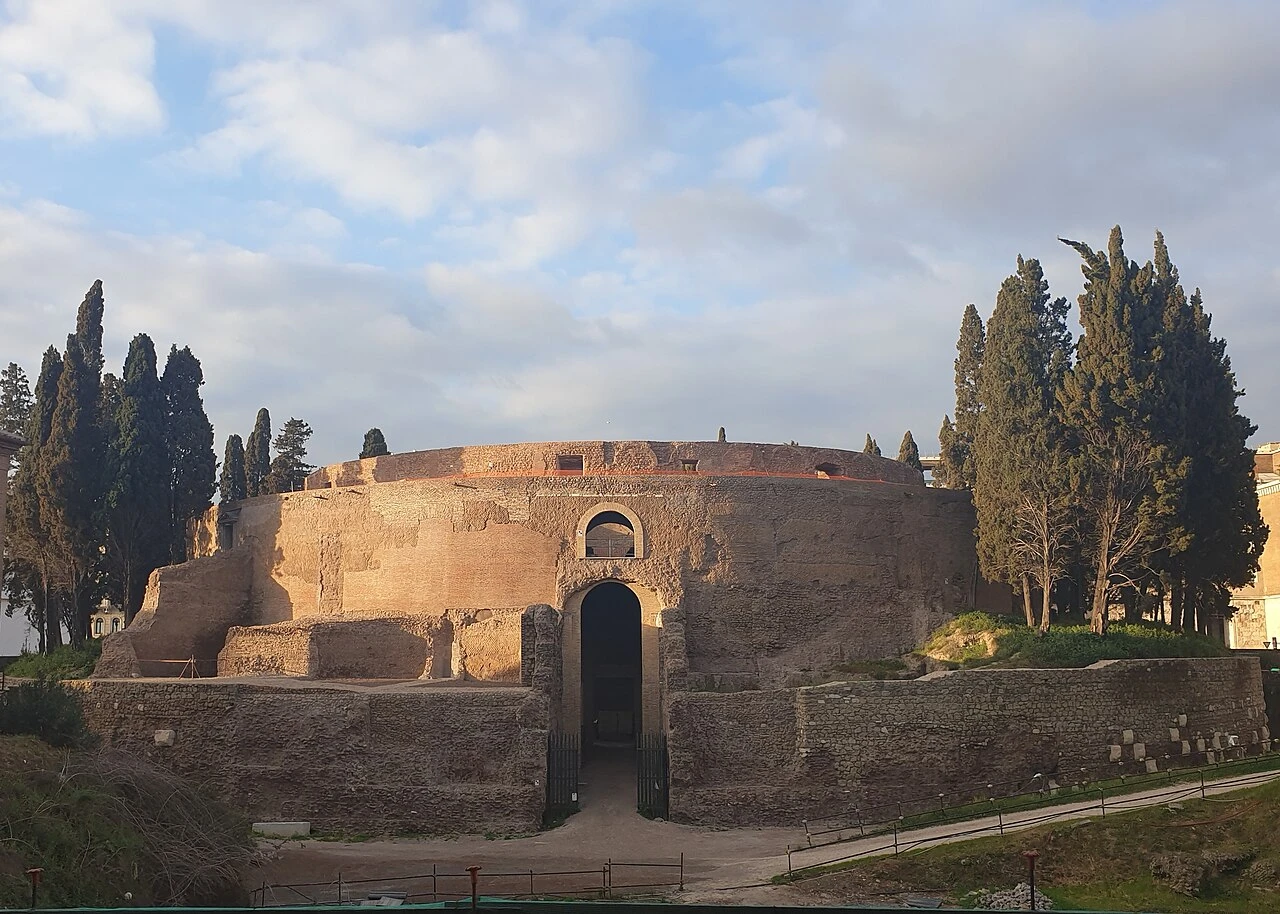
Mausoleum of Augustus
Content & sources
MumblerJamie · CC BY-SA 2.0
Rome · 1 km
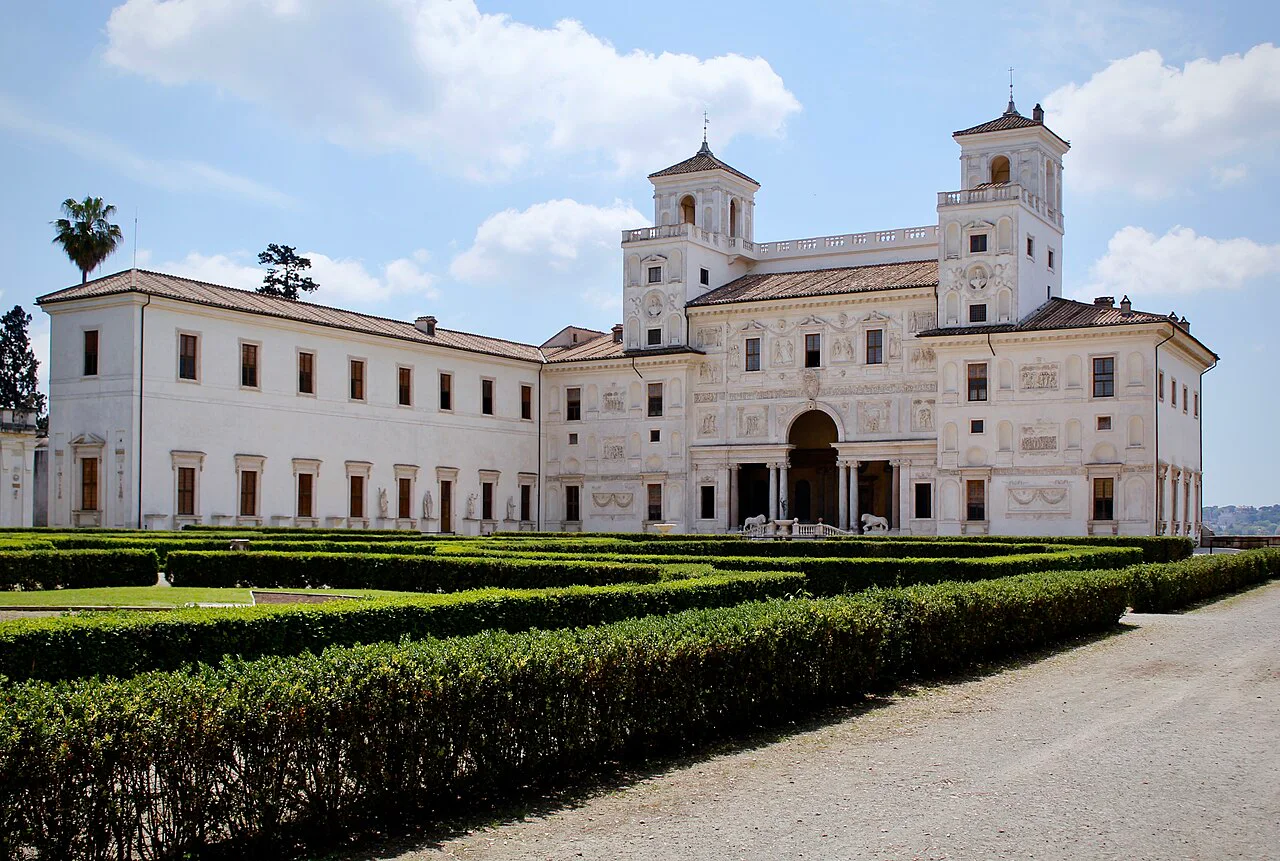
Villa Medici
Content & sources
Photo: Laterbat · CC BY-SA 4.0
Rome · 1 km
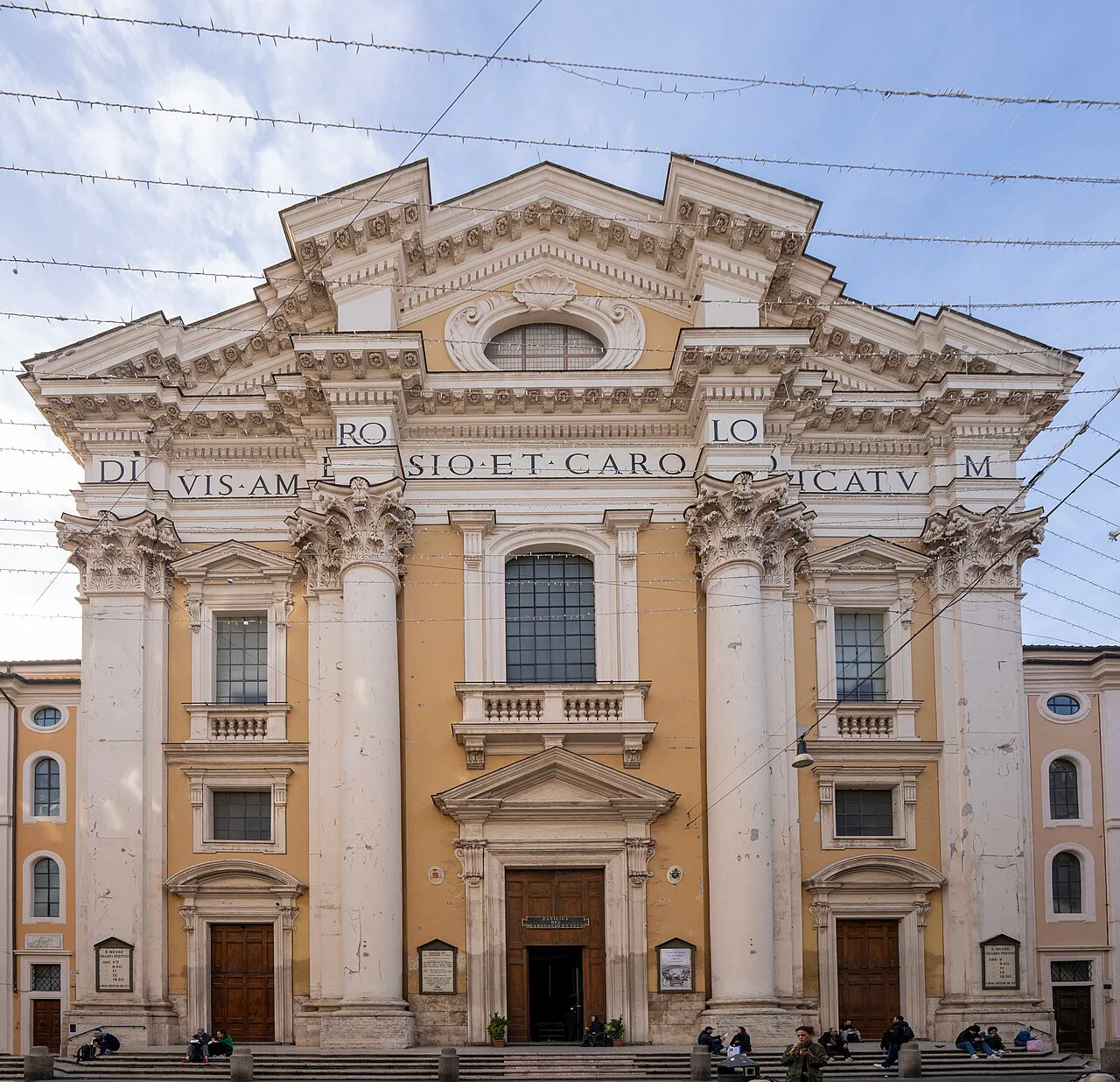
Basilica dei Santi Ambrogio e Carlo al Corso
Content & sources
Photo: DellaGherardesca · CC BY 4.0
Rome · 1 km
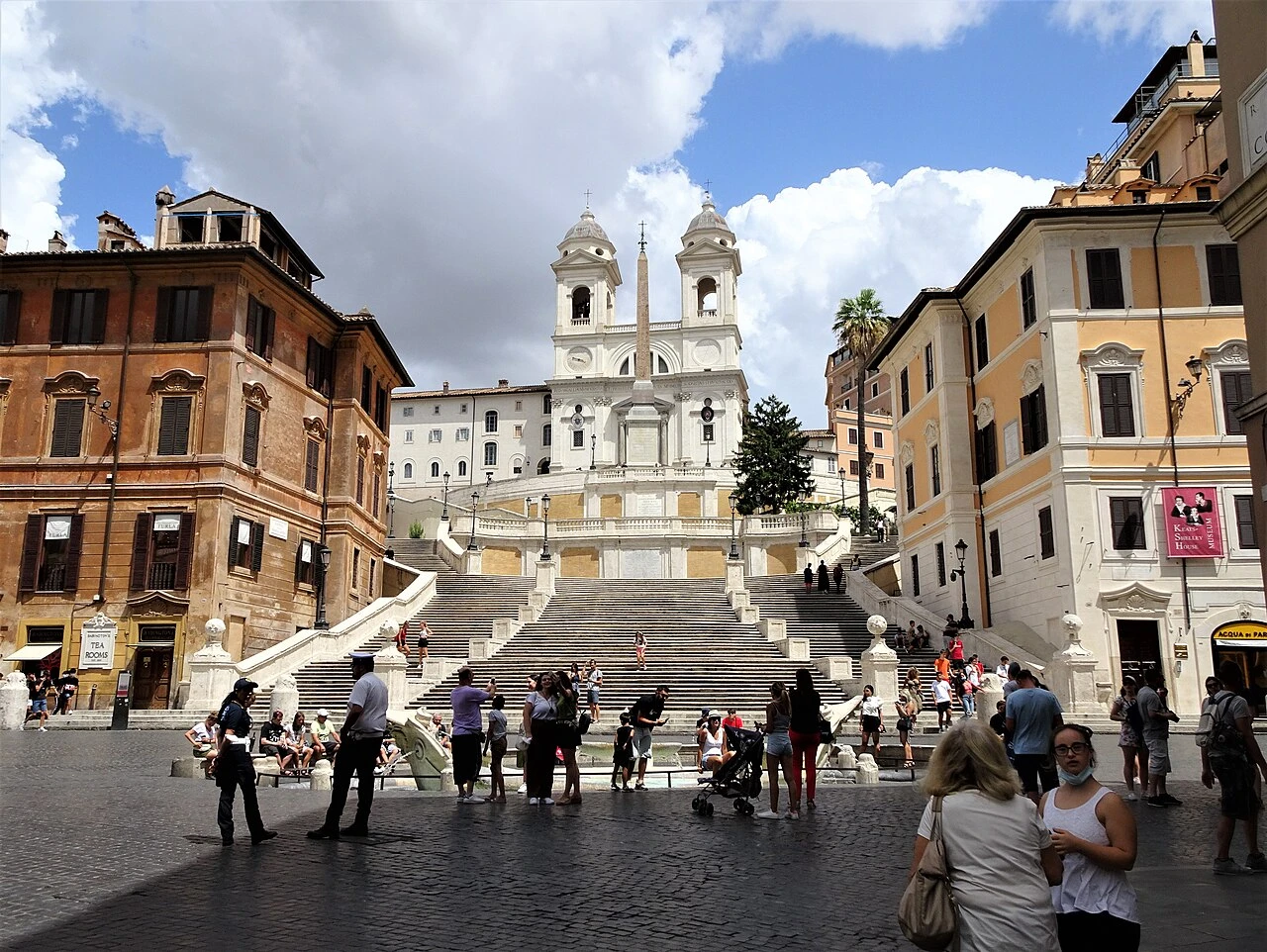
Spanish Steps
Content & sources
Photo: Hugo DK · CC BY-SA 4.0