Stanza · Audio guide
Villa Medici Audio Guide
A place to remember. A story to take with you.
The Villa Medici is a sixteenth-century Italian Mannerist villa and architectural complex located in Rome. It features a 7-hectare Italian garden and is situated on the Pincian Hill in the historic centre of…
Download Stanza, then search for “Villa Medici”.
About the tour
One guide. Your kind of visit.
The Villa Medici is a sixteenth-century Italian Mannerist villa and architectural complex located in Rome. It features a 7-hectare Italian garden and is situated on the Pincian Hill in the historic centre of the city.
Ready when you are.
- 01Get the free Stanza app.
iOS & Android
- 02Find your guide.
“Villa Medici”
- 03Download before you go.
Works offline
Audio guide / 13 narrated stops
Inside the guide
Get to know a few of the stories before you go. Open a stop to read more.
01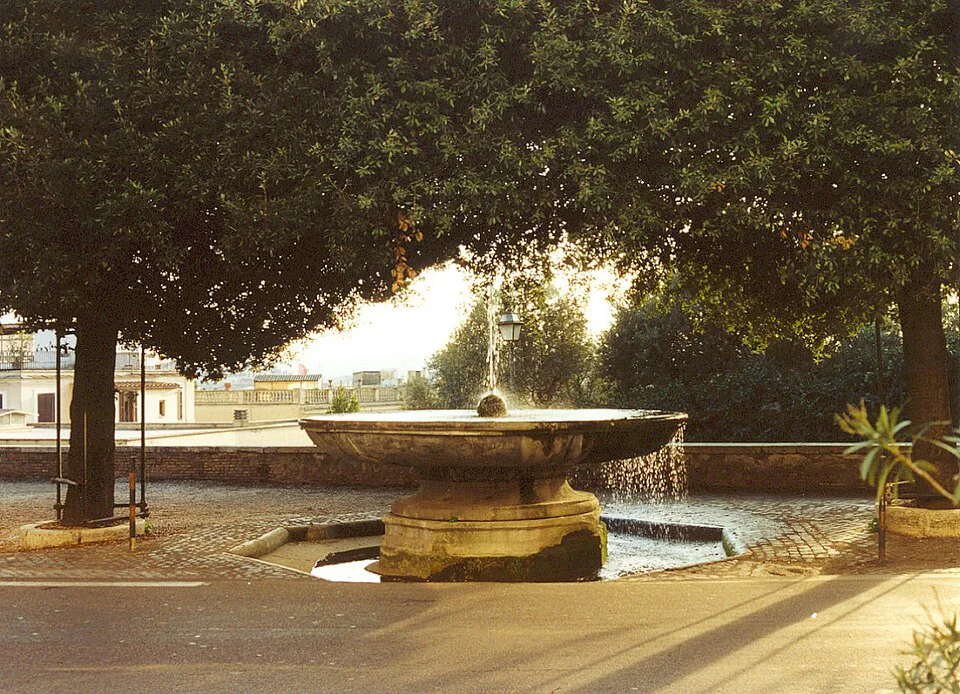 Forecourt and the City-Facing Facade
The Forecourt Fountain on the Pincio
Welcome to the Villa Medici, on the Pincian Hill beside Trinità dei Monti. This tour covers the villa's facades, gardens and rooms, and it ends at a high view over Rome. The forecourt fountain comes first. A wide basin sits on a thick round pedestal, and a jet of water rises from its centre. Water spills over the rim and collects in a shallow pool around the foot. The basin is said to be made from a red granite vase of ancient Rome. Annibale Lippi is credited with the design, dated to 1589. Painters have often shown the view from the villa, across this fountain, toward Saint Peter's. Trees in the foreground now hide much of that view. Ottorino Respighi's Fountains of Rome includes a musical evocation of the villa's garden fountains.
Peter J.St B.Green (Waysider1925 at en.wikipedia.) · CC BY-SA 3.0
02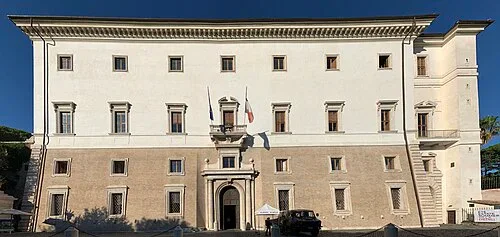 Forecourt and the City-Facing Facade
The Street Facade of Villa Medici
The Medici wanted a foothold in Rome, and this villa became their first property in the city. Cardinal Ferdinando de' Medici acquired the estate in 1576. The family meant it as a statement. It would show that the Medici ranked among the great princes of Italy. They also intended to stay in Rome for good. The street front is simple. A broad white upper storey rises above a darker lower storey, with a central arched doorway at the base. Two flags hang from a balcony above the entrance. For about a century and a half the villa was the seat of the Grand Dukes' embassy to the Holy See. Today the French Academy in Rome occupies it. The villa also has a legend about a cannonball. In 1656, Queen Christina of Sweden was said to have fired a cannon from the top of Castel Sant'Angelo without taking aim. The wayward ball struck the villa and destroyed one of the Florentine lilies that decorated its facade.
Photo: Chabe01 · CC BY-SA 4.0
03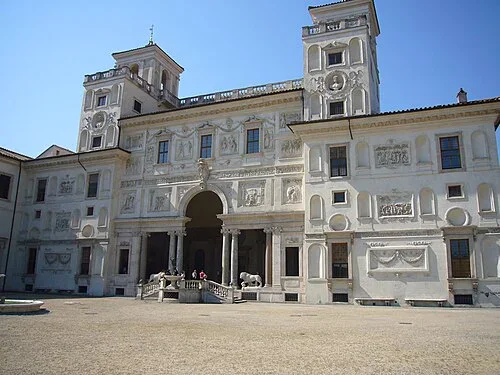 The Antiquarian Facade and the Loggia of the Lions
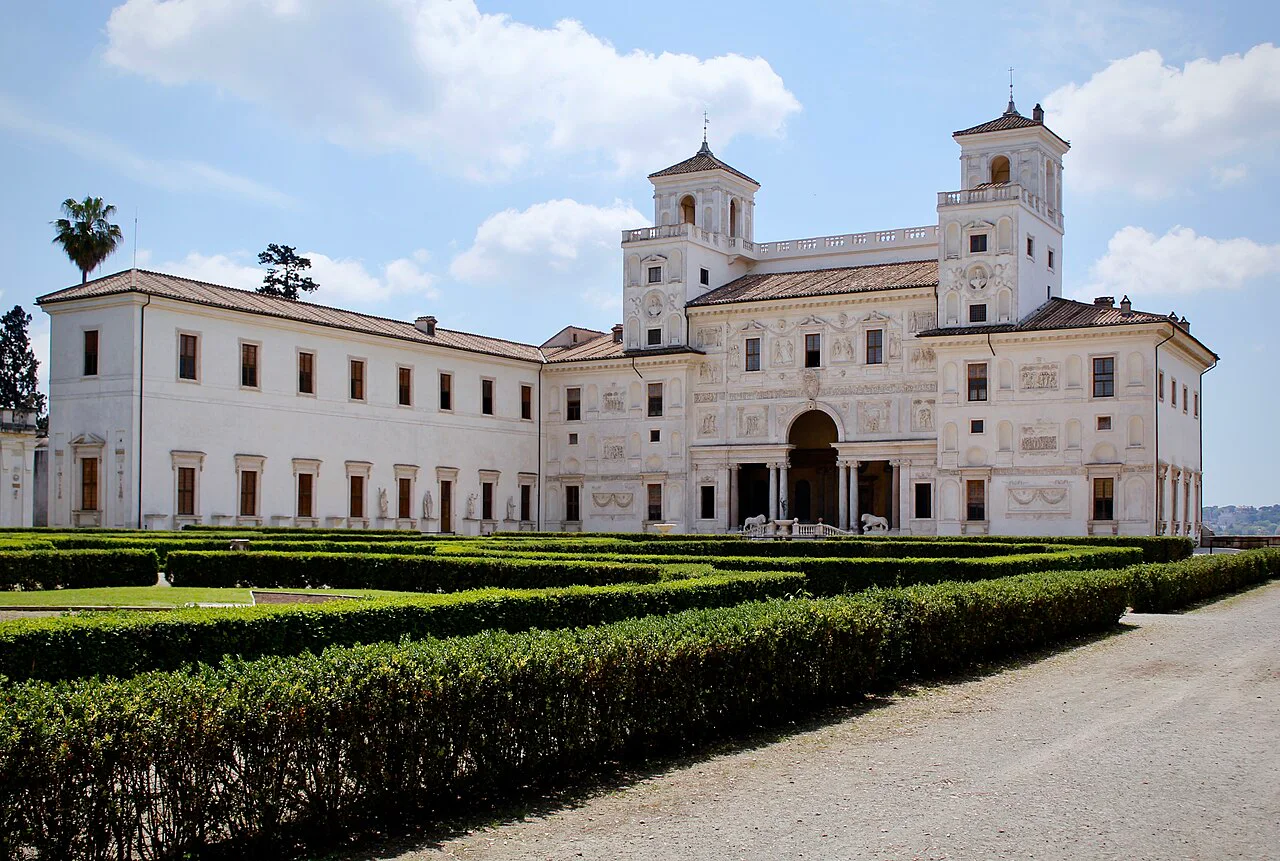
The Inner Garden Facade
The garden side of the Villa Medici is covered with ancient Rome. Roman reliefs and statues came up with almost every spadeful of earth. Cardinal Ferdinando de' Medici had many of them set into the walls, and some broken ruins were covered with earth instead. The facades became, in effect, a virtual open-air museum of Roman art. Work on the building resumed in 1564, under several architects. It was finished to designs by Bartolomeo Ammanati in 1580. A tall arched doorway stands at the centre, framed by columns. Carved panels and round medallions fill the pale walls on either side, and a stone lion rests at the foot of the steps. The villa's collection also grew by purchase. About one hundred seventy Roman sculptures were bought from the Capranica and della Valle collections, which had come together through marriage.
Listen in the appPhoto: Lalupa · CC BY-SA 3.0
04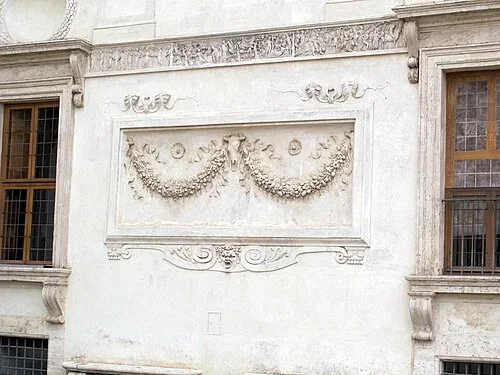 The Antiquarian Facade and the Loggia of the Lions
Garland Relief on the Inner Facade
Two carved garlands sag in a swag from a central knot, set inside a raised frame. Small scroll shapes sit at the edges of the frame. The garden facade is said to hold a pair of garlands that came from the Ara Pacis. Whether this panel is the ancient carving itself or a later piece is hard to tell from the stone alone. The Ara Pacis is an altar in Rome from the time of the emperor Augustus.
Listen in the appPhoto: Sailko · CC BY 3.0
05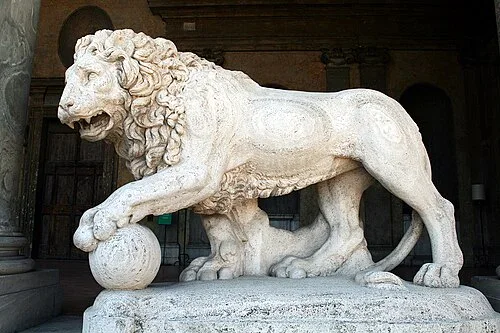 The Antiquarian Facade and the Loggia of the Lions
The Lion of the Loggia dei Leoni
A pale marble lion rests one heavy paw on a round ball, on a stone plinth. The Medici lions by the stairs to the courtyard were completed in 1598. The original lions were later taken to Florence, and they now stand in the Loggia dei Lanzi. The lions at the villa today are copies, among them a marble one by Augustin Pajou. The marble lions inspired Bernard Foucquet's bronze lions in Stockholm. Those lions stand on the Lejonbacken, the lion slope on the north side of the Royal Palace. They date from 1700 to 1704.
Listen in the appPhoto: Jean-Pol GRANDMONT · CC BY 4.0
06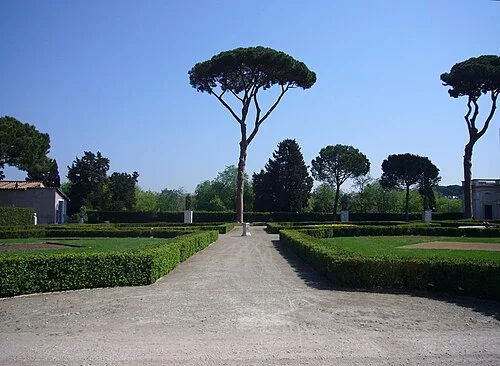 The Renaissance Parterres and the Carré des Niobides
The Garden Perspective and Central Allée
The garden covers about seven hectares on the Pincian slope, and it adjoins the larger Borghese Gardens. The grand gardens recalled the botanical gardens that the Cardinal's father, Cosimo the First, had made at Pisa and at Florence. Plantations of pines, cypresses and oaks sheltered the Villa Medici gardens. Today a wide gravel path runs down the centre, between clipped hedges and lawns. Tall maritime pines line the way, and a pale statue on a pedestal marks the far end. The painter Balthus, then head of the Academy, led a vast restoration of the palace and its gardens between 1961 and 1967.
Listen in the appPhoto: Lalupa · CC BY-SA 3.0
07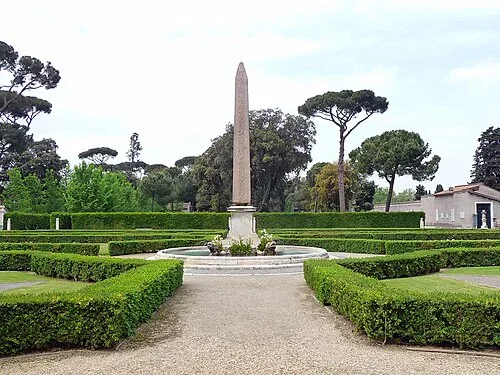 The Renaissance Parterres and the Carré des Niobides
The Obelisk in the Garden Parterre
The ground under this villa was once part of the gardens of Lucullus, in ancient Rome. Later the gardens came into imperial hands through Messalina, who was murdered here. Today a tall obelisk rises from a round, stepped base at the centre of the garden, with clipped hedges and pines around it. It is a copy. The ancient original was among the treasures the Medici sent to Florence, and it now stands in the Boboli Gardens.
Listen in the appPhoto: Warburg · CC BY-SA 3.0
08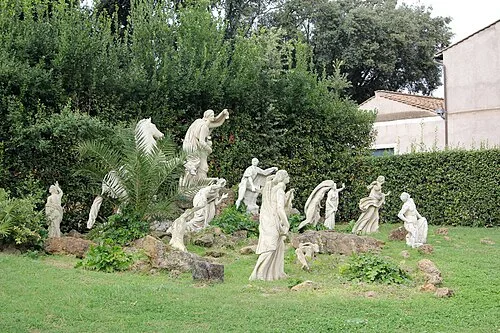 The Renaissance Parterres and the Carré des Niobides
Carré des Niobides
The square takes its name from the Niobids, the children of Niobe in Greek myth. Pale figures stand among rocks and leafy plants on the lawn, some reaching upward. Excavations in 1583 brought the Niobe group to light, and Cardinal Ferdinando bought it at once. He placed it in this square, facing his private study. In 1587 Ferdinando succeeded as Grand Duke of Tuscany. He was content to have plaster copies of the Niobe group made for himself, so the originals stayed in Rome. The Medici male line died out in 1737, and the villa passed to the house of Lorraine. The Medici sculptures were not taken to Florence until the eighteenth century. The Niobe group, the Medici Vase and the Venus de' Medici were among them. They became the core of the Uffizi's collection of antiquities.
Listen in the appPhoto: Founzy · CC BY-SA 4.0
09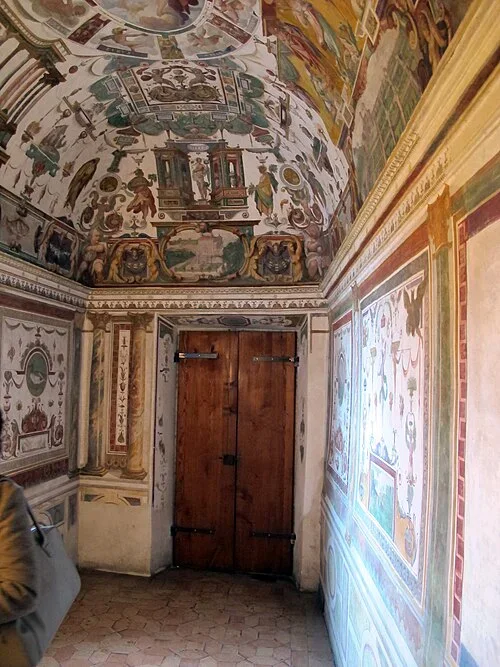 The Upper Bosco and Cardinal Ferdinando's Secret Retreats
Cardinal Ferdinando's Studiolo
Cardinal Ferdinando had a small private study built north-east of the garden, above the old Aurelian Wall. It was a place for study and contemplation. The rooms once looked over the Roman countryside, and now they look onto the Borghese Gardens. The two rooms stayed hidden under whitewash until the restorer Geraldine Albers uncovered them in 1985. Jacopo Zucchi painted the frescoes in the late 1570s, and the whitewash had kept them safe. The vault is crowded with painted figures, columns and medallions. Painted panels cover the walls below it, and a plain wooden door stands in one wall. Ferdinando also raised a small artificial hill, the Parnaso, over the buried ruins of an ancient temple. The temple was probably dedicated to Fortuna. A new avenue ran north to south, linking the garden to the mound. The hill seems to have placed the grounds under Apollo's protection.
Listen in the appPhoto: Sailko · CC BY-SA 3.0
10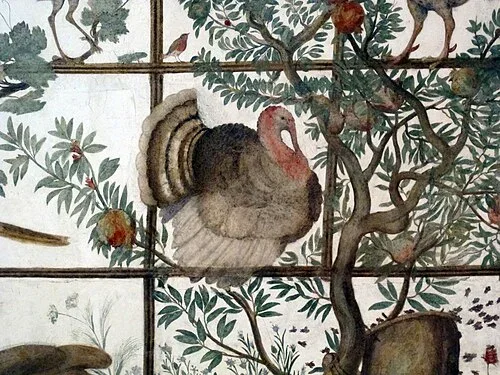 The Upper Bosco and Cardinal Ferdinando's Secret Retreats
The Turkey in the Aviary Vault
Turkeys are native to the Americas, which made this bird a newcomer to Europe. The garden holds a masonry aviary, and its painted walls show several animals. Among them is a turkey that is said to be the first European depiction of the bird, the work of Jacopo Zucchi. A painted lattice divides the scene into squares, with other birds at the edges.
Listen in the appPhoto: Sailko · CC BY-SA 3.0
- 11
The Dining Room of Villa Medici
How the Prix de Rome residency worked, was interrupted, and was changed in 1968.
- 12
The Gypsothèque (Plaster-Cast Gallery)
How Napoleon brought the French Academy to the villa in 1803 so that artists could copy antiquity.
- 13
Rome's Centre Toward the Vatican
How Galileo lived at the villa during his 1633 trial, first at liberty and then under compulsion.
Villa Medici
Frequently asked questions
How much does the guide cost?
Free app download. Listed guide price: $0.99. Guide price shown in the app. Audio guide only. Venue admission is separate.
Can I listen without internet?
Yes. Download the guide’s audio, images, and maps in the app before your visit. Your downloaded content is then available offline.
Can I listen in my language?
This audio guide is available in 15 languages, including English.
Do I need to follow a schedule?
No. This is a self-guided experience. Choose your stops, pause whenever you like, and return to a story at your own pace.
At your own pace
Explore Villa Medici.
Download Stanza, then search for “Villa Medici”.
Free app download · Guide price shown in the app
Keep exploring
Nearby audio guides
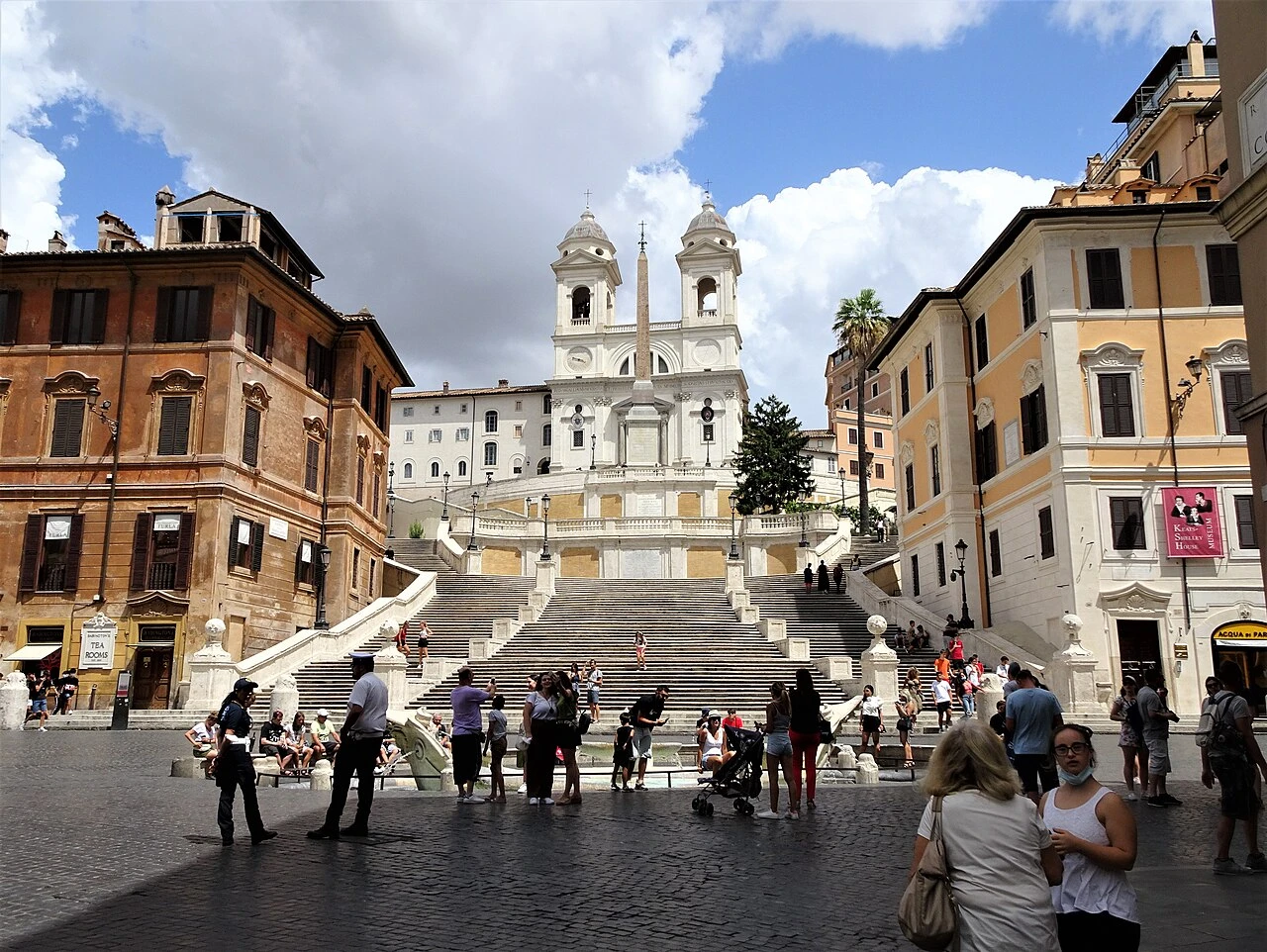
Rome · 1 km
Spanish Steps
Content & sources
Photo: Hugo DK · CC BY-SA 4.0
Rome · 1 km
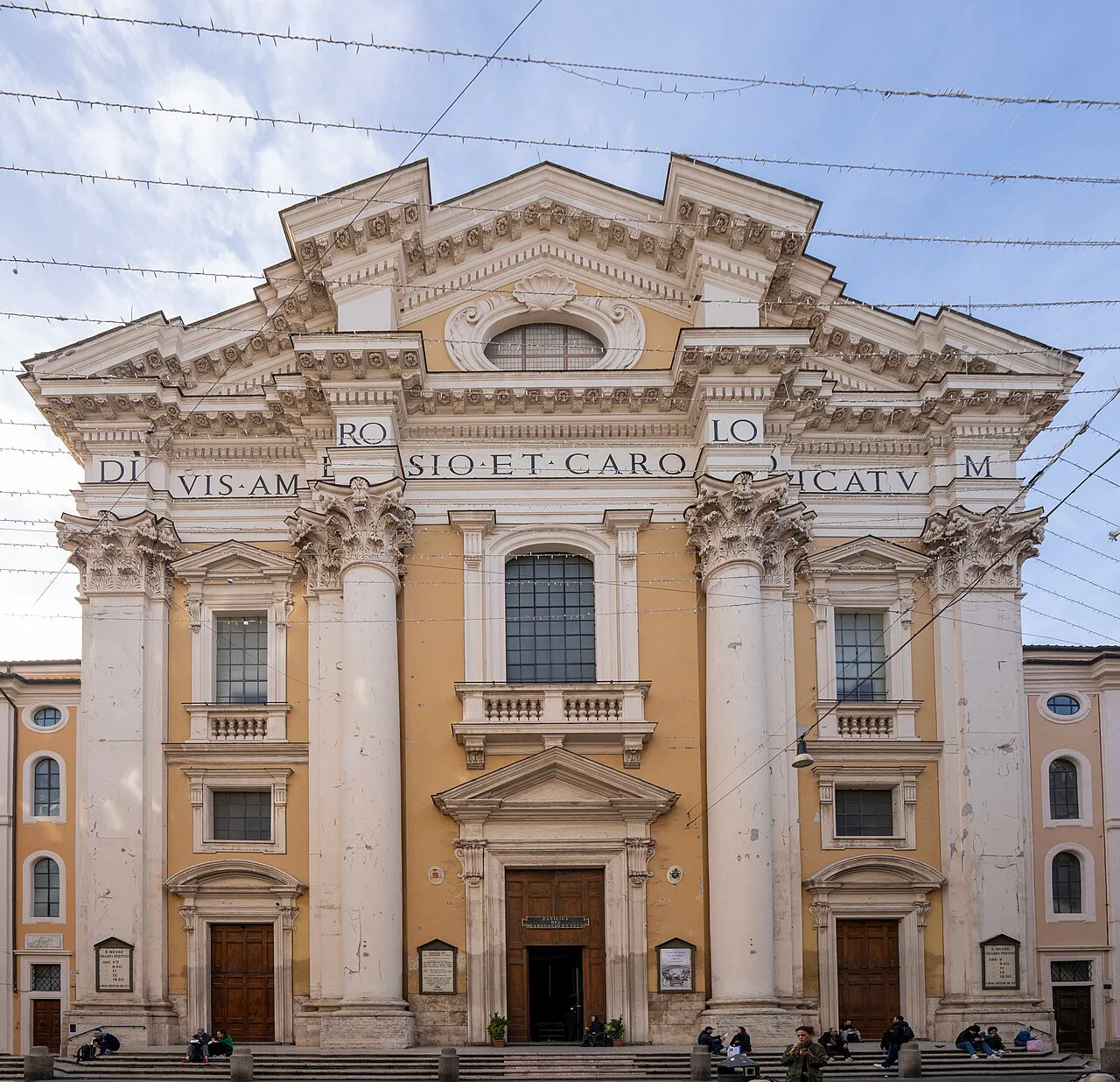
Basilica dei Santi Ambrogio e Carlo al Corso
Content & sources
Photo: DellaGherardesca · CC BY 4.0
Rome · 1 km
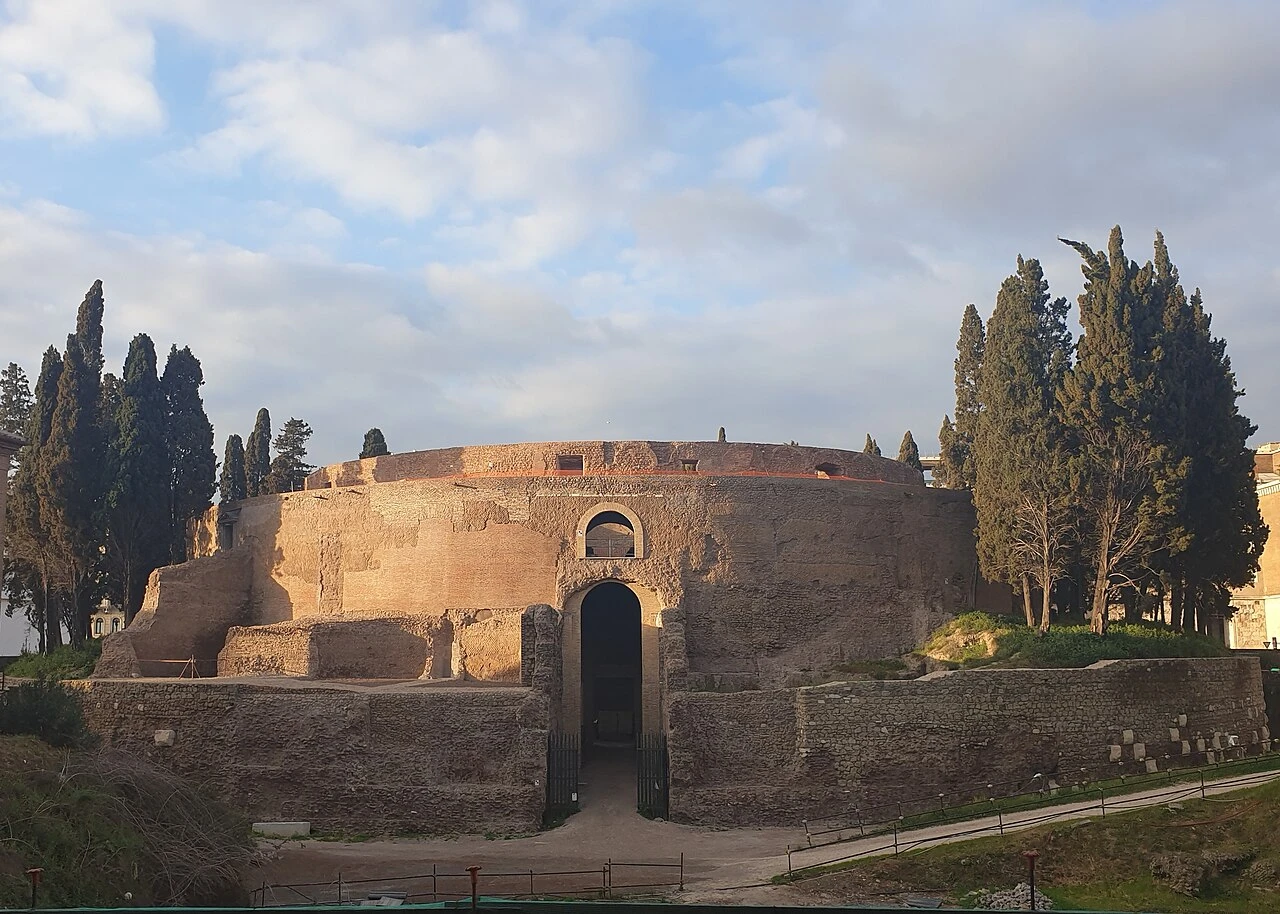
Mausoleum of Augustus
Content & sources
MumblerJamie · CC BY-SA 2.0
Rome · 1 km
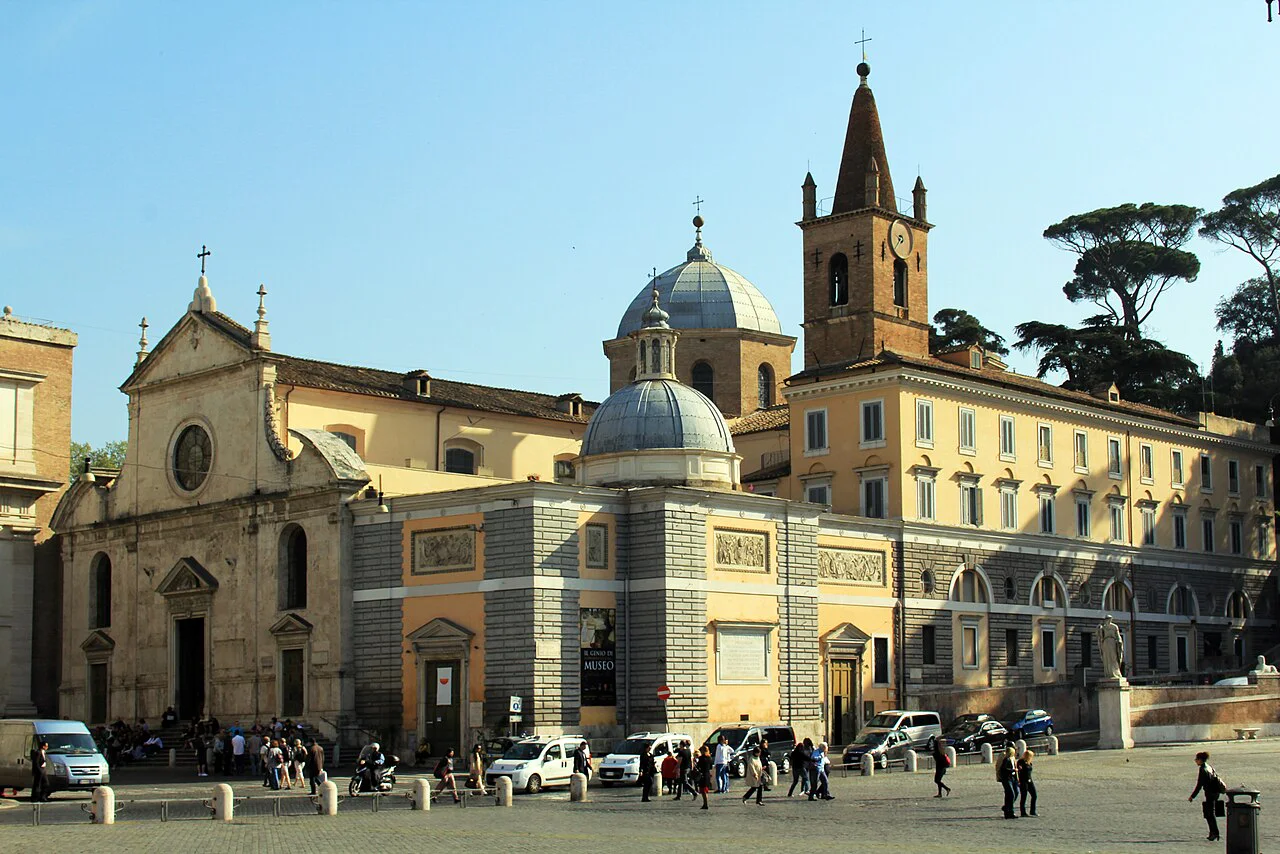
Basilica di Santa Maria del Popolo
Content & sources
Photo: Karelj · Public domain