Stanza · Audio guide
Chiesa di San Pietro in Montorio Audio Guide
A place to remember. A story to take with you.
San Pietro in Montorio is a church in Rome, Italy. It includes in its courtyard the Tempietto del Bramante, a small commemorative martyrium built by Donato Bramante.
Download Stanza, then search for “Chiesa di San Pietro in Montorio”.
About the tour
One guide. Your kind of visit.
San Pietro in Montorio is a church in Rome, Italy. It includes in its courtyard the Tempietto del Bramante, a small commemorative martyrium built by Donato Bramante.
Ready when you are.
- 01Get the free Stanza app.
iOS & Android
- 02Find your guide.
“Chiesa di San Pietro in Montorio”
- 03Download before you go.
Works offline
Audio guide / 11 narrated stops
Inside the guide
Get to know a few of the stories before you go. Open a stop to read more.
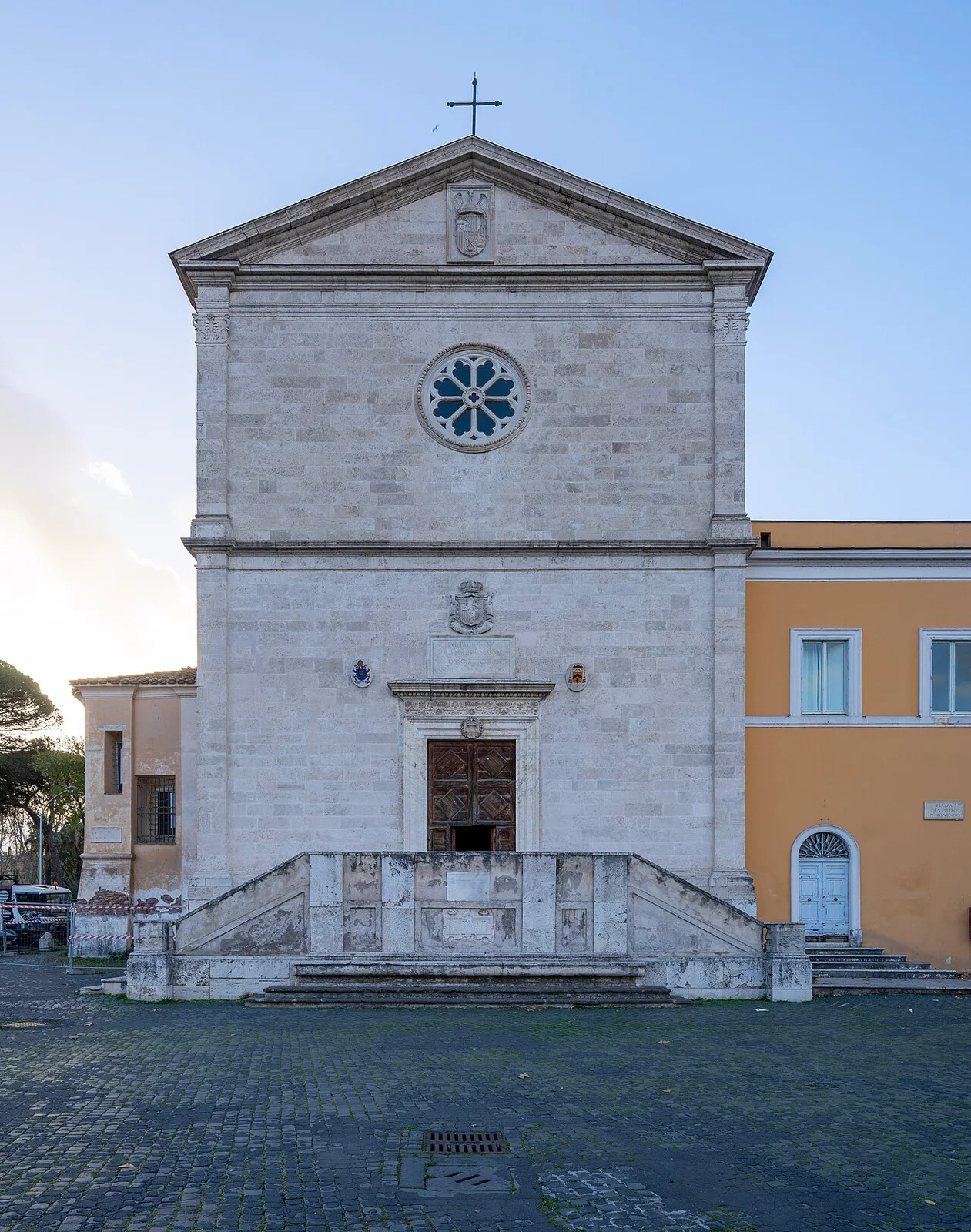
01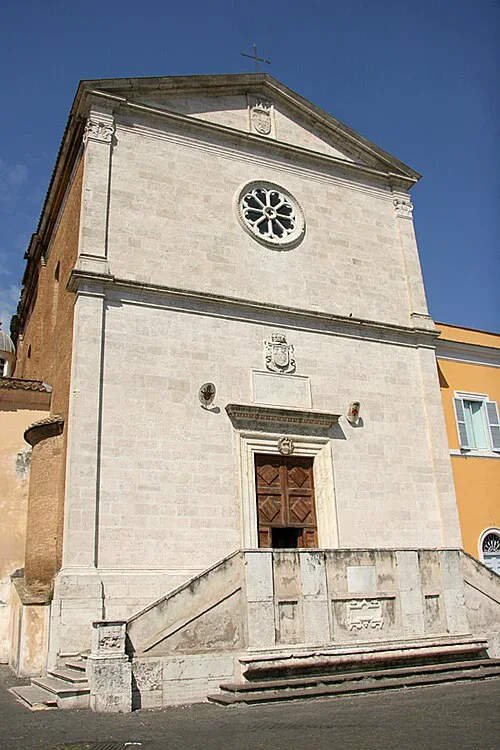 The Renaissance Facade & Janiculum Overlook
Facade of San Pietro in Montorio
Welcome to San Pietro in Montorio, high on Rome's Janiculum hill. A church to Saint Peter has stood here since the ninth century, and the building was begun again in 1481. The money came from far away: Ferdinand and Isabella of Spain, the joint rulers who also sent Columbus across the Atlantic. Pope Alexander VI consecrated the finished church in 1500. Tradition holds that Peter himself was crucified on this spot, upside down, which is why the hill mattered so much. The facade is plain pale travertine, with a rose window and a quiet doorway, more fortress than theatre. Its exposed position at the edge of the city brought trouble in 1849, when fighting reached the Janiculum during the siege of Rome. The church was used as a hospital, its archives were scattered and looted, and Romans gave it a bitter nickname: San Pietro in Mortorio, Saint Peter of the Death-house.
Photo: Quinok · CC BY-SA 3.0
02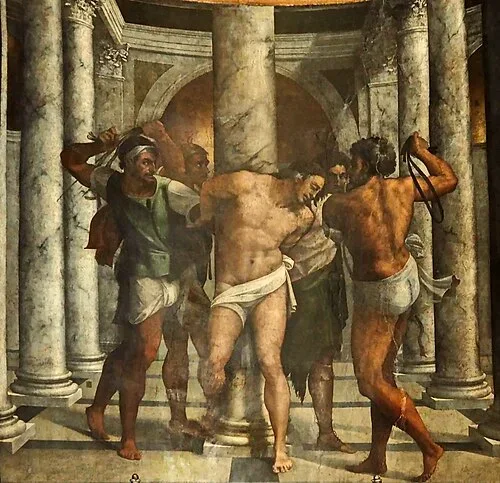 The Borgherini Chapel & Michelangelo's Secret Design
Sebastiano del Piombo's Flagellation
The first chapel on the right holds one of the great collaborations of the Renaissance. Sebastiano del Piombo painted this Flagellation between 1516 and 1524, showing Christ bound to a column while soldiers raise their whips. By then Sebastiano had become close friends with Michelangelo in Rome, and Michelangelo sent him drawings of the figures to work from. The friendship had a purpose. Michelangelo was locked in rivalry with Raphael, and he hoped Sebastiano, armed with his drawings, could outpaint him. Look at the Christ at the center, the heavy torso and twisted pose. That muscular anatomy is Michelangelo's style flowing through another man's brush. Whether the scheme ever truly beat Raphael is another matter, but the fresco remains rare evidence of two geniuses working toward one image.
Photo: Peter1936F · CC BY-SA 4.0
03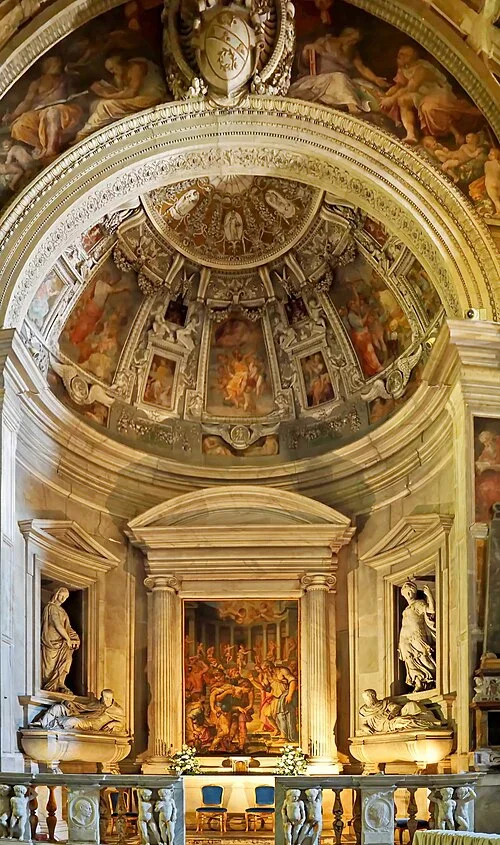 The Del Monte Chapel
This chapel is the monument of a family that reached the very top. Pope Julius III belonged to the Del Monte, and here they gathered their glory under a painted dome. The ceiling frescoes are by Giorgio Vasari, the same man who wrote the famous Lives of the artists. The tombs of Cardinal Antonio del Monte, the pope's uncle, and of Roberto Nobili were carved by Bartolomeo Ammannati, with seated figures and reclining effigies framing the altar. The altarpiece is attributed to Giulio Mazzoni. One more burial belongs here, and it is the awkward one. Cardinal Innocenzo Ciocchi Del Monte lies in this chapel too, called the pope's nephew. Gossip of the time told the relationship very differently, and the word nephew carried a scandal that has never quite faded.
Listen in the appPhoto: Peter1936F · CC BY-SA 4.0
04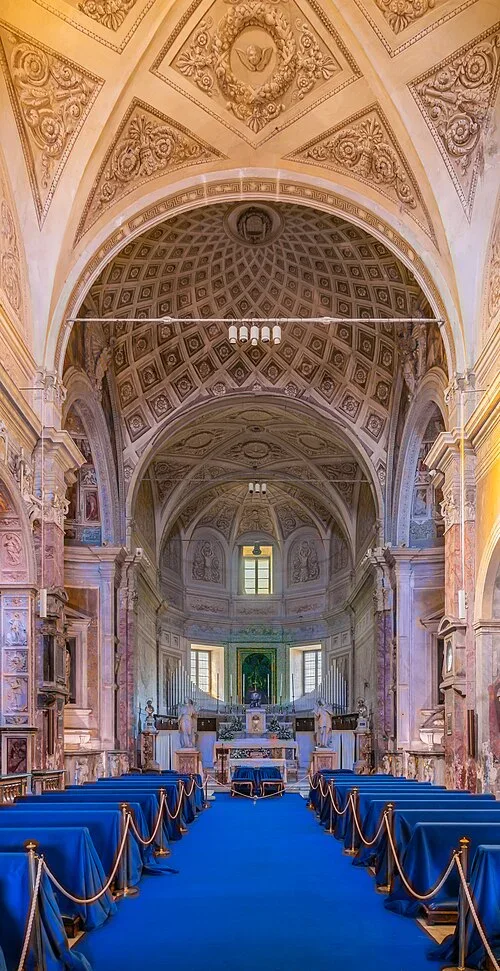 The High Altar & Tombs of the Irish Earls
The Nave and High Altar
The altar at the end of the nave once displayed one of the most famous paintings in the world. Raphael's Transfiguration, his final masterpiece, stood here until 1797. In that year the French took it away by treaty, and it now hangs in the Vatican Pinacoteca. In its place the altar shows a copy, painted by Camuccini after Guido Reni's Crucifixion of Saint Peter, which is also in the Vatican today. Below this altar lies a sadder story. Tradition says Beatrice Cenci is buried here, the young Roman executed in 1599 for the murder of her abusive father, later made famous by Shelley and others. There is no grave marker to confirm it. What is recorded is that French soldiers broke open the tomb in 1798.
Listen in the appKrzysztof Golik · CC BY-SA 4.0
05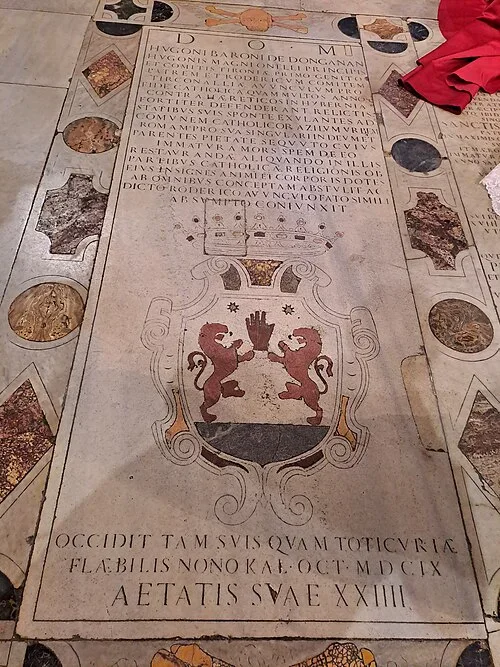 The High Altar & Tombs of the Irish Earls
Tomb Slab of the Irish Earls
Set into the floor near the high altar is a slab that carries Ireland into this Roman church. In 1607, Hugh O'Neill, Earl of Tyrone, and Rory O'Donnell, Earl of Tyrconnell, fled Ireland with ninety followers, driven out by the English-led government. It is known as the Flight of the Earls. O'Donnell and his brother Cathbharr died the next year of fever, probably malaria caught on an unlucky holiday to Ostia. O'Neill lived on until 1616, but he was buried with little ceremony, most likely because he had almost no money left. At least eleven Irish exiles were laid to rest in this church. The inscription on the slab reads D.O.M. Hugonis principis ONelli ossa, the bones of Prince Hugh O'Neill. The original stone was lost long ago, and in 1989 Cardinal Tomás Ó Fiaich laid a new marble plaque with the same words.
Listen in the appPhoto: Jean Yves Oufrani · CC BY-SA 4.0
06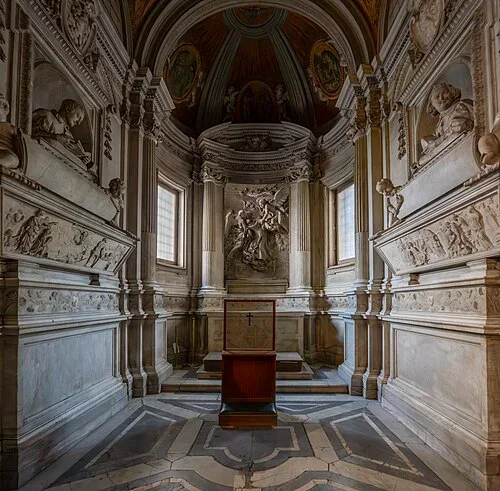 The Raimondi Chapel & Bernini's Theater of Light
The Raimondi Chapel
The second chapel on the left is early Baroque theatre, and Gian Lorenzo Bernini drew the plan. It was finished in 1640 for the Raimondi family. The heart of it is Francesco Baratta's Saint Francis in Ecstasy, flanked by sculptures from Andrea Bolgi and Niccolò Sale. What makes the chapel famous is something harder to see at first: the light. A window is hidden behind the sculptural group, so daylight falls on the saint from nowhere the eye can trace. The tombs along the walls catch only a shallow side light, which gives the carved figures an uncanny life. Bernini had learned that in a chapel, light can be directed like scenery.
Listen in the appPhoto: Labicanense · CC BY 4.0
07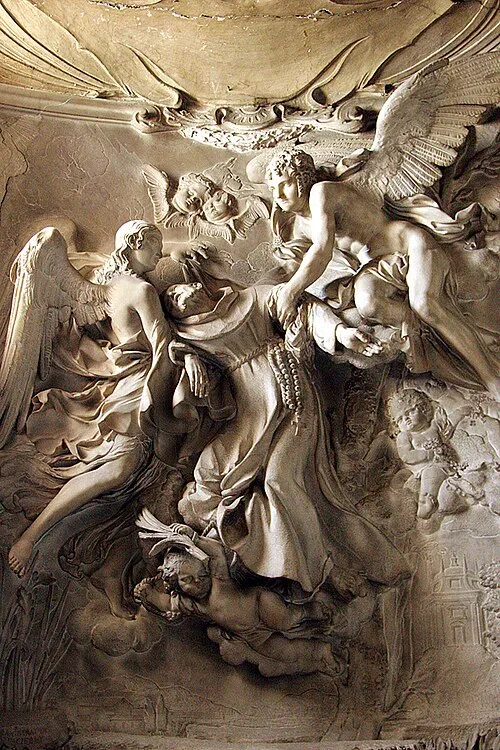 The Raimondi Chapel & Bernini's Theater of Light
Saint Francis Carried by Angels
The relief at the center of the chapel shows the moment itself. Saint Francis swoons, his body sinking, his robes swept upward as if by wind. Two angels strain to hold him, their wings cutting across the marble, while putti tumble below. Baratta carved the whole scene so that the drapery seems to move, hard stone turned into billowing cloth. It became the devotional heart of the chapel, and that fits the house. Franciscan friars have kept this church since the fifteenth century, so a vision of their founder, carried to heaven by angels, belongs here more than anywhere else in Rome.
Listen in the appPhoto: Quinok · CC BY-SA 3.0
08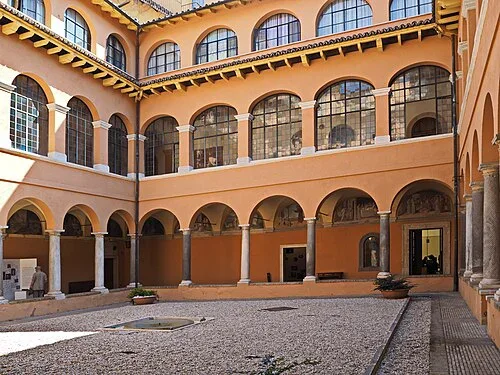 The Spanish Cloister & Royal Academy
The Monastery Cloister
This arcaded courtyard belonged to the monastery that always stood beside the church. In the fifteenth century the ruined site was given to the Amadist friars, a reform branch of the Franciscans founded by the Blessed Amadeus of Portugal, who had been confessor to Pope Sixtus IV. The friars walked these covered passages and drew water from the well-head at the center of the gravel. They were far from the first community here. Before them the complex passed through Benedictine hands, then the Celestines, who by 1320 called it Sancti Petri Montis Aurei, Saint Peter of the Golden Mountain, after the yellowish earth of the Janiculum. Ambrosians followed, then Cistercian nuns, before the Franciscans took root.
Listen in the appPhoto: Peter1936F · CC BY-SA 4.0
09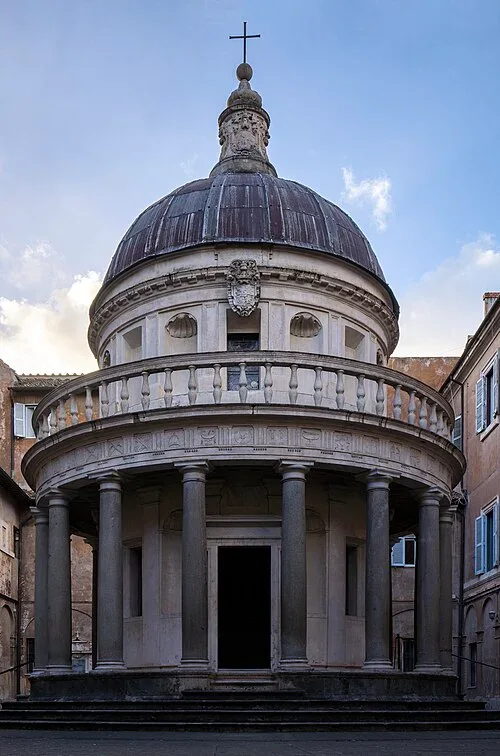 Bramante's Tempietto & Martyrdom Crypt
Bramante's Tempietto
In the courtyard stands a building barely bigger than a house, and yet architects have admired it for five centuries. This is the Tempietto, the little temple, designed by Donato Bramante and possibly built as early as 1502. Ferdinand and Isabella of Spain commissioned it, the same royal pair who paid for the church itself. It is a martyrium, a small commemorative monument raised over a place of martyrdom. That explains the round shape. A circle has no front and no back, setting the shrine apart from the everyday church nearby. A colonnade of Tuscan columns rings the drum, crowned by a dome, with niches cut into the wall and a frieze of triglyphs and metopes carved with liturgical motifs of Greek origin. It is counted a masterpiece of the High Renaissance, a classical temple reborn in miniature.
Listen in the appPhoto: Labicanense · CC BY 4.0
10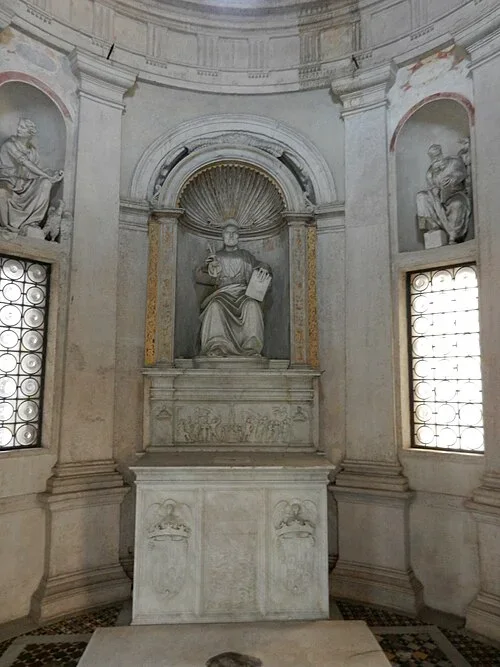 Bramante's Tempietto & Martyrdom Crypt
Inside the Tempietto
Step inside and the building shrinks around you. The inner room, the cella, is only about four and a half meters across, a space a handful of people can share. Yet every part is measured. The dome's radius equals its own height, and the height of the drum beneath it, so the whole structure is calibrated like a classical temple. An altar niche holds a statue of Peter, and narrow windows let in thin blades of light. The effect is compression, not grandeur. Bramante built the proportions of a vast temple into a room you could cross in three strides.
Listen in the appPhoto: Geobia · CC BY-SA 4.0
- 11
The Crypt of the Martyrdom
The crypt hole that tradition says marks the very place of the crucifixion.
Chiesa di San Pietro in Montorio
Frequently asked questions
How much does the guide cost?
Free app download. Listed guide price: $0.99. Guide price shown in the app. Audio guide only. Venue admission is separate.
Can I listen without internet?
Yes. Download the guide’s audio, images, and maps in the app before your visit. Your downloaded content is then available offline.
Can I listen in my language?
This audio guide is available in 15 languages, including English.
Do I need to follow a schedule?
No. This is a self-guided experience. Choose your stops, pause whenever you like, and return to a story at your own pace.
At your own pace
Explore Chiesa di San Pietro in Montorio.
Download Stanza, then search for “Chiesa di San Pietro in Montorio”.
Free app download · Guide price shown in the app
Keep exploring
Nearby audio guides
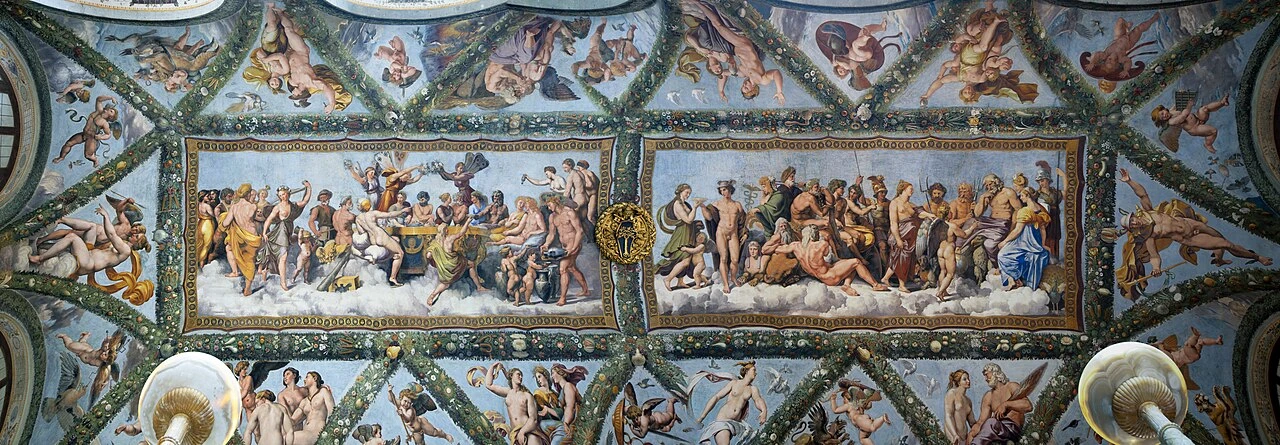
Rome · 1 km
Villa Farnesina
Content & sources
Paris Orlando · CC BY-SA 4.0
Rome · 1 km
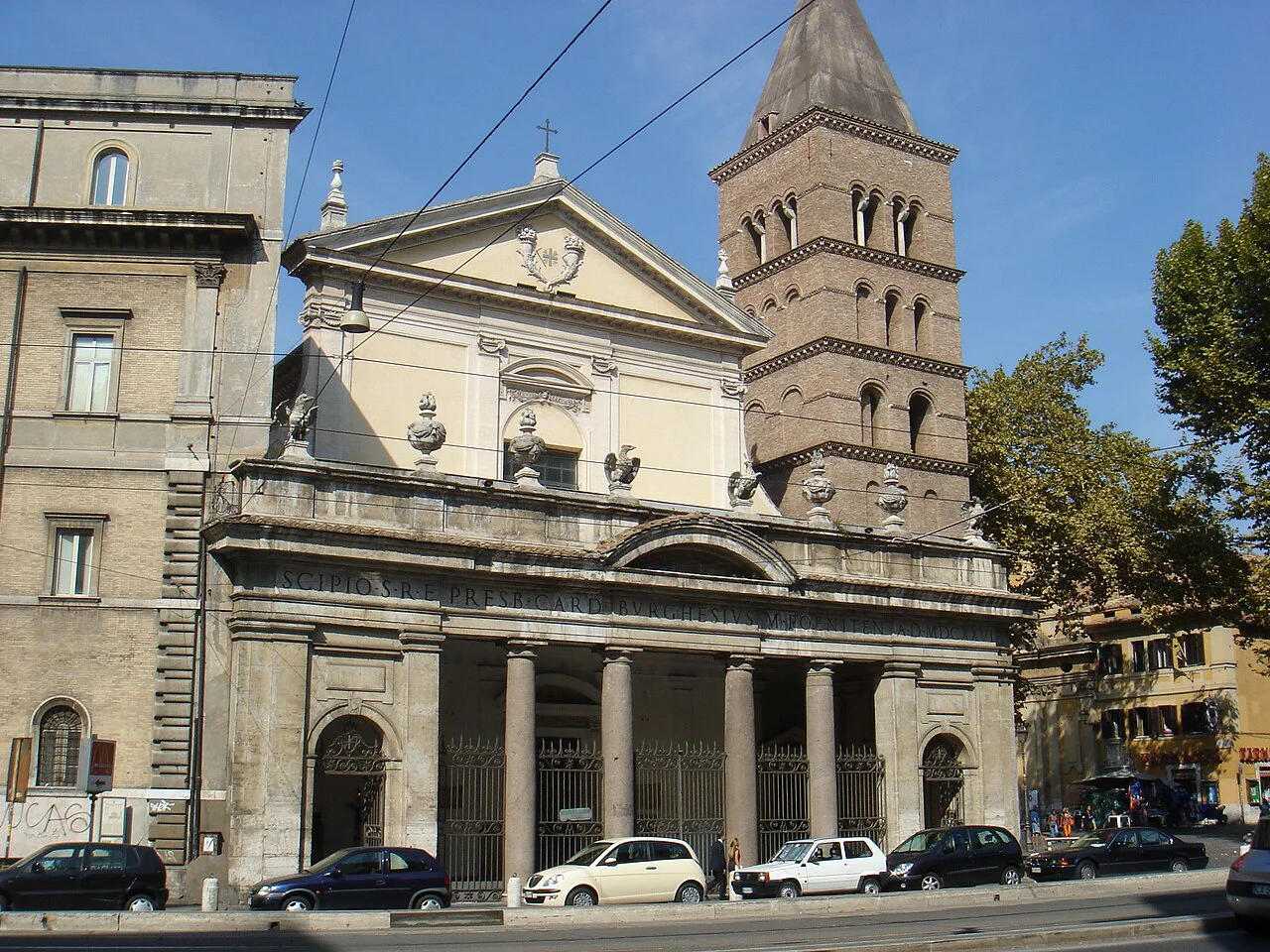
Basilica di San Crisogono
Content & sources
Photo: Lalupa · CC BY-SA 3.0
Rome · 1 km
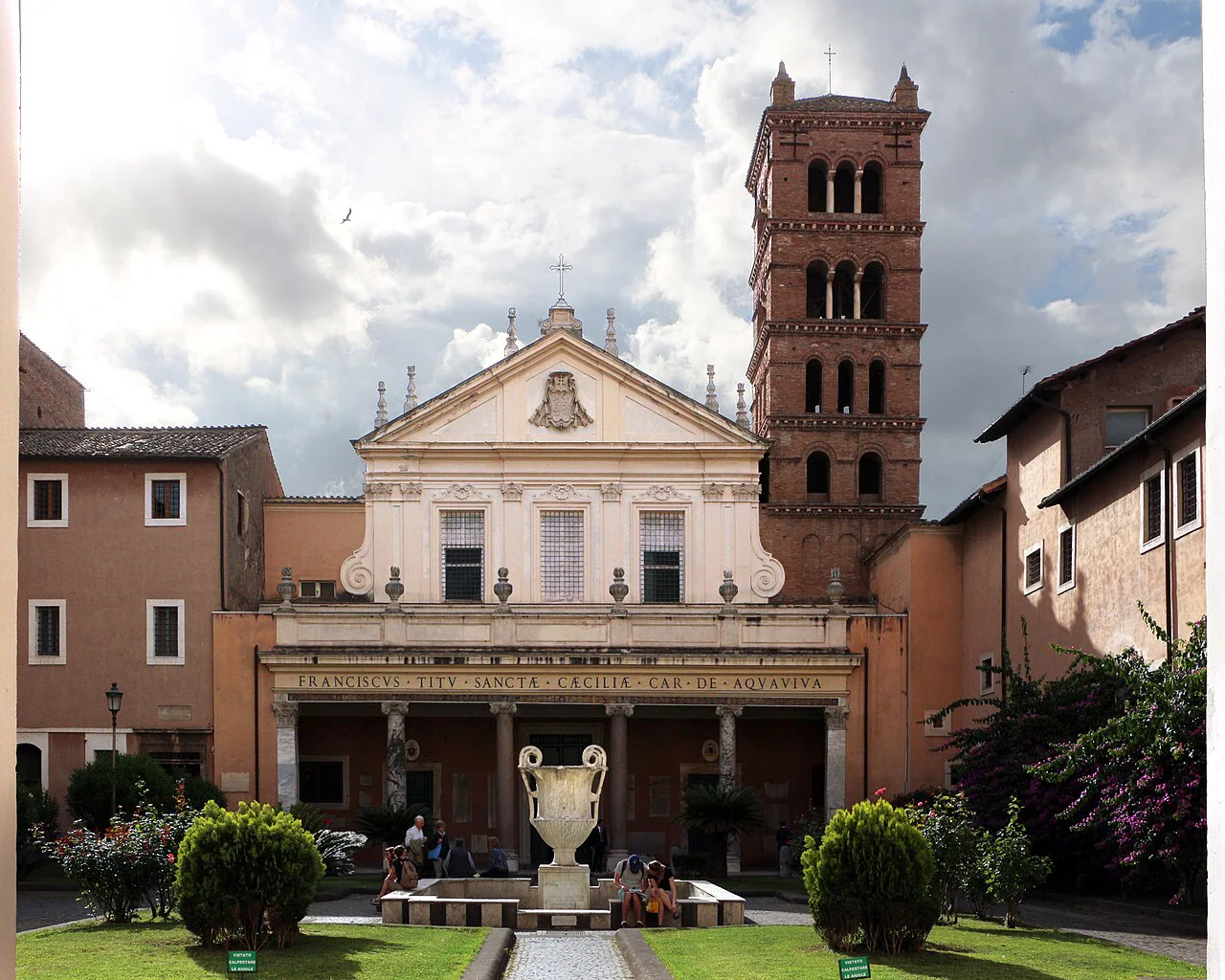
Basilica di Santa Cecilia in Trastevere
Content & sources
Photo: Sailko · CC BY 3.0
Rome · 1 km
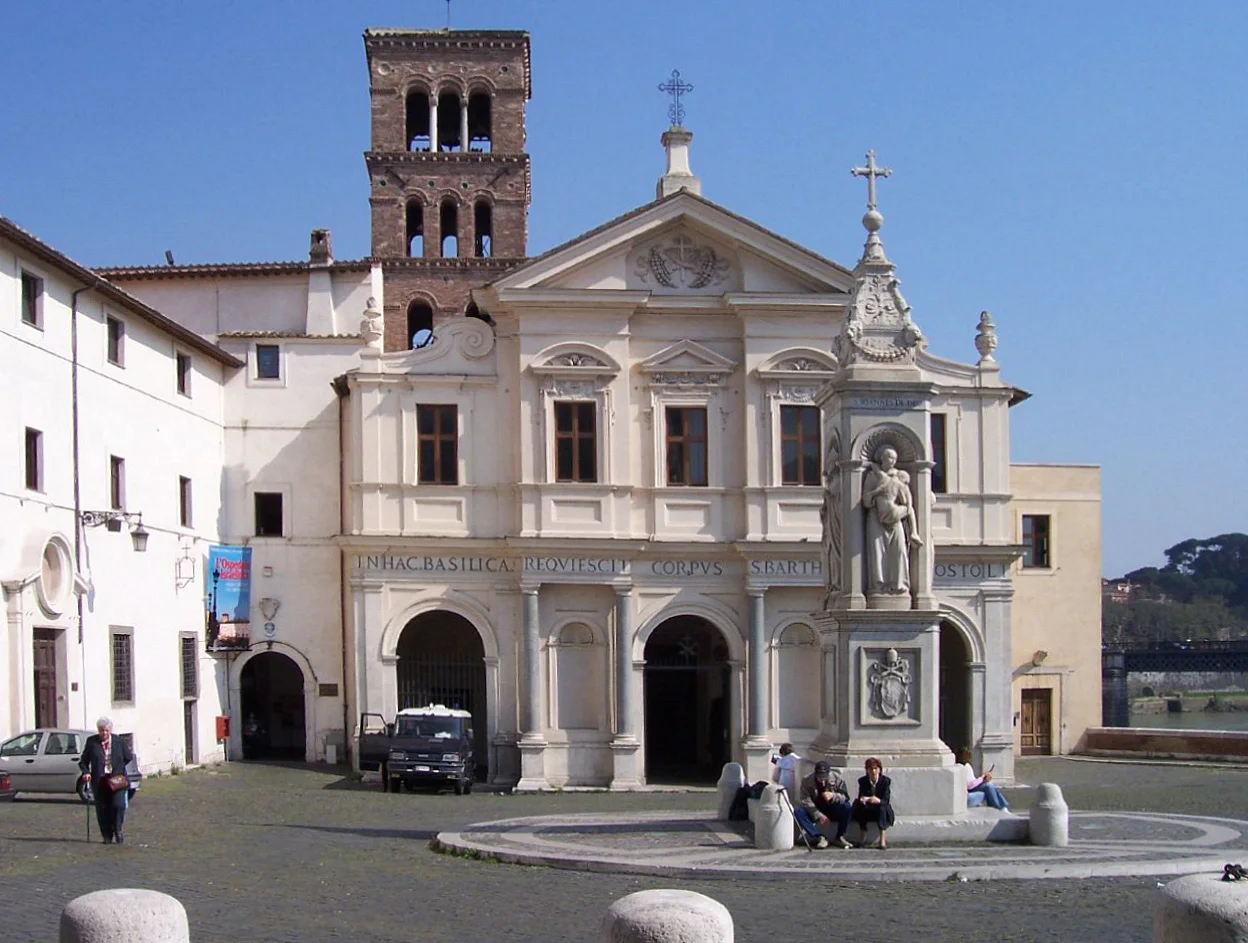
Basilica di San Bartolomeo all'Isola
Content & sources
sonofgroucho · CC BY 2.0