Stanza · Audio guide
Roman Theatre of AmmanAudio guide
A place to remember. A story to take with you.
A 2nd-century Roman theatre built into the side of a hill that serves as one of the most prominent landmarks in Amman. It remains in use today for cultural events and performances.
Download Stanza, then search for “Roman Theatre of Amman”.
About the tour
One guide. Your kind of visit.
A 2nd-century Roman theatre built into the side of a hill that serves as one of the most prominent landmarks in Amman. It remains in use today for cultural events and performances.
Ready when you are.
- 01Get the free Stanza app.
iOS & Android
- 02Find your guide.
“Roman Theatre of Amman”
- 03Download before you go.
Works offline
Audio guide / 9 narrated stops
Inside the guide
Get to know a few of the stories before you go. Open a stop to read more.
01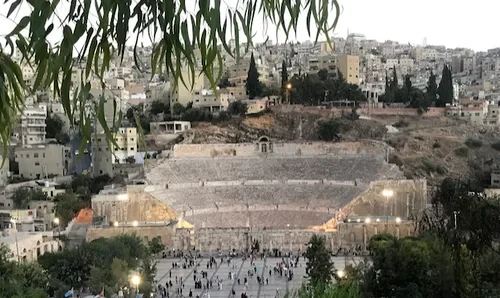 Hashemite Plaza and ColonnadeHashemite Plaza Overview
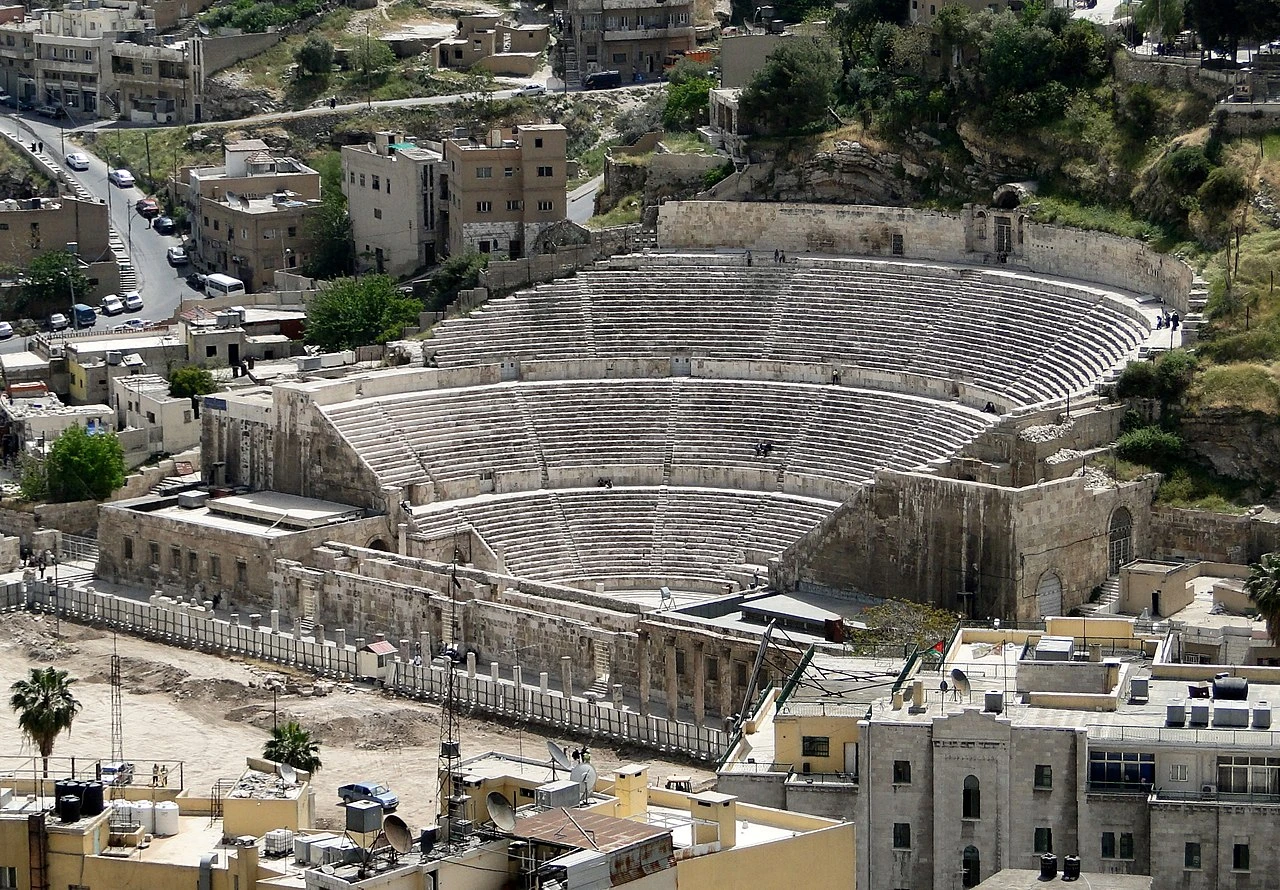
Welcome to the ancient Roman city of Philadelphia, known today as Amman. Standing in the modern, expansive Hashemite Plaza, the sheer scale of the Roman Theatre becomes immediately apparent. Constructed during the second century CE under the rule of Emperor Antoninus Pius, this architectural feat was designed to accommodate up to six thousand spectators. The towering tiers of limestone seats are carved directly into the natural northern slope of the hillside, merging structural stability with natural geography. The expansive plaza at its base serves as a central gathering point, much as it did when the city was a prominent member of the Decapolis League. From this vantage point, you can appreciate how the ancient builders utilized the landscape to create an enduring monument that remains a central focal point of the modern city's daily life. Look up at the vast seating curves that draw the eye toward the sky.
Photo: Iainsimpsonstewart · CC0
02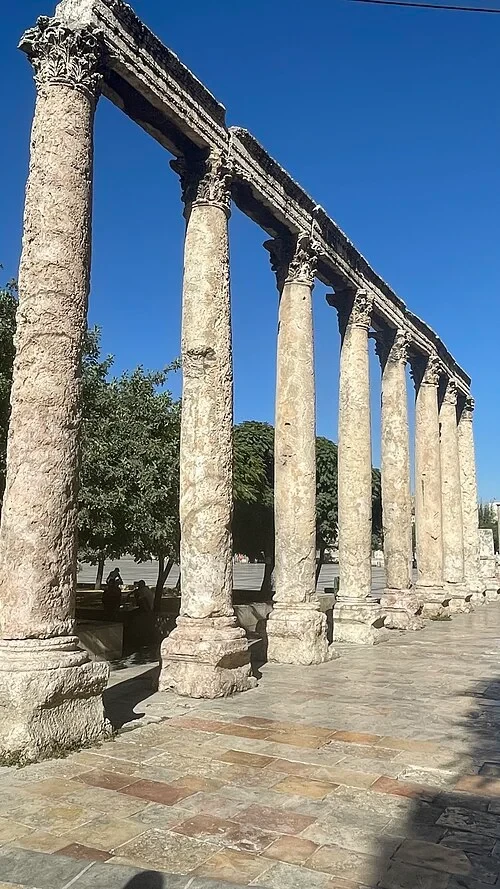 Hashemite Plaza and ColonnadeThe Roman Colonnade
A line of towering stone columns marks the edge of the public plaza, representing the architectural boundary of the ancient municipal complex. These tall pillars feature weathered Corinthian capitals decorated with carved acanthus leaves, though centuries of wind and sand have softened their intricate details. If you look closely at the top of the columns, you can see a surviving horizontal architrave block still resting in its original position. In the second century, this grand colonnade served a practical and symbolic purpose as a formal entranceway. It physically separated the bustling municipal forum—where merchants traded and citizens debated—from the quiet, structured environment of the theatrical entertainment complex. Walking through this gateway signified a transition from the chaotic business of the city into a world of drama, music, and performance. Today, the columns provide a striking architectural frame, demonstrating the elegant urban planning of Roman Philadelphia.
Photo: Mervat · CC BY-SA 4.0
03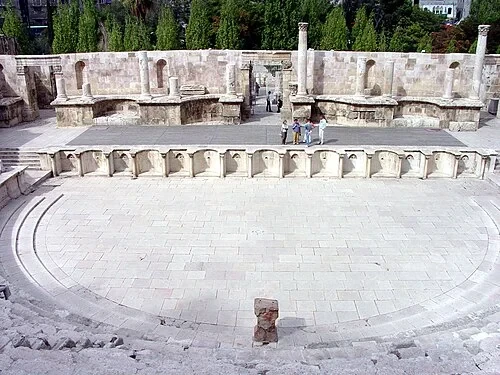 The Orchestra and StageThe Orchestra and Stage
The semi-circular floor at the base of the seating area is the orchestra, the focal point of the ancient theatre. In Roman times, this flat space was not used for the chorus as in Greek theatres, but was instead reserved for prestigious seating for high-ranking officials and VIPs. A low stone barrier separates this floor from the steep rise of the general seating tiers, ensuring a clear division of space. Behind the orchestra lie the remains of the stage wall, known as the scaenae frons. Although only the lower portions remain standing today, this backdrop was originally a highly decorated, multi-story structure featuring columns, niches, and statues. Actors used the shallow stage in front of this wall to perform plays, comedies, and tragedies, utilizing the acoustic properties of the stone backdrop to project their voices to the thousands of spectators watching from the steep benches above.
Listen in the appMichael Gunther · CC BY-SA 3.0
04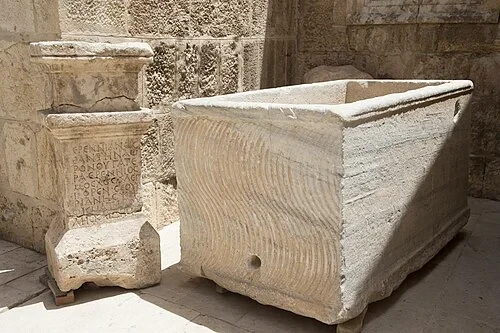 The Orchestra and StageThe Imperial Dedication
Standing alongside a large, rectangular stone basin is an inscribed stone pedestal that provides crucial historical context for the entire complex. Carved into the surface of this block are ancient Greek letters that formally dedicate the theatre to Emperor Antoninus Pius, who ruled Rome in the second century CE. The deep-cut Greek characters are still visible, though they show significant wear from nearly two millennia of exposure to the elements. Such dedication stones were common in public works across the Roman Empire, serving to honor the imperial patron while reinforcing Rome's authority in provincial cities like Philadelphia. The physical weathering on the block, from chipped corners to faded edges, records the long history of this site. This modest stone block serves as the primary historical document that anchors the theatre to a specific era of Roman prosperity.
Listen in the appPhoto: Dosseman · CC BY-SA 4.0
05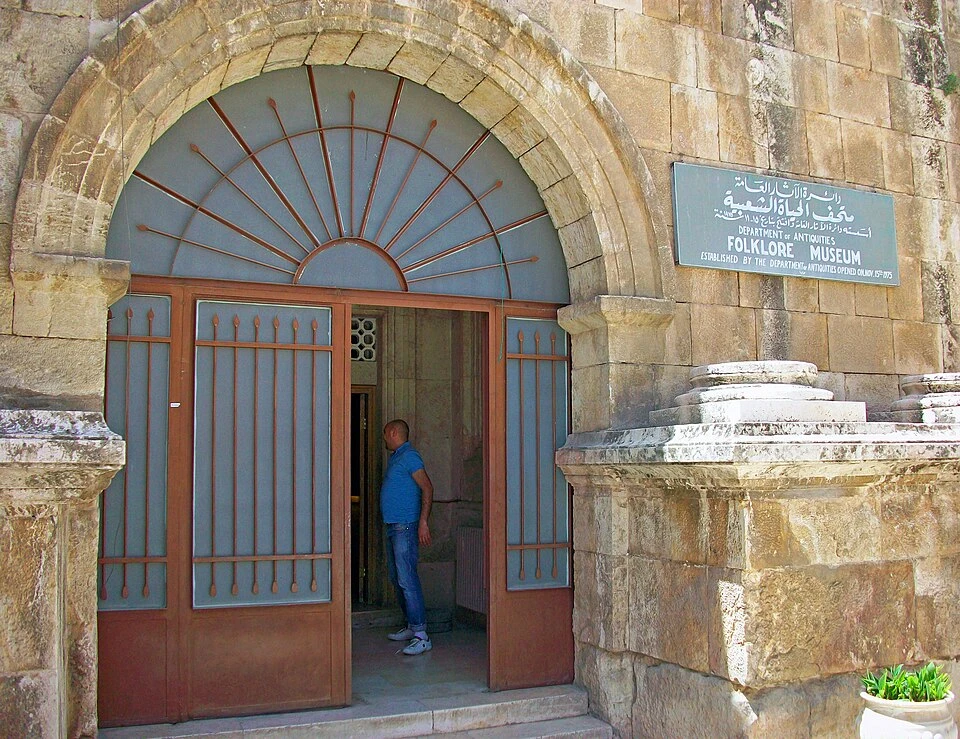 Jordan Folklore MuseumFolklore Museum Vaults
The arched stone entryways built into the heavy side vaults of the theatre are known historically as the paradoi. In antiquity, these vaulted side passages functioned as the primary entrance corridors for spectators entering the lower levels of the seating area, managing large crowds with remarkable efficiency. Today, these ancient stone vaults have been adapted for a different civic purpose. They now house the Jordan Folklore Museum, bridging the physical remnants of the Roman past with modern efforts to preserve and celebrate Jordanian heritage. The thick limestone walls of the vaults provide a natural, climate-controlled environment that helps protect the delicate exhibits inside. Walking through these cool, arched passages allows you to experience the spatial engineering of Roman architecture while transitioning into a space dedicated to the cultural history of the region's modern inhabitants.
Listen in the appPhoto: Daniel Case · CC BY-SA 3.0
06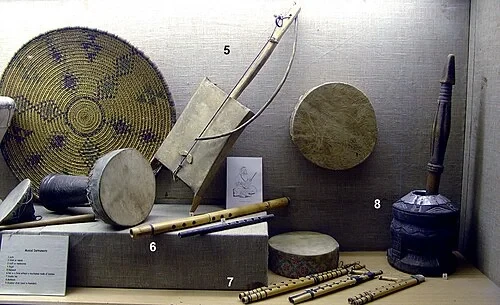 Jordan Folklore MuseumTraditional Musical Instruments
Inside the display cases of the museum, you will find a collection of traditional musical instruments that tell the story of Jordan's cultural heritage. Among the items on display is the rababa, a traditional single-stringed instrument wrapped in animal skin, which has long been used by Bedouin poets to accompany epic oral histories. Beside it are various skin-headed drums and simple reed flutes, instruments that provided the rhythmic and melodic backbone for celebrations in nomadic and agrarian communities. These objects highlight a long history of folk music that was passed down through generations. Displaying these instruments inside the repurposed vaults of the Roman theatre creates a unique connection between ancient and modern performance arts, showing how the tradition of music and gathering continues to be celebrated within the very walls built for entertainment nearly two thousand years ago.
Listen in the appMichael Gunther · CC BY-SA 4.0
07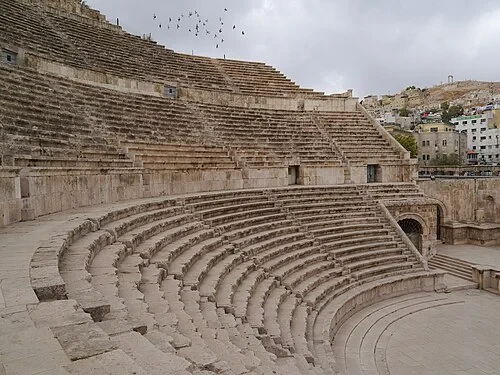 The Cavea and Hillside EngineeringThe Cavea Seating Tiers
The massive, steep curve of stone benches rising above the orchestra is called the cavea. To manage the movement of up to six thousand spectators, Roman engineers divided the seating into three distinct horizontal sections separated by wide walkways called diazomata. These divisions were not merely functional for crowd control; they also enforced the rigid social hierarchies of the Roman Empire. The lowest tier, closest to the stage and the orchestra, was reserved for the city's elite, including magistrates, priests, and wealthy patrons. The middle tier was occupied by Roman citizens, merchants, and soldiers, while the highest, most distant tiers were designated for the general public, foreigners, and women. This architectural layout ensured that every spectator's place in society was visually and physically reinforced during public spectacles, making the theatre a miniature representation of the social order of Roman Philadelphia.
Listen in the appPhoto: Zairon · CC BY-SA 3.0
08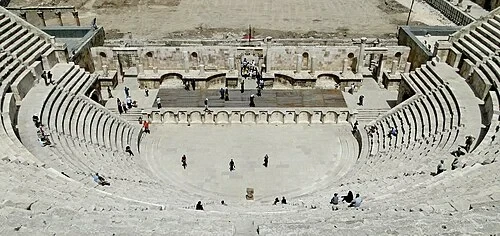 The Cavea and Hillside EngineeringView from the Peak
Standing at the very top of the highest seating tier offers a dramatic, birds-eye view of the entire semi-circular structure and the city beyond. From this elevated vantage point, the clever planning of the Roman architects becomes clear. The theatre was specifically oriented to face north, a deliberate engineering decision designed to keep the harsh desert sun behind the audience during afternoon performances, preventing glare and providing shade for the spectators. Additionally, carving the massive structure directly into the natural slope of the hillside was not just about saving labor; it also maximized the natural acoustic properties of the bowl. Sound waves generated at the stage level travel up the curved stone tiers with minimal loss of volume, allowing even those sitting on these highest benches to hear the actors' voices clearly. The design perfectly blends natural geography with advanced Roman acoustic and solar engineering.
Listen in the appBernard Gagnon · CC BY-SA 3.0
09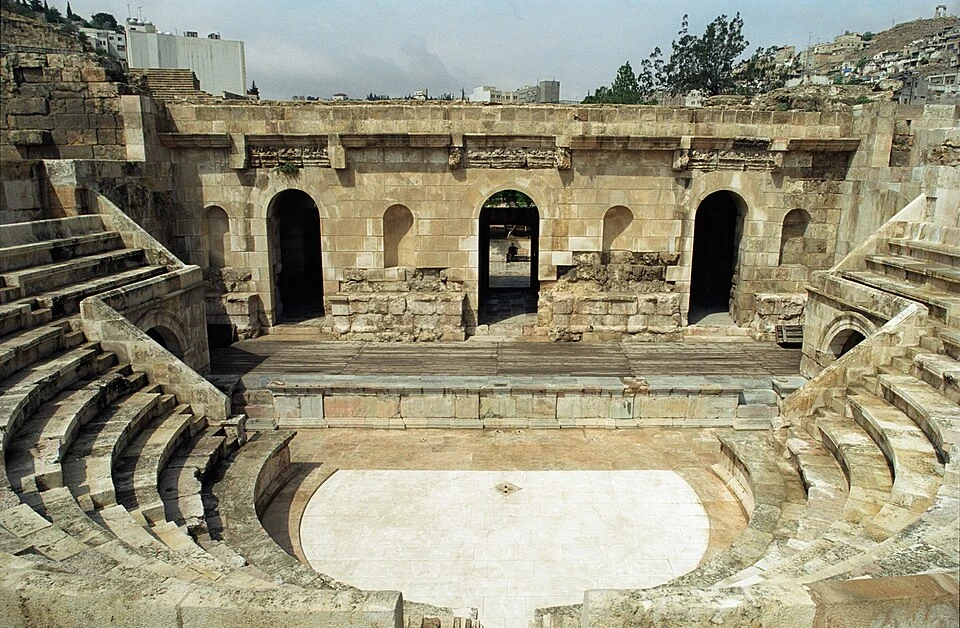 The Odeon of AmmanThe Neighboring Odeon
Located just across the plaza from the main theatre is a much smaller, semi-circular structure known as the Odeon. Built to accommodate roughly five hundred spectators, this intimate venue contrasts sharply with the massive six-thousand-seat theatre next door. Historically, the Odeon was a fully enclosed space, originally covered by a wooden roof that has long since vanished. Because of its smaller scale and enclosed nature, it was used primarily for intimate musical performances, poetry recitals, and lectures where acoustic clarity was paramount. Additionally, the Odeon functioned as a civic meeting hall, hosting gatherings of the city's governing council to debate municipal affairs. While the large theatre was designed for grand spectacles for the entire populace, the Odeon served the elite and intellectual circles of Philadelphia, providing a specialized space for administrative governance and refined cultural events.
Listen in the appJerzy Strzelecki · CC BY-SA 3.0
Roman Theatre of Amman
Frequently asked questions
How much does the guide cost?
Free app download. Listed guide price: $3.99. Guide price shown in the app. Audio guide only. Venue admission is separate.
Can I listen without internet?
Yes. Download the guide’s audio, images, and maps in the app before your visit. Your downloaded content is then available offline.
Can I listen in my language?
Stanza supports 15 languages. Check the app for the languages available for this guide.
Do I need to follow a schedule?
No. This is a self-guided experience. Choose your stops, pause whenever you like, and return to a story at your own pace.
At your own pace
Explore Roman Theatre of Amman.
Download Stanza, then search for “Roman Theatre of Amman”.
Free app download · Guide price shown in the app
Keep exploring
Nearby audio guides
Jerash
Jerash
Content & sources
Photo: JoTB · CC BY-SA 3.0
Petra Sub-District
Petra
Content & sources
Diego Delso · CC BY-SA 3.0