Stanza · Audio guide
St. Peter's Church, Riga Audio Guide
A place to remember. A story to take with you.
St. Peter's Church is a Lutheran church in Riga dedicated to Saint Peter. It serves as a parish church of the Evangelical Lutheran Church of Latvia.
Download Stanza, then search for “St. Peter's Church, Riga”.
About the tour
One guide. Your kind of visit.
St. Peter's Church is a Lutheran church in Riga dedicated to Saint Peter. It serves as a parish church of the Evangelical Lutheran Church of Latvia.
Ready when you are.
- 01Get the free Stanza app.
iOS & Android
- 02Find your guide.
“St. Peter's Church, Riga”
- 03Download before you go.
Works offline
Audio guide / 11 narrated stops
Inside the guide
Get to know a few of the stories before you go. Open a stop to read more.
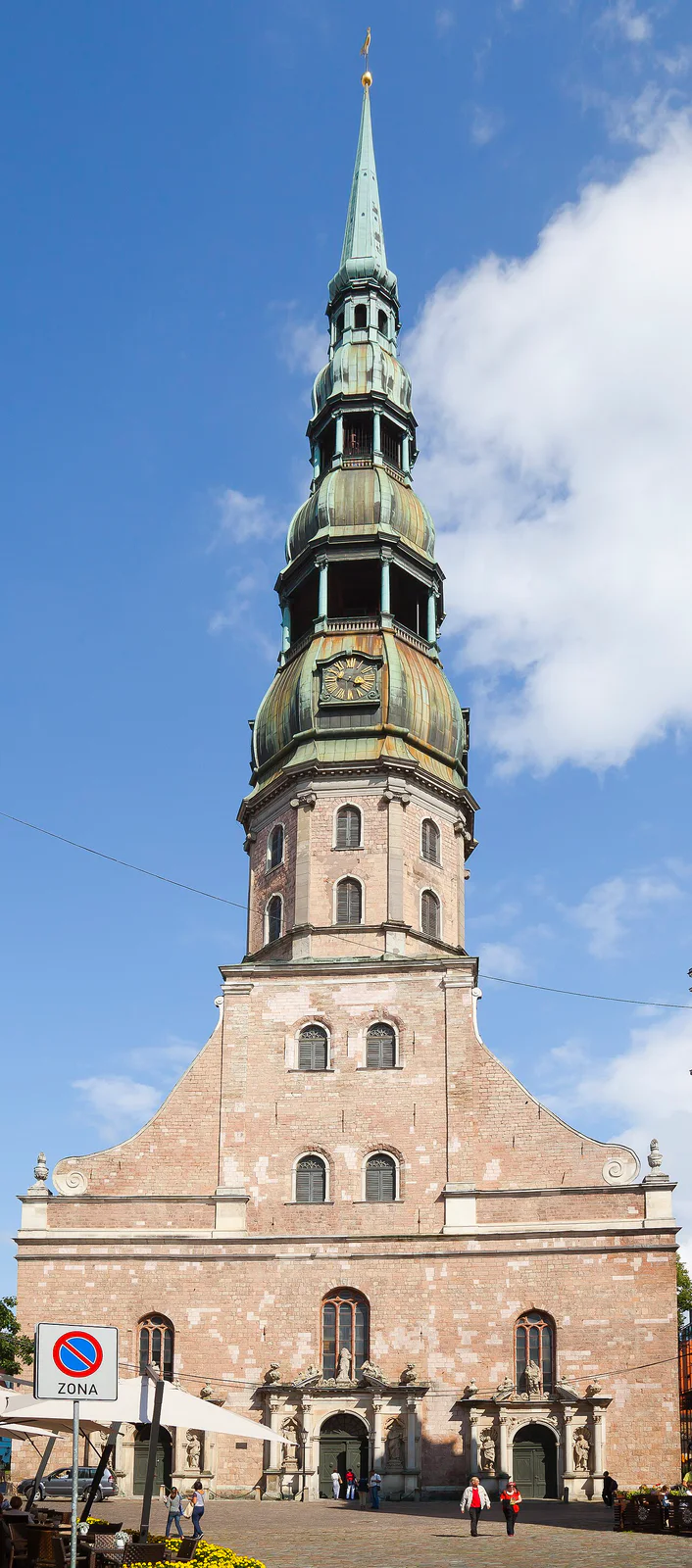
01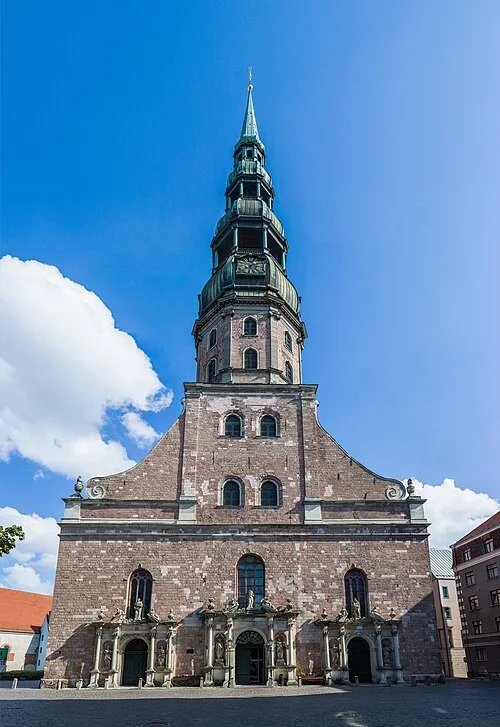 Western Facade and Baroque Portals
St. Peter's Church Facade and Tower
Here we follow Saint Peter's Church through the rebuilds that shaped it. The church is a parish church of the Evangelical Lutheran Church of Latvia, in Old Riga. It is first mentioned in 1209. That same year a city fire swept through Riga, but the church was built of masonry, stone and brick set in mortar, so it came through undamaged. Its founder is credited as Albert of Riga. Today the tower rises a hundred and twenty-three and a quarter metres, and it has been rebuilt more than once. Stepped gables with scrolled stone edges frame the brick front, and the tiered tower climbs above them, with its clock and tall spire.
Photo: Jānis U. · CC BY-SA 4.0
02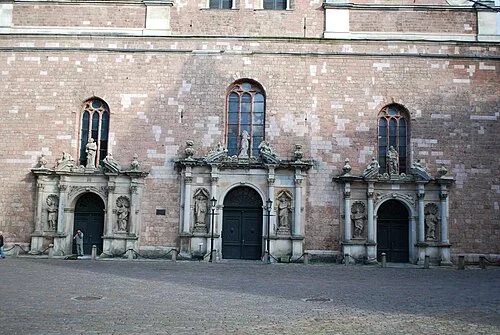 Western Facade and Baroque Portals
Baroque Western Portals
The earlier tower collapsed in 1666, destroying a neighbouring building and burying eight people in the rubble. A new cornerstone was laid the following year. Work on the western front and the new tower began in 1671. It went on until 1690. Jacob Josten, the Dutch-born master builder of Riga, designed the tower and supervised its construction. Rupert Bindenschu took over in 1675. In 1692 the city council approved Bindenschu's design for three identical portals. A merchant named Klaus Mistett paid for them, and several stonemasons and sculptors built them. The brick front was covered in reddish limestone from Salaspils and Koknese. Its scrolls, pilasters, cornices and vases are made of Gotland stone. Carved figures stand in niches beside the doorways. The sculptures are in the Baroque style, carved in limestone. A Polish firm called PKZ restored the main front and the portals between 1987 and 1991.
Photo: Jānis U. · CC BY-SA 4.0
03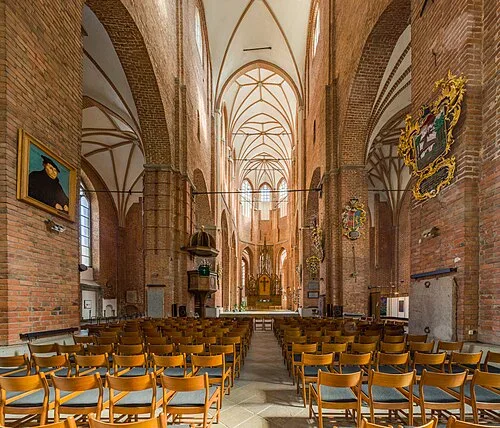 The Gothic Basilica Nave and Vaults
Gothic Basilica Nave
Johannes Rumeschottel, a master builder brought in from Rostock, led the building of the new sanctuary from 1408. He modelled it on Saint Mary's Church in Rostock, in the Gothic style. The sanctuary was almost finished by 1409. Then the Polish-Lithuanian-Teutonic War held the work back. The sanctuary was only completed and dedicated in 1419. A plague interrupted the rest of the building in 1420, and it resumed in the 1430s. The older thirteenth-century church was rebuilt to match the new sanctuary, starting in 1456, and that work ran until 1466. In the 1470s the two parts were joined into one basilica, a long church with a tall central aisle and lower side aisles. The result has three aisles and vaulted ceilings. The church is about seventy-nine metres long. It is nearly thirty-five metres wide. Only traces of the thirteenth-century church survive, in its outer walls and a few pillars. Larger pillars were later built around some of those older pillars.
Listen in the appPhoto: Diliff · CC BY-SA 3.0
04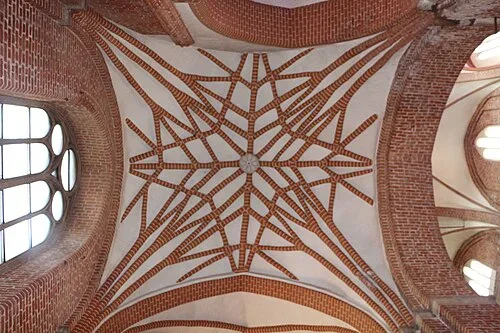 The Gothic Basilica Nave and Vaults
Ribbed Vault in a Side Aisle
The tower was still being built in 1677. A citywide fire destroyed it on the twenty-first of May, along with the church's interior. Rupert Bindenschu supervised the repairs, which took about two years. The old masonry vaults were replaced with wooden vaulted ceilings. Ribs spread across the pale ceiling in a star-like pattern. With vaults rebuilt after the fire and repaired again later, a ceiling like this one is hard to date by eye. In 1794 Christoph Haberland renovated the wooden vaulted ceilings over the central part of the nave.
Listen in the appPhoto: Agnete · CC BY-SA 4.0
05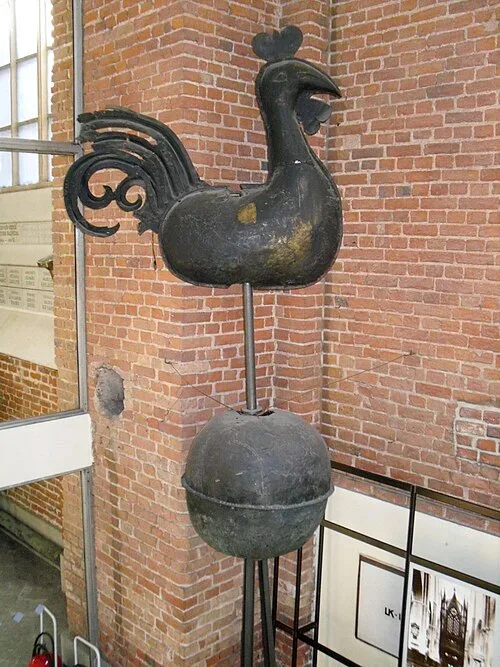 Historical Relics and Memorial Chapels
Historic Rooster Weathervane on Display
Seven roosters have topped this tower since the Gothic tower of the fifteenth century was built. The rooster standing inside the church is an original from a former tower. Its tail is spread wide, and its dark metal is worn, with lighter patches showing. The sixth rooster went up in 1690, on a new steeple built of wood. That steeple was then the tallest wooden structure in Europe. The rooster that tops the tower today went up in 1970. It is a precise copy of the one before it, and the seventh rooster in all. To gild it, one hundred and forty grams of gold were used.
Listen in the appPhoto: Artifex · Public domain
06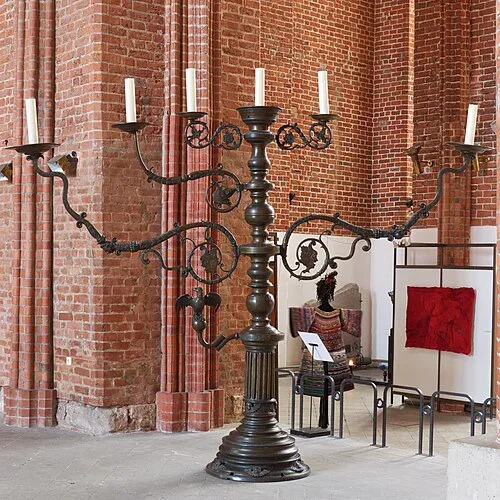 Historical Relics and Memorial Chapels
1596 Bronze Candelabrum
The Riga City Council ordered this bronze candelabrum in 1596 from the metal founder Hans Meyer's foundry in Riga. It is late Renaissance work, and it was once called a standing lantern. It stands just over three metres high. It is nearly four metres wide. Scrolled branches hold white candles above a stepped base. During the Second World War, Germans from Riga were moved into Polish territory that Germany had annexed, and the candelabrum went with them to Włocławek. After the war it was displayed in the basilica cathedral of Saint Mary of the Assumption in Włocławek. On the first of March, 2012, it came back to Riga, under an agreement to return cultural property.
Listen in the appPhoto: Donato de Bramante · CC BY-SA 4.0
07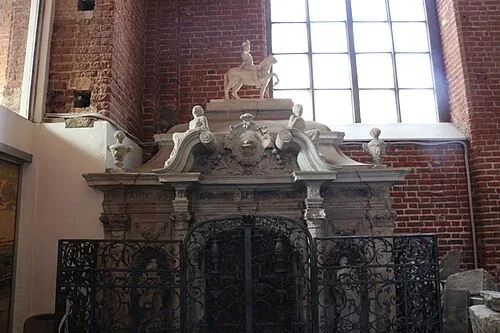 Historical Relics and Memorial Chapels
Sculpted Stone Monument with a Mounted Figure
Carved stone monuments like this one were a familiar way to remember people in churches. Nothing in the carving itself tells us who is remembered here, or when it was made. What the stone does show is a scrolled cornice, small carved figures at each end, and a rider on horseback at the top.
Listen in the appPhoto: Agnete · CC BY-SA 4.0
08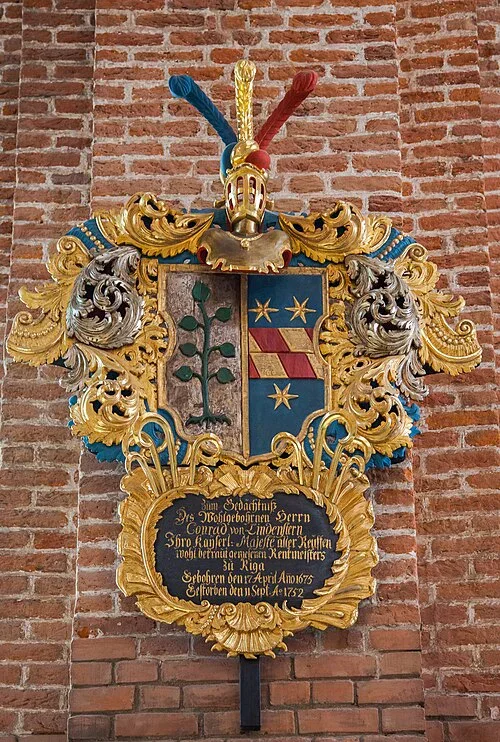 Historical Relics and Memorial Chapels
Baroque Memorial with Coat of Arms and German Inscription
From 1526 until 1940, this church served the German Lutheran parish of Saint Peter's in Riga. Until 1524 it had been a Roman Catholic church. The memorial is a gilded frame, and a helmet with blue and red plumes crowns it. Its shield shows a green plant on one side, and stars on a blue field on the other. Beneath the shield, a dark panel carries a German inscription that opens with the words 'In memory of'. It honours a Rentmeister, a treasury official in Riga, and it also records when he was born and when he died. Until a law of 1773, the church was also a burial place. Almost all of the parish's members left Latvia during the war years.
Listen in the appDiego Delso · CC BY-SA 3.0
09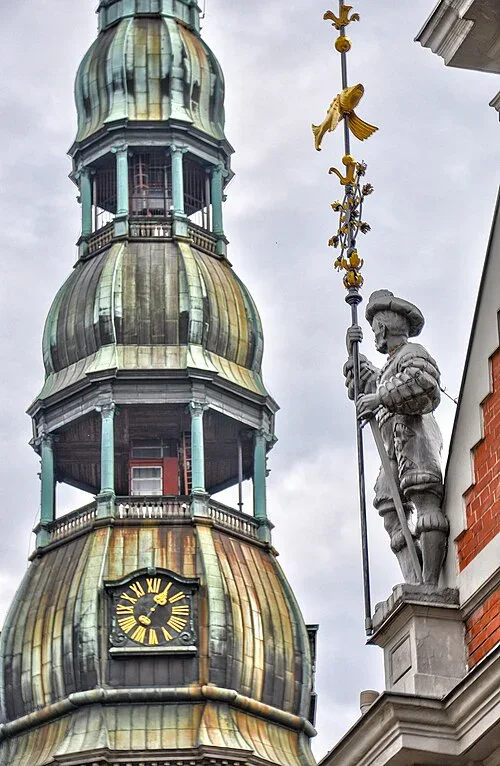 The Spire and 72-Meter Observation Deck
Tower Clock Face and Chimes
In 1694 a new tower clock was installed here, along with a glockenspiel from Amsterdam. A glockenspiel is a set of tuned bells that can play a tune. The clock face has Roman numerals, and it sits on a copper stage with open galleries above. The renovated clock began to show the time in July 1975. By tradition, it has only an hour hand. Bell music began in 1976. The bells play the Latvian folk melody 'Rīga dimd' five times a day, and they ring at the top of every hour.
Listen in the appKristof Zerbe · CC BY 3.0
10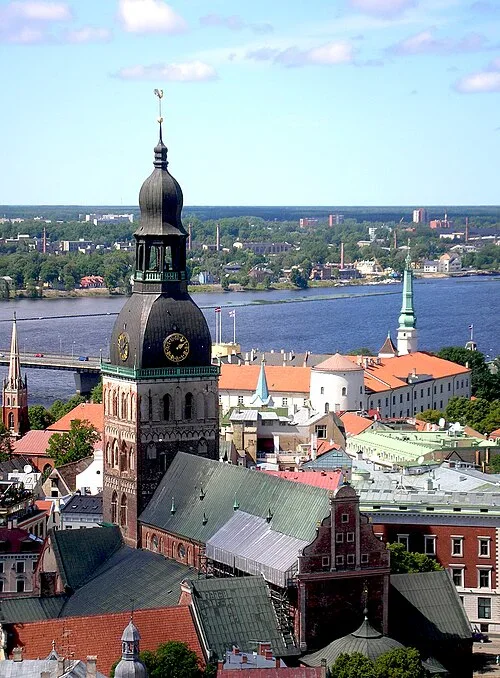 The Spire and 72-Meter Observation Deck
Panoramic View over Old Riga and the Daugava
Artillery fire destroyed Saint Peter's Church on the twenty-ninth of June, 1941. The church burned, and the tower was lost with it. Restoration began in 1954, with research by the architect Pēteris Saulītis. The work ran on into the 1980s, under an order of the Latvian Soviet government. The tower was rebuilt on a metal frame, starting in 1967. The rebuilt tower was finished on the twenty-ninth of June, 1973. That was thirty-two years to the day after it was lost. A lift now carries visitors to a gallery seventy-two metres up. From there, the red roofs of the Old Town, the Daugava river and a bridge come into view.
Listen in the appVéronique Dauge · CC BY-SA 3.0 igo
- 11
The Bremen Town Musicians Statue
A bronze donkey, dog, cat and rooster from a German folk tale, standing outside the church.
St. Peter's Church, Riga
Frequently asked questions
How much does the guide cost?
Free app download. Listed guide price: $0.99. Guide price shown in the app. Audio guide only. Venue admission is separate.
Can I listen without internet?
Yes. Download the guide’s audio, images, and maps in the app before your visit. Your downloaded content is then available offline.
Can I listen in my language?
This audio guide is available in 15 languages, including English.
Do I need to follow a schedule?
No. This is a self-guided experience. Choose your stops, pause whenever you like, and return to a story at your own pace.
At your own pace
Explore St. Peter's Church, Riga.
Download Stanza, then search for “St. Peter's Church, Riga”.
Free app download · Guide price shown in the app
Keep exploring
Nearby audio guides
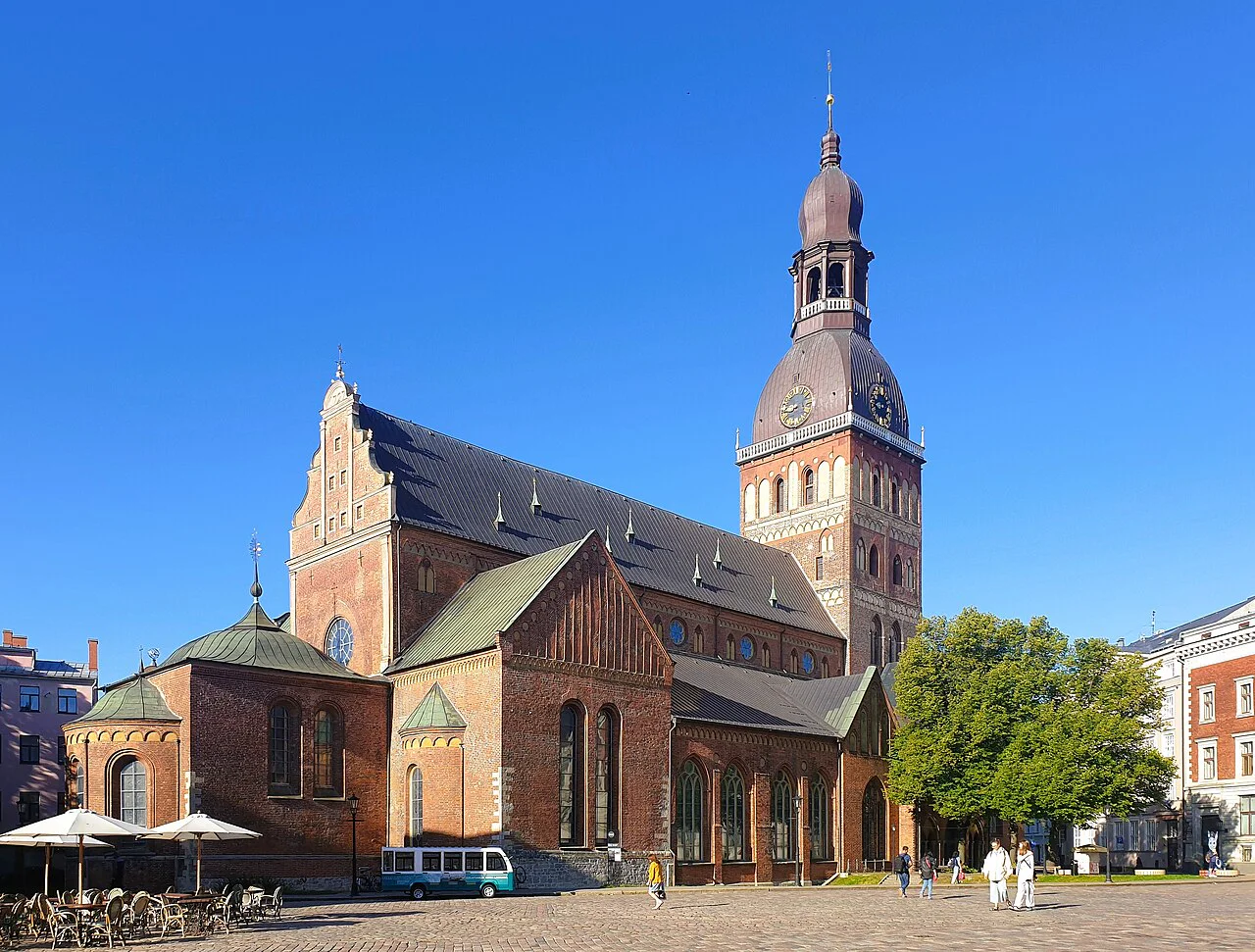
Riga · 1 km
Riga Cathedral
Content & sources
Photo: Chris06 · CC BY-SA 4.0
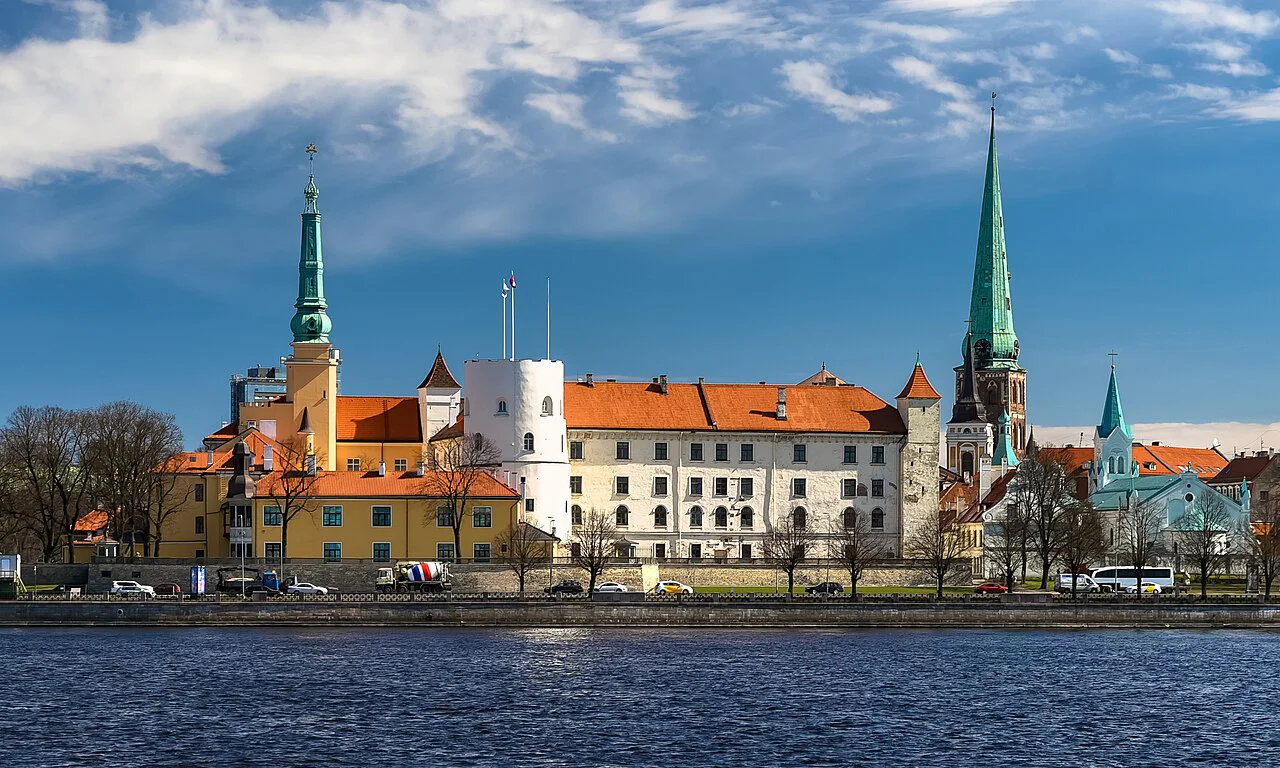
Riga · 1 km
Riga Castle
Content & sources
Jorge Franganillo · CC BY 2.0
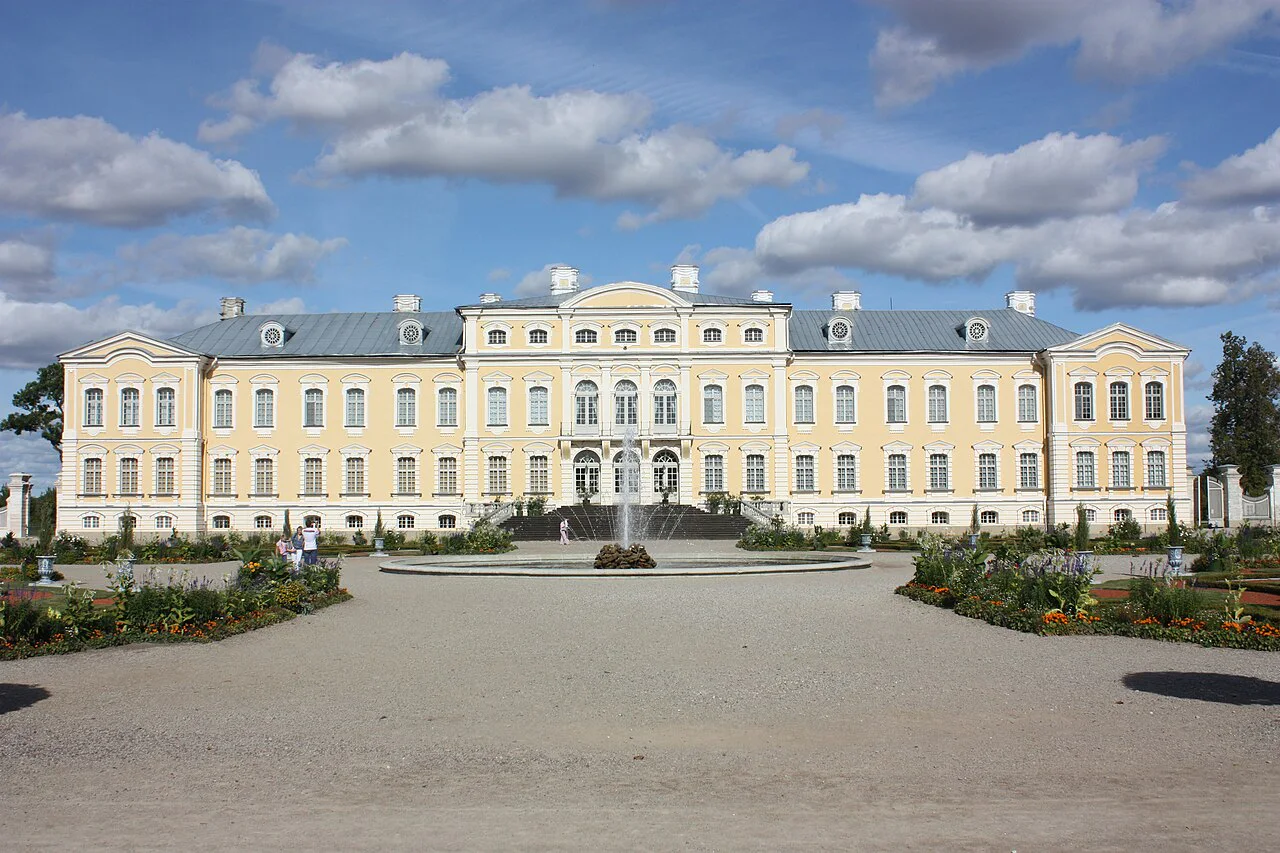
Pilsrundāle · 60 km
Rundāle Palace
Content & sources
Arian Zwegers · CC BY 2.0
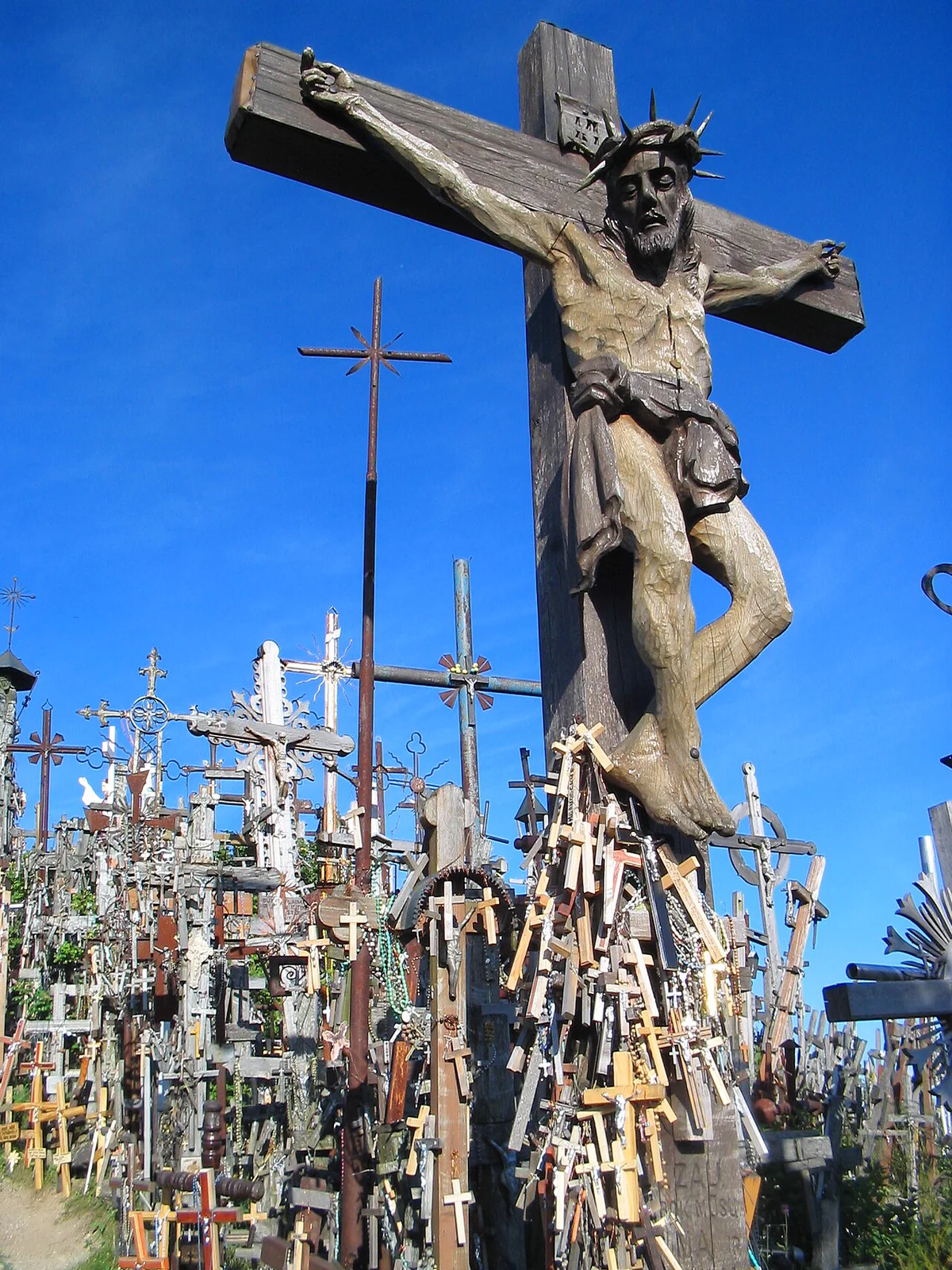
Jurgaičiai · 112 km
Hill of Crosses
Content & sources
Thomas Stegh · CC BY-SA 3.0