Stanza · Audio guide
Rotunda of Mosta Audio Guide
A place to remember. A story to take with you.
The Rotunda of Mosta is a Roman Catholic parish church and basilica in Mosta, Malta. It was built between 1833 and the 1860s to neoclassical designs on the site of an earlier Renaissance church.
Download Stanza, then search for “Rotunda of Mosta”.
About the tour
One guide. Your kind of visit.
The Rotunda of Mosta is a Roman Catholic parish church and basilica in Mosta, Malta. It was built between 1833 and the 1860s to neoclassical designs on the site of an earlier Renaissance church.
Ready when you are.
- 01Get the free Stanza app.
iOS & Android
- 02Find your guide.
“Rotunda of Mosta”
- 03Download before you go.
Works offline
Audio guide / 8 narrated stops
Inside the guide
Get to know a few of the stories before you go. Open a stop to read more.
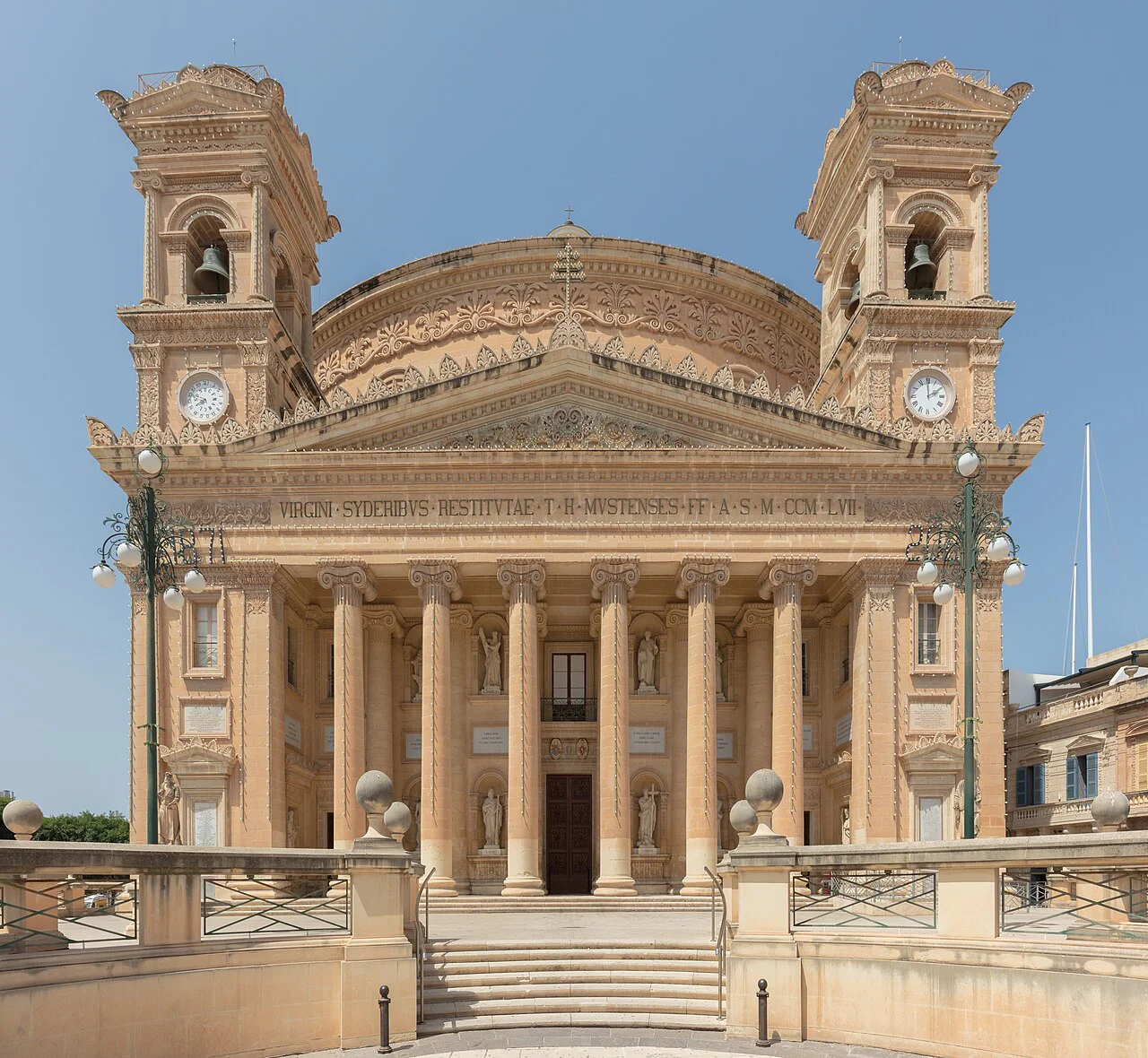
01 Parvis and Neoclassical Façade
The Rotunda from the Parvis: A Parish Rebuilds
Welcome to the Rotunda of Mosta, the great domed church that people across Malta simply call the Mosta Dome. This tour follows it from the parvis, under the portico, up into the dome, and finally to the bomb that fell here in the war. Its formal name is the Sanctuary Basilica of the Assumption of Our Lady, and it is the largest church in Malta. Two centuries ago this was a country town with a modest parish church. That older church had stood since around 1614, built to designs attributed to the Renaissance architect Tommaso Dingli, and people knew it as Ta' Ziri. By the 1830s Mosta had simply outgrown it. A local man, Giorgio Grognet de Vassé, proposed something far bolder: a neoclassical rotunda modelled on the Pantheon in Rome. Bishop Francesco Saverio Caruana opposed the design. It was approved all the same, and the first stone was laid on 30 May 1833. What rose here over the following decades became the work Grognet is remembered for.
Photo: Silar · CC BY-SA 4.0
02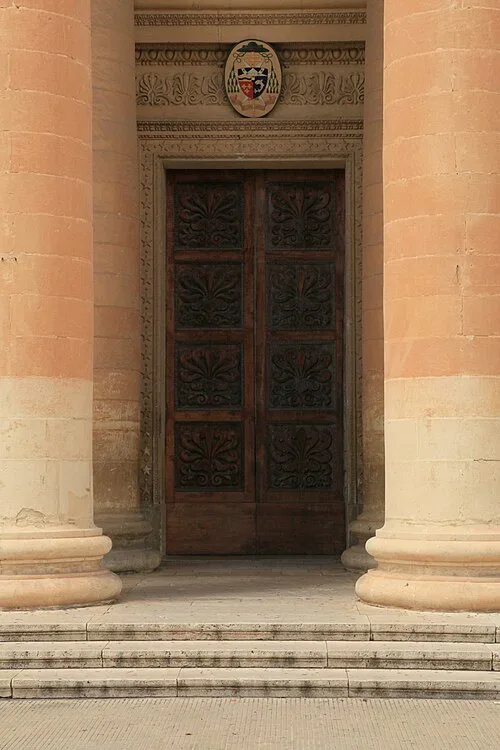 Ionic Portico and Main Entrance
Under the Portico: Rome's Temple Reborn in Limestone
The six Ionic columns of this portico are a deliberate echo of the Pantheon in Rome. That choice caused trouble before a stone was cut. Some in the church felt a Roman pagan temple was an unsuitable model for a Catholic sanctuary. Others admired the design openly. A guidebook written in 1839, while the church was still rising, called it certainly the most magnificent, extensive and solid modern building in Malta. It predicted the church would immortalise the architect and draw every visitor to the island towards this town. Time proved the enthusiastic readers right. These heavy wooden doors, carved with deep panels, are the threshold into the rotunda. They have one strange story of their own. In 1983 a taxi driver named Carmelo Aquilina lost a bet. He drove his car up these steps, broke through the main doorway, and stopped inside the church near the altar. He served three months in prison and lost his licence.
Frank Vincentz · CC BY-SA 3.0
03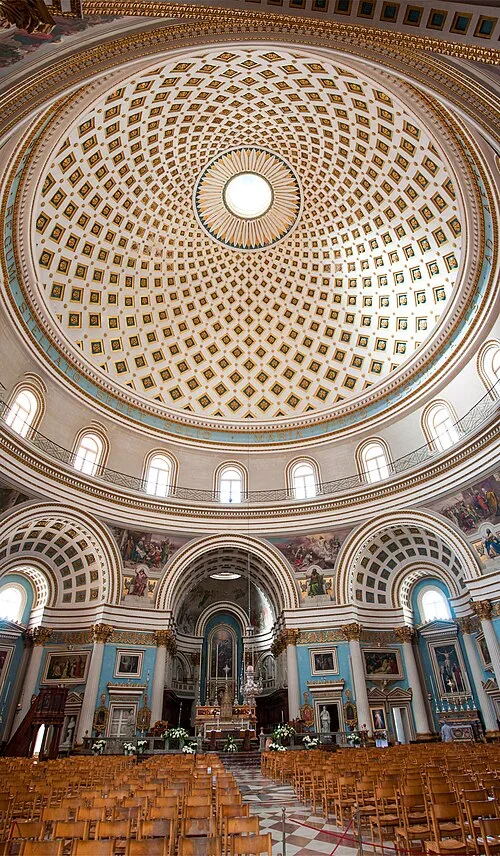 Central Nave and the Unsupported Dome
Beneath the Dome: Scale Without Support
Inside, the eye climbs straight up into the coffered dome. The building is a true rotunda, a perfect circle, and its walls do all the work. They are about thirty feet thick, and they carry a dome with an internal diameter of 130 feet, forty metres across. There are no pillars inside holding any of it up. At one time this was the third-largest unsupported dome in the world. The circular wall is broken by eight deep niches, like the bays of a great round hall. One of them forms the entrance bay behind you. Another, straight ahead, is the deep apse that holds the main altar. Between them, the niches and the arches ring the whole space, so the dome seems to float over the congregation gathered at its centre.
Listen in the appPhoto: Boguslaw Garbacz · CC BY 3.0
04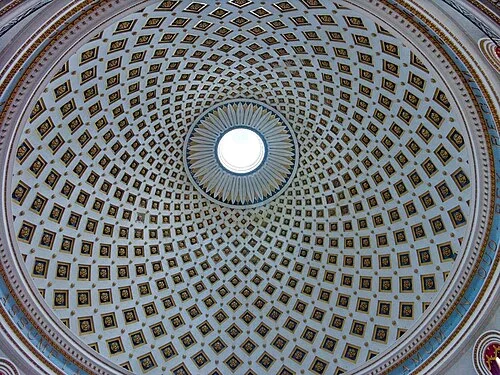 Central Nave and the Unsupported Dome
A Church Built Around a Church
For most of its construction, this dome rose around another church. The old parish church of Ta' Ziri, the one you heard about at the parvis, stayed standing at the centre of the site, and Mass went on inside it throughout. The new rotunda was built in a ring around it, closing over it year by year. The people of Mosta did much of the building themselves, turning out on Sundays and public holidays to work on their own church. Grognet had never trained as an architect, so he took consultation from an architect of the Sammut family. The whole project took twenty-eight years, finishing in the early 1860s. Once the dome was closed overhead, the workers dismantled the old church from within, completing the demolition in 1860. Because the site had never once stopped being a place of worship, the finished building needed no consecration. It was officially dedicated on 15 October 1871.
Listen in the appPhoto: Jean-Christophe BENOIST · CC BY 2.5
05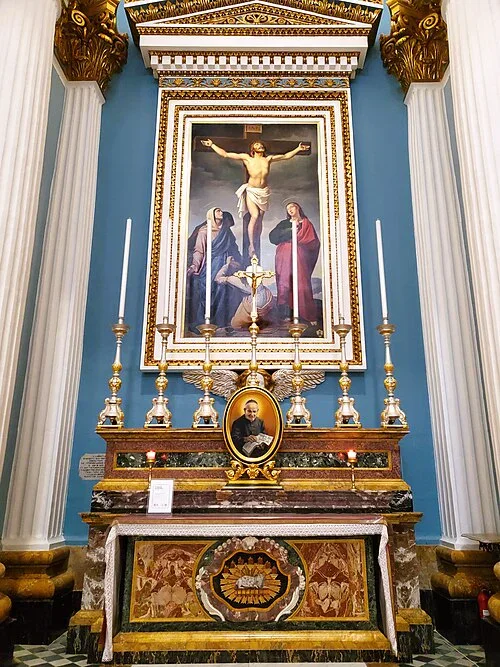 Side Niches and Altars
Along the Niches: Side Altars of the Rotunda
Around the edge of the rotunda, the deep niches in the circular wall serve as side altars. This one is typical of how the parish uses them. A painting of the crucifixion hangs in a tall gilded frame against the blue wall, flanked by slender white candlesticks. Below it, the altar is dressed in marble, with an ornate frontal across its face. Gilded columns frame the whole bay, so each niche reads as a small chapel set into the great round wall. On feast days and ordinary weekdays alike, these bays carry the devotional life of the parish, spread in a ring beneath the dome.
Listen in the appPhoto: Bärwinkel,Klaus · CC BY 4.0
06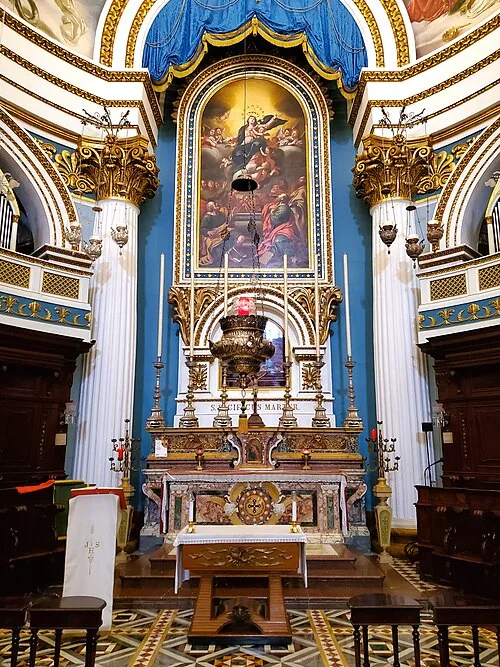 Main Altar and Sanctuary Apse
The High Altar: Dedicated to the Assumption
The deep apse ahead is the spiritual heart of the building, and it is one of the eight niches of the circular plan, set directly opposite the entrance bay. Above the high altar hangs a large painting of the Assumption of Mary, the belief that Mary was taken body and soul into heaven. The church is dedicated to her, which is why its formal title names the Assumption of Our Lady. The altar itself is richly dressed, with candlesticks and a blue canopy drawn above the painting. In 2015 the parish asked the Vatican to recognise the church formally with a higher title. The answer came on 29 July 2018, when the Rotunda was elevated to a minor basilica. The title confirmed what the building had long been: the principal parish church of its town, and still a working one.
Listen in the appPhoto: Bärwinkel,Klaus · CC BY 4.0
07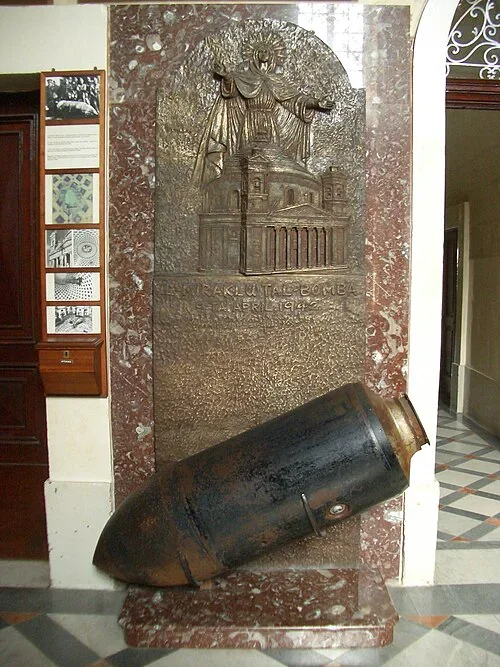 Sacristy and WWII Miracle Bomb Exhibition
The Miracle of the Bomb, 9 April 1942
On 9 April 1942, during the Siege of Malta, a German aerial bomb came down on this church. It pierced the dome and fell into the rotunda while Mass was being celebrated below. Then it did nothing at all. The bomb failed to explode. A bomb disposal unit of the Royal Engineers defused it, carried it away, and dumped it into the sea off Malta's west coast. The people of Mosta read what had happened in only one way: a miracle. A bomb that falls through a roof during Mass and does not burst is hard to explain any other way, in a town that had built this church with its own hands. The casing you see here, tilted against its stone base, is of an identical bomb type, kept so that the event is never just a story. The bronze relief above it carries the town's own word for that day.
Listen in the appGibmetal77 at English Wikipedia · CC BY-SA 2.5
08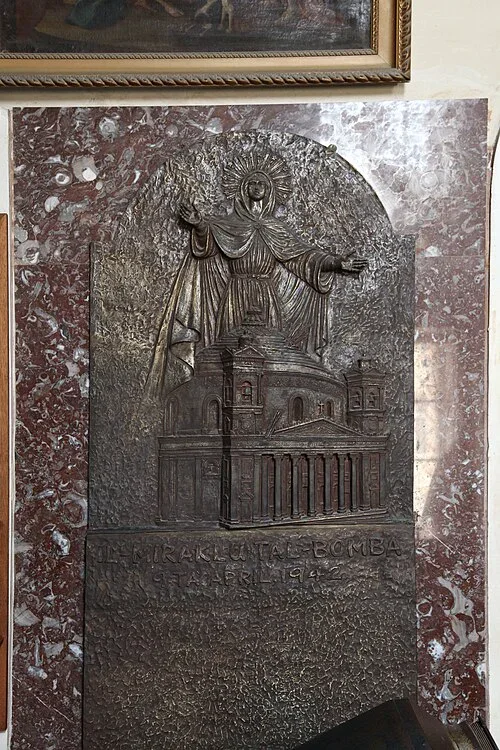 Sacristy and WWII Miracle Bomb Exhibition
Closing: Il-Miraklu tal-Bomba
The bronze relief in the sacristy is inscribed Il-Miraklu tal-Bomba, 9 ta' April 1942, the Miracle of the Bomb. It shows a robed figure of Mary with her arms spread wide, her mantle opening over the domed rotunda below her, sheltering the whole building in bronze. That image is the parish's own account of the day you heard about at the bomb display, cast in metal so it could be read by every generation after. The relief also closes a longer story. A self-taught architect dared to rebuild the Pantheon in a Maltese town, and his neighbours built it with their own hands. The Rotunda of Mosta has stood at the centre of this town's life ever since, and the town has never doubted whose hands held it up.
Listen in the appFrank Vincentz · CC BY-SA 3.0
Rotunda of Mosta
Frequently asked questions
How much does the guide cost?
Free app download. Listed guide price: $0.99. Guide price shown in the app. Audio guide only. Venue admission is separate.
Can I listen without internet?
Yes. Download the guide’s audio, images, and maps in the app before your visit. Your downloaded content is then available offline.
Can I listen in my language?
This audio guide is available in 15 languages, including English.
Do I need to follow a schedule?
No. This is a self-guided experience. Choose your stops, pause whenever you like, and return to a story at your own pace.
At your own pace
Explore Rotunda of Mosta.
Download Stanza, then search for “Rotunda of Mosta”.
Free app download · Guide price shown in the app
Keep exploring
Nearby audio guides
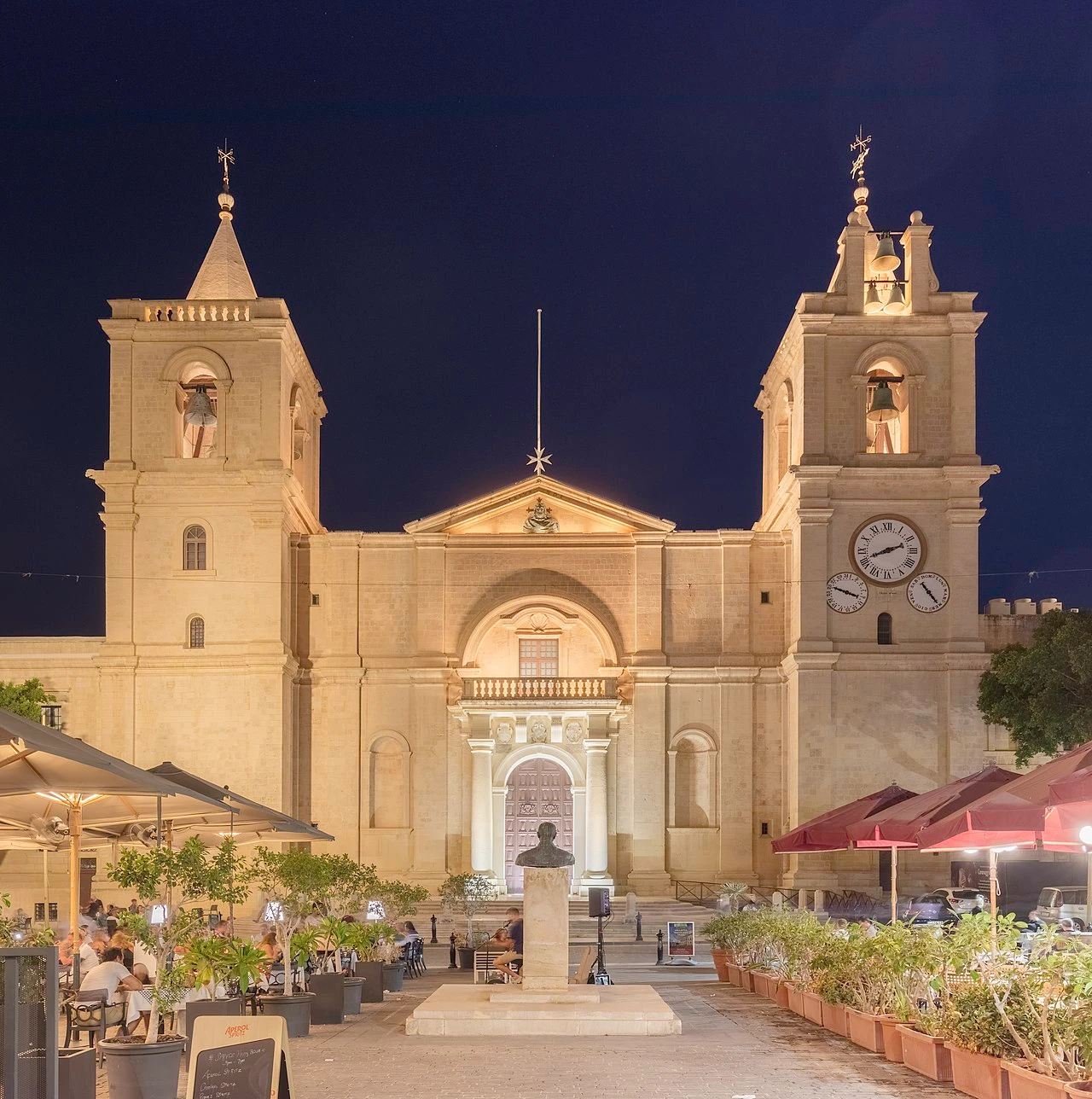
Valletta · 8 km
St. John's Co-Cathedral
Content & sources
Diego Delso · CC BY-SA 4.0
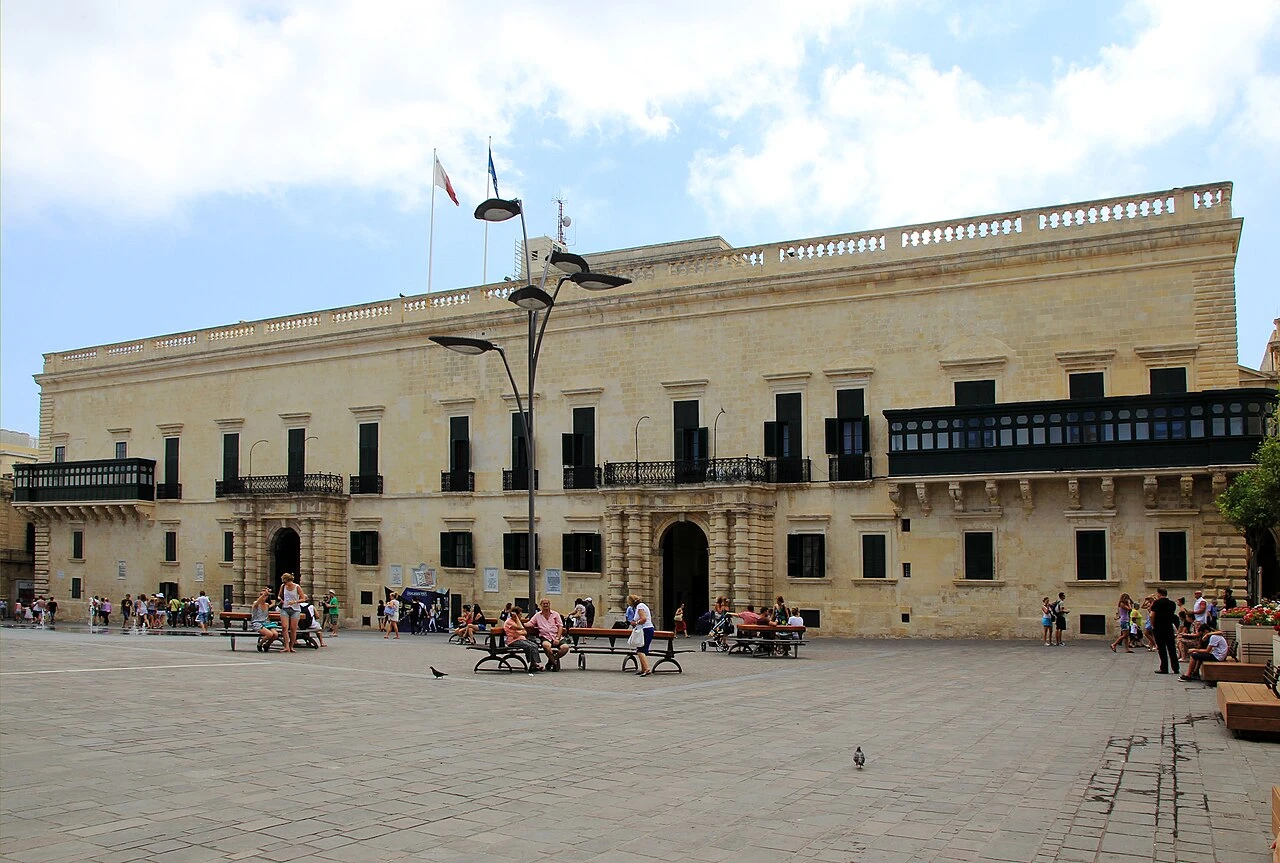
Valletta · 8 km
Grandmaster's Palace
Content & sources
Photo: Karelj · Public domain
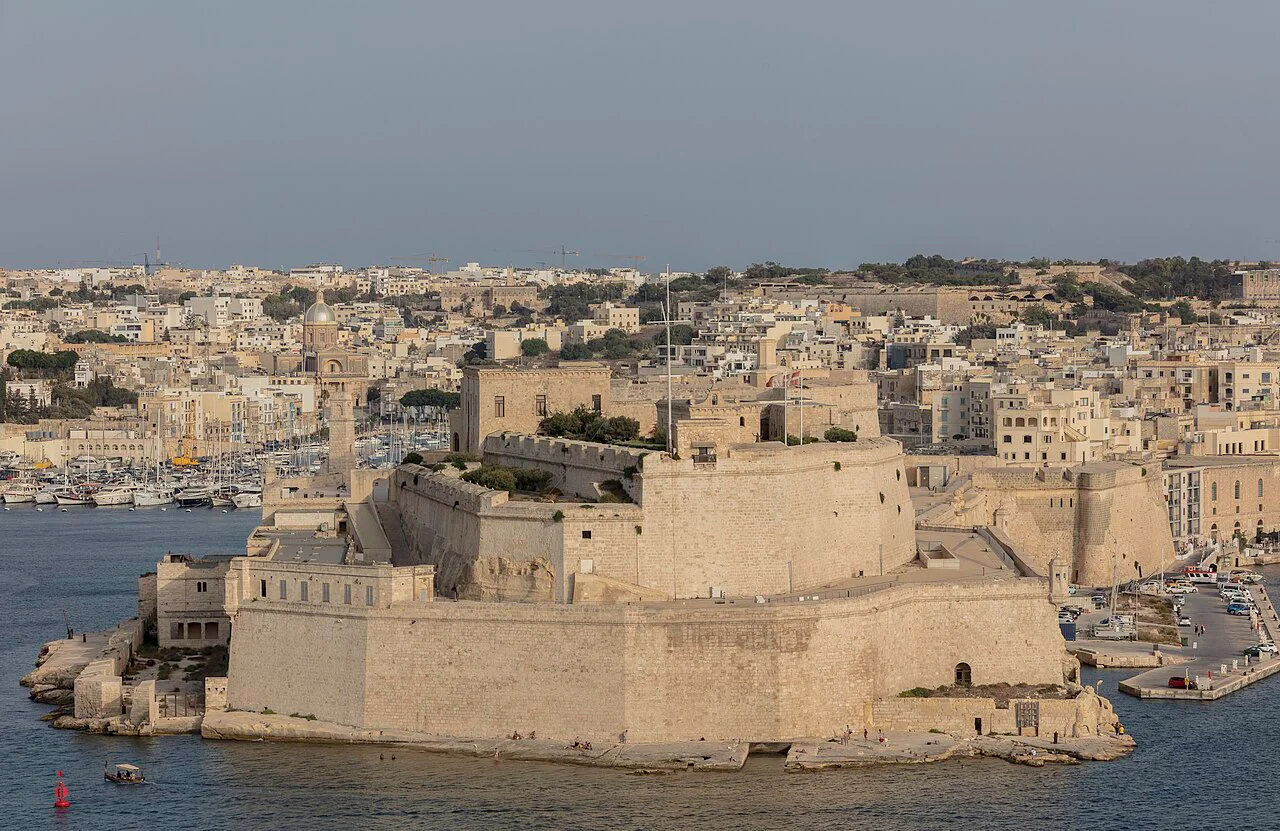
Birgu · 9 km
Fort St. Angelo
Content & sources
Diego Delso · CC BY-SA 4.0
Tarxien · 9 km
Tarxien Temples
Content & sources
Joonas L. · CC BY 2.0