Stanza · Audio guide
St. John's Co-CathedralAudio guide
A place to remember. A story to take with you.
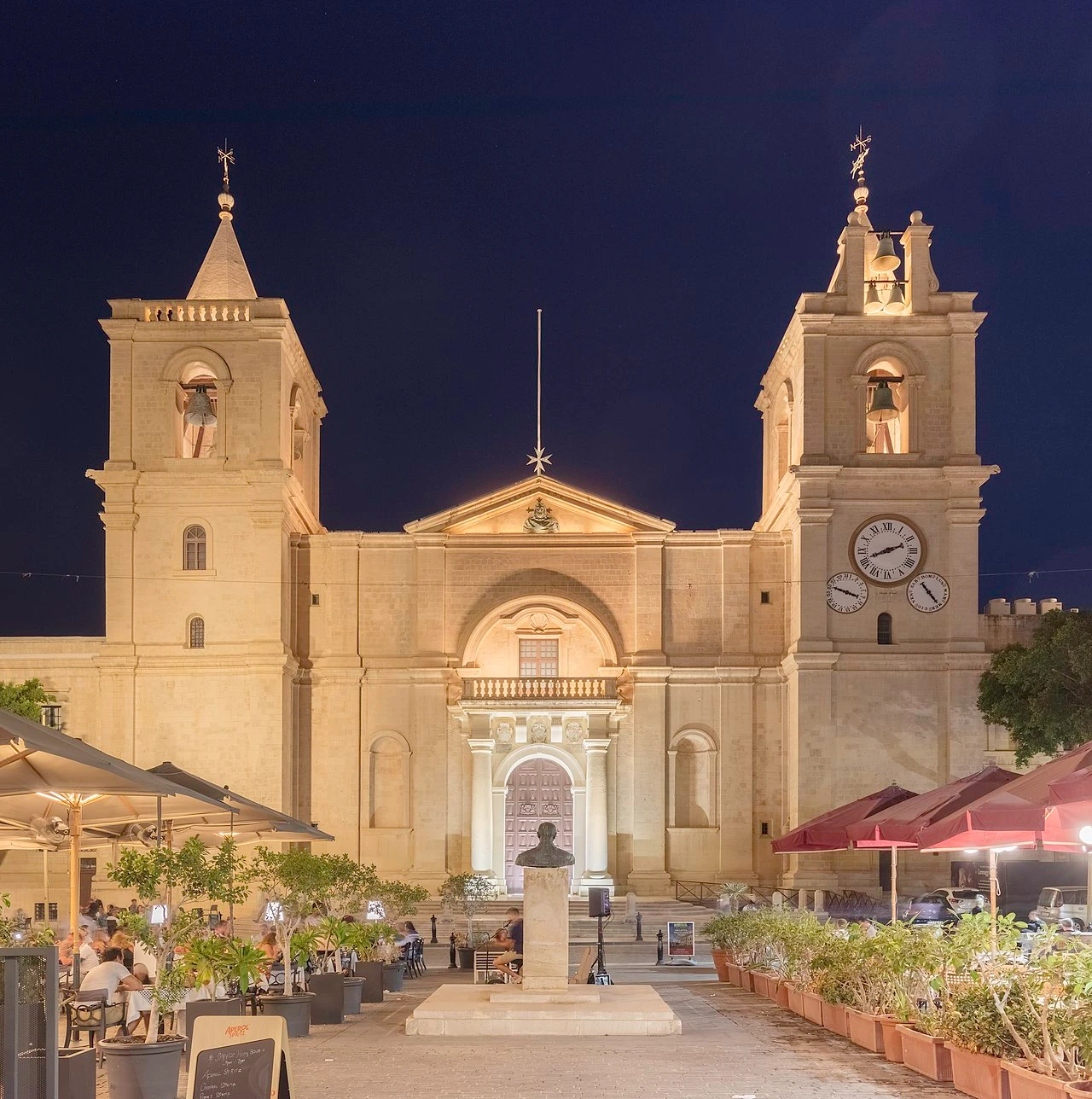
St. John's Co-Cathedral is a Roman Catholic co-cathedral in Valletta, Malta. It was built by the Knights of Malta between 1572 and 1577.
Download Stanza, then search for “St. John's Co-Cathedral”.
About the tour
One guide. Your kind of visit.
St. John's Co-Cathedral is a Roman Catholic co-cathedral in Valletta, Malta. It was built by the Knights of Malta between 1572 and 1577.
Ready when you are.
- 01Get the free Stanza app.
iOS & Android
- 02Find your guide.
“St. John's Co-Cathedral”
- 03Download before you go.
Works offline
Audio guide / 14 narrated stops
Inside the guide
Get to know a few of the stories before you go. Open a stop to read more.
01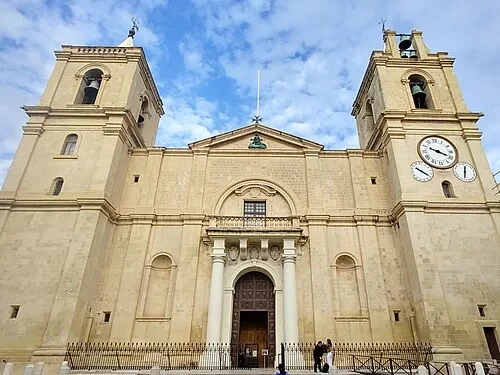 The Fortress Exterior and Astronomical ClockThe Mannerist Facade
Welcome to one of the most significant architectural landmarks in the Mediterranean. This facade appears strikingly plain, almost austere, with its heavy corners and lack of ornate decoration. This was intentional. Following the harrowing Great Siege of 1565, the Knights were still in a defensive mindset, and their chief military engineer, Girolamo Cassar, designed the cathedral with the sturdy lines of a bastion. Constructed between 1573 and 1577 using local Maltese limestone, the exterior masks the opulence within. This restrained Mannerist style serves as a deliberate visual barrier, separating the harsh world of military duty from the spiritual sanctuary inside. When you eventually step through the doors, the transformation from this sandy, flat stone to a riot of gold and color will be even more overwhelming because of this simple entrance. Two bell towers flank the central structure, standing like silent sentinels over the city of Valletta. Observe the thick, unadorned walls which suggest security and permanence, values that were paramount to the Order during this era of reconstruction.
Photo: MairCalvo · CC0
02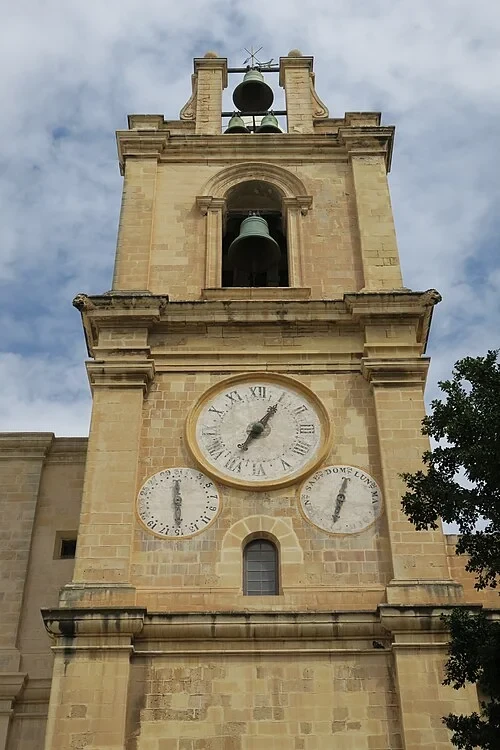 The Fortress Exterior and Astronomical ClockThe Three-Faced Clock
The right-hand bell tower features a distinctive three-faced astronomical clock, a marvel of engineering that served the daily administrative and religious needs of the Order. These dials are arranged in a triangular configuration to provide a complete calendar at a glance. The large upper dial indicates the time, while the two smaller dials below track the date and the day of the week. Specifically, the dial on the bottom left shows the day of the month, and the one on the bottom right identifies the day of the week in Latin. Inside this tower hangs the cathedral’s largest bell, a massive instrument weighing 7,000 kilograms. It stands as the third-largest bell in all of Malta, its deep toll once signaling everything from prayer times to the arrival of important dignitaries or the announcement of a new Grand Master. The complex mechanics of the astronomical clock allowed the Knights to keep their lives synchronized with both the celestial cycles and the rigorous schedule of their religious duties. It remains a rare example of how timekeeping was integrated into the very fabric of military and monastic life.
Photo: Hnapel · CC BY-SA 4.0
03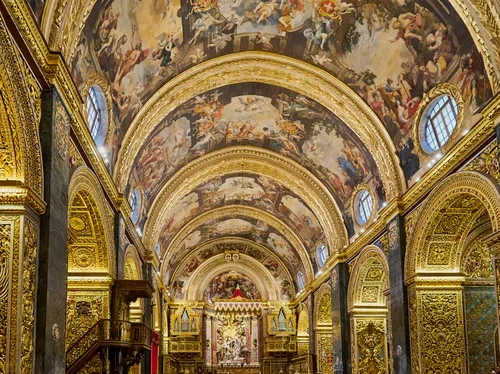 The Nave and Preti's Golden VaultThe Golden Nave
Step into a space that defines the peak of Baroque exuberance. Measuring sixty-five meters in length with a central nave twenty meters wide, this hall was once a simple, bare-stone interior. That changed in the 1660s when the Calabrian artist Mattia Preti arrived and spent decades transforming every square inch of the limestone walls into a gilded masterpiece. Preti oversaw the carving of intricate patterns directly into the stone, which were then covered in gold leaf. The result is so dazzling that the famous novelist Sir Walter Scott described it as the most striking interior he had ever seen. The sheer volume of gold and the complexity of the carvings create a visual rhythm that leads the eye toward the distant altar. This transformation was part of a broader effort by the Knights to show the world that their Order was not just a military force, but one of the wealthiest and most sophisticated religious institutions in Europe. Notice how the light reflects off the various surfaces, making the entire structure appear as if it were cast from solid gold rather than local stone.
Listen in the appPhoto: Georg Karl Ell · CC BY-SA 4.0
04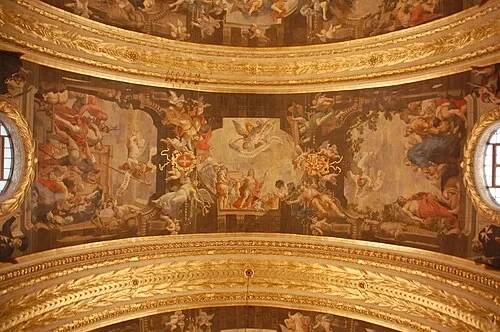 The Nave and Preti's Golden VaultThe Vault of Saint John
Looking up, you see the life's work of Mattia Preti, who spent five years suspended beneath this vault. These eighteen distinct scenes narrate the life of Saint John the Baptist, the patron saint of the Order. Preti utilized a revolutionary technique, painting with oil pigments directly onto the porous Maltese limestone rather than using traditional fresco methods. To prevent the paint from being absorbed, the stone was treated with linseed oil first. One of the most remarkable features is the use of 'trompe l’oeil,' a French term for tricking the eye. Preti painted architectural details like columns and ledges, using deep shadows and highlights to create the illusion of three-dimensional stone carvings where there is actually only flat paint. The figures seem to lean out from the architecture, populating a celestial space that appears to open up far beyond the physical ceiling of the cathedral. This immense project cemented Preti's status as the official artist of the Order and transformed the once-plain vault into an endless sky filled with religious history.
Listen in the appDenis Barthel (talk) · CC BY-SA 3.0
05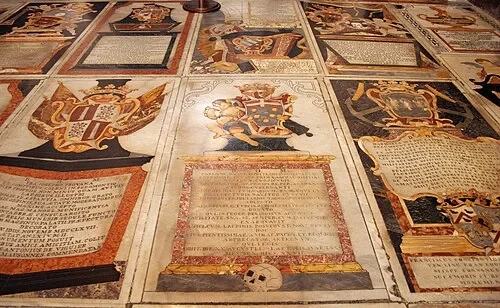 The Knights' Funerary FloorThe Marble Tomb Floor
The floor of the cathedral is an unparalleled masterpiece of marble inlay, consisting of nearly four hundred individual ledger stones. These are not merely decorative; they mark the graves of the Order’s most distinguished knights and officers. Each stone is a unique work of art, featuring the family coat of arms, military trophies, and Latin epitaphs that recount the bravery and virtues of the deceased. The stones are crafted from various colors of marble brought from across Europe, meticulously fitted together like a giant jigsaw puzzle. Because the material is quite thin and delicate, a strict rule is enforced: visitors must wear flat shoes to prevent the concentrated pressure of heels from cracking the marble. Walking across this surface is like walking through a genealogical history of European nobility, as the floor represents a colorful, permanent record of the men who defended the Mediterranean for centuries. This vast mosaic creates a sense of walking atop history itself, where every step passes over a different family legacy or a forgotten battle honor.
Listen in the appMyriam Thyes · Public domain
06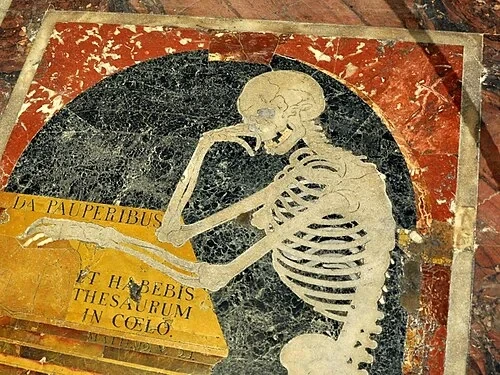 The Knights' Funerary FloorMemento Mori Floor Detail
Looking closely at the individual floor slabs, you will notice a recurring and somewhat macabre theme: skeletons, hourglasses, and scythes. These figures represent the 'memento mori,' a Latin phrase meaning 'remember that you will die.' This artistic tradition was intended to remind the viewer that death is the great equalizer, claiming knights and commoners alike regardless of their worldly rank or wealth. Many of the inscriptions reinforce this message of spiritual humility. One prominent slab features a Latin phrase referencing 'treasures in heaven,' suggesting that the true wealth of a Knight was not found in his armor or estates, but in his service to the faith. The skeletons are often depicted in dynamic poses—some holding trumpets, others clutching scythes—creating a lively yet somber conversation between the living and the dead. This focus on mortality reflected the deep religious devotion of the Order, who viewed their lives on earth as a temporary preparation for eternity. These stones ensure that the knights remain present in the cathedral, even centuries after their passing.
Listen in the appRobin & Bazylek · CC BY 2.0
07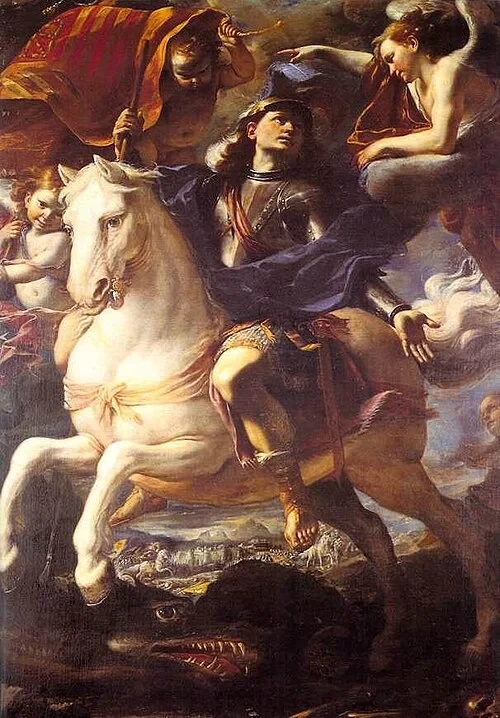 The Chapels of the LanguesSaint George on Horseback
In the Chapel of Aragon, you can see Mattia Preti’s first significant commission for the Order. The cathedral’s side chapels were divided among the various 'langues' or national groups that made up the Knights, and this one belonged to the Spanish-speaking Aragon group. The painting of Saint George on Horseback serves as the chapel’s focal point, showcasing Preti’s mastery of the high-Baroque style. Notice how the white horse is captured mid-leap, positioned at such an angle that it appears to be jumping out of the canvas into the chapel itself. The dramatic lighting and the twisting forms of the saint and the dragon create a sense of urgent, swirling energy. The success of this single work was so profound that it convinced the Grand Master to hire Preti to paint the entire ceiling of the nave. It transformed the artist from a visiting painter into a hero of the Order, eventually leading to his induction as a Knight of Grace. The horse's powerful stance and the fallen dragon beneath its hooves provided a fitting symbol for the military order's own victories.
Listen in the appMattia Preti · Public domain
08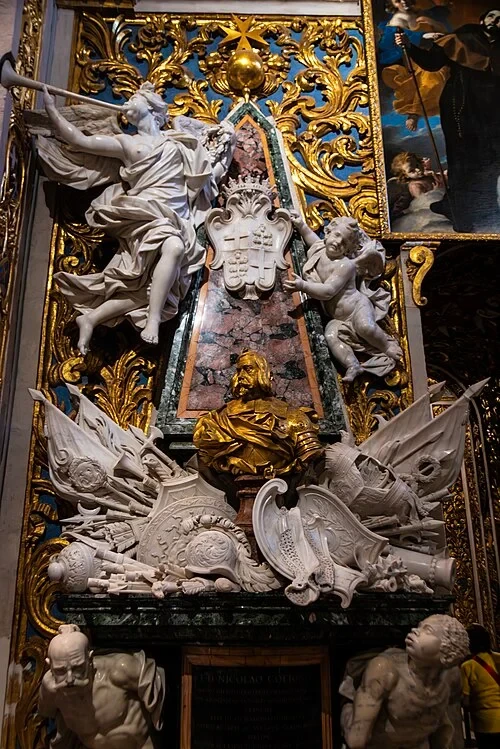 The Chapels of the LanguesMonument to Grand Master Cotoner
The Chapel of Aragon also contains the elaborate funerary monument of Grand Master Nicolas Cotoner. At the center of this high-Baroque ensemble is a bronze bust of the Grand Master himself, but the most striking elements are the two muscular, Atlas-like figures supporting the structure. These figures represent captives taken during the Order's numerous naval battles in the Mediterranean. Their strained muscles and expressive faces highlight the military triumphs of the Cotoner brothers’ reign. The artist used a sophisticated palette of contrasting materials, setting the white figures against rich, dark, and colored marbles to heighten the theatrical effect. Every detail, from the draped flags to the ornamental shields, is designed to evoke a sense of triumph and eternal glory. This monument is a prime example of how the Knights used funerary art not just for mourning, but as a powerful tool for propaganda, celebrating their role as the defenders of the faith through large-scale, dramatic sculpture. The sheer size and complexity of the stone carvings make it one of the most prominent monuments in the entire cathedral.
Listen in the appPhoto: Julian Lupyan · CC0
09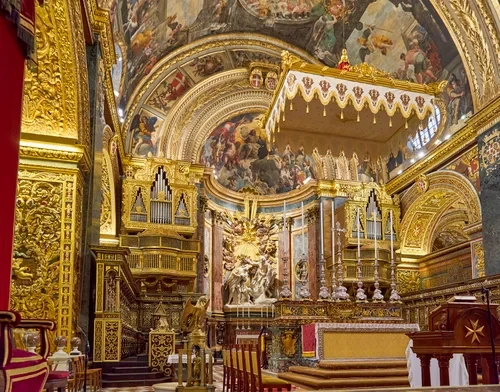 The High Altar and SanctuaryThe High Altar
Your attention is naturally drawn to the high altar, the spiritual heart of the cathedral. This area is a showcase of immense wealth and devotion, utilizing materials of extreme rarity and value. The altar itself is constructed from precious marbles and inlaid with lapis lazuli, a deep blue semi-precious stone that was more expensive than gold at the time of its construction. Above the altar sits an ornate canopy, designed to provide a grand architectural frame for the religious ceremonies held here. Notice the massive silver lamps hanging nearby; these were significant gifts to the cathedral, intended to burn perpetually. The entire sanctuary is designed with the specific goal of focusing the eyes of everyone in the nave on this single sacred point. During the era of the Knights, the high altar was the site of elaborate rituals where the Grand Master and the religious leaders of the Order would gather, surrounded by the glow of silver and the shimmer of gilded carvings. The heavy use of gold leaf and intricate stone-work creates a brilliant background for the most sacred parts of the liturgy.
Listen in the appPhoto: Georg Karl Ell · CC BY-SA 4.0
10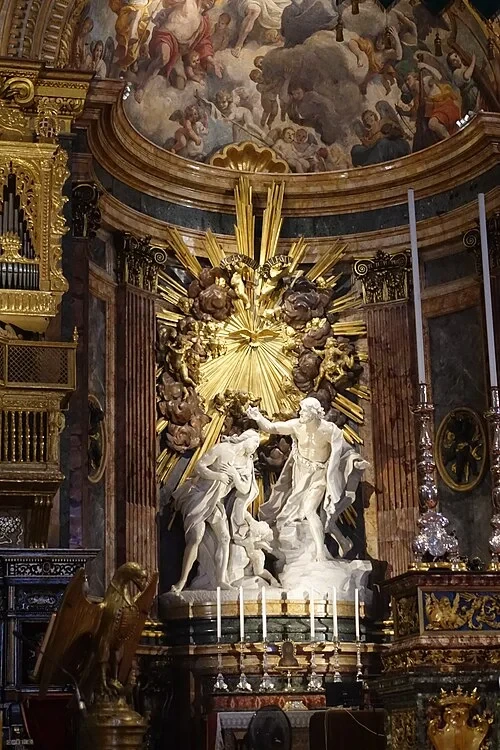 The High Altar and SanctuaryThe Baptism of Christ
Positioned behind the high altar is the monumental sculpture group depicting the Baptism of Christ. This was a particularly significant theme for the cathedral, as Saint John the Baptist was the patron saint of the Order. The design was the final work of the talented Maltese sculptor Melchiorre Cafà, though he died before it was finished. The project was eventually completed by the sculptor Giuseppe Mazzuoli. The two central figures are carved from white marble, creating a serene and pure contrast to the heavy gold and colored marble of the surrounding sanctuary. Above the figures, a radiant golden sunburst with a dove at its center symbolizes the presence of the Holy Spirit descending during the baptism. The light from the high windows often catches these golden rays, creating a natural glow that illuminates the marble figures. This sculpture group effectively concludes the visual narrative of the cathedral, bringing the focus back to the fundamental religious identity of the Knights. The interaction between the figures and the surrounding architecture creates a sense of sacred space that dominates the entire apse.
Listen in the appPhoto: Joseolgon · CC BY 4.0
St. John's Co-Cathedral
Frequently asked questions
How much does the guide cost?
Free app download. Listed guide price: $0.99. Guide price shown in the app. Audio guide only. Venue admission is separate.
Can I listen without internet?
Yes. Download the guide’s audio, images, and maps in the app before your visit. Your downloaded content is then available offline.
Can I listen in my language?
Stanza supports 15 languages. Check the app for the languages available for this guide.
Do I need to follow a schedule?
No. This is a self-guided experience. Choose your stops, pause whenever you like, and return to a story at your own pace.
At your own pace
Explore St. John's Co-Cathedral.
Download Stanza, then search for “St. John's Co-Cathedral”.
Free app download · Guide price shown in the app
Keep exploring
Nearby audio guides
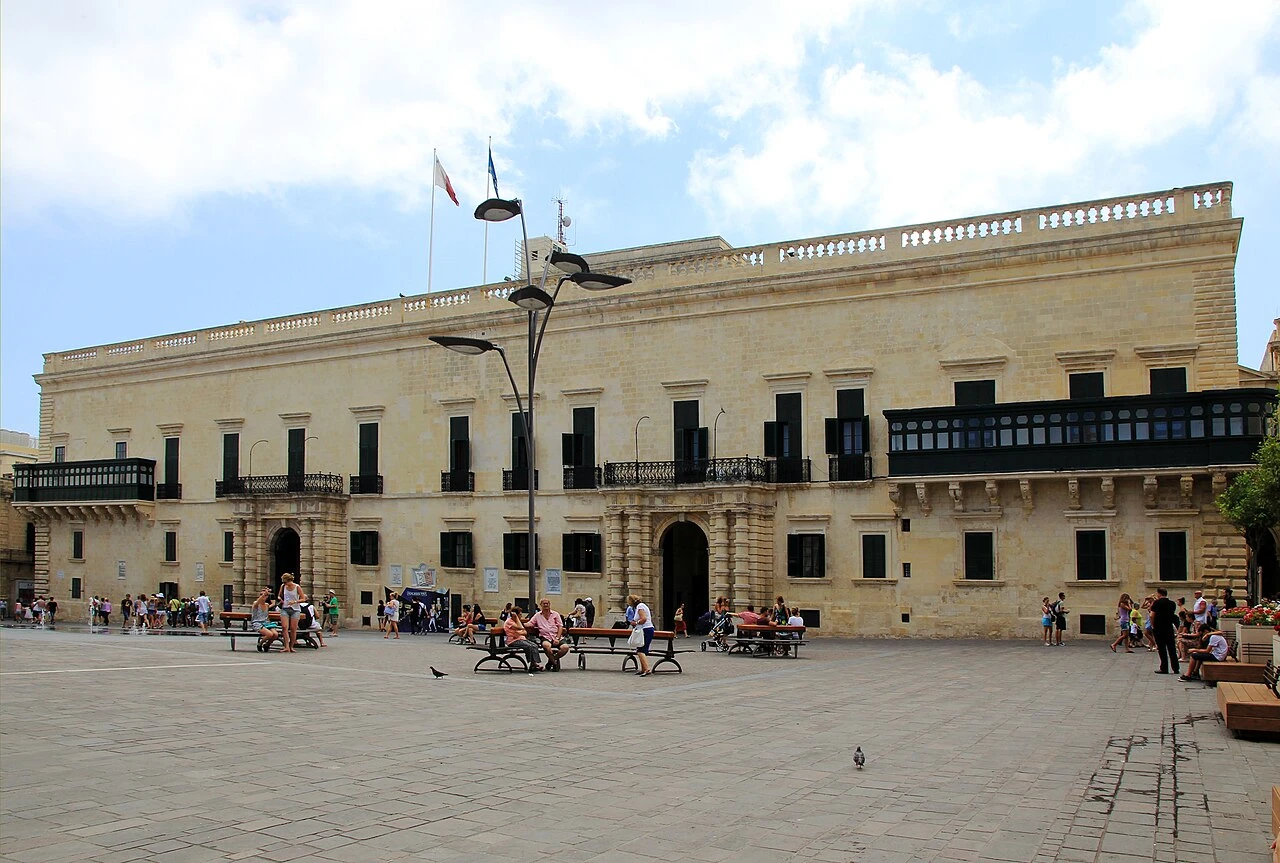
Valletta
Grandmaster's Palace
Content & sources
Photo: Karelj · Public domain
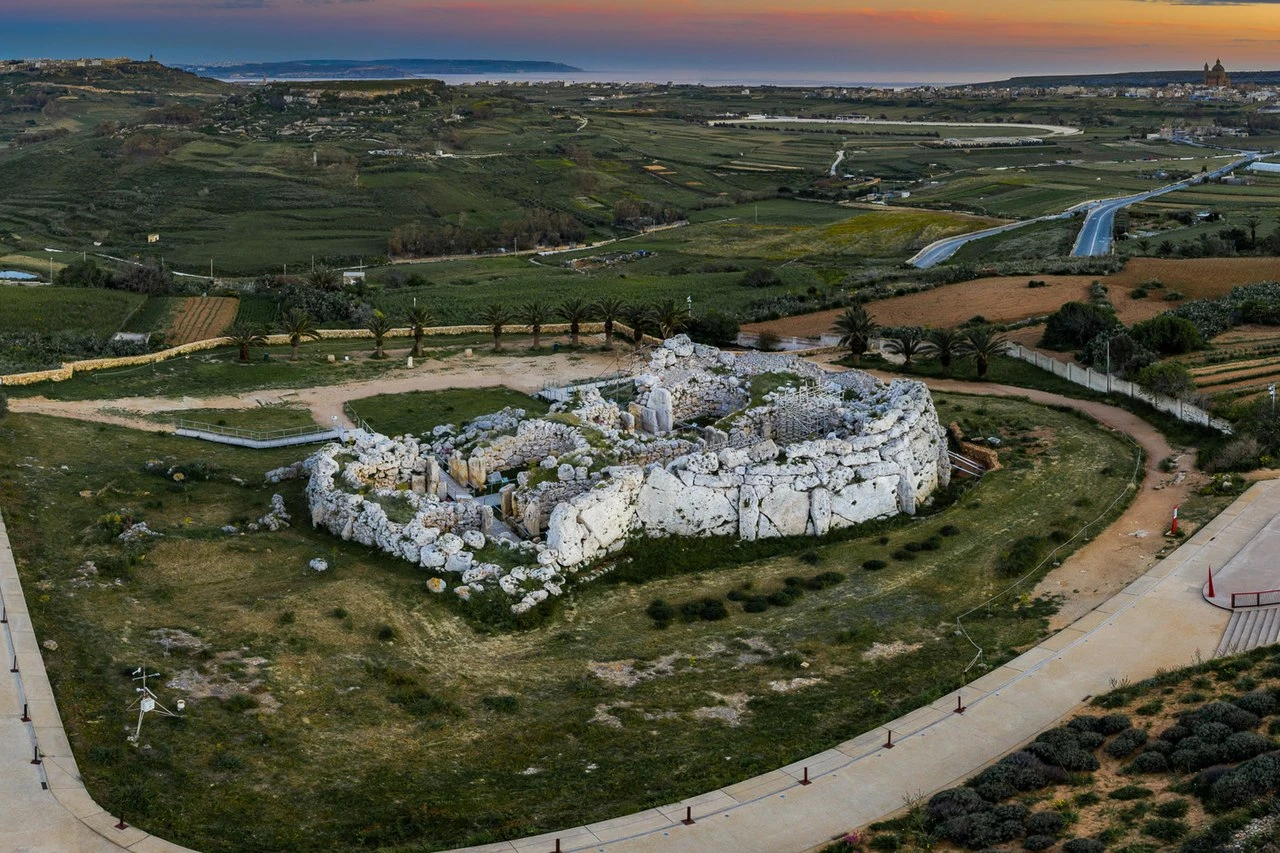
Xagħra
Ġgantija
Content & sources
FritzPhotography · CC BY-SA 4.0
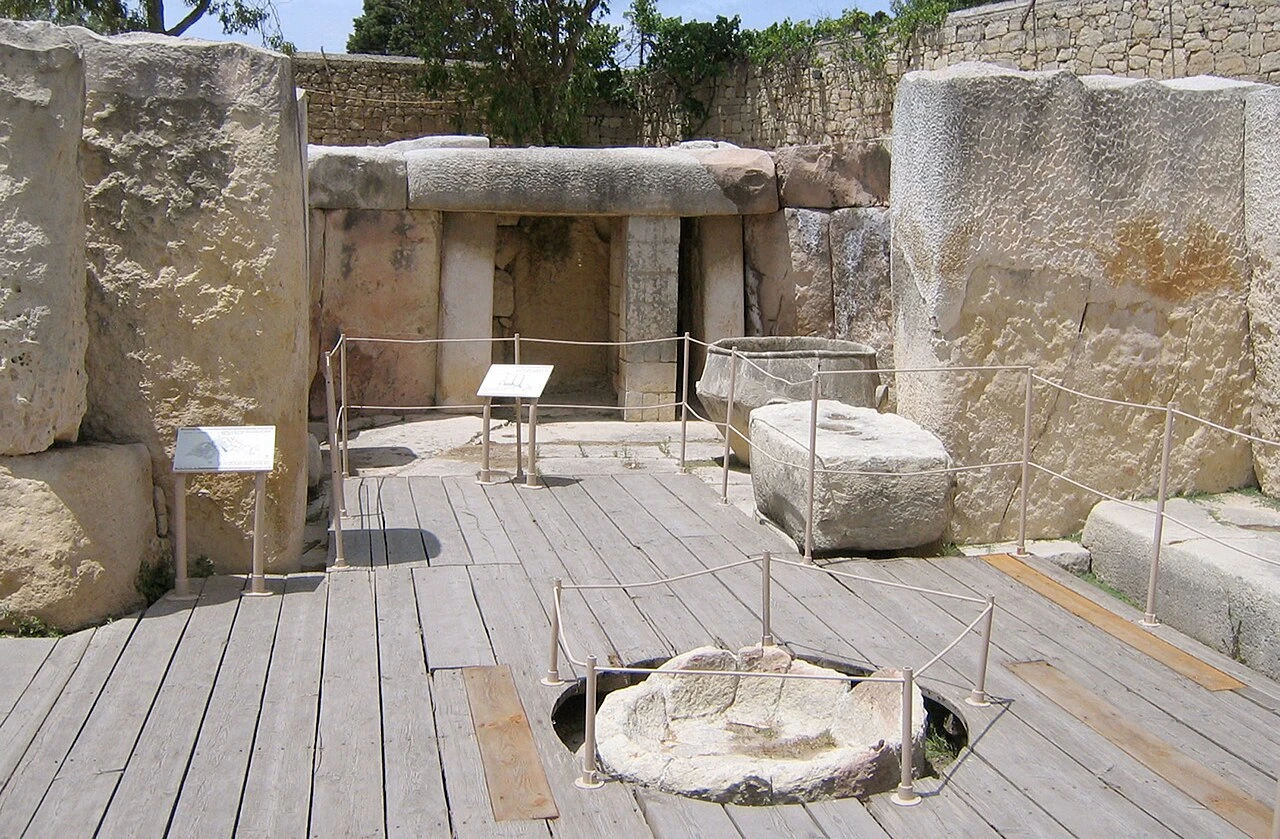
Tarxien
Tarxien Temples
Content & sources
Joonas L. · CC BY 2.0