Stanza · Audio guide
Tarxien TemplesAudio guide
A place to remember. A story to take with you.
An important archaeological complex located in Tarxien, Malta. It features several large prehistoric megalithic temples.
Download Stanza, then search for “Tarxien Temples”.
About the tour
One guide. Your kind of visit.
An important archaeological complex located in Tarxien, Malta. It features several large prehistoric megalithic temples.
Ready when you are.
- 01Get the free Stanza app.
iOS & Android
- 02Find your guide.
“Tarxien Temples”
- 03Download before you go.
Works offline
Audio guide / 20 narrated stops
Inside the guide
Get to know a few of the stories before you go. Open a stop to read more.
01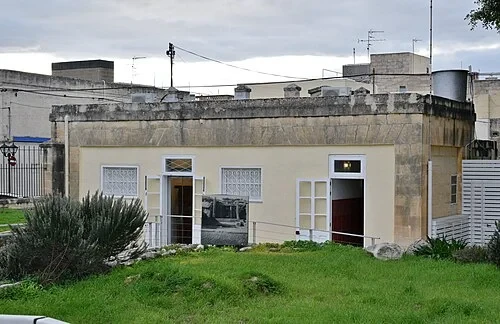 Arrival at the Tarxien GatewayThe Visitor Center
Welcome to the Tarxien Temples. This prehistoric complex is recognized as a UNESCO World Heritage Site, inscribed in 1992 for its exceptional architectural and cultural significance. The temples were constructed by a sophisticated Neolithic society between 3250 and 2800 BC, making them significantly older than the Great Pyramid of Giza. For thousands of years, these ruins lay buried and forgotten beneath the Maltese soil. Their rediscovery in 1913 was a matter of pure chance. A local farmer named Lorenzo Despott was plowing his fields when his equipment repeatedly struck massive stone blocks just below the surface. Curious about the nature of these obstructions, he reported the find to local authorities. This discovery led to the first formal excavations, which gradually revealed four distinct temple structures linked together. As you start your tour, consider that this entire area was once ordinary farmland. Today, it stands as one of the most important archaeological sites in the Mediterranean, offering a direct link to a civilization that flourished and then faded away long before the arrival of the Romans or even the Greeks. The stones you see represent the pinnacle of Maltese megalithic building.
Enrique Íñiguez Rodríguez (Qoan) Credit information This work was created by Enrique Íñiguez (Qoan). You are free to use it for any purpose as long as you credit me properly (e.g. © Enrique Íñiguez (CC-BY-SA); other variants are acceptable, let me know if in doubt). .mw-parser-output .div-col{margin-top:.3em;column-width:30em}.mw-parser-output .div-col-small{font-size:90%}.mw-parser-output .div-col-rules{column-rule:thin solid var(--border-color-base)}.mw-parser-output .div-col dl,.mw-parser-output .div-col ol,.mw-parser-output .div-col ul{margin-top:0}.mw-parser-output .div-col li,.mw-parser-output .div-col dd{page-break-inside:avoid;break-inside:avoid-column} Reuse: If you use this image outside of Wikimedia projects, I would be happy to hear from you. If you use this image in a printed publication, I would love to get a copy for my archives. Contact me: If you're unsure about how you can use this picture. If you have any questions about attribution or other topics related to my files. · CC BY-SA 4.0
02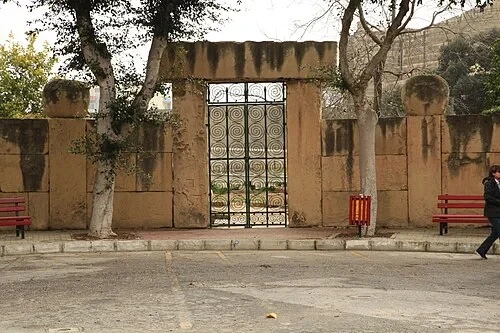 Arrival at the Tarxien GatewayThe Modern Gateway
Entering this gateway marks a significant transition from the modern urban environment of Tarxien into a prehistoric landscape. The preservation of what you see today is largely due to the meticulous efforts of Sir Themistocles Zammit. Between 1915 and 1919, Zammit led the first scientific excavations of the site. At a time when archaeology was often synonymous with destructive treasure hunting, Zammit introduced a disciplined, academic approach. He moved away from simply looking for 'prizes' and instead focused on the context of the finds, carefully recording the layers of soil and the positions of artifacts. This rigorous method allowed researchers to understand the timeline of the site, from its Neolithic temple use to its later reuse as a Bronze Age cemetery. His work set a high standard for Maltese archaeology, moving it into the modern era. As you pass through this area, the contrast between the surrounding contemporary houses and the ancient megaliths highlights the unique positioning of the site. It is rare to find such a significant prehistoric sanctuary located directly in the middle of a modern town, where the past and present reside side-by-side.
Frank Vincentz · CC BY-SA 3.0
03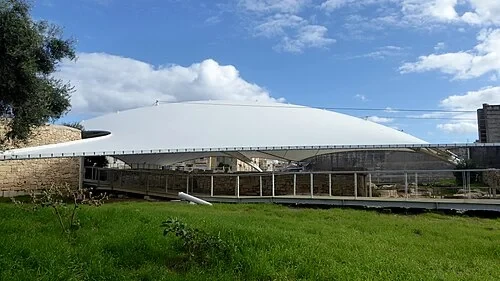 The Protective Canopy and Site OverviewThe Protective Canopy
The large, white tensile structure covering the site was installed in 2015 as part of an essential conservation strategy. While it is a modern addition to the prehistoric landscape, its purpose is to ensure the survival of the ruins for future generations. The temples are primarily built from Globigerina limestone, a material that is famously soft and easy to carve, but also highly susceptible to erosion. Before the canopy was installed, the stones were directly exposed to the harsh Mediterranean sun, heavy rain, and salt-laden winds. These environmental factors were causing the stone surfaces to crumble, a process that threatened the intricate carvings and structural integrity of the site. The canopy acts as a protective shield, regulating the temperature and moisture levels across the ruins. It prevents direct sunlight from drying out the stone too quickly and stops rainwater from washing away delicate decorative features. By creating a controlled microclimate, this structure helps slow the natural degradation of the megaliths. This intervention allows visitors to see the prehistoric architecture in a state that is as close as possible to how it appeared when archaeologists first uncovered it over a century ago.
Listen in the appEthan Doyle White · CC BY-SA 4.0
04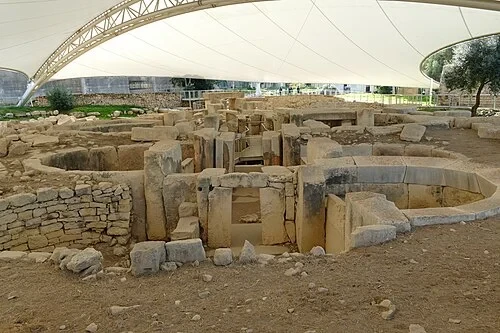 The Protective Canopy and Site OverviewSite Overview
From this vantage point, you can appreciate the complex layout of the Tarxien complex. It is not a single building but a series of four distinct structures that were built and modified over a period of roughly 450 years. This phased construction reflects the evolution of the society that lived here. One of the most striking architectural features is the shape of the individual chambers. These are designed in a 'cloverleaf' or lobed pattern, which is a signature style of Maltese megalithic architecture. This layout typically consists of a central passage leading to semi-circular rooms, known as apses. The thick outer walls were originally filled with earth and smaller stones to provide stability and insulation. While the roofs are no longer present, historians believe they were likely made of timber or corbelled stone slabs that gradually narrowed toward the top. The sheer scale of the megaliths used in the walls demonstrates the engineering capabilities of the Neolithic people. Without iron tools or pulleys, they quarried, moved, and precisely placed stones weighing several tons each. This big-picture view highlights the sophisticated planning required to create a sanctuary of this magnitude in such a remote era.
Listen in the appPhoto: Kritzolina · CC BY-SA 4.0
05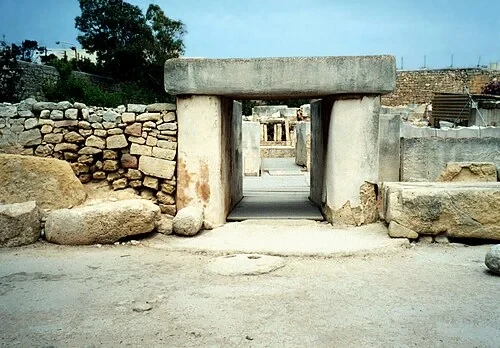 The South Temple and the Colossal StatueSouth Temple Entrance
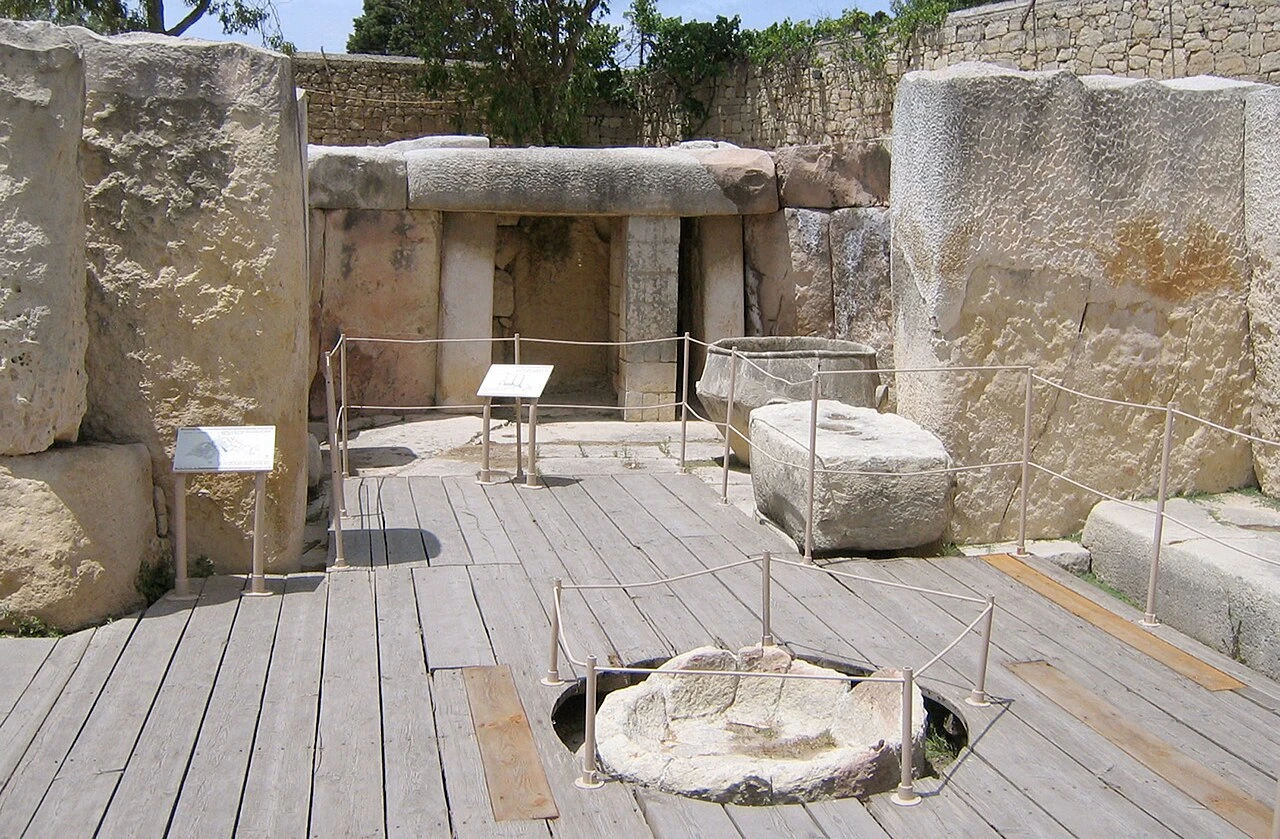
You are looking at the entrance to the South Temple, the most elaborately decorated structure within the entire Tarxien complex. The doorway is formed by a massive trilithon—a term meaning 'three stones'—consisting of two vertical uprights supporting a large horizontal lintel across the top. While this specific entrance was reconstructed during early twentieth-century excavations using original stones found on the ground, it accurately reflects the prehistoric architecture of the site. This trilithon served as a formal threshold, separating the exterior world from the sacred interior. Crossing this boundary would have been a significant act for ancient visitors. The South Temple was the last of the four structures to be built, and it shows the highest level of craftsmanship and artistic detail. Its builders utilized the soft Globigerina limestone to create intricate reliefs that are not found in the older, simpler structures of the site. As you look through the opening, you can see how the architecture was designed to focus the visitor’s attention toward the inner chambers. This entrance was the beginning of a carefully controlled journey through a space dedicated to the spiritual and social life of the community.
Listen in the appMichael Gunther · CC BY-SA 4.0
06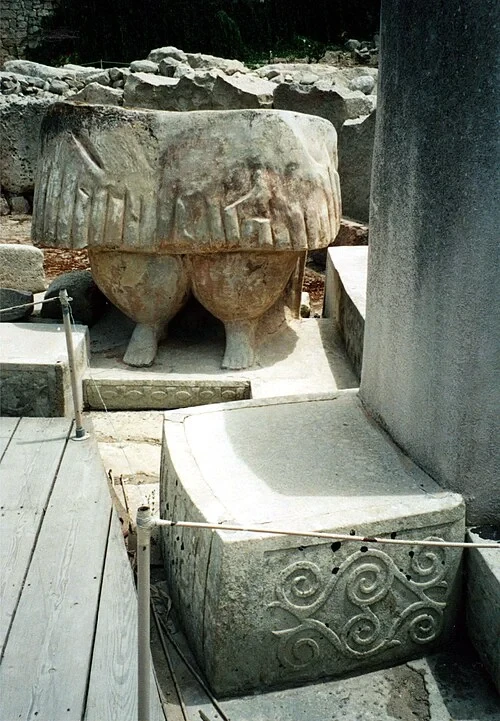 The South Temple and the Colossal StatueThe Colossal Statue Replica
This impressive stone fragment depicts the lower half of a monumental human figure. It is the largest Neolithic representation of a person ever found on the Maltese islands. Archaeologists estimate that the original statue would have stood approximately 2.5 meters tall, roughly eight feet, making it a truly colossal presence within the temple. Notice the heavy, robust proportions of the legs and feet, as well as the intricate details of the pleated skirt. For decades, researchers have debated the identity of the person shown. Some suggest it represents a 'Mother Goddess' or fertility deity, while others argue it could be a priest or a gender-neutral ancestor figure. The pleated garment is particularly interesting, as it indicates a sophisticated level of textile work or a specific ceremonial dress worn during the temple's height. The figure is shown in a seated or standing position that emphasizes stability and weight. The replica here occupies the exact spot where the original was found, giving you a sense of the scale and impact the figure would have had on those entering the sanctuary thousands of years ago. It stands as a testament to the artistic ambition of the temple builders.
Listen in the appMichael Gunther · CC BY-SA 4.0
07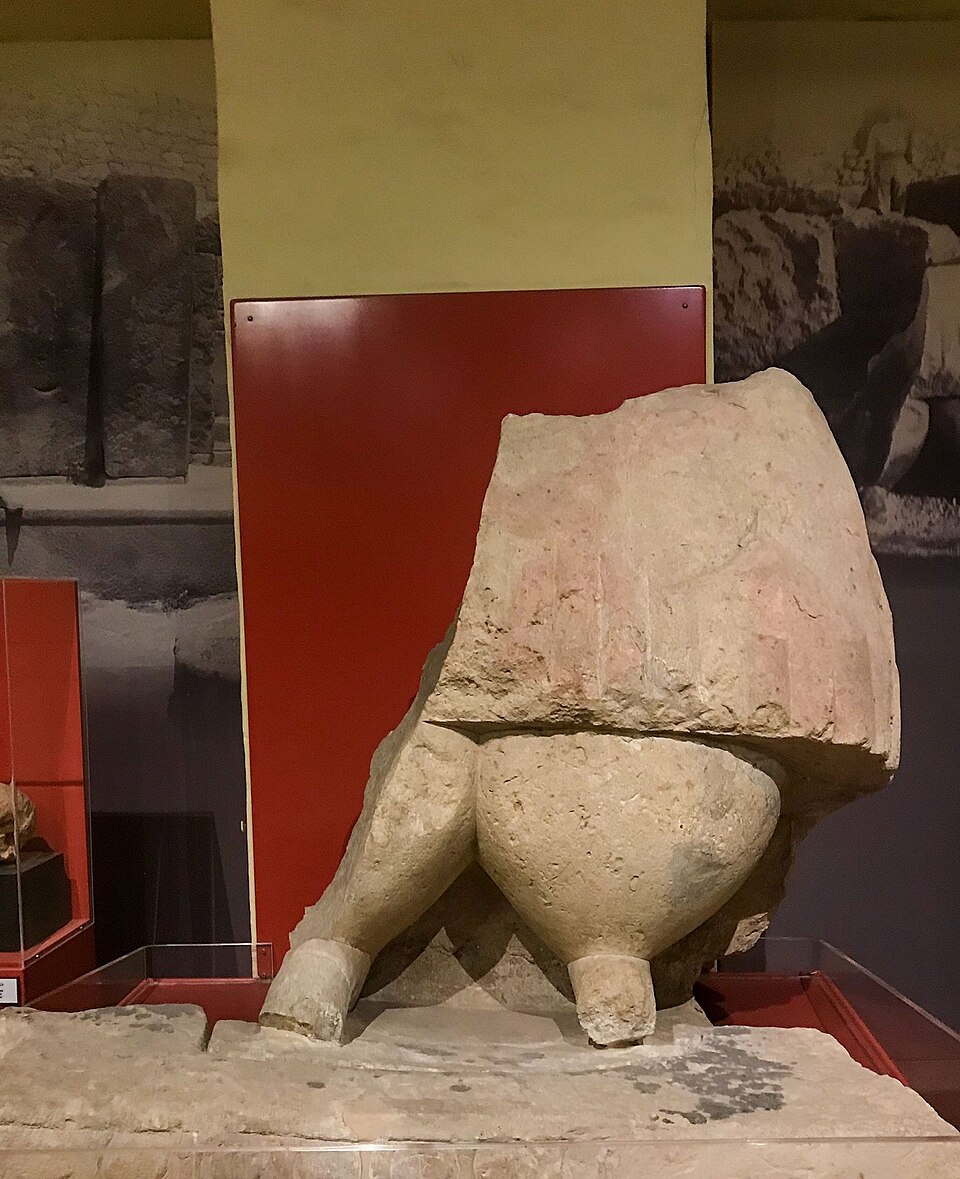 The South Temple and the Colossal StatueThe Colossal Original
While the statue fragment you see here is a replica, the original fragment is safely housed in the National Museum of Archaeology in Valletta. This is done to protect the delicate original from further weathering and damage. If you look closely at the replica, you can see the deep pockmarks and erosion caused by centuries of exposure before its 1913 discovery. In contrast, the original piece still retains many of the fine details that the replica can only approximate. Comparing the two highlights the challenges of preserving open-air sites. The sheer scale of the feet and legs is remarkable; they are far larger than human size, designed to inspire awe. The feet are flat and planted firmly on the ground, supporting the immense weight of the limestone torso that once rested upon them. This monumental carving was likely the focal point of rituals within the South Temple. Its placement near the entrance suggests it may have served as a guardian or a primary deity to be honored upon entry. The preservation of the original allows us to study the exact tool marks left by prehistoric sculptors, revealing their patience and mastery over the stone.
Listen in the appPhoto: EnriqueTabone · CC BY-SA 4.0
08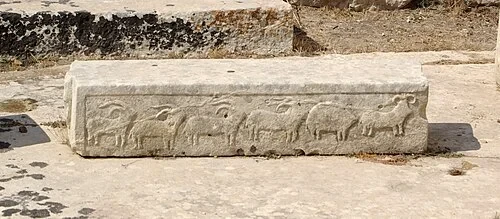 Sacred Art: Spirals and Animal ReliefsAnimal Relief Carvings
On this stone slab, you can observe one of the most famous examples of Neolithic relief carving. It depicts a procession of animals, including goats and rams, moving in a single line. The level of detail is quite advanced for the period; the horns and legs are clearly defined, giving the animals a sense of motion. These carvings are more than just art; they provide crucial information about the daily lives and beliefs of the temple culture. The presence of these domestic animals suggests that animal husbandry was a cornerstone of the community's economy and diet. Furthermore, it is widely believed that these reliefs depict animals intended for ritual sacrifice. Archaeological evidence found elsewhere on the site, such as bone fragments, supports the idea that animals were offered to deities as part of temple ceremonies. The placement of such carvings within the temple interior indicates that the relationship between humans and their livestock was deeply intertwined with their spiritual world. The ram, in particular, was a recurring motif in megalithic art, often symbolizing strength or virility. These reliefs turned the stone walls of the temple into a narrative space that honored the sources of the community's survival.
Listen in the appPhoto: Berthold Werner · CC BY-SA 3.0
09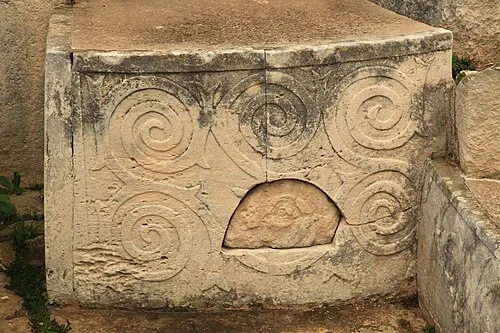 Sacred Art: Spirals and Animal ReliefsThe Spiral Altar
The stone block before you features an intricate carving of interconnected double-spirals. This spiral motif is one of the most recognizable and recurring designs found throughout Malta’s prehistoric temples. The carvings are executed with great precision, showing a high level of artistic control over the limestone surface. While the exact meaning of the spirals remains unknown, scholars have proposed several theories. They may represent the idea of eternity, the cycles of life and death, or the constant growth and unfolding of nature. Some suggest the spirals could even be a stylized representation of the sun or the movement of the stars. In the context of an altar, these designs likely held a sacred significance, perhaps serving as a focus for meditation or prayer during rituals. The double-spiral, in which two curves wind toward or away from each other, is particularly complex. Notice how the spirals are not just scratched into the surface but are raised in relief, creating a sense of depth and shadow. This altar is a prime example of how the temple builders used art to transform functional architectural elements into objects of religious devotion, weaving symbolic meaning into the very fabric of the sanctuary.
Listen in the appFrank Vincentz · CC BY-SA 3.0
10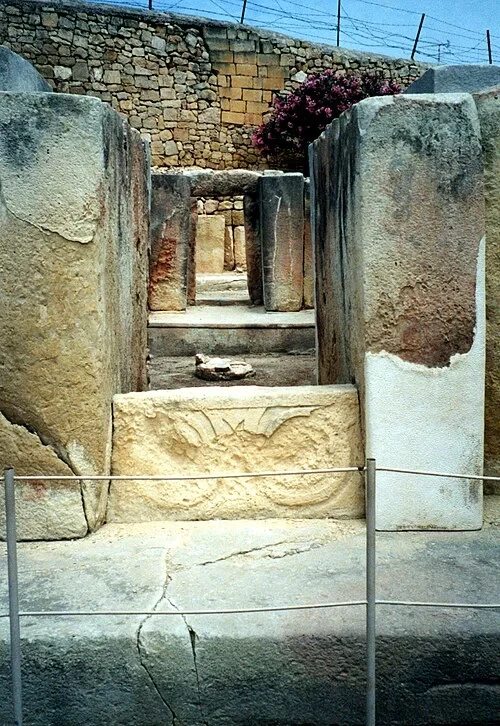 The Central Temple: Architecture of the Six ChambersCentral Temple Passage
As you look down this narrow passage, you are following the same path ancient visitors took to enter the Central Temple. The architecture here is designed to control movement and visibility. Unlike modern buildings with open floor plans, these prehistoric structures used narrow corridors and stone screens to create a sense of mystery and progression. Look for the decorative screen visible near the ground level at the end of the passage. This low stone wall or 'sill' often demarcated different levels of sanctity within the temple. Certain areas may have been restricted to priests or specific members of the community. By making the passages narrow, the builders forced people to move in single file, perhaps as a way of instilling discipline or reverence. This physical constraints also meant that the transition from the bright, open exterior into the darker, more enclosed interior would have been a powerful sensory experience. The lighting within these chambers would have been very different in antiquity, perhaps illuminated by oil lamps or small openings in the roof. Every turn in the passage was a deliberate choice, intended to lead the participant deeper into the ritual space while shielding the most sacred activities from public view.
Listen in the appMichael Gunther · CC BY-SA 4.0
Tarxien Temples
Frequently asked questions
How much does the guide cost?
Free app download. Listed guide price: $1.99. Guide price shown in the app. Audio guide only. Venue admission is separate.
Can I listen without internet?
Yes. Download the guide’s audio, images, and maps in the app before your visit. Your downloaded content is then available offline.
Can I listen in my language?
Stanza supports 15 languages. Check the app for the languages available for this guide.
Do I need to follow a schedule?
No. This is a self-guided experience. Choose your stops, pause whenever you like, and return to a story at your own pace.
At your own pace
Explore Tarxien Temples.
Download Stanza, then search for “Tarxien Temples”.
Free app download · Guide price shown in the app
Keep exploring
Nearby audio guides
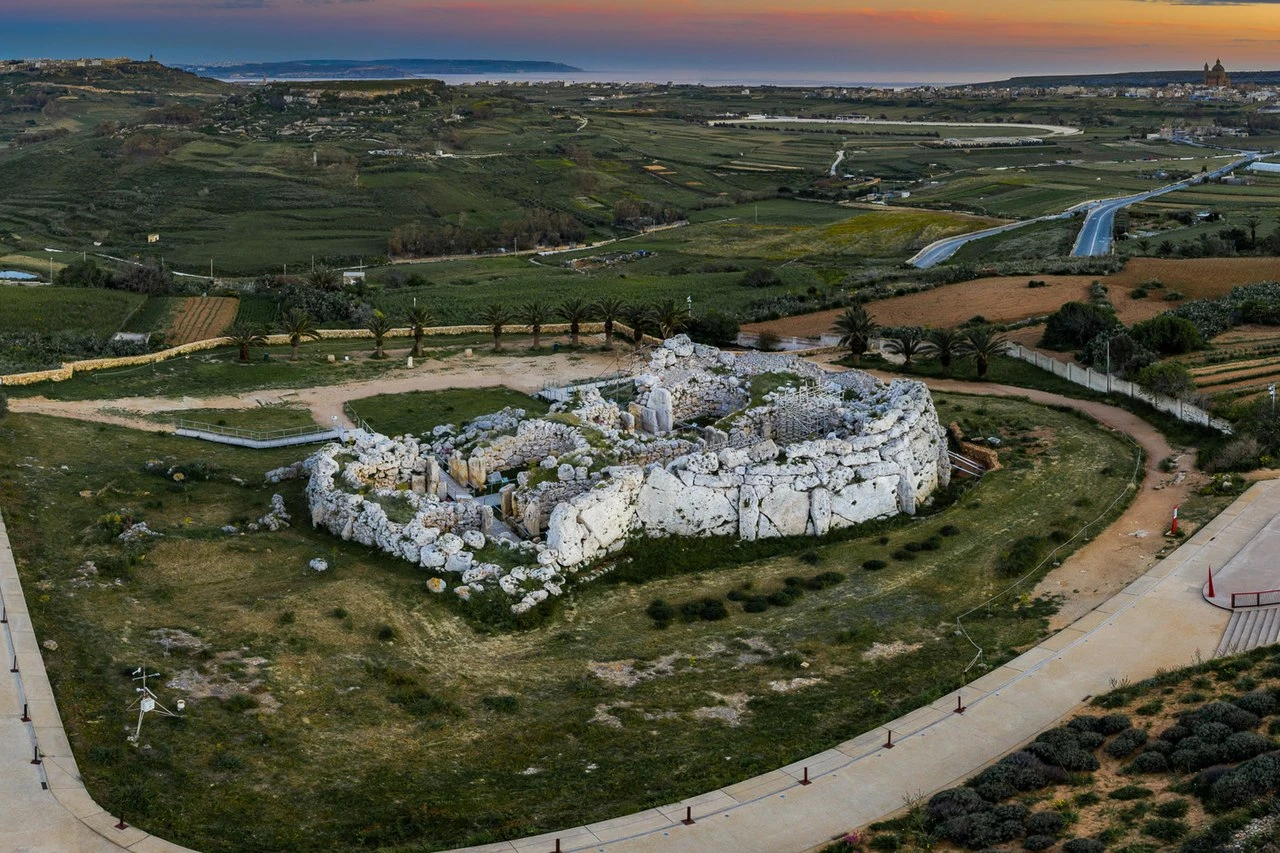
Xagħra
Ġgantija
Content & sources
FritzPhotography · CC BY-SA 4.0
Valletta
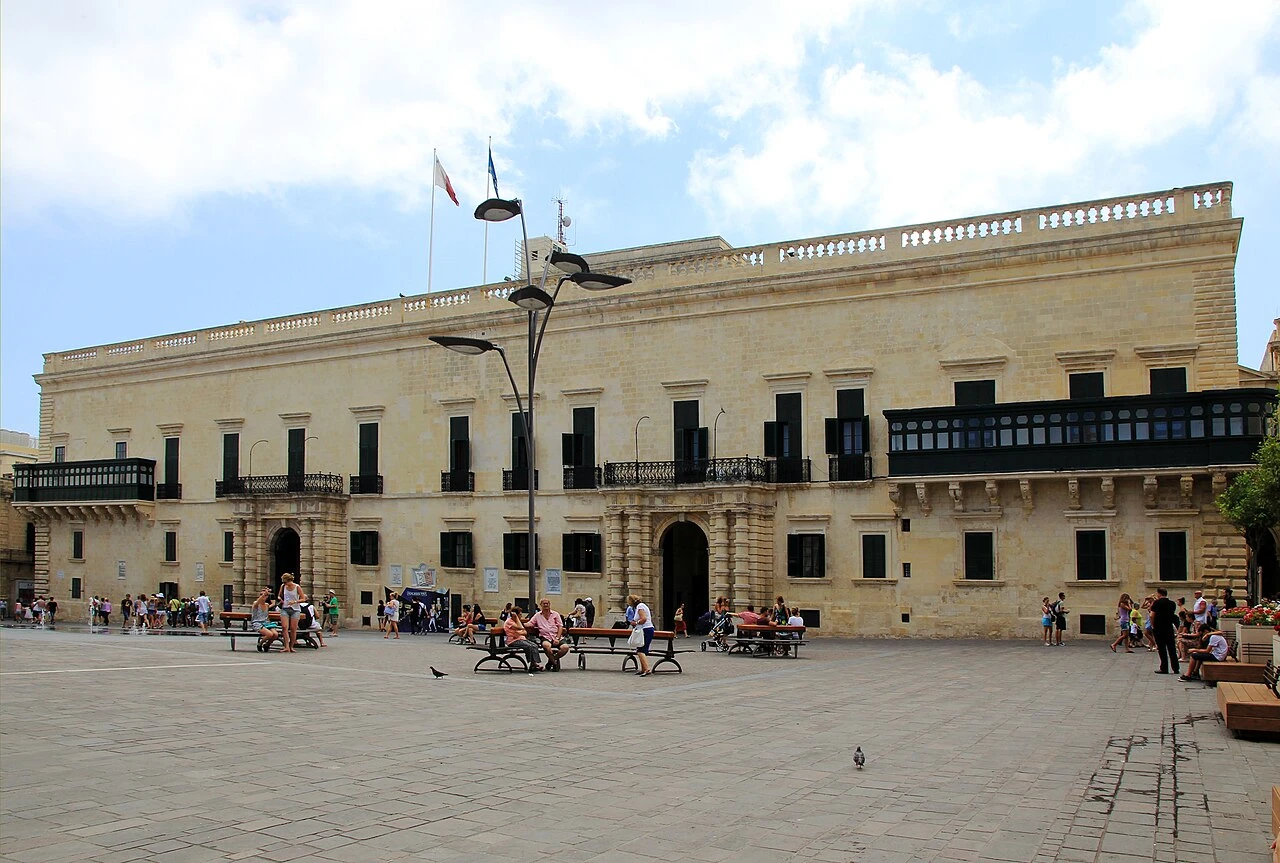
Grandmaster's Palace
Content & sources
Photo: Karelj · Public domain
Valletta
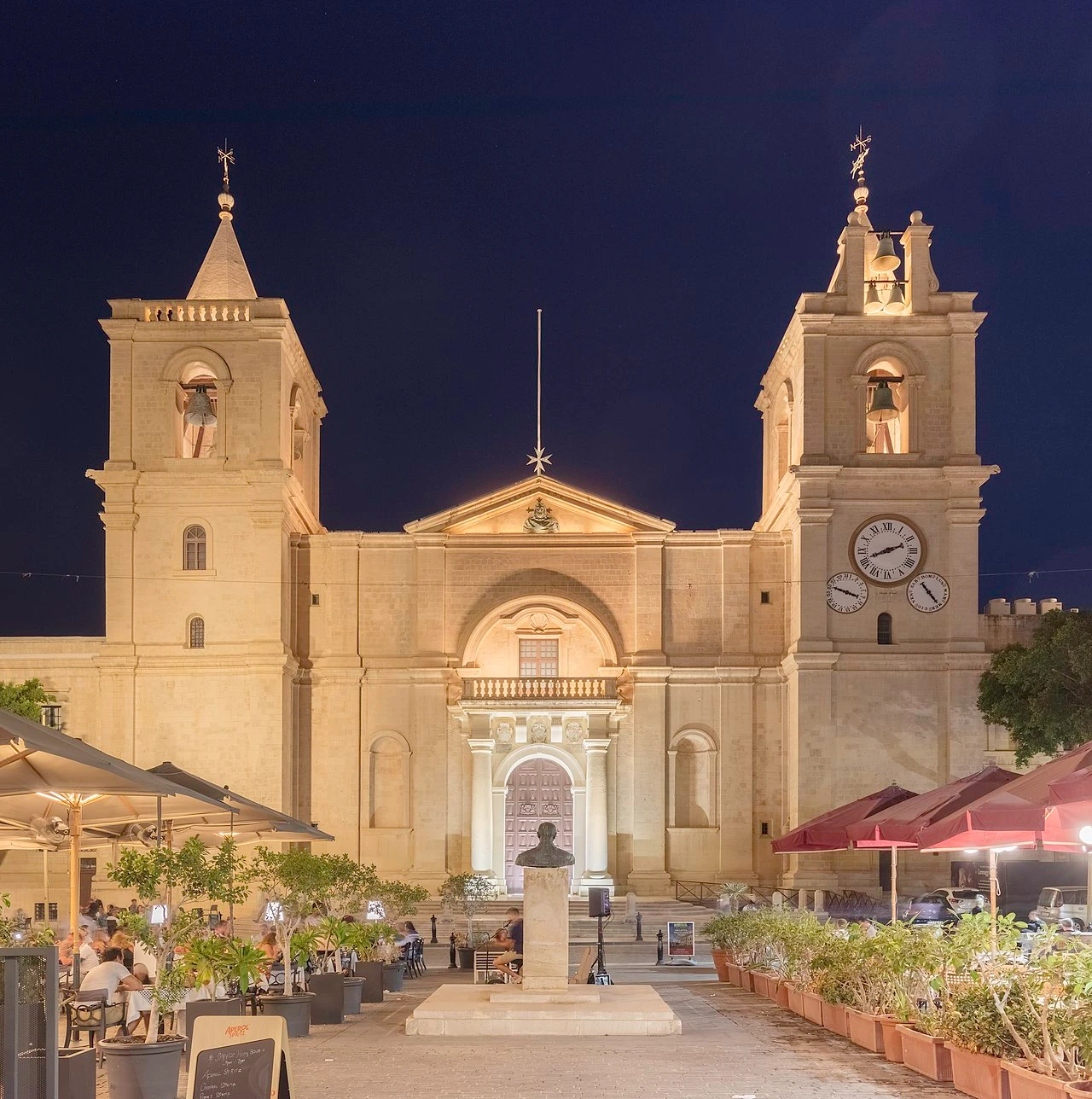
St. John's Co-Cathedral
Content & sources
Diego Delso · CC BY-SA 4.0