Stanza · Audio guide
Cittadella Audio Guide
A place to remember. A story to take with you.
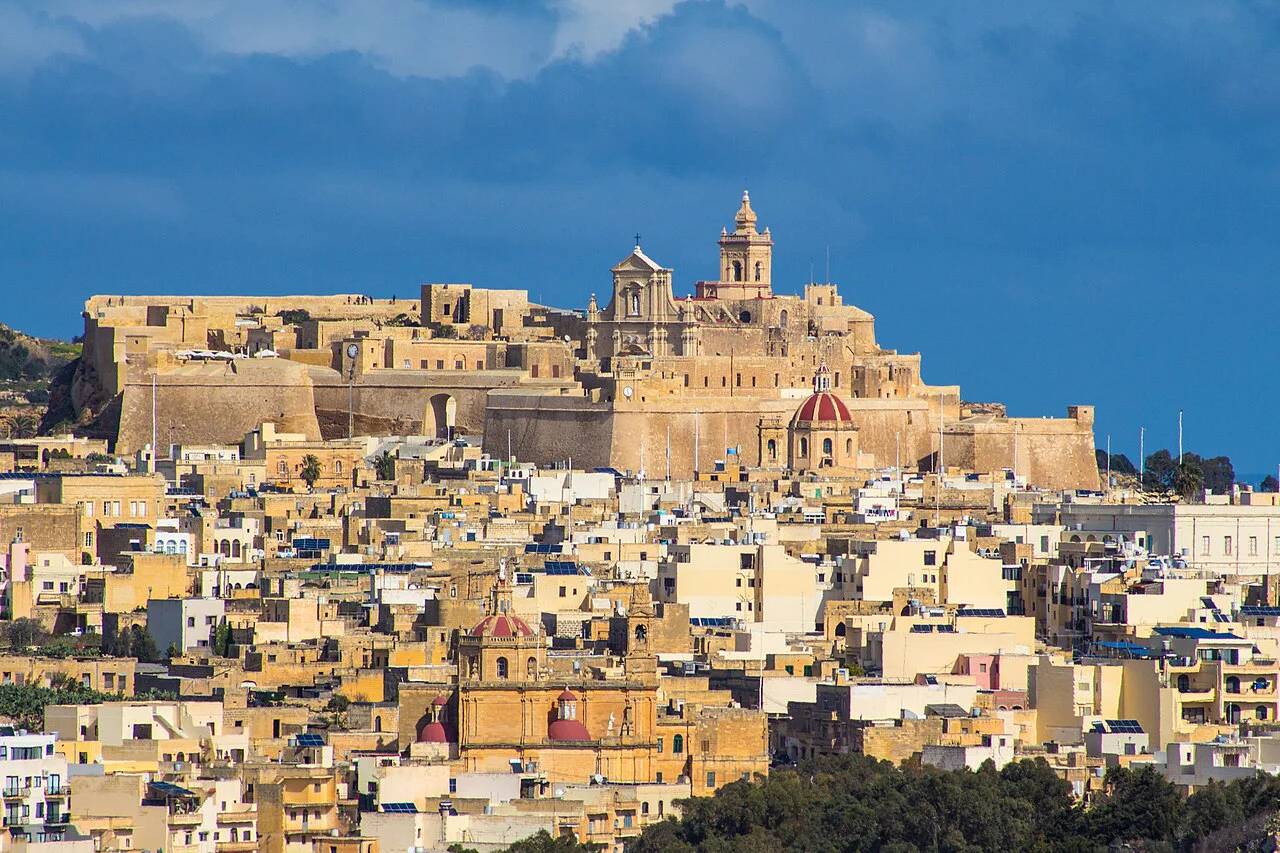
The Cittadella is the citadel of Victoria on the island of Gozo, Malta. The site has been inhabited since the Bronze Age and is believed to have been the acropolis of the Punic-Roman city of Gaulos.
Download Stanza, then search for “Cittadella”.
About the tour
One guide. Your kind of visit.
The Cittadella is the citadel of Victoria on the island of Gozo, Malta. The site has been inhabited since the Bronze Age and is believed to have been the acropolis of the Punic-Roman city of Gaulos.
Ready when you are.
- 01Get the free Stanza app.
iOS & Android
- 02Find your guide.
“Cittadella”
- 03Download before you go.
Works offline
Audio guide / 16 narrated stops
Inside the guide
Get to know a few of the stories before you go. Open a stop to read more.
01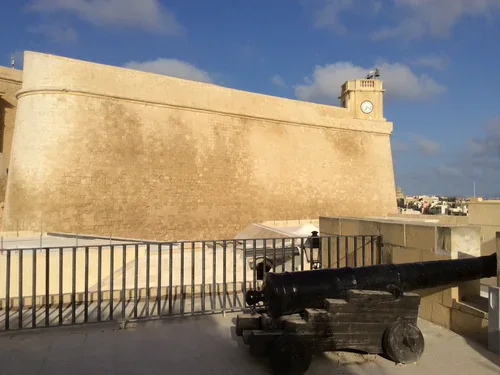 The Outer Defences and Main Gate
Cannon on the Ravelin
A single black cannon rests on a wooden carriage, its barrel aimed across the small stone outwork that guards the approach to the gate. That outwork is a ravelin, a detached island of defence set in front of the entrance, so that anyone attacking the gate would come under fire from two sides. Most of its original stonework has been lost, and it now reads more as a garden than as a fortress. Welcome to the Cittadella, the walled heart of the island of Gozo. People have lived on this hill since the Bronze Age, and for centuries it was the whole island's refuge, its seat of government and its holy ground. The fortress kept its garrison until the British decommissioned it in 1868. Past the cannon, the main gate waits beneath its little clock tower, and that is where the story begins.
Photo: Continentaleurope · CC BY-SA 4.0
02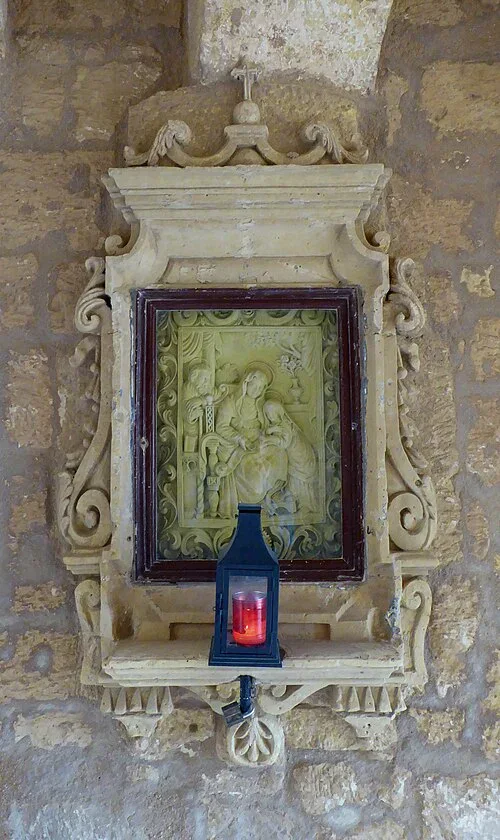 The Outer Defences and Main Gate
Relief of St Anne
Set into the coarse limestone near the gate, a carved niche holds one of the gentlest things in this fortress. Within an ornate frame of Baroque scrollwork sits a relief of St Anne with the child Mary. No one knows exactly when the carving was set here, or who paid for it. What it shows is simple enough: the people who built and used this stronghold wanted a blessing at the threshold, and the wall of a fortress made room for faith. A small cross crowns the frame, and a red light still burns in the lantern hanging below.
Ethan Doyle White · CC BY-SA 4.0
03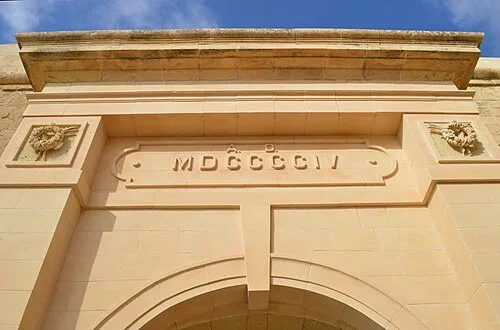 The Outer Defences and Main Gate
The Main Gate
High on the arch, a carved inscription reads MDCCCCIV, which spells out the year 1904. That date belongs to the present gateway, a modern rebuilding of an opening that has been remade over the centuries. For most of its life, this door worked under a law. From the medieval period onwards, the people of Gozo were required to spend every night inside these walls. The island had no other fortified refuge, so at dusk the whole population came in, and at dawn they went out to their fields again. That obligation lasted until the fifteenth of April, 1637, when the curfew was finally lifted. The day this refuge failed is told later, at the Summit Ramparts.
Listen in the appPhoto: Continentaleurope · CC BY-SA 4.0
04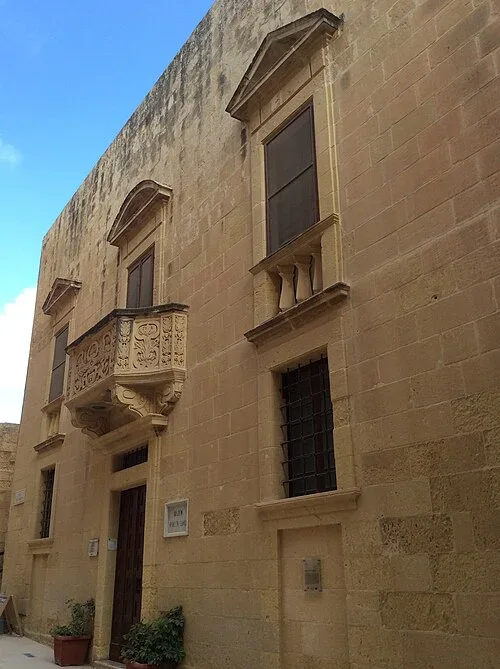 Cathedral Square and Ancient Gaulos Heritage
Casa Bondi – Gozo Museum of Archaeology
Long before any of these walls, this hill was the acropolis of a city the Romans knew as Gaulos. Pottery found inside the citadel shows a settled community here in the Bronze Age. Silos unearthed outside the walls in the nineteenth century suggest the settlement was then even larger than today's fortress. Through Punic and Roman times the town went on living here, its citadel on the hill and its streets below. The house that holds the island's archaeology today is Casa Bondi, a town house of the seventeenth century, its carved stone balconies still giving it the air of a private home. Inside, the story runs from prehistoric pottery to the inscriptions of Roman Gaulos.
Listen in the appContinentaleurope · CC BY-SA 4.0
05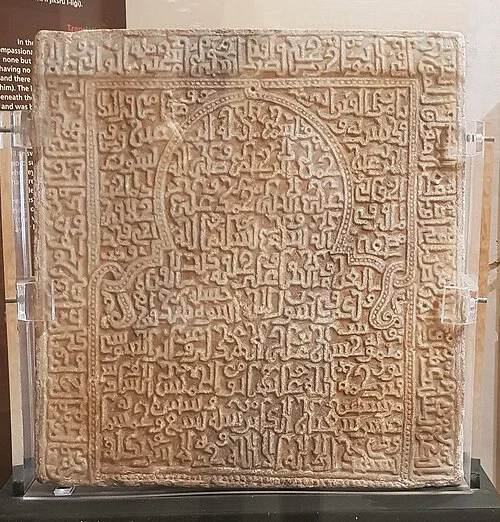 Cathedral Square and Ancient Gaulos Heritage
The Maymūnah Stone
Behind glass in the museum lies a slab of limestone crowded with carved Arabic writing from edge to edge. It is known as the Maymūnah Stone. Between the Roman city of Gaulos and the medieval castle lies a chapter the island shared with Malta: centuries under Arab rule. A stone like this, its letters cut dense and angular around a pointed arch at the centre, is the most tangible trace of that time on Gozo. By the Middle Ages the hill no longer held a Roman town but a castle, the castrum of Gozo, standing on this same high ground.
Listen in the appPhoto: Matthew Axiak · CC BY-SA 4.0
06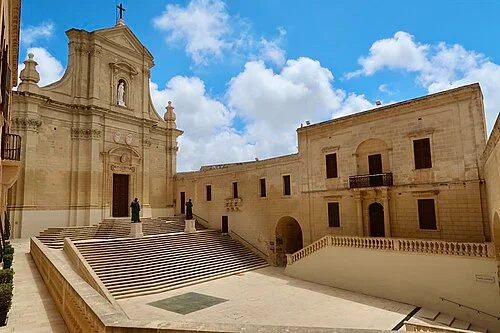 Cathedral of the Assumption and the Illusion Dome
Cathedral of the Assumption
Tradition puts a Roman temple to Juno on this very spot, and when builders dug for the present church they found extensive remains of a Roman building, some of which still survive below. A parish church stood inside the citadel by the thirteenth century, and it was enlarged over the following centuries. The attack of 1551 damaged it, though it was repaired within a few years. Then the great Sicily earthquake of 1693 left it beyond saving, and it was pulled down. The present Baroque church was begun in 1697. It was completed in 1711, to designs by Lorenzo Gafà, the Maltese architect who also built the cathedral at Mdina. In 1864 the church became a cathedral, when the diocese of Gozo was created. Over the nave hangs the building's most famous feature, and that is the next stop.
Listen in the appPhoto: Xanella22 · CC BY-SA 4.0
07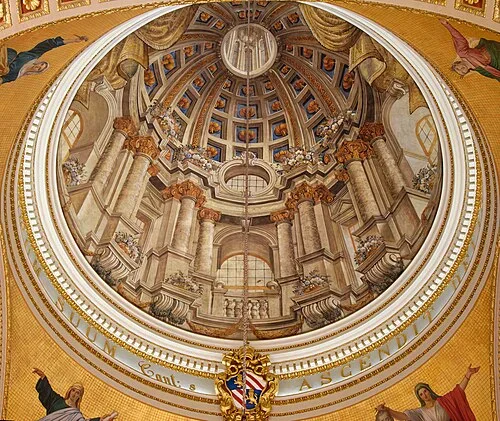 Cathedral of the Assumption and the Illusion Dome
The Painted Dome
From the floor of the nave, the dome looks utterly solid: coffered vaults, marble columns, balconies, a lantern opening onto the sky. Every bit of it is paint. The Sicilian artist Antonio Manuele painted the perspective of a dome that was never built, flat plaster doing the work of real architecture. The trick has a name, trompe-l'œil, French for deceive the eye. The story goes that the money ran out before a dome of stone could rise. Either way, the illusion holds its power: seen from below, the eye still accepts the whole impossible building.
Listen in the appPhoto: Tranceliner · CC BY-SA 4.0
08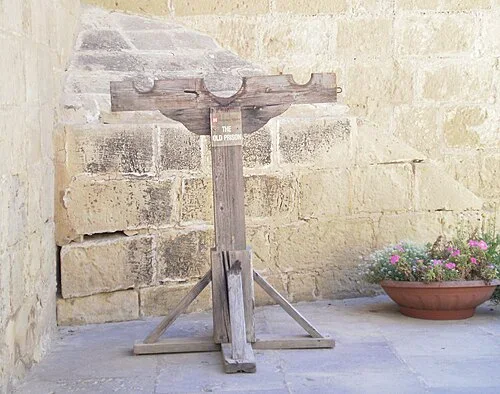 The Old Prison and Judicial Quarter
The Pillory
A rough wooden frame stands on splayed legs, its crossbeam pierced with holes for neck and wrists. This is a pillory, the old instrument for punishing offenders in full public view. It fits its setting, for this part of the citadel was where law was made and enforced. The Law Courts nearby occupy a palace built for the Governor in the early 1600s. In 1798 the fortress changed hands twice. French troops landed on the island in June, and the citadel fell by nightfall. When the Gozitans rose in revolt, the French garrison withdrew behind these walls. After negotiations, they capitulated on 28 October. The next day control passed to the Gozitans, who set up a provisional government under Saverio Cassar and briefly ran the island as an independent state, La Nazione Gozitana.
Listen in the appPhoto: Chrisportelli · CC BY-SA 3.0
09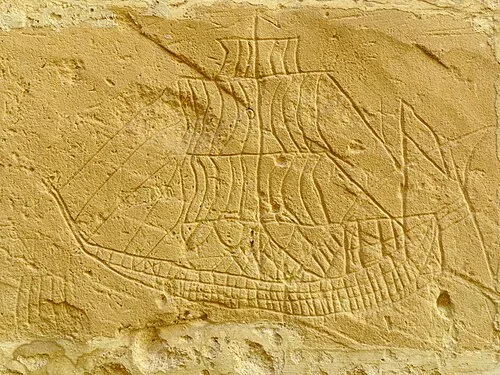 The Old Prison and Judicial Quarter
The Carved Ship of the Old Prison
A three-masted sailing ship is carved into the limestone of a prison cell, its hull, rigging and furled sails scratched in with simple lines. The building behind the Law Courts served as a prison from the sixteenth century onwards. Its last inmates left in 1962. Four centuries of prisoners passed through these cells, and the walls carry what they left behind: names, dates, ships and symbols cut into the stone. Some carvings are said to be the work of imprisoned Knights of St John, though no one can say for certain which. The citadel's courts kept the island's order. This prison was the other face of that order. Each generation of inmates wrote over the marks of the last, because the soft Gozitan limestone took a blade so readily.
Listen in the appPhoto: TeWeBs · CC BY-SA 4.0
10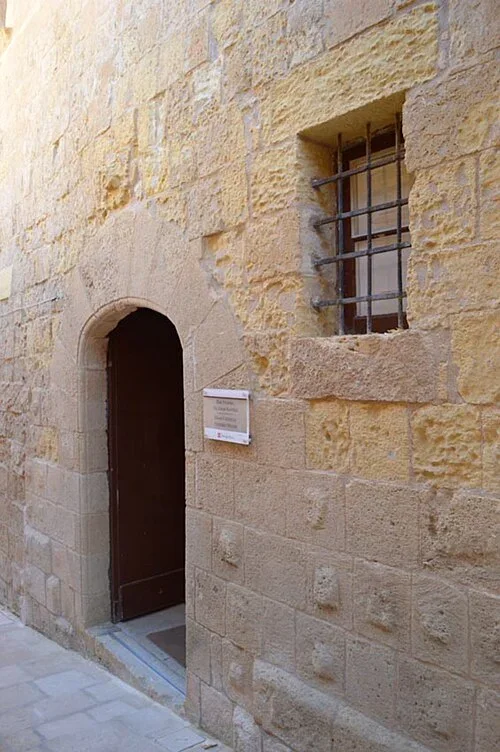 The Medieval Quarter and Northern Enceinte
Gran Castello Historic House
For centuries, the citadel was a neighbourhood as much as a fortress. This cluster of houses went up in the early sixteenth century, when families still lived within the walls. Its arched doorway and barred window belong to a substantial dwelling of honey-coloured limestone. The cluster survives as the Gran Castello Historic House, a museum of Gozitan folklore opened in 1983. It is dedicated to the everyday life of the island. By the early eighteenth century the citadel had become a fortress first, and many of the houses inside were falling into ruin. Domestic life here was shaped by the refuge the hill provided. The great disaster of this place came earlier still, in 1551, and it is told later at the Summit Ramparts.
Listen in the appPhoto: Continentaleurope · CC BY-SA 4.0
- 11
Chapel of St Joseph
A chapel on the bastions and a bishop's palace, proof that clergy and nobles lived inside the fortress too.
- 12
The Northern Covertway and Medieval Enceinte
The northern ramparts kept their medieval face while the south became a gunpowder fortress, and the castle's story runs back to 1241.
- 13
St John's Demi-Bastion
The massive southern walls of 1599 to 1622, engineered by Rinaldini and Cassar for the age of gunpowder.
- 14
The Gunpowder Magazine
A small arched doorway at the wall's junction, where the fortress kept its powder dry and close to the guns.
- 15
The Summit Ramparts
From the summit, the whole island in view, and the story of July 1551, when the refuge failed six thousand people.
- 16
The Ditch Gardens
The ditch that was once the killing ground of the gunpowder front, now a garden, with the restored citadel of 2016.
Cittadella
Frequently asked questions
How much does the guide cost?
Free app download. Listed guide price: $0.99. Guide price shown in the app. Audio guide only. Venue admission is separate.
Can I listen without internet?
Yes. Download the guide’s audio, images, and maps in the app before your visit. Your downloaded content is then available offline.
Can I listen in my language?
This audio guide is available in 15 languages, including English.
Do I need to follow a schedule?
No. This is a self-guided experience. Choose your stops, pause whenever you like, and return to a story at your own pace.
At your own pace
Explore Cittadella.
Download Stanza, then search for “Cittadella”.
Free app download · Guide price shown in the app
Keep exploring
Nearby audio guides
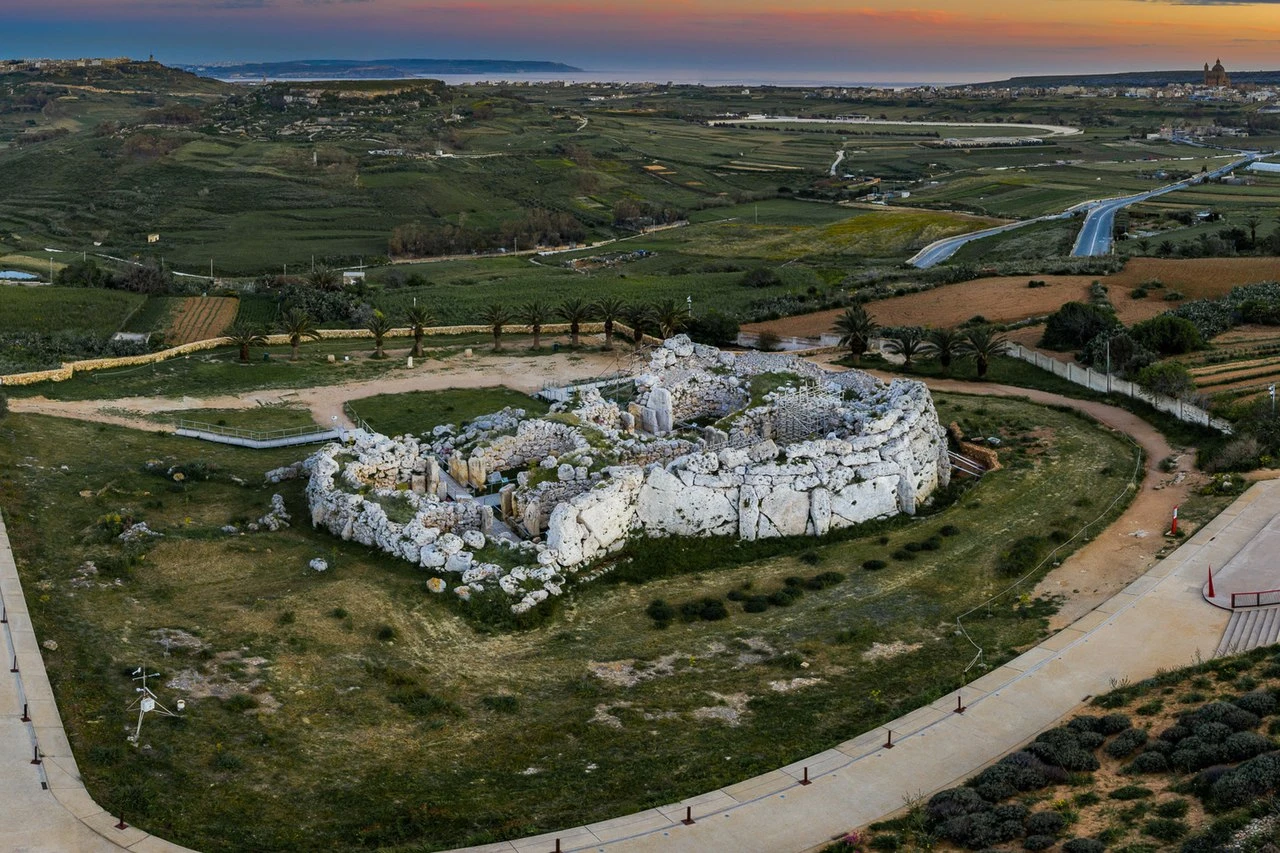
Xagħra · 3 km
Ġgantija
Content & sources
FritzPhotography · CC BY-SA 4.0
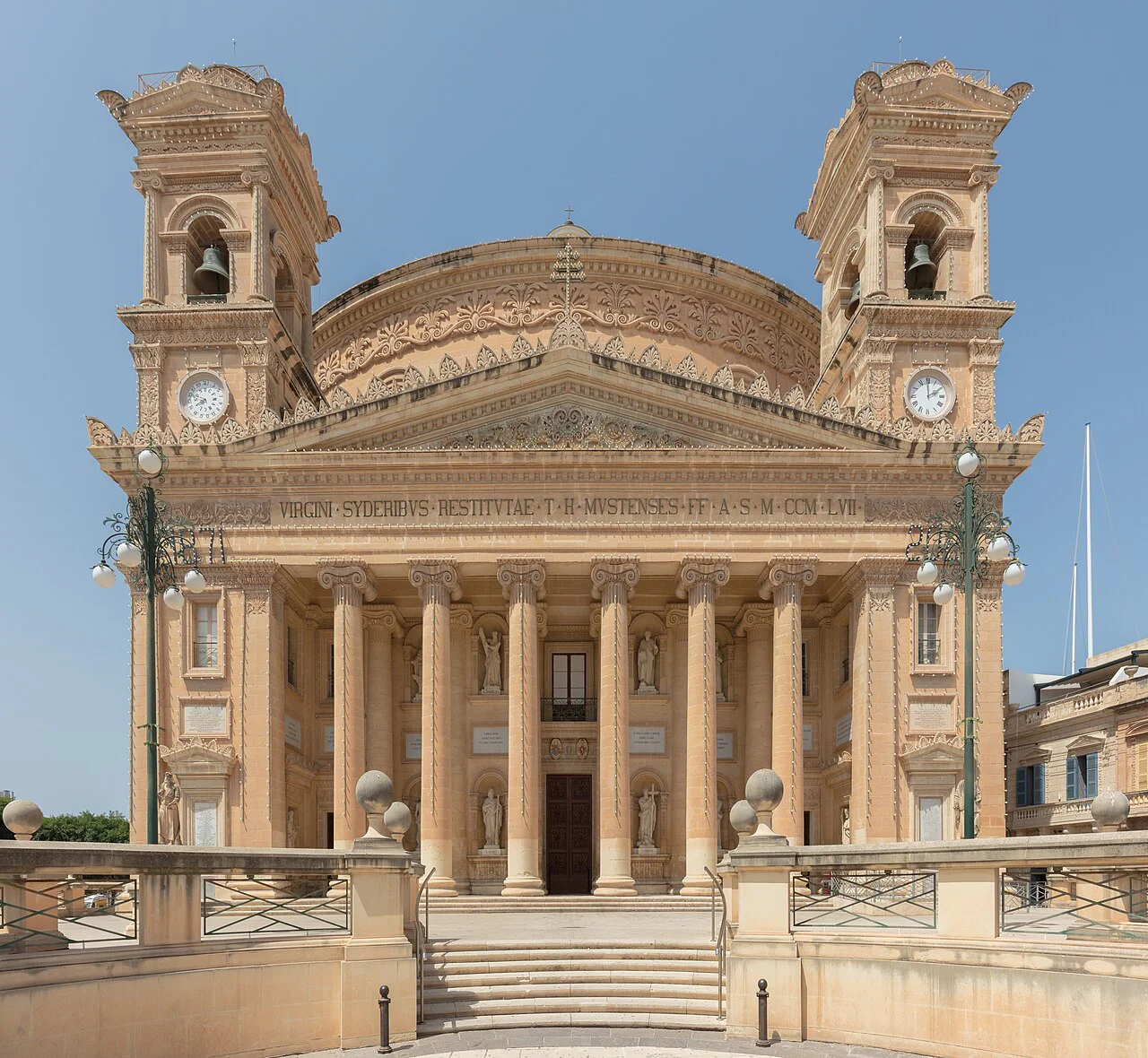
Mosta · 23 km
Rotunda of Mosta
Content & sources
Diego Delso · CC BY-SA 4.0
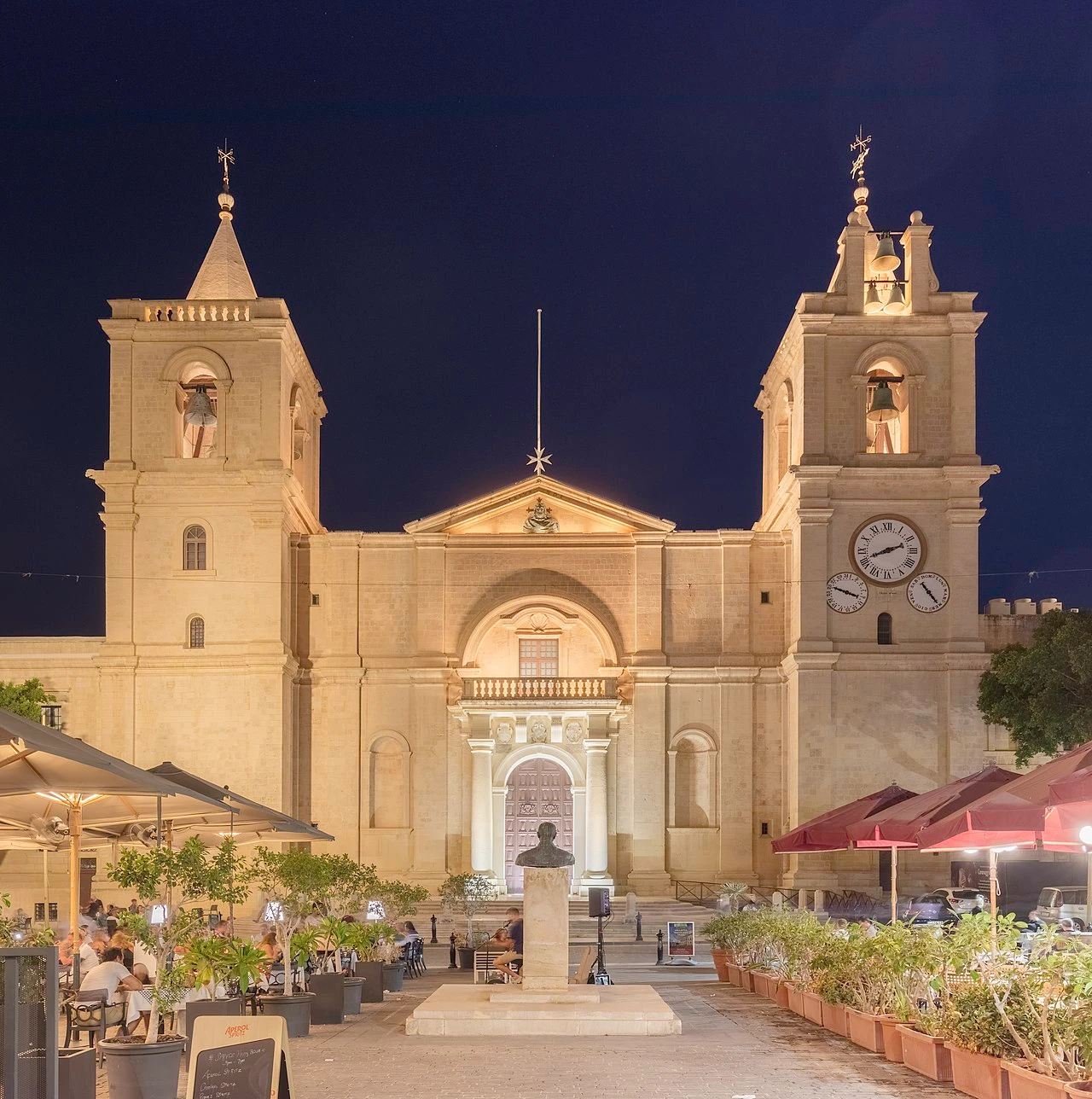
Valletta · 30 km
St. John's Co-Cathedral
Content & sources
Diego Delso · CC BY-SA 4.0
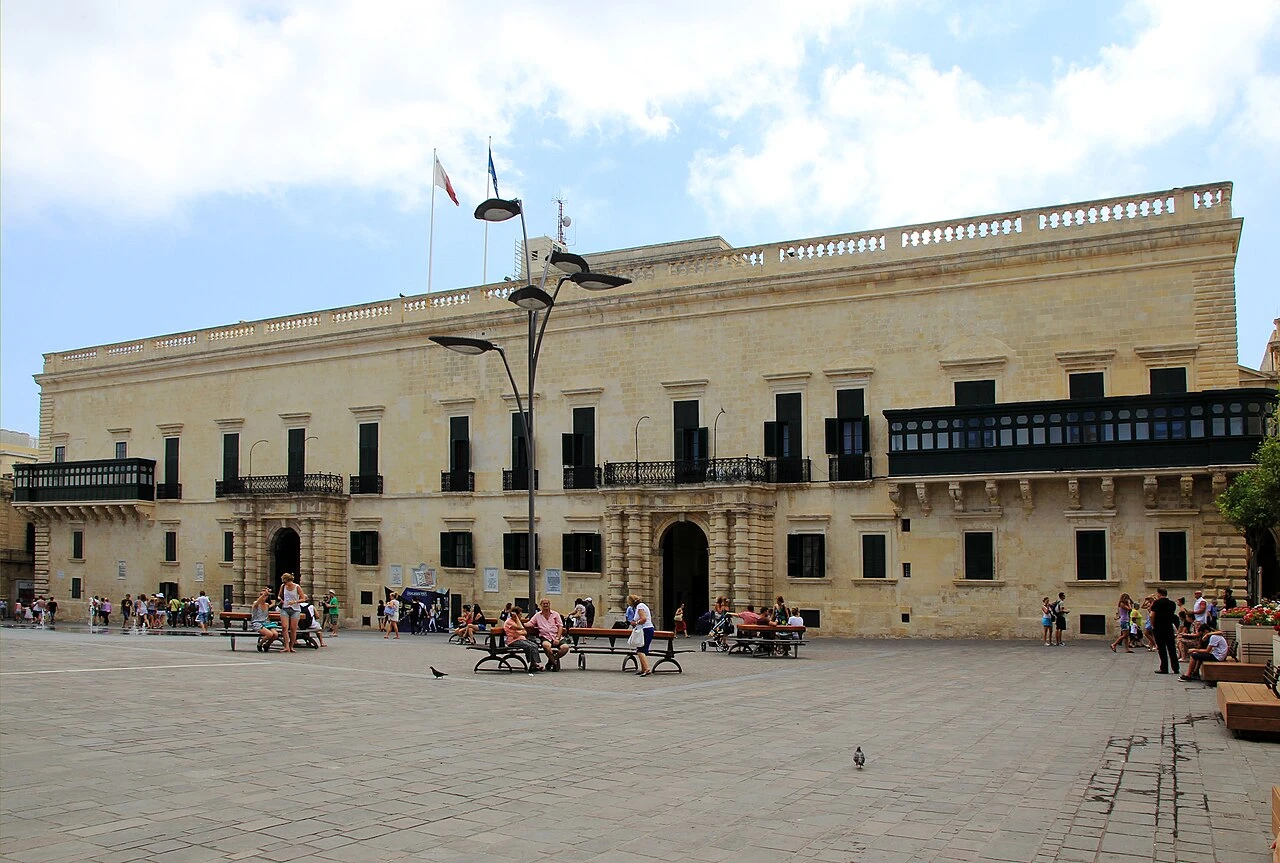
Valletta · 30 km
Grandmaster's Palace
Content & sources
Photo: Karelj · Public domain