Stanza · Audio guide
Palacio de Bellas Artes Audio Guide
A place to remember. A story to take with you.
This iconic cultural center and opera house in Mexico City is a prominent venue for music, dance, theater, and art exhibitions. It is renowned for its stunning Art Nouveau and Art Deco architecture and its…
Download Stanza, then search for “Palacio de Bellas Artes”.
About the tour
One guide. Your kind of visit.
This iconic cultural center and opera house in Mexico City is a prominent venue for music, dance, theater, and art exhibitions. It is renowned for its stunning Art Nouveau and Art Deco architecture and its collection of murals by famous Mexican artists.
Ready when you are.
- 01Get the free Stanza app.
iOS & Android
- 02Find your guide.
“Palacio de Bellas Artes”
- 03Download before you go.
Works offline
Audio guide / 12 narrated stops
Inside the guide
Get to know a few of the stories before you go. Open a stop to read more.
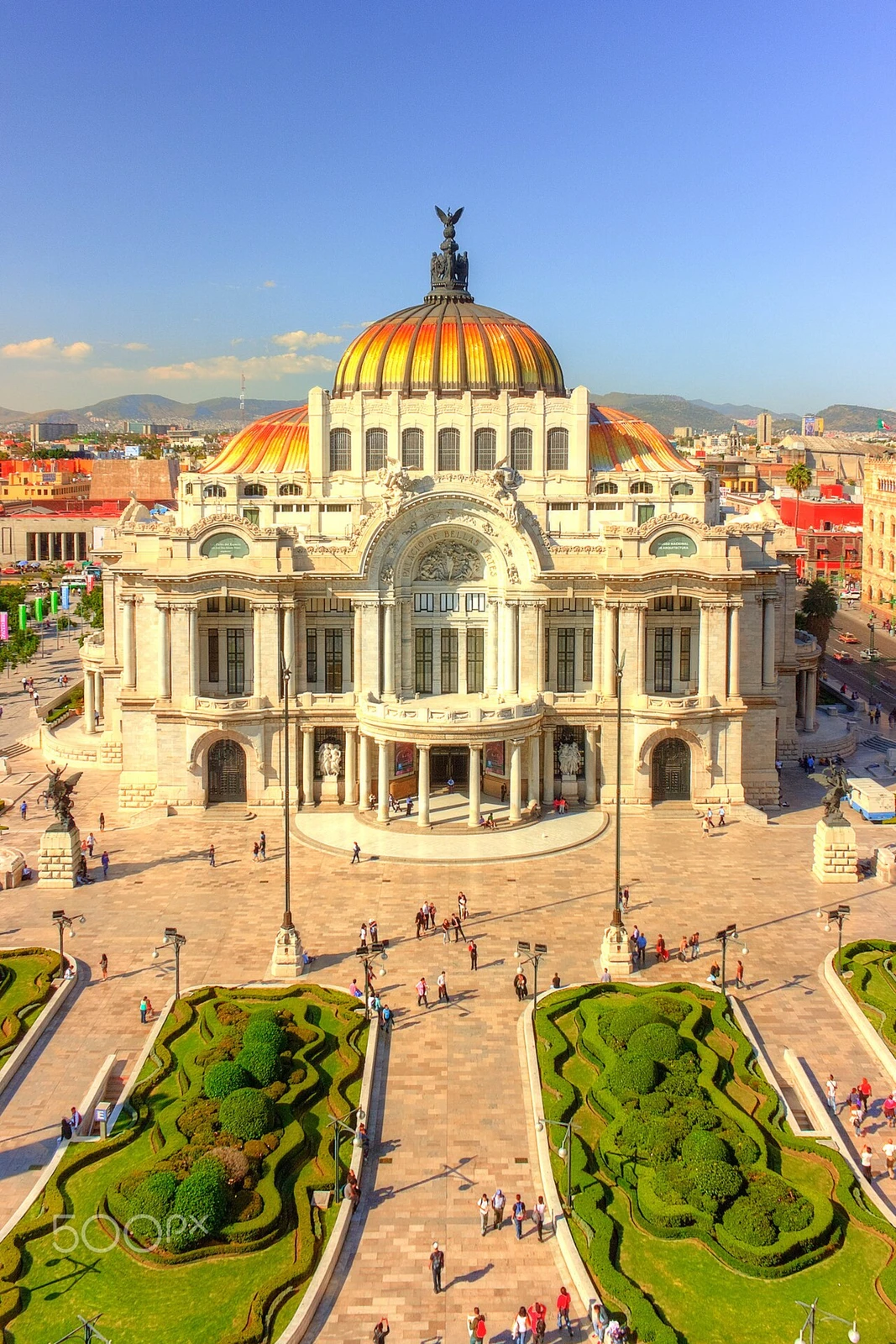
01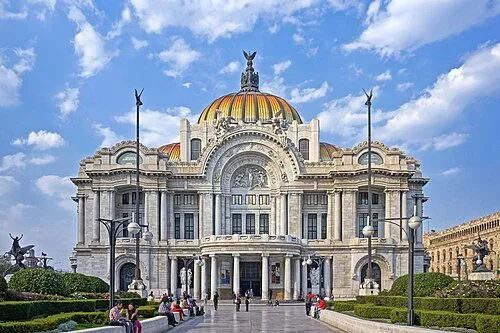 Sunken Esplanade and Pegasus Plaza
The Palace of Fine Arts: An Opera House for the Centennial
Welcome to the Palace of Fine Arts, the great marble opera house on the western edge of Mexico City's historic center. Its story begins with an older theater on this spot, the Gran Teatro Nacional, torn down in 1901. The plan was audacious: a grander opera house, the Gran Teatro de Ópera, ready for the centennial of Mexican Independence in 1910. The commission went to the Italian architect Adamo Boari, who also designed the ornate post office across the street. In 1904, Porfirio Díaz himself laid the first stone, and Boari promised a vast metallic structure, a scale attempted nowhere outside the United States. Then the ground betrayed him. The heavy shell began sinking into the soft, spongy subsoil of the old lakebed beneath the city. By 1913, political chaos and the Mexican Revolution had stopped the work entirely, and Boari went home to Italy. The unfinished shell sat for roughly twenty years. In 1932, the Mexican architect Federico Mariscal took over, finished the building, and on the twenty-ninth of September, 1934, the palace finally opened. The white marble facades and the multicolored dome above the grand stair are the result of both men's work.
Xavier Quetzalcoatl Contreras Castillo · CC BY-SA 3.0
02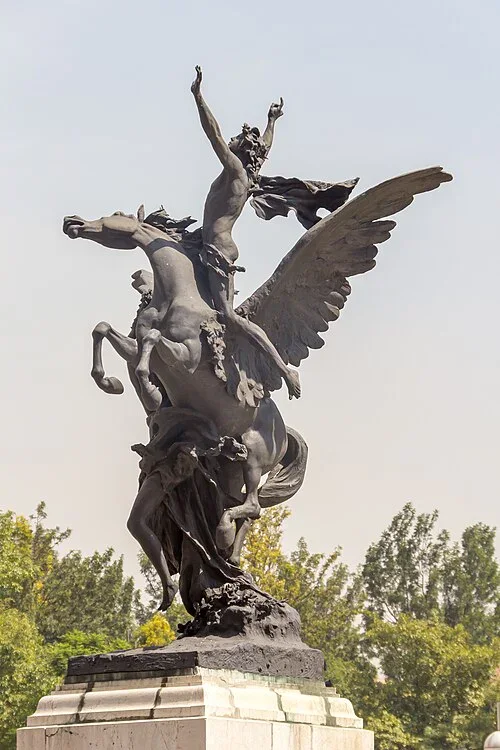 Sunken Esplanade and Pegasus Plaza
The Pegasus Fountain on the Plaza
One of the four bronze Pegasus sculptures keeps watch on the plaza front, wings spread against the sky. The Catalan sculptor Agustí Querol Subirats cast these rearing winged horses, and Boari designed their setting on the building's plaza side. Before they came here, the horses stood on the Zocalo, the great square at the heart of the capital. They were brought to this plaza later. Their presence says something about the era's taste: European allegory, classical myth, and grand sculptural ornament arranged around a modern public building.
Photograph by Mike Peel (www.mikepeel.net). · CC BY-SA 4.0
03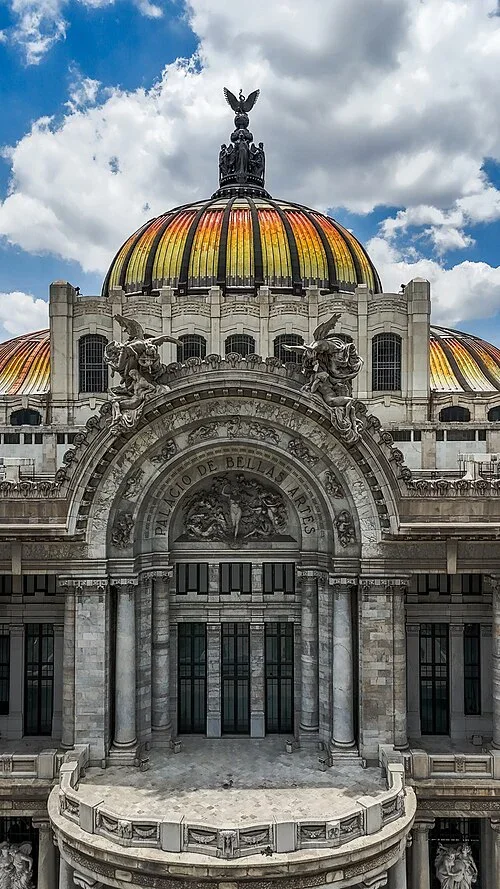 Neoclassical and Art Nouveau Portal
The Portal: Harmony and Her Companions
High on the central portal, the carved tympanum announces the building's Porfirian ambitions. Inside the portal sits a sculptural group by the Italian Leonardo Bistolfi: Harmony, surrounded by Pain, Rage, Happiness, Peace, and Love. Elsewhere on the facade, cherubs and figures representing music and inspiration complete the program. The stone itself traveled far. The lower structure wears beige marble from Yautepec in Morelos, while the facades carry white marble from Buenavista de Cuéllar in Guerrero and from Carrara in Italy. The main tympanum was put in place in 1910, the centennial year the building was meant to open. Under Porfirio Díaz, the capital wanted a monumental face in the European manner, and this Art Nouveau exterior was meant to provide it.
Listen in the appPhoto: ProtoplasmaKid · CC BY-SA 4.0
04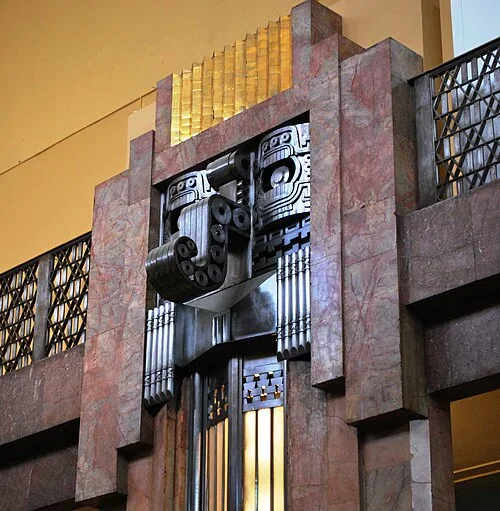 Art Deco Grand Vestibule and Central Cupola
Chaac in Art Deco: The Mexican Interior
A carved Maya Chaac mask stares out from a vertical light panel, all geometry and glistening stone. This is where the palace changes character. Boari's Art Nouveau rules the outside, but Federico Mariscal finished the inside in Art Deco, the sharp modern style of the 1930s. He did something more deliberate than change fashion. He paired those angular 1930s forms with pre-Hispanic Mexican motifs. Serpent heads crown the window arches, and the rain deities of the old worlds appear throughout: Chaac of the Maya, and Tlaloc of the Aztecs. At the theatre entrance, bronze mascarons depicting both water gods were designed by Gianette Fiorenzo. After the Revolution, the interior spoke in an indigenous Mexican visual language instead of a European one.
Listen in the appPhoto: AlejandroLinaresGarcia · CC BY-SA 4.0
05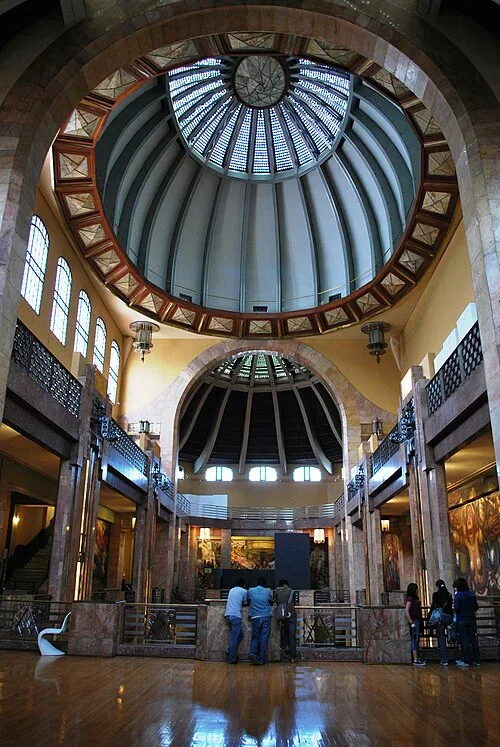 Art Deco Grand Vestibule and Central Cupola
Under the Glass Dome: Hall of the Muses
Looking up, the great dome opens overhead in glass and iron, designed by the Hungarian Géza Maróti and depicting the Muses with Apollo. This central hall anchors the whole interior. Around it rise the balconies of three upper floors, and from the ground floor all of them stay in view. The building divides into three sections: this main hall with its exhibition spaces, the theatre, and the offices of the National Institute of Fine Arts, which makes its home here. The palace also serves a solemn civic purpose. Sixty-five figures from arts and culture have received funeral tributes within these walls, beginning with the muralist José Clemente Orozco in 1949. In later years, honors came for figures such as Frida Kahlo, Diego Rivera, and the writer Gabriel García Márquez.
Listen in the appPhoto: AlejandroLinaresGarcia · CC BY-SA 4.0
06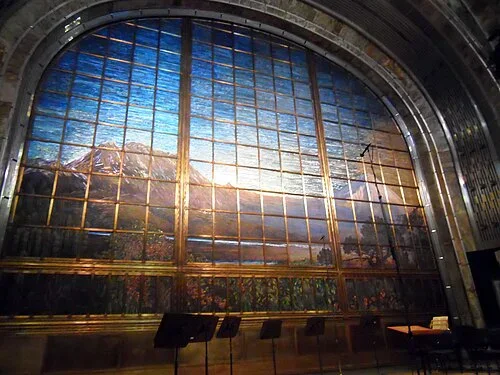 Main Theater Hall and Tiffany Glass Curtain
The Tiffany Glass Curtain: Volcanoes in Glass
The stage curtain glows with an image of the Valley of Mexico, Popocatépetl and Iztaccíhuatl rising at its center. This is no fabric drape. Tiffany Studios in New York assembled it as a foldable stained-glass panel, nearly a million pieces of iridescent colored glass fitted together like an enormous puzzle. It remains the only curtain of its kind in any opera house in the world. Around the volcanoes spreads a Mexican landscape, framed by images of sculptures from Yautepec and Oaxaca. The design drew its inspiration from the painter Gerardo Murillo, better known as Dr. Atl. The panel was conceived as a fireproof barrier as much as a spectacle. It rises as a single piece, taking a minute and a half to lift, and waits in a vault above the stage when not in use.
Listen in the appPatricia Alzuarte Díaz · CC BY-SA 3.0
07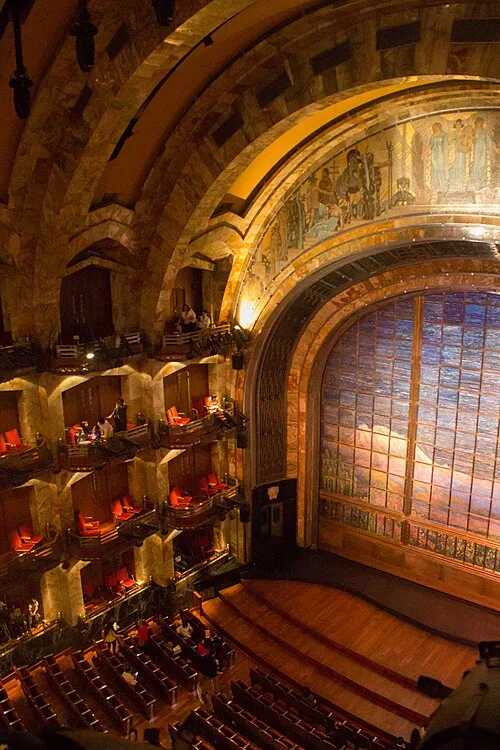 Main Theater Hall and Tiffany Glass Curtain
The Sala Principal: A Stage Built for Opera
The main auditorium seats about fifteen hundred and ninety people beneath a mosaic arch of Apollo and the Muses, built in Maróti's Hungarian workshops. This stage was the palace's whole reason for existing, and it has earned its keep. In May of 1950, Maria Callas made her debut here singing Norma. That same season came the celebrated Aida performance, when she interpolated an unwritten high E-flat at the end of the second act. The orchestra fell silent, and the recording of that moment has passed into history. She also sang here the only two performances of Rigoletto she ever gave in her life. The stage's original purpose still runs. The Ballet Folklórico de México performs here twice a week, and the great orchestras of the world, from Vienna to New York, have played this hall.
Listen in the appPhoto: Dana Herrera · CC BY-SA 4.0
08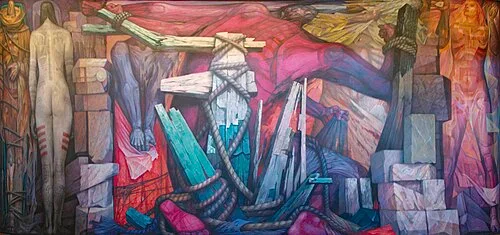 Second Floor Promenade: Murals of National Identity
Liberation: Entering the Mural Floors
Jorge González Camarena's Liberation fills the wall with writhing figures and raw color, humanity pulling itself free of misery. It was painted in 1963, and its full title says it plainly: Humanity Is Released from Misery. This work opens the palace's greatest treasure, the permanent mural collection. Seventeen monumental murals, created between 1928 and 1963 by seven of Mexico's most celebrated artists, line the floors above the foyer. Rivera, Siqueiros, and Orozco all appear here, alongside Tamayo, Montenegro, and others. It is the oldest exhibition space in the country devoted to Mexican plastic art. On the floors ahead, the three great muralists each get a wall of their own.
Listen in the appHalweb12 · CC BY-SA 3.0
09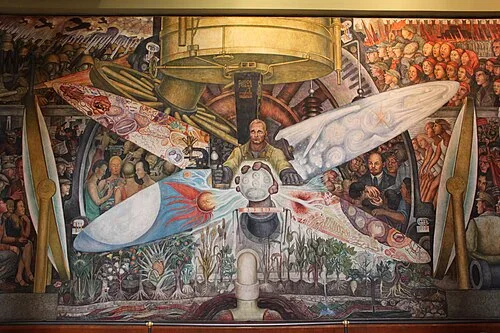 Third Floor Promenade: Masterpieces of Rivera, Orozco, and Siqueiros
Rivera's Defiant Re-Creation: Man, Controller of the Universe
At the west end of the third floor hangs one of the most famous acts of artistic defiance in the Americas. In 1933, Diego Rivera was commissioned to paint a mural for New York's Rockefeller Center. He titled it Man at the Crossroads, and filled it with technology and society: the discoveries made possible by microscopes and telescopes, workers and crowds divided on either side. Then came the problem. Rivera included Lenin, and a Soviet May Day parade, and the Rockefellers were not pleased. The unfinished work was destroyed and painted over. Rivera's answer was to paint it again, here, in 1934, as Man, Controller of the Universe. In the Mexico City version, Lenin, Trotsky, and Marx appear openly, with nothing painted out.
Listen in the appAAP86 · CC BY-SA 3.0
10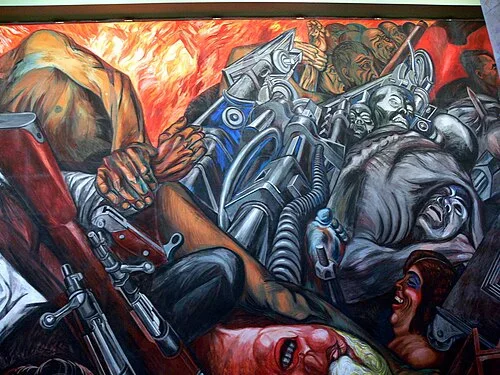 Third Floor Promenade: Masterpieces of Rivera, Orozco, and Siqueiros
Orozco's Katharsis
José Clemente Orozco saw modernity very differently from Rivera. His Katharsis, painted in 1934, is a scene of chaos: machinery and rifles grinding through writhing human bodies, flames roaring behind them. The mural depicts the conflict between humankind's social and natural aspects, and neither side wins. Faces scream from the lower edge, and armored machines crush the figures beneath them. Where Rivera's mural offered an ordered, technocratic faith in progress, Orozco answered with tragedy. The two paintings hang on the same floor, and the contrast between them was clearly no accident.
Listen in the appJosé Clemente Orozco · Public domain
- 11
Siqueiros's New Democracy
Siqueiros's chained figure straining toward freedom, the most militant voice of the three great muralists.
- 12
The Crown: Eagle and Muses Above the City
The eagle above the dome, and the palace's place as Mexico's cathedral of art.
Palacio de Bellas Artes
Frequently asked questions
How much does the guide cost?
Free app download. Listed guide price: $0.99. Guide price shown in the app. Audio guide only. Venue admission is separate.
Can I listen without internet?
Yes. Download the guide’s audio, images, and maps in the app before your visit. Your downloaded content is then available offline.
Can I listen in my language?
This audio guide is available in 15 languages, including English.
Do I need to follow a schedule?
No. This is a self-guided experience. Choose your stops, pause whenever you like, and return to a story at your own pace.
At your own pace
Explore Palacio de Bellas Artes.
Download Stanza, then search for “Palacio de Bellas Artes”.
Free app download · Guide price shown in the app
Keep exploring
Nearby audio guides
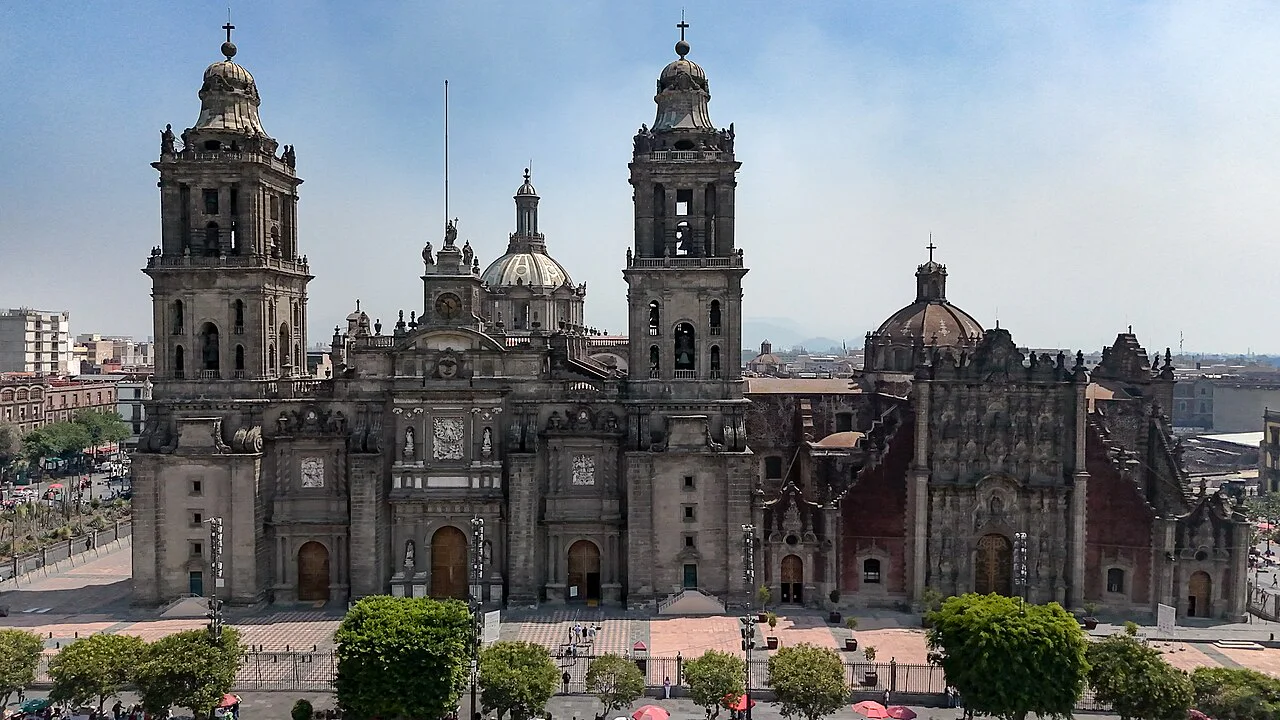
Mexico City · 1 km
Catedral Metropolitana de la Ciudad de México
Content & sources
Photo: ProtoplasmaKid · CC BY-SA 4.0
Mexico City · 1 km
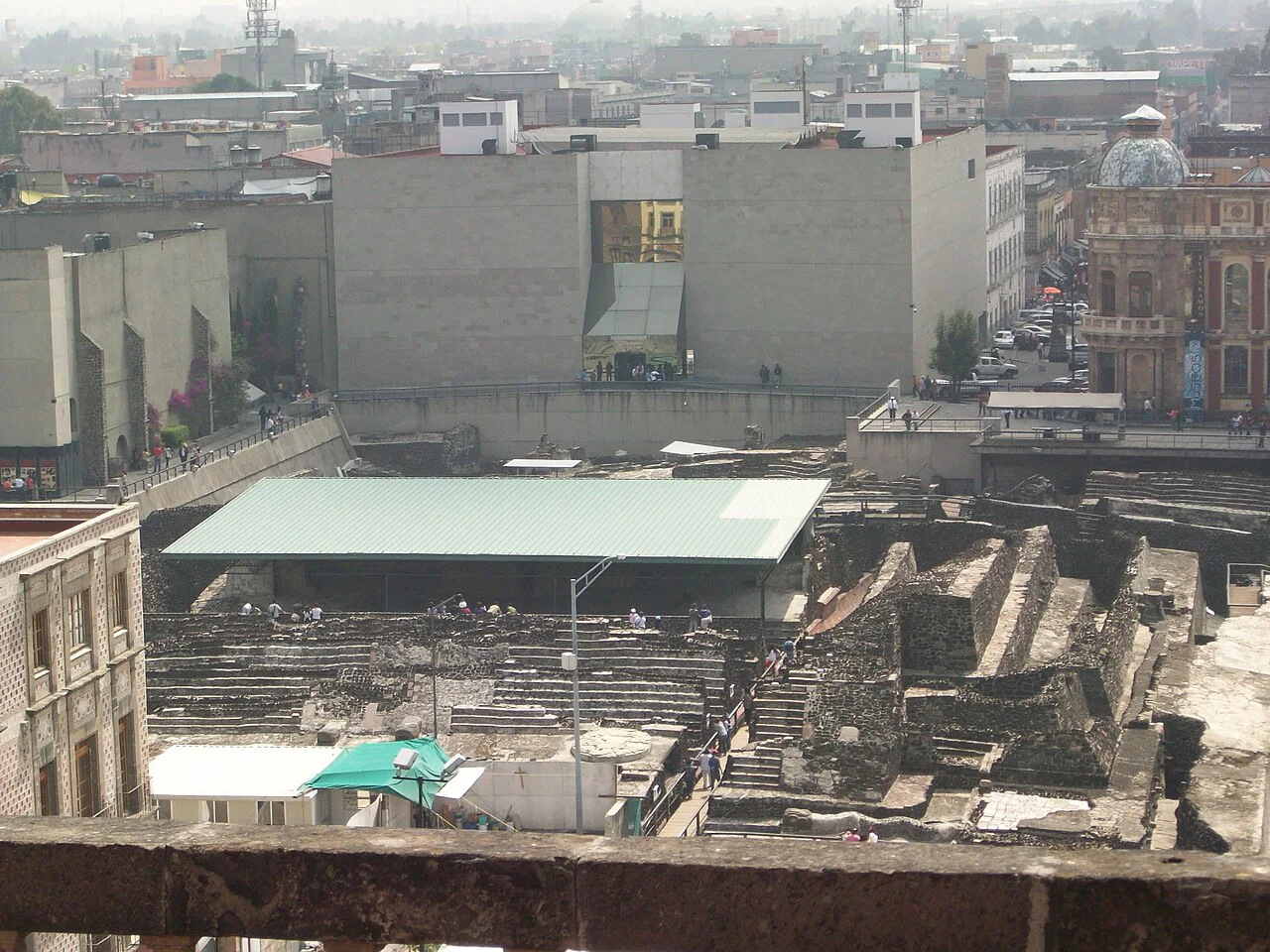
Templo Mayor
Content & sources
Photo: GAED · CC BY-SA 3.0
Mexico City · 1 km
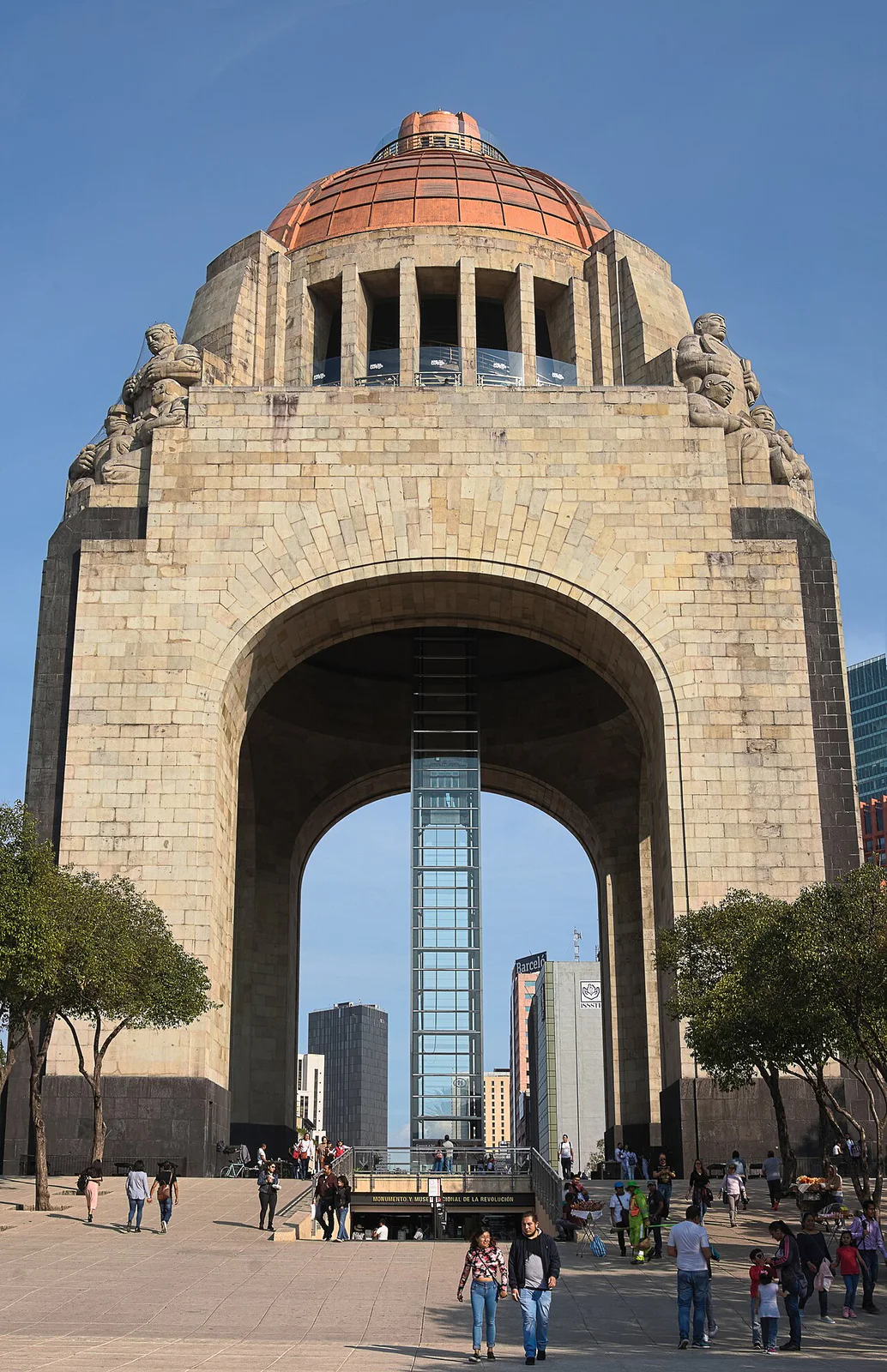
Monumento a la Revolución
Content & sources
Carlos Valenzuela · CC BY-SA 4.0
Mexico City · 5 km
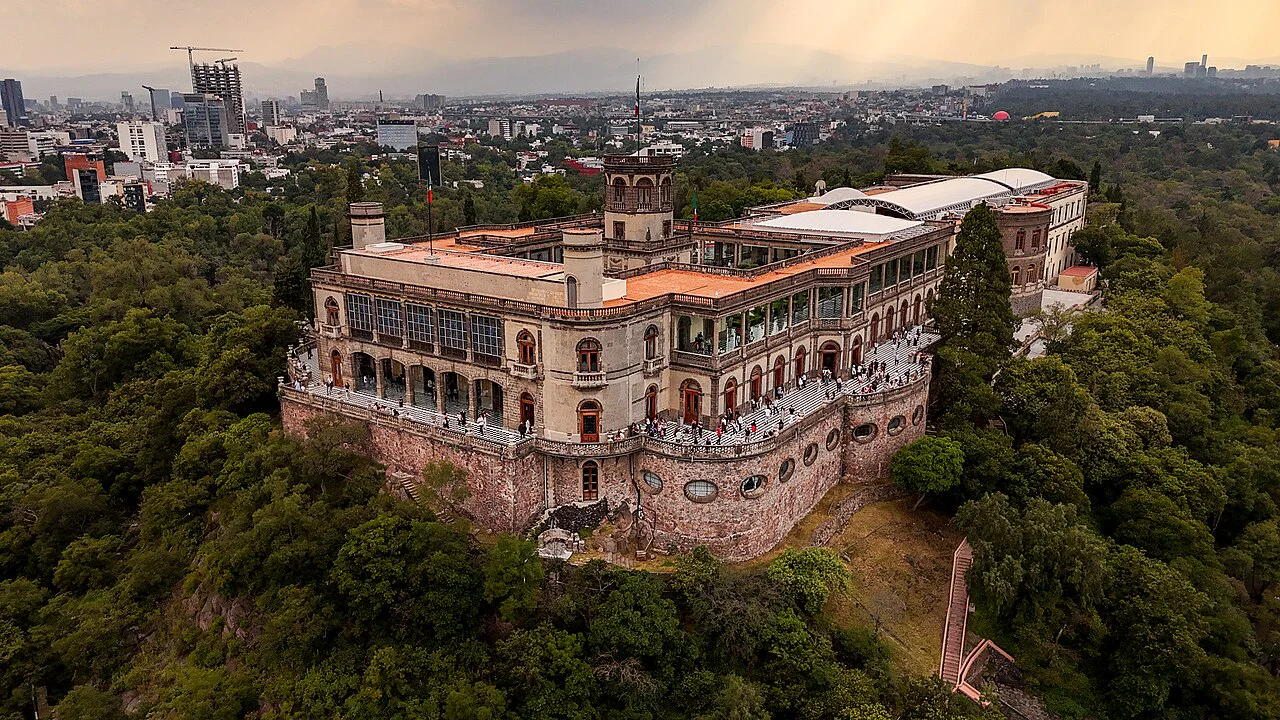
Castillo de Chapultepec
Content & sources
Own work · CC BY-SA 4.0