Stanza · Audio guide
Tollan-Xicocotitlan Audio Guide
A place to remember. A story to take with you.
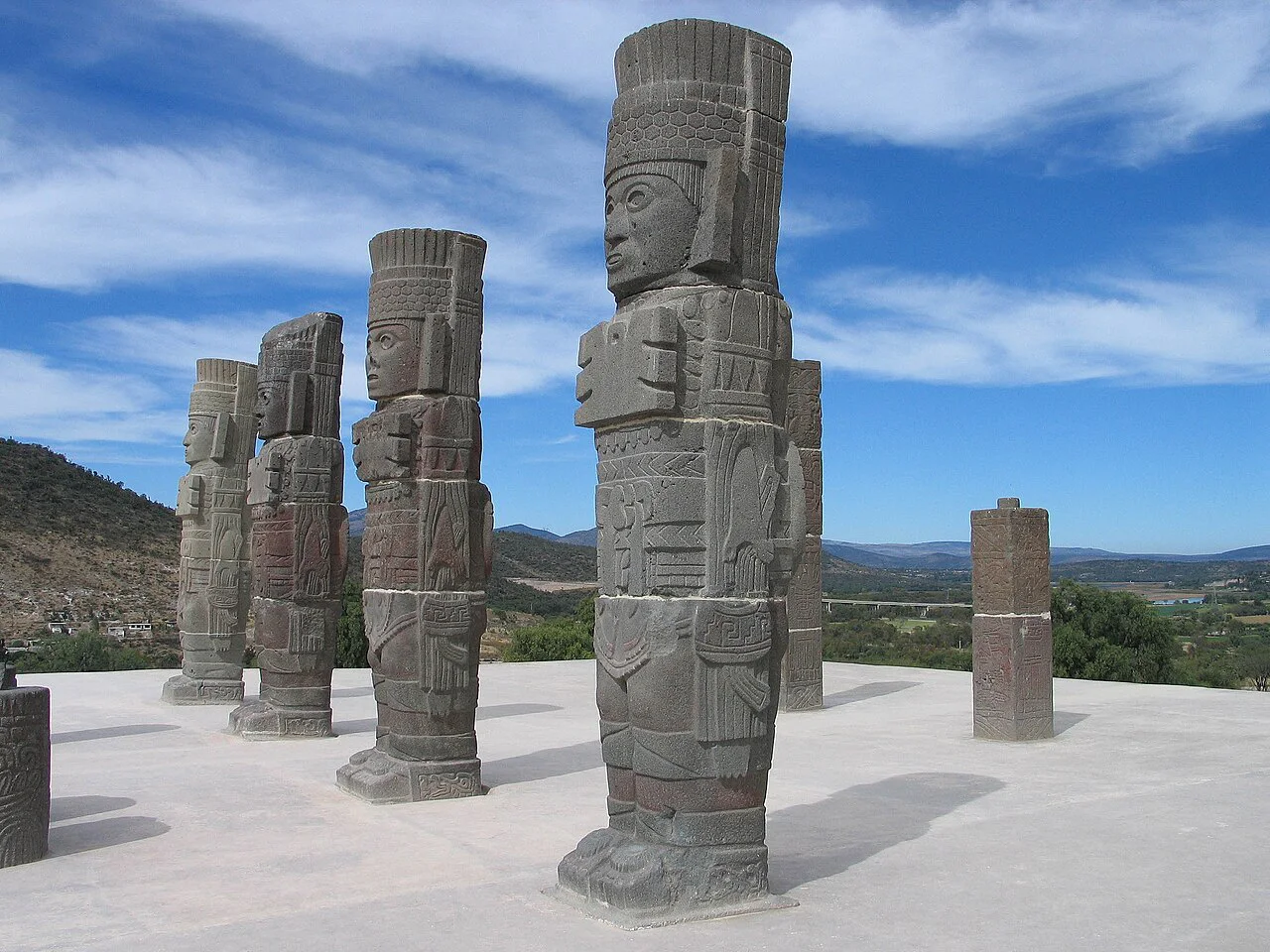
Tula is a Mesoamerican archaeological site that served as the capital of the Toltec Empire. It is known for the Pyramid of Quetzalcoatl, which features four basalt columns carved in the shape of Toltec…
Download Stanza, then search for “Tollan-Xicocotitlan”.
About the tour
One guide. Your kind of visit.
Tula is a Mesoamerican archaeological site that served as the capital of the Toltec Empire. It is known for the Pyramid of Quetzalcoatl, which features four basalt columns carved in the shape of Toltec warriors.
Ready when you are.
- 01Get the free Stanza app.
iOS & Android
- 02Find your guide.
“Tollan-Xicocotitlan”
- 03Download before you go.
Works offline
Audio guide / 13 narrated stops
Inside the guide
Get to know a few of the stories before you go. Open a stop to read more.
01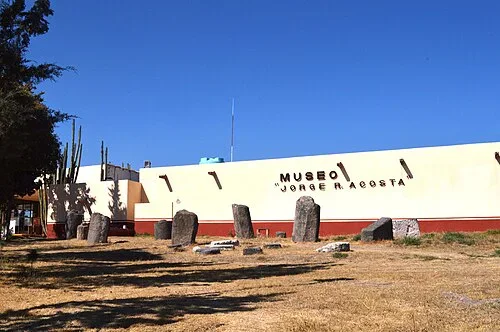 Jorge R. Acosta Site Museum
Welcome to Tollan-Xicocotitlan, the city later remembered simply as Tollan, a name meaning near the cattails. It was the capital of the Toltecs, the great power of central Mexico between the fall of Teotihuacan and the rise of Tenochtitlan. The city's greatness ran from about the year 900. It lasted until roughly 1150. The ruins lie in a semi-arid river valley, seventy-five kilometers north of Mexico City. Tula grew rich on obsidian, the volcanic glass Mesoamericans prized for sharp blades. Mining and crafting it occupied about half the city's people, a role taken over from Teotihuacan. Trade carried the city further still. Among the ceramics found here are grey-green plumbate ware from southern Guatemala and painted pottery from Costa Rica, exchanged most likely for obsidian. Farming did the rest of the work, with irrigated corn as the staple, alongside beans, chili peppers, squash and maguey. The museum at the entrance bears the name of Jorge R. Acosta, of Mexico's National Institute of Anthropology and History. In 1940 he began the most ambitious exploration the site had seen. It kept him at work here for twenty years. His teams uncovered the temples and palaces of Tula Grande, among them the Pyramid of Quetzalcoatl, the Burnt Palace and the serpent wall. Some of the carved stones they lifted from the soil still rest on the ground outside this building.
Photo: AlejandroLinaresGarcia · CC BY-SA 3.0
02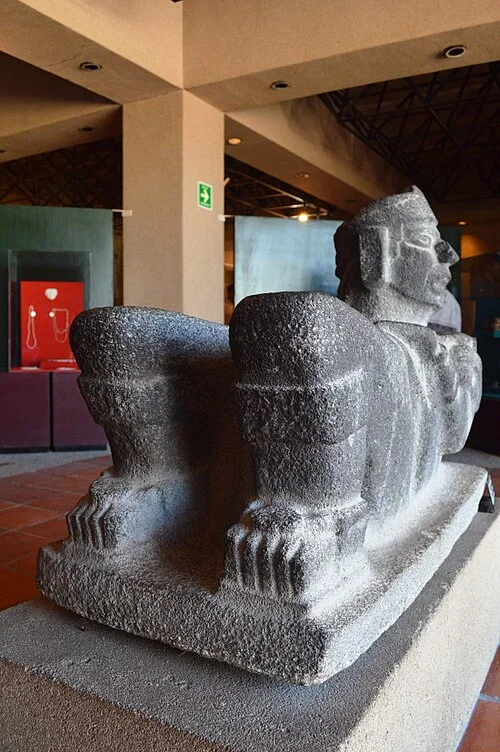 Jorge R. Acosta Site Museum
The Chac Mool of Tula
Among the museum's treasures is a reclining stone figure known as a Chac Mool. This one was excavated from Room 2 of the Burnt Palace, the great hall beside the pyramid. The figure lies on its back with knees drawn up and head turned to one side. A flint knife rests along one arm. On its chest hangs a pectoral shaped like a butterfly. The sculpture came to light together with a turquoise disc and armor of shell and conch. Scholars link these offerings, along with the sunken basins in the palace floors, to rituals of the rain god Tlaloc, a cult that may have roots at Teotihuacan. Some also read them as evidence of human sacrifice at the center of Toltec government. That reading is an interpretation of the finds, not a settled fact. Either way, the same butterfly pectoral and flint knife reappear on the great warriors of Pyramid B, a visual code shared between palace and pyramid.
Photo: AlejandroLinaresGarcia · CC BY-SA 3.0
03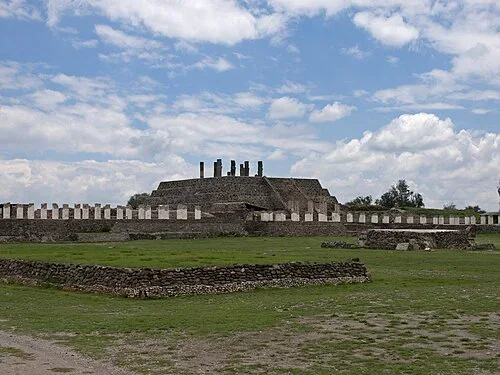 The Great Ceremonial Plaza
Tula Grande's great plaza was built for crowds. It had room for about one hundred thousand people. On three sides stood long meeting halls, their roofs carried on rows of columns, all facing the open space. Inside ran more than a thousand meters of benches, carved with reliefs of warriors and others in procession. The architecture records a change in how Mesoamericans worshipped. Rituals had once been performed by a few people in closed spaces. Here they became large public ceremonies, watched by many and dominated by warriors. The setting itself was chosen with care. The ceremonial center sits on a limestone outcropping with steep banks on three sides, easy to defend.
Listen in the appPhoto: Ymblanter · CC BY-SA 4.0
04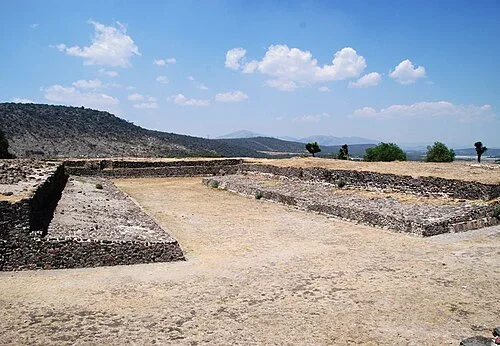 Ballcourt 1
Ballcourt 1 is one of the two main formal ballcourts at Tula, and its best preserved. The Mesoamerican ballgame was far older than this city, and it was played by elites across the whole region. It was athletic, political and ritual at once, though its deeper meaning varied from one city to another. The architecture here is plain to read. A long playing alley sits sunken between two sloping lateral structures, the classic form of the Mesoamerican court. Beyond it, the dry hills that ring the Tula Valley close the horizon.
Listen in the appPhoto: Elelicht · CC BY-SA 3.0
05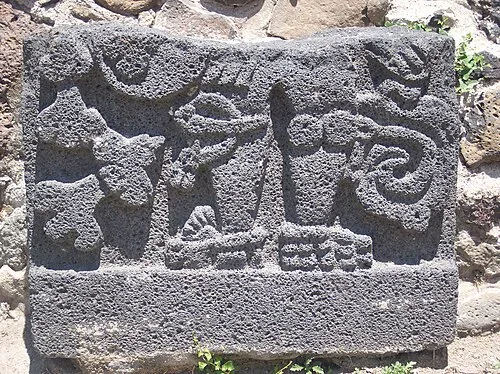 Ballcourt 1
Ballgame Relief Carving
A carved stone panel near the ballcourt shows a figure in the dense, angular relief style used across Tula. The body folds into tight geometric forms, typical of Toltec carving at its most disciplined. What the scene depicts exactly, and where the panel originally stood, remain open questions. What is clear is that the panel belongs to the same visual world as the warriors and processions.
Listen in the appSusana Torres Sánchez · CC BY-SA 3.0
06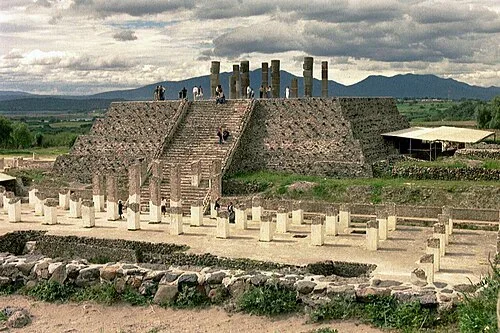 Pyramid B and the Great Vestibule
Pyramid B (Pyramid of Quetzalcoatl)
Pyramid B rises in five stepped tiers, and it carries more names than any other building here. Some call it the Pyramid of Quetzalcoatl, others the Pyramid of the Morning Star. Acosta's excavations uncovered its summit temple, dedicated to Tlahuizcalpantecuhtli, the Morning Star. A great vestibule with colonnades fronts the pyramid and ties it to the neighboring buildings. Spanish missionaries recorded indigenous accounts of a struggle for control of Tollan. Legend tells of a ruler named Ce Acatl Topiltzin Quetzalcoatl, who bore his god's name. The dark deity Tezcatlipoca deceived and disgraced him. The expelled ruler wandered to the Gulf Coast, burned himself on a pyre, and rose as the morning star, Venus. Behind the legend, scholars see a real dispute inside the city. One faction, led by Ce Acatl Topiltzin Quetzalcoatl, was driven out by followers of the cult of Tezcatlipoca. The conflict may have played out in the tenth century, or centuries later. By the time the Spanish arrived, worship of Quetzalcoatl stretched from central Mexico deep into Central America. The central stairway is reconstructed, and visitors climb it to the summit platform where the famous warriors stand.
Listen in the appBgabel · CC BY-SA 3.0
07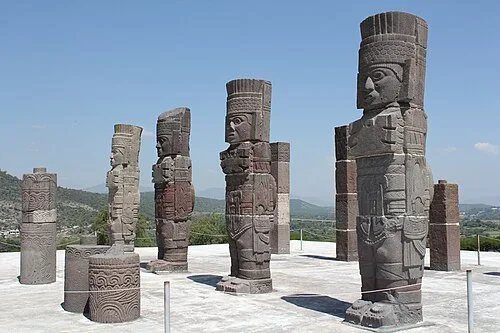 Summit Platform of the Atlantes
The Atlantean Warriors
On the summit platform stand the four figures that have become the emblem of the Toltecs. Each is a column of basalt carved in the likeness of a warrior, four meters tall. They once supported the roof of the temple that crowned Pyramid B. Sculptors shaped them by hand from massive stone blocks, using stone chisels, hammers and scrapers. Their name, the Atlantes, comes from the classical tradition of Atlas figures holding up buildings in European architecture. The idea was not new here. The Olmecs had carved atlantean figures in relief long before, and Maya sculptors carved their own at Chichen Itza. The Aztecs later made warrior statues closely modeled on these.
Listen in the appArian Zwegers from Brussels, Belgium · CC BY 2.0
08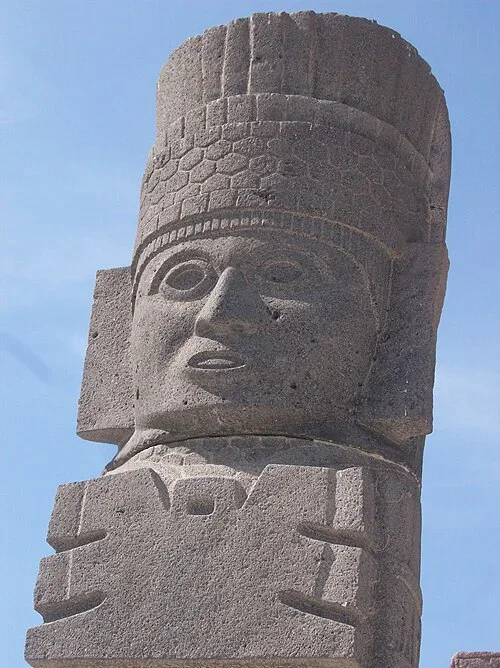 Summit Platform of the Atlantes
Atlante Detail: The Warrior's Regalia
Up close, each warrior carries his equipment in stone. In one hand is an atlatl, a spear-thrower that gave a dart far more force than an arm alone. The other hand holds incense for burning. On the back hangs a disk shaped like the sun. The regalia announces what Toltec society honored most, the warrior. War and sacrifice dominate the imagery of the whole site. Jaguars and coyotes appear as warrior beings, and eagles feast on human hearts.
Listen in the appSusana Torres Sánchez · CC BY-SA 3.0
09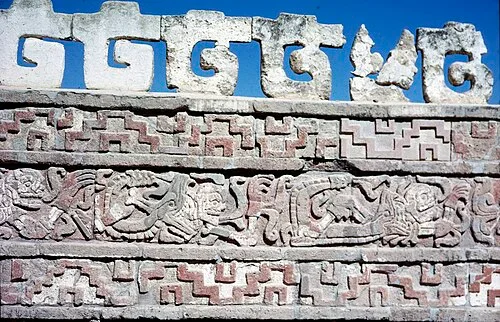 The Coatepantli (Serpent Wall)
Behind Pyramid B stands the Coatepantli, the serpent wall of Tula. Its name joins the Nahuatl words for serpent and wall. Carved serpents run the length of its panels, their bodies interlacing above geometric borders. The wall marks the boundary of the sacred precinct, enclosing the ceremonial heart of the city. Walls like it were rare in Mesoamerica before the Toltecs. Centuries later, the Aztecs used this one as the model for a similar structure in their capital, Tenochtitlan.
Listen in the appPhoto: HJPD · CC BY 3.0
10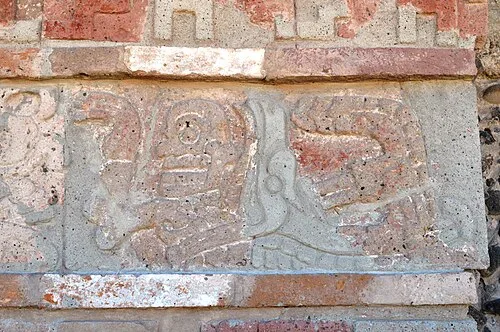 The Coatepantli (Serpent Wall)
Serpent and Skeleton Frieze
The friezes of the serpent wall carry the precinct's darkest imagery. In the carved panel, a serpent engorges a human skeleton, the ribcage still readable inside its jaws. The point was made at the very threshold of the sacred precinct. Death and sacrificial power were on open display to all who passed.
Listen in the appPhoto: AlejandroLinaresGarcia · CC BY-SA 3.0
- 11
The Burnt Palace (Palacio Quemado)
The burned hall of columns, and the thousand-kilometer mystery it shares with Chichen Itza.
- 12
The Council Benches of the Burnt Palace
Throne-like benches and painted processions: the palace that turned out to be a council hall.
- 13
Pyramid C and the City's Afterlife
The city's largest platform, its fiery end, and the Aztec kings who claimed its legacy.
Tollan-Xicocotitlan
Frequently asked questions
How much does the guide cost?
Free app download. Listed guide price: $0.99. Guide price shown in the app. Audio guide only. Venue admission is separate.
Can I listen without internet?
Yes. Download the guide’s audio, images, and maps in the app before your visit. Your downloaded content is then available offline.
Can I listen in my language?
This audio guide is available in 15 languages, including English.
Do I need to follow a schedule?
No. This is a self-guided experience. Choose your stops, pause whenever you like, and return to a story at your own pace.
At your own pace
Explore Tollan-Xicocotitlan.
Download Stanza, then search for “Tollan-Xicocotitlan”.
Free app download · Guide price shown in the app
Keep exploring
Nearby audio guides
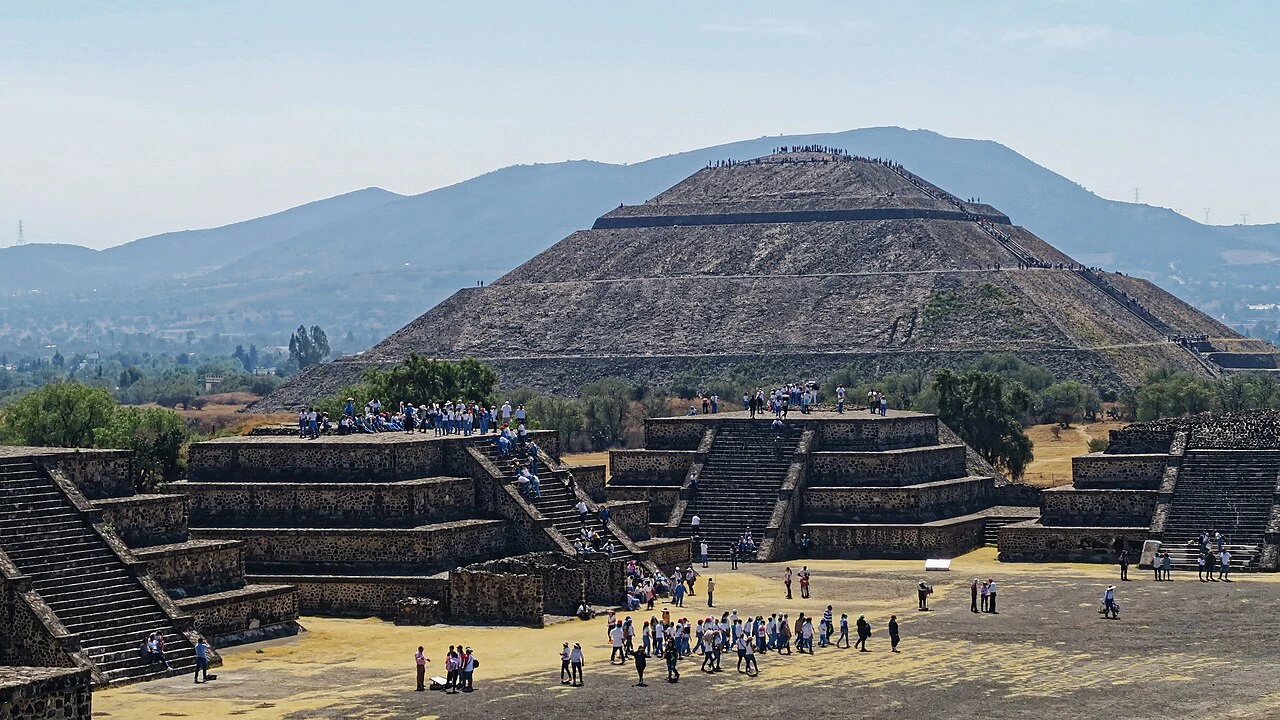
San Francisco Mazapa · 66 km
Teotihuacan
Content & sources
Burkhard Mücke · CC BY-SA 4.0
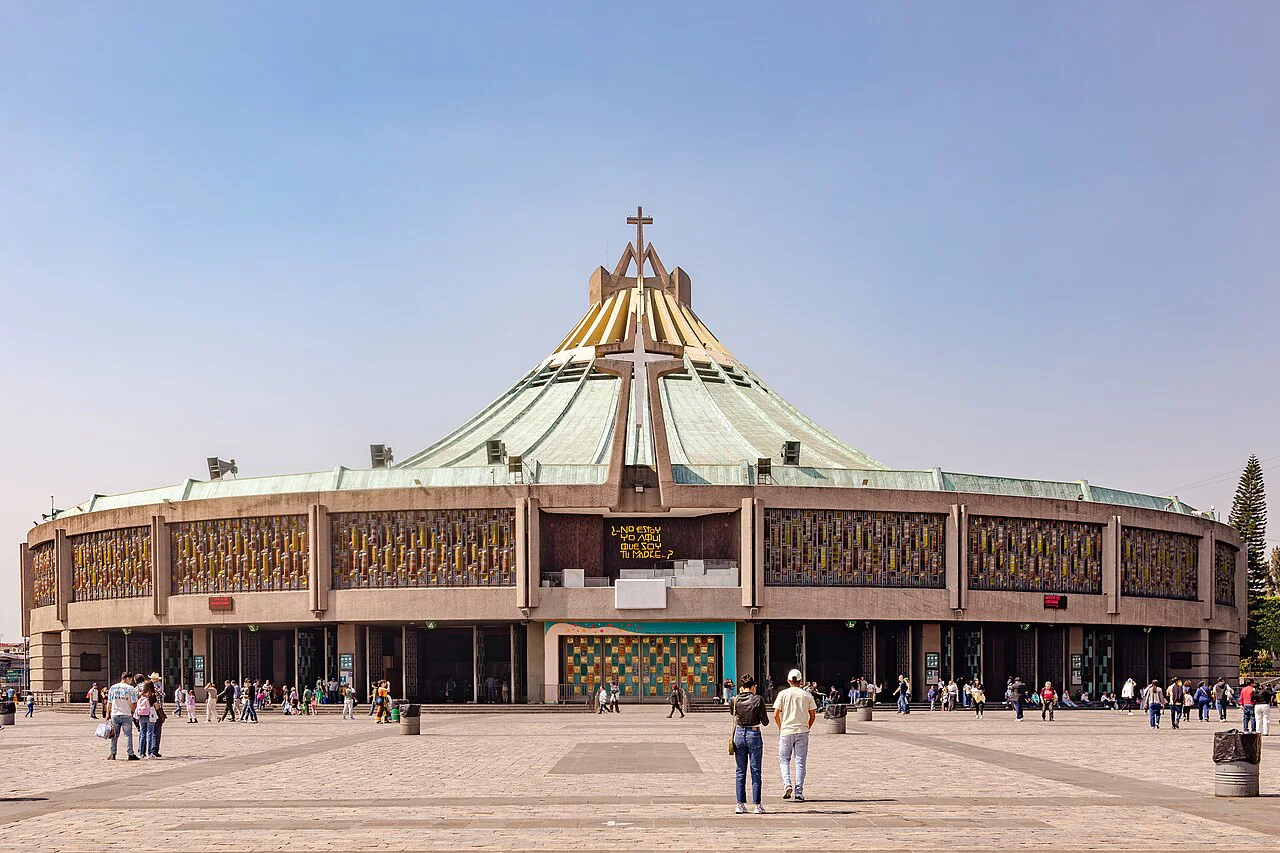
Mexico City · 69 km
Basílica de Santa María de Guadalupe
Content & sources
Photo: Arne Müseler · CC BY-SA 3.0 de
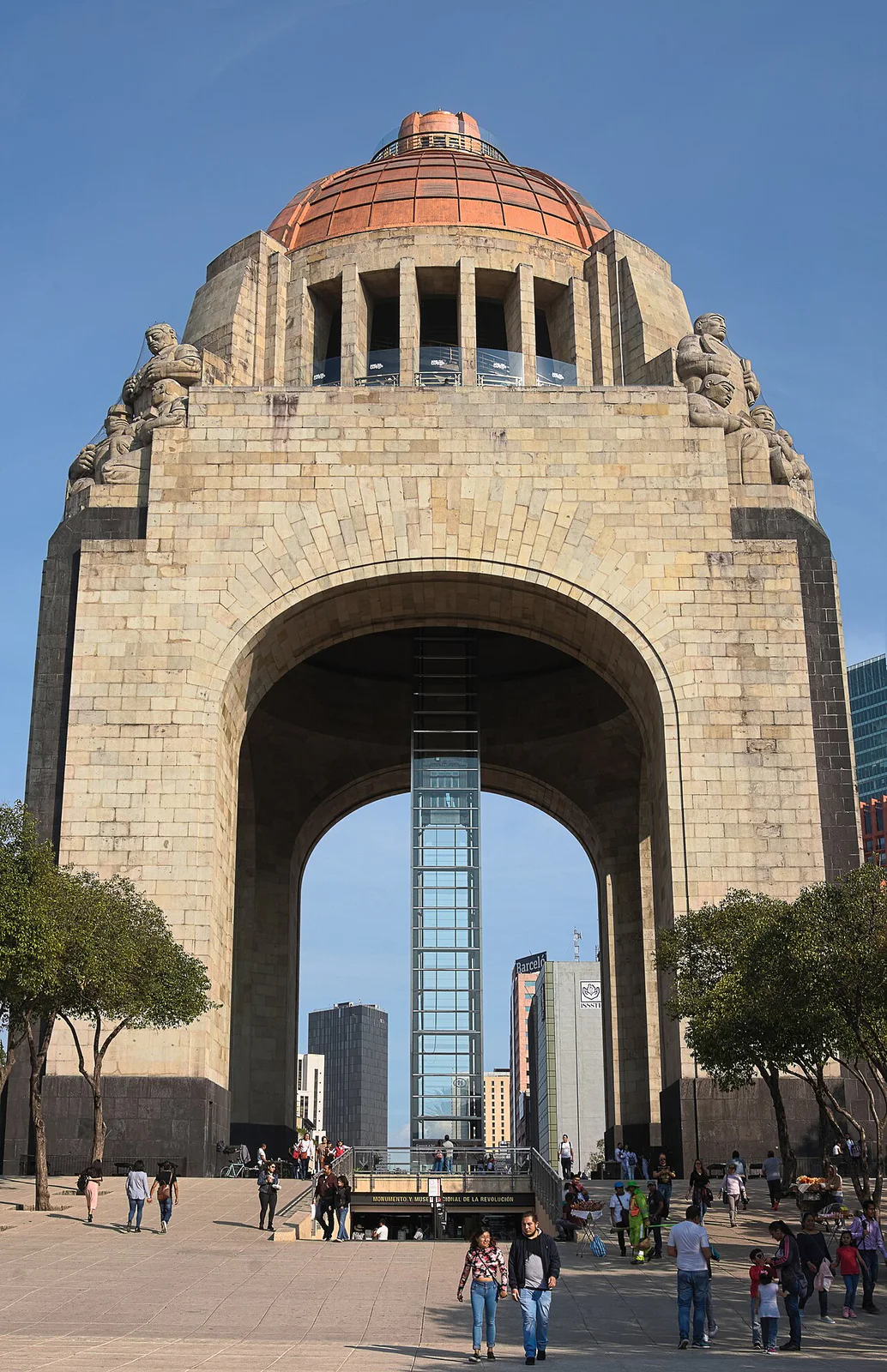
Mexico City · 72 km
Monumento a la Revolución
Content & sources
Carlos Valenzuela · CC BY-SA 4.0
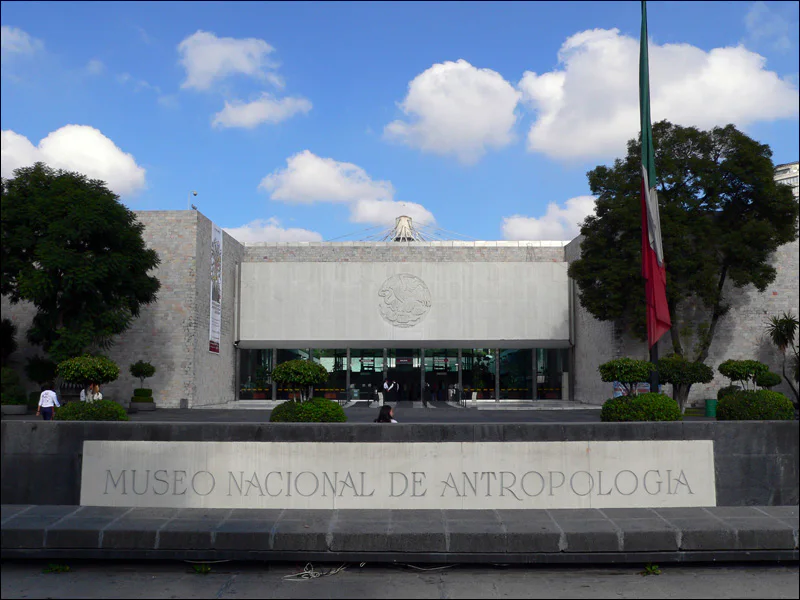
Mexico City · 73 km
Museo Nacional de Antropología
Content & sources
Photo: Kornemuz · CC BY-SA 3.0