Stanza · Audio guide
Basílica de Santa María de Guadalupe Audio guide
A place to remember. A story to take with you.
The Basilica of Santa María de Guadalupe is a basilica of the Catholic Church located in Mexico City. It is dedicated to the Virgin Mary in her invocation of Our Lady of Guadalupe.
Download Stanza, then search for “Basílica de Santa María de Guadalupe”.
About the tour
One guide. Your kind of visit.
The Basilica of Santa María de Guadalupe is a basilica of the Catholic Church located in Mexico City. It is dedicated to the Virgin Mary in her invocation of Our Lady of Guadalupe.
Ready when you are.
- 01Get the free Stanza app.
iOS & Android
- 02Find your guide.
“Basílica de Santa María de Guadalupe”
- 03Download before you go.
Works offline
Audio guide / 14 narrated stops
Inside the guide
Get to know a few of the stories before you go. Open a stop to read more.
01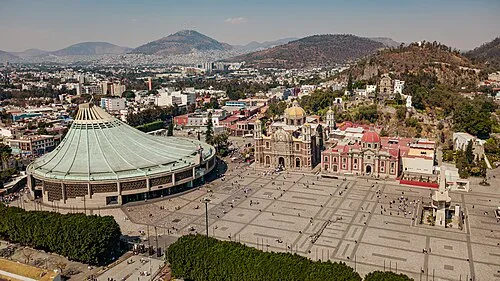 Plaza of the AmericasThe Atrio de las Américas: Two Basilicas Side by Side
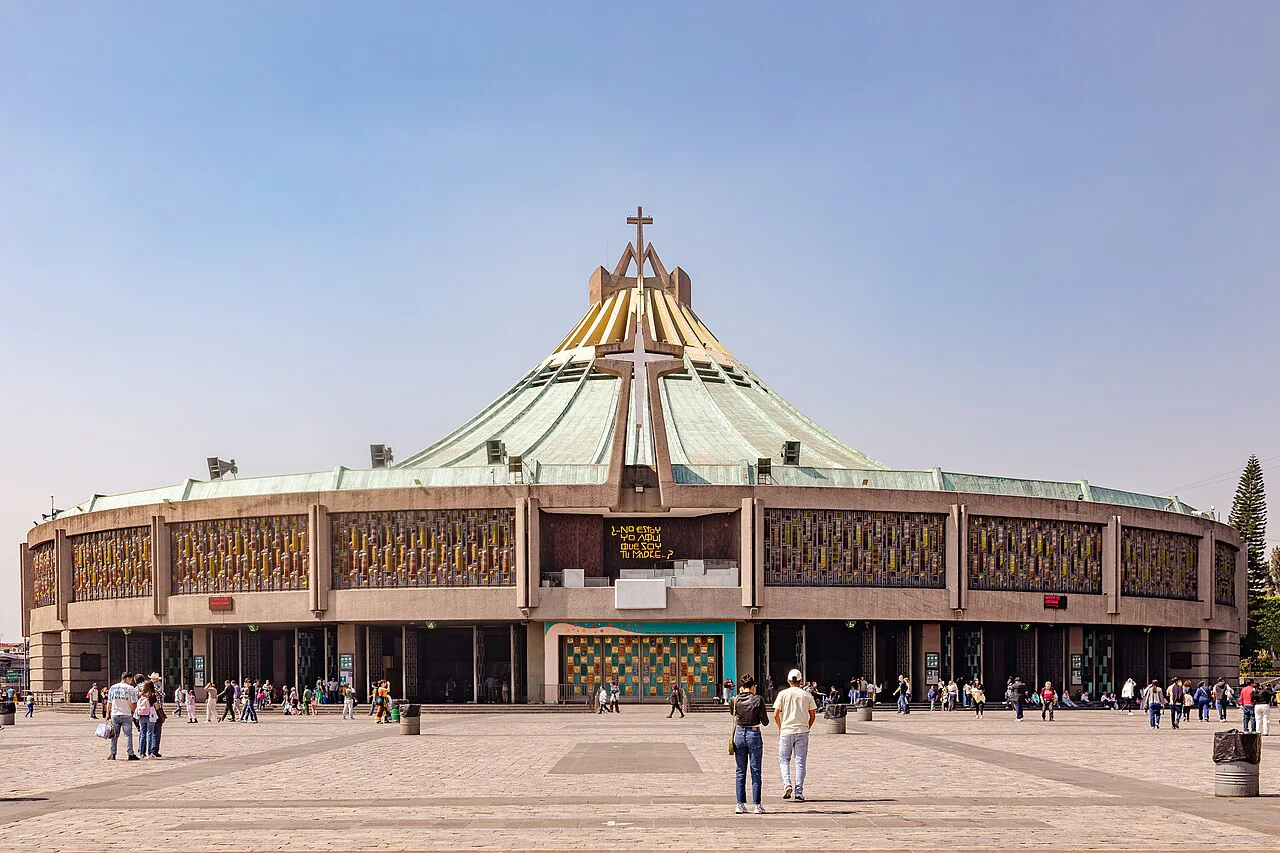
Welcome to the sanctuary of Guadalupe, at the foot of Tepeyac hill in the north of Mexico City. Everything here grew from a single devotion: the image of the Virgin Mary known as the Virgin of Guadalupe. The great open square is the Atrio de las Américas, and it holds an unusual sight. Two basilicas stand side by side on the same plaza. One is round, crowned with a tent-shaped roof of green copper. The other is an eighteenth-century temple with a dome of yellow and blue tile. Pilgrims come in extraordinary numbers, about twenty million a year. That is at least twice as many as visit the best-known Marian shrines of the world. Of those millions, some nine million arrive in the days around December the twelfth, the feast of Our Lady of Guadalupe. The story ahead covers the image, the crowds, and the reason one shrine came to need two basilicas.
Photo: Arne Müseler · CC BY-SA 3.0 de
02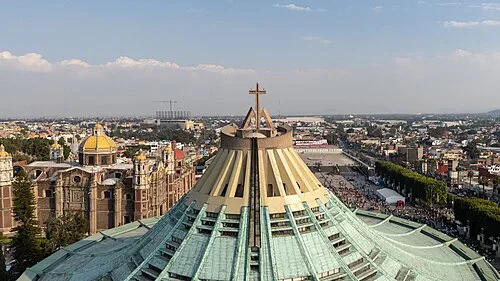 Plaza of the AmericasFrom the Air: A Shrine on Sinking Ground
The pairing of the two basilicas comes down to failing ground. The old domed church was raised on the soft soils of what was once a lakebed. Over time the earth beneath it shifted and sank, unevenly, the way buildings across this part of Mexico City still do. The temple grew unstable, and in the end it was judged dangerous to use. A shrine could not simply give up its sacred image, though. So the image had to be moved, and a new sanctuary rose on steadier ground beside the old one. The next stop tells how that new building was raised, and how it received the Virgin.
Photo: ProtoplasmaKid · CC BY-SA 4.0
03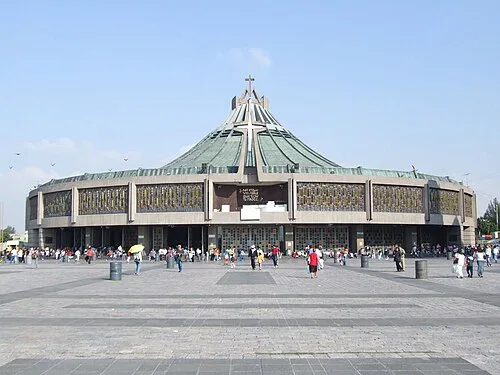 The Modern Basilica ExteriorThe New Basilica: Built for the Crowds
Work on the round basilica began in 1974, during the abbacy of Monsignor Guillermo Schulenburg. A lawyer of the basilica, Odilón Ramírez Pelayo, handled the purchase of the land and brought the architects together. The design team was led by Pedro Ramírez Vázquez and José Luis Benlliure, with four more architects beside them. Ramírez Pelayo even arranged for a small chapel dedicated to the new basilica to be built inside Saint Peter's in Rome. Seven entrances open on the front facade. Above them sits an open chapel, echoing the atriums of the sixteenth century, from which mass could be celebrated for the crowds gathered outside. On the twelfth of October 1976, with the work finished, the image of the Virgin was carried in solemn procession into its new sanctuary.
Listen in the appAndrew McMillan · Public domain
04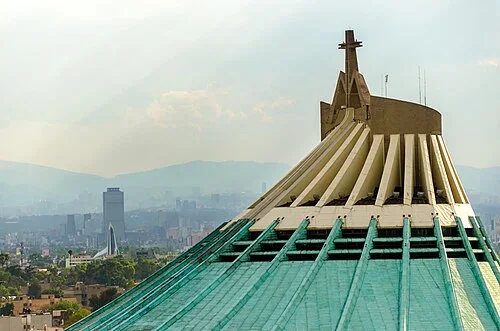 The Modern Basilica ExteriorA Tent of Copper
The circular shape is no accident of style. The architects meant the building to echo the tent that sheltered the Ark of the Covenant on its march through the desert. A tent, in their idea, for the new Ark: the image of the Virgin. The roof structure is reinforced concrete, covered in sheets of copper that have weathered to a soft green. That green crown, with its cross at the peak, is the landmark of the whole atrium.
Listen in the appLidia Lopez · CC BY 2.0
05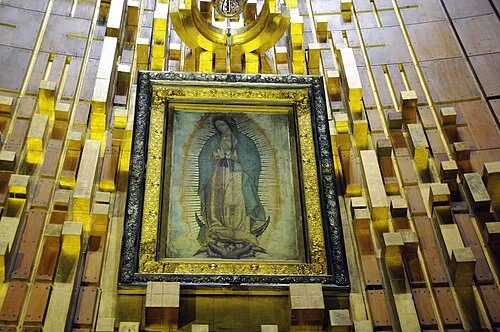 Sanctuary Interior and the Sacred TilmaThe Tilma of Juan Diego
Here is the reason for everything around it: the image itself. According to Catholic tradition, the Virgin Mary appeared in 1531 to a man named Juan Diego, on Tepeyac hill. As the story is told, his tilma, a cloak woven of maguey fibre, carried her portrait, imprinted on the cloth by no human hand. That cloth has been venerated ever since, and it is the relic that draws the pilgrims here. Modern historians and art historians describe the surviving object in plainer terms: a painted cloth image from colonial-era New Spain, whose documented history becomes clearer through the sixteenth century. For the millions who come each year, though, it remains the tilma of Juan Diego.
Listen in the appPhoto: Karolja · CC BY-SA 4.0
06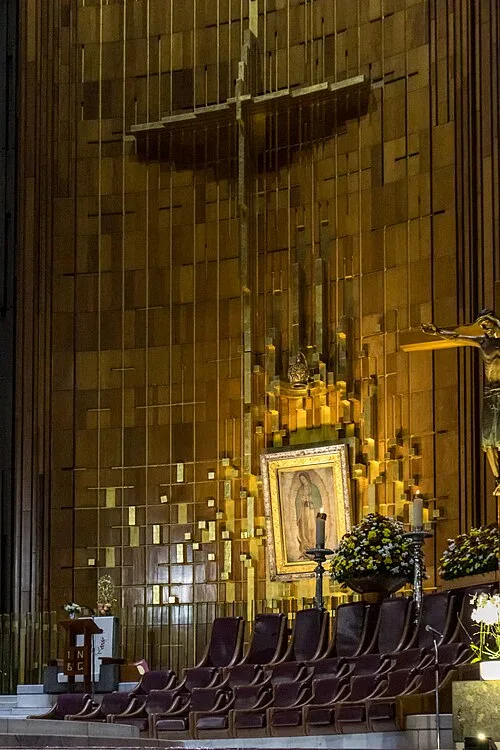 Sanctuary Interior and the Sacred TilmaInside the Sanctuary: Devotion Without Interruption
The round interior has no columns to block the view. The image hangs behind the main altar, under a large cross, on a wall finished like the ceiling. From anywhere inside the basilica, it can be seen. To let pilgrims pass close by, a walkway runs beneath the altar, with conveyor belts to keep the line moving. The sanctuary still receives the most prominent visitors in the Catholic world. Pope John Paul II came five times. His visits stretched from 1979 to 2002, and included the beatification and later the canonization of Juan Diego. In February 2016, Pope Francis celebrated mass at the main altar.
Listen in the appPhoto: ProtoplasmaKid · CC BY 4.0
07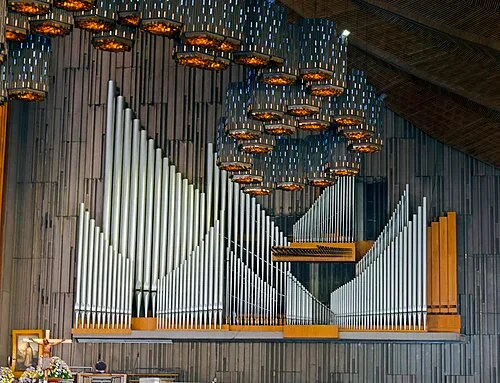 Sanctuary Interior and the Sacred TilmaThe Organ and the Liturgy
A church built for vast crowds is still, before all else, a place of worship. Against the curved wall stands the great pipe organ, its pale pipes rising in tiers beneath the hanging lamps. Mass is celebrated here every day, and on feast days music carries around the whole circle of the room. Whatever the size of the congregation, the liturgy goes on.
Listen in the appPhoto: Daniel Case · CC BY-SA 3.0
08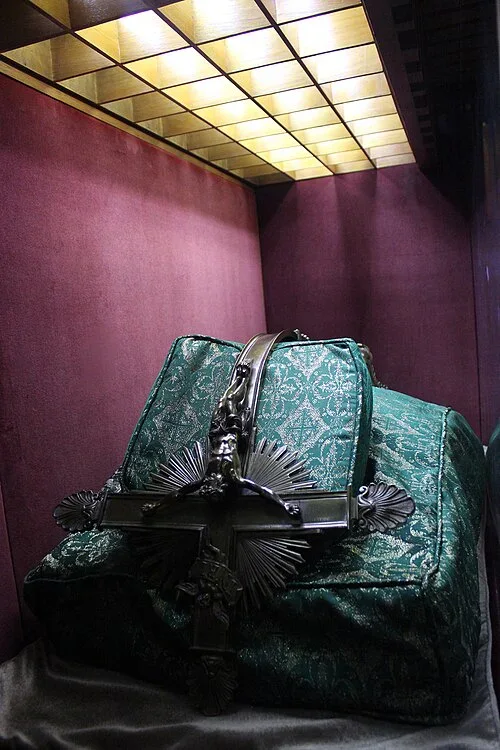 The Crucifix of the Altar BombingThe Bent Crucifix of 1921
On the fourteenth of November 1921, a bomb hidden in a flower arrangement exploded at the main altar. The blast damaged the altar steps and the stained-glass windows. The image of the Virgin itself was not destroyed. This bent metal crucifix was preserved from the explosion, and it is kept in the basilica as a witness of that day. No one can say who planted the bomb, or why. The repairs that followed raised the image about a metre higher than before, in the old basilica where it then lived.
Listen in the appPhoto: Avillac5 · CC BY-SA 4.0
09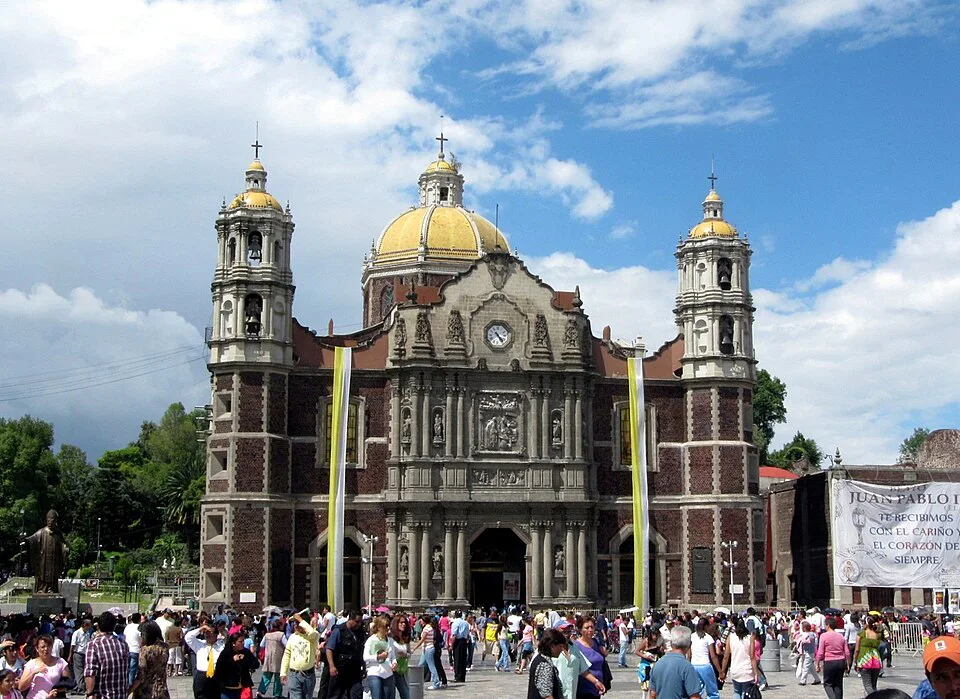 The Old BasilicaThe Old Basilica: Pedro de Arrieta's Temple
The first stone of the old basilica was laid on the twenty-fifth of March 1695. Its architect was Pedro de Arrieta, and the temple opened on the first of May 1709 with a solemn novena. The image of the Virgin was received here at the dedication, and it stayed until 1976. Why it moved on, you have already heard. Four octagonal towers stand at the corners. Fifteen vaults cover the interior, and the dome carries a lantern dressed in yellow and blue Talavera tile. In 1749 the church received the title of collegiate, which meant that, without being a cathedral, it had its own chapter and an abbot. In 1815 the insurgent priest José María Morelos, condemned to death, was granted his last wish, to pray to the Virgin of Guadalupe in this temple. He died soon afterwards in a nearby town, in what is now the municipality of Ecatepec de Morelos.
Listen in the appPhoto: Minaram · CC BY-SA 4.0
10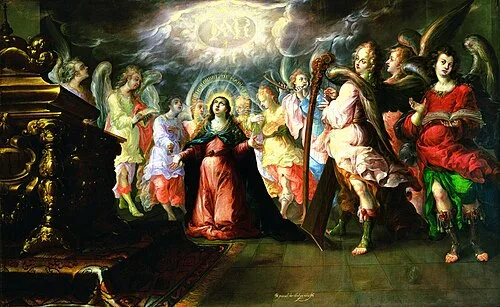 The Old BasilicaThe Holy Name of Mary
The Holy Name of Mary, painted in the 1690s, is the work of Cristóbal de Villalpando. Mary stands among angels beneath a breaking sky, in the exuberant manner of the New Spanish world that also built the old basilica. It is an example of the Marian painting that flourished around the shrine, rather than an object from its altar. Paintings like this one belong to the basilica's museum, opened in 1941 in the north wing of the old Capuchinas convent. Its collection of New Spanish art runs to nearly four thousand pieces, with works by Villalpando, Miguel Cabrera and Juan Correa among the highlights. The museum's vestibule holds more than two thousand ex-votos, small painted thanks left for the Virgin.
Listen in the appCristóbal de Villalpando · Public domain
Basílica de Santa María de Guadalupe
Frequently asked questions
How much does the guide cost?
Free app download. Listed guide price: $1.99. Guide price shown in the app. Audio guide only. Venue admission is separate.
Can I listen without internet?
Yes. Download the guide’s audio, images, and maps in the app before your visit. Your downloaded content is then available offline.
Can I listen in my language?
This audio guide is available in 15 languages, including English.
Do I need to follow a schedule?
No. This is a self-guided experience. Choose your stops, pause whenever you like, and return to a story at your own pace.
At your own pace
Explore Basílica de Santa María de Guadalupe.
Download Stanza, then search for “Basílica de Santa María de Guadalupe”.
Free app download · Guide price shown in the app
Keep exploring
Nearby audio guides
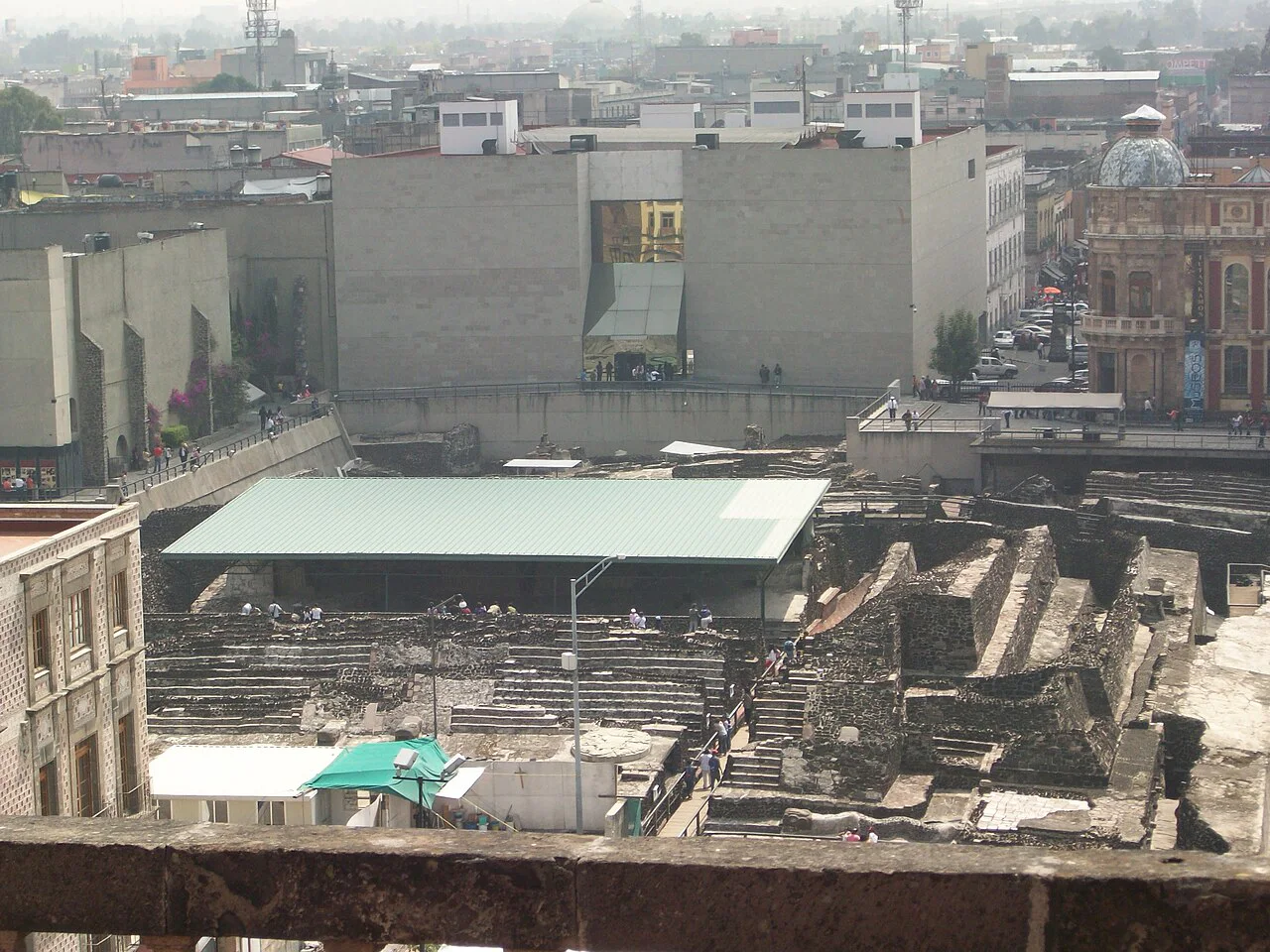
Mexico City · 6 km
Templo Mayor
Content & sources
Photo: GAED · CC BY-SA 3.0
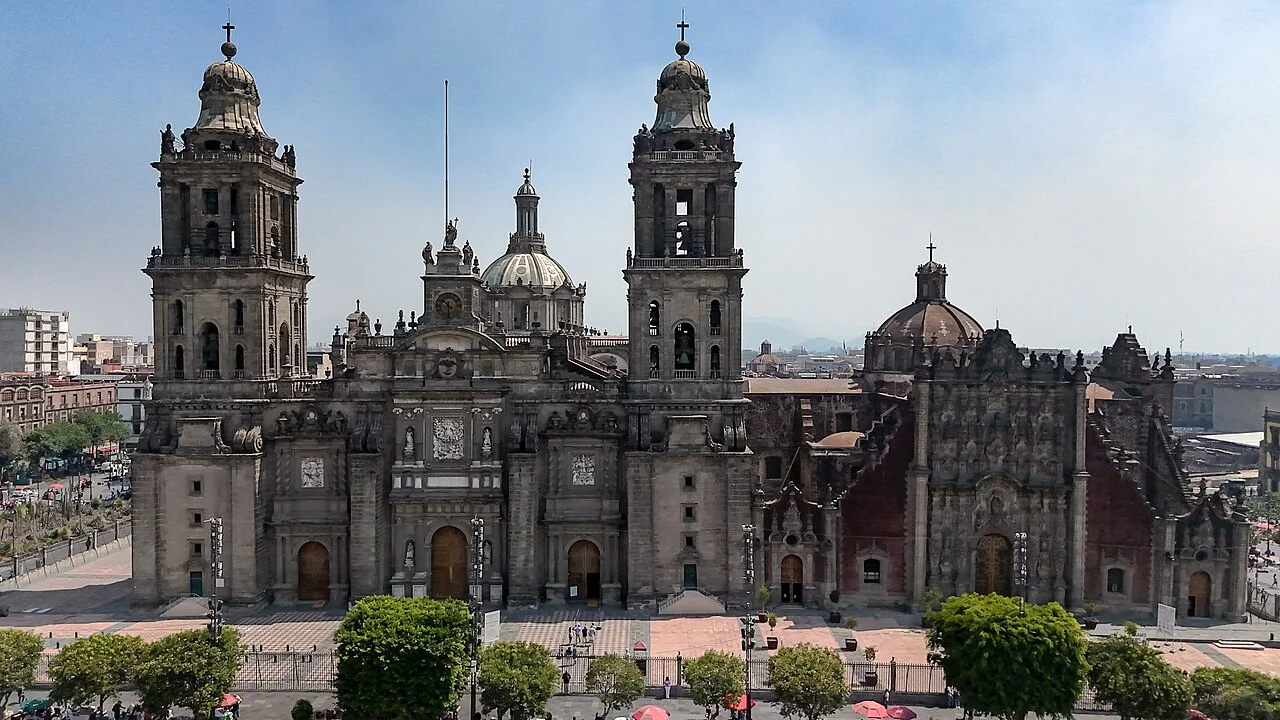
Mexico City · 6 km
Catedral Metropolitana de la Ciudad de México
Content & sources
Photo: ProtoplasmaKid · CC BY-SA 4.0
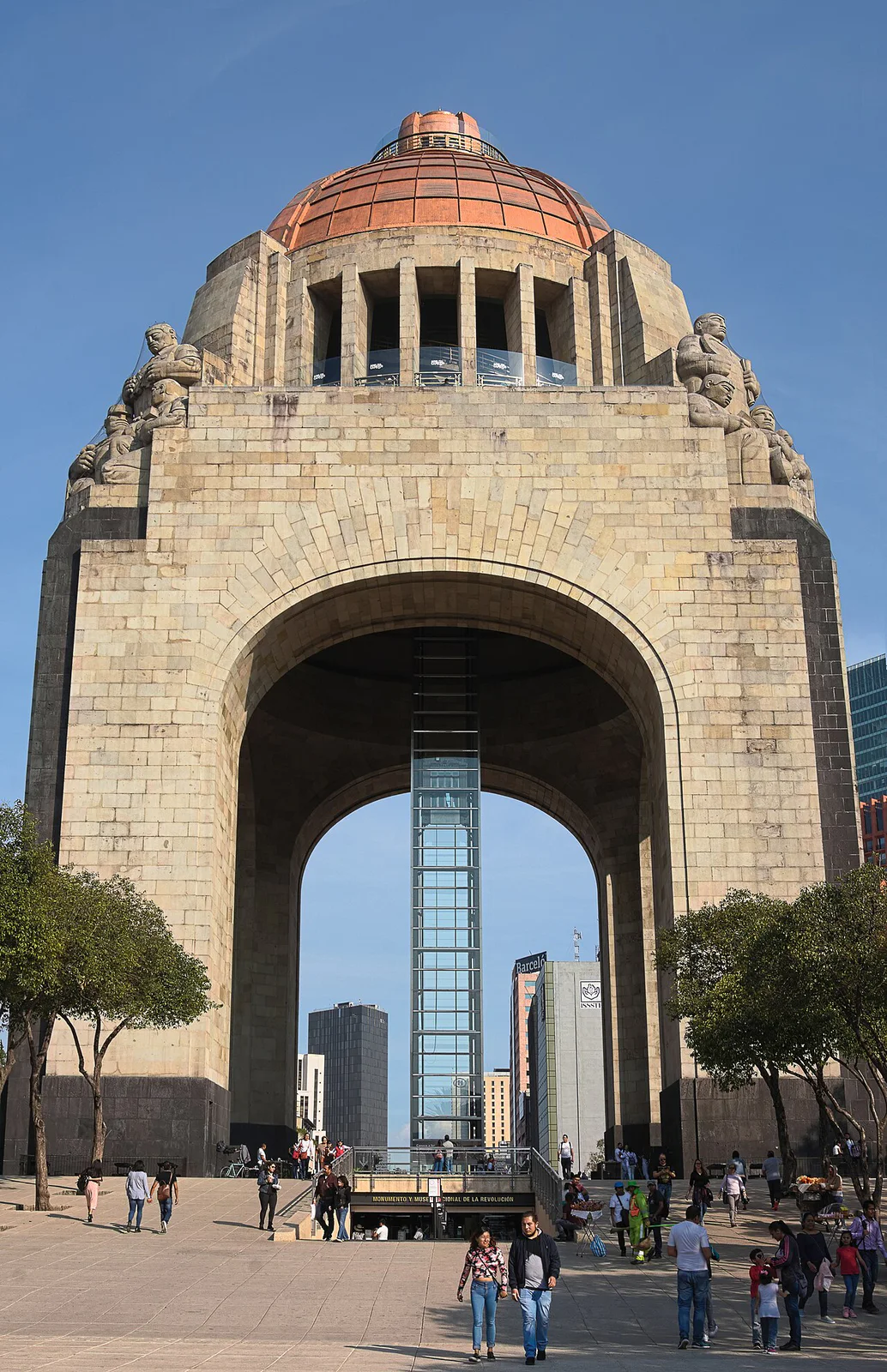
Mexico City · 7 km
Monumento a la Revolución
Content & sources
Carlos Valenzuela · CC BY-SA 4.0
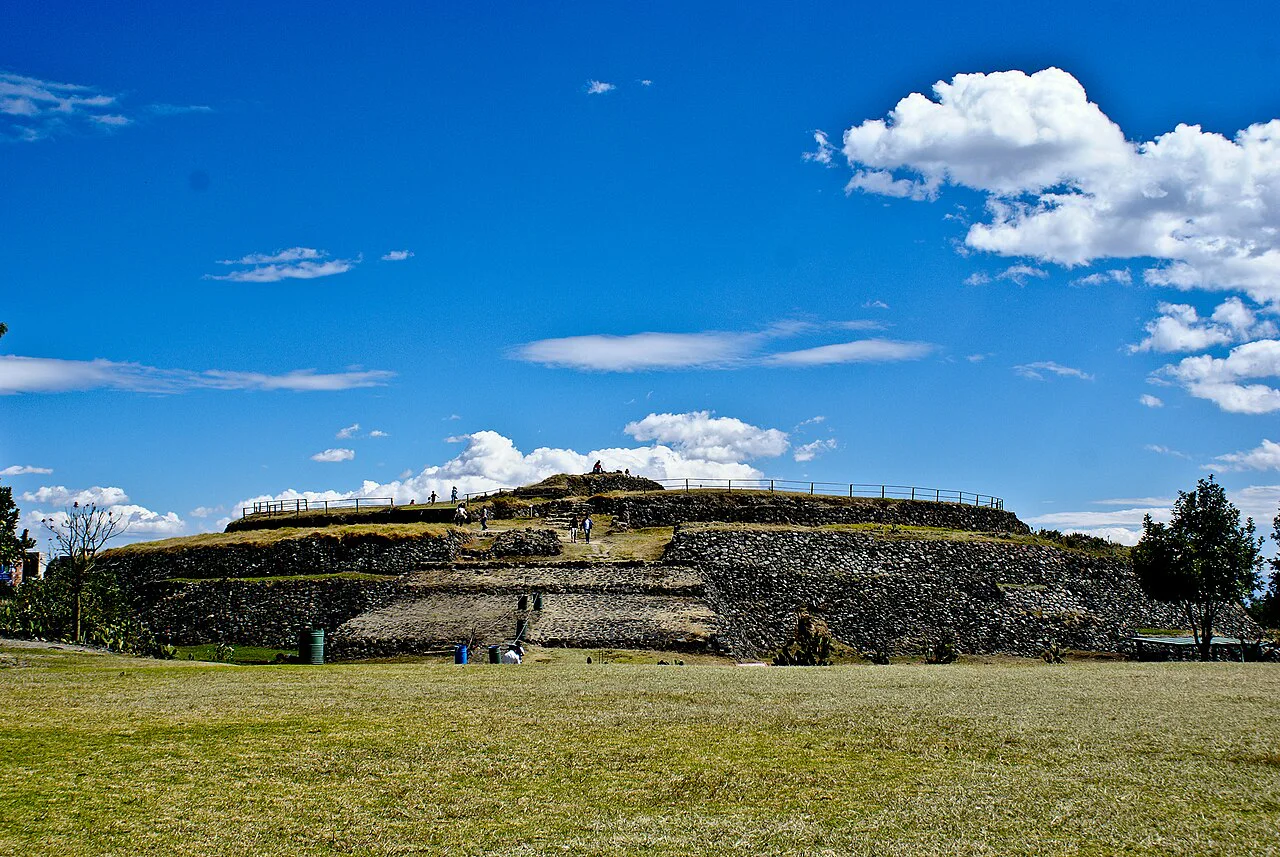
Mexico City · 21 km
Cuicuilco
Content & sources
Photo: Felipe huerta hdez · CC BY-SA 3.0