Stanza · Audio guide
Kutubiyya Mosque Audio Guide
A place to remember. A story to take with you.
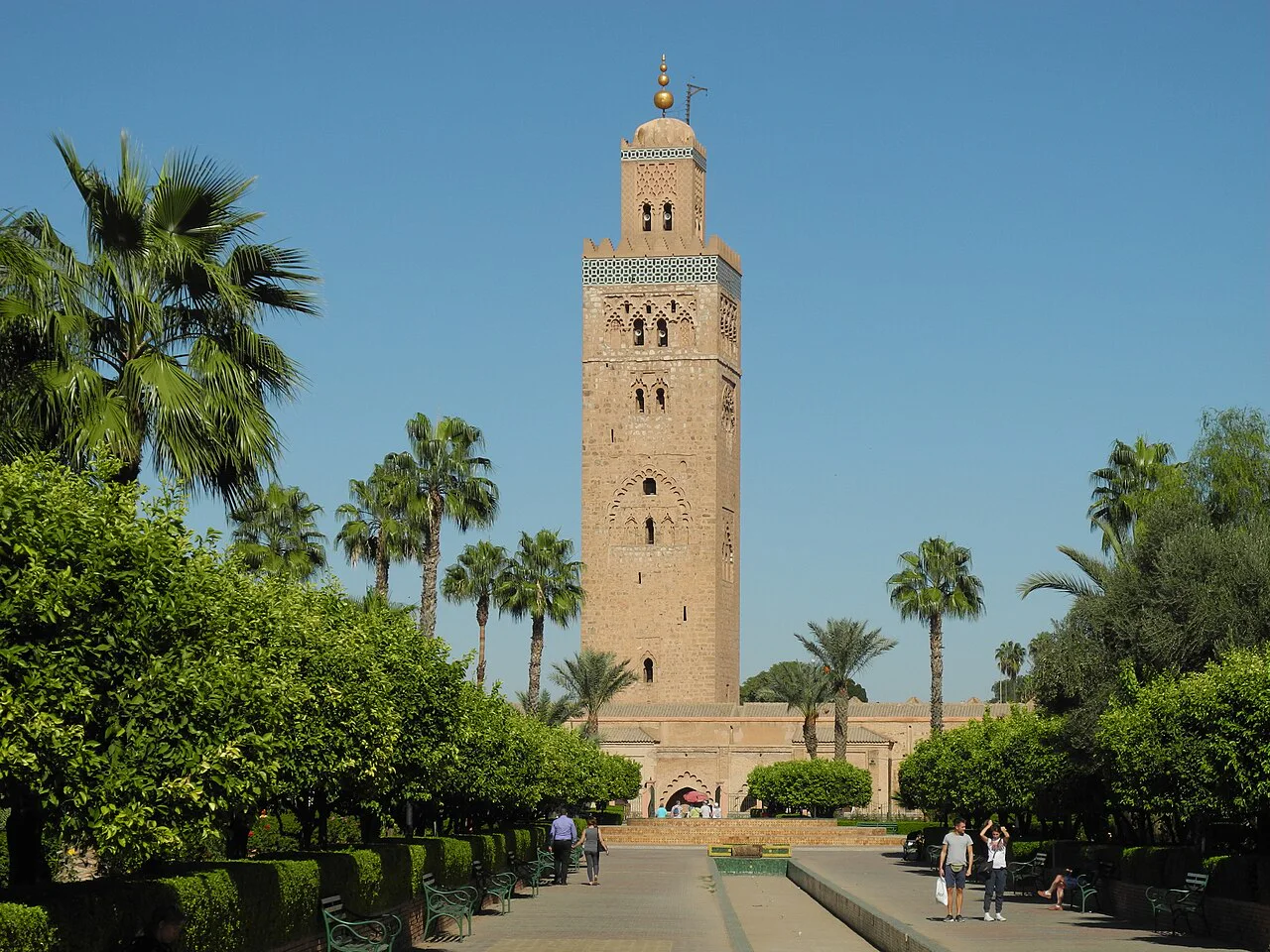
The Kutubiyya Mosque is the largest mosque in Marrakesh, Morocco. It is located in the southwest medina quarter near the Jemaa el-Fnaa market place.
Download Stanza, then search for “Kutubiyya Mosque”.
About the tour
One guide. Your kind of visit.
The Kutubiyya Mosque is the largest mosque in Marrakesh, Morocco. It is located in the southwest medina quarter near the Jemaa el-Fnaa market place.
Ready when you are.
- 01Get the free Stanza app.
iOS & Android
- 02Find your guide.
“Kutubiyya Mosque”
- 03Download before you go.
Works offline
Audio guide / 10 narrated stops
Inside the guide
Get to know a few of the stories before you go. Open a stop to read more.
01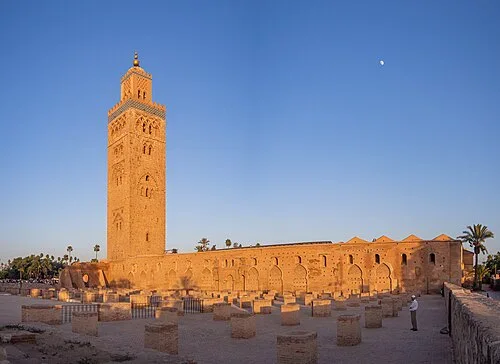 Esplanade and Jemaa el-Fnaa Approach
Esplanade panorama: the mosque and its ruins
Welcome to the Kutubiyya, the great Friday mosque of Marrakesh and the largest in the city. It was founded in 1147 by the Almohad caliph Abd al-Mu'min, almost the moment his army took Marrakesh from the Almoravids. He made this conquered capital his own, and raised his state mosque on ground beside the old royal fortress. The wide view shows two buildings at once. The tall minaret and its mosque still stand in use, filled for Friday prayers. The low grid of walls and stumps on the esplanade is the excavated skeleton of an earlier mosque, abandoned centuries ago. One prayer hall was replaced by another, and both shared this same ground. The prayer hall itself is open to worshippers only, so this tour follows the esplanade, the ruins and the gardens, where the whole story is laid out in the open air.
Photo: C messier · CC BY-SA 4.0
02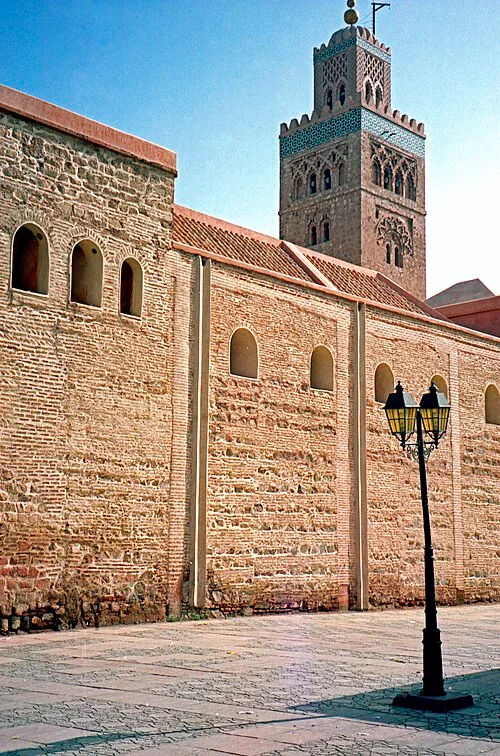 Esplanade and Jemaa el-Fnaa Approach
The Eastern Wall and the Booksellers' Mosque
The mosque's name comes from the kutubiyyin, the booksellers. Along this long eastern wall ran the souk where they worked, selling manuscripts and ink to the scholars of Marrakesh. At the height of the trade, as many as a hundred book vendors worked the streets at the mosque's base. The eastern side faced their shops, and the building became known simply as the Booksellers' Mosque. It is a plain wall of brick today, with only a few small arched windows to break it. But behind it the interior opens into a hypostyle hall of more than a hundred pillars, carrying rows of horseshoe arches that divide the space into seventeen naves. The mosque has eight entrances, four on the west side and four on the east, and the eastern doors opened straight towards the booksellers' street. A mosque named after the trade that pressed against its walls is a rare thing, and the name has outlived the souk itself.
Dennis G. Jarvis · CC BY-SA 2.0
03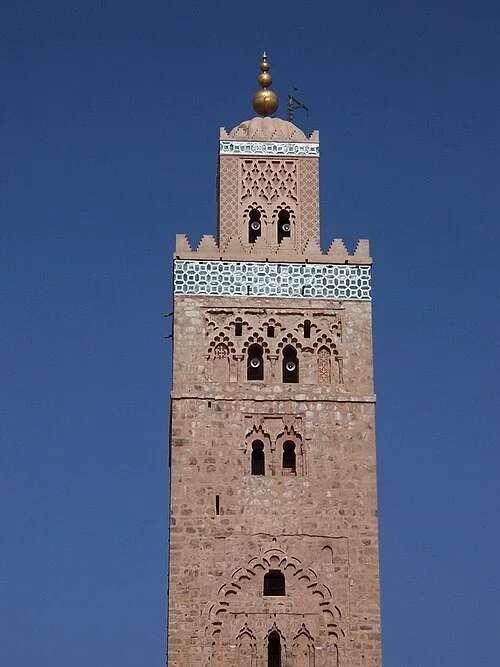 The Monumental Almohad Minaret
The Minaret Shaft
The minaret rises about seventy-seven metres from the ground to the tip of its finial. Its main shaft is a square block, nearly fifty-six metres tall on a base just under thirteen metres a side. That gives a height-to-width ratio of a little over four to one, and those proportions changed minaret design across North Africa. Earlier towers in the region had been shorter and heavier. The Almohad builders made theirs taller and more slender, and this one became the model for everything that followed under their influence. It was built in rubble masonry with sandstone, and for centuries it wore the pink plaster of Marrakesh, until experts stripped it back in the 1990s to show the original stone. The pattern of blind arches and windows on each face is not random. Each opening marks a point along the great interior ramp, which was wide enough for the muezzin to ride a horse to the top. Two towers copied the design soon after: the Hassan Tower in Rabat, never finished, and the minaret of the Great Mosque of Seville, which survives today as the Giralda.
Listen in the appDaniel Csörföly · CC BY-SA 3.0
04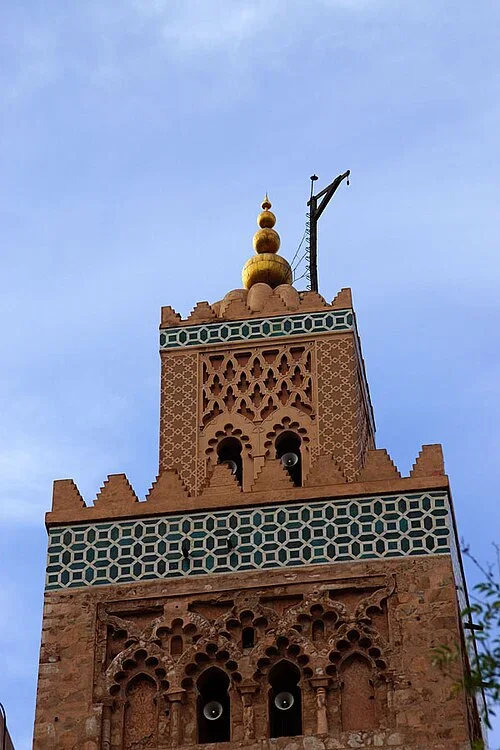 The Monumental Almohad Minaret
The Spire and the Call to Prayer
Above the main shaft sits an open-air platform, and from it the muezzin traditionally gave the call to prayer towards all four directions of the compass. Beside the orbs at the very top stands a flagpole, where the green flag of the Prophet is hoisted every Friday and on religious occasions. The crowning finial is a pole carrying three spheres, each smaller than the one below, and the largest is about two metres across. They are made of copper plating, riveted together. The popular legend tells a different story. It says a fourth sphere once existed, made of pure gold, donated by the wife of the caliph Ya'qub al-Mansur. She had broken her fast for three hours during Ramadan, the story goes, and melted down her jewellery as penance. Another version makes the balls entirely golden, fashioned from the jewellery of the wife of the Saadi sultan Ahmad al-Mansur. The tale was first told about the Kasbah Mosque further south, which carries a similar finial, and only later drifted to this tower.
Listen in the appHeribert Bechen .. thanks for 2.6 mio. visits from Bergisch Gladbach, Germany · CC BY-SA 2.0
05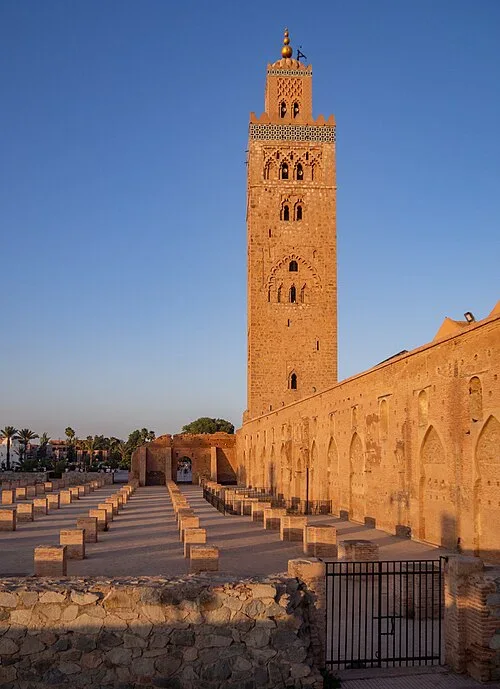 Excavated Ruins and Qibla Realignment
Excavations of the First Mosque
When the Almohads took Marrakesh in 1147, they wanted no trace of the religious monuments of the Almoravids, whom they considered heretics. They reportedly demolished the city's mosques, including the great Ben Youssef Mosque, claiming their prayer direction was wrong. So Abd al-Mu'min built his new mosque on fresh ground beside the old fortress, and the first Kutubiyya was laid out just northwest of it. That first mosque no longer stands, but its layout is well known, because excavations beginning in 1923 uncovered its foundations. The grid of column bases and wall stumps on the esplanade is what those digs revealed. For a long time the two mosques were believed to have replaced one another. A study published in 2022 by Almagro and Jiménez proposes something different: that the two operated together as one great mosque into the seventeenth century. When Marrakesh fell into decline in the later 1600s, the older half was neglected and ruined. When the city revived in the eighteenth, the standing mosque was restored and the passages between the two halves were sealed, leaving the older section to its abandonment.
Listen in the appPhoto: C messier · CC BY-SA 4.0
06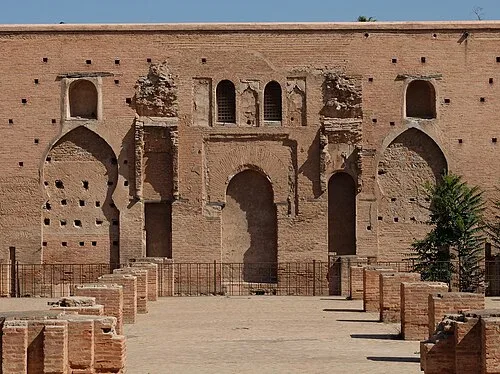 Excavated Ruins and Qibla Realignment
The Mihrab of the First Mosque
This carved wall belongs to the first mosque, and its arches mark the mihrab, the niche that showed the direction of prayer. Medieval Muslims could calculate that direction towards Mecca quite accurately, and the Almoravid Ben Youssef Mosque had already been laid out roughly so. The Almohads chose otherwise. They followed an older tradition of the western Islamic world, in which the qibla pointed south rather than east, citing a saying of Muhammad that what lies between east and west is a qibla. Some scholars think this was genuine conviction, drawn from the orientation of the Kaaba itself in Mecca. Others suspect it was mostly a symbolic claim, a way of setting themselves apart from the Almoravids they had overthrown. Either way, to pray in the Almohad direction, Abd al-Mu'min began an entire second mosque in 1158, adjoining the first on its southeastern side. The standing mosque faces between 159 and 161 degrees from true north, against the first mosque's 154. Measured against the true direction of Mecca, the new mosque was actually further out of line than the old one.
Listen in the appRobert Prazeres · CC BY-SA 4.0
07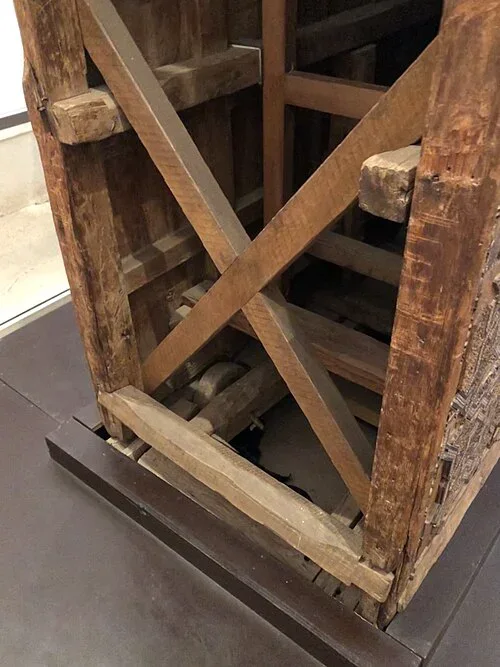 Excavated Ruins and Qibla Realignment
The Almoravid Minbar
The pulpit of this mosque was commissioned by Ali ibn Yusuf, one of the last Almoravid rulers, and made by a workshop in Cordoba. Work began in 1137 and is estimated to have taken seven years. It is regarded as one of the unsurpassed creations of Islamic art, and later pulpits across Morocco and parts of Algeria imitated it without ever matching it. Abd al-Mu'min transferred it from the Ben Youssef Mosque to the first Kutubiyya, and then to the second, where it stayed until 1962. It is now on display at the El Badi Palace, its wooden frame and wheels still visible beneath the base. The wonder was in how it moved. Historical accounts describe the minbar sliding forward on its own from its storage chamber beside the mihrab, into position for the Friday sermon. A wooden screen called the maqsura, which enclosed the caliph during prayers, rose from a trench in the floor when he arrived and withdrew when he left. The mechanism was designed by an engineer from Málaga named Hajj al-Ya'ish, and it drew great curiosity from those who saw it. Excavations have confirmed the mechanism existed, and the most plausible theory is that hidden pulleys and counterweights powered it.
Listen in the appPhoto: إيان · CC BY-SA 4.0
08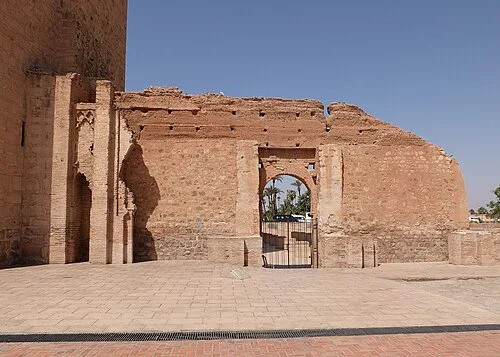 Almoravid Ksar al-Hajjar Fortress
Remains of Ksar al-Hajjar
Some of the sturdiest masonry on this site predates both mosques. On the northern side of the first mosque's ruins, excavations uncovered part of the perimeter of the Ksar al-Hajjar, the stone fortress built around 1070 by Abu Bakr ibn Umar, the Almoravid founder of Marrakesh. His dynasty made this their capital, and the fortress was the city's first seat of power. Next to it stood the palace of Ali ibn Yusuf, completed in 1126. Its remains are visible at the northeast corner of the ruins and in other spots around the plaza. When the Almohads built their new mosque, they demolished that palace to make way for it. The mosque rose directly on top of the old royal ground, and may even cover annexes of the palace or a royal cemetery. A covered passage is believed to have linked the mosque to the Almohad palace that replaced the fortress, letting the caliph walk straight into the prayer hall without passing the public doors. One fragment of stonework here, once identified as a palace gate, has been argued by Almagro and Jiménez to be the base of the first mosque's own minaret, built over a corner tower of the fortress.
Listen in the appPhoto: R Prazeres · CC BY-SA 4.0
09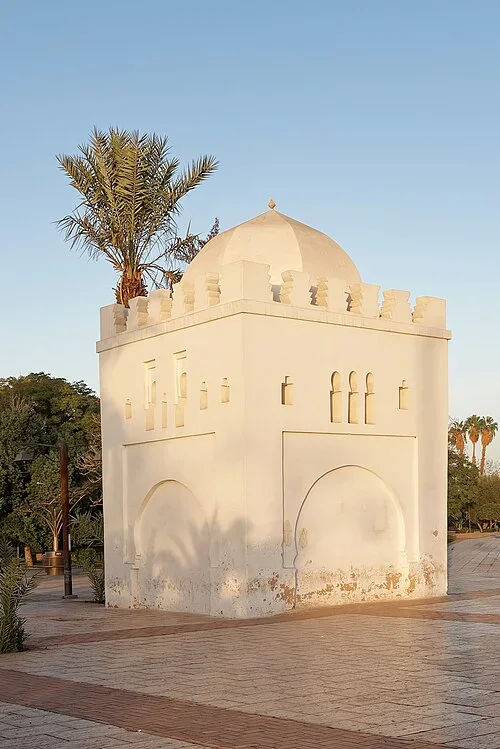 Koubba of Lalla Zohra
Beside the great mosque stands a much smaller building, a white domed koubba with crenellated corners. It is the tomb of Fatima Zohra bint al-Kush, known as Lalla Zohra, a female mystic of Marrakesh. She died in the early seventeenth century and was buried here, close by the mosque. Her tomb still carries her name, and people still come to it. It is a quiet counterpoint to the vast state mosque around it, a place of popular devotion rather than royal ceremony. Palm trees rise behind its dome, and its whitewashed walls catch the morning light. The great caliphs and their mosques dominate the esplanade, but this modest shrine has held its own patch of ground among them for four hundred years.
Listen in the appJakub Hałun · CC BY 4.0
10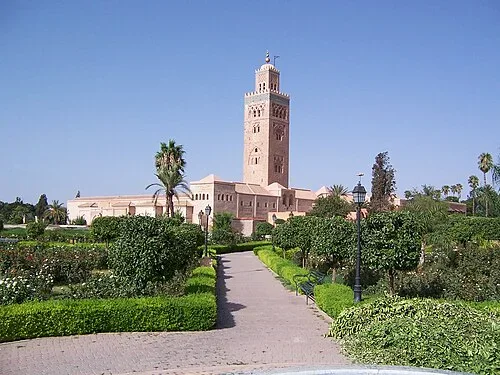 Koutoubia Gardens
The Gardens: Closing View
From the rose gardens south and west of the mosque, the tower appears framed by green hedges and palm trees. In January 1943, after the Casablanca Conference, Winston Churchill brought President Roosevelt here to watch the sunset over the minaret, and painted it as Tower of the Koutoubia Mosque. The city has guarded that view ever since. An ordinance forbids any building taller than a palm tree from rising around the minaret, so no modern block competes with it on the skyline. On the eighth of September 2023, an earthquake of magnitude 6.8 struck the Al Haouz region, and footage showed the mosque shaking. The building stayed standing, but cracks opened in the minaret. Restoration work followed, at a cost reported by the minister of religious affairs at twenty-four million dirhams, and the mosque reopened in March 2024. The solar panels and efficient lighting fitted in 2016 were part of the same long habit of care. Nearly nine centuries after its founding, the tower still gives the city its landmark, and the call to prayer still rises from it.
Listen in the appDaniel Csörföly · CC BY-SA 3.0
Kutubiyya Mosque
Frequently asked questions
How much does the guide cost?
Free app download. Listed guide price: $0.99. Guide price shown in the app. Audio guide only. Venue admission is separate.
Can I listen without internet?
Yes. Download the guide’s audio, images, and maps in the app before your visit. Your downloaded content is then available offline.
Can I listen in my language?
This audio guide is available in 15 languages, including English.
Do I need to follow a schedule?
No. This is a self-guided experience. Choose your stops, pause whenever you like, and return to a story at your own pace.
At your own pace
Explore Kutubiyya Mosque.
Download Stanza, then search for “Kutubiyya Mosque”.
Free app download · Guide price shown in the app
Keep exploring
Audio guides — Morocco
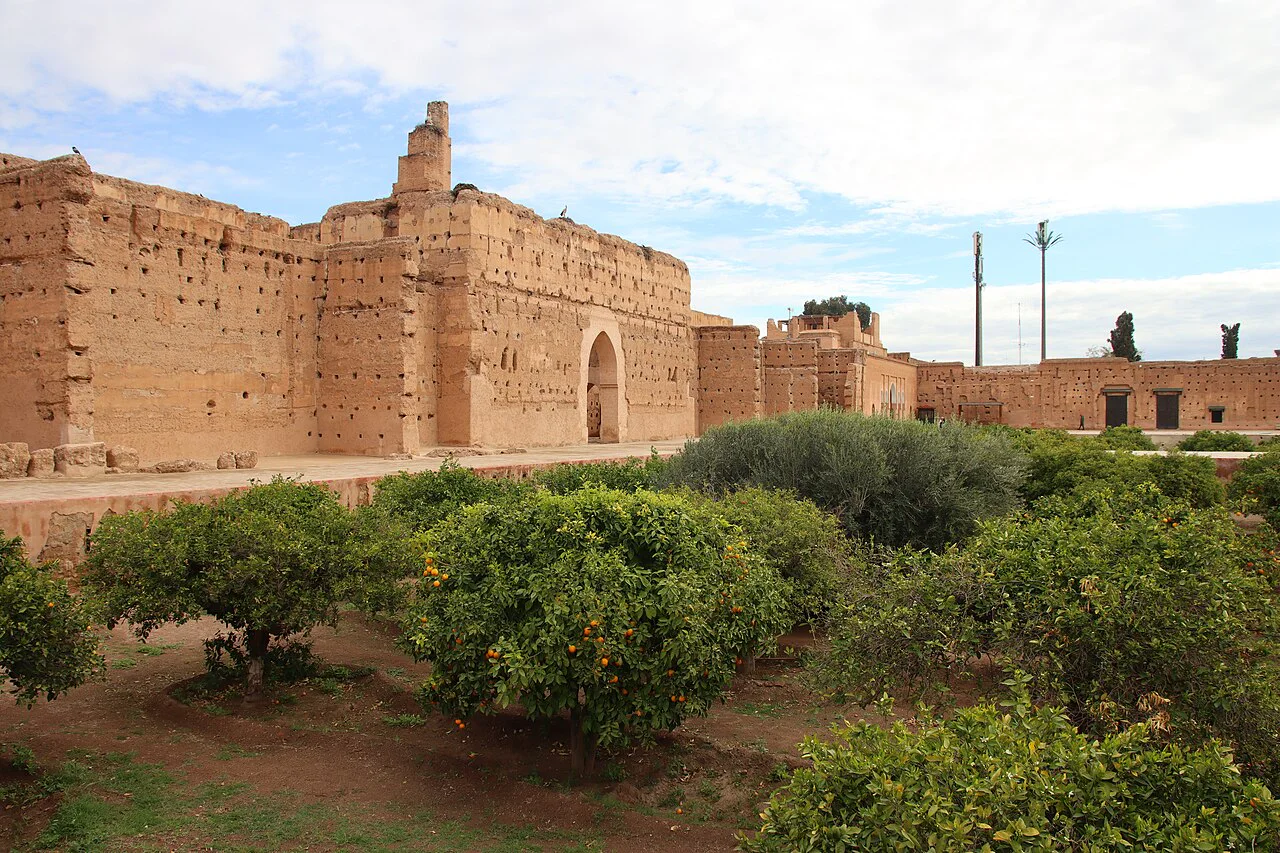
Marrakech · 1 km
El Badi Palace
Content & sources
Photo: Draceane · CC BY-SA 4.0
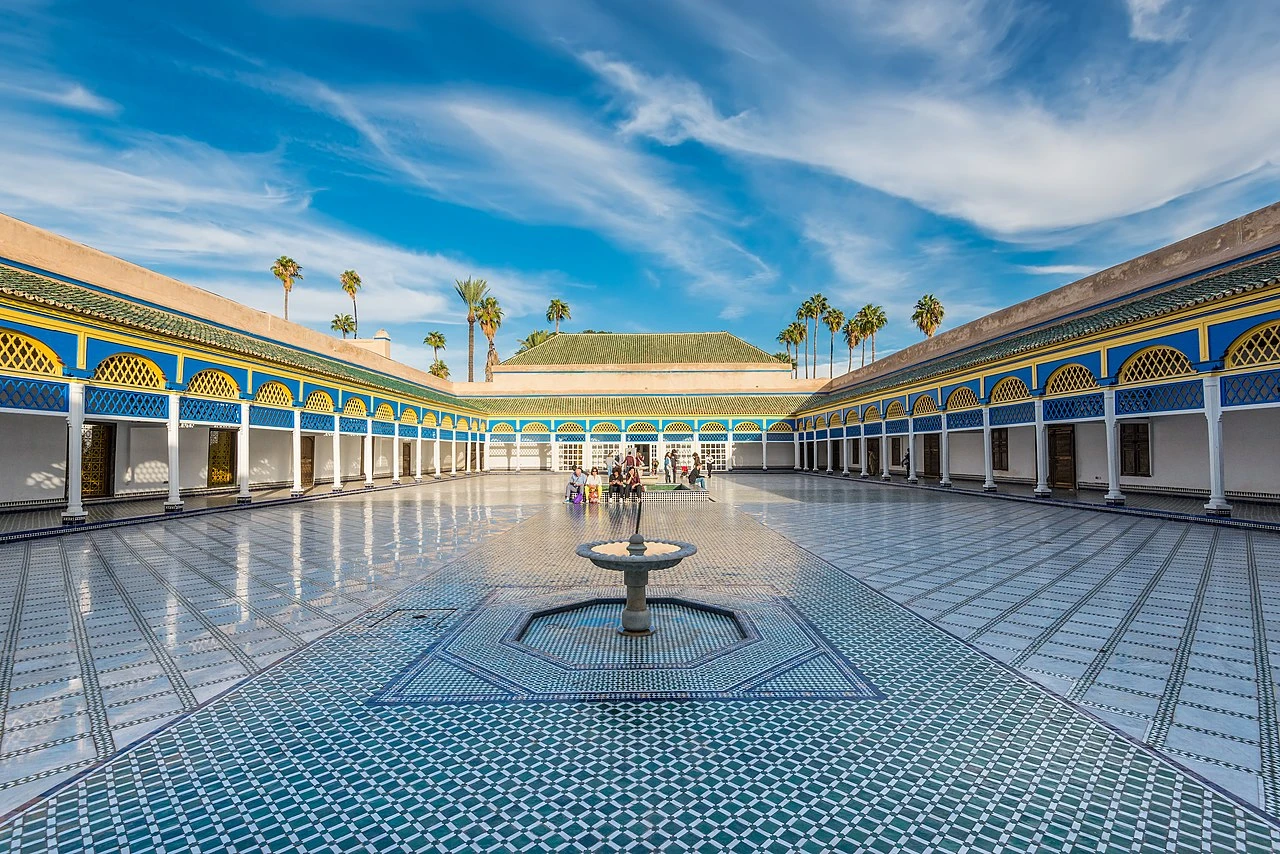
Marrakesh · 1 km
Bahia Palace
Content & sources
Val Traveler · CC BY-SA 4.0
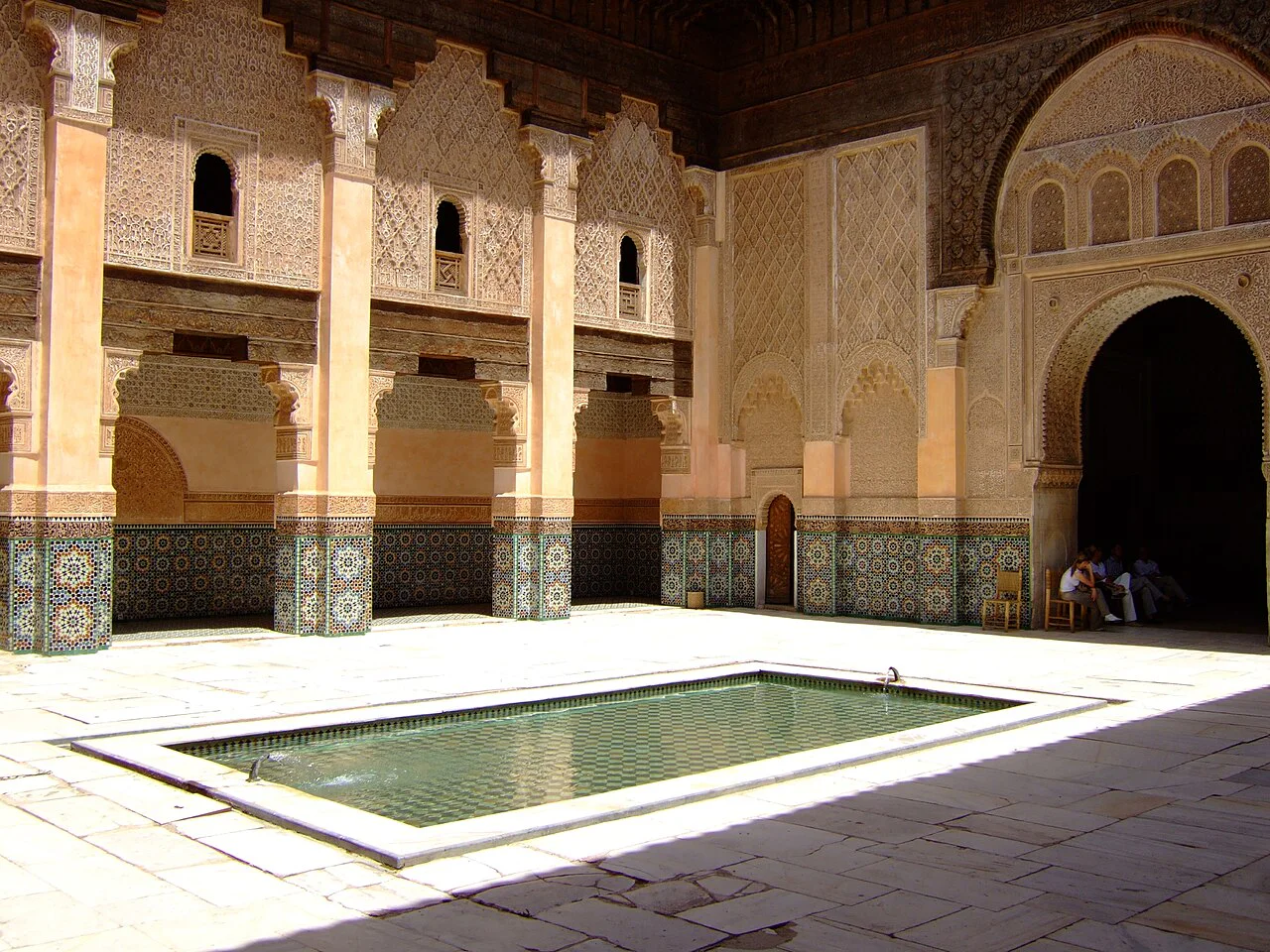
Marrakech · 1 km
Ben Youssef Madrasa
Content & sources
Lundeux · CC BY-SA 2.5
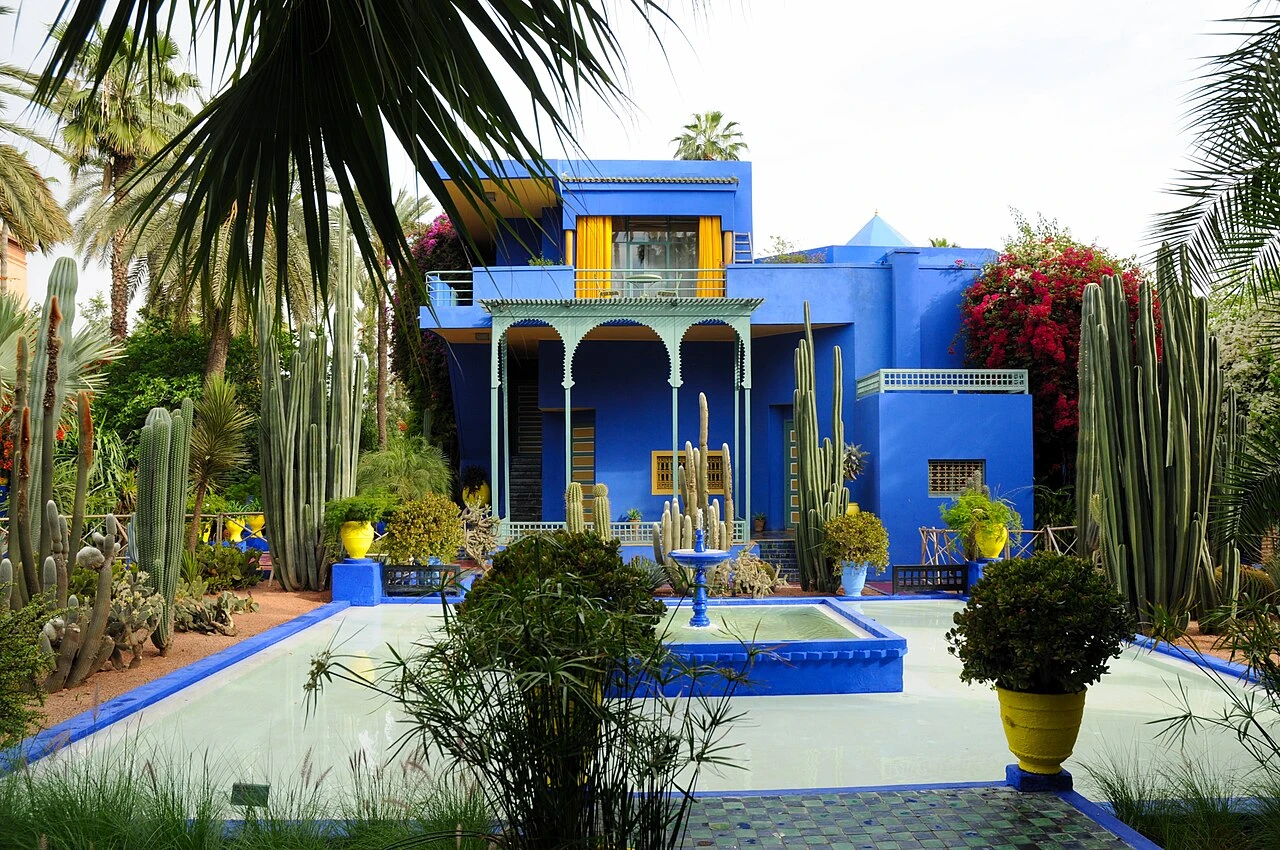
Marrakesh · 2 km
Jardin Majorelle
Content & sources
Photo: Viault · CC BY-SA 4.0
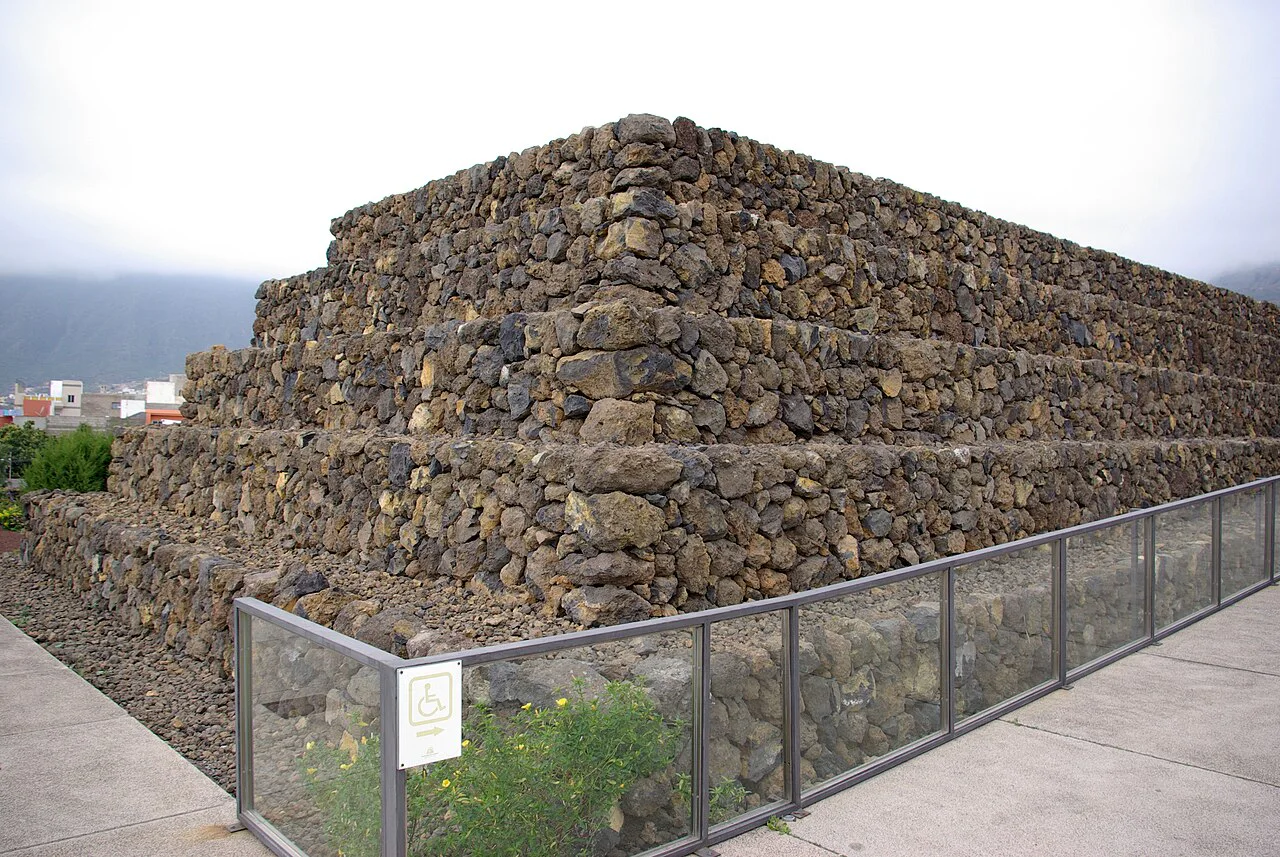
Güímar
Pirámides de Güímar
Content & sources
Photo: Berthold Werner · Public domain