Stanza · Audio guide
Hisham's Palace Audio Guide
A place to remember. A story to take with you.
Hisham's Palace is an early Islamic archaeological site located in Jericho. Built by the Umayyad dynasty in the 8th century, it is recognized as one of the Umayyad desert castles.
Download Stanza, then search for “Hisham's Palace”.
About the tour
One guide. Your kind of visit.
Hisham's Palace is an early Islamic archaeological site located in Jericho. Built by the Umayyad dynasty in the 8th century, it is recognized as one of the Umayyad desert castles.
Ready when you are.
- 01Get the free Stanza app.
iOS & Android
- 02Find your guide.
“Hisham's Palace”
- 03Download before you go.
Works offline
Audio guide / 10 narrated stops
Inside the guide
Get to know a few of the stories before you go. Open a stop to read more.
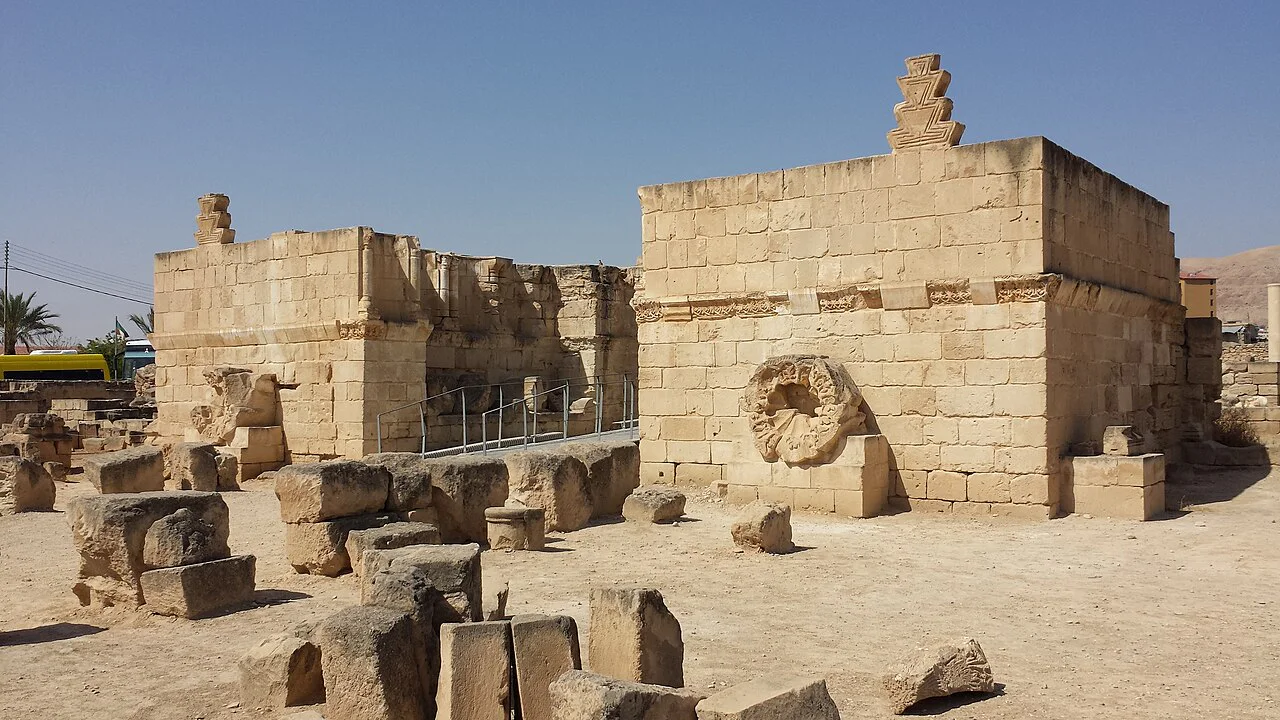
01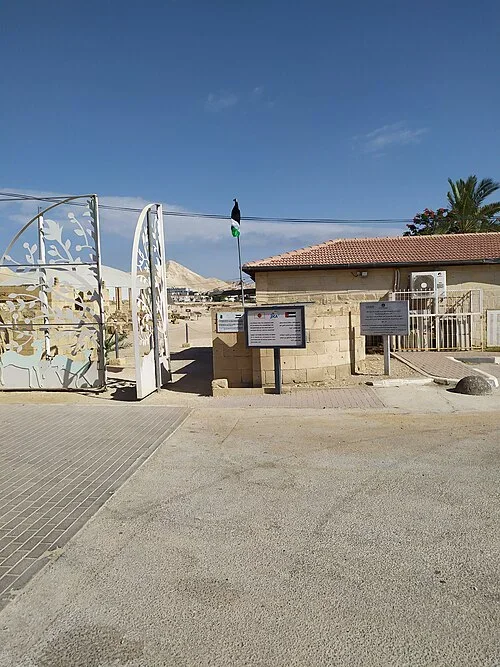 The Arrival Gate and Palace Museum
Hisham's Palace Museum Entrance
Welcome to Hisham's Palace, an early Islamic complex built between 724 and 743, three kilometres north of Jericho. Its Arabic name is Qasr Hisham, and it is often counted among the Umayyad desert castles scattered across Syria, Jordan and Palestine. Most of those stand in dry country, but this one was set in fertile land, close to the town yet separated from it by the Wadi Nueima. The site spreads over sixty hectares, and it held three parts: a palace, an ornate bath complex, and an agricultural estate. Water made all of it possible. The main spring near Jericho was awkward to reach, so aqueducts carried water instead from springs at Naaran, to the north-west. The palace also stood beside the road running north through the Jordan Valley towards Damascus. Inside the grounds, a museum opened in 2000 shows pottery and relics from the Umayyad and Abbasid caliphs, all found here. The tour ahead runs through the courtyard, the mosque, the great bath hall, the diwan with its famous mosaic, and ends at the carved star that has become the site's emblem.
Photo: M sh شراونة محمد · CC BY-SA 4.0
02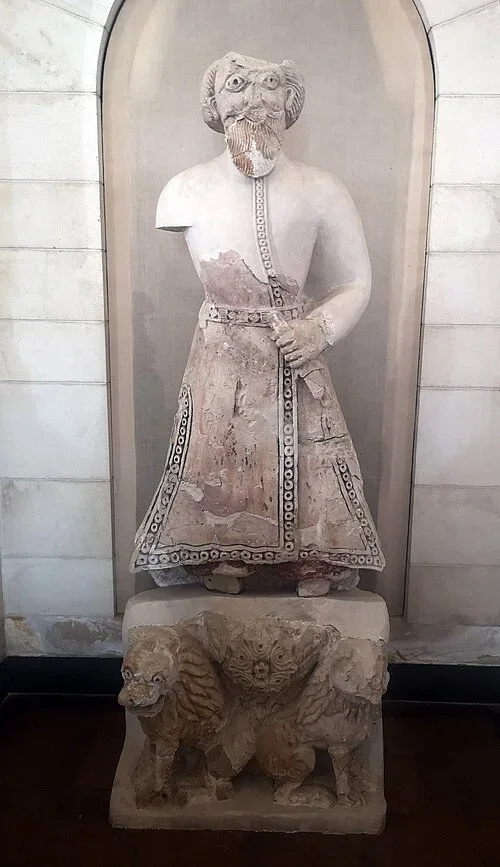 The Arrival Gate and Palace Museum
The Caliph Statue from the Bath Entrance
A robed figure stares out from a museum niche, sword in hand, carved in plaster. This is the statue often presumed to show the caliph himself, and it once stood in a niche above the entrance to the bath hall at Hisham's Palace. Many of the finest finds from the digs of 1935 to 1948 were moved to the Rockefeller Archaeological Museum in East Jerusalem for safekeeping, and this statue is displayed there today. Those excavations were led by Dimitri Baramki, a Palestinian archaeologist who worked the site for thirteen years. His colleague Robert Hamilton later published the major book on the palace. Who built it is still argued over. An inscribed shard bearing the name Hisham pointed to the caliph Hisham ibn Abd al-Malik. Hamilton disagreed, and argued the patron was Hisham's nephew, al-Walid ibn Yazid, a man famous for his extravagant way of life. Neither case is settled. Art historians have also traced the carving style eastwards, reading in it an Islamic language of power shaped by Sasanian influences from Iraq.
Israel Parker (ישראל פרקר) · CC BY 2.5
03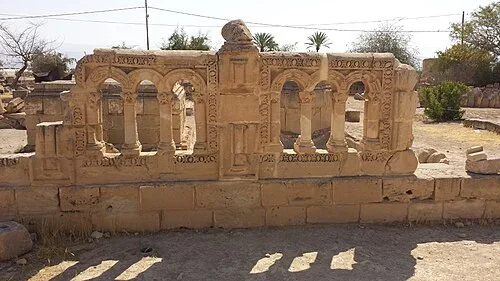 The Grand Courtyard and Fountain Pavilion
Fountain Pavilion Balustrade
Carved into this stone balustrade are rows of tiny arcades, each arch held up by slender colonnettes no thicker than a wrist. It belonged to a pavilion that stood in the courtyard east of the palace and baths, and at its heart was a monumental fountain. In a court where water had to be carried by aqueduct across the plain, a fountain was pure display, a way of showing wealth to every guest who crossed the courtyard. The carving gives a taste of what covered the whole complex. Stone at Hisham's Palace was worked like fabric or wood, with geometric and vegetal patterns running across walls, screens and railings. Hamilton, the excavator, called the carvings amateurish and chaotic, but later art historians have disagreed, tracing their themes to Iranian models. Whatever the judgement, the patience behind a balustrade like this one is easy to see.
Listen in the appPhoto: Randa Fawzi · CC BY-SA 4.0
04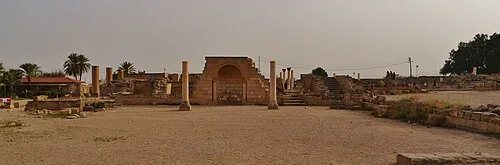 The Grand Courtyard and Fountain Pavilion
The Palace Courtyard and Standing Arches
Across the courtyard, a few arches and pillars still stand where the palace rose. It was the largest building here, roughly square, with round towers at its corners, and it originally had two storeys. Guests entered through a gate set in the middle of the east side. Inside, the rooms were arranged around a central paved portico, called a riwaq, and beneath it lay a sirdab, an underground cellar where the household could escape the heat of the Jordan Valley. A retaining wall wrapped the palace, the bath complex and the mosque into one enclosure. For a long time only the southern gate was known, from Baramki's excavations. Then, in the twenty-first century, a northern gate was found lying in exact alignment with it. That discovery settled something important: the whole development, palace, baths and all, was conceived as a complete unit and built at once, not grown piecemeal over the years.
Listen in the appPhoto: Zairon · CC BY-SA 4.0
05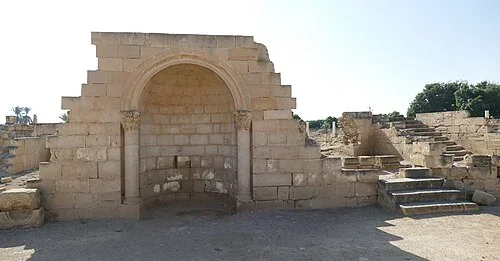 The Palace Mosque
 Prayer Niche
This arched niche, rebuilt with its columns, is a mihrab, the marker of the direction of prayer. The room to the south of the palace portico was a mosque, and its mihrab was built straight into the outer wall. Prayer belonged to the ordinary rhythm of the court, woven into the same building that held reception rooms and living quarters. What is striking is that one residence here had two mosques. A second, larger congregational mosque stood inside the complex, north of the palace gateway, big enough for the wider household and its dependants. The smaller one served the palace itself, close at hand for the people who lived around the portico. Together they show that this was planned as a working seat of power, not only a place of pleasure.
Listen in the appPhoto: Bukvoed · CC BY 4.0
06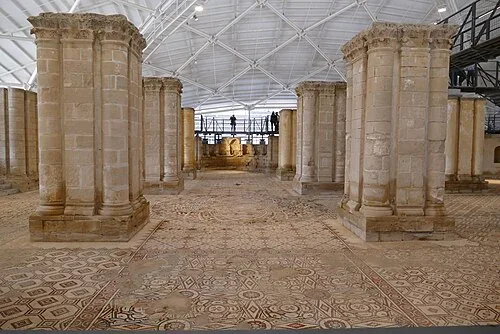 The Great Bath Hall
 Under the Dome
Just north of the palace, across an open stretch of ground, stands the bath complex, a free-standing building almost thirty metres square. Semi-circular exedrae project from three of its sides, three each to the south and west and two to the east, and an ornate entrance filled the centre of its east face. Inside, the great hall rises under a white dome-shaped shelter. That shelter is new. It was designed and built by a Japanese architecture office, with Japanese funding, as part of a restoration costing twelve million dollars. In October 2021, after the work was finished, the bath opened to the public for the first time in decades. Visitors now cross the hall on walkways suspended above the floor, so the mosaics below can be seen without being walked on. Along much of the southern side of the hall ran a pool, where the bathing itself took place.
Listen in the appPhoto: Bukvoed · CC BY 4.0
07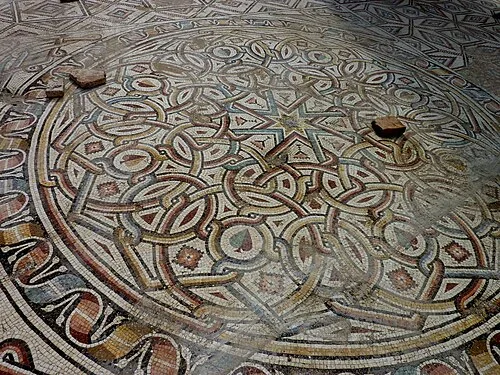 The Great Bath Hall
The Geometric Mosaic Carpet
The floor itself is the treasure. It covers 836 square metres, one of the largest continuous floor mosaics to survive from the ancient world. More than five million pieces of stone, all cut from stone found in Palestine, went into it. The pavement is divided into twenty-five square bays, separated from one another by clusters of piers that once carried the roof. Within each bay the geometric designs run on and on, and hardly any of them repeat. The colours come mainly from five stones: blue, red, green, yellow and orange. At the centre of the hall lies a large kaleidoscope design, a round pattern of interlaced shapes that turns in on itself like a wheel. Craftsmen laid this carpet stone by stone, and the variety shows they were working from a repertoire, not a stencil.
Listen in the appDYKT Mohigan · CC BY 2.0
08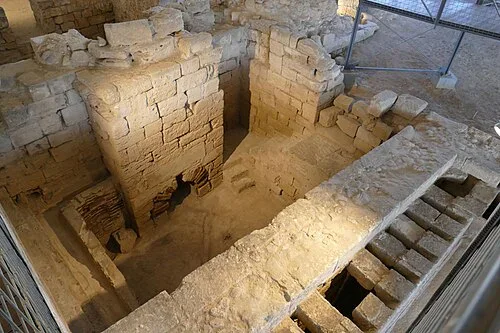 The Great Bath Hall
Below the Floor: the Hypocaust
Beneath the floor of the baths lies the space where the heating lived. The actual bathing rooms were attached to the northern wall of the complex, and they were warmed from below by hypocausts. A hypocaust is an old idea, inherited from Roman and late-antique bathing. The floor rests on short supports, leaving a hollow underneath, and hot air from a furnace circulates through that space, warming the pavement above. Walls could be heated the same way, through hollow channels. In this semi-arid valley, where winters turn cold and water had to be piped in from springs kilometres away, a hot bath was a serious luxury. The engineering below the floor is plain brick and stone, nothing ornamental. Everything above it depended on this hidden machinery doing its work.
Listen in the appPhoto: Bukvoed · CC BY 4.0
09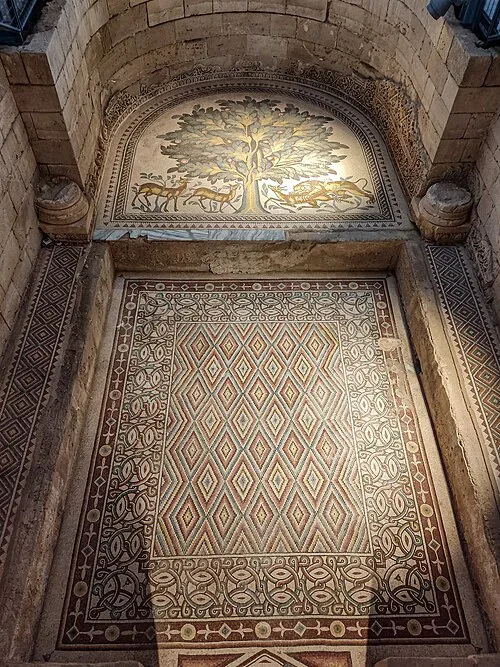 The Diwan and the Tree of Life
At the northwestern corner of the bath hall, a doorway led into the diwan, the private room where the ruler received chosen guests. Its floor holds the most celebrated mosaic on the site. Archaeologists Hamdan Taha and Donald Whitcomb have called it the most famous of Umayyad mosaics. A fruiting tree fills the panel. On the left, two gazelles graze, unaware of what waits. On the right, a lion attacks a third gazelle. What the scene means has been argued for years. One reading sees the peace that the caliph's military strength brought: the lion asserting its power over the grazing herds. Another starts from the border, which resembles the tassels of a curtain. In court ritual of the Umayyad and later periods, caliphs appeared from behind curtains at set moments, so the tassels may frame the whole scene as something intimate, meant for the ruler's own circle. Around the panel runs a geometric carpet.
Listen in the appPhoto: Basem mosa · CC BY-SA 4.0
10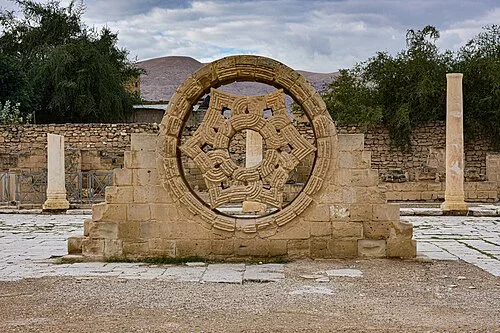 The Star of Hisham
This carved rosette, set upright among the ruins, has become the symbol of Hisham's Palace. Its six-pointed star is worked in deep relief, geometry turned into architecture, and it was probably part of a window, reconstructed upright here from the fallen pieces. The star distils the same geometric mastery that runs through the whole complex, from the balustrades to the great floor. The ruins around it also hold a corrected story. For a long time people believed the palace was destroyed in the earthquake of 749 and abandoned. A close reading of Baramki's excavation reports shows that is wrong. The pottery record shows life here continued for centuries afterwards, with a significant phase between 900 and 1000, under the Abbasids and Fatimids, and on into the Ayyubid and Mamluk periods. A geological study from 2013 points instead to the later earthquake of 1033, and found damage there matching a more severe shock than the one of 749. A palace built to display power lasted, in one form or another, some three hundred years.
Listen in the appPhoto: Basem mosa · CC BY-SA 4.0
Hisham's Palace
Frequently asked questions
How much does the guide cost?
Free app download. Listed guide price: $0.99. Guide price shown in the app. Audio guide only. Venue admission is separate.
Can I listen without internet?
Yes. Download the guide’s audio, images, and maps in the app before your visit. Your downloaded content is then available offline.
Can I listen in my language?
This audio guide is available in 15 languages, including English.
Do I need to follow a schedule?
No. This is a self-guided experience. Choose your stops, pause whenever you like, and return to a story at your own pace.
At your own pace
Explore Hisham's Palace.
Download Stanza, then search for “Hisham's Palace”.
Free app download · Guide price shown in the app
Keep exploring
Nearby audio guides
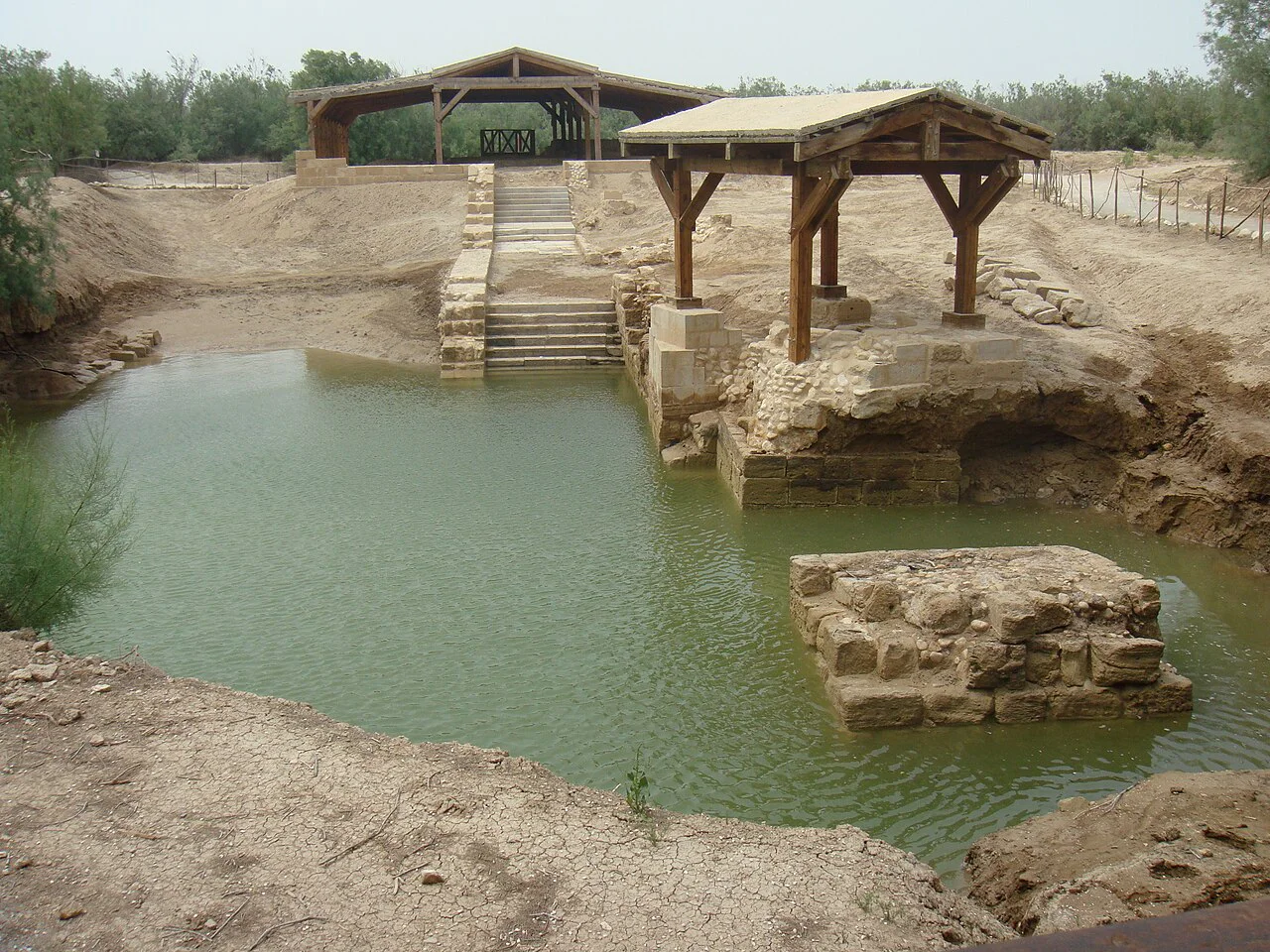
Shoonah Janoobiyah Sub-District · 10 km
Al-Maghtas
Content & sources
Producer (talk) · CC BY 2.5
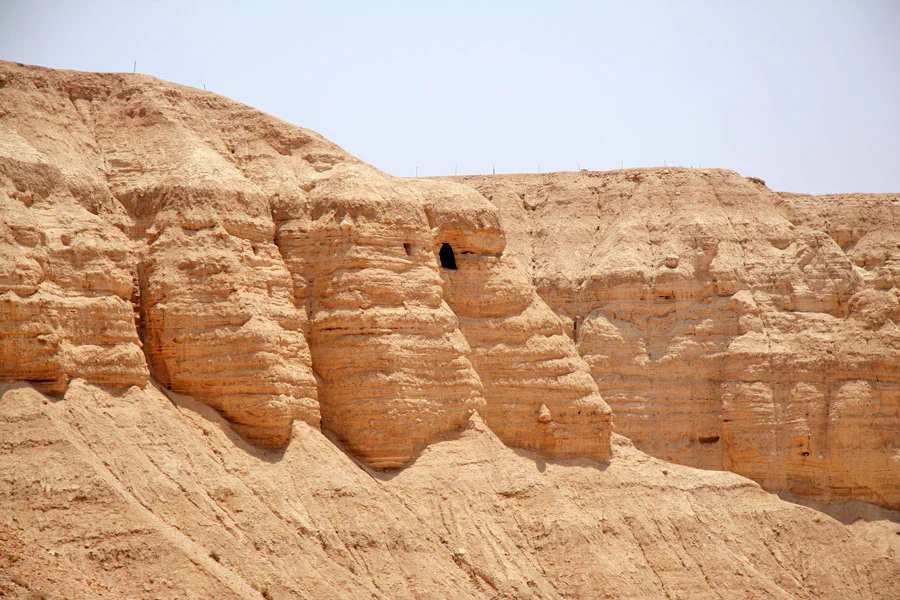
Megilot Yam HaMelakh Regional Council · 16 km
Qumran
Content & sources
Photo: Tamarah · CC BY-SA 2.5
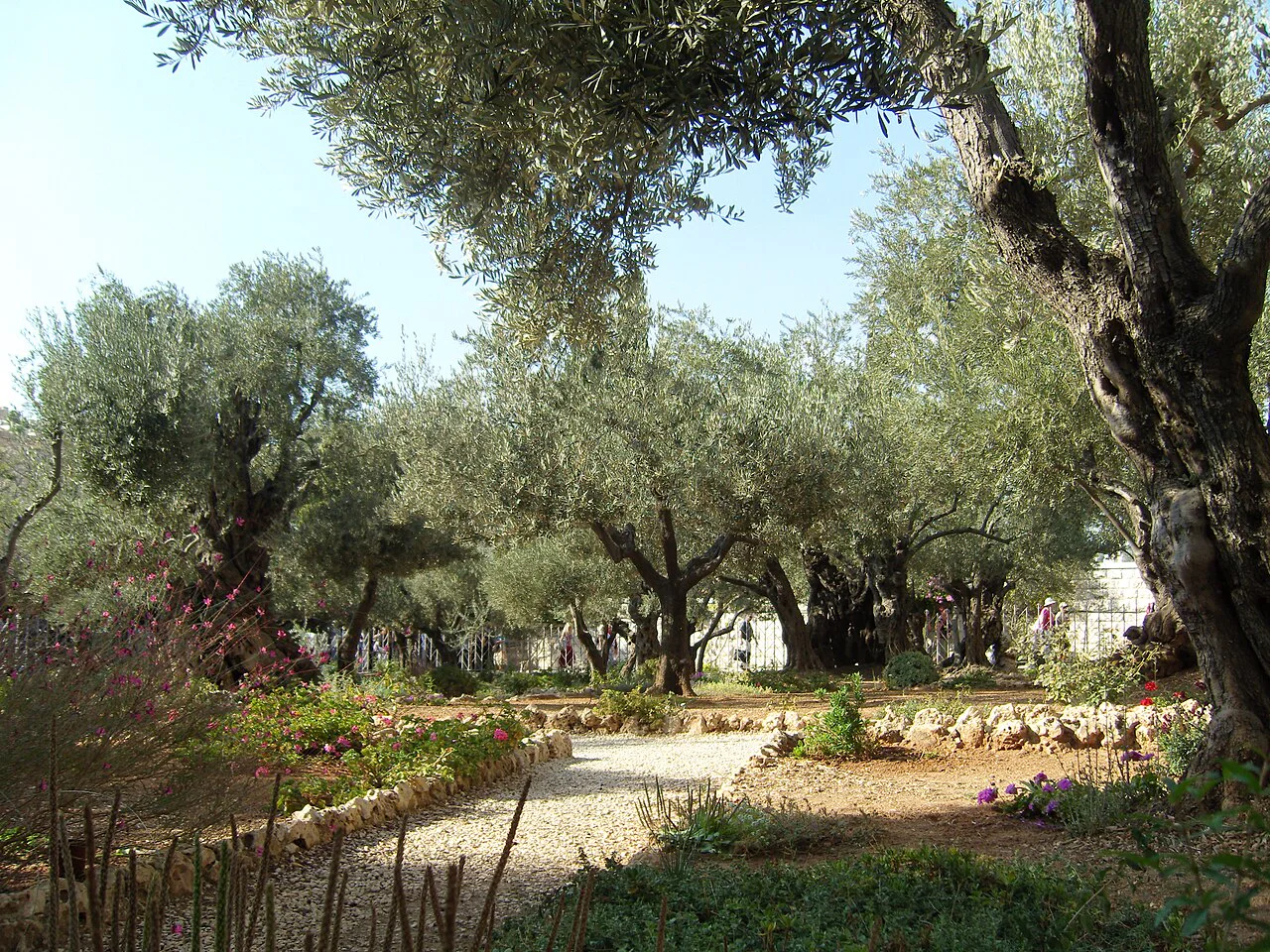
Jerusalem · 24 km
Gethsemane
Content & sources
Photo: Mewasul · CC BY-SA 3.0
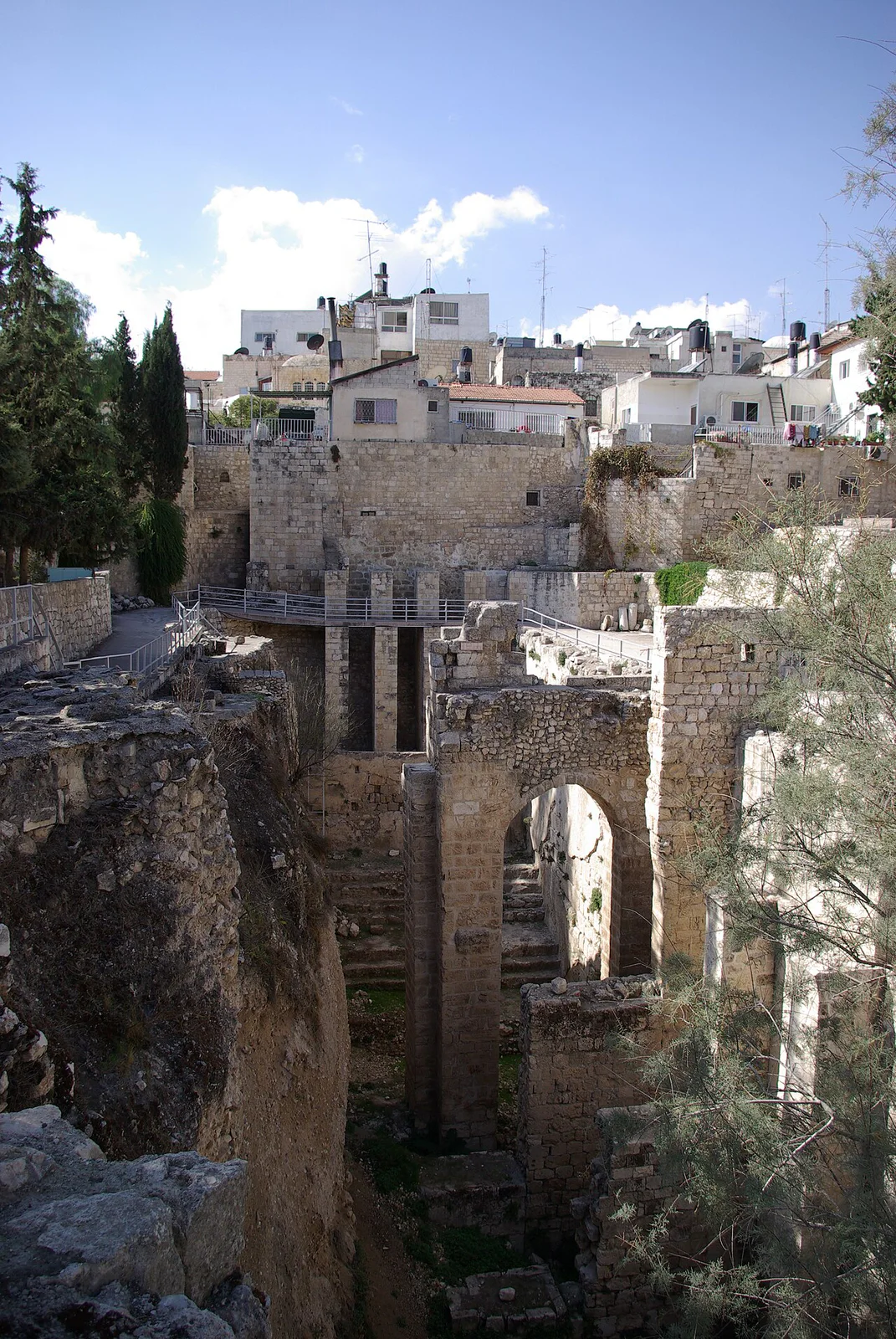
Jerusalem · 24 km
Pool of Bethesda
Content & sources
Photo: Berthold Werner · Public domain