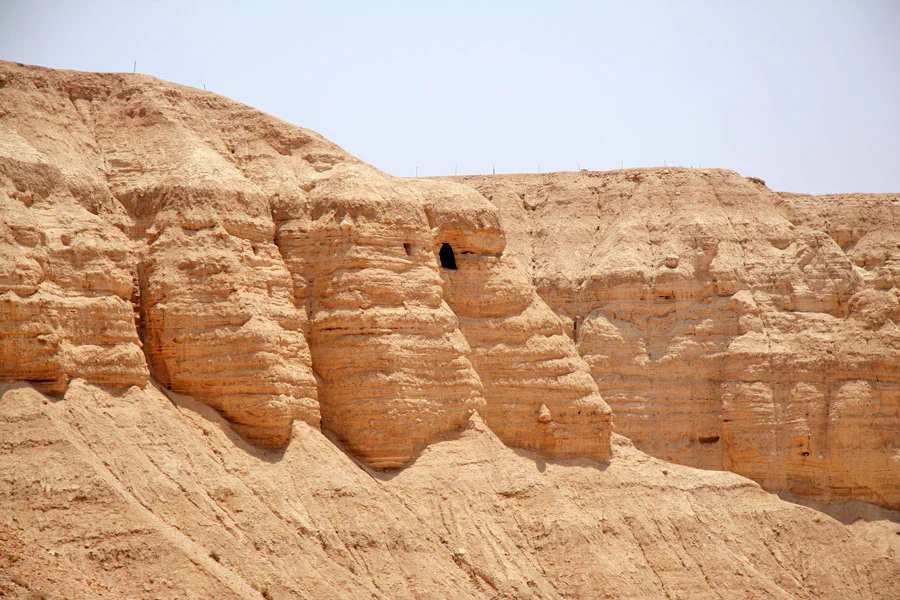
 Stanza / Audio guide
Content & sources
Stanza · Audio guide
Qumran Audio Guide
A place to remember. A story to take with you.
Qumran is an archaeological site located on a dry marl plateau in the West Bank. It is managed by Israel's Qumran National Park and is situated near the northwestern shore of the Dead Sea.
Download Stanza, then search for “Qumran”.
About the tour
One guide. Your kind of visit.
Qumran is an archaeological site located on a dry marl plateau in the West Bank. It is managed by Israel's Qumran National Park and is situated near the northwestern shore of the Dead Sea.
Ready when you are.
- 01Get the free Stanza app.
iOS & Android
- 02Find your guide.
“Qumran”
- 03Download before you go.
Works offline
Audio guide / 11 narrated stops
Inside the guide
Get to know a few of the stories before you go. Open a stop to read more.
01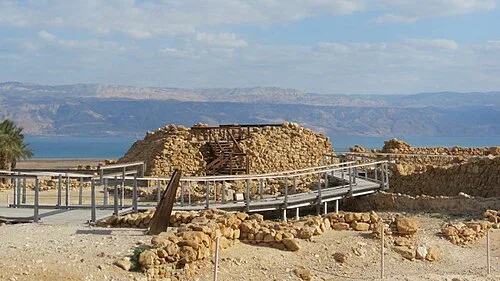 Visitor Center Walkway and Scroll Jar Display
Qumran from the Entrance Walkway
Welcome to Qumran, an archaeological site on a dry marl plateau about a mile from the northwestern shore of the Dead Sea. Jericho lies roughly six miles to the north. The settlement was built during the reign of the Hasmonean ruler John Hyrcanus, between 134 and 104 BCE, or a little later. People lived here for roughly two hundred years, until the First Jewish War against Rome. The ruins hold a squarish main building of two stories, with a courtyard at its center and a tower at the northwestern corner. Stepped pools dot the site, fed by an ingenious water system, and sheer desert cliffs rise nearby. The question that runs through everything here is simple to ask and hard to answer. Who lived in this isolated compound, and why did they choose one of the driest places on earth? Most scholars identify the inhabitants with the Essenes, a Jewish sect of the late Second Temple period. Others have proposed different groups entirely, and that debate is still alive.
Photo: Hoshvilim · CC BY-SA 4.0
02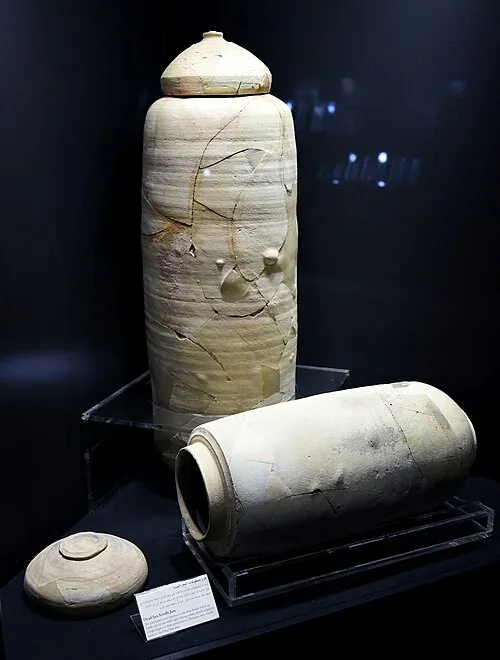 Visitor Center Walkway and Scroll Jar Display
Scroll Jars
Two tall clay jars, now in the Jordan Museum in Amman, show the shape: one stands upright with its lid, the other lies on its side. Vessels like these are the signature containers of the Dead Sea Scrolls. Nearly nine hundred manuscripts came out of eleven caves around Qumran, and jars of this cylindrical shape held many of them. Most of the scrolls were written on parchment, and some on papyrus. The lids fit snugly, and the tall bodies kept rolled copies safe in the dark and the dry. Jars like these are strongly associated with Qumran, but scholars have debated how unique they really are. Comparable forms have been reported at Jericho and Masada, and one was said to have turned up at Qalandiya, near Jerusalem. So the form is rare outside Qumran, though clearly not unique to it.
Osama Shukir Muhammed Amin FRCP(Glasg) · CC BY-SA 4.0
03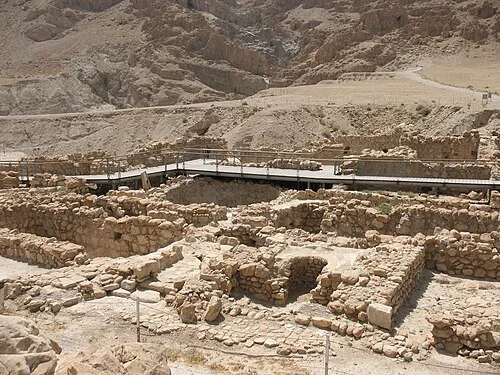 Northwestern Defensive Watchtower
The Excavated Compound and the Watchtower
The strongest remnant of the compound is its tower, at the northwestern corner of the main building. A second building stood to its west. European travelers reached this ruin long before any archaeologist did. In December 1856 the lawyer Albert Isaacs, the British consul James Finn, and the photographer James Graham visited together. Isaacs judged the tower commanding, and well adapted for defensive operations. Finn went further and suggested the whole place was some ancient fort with a cistern. Both readings were reasonable guesses, and later excavation complicated them. The real digging began only after the Second World War. In 1949 Roland de Vaux and Gerald Lankester Harding excavated the first scroll-bearing cave. A surface survey of the ruins in 1951 turned up pottery closely related to what that cave had yielded. That find triggered six seasons of excavation at Qumran, from 1951 to 1956, all under de Vaux's direction. Much of what a visitor sees of the compound today came out of those seasons. Among the prizes was a room on the west side holding three small juglets, filled with more than five hundred silver coins minted in Tyre.
Listen in the appJames Emery from Douglasville, United States · CC BY 2.0
04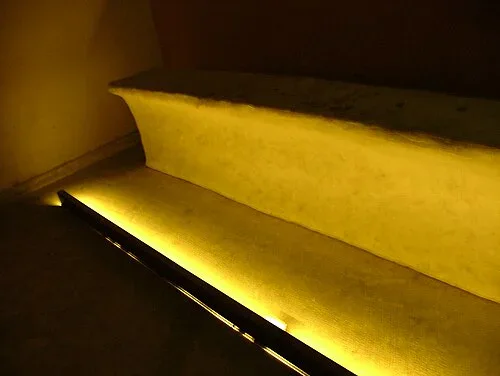 The Scriptorium (Locus 30)
A long narrow room runs against the inner wall of the main building's western wing. In its ruined upper story, Roland de Vaux found plastered elements he read as benches or tables for writing. The largest surface, once reconstructed, measured five meters long, forty centimeters wide, and only half a meter high. Those benches had fallen through the floor when the ceiling above them collapsed. De Vaux called the upper room, Locus 30, the scriptorium, the place where scribes worked, and concluded that some of the Dead Sea Scrolls could have been written there. Not every scholar accepts that reading of the room. Nearly all of them, though, agree that some form of writing took place on this upper floor. The inkwell evidence is hard to argue with. De Vaux found three inkwells at Qumran, and more kept coming to light over the years, until six in all were counted. That is more inkwells than at any other site of the Second Temple period. Writing left other traces too. Ostraca, broken pottery shards inscribed with notes, have been found in and around the site, including one carrying a practice alphabet. A scribe somewhere here once ran through his letters on a shard, the way a child practices a hand.
Listen in the appPhoto: SuperJew · CC BY-SA 3.0
05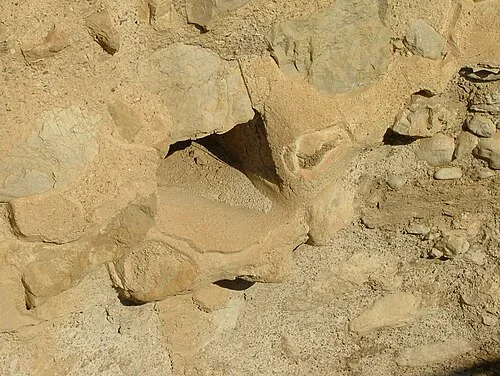 Desert Aqueduct and Water Feeder System
The Aqueduct and Water System
Rain almost never falls at Qumran, so the settlement caught its water where it could. A dam was placed in the upper section of the Wadi Qumran to capture seasonal floodwater. From there, an aqueduct carried the rainwater down to the settlement. The channel snakes its way through the site, feeding a network of stepped cisterns, two of which lay inside the walls of the main building. The stonework of the feeder line still survives, cut through and plastered where it dropped water toward the pools. Nothing here was built in one go. Both the buildings and the water system show constant evolution across the settlement's life. The channel was raised again and again, to carry water to newer cisterns farther away. Rooms were added, floors were lifted, pottery ovens were relocated, and old spaces found new uses. The aqueduct itself carries a date with it. The scholar David Stacey argues it was built around 95 to 90 BCE, which falls in de Vaux's Period Ib. Whenever exactly it was laid, the raised channel opened possibilities the first builders never had. Water could now be carried farther, and stored in much bigger basins, than the site had ever managed before.
Listen in the appPhoto: SuperJew · CC BY-SA 3.0
06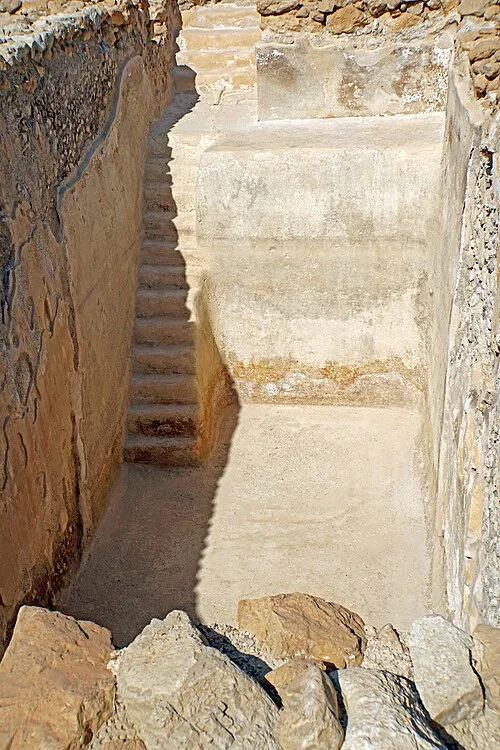 Stepped Ritual Baths and the Earthquake Crack
Stepped Pool (Loci 56/58)
Immediately south of the main building, inside the southern wall, lies a deep stepped pool. It began life as one long pool, dug to take full advantage of the slope, so only minimal excavation was needed for its capacity. Later an internal wall divided it in two. The western half kept the steps, and works like most of the other stepped pools on the site. The eastern side was dug out much deeper and turned into a storage cistern. Roland de Vaux read the site's many stepped, partitioned cisterns as miqva'ot, Jewish ritual baths. His reasoning rested on their similarity to stepped and partitioned baths near the Jerusalem Temple Mount. In the Second Temple period, immersion pools like those served Jewish purity practices. Whether this particular pool hosted ritual immersion, or simply stored water, remains an open question. Either way, the water did not stop here. A channel beside the pool carried it onward to the stepped pools farther south, including the largest one on the site.
Listen in the appDennis G. Jarvis · CC BY-SA 2.0
07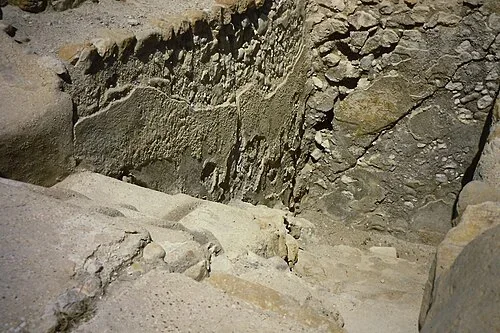 Stepped Ritual Baths and the Earthquake Crack
The Cracked Cistern (Loci 48/49)
The steps and plastered walls of this cistern are split by a visible crack, and it points to a violent moment in Qumran's story. In 31 BCE a massive earthquake struck Judea, in the reign of Herod the Great. At Qumran it cracked the stone water installations and set structural fires burning. In de Vaux's chronology the quake ended his Period Ib, and the site stood empty for a stretch before the Herodian-era Period II began around 4 BCE. The crack running through this pool is read as the physical trace of that tremor. The quake was not the end of the water story. The system kept growing until it reached its last and largest pool, dug into the southeast corner of the settlement. That enormous reservoir could hold three hundred cubic meters of water, more than all the other stepped pools combined. Scholars still debate whether it served as a ritual bath, a cistern, or a vat for clay.
Listen in the appPhoto: Ktiv · CC BY-SA 4.0
08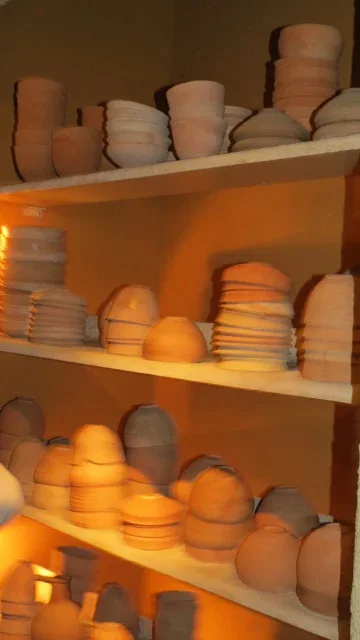 Communal Refectory and Pottery Pantry
The Pantry Assemblage (Loci 86/89)
At the southern end of the complex, de Vaux found a remarkable domestic assemblage at Qumran. In the pantry room lay seven hundred and eight bowls alone, mostly stacked neatly one inside another. With them came plates, goblets, terrines, jars and jugs, more than a thousand ceramic pieces in all. De Vaux believed this crockery served meals in the long room next door, which he called the refectory. That room runs narrow and long against the main southern wall, and pillars once stood at its far end. If he was right, the community here ate together, from a shared store of dishes, in one long hall. The southern end of the pantry had been walled off at some point. That wall later collapsed over the pottery, crushing it, possibly in the same earthquake whose crack splits the cisterns. One piece carries a person's name. A bowl from the find was inscribed Eleazar, a name that also appears on ostraca from the site. Not everyone accepts the dining-hall reading. Some argue the room's size and layout suit a drying floor for clay production, noting that it lines up with the summer solstice.
Listen in the appPhoto: Hoshvilim · CC BY-SA 4.0
09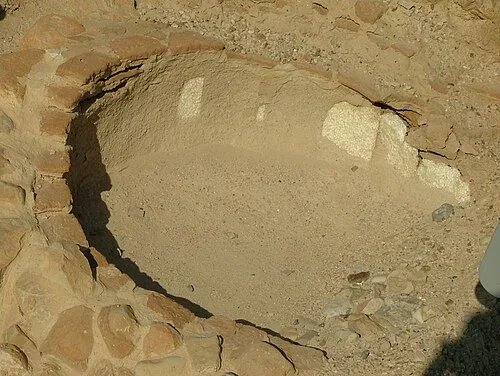 Pottery Kilns and Workshop Zone
The Pottery Kiln
West of the tower area lies a round installation that may have been the bottom of a kiln, or possibly some other structure heated from beneath. The identification stays cautious, because the evidence is a shape in the ground. Pottery ovens appear again and again among the site's repeated reworkings, moved around as the compound evolved. Some pottery was made here, on site, but studies suggest that as much as two-thirds of the pottery found at Qumran was not made from local clay. This is where Qumran's identity debate sharpens. The scholars Robert and Pauline Donceel argued that the range of pottery, the sophisticated glass, and the high quantity of coins do not sit well with an isolated sectarian settlement. Those materials, they said, point to trade connections in the region. Others have gone further and proposed that Qumran was a production center, making goods for a wider market. A single kiln thus feeds two opposite stories at once. One says a self-sufficient community fired its own dishes. The other says a working site produced and traded, like any other in the Jordan valley.
Listen in the appPhoto: SuperJew · CC BY-SA 3.0
10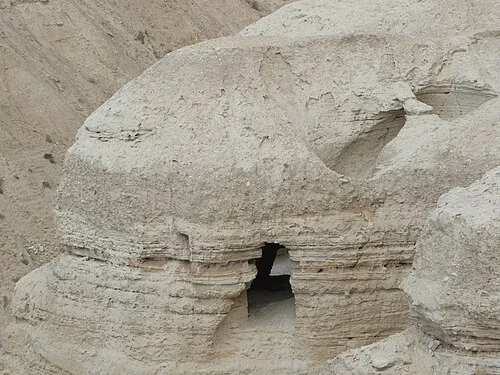 Wadi Qumran Overlook Facing Cave 4
Cave 4 Overlook
Across the gorge from the settlement's southern side, a dark opening gapes in the cliff face. This is Cave 4, and it is not a natural cave. Human hands cut it into the marl, and behind it the upper course of the Wadi Qumran winds down toward the wadi floor. The story of the scrolls began nearby, in 1947. Bedouin of the Ta'amireh tribe stumbled on the first Dead Sea Scrolls in clay jars, hidden in a cliffside cave. Cave 4 itself was found and opened in the twentieth century by a local Bedouin who had been searching for scrolls. Several hundred scrolls came out of this one cave, recovered by Bedouin and archaeologists together, in thousands of fragments. Scholars then faced the task of piecing those fragments back into whole texts. What emerged changed biblical scholarship forever. The caves held the oldest surviving Hebrew copies of the scriptures, centuries older than any known before. This cave held the largest share of them, cut by hands that wanted a hiding place no one would find.
Listen in the appPhoto: Immanuel Giel · CC BY-SA 4.0
- 11
The Cemetery and the End of the Settlement
The Roman destruction of 68 CE, the thousand graves of the desert cemetery, and the questions Qumran never answered.
Qumran
Frequently asked questions
How much does the guide cost?
Free app download. Listed guide price: $1.99. Guide price shown in the app. Audio guide only. Venue admission is separate.
Can I listen without internet?
Yes. Download the guide’s audio, images, and maps in the app before your visit. Your downloaded content is then available offline.
Can I listen in my language?
This audio guide is available in 15 languages, including English.
Do I need to follow a schedule?
No. This is a self-guided experience. Choose your stops, pause whenever you like, and return to a story at your own pace.
At your own pace
Explore Qumran.
Download Stanza, then search for “Qumran”.
Free app download · Guide price shown in the app
Keep exploring
Nearby audio guides
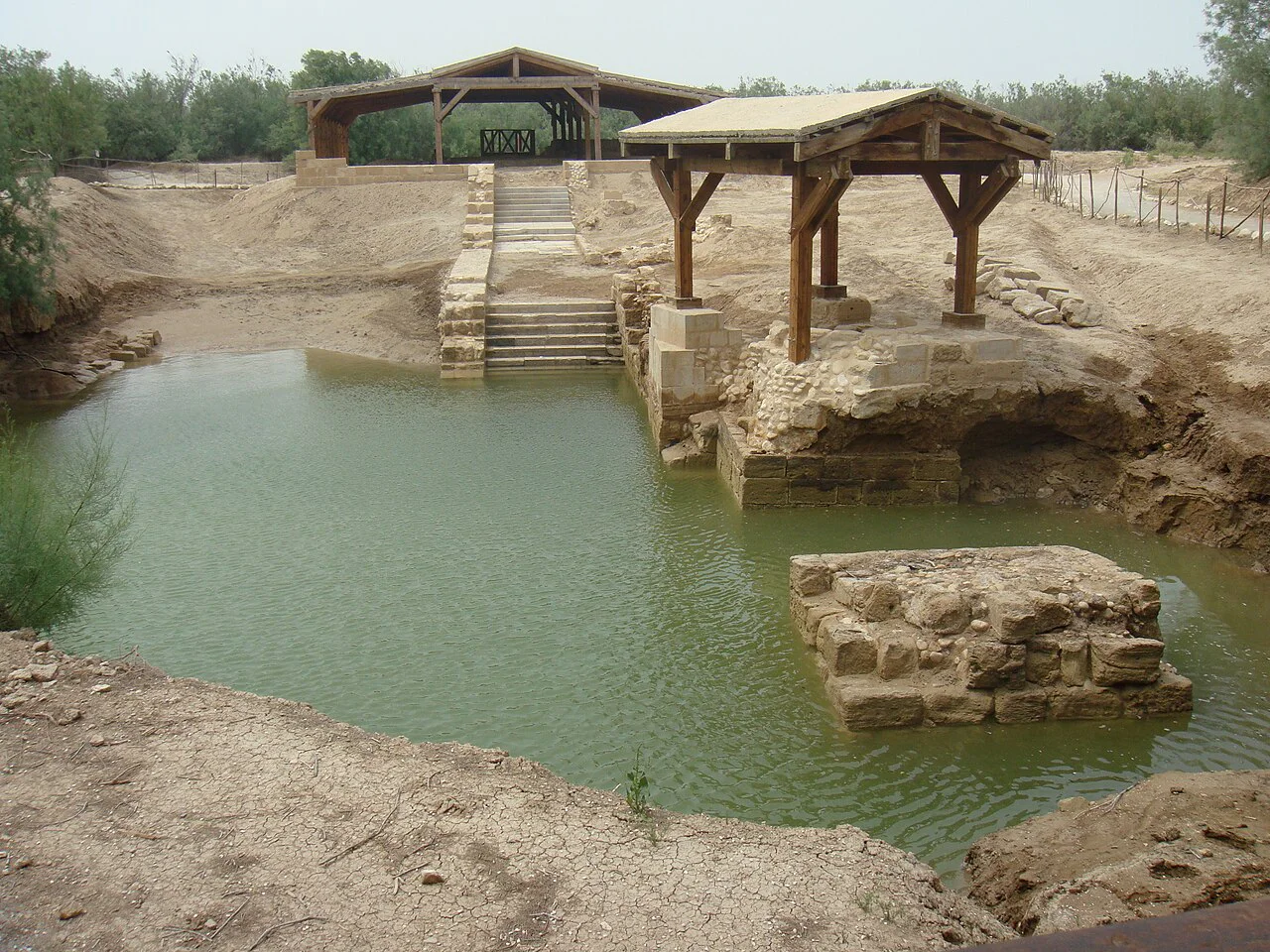
Shoonah Janoobiyah Sub-District · 14 km
Al-Maghtas
Content & sources
Producer (talk) · CC BY 2.5
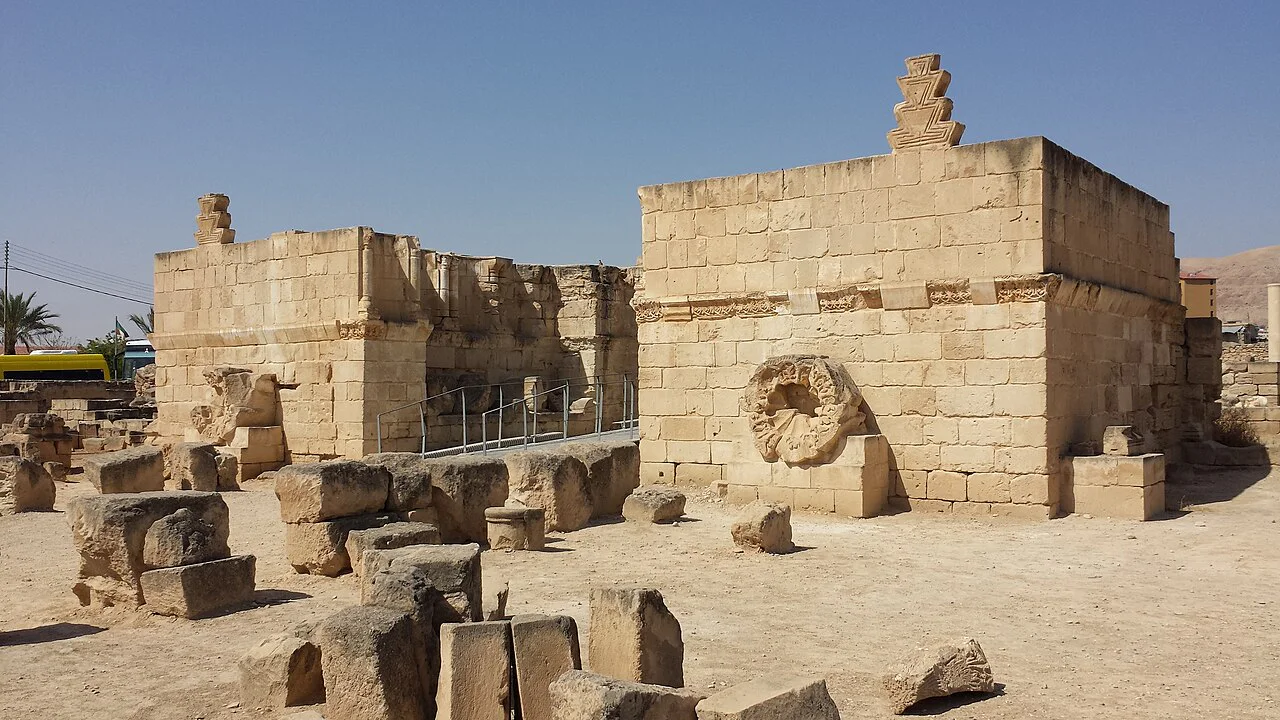
Jericho · 16 km
Hisham's Palace
Content & sources
Photo: Randa Fawzi · CC BY-SA 4.0
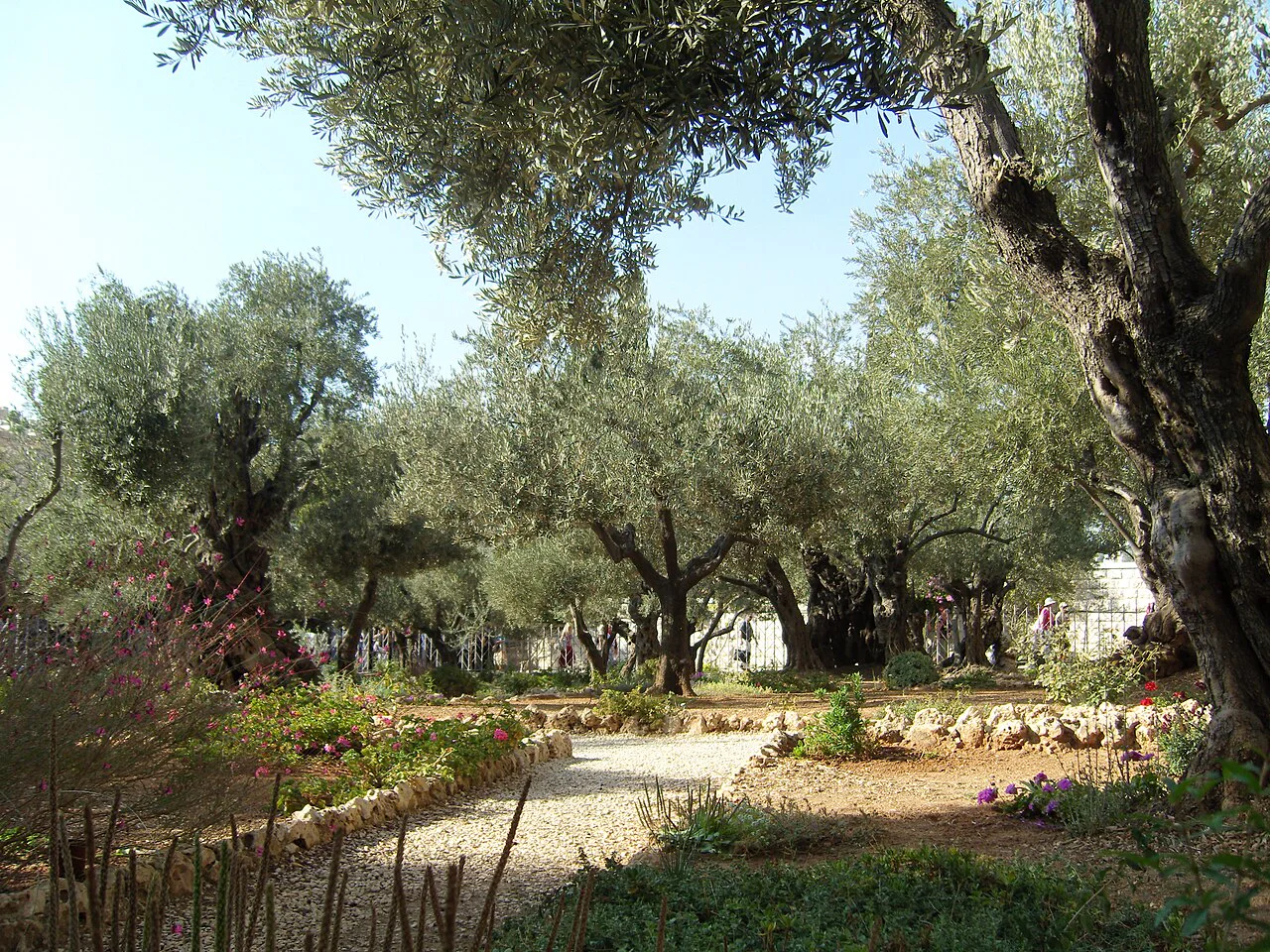
Jerusalem · 21 km
Gethsemane
Content & sources
Photo: Mewasul · CC BY-SA 3.0
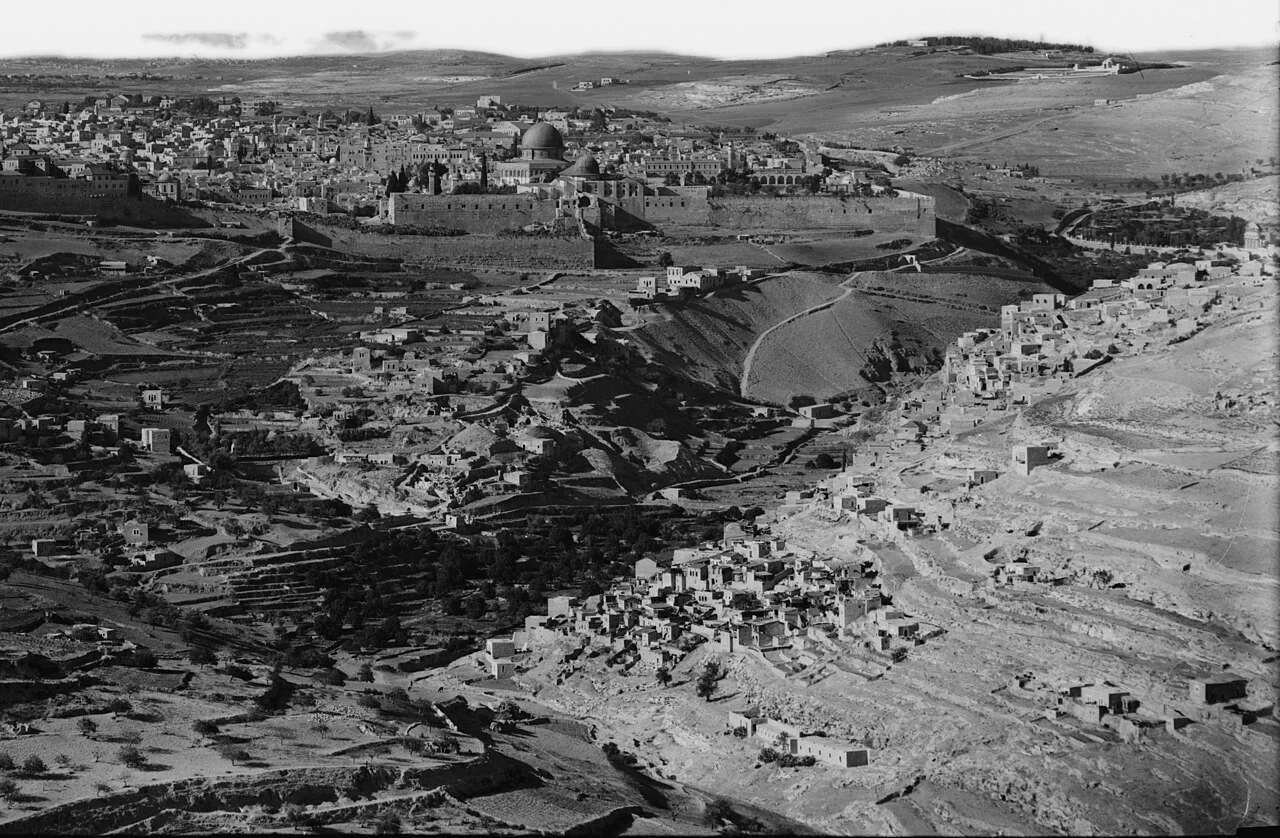
Jerusalem · 22 km
City of David
Content & sources
Matson Collection · Public domain