Languages
15Castelo de São Jorge Audio Guide
Castelo de São Jorge is a landmark in Lisbon, Portugal. Explore it with Stanza's GPS-triggered offline audio guide — available in 15 languages.
Quick Facts
25
Stops
15
Languages
100%
Offline
📍 Lisbon, Portugal · 38.7139°N, -9.1333°E
About Castelo de São Jorge
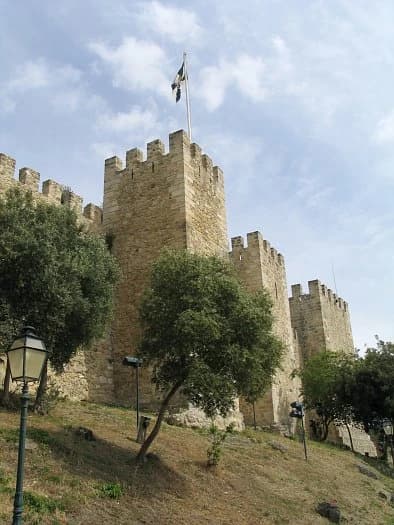
A historic Moorish castle located on the highest hill in the city of Lisbon. It serves as a major cultural heritage site offering panoramic views of the capital.
Castelo de São Jorge is also known as Castle of São Jorge, St. George's Castle, Castelo de Sao Jorge, Castelo de São Jorge.
This self-guided audio tour features 25 narrated stops organized across 6 sections, including Ruins of the Royal Palace (Alcáçova), The Moorish Quarter Excavations, The Castle Museum (Núcleo Museológico), The Barbican and Dry Moat, The Inner Castle (Castelejo), The Tower of Ulysses & Camera Obscura. As a castle, Castelo de São Jorge offers a unique cultural experience in the heart of Lisbon, Portugal.
The Stanza audio guide is available in 15 languages and works entirely offline — download the complete tour including audio narration, maps, and images before your visit. As you walk through Castelo de São Jorge, GPS-triggered narration plays automatically at each point of interest.
Last updated:
What you will hear
Ruins of the Royal Palace (Alcáçova)
Explore the stone arches and ruins of the former royal residence where Portuguese kings hosted explorers like Vasco da Gama.

The Royal Palace Arches
Scattered through the grounds are the weathered arches and walls of the Royal Palace of the Alcáçova. From the 13th until the early 16th century, this palace served as the primary residence for the kings of Portugal. It was the center of political life, where laws were debated and major decisions regarding the empire were made. One of the most significant events in world history took place right here in 1499, when King Manuel I received the explorer Vasco da Gama. Da Gama had just returned from his historic voyage around the tip of Africa to India, a journey that opened a direct sea route between Europe and Asia and forever changed global trade. Imagine the excitement within these palace walls as the King listened to reports of spices, riches, and distant lands. The palace was not just a fortress, but a place of luxury and ceremony, reflecting the growing wealth of the Portuguese Crown. Although only fragments of the structure remain today, these arches offer a window into the era when Lisbon was the nerve center of a vast maritime empire, hosting navigators who mapped the farthest reaches of the globe. The stone remains stand as silent markers of a long-vanished royal court.

The Palace Gardens
In this peaceful area of the castle, nature now grows alongside the fragmented remains of the royal palace. The course of history here was abruptly changed on November 1, 1755, by the Great Lisbon Earthquake. The massive tremors and subsequent fires devastated the royal palace, making it uninhabitable. Rather than rebuilding the palace on the hilltop, the monarchy chose to abandon the site and relocate to the lower city, near the riverbank at what is now Praça do Comércio. This move marked the end of the castle's life as a royal home. During your walk, notice the mixture of stone masonry and exposed brickwork in the arches. These elements were carefully consolidated during the major restoration campaign of the 1940s to prevent further decay. The project aimed to preserve the evocative nature of the ruins while creating a garden atmosphere for the public. Today, the space serves as a quiet reminder of the city's resilience. The stone pines provide shade over the ancient structures, creating a contrast between the living landscape and the static, historic stone that once sheltered the most powerful figures in Portuguese history. The sound of birds and the rustle of leaves replace the former bustle of the royal court.
The Moorish Quarter Excavations
Descend into the archaeological site to see the foundations of 11th-century houses, revealing the castle's origins as an Islamic citadel.

The Archaeological Site
As you look down into the excavation pits, you are essentially looking through a vertical timeline of Lisbon’s history. The low stone walls and foundations visible here represent different eras of occupation piled one on top of the other. Archaeologists have discovered remnants from the Iron Age, showing that people were living on this hilltop as early as the 7th century BC. As you trace the walls, you are seeing the transitions between civilizations. Some layers reveal the elite Moorish residences of the 11th and 12th centuries, while deeper excavations have found traces of Roman and even earlier indigenous settlements. This continuous record of occupation proves that the site's strategic value—offering clear views of the river and the surrounding land—has been recognized for over two millennia. The excavations here provide critical evidence for understanding how Lisbon grew from a small tribal settlement into a major Roman center and eventually a grand Islamic citadel. By preserving these ruins in place, the site allows us to see the actual foundations of the city’s past. Each row of stones tells a story of survival, conquest, and the enduring importance of this specific piece of ground in the history of the Iberian Peninsula. The site is a living laboratory for uncovering the city's earliest beginnings.

Moorish Quarter Excavations
This archaeological area offers a rare glimpse into the daily life of Lisbon's Islamic past. Beneath the protective white roof, you can see the excavated foundations of a neighborhood that dates back to the 11th century. Before the Christian conquest, this hilltop was a dense, thriving citadel known as the Alcáçova. Unlike the grand palace ruins elsewhere on the site, these foundations belonged to residential houses. Archaeologists have identified the layouts of these homes, which were typically built around small central courtyards to provide light and ventilation while maintaining privacy. The neighborhood was crisscrossed by narrow, winding streets, a common feature of medieval Islamic urban design. This area was the elite center of the city, housing the governing officials and wealthy citizens who lived within the security of the inner fortifications. Seeing these low stone walls helps us visualize the bustling community that existed here for hundreds of years. It reveals a sophisticated society that valued architecture and urban organization long before the castle became a Christian stronghold. These excavations prove that the castle wasn't just a military fort; it was a living part of a complex urban fabric. The preservation of these domestic remains highlights the city's diverse cultural foundations.
The Castle Museum (Núcleo Museológico)
This museum houses a collection of artifacts found on-site, including Arabic inscriptions and traditional Portuguese tiles that trace 2,000 years of occupation.
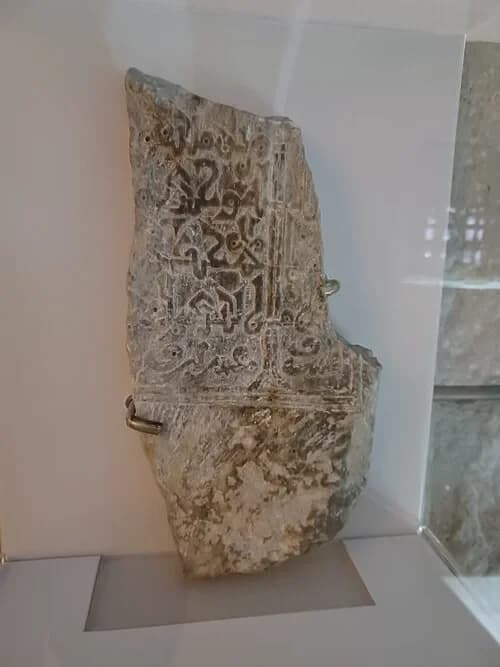
Arabic Funerary Inscription
Take a moment to examine the delicate calligraphy carved into this stone fragment. This is an Arabic funerary inscription dating back to the period when Lisbon was a major center of the Islamic world. For four centuries, the city was part of a sprawling cultural network that valued poetry, science, and beautiful craftsmanship. The flowing script you see here is more than just information; it is a piece of art that reflects the high level of intellectual and aesthetic sophistication present in the Moorish community. During this time, the castle was not only a military stronghold but also a place of high culture where scholars and artisans lived. The script typically includes religious verses or information about the deceased, carved with a precision that has survived the passage of time. This fragment is one of the few surviving direct links to the individuals who inhabited the hilltop before the Christian conquest. It serves as a visual reminder of the diverse cultural heritage that forms the foundation of modern Lisbon. The elegance of the lettering stands in contrast to the heavy, utilitarian stone of the defensive walls outside, highlighting the multi-faceted nature of life within the ancient citadel. The fragment is displayed to reveal the depth and skill of the original carving.

Renaissance Ceramic Tiles
These fragments of decorative floor tiles, known as azulejos, offer a glimpse into the colorful interior of the Royal Palace during the 15th and 16th centuries. Notice the intricate geometric patterns in shades of green and blue. These designs are a direct legacy of the Islamic artistic traditions that remained popular in Portugal long after the Christian conquest. Even as the country entered the Renaissance, Portuguese craftsmen continued to adapt Moorish techniques, creating the unique tile style that is now synonymous with the nation's identity. During the reigns of kings like Manuel I, these tiles covered floors and walls, adding a sense of luxury and cool temperature to the palace rooms. They were status symbols, expensive to produce and highly prized. These specific fragments were recovered during excavations on the castle grounds, proving that the royal residents lived in a world of vibrant color and complex patterns. The tiles represent a fascinating cultural fusion, where the geometry of the Islamic past met the expanding horizons of the Portuguese Age of Discovery. They remind us that even in a fortress built for war, there was a constant desire for beauty and artistic expression, fueled by a heritage that spanned multiple continents. The glazed surfaces still catch the light even after centuries underground.
The Barbican and Dry Moat
Walk along the lower outer wall, or barbican, designed to keep siege engines away from the main fortifications. The dry moat below showcases the castle's defensive engineering.

The Defensive Stone Bridge
The stone bridge you see crossing the dry moat was a masterpiece of strategic design. In a time of war, this bridge was the only way to enter or exit the central fortress, making it a critical bottleneck. Its narrow width was intentional; it prevented large groups of attackers from rushing the gate all at once, allowing the defenders to pick off enemies one by one. Notice the masonry of the bridge itself. While the main castle walls are made of rough, irregular stones, the bridge and its supporting arch feature smoother, more precisely cut blocks. This suggests a higher level of engineering for this vital link. If the castle were under heavy assault, the bridge could be barricaded or even partially destroyed to completely isolate the inner courtyard. Standing on it now, you can appreciate the height of the walls that loom over the moat on either side. Every inch of this space was designed to be defensible, turning a simple path into a deadly trap for anyone who didn't belong. This bridge was the thin line between the vulnerability of the outer city and the absolute security of the inner stronghold, reflecting the constant state of military readiness required of the castle's medieval inhabitants. Today, it provides a safe and picturesque route for visitors into the heart of the fortress.
The Inner Castle (Castelejo)
Enter the final defensive stronghold. This area prominently displays the 1940s restoration works that gave the castle its clean, 'medieval' silhouette.

The Inner Ramparts
Climbing to the top of the inner ramparts reveals exactly why this hilltop was fortified for so many centuries. From this vantage point, you have an unobstructed view of the Tagus River and the entire city spread out below. In an era before modern technology, being on the highest point provided a massive strategic advantage, allowing the garrison to see enemy ships or armies approaching from miles away. While these walls look perfectly medieval, they were significantly rebuilt during the 1940s restoration project. To ensure the safety of visitors today, engineers used a combination of traditional stone masonry and modern reinforced concrete hidden within the structure. This careful reconstruction allows us to experience the same panoramic perspective that soldiers had 800 years ago. You can see how the walls follow the natural contours of the hill, maximizing the height of the terrain to create an imposing barrier. The view also highlights the connection between the castle and the river, which was the lifeline of Lisbon's economy and defense. These ramparts were the eyes of the city, standing as its highest and most secure lookout point. Looking out today, you can trace the city’s growth from the ancient core at your feet to the sprawling modern districts on the horizon. The wind from the Atlantic often sweeps across these high stone paths.
The Tower of Ulysses & Camera Obscura
Formerly the site of the national archives, this tower now houses a camera obscura that provides a real-time, 360-degree view of Lisbon.

Tower of Ulysses
Known historically as the Torre do Tombo, this massive stone structure served a purpose far more critical than simple defense. Starting in 1378, the tower became the official repository for the national archives of the Kingdom of Portugal. For over 400 years, the most significant legal, royal, and diplomatic documents were kept within these thick walls. This high, isolated position was a strategic choice, designed to protect the kingdom’s collective memory from the constant threats of urban fire and theft that plagued the lower city. Even today, the phrase 'Torre do Tombo' is synonymous with the National Archives in Portugal, despite the institution having moved locations long ago. While it once held parchment and ink, the tower's interior has since been repurposed for modern visitors. The architecture itself reflects its secondary life as a high-security vault, featuring substantial masonry intended to withstand the test of time and disaster. It remained the center of administrative history until the devastating earthquake of 1755 necessitated a relocation of the state's most precious scrolls and records to a safer location outside the castle walls.

The Camera Obscura
Inside the dark upper chamber of the Tower of Ulysses, the castle offers a unique perspective on the city through a camera obscura. This optical device functions using principles described by Leonardo da Vinci, utilizing a sophisticated system of lenses and a periscope-style mirror mounted at the very top of the tower. As light enters the darkened room, it projects a real-time, 360-degree panoramic image of Lisbon onto a large, concave white dish located in the center of the floor. Because it is a live projection, you can watch the movement of cars on the 25 de Abril Bridge, the ships crossing the Tagus, and pedestrians in the squares below—all without the use of digital screens or cameras. The clarity of the image depends entirely on the natural light available outside, making every viewing a slightly different experience. This blend of Renaissance science and medieval architecture provides an immersive way to survey the modern urban landscape. It transforms the historical defense tower into a giant eye, capturing the pulse of the city in a continuous, silent movie that covers several miles of visibility in every direction.
Want to hear the rest?
Download the Stanza app to unlock all 25 stops and full GPS-guided navigation.
Frequently Asked Questions
How long does the Castelo de São Jorge audio tour take?
The Castelo de São Jorge audio guide includes 25 narrated stops. Most visitors spend 45 minutes to 1.5 hours exploring the complete tour, though you can listen at your own pace and skip or revisit any stop.
Is the Castelo de São Jorge audio guide available in my language?
Stanza supports 15 languages: English, Spanish, French, German, Italian, Portuguese, Russian, Japanese, Chinese, Korean, Arabic, Hindi, Polish, Dutch, Hebrew. Check the guide in the app to confirm the languages currently available for this tour.
Can I use the audio guide offline at Castelo de São Jorge?
Yes! Download the complete Castelo de São Jorge tour — including all audio, maps, and images — before your visit. The Stanza app works completely offline, so you don't need WiFi or mobile data at the venue.
How much does the Castelo de São Jorge audio guide cost?
The Stanza app is free to download. Free and paid audio guides are available; current prices are shown in the app.
How do I use the Stanza audio guide at Castelo de São Jorge?
Download the free Stanza app, search for "Castelo de São Jorge", and download the tour. When you arrive at the venue, the app uses GPS to detect your location and automatically plays the relevant narration as you move between points of interest — completely hands-free.
What makes the Stanza audio guide different from other Castelo de São Jorge tours?
Stanza offers GPS-triggered narration that plays automatically as you walk through Castelo de São Jorge — no need to manually select stops. The tour is available in 15 languages, works fully offline, and includes 25 expertly narrated stops with images and historical context.
What other audio guides are available near Castelo de São Jorge?
Stanza offers multiple audio guides in Lisbon, Portugal and nearby areas. After downloading the app, browse the map to discover all available tours near Castelo de São Jorge. Each guide can be downloaded for offline use.