Stanza · Audio guide
Igreja de Santa EngráciaAudio guide
A place to remember. A story to take with you.
The Church of Santa Engrácia is a magnificent 17th-century Baroque building that serves as the National Pantheon of Portugal. It is renowned for its iconic large white dome and for housing the tombs of…
Download Stanza, then search for “Igreja de Santa Engrácia”.
About the tour
One guide. Your kind of visit.
The Church of Santa Engrácia is a magnificent 17th-century Baroque building that serves as the National Pantheon of Portugal. It is renowned for its iconic large white dome and for housing the tombs of several prominent Portuguese historical figures.
Ready when you are.
- 01Get the free Stanza app.
iOS & Android
- 02Find your guide.
“Igreja de Santa Engrácia”
- 03Download before you go.
Works offline
Audio guide / 18 narrated stops
Inside the guide
Get to know a few of the stories before you go. Open a stop to read more.
01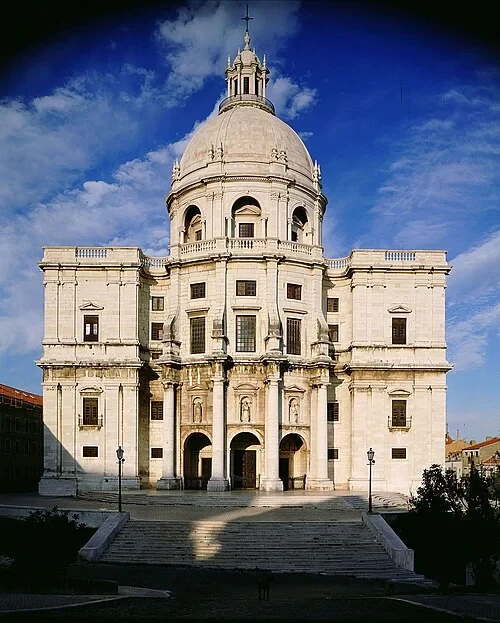 The Grand Facade and the Endless ConstructionThe Facade of Endless Time
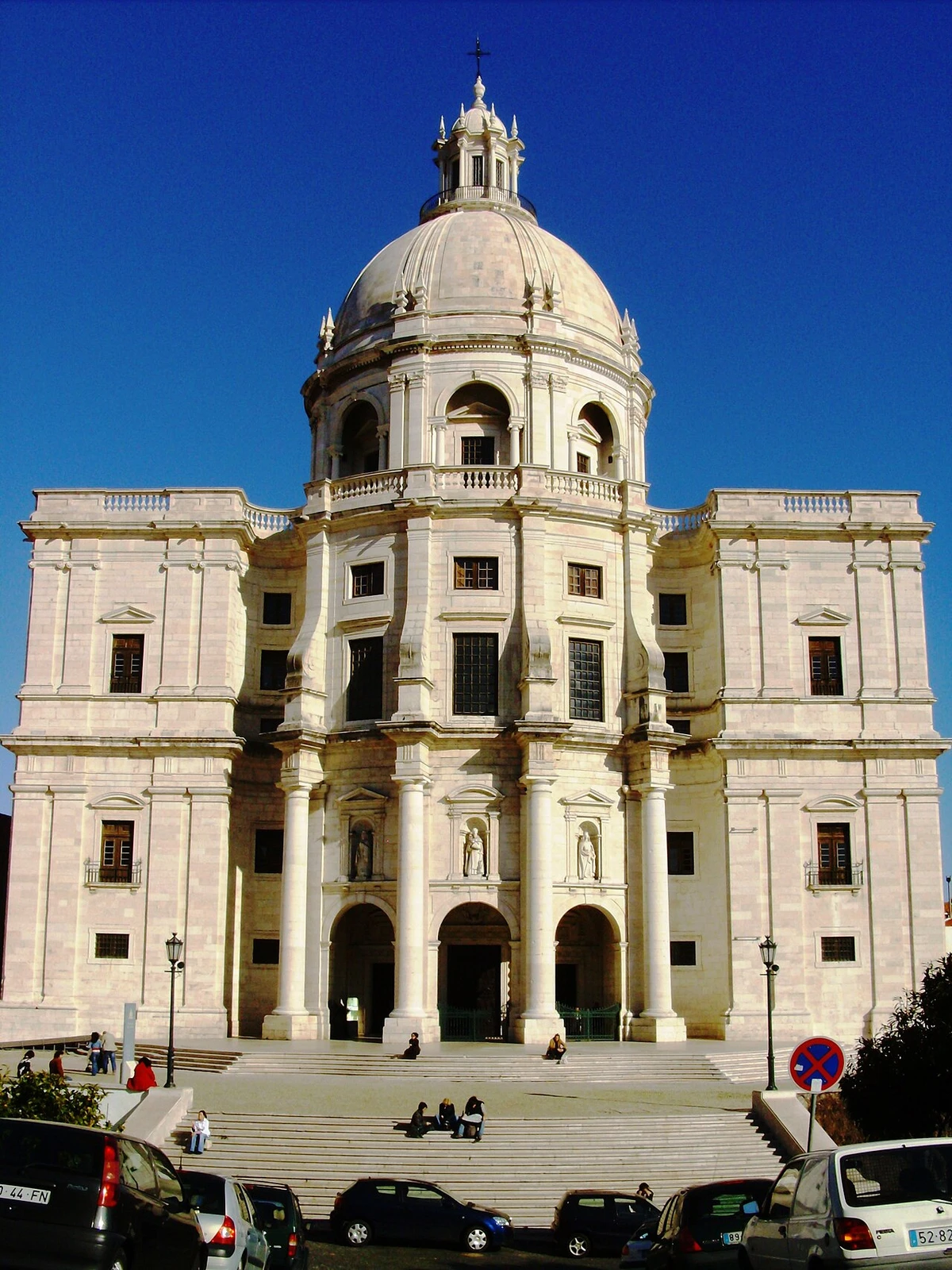
Spanning from 1682 to 1966, the construction of this monument lasted an incredible 284 years. Originally designed by architect João Antunes, it stands as Portugal's first major Baroque monument. The exterior features undulating curves of white limestone, a signature of the late Baroque style that creates a dynamic sense of movement even in solid stone. Look at the building's footprint to see a unique Greek Cross plan, characterized by four arms of equal length. For generations, the skyline of Lisbon was marked by this massive unfinished silhouette, which lacked its roof and dome until the mid-20th century. The building reflects a transition of historical eras, yet it maintains the core vision established by Antunes in the 17th century. This architectural persistence eventually led to its designation as the National Pantheon, a place where Portugal honors its most illustrious figures. The pale limestone glows brightly in the Lisbon sun, emphasizing the dramatic shadows of its curved walls and tall, arched windows. A wide set of stone stairs leads up to the main entrance, establishing a sense of grandeur.
Photo: Fulviusbsas · CC BY-SA 3.0
02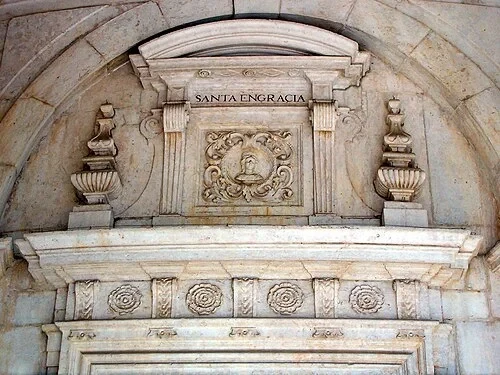 The Grand Facade and the Endless ConstructionThe Legend of the Curse
Above the entrance portal, the name 'SANTA ENGRACIA' is carved into the stone beneath a classical pediment. Behind this name lies a dark legend involving Simão Pires Solis, a man wrongly executed in 1630. Tradition holds that before his death, he cursed the construction of the church to never be finished. This legend was so persistent that for centuries, the site became a punchline. The endless delays gave rise to the popular Portuguese idiom, 'obras de Santa Engrácia,' which locals still use today to describe any project or task that seems to take an eternity to complete. While the curse didn't technically last forever, the building did remain a roofless ruin for nearly three hundred years. The entrance features intricate reliefs, including a central bust and decorative urns on either side. These elements reflect the refined craftsmanship expected of a major religious site. The lettering of the inscription is deep and precise, standing out against the weather-beaten stone of the lower facade.
Photo: Koshelyev · CC BY-SA 3.0
03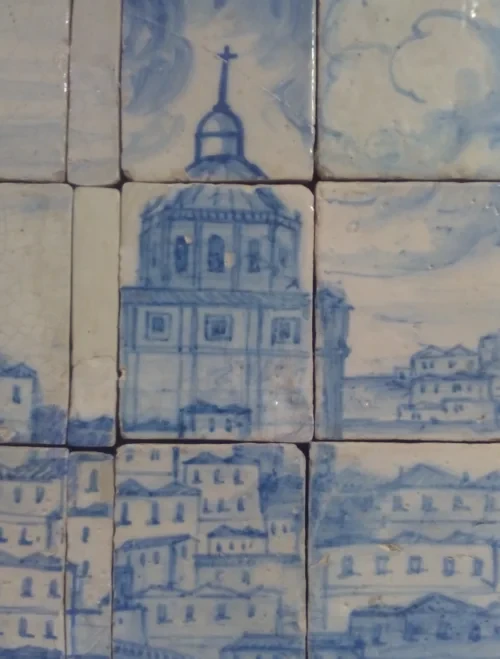 The Grand Facade and the Endless ConstructionThe Church of Tiles
In the famous 'Great Panorama of Lisbon' azulejo tile panel, we see a detailed snapshot of the city from the early 18th century. Interestingly, Santa Engrácia appears as a landmark defined by what it lacked. For most of its existence, the building was a roofless shell, standing tall but incomplete against the river. Because it was essentially an abandoned construction site, it served various unusual roles over the years. At different points in its history, the hollow interior was used as an army warehouse and even transformed into a shoe factory. These humble uses stood in stark contrast to the grand architectural ambitions of João Antunes. The tilework captures the church's silhouette as a permanent fixture of the urban landscape, even in its neglected state. It illustrates how the local population grew accustomed to the 'unfinished' church as a normal part of the city's scenery. This artistic record preserves a version of the building that current visitors can no longer see. The blue ink captures the dome's structure before the modern finish was added.
Listen in the appPhoto: RickMorais · CC BY-SA 4.0
04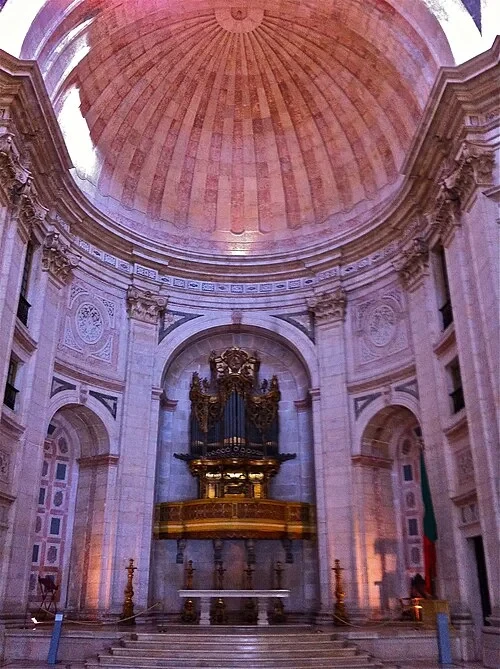 The Central Nave and Polychrome MarbleThe Central Nave
The interior of the Pantheon opens into a vast, centralized space designed to accommodate grand state ceremonies and official funerals. Its Greek Cross layout means there is no traditional long aisle; instead, focus is drawn immediately to the center of the structure. High windows are positioned to filter sunlight downward, which bounces off the polished pale stone to create a soft, ethereal glow throughout the chamber. This lighting highlights the architectural details and emphasizes the height of the vaulting. Toward the back, the high altar area is framed by massive columns, creating a focal point for the entire interior. This is also where you can see the historical organ, integrated into the overall design above the altar. The lack of excessive ornamentation allows the geometric purity of the space to stand out. The acoustics are equally monumental, with sounds echoing long after they are made. Looking up, the transition from the square base to the circular dome area demonstrates the engineering required to support such a massive open volume.
Listen in the appRavi Sarma · CC BY 2.0
05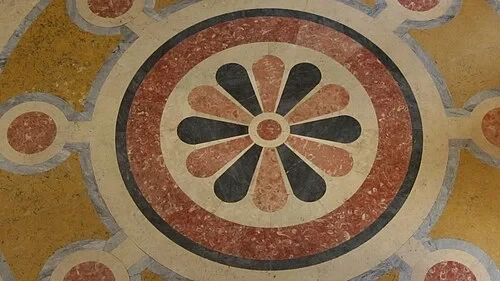 The Central Nave and Polychrome MarblePolychrome Marble Floor
The floor features one of the most exquisite examples of polychrome marble in the country. This technique involves carefully inlaying different colored stones to create complex patterns. You can see shades of pink, yellow, red, and grey stone arranged in geometric and floral designs that repeat across the vast nave. During the Portuguese Baroque era, such floors were a significant display of wealth and craftsmanship, intended to impress anyone who entered. The stones were sourced from various regions across Portugal, highlighting the richness of local resources. These patterns aren't just decorative; they help to define the symmetry of the Greek Cross floor plan, leading the eye toward the center of the building. The smooth, polished surface reflects the light coming from the dome, adding to the sense of brightness within the space. Each section of the floor is a puzzle of perfectly fitted pieces, showing the meticulous skill of the masons who laid them. A central floral medallion serves as the anchor for the entire geometric scheme.
Listen in the appLucas £ € $ ¥ · CC BY 2.0
06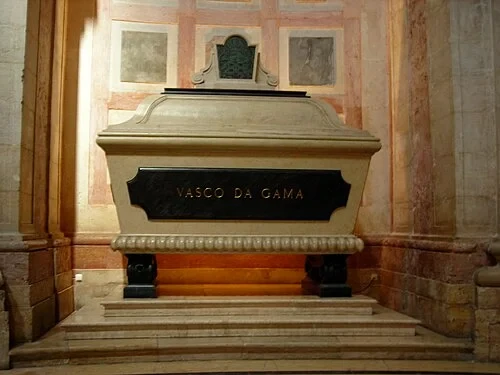 Cenotaphs of the Great ExplorersCenotaph of Vasco da Gama
While this structure looks like a traditional tomb, it is actually a cenotaph, an 'empty tomb.' Vasco da Gama, the legendary explorer who successfully navigated the sea route to India, is not actually buried here. His physical remains rest in the Jerónimos Monastery in Belém, closer to the waters he once sailed. This memorial was placed in the National Pantheon to ensure that one of Portugal's most significant historical figures is represented among the nation's elite. The carvings on the light-colored stone are rich with maritime symbolism, referencing the voyages that changed the map of the world. Notice the dark plaque on the front which clearly marks his name in gold lettering. The design is heavy and solemn, supported by dark, ornate feet that elevate the sarcophagus. By placing this cenotaph here, the state recognizes his status as a permanent part of the national identity. The memorial is positioned in a niche decorated with colorful marble panels, maintaining the dignified atmosphere of the surrounding space.
Listen in the appTherese C · CC BY 2.0
07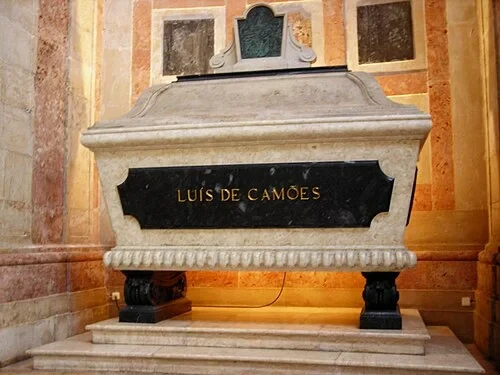 Cenotaphs of the Great ExplorersMemorial to Luís de Camões
Luís de Camões is celebrated as Portugal’s greatest literary figure, most famous for his epic poem 'The Lusiads.' It is fitting that his memorial sits in the same hall as the great explorers, as his words captured the spirit and daring of the Age of Discovery more than any other writer. Like the nearby cenotaph of Vasco da Gama, this is also a commemorative monument; Camões’ true resting place is the Jerónimos Monastery. This memorial serves as a national focus for his literary legacy, cementing his role as a pillar of Portuguese identity. His writing transformed historical events into a timeless narrative that helped shape how the Portuguese see themselves. The architecture of the monument reflects this high status, with refined stone carvings and a dark marble plaque bearing his name in gold. His presence here highlights the fact that national greatness is measured by both deeds of action and works of the mind. The monument stands on a tiered stone base within an arched alcove.
Listen in the appTherese C · CC BY 2.0
08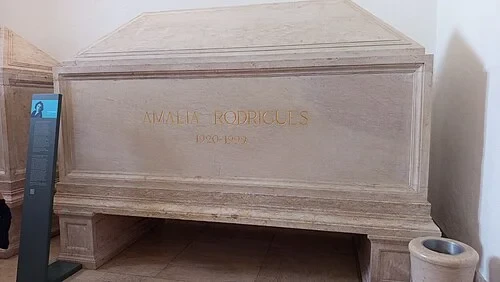 The Tomb of Amália Rodrigues: Queen of FadoTomb of Amália Rodrigues
Amália Rodrigues was more than a singer; she was a cultural phenomenon known globally as the 'Queen of Fado.' When she passed away in 1999, the entire nation went into a period of deep mourning. Her interment here in 2001 was a historic event that required a change in Portuguese law, which previously prohibited burials in the National Pantheon so soon after death. This exception highlights her unique status as the voice of Portugal. Through her soulful music, she turned Fado into an international symbol of the Portuguese spirit. Her tomb is simpler and more modern in design than the older cenotaphs, featuring clean lines and gold-filled lettering on smooth, light-colored stone. It is often a point of pilgrimage for fans who leave flowers and tributes to honor her memory. Her inclusion here opened the doors for other contemporary cultural icons to be recognized alongside historical figures. The tomb stands as a permanent anchor for the musical heritage she left behind, inscribed with her name and years of life.
Listen in the appPhoto: DavidFerreira20048 · CC BY-SA 4.0
09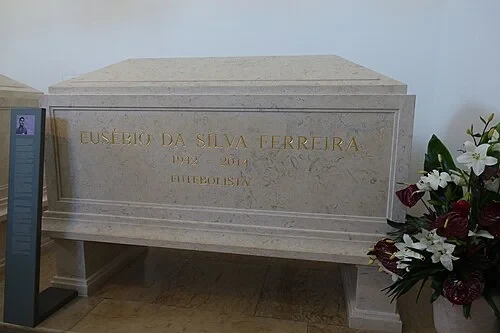 The Tomb of Eusébio: A Sporting LegendTomb of Eusébio
Known affectionately as the 'Black Panther,' Eusébio is arguably the most famous athlete in Portuguese history. His burial here in 2014 marked a significant shift in who the nation considers a national hero, as he was the first sportsman to receive this honor. Eusébio was a cultural icon who transcended the world of sports, representing the deep, emotional connection between Portuguese national identity and football. His success on the world stage during the 1960s brought a sense of pride to the country. The decision to move his remains here followed a massive public campaign and a vote in the national parliament. His tomb is characterized by its clean, contemporary lines and the golden lettering of his full name. Underneath his name, the word 'Futebolista' is inscribed, identifying his profession. It stands as a reminder of how modern icons shape a nation's story just as much as figures from the distant past. Fresh floral arrangements are frequently placed at the base of his monument.
Listen in the appJeremy Thompson from Los Angeles, California · CC BY 2.0
10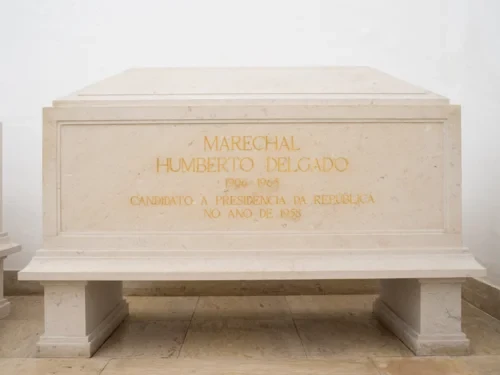 Hall of Presidents and Political FiguresTomb of Humberto Delgado
Humberto Delgado was a high-ranking military officer who famously challenged the dictatorship of António de Oliveira Salazar in the 1958 presidential election. His fearless opposition earned him his nickname and made him a symbol of hope for those resisting the regime. Tragically, he was assassinated by the regime's secret police in 1965 near the Spanish border. Following the restoration of democracy in Portugal after 1974, Delgado was posthumously promoted to Marshal and his remains were eventually moved here to the National Pantheon. His presence in this hall is a powerful recognition of the struggle for freedom and the sacrifices made to achieve it. The monument is dignified and reflects his military rank, with gold lettering that specifies his title as 'Marechal.' It serves as a reminder of a turbulent period in 20th-century Portuguese history and the eventual triumph of democratic ideals. The tomb's inscription also mentions his candidacy for the presidency, ensuring that his political courage is remembered as clearly as his military service.
Listen in the appAntónio Fragoso · CC BY 2.0
Igreja de Santa Engrácia
Frequently asked questions
How much does the guide cost?
Free app download. Listed guide price: $3.99. Guide price shown in the app. Audio guide only. Venue admission is separate.
Can I listen without internet?
Yes. Download the guide’s audio, images, and maps in the app before your visit. Your downloaded content is then available offline.
Can I listen in my language?
Stanza supports 15 languages. Check the app for the languages available for this guide.
Do I need to follow a schedule?
No. This is a self-guided experience. Choose your stops, pause whenever you like, and return to a story at your own pace.
At your own pace
Explore Igreja de Santa Engrácia.
Download Stanza, then search for “Igreja de Santa Engrácia”.
Free app download · Guide price shown in the app
Keep exploring
Nearby audio guides
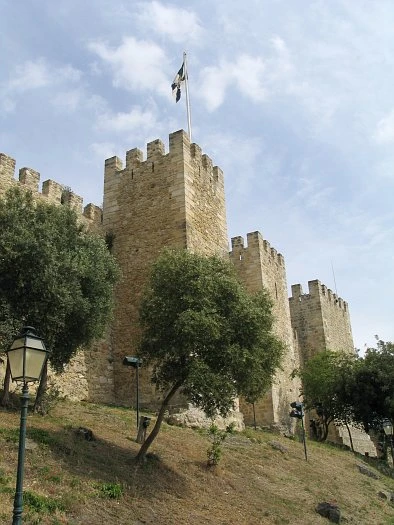
Lisbon
Castelo de São Jorge
Content & sources
Photo: Rotatebot · CC BY-SA 2.0
Lisbon
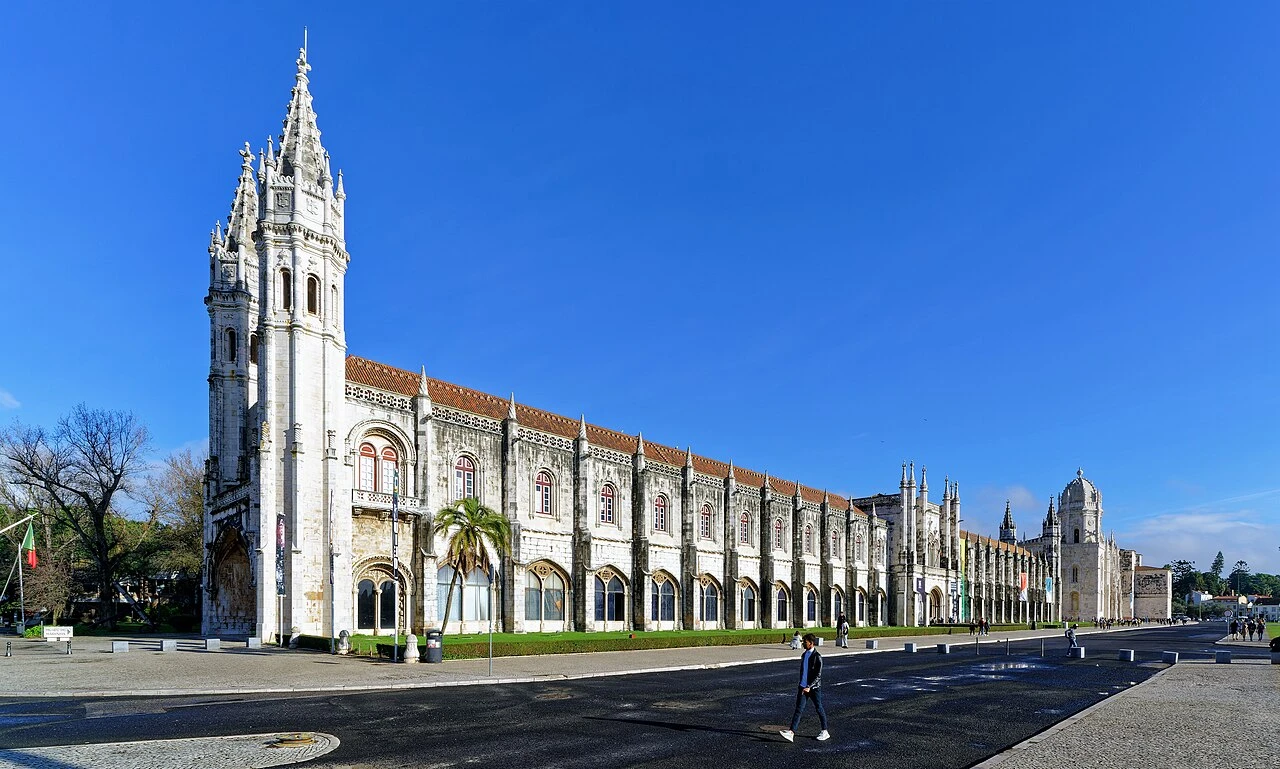
Mosteiro dos Jerónimos
Content & sources
Photo: Holger Uwe Schmitt · CC BY-SA 4.0
Lisbon
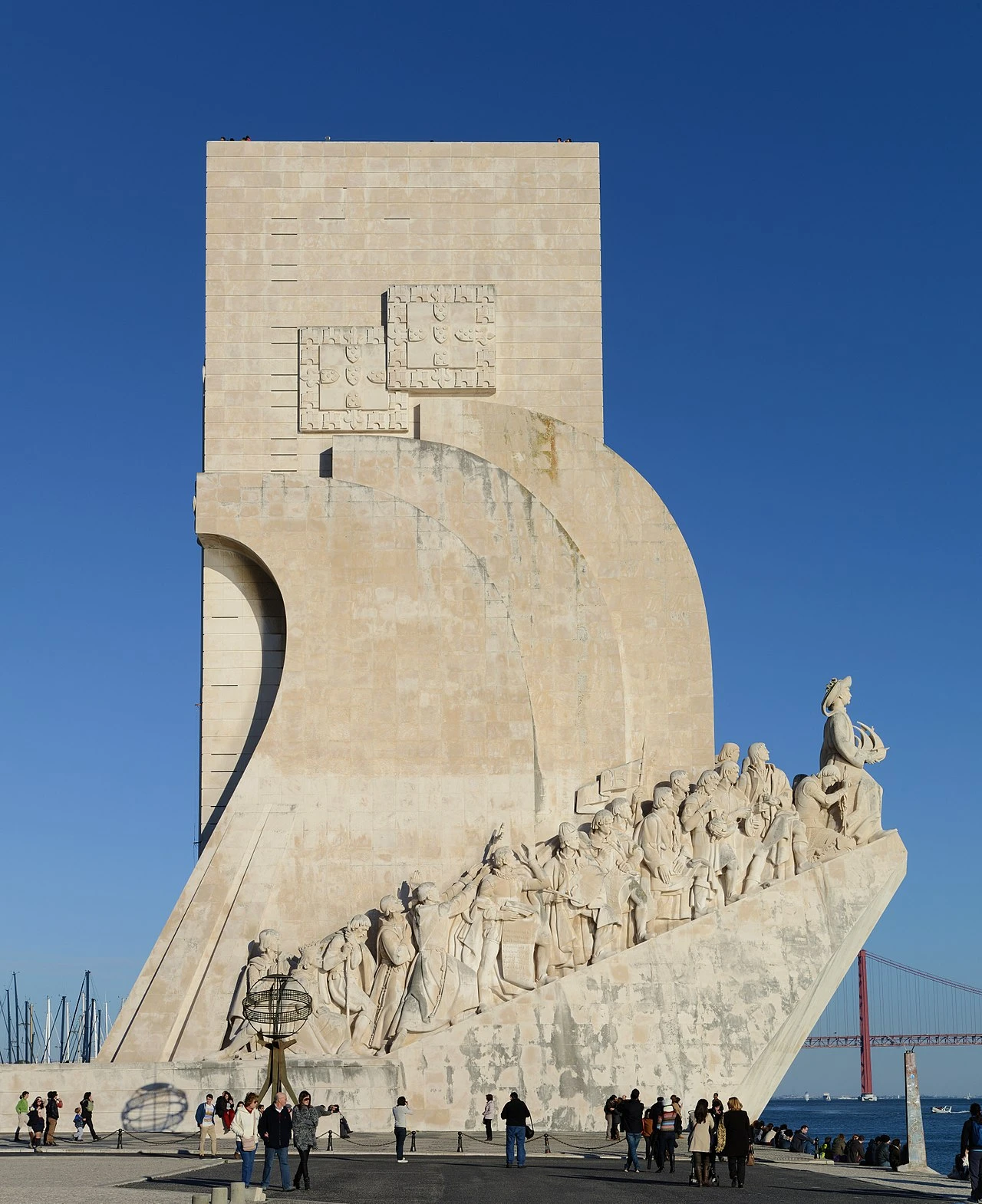
Padrão dos Descobrimentos
Content & sources
Photo: Alvesgaspar · CC BY-SA 4.0
Lisbon
Palácio Nacional da Ajuda
Content & sources
Photo: OsvaldoGago · CC BY-SA 2.0