Languages
15Palácio Nacional da Ajuda Audio Guide
Palácio Nacional da Ajuda is a landmark in Lisbon, Portugal. Explore it with Stanza's GPS-triggered offline audio guide — available in 15 languages.
Quick Facts
16
Stops
15
Languages
100%
Offline
📍 Lisbon, Portugal · 38.7075°N, -9.1978°E
About Palácio Nacional da Ajuda
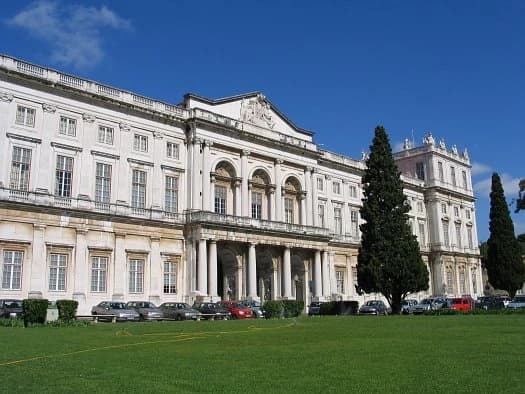
A neoclassical palace that served as the official residence of the Portuguese royal family during the late 19th century. It currently functions as a museum showcasing royal collections and period rooms.
Palácio Nacional da Ajuda is also known as Ajuda National Palace, Palácio Nacional da Ajuda, Ermida de Nossa Senhora da Ajuda, Real barraca, and 4 other names in various languages.
This self-guided audio tour features 16 narrated stops organized across 9 sections. As a palace, Palácio Nacional da Ajuda offers a unique cultural experience in the heart of Lisbon, Portugal.
The Stanza audio guide is available in 15 languages and works entirely offline — download the complete tour including audio narration, maps, and images before your visit. As you walk through Palácio Nacional da Ajuda, GPS-triggered narration plays automatically at each point of interest.
Last updated:
What you will hear
The Monumental Facade and the Unfinished Dream
Start outside to appreciate the grand neoclassical architecture and the famous unfinished western wing, which tells the story of the monarchy's flight and financial struggles.
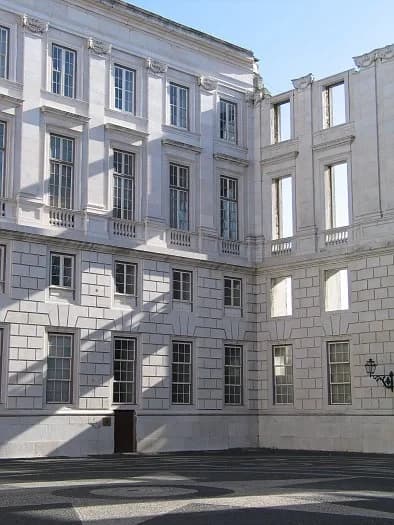
The Unfinished Facade
Standing before the exterior, the gaps in the original neoclassical design become apparent. The western wing remained a shell for more than two centuries, earning the building its reputation as an unfinished masterpiece. Several major historical events halted progress: first, the Napoleonic invasions in the early nineteenth century, followed by the subsequent flight of the Royal Family to Brazil in 1807. Even after their return, persistent financial crises and political instability meant that completing the original vision was never a priority. For generations, the palace appeared as a truncated structure, missing the symmetry intended by its Italian designers. This long wait finally ended between 2018 and 2020. A modern architectural intervention was implemented to complete the wing, but with a contemporary aesthetic that distinguishes the new from the old. This newly finished section now provides a secure, state-of-the-art environment for the Royal Treasure Museum. The contrast between the weathered stone of the original facade and the clean lines of the modern completion serves as a visible timeline of Portuguese history, marking the long road from absolute monarchy to a modern republic protecting its cultural heritage.
The Grand Vestibule and the 47 Statues
Enter the palace through the vestibule, where visitors are greeted by a monumental collection of 47 marble statues and a royal carriage.
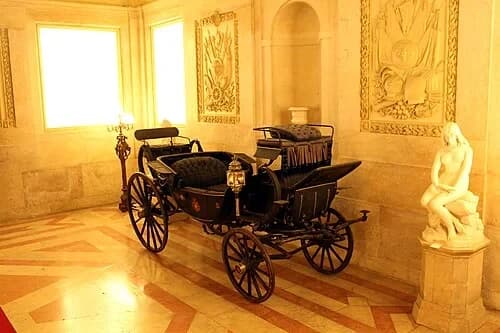
The Grand Vestibule
High-ranking guests entering the palace were greeted by the impressive scale of the Grand Vestibule. This space was carefully designed to act as a threshold between the outside world and the absolute seat of power. Lining the hall are forty-seven marble statues, each meticulously carved by prominent Portuguese sculptors of the nineteenth century. These figures represent various allegories and virtues, providing a silent, stoic welcome to diplomats and dignitaries. Central to this space is a well-preserved nineteenth-century royal carriage. Such vehicles were essential for the public display of royal status, often appearing in processions and state ceremonies. The transition from the open courtyard into this enclosed, art-filled gallery signaled a change in atmosphere, moving from the public sphere into the private and protected realm of the monarch. The height of the ceilings and the rhythmic placement of the sculptures create a sense of order and permanence. Each statue serves as an example of the high level of craftsmanship available in Portugal during this period. The vestibule remains one of the most complete examples of ceremonial palace architecture in the country, maintaining the exact layout intended for royal receptions.
The Monumental Staircase
Ascend the grand staircase, a masterpiece of stone carving that leads to the 'Andar Nobre' or Noble Floor.
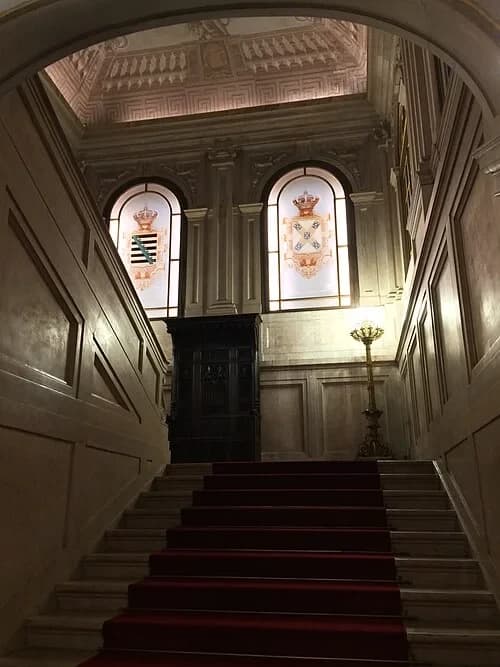
The Monumental Staircase
Ascending toward the 'Andar Nobre,' or Noble Floor, the scale of the architecture shifts once more. The monumental staircase was engineered not just for movement, but to intimidate and impress those invited into the inner sanctum of the palace. Notice the rhythm of the heavy stone arches and the complex vaulting overhead, which demonstrate the structural ambitions of the architects. Large stained-glass windows dominate the space, featuring the intricate coats of arms of the Portuguese monarchy. These heraldic symbols reminded every visitor of the lineage and divine right claimed by the residents of the palace. The light filtering through the colored glass adds a sense of gravity to the climb. By the time a guest reached the top landing, the architecture had successfully established the hierarchy of the space. This was the final stage before entering the public state rooms, where the most critical business of the kingdom was conducted. The cool stone and vast vertical space contrast sharply with the richly decorated rooms that follow, serving as a buffer that underscores the transition from the functional parts of the building to the symbolic heart of the royal residence.
The Throne Room
The heart of official royal life, this room features the twin thrones under a red canopy and a magnificent ceiling mural.

The Twin Thrones
Positioned prominently under a heavy red velvet canopy are the twin thrones used by King Luís I and Queen Maria Pia. These chairs are masterpieces of nineteenth-century furniture design, featuring intricate carvings that include playful cherubs and the official royal arms of Portugal. While they appear nearly identical at first glance, a closer look reveals small functional differences tailored to each monarch. For instance, notice the varying heights of the footrests, which were adjusted for the physical comfort of the King and Queen during long state audiences. These thrones were the physical manifestation of the monarchy's authority. When the royal couple sat here, they were performing their roles as heads of state for formal receptions and diplomatic greetings. The canopy above, also draped in the same red velvet found throughout the room, creates a framed space that further elevates the monarchs above their subjects and guests. The use of gold leaf and velvet serves to separate these objects from ordinary furniture, marking them as the focal point of the kingdom's political and social life. They have stood in this exact arrangement for well over a century, survivors of the transition from monarchy to republic.
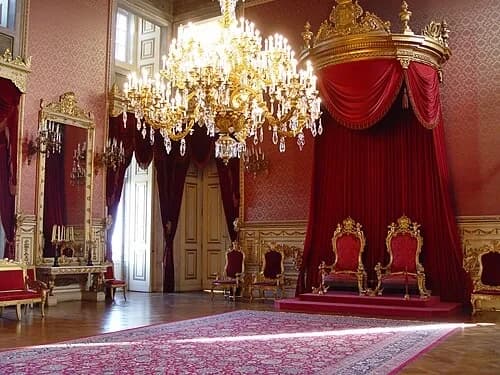
The Throne Room
Stepping into the Throne Room, the atmosphere changes to one of intense formality and royal splendor. The walls are entirely covered in rich red damask, a fabric traditionally associated with power and sovereignty. Overlapping this vibrant backdrop are monumental crystal chandeliers that hang from the high ceiling, their many facets designed to catch and multiply the light during evening receptions. This room served as the primary venue for state ceremonies, including the official acclamations of King Luís I and Queen Maria Pia. Looking upward, a large ceiling mural depicts the virtues of the monarchy, reinforcing the ideological foundation of the Portuguese throne through allegorical figures. Every element of the room, from the gilded moldings to the patterned flooring, was designed to focus attention on the sovereign. It was here that the monarch received foreign ambassadors, granted audiences, and performed the most public duties of their office. The sheer volume of the space and the consistency of the decorative scheme make it one of the most significant examples of nineteenth-century ceremonial interior design in Europe. It remains preserved much as it appeared during the height of its use in the late 1800s.
The Hall of John VI and the Royal Return
This hall commemorates the return of the Royal Family from Brazil, captured in a massive historical painting.

The Return of King John VI from Rio de Janeiro to Lisbon in 1821
Arcângelo Fuschini · 1825
This large-scale allegorical painting commemorates a pivotal moment in Portuguese history: the return of King João VI to Lisbon in 1821. Fourteen years earlier, the entire royal court had fled to Brazil to escape the invading forces of Napoleon. This move transformed Rio de Janeiro into the capital of a transatlantic empire, a unique event in colonial history. The artwork celebrates the King's homecoming not merely as a travel log, but as a mythic triumph. João VI is depicted as a maritime hero, surrounded by personifications of the city of Lisbon and the Tagus River, who welcome him back to European soil. This imagery was intended to heal the political divisions caused by the family's long absence and to re-establish the monarch's central role in the nation's life. The painting serves as a powerful reminder of the complex relationship between Portugal and its largest colony. It also highlights the Palácio da Ajuda's significance as the intended seat of power for a king returning to claim his ancestral home after a generation in exile. The composition uses classical symbolism to elevate a political necessity into a grand historical event.
The Pink Room and Porcelain Collection
Explore the Pink Room, also known as the Saxe Room, which houses the palace's extensive and delicate porcelain collection.
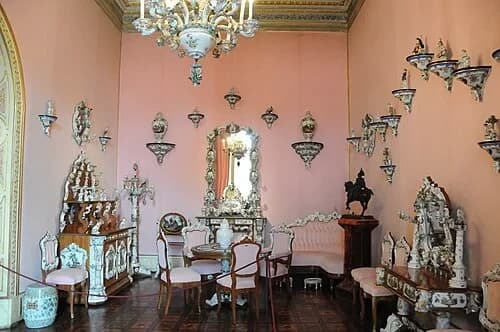
The Saxon Pink Room
The Sala Saxe, or Saxon Pink Room, is a tribute to the royal family's passion for high-quality ceramics. Its nickname comes from the collection of Meissen porcelain on display, often referred to as 'Saxe' porcelain because the factory is located in Saxony, Germany. The walls are painted a soft, delicate pink, providing a harmonious background for the white and blue porcelain. Throughout the room, intricate wall brackets support various figurines, vases, and dishes, turning the walls themselves into a display gallery. This room represents only a fraction of the palace's total ceramic wealth; the entire collection across the residence includes roughly seventeen thousand pieces of porcelain and earthenware. These items were not just decorative but served as status symbols, demonstrating the wealth and international connections of the Portuguese court. During the nineteenth century, acquiring pieces from the Meissen factory was a hallmark of refined taste among European royalty. The arrangement here shows how art was integrated into the daily environment of the palace, creating spaces that were both grand and intricately detailed. The play of light on the glazed surfaces of the porcelain adds a bright, luminous quality to the room, contrasting with the heavier fabrics found in the more formal state apartments.
The Winter Garden
The Marble Room serves as an indoor Winter Garden, reflecting the Queen's modernizing influence and love for nature.
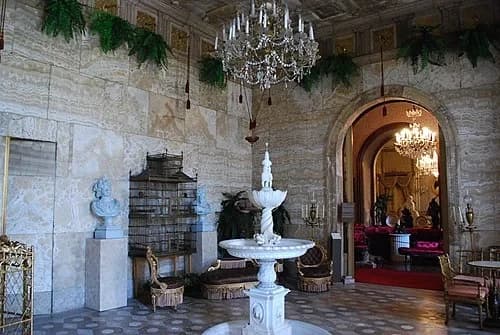
The Winter Garden
The Winter Garden, originally known as the Marble Room, is one of the most distinctive spaces in the palace. It reflects a popular nineteenth-century trend among European elite: the desire to bring nature indoors. Queen Maria Pia transformed this formal, stone-lined hall into a lush, interior oasis. The centerpiece is a fountain carved from Carrara marble, its flowing water once providing a soothing soundtrack for the Queen and her guests. Surrounding the fountain, she placed various birdcages and a collection of ferns and other greenery, which thrived in the light filtering through the large windows. This room highlights the Queen's interest in modern comfort and the creation of leisure spaces that broke away from rigid court etiquette. The transition from the solid stone walls of the hallway to this airy, organic environment was intended to surprise and delight. It served as a place for informal gatherings, afternoon tea, or quiet reflection. The inclusion of the fountain and live plants within a royal residence was a sign of technological and social modernization, blending the permanence of architectural stone with the fleeting beauty of the natural world.
The State Dining Room
The Sala da Ceia was the stage for lavish state banquets and remains set as if for a royal feast.
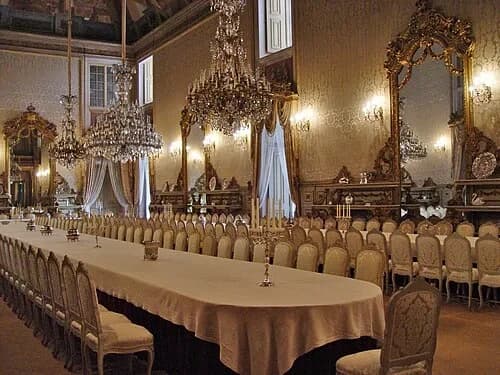
The State Dining Room
The 'Sala da Ceia,' or State Dining Room, remains set today much as it would have been for a grand royal banquet. A long, polished mahogany table stretches down the center of the room, surrounded by dozens of chairs intended for the highest-ranking guests of the kingdom. The walls are covered in silk, and massive crystal chandeliers hang overhead, providing the necessary light for evening events that could last for many hours. This room was far more than a place for meals; it was a theater for diplomacy and political theater. It hosted some of the most important diplomatic dinners in Portuguese history and was even the site of the acclamation of King Miguel I. The scale of the room and the richness of its appointments were intended to demonstrate the hospitality and the resources of the Portuguese state. Every meal served here followed strict protocol, with the King and Queen presiding over a carefully arranged seating chart that reflected the social hierarchy of the time. The grandeur of the space serves as a reminder that for a nineteenth-century monarch, even the act of dining was a public and symbolic duty performed before an audience of courtiers and foreign representatives.
The Royal Treasure Museum
Located in the new high-security vault, this collection houses the glittering crown jewels and the Germain silver service.

The Portuguese Crown
Housed within a high-security vault that stretches forty meters in length, the Portuguese Crown is the centerpiece of the Royal Treasure Museum. This specific crown was crafted in 1817 for King João VI while the court was still in Brazil. It is made of gold and features intricate workmanship, but its history contains a surprising fact: it was never actually worn on the head of a Portuguese monarch. Following a tradition that began after the Restoration of Independence in 1640, the Portuguese kings and queens believed their power came directly from God. As a result, the crown was treated as a sacred symbol. During coronations and major state ceremonies, it was placed on a velvet cushion to the side of the monarch, rather than being placed on their head. This practice emphasized that the sovereign was the representative of a divine authority that the crown itself symbolized. Despite its lack of physical contact with the kings, it remained the most important object in the kingdom’s treasury. Its presence in this modern, heavily guarded vault allows visitors to see one of the most significant artifacts of the old regime, preserved as a symbol of the nation’s history.
Want to hear the rest?
Download the Stanza app to unlock all 16 stops and full GPS-guided navigation.
Frequently Asked Questions
How long does the Palácio Nacional da Ajuda audio tour take?
The Palácio Nacional da Ajuda audio guide includes 16 narrated stops. Most visitors spend 45 minutes to 1.5 hours exploring the complete tour, though you can listen at your own pace and skip or revisit any stop.
Is the Palácio Nacional da Ajuda audio guide available in my language?
Stanza supports 15 languages: English, Spanish, French, German, Italian, Portuguese, Russian, Japanese, Chinese, Korean, Arabic, Hindi, Polish, Dutch, Hebrew. Check the guide in the app to confirm the languages currently available for this tour.
Can I use the audio guide offline at Palácio Nacional da Ajuda?
Yes! Download the complete Palácio Nacional da Ajuda tour — including all audio, maps, and images — before your visit. The Stanza app works completely offline, so you don't need WiFi or mobile data at the venue.
How much does the Palácio Nacional da Ajuda audio guide cost?
The Stanza app is free to download. Free and paid audio guides are available; current prices are shown in the app.
How do I use the Stanza audio guide at Palácio Nacional da Ajuda?
Download the free Stanza app, search for "Palácio Nacional da Ajuda", and download the tour. When you arrive at the venue, the app uses GPS to detect your location and automatically plays the relevant narration as you move between points of interest — completely hands-free.
What makes the Stanza audio guide different from other Palácio Nacional da Ajuda tours?
Stanza offers GPS-triggered narration that plays automatically as you walk through Palácio Nacional da Ajuda — no need to manually select stops. The tour is available in 15 languages, works fully offline, and includes 16 expertly narrated stops with images and historical context.
What other audio guides are available near Palácio Nacional da Ajuda?
Stanza offers multiple audio guides in Lisbon, Portugal and nearby areas. After downloading the app, browse the map to discover all available tours near Palácio Nacional da Ajuda. Each guide can be downloaded for offline use.