Languages
15Forte de São João Baptista das Berlengas Audio Guide
Forte de São João Baptista das Berlengas is a landmark in Peniche, Portugal. Explore it with Stanza's GPS-triggered offline audio guide — available in 15 languages.
Quick Facts
10
Stops
15
Languages
100%
Offline
📍 Peniche, Portugal · 39.4112°N, -9.5101°E
About Forte de São João Baptista das Berlengas
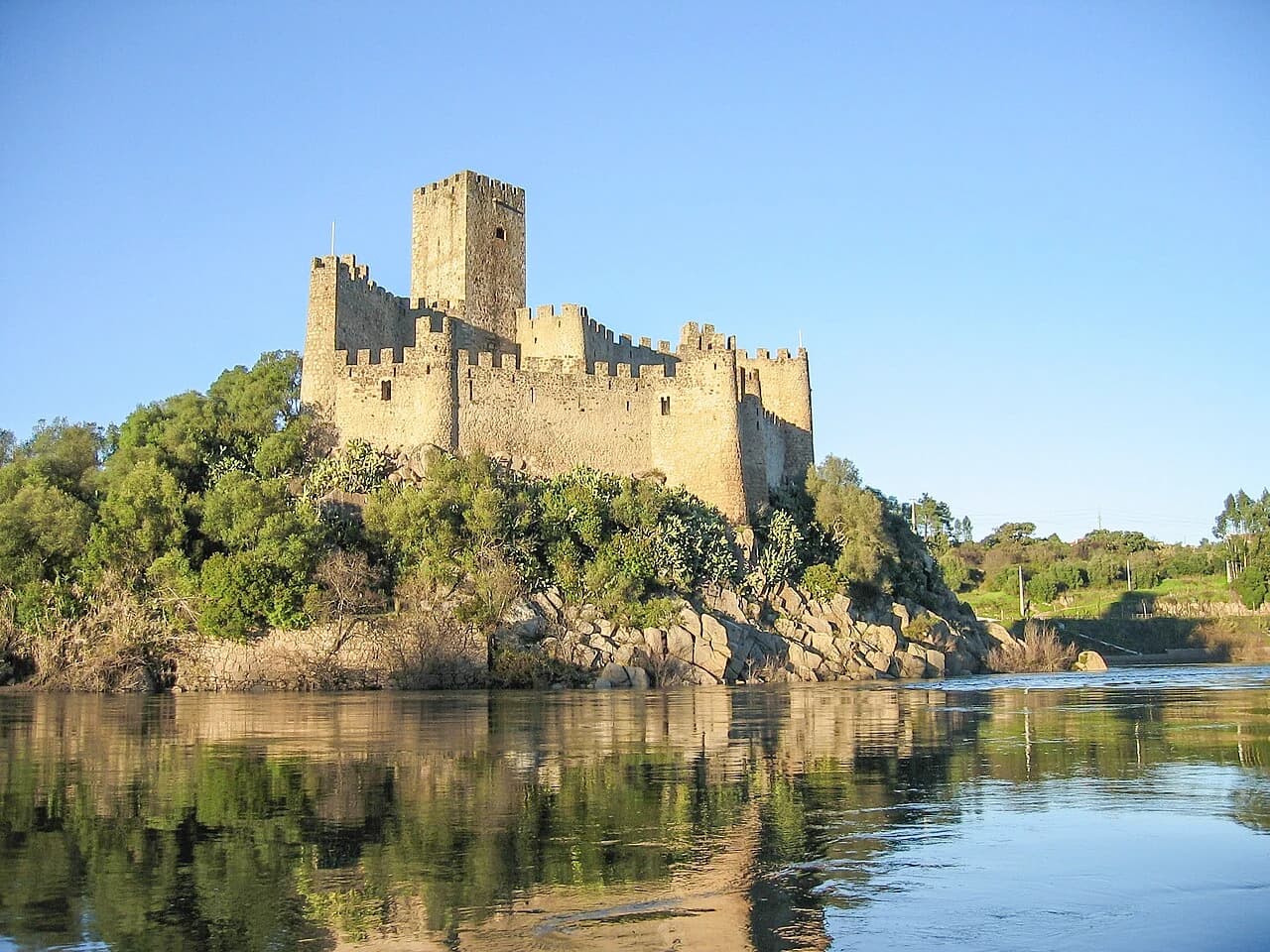
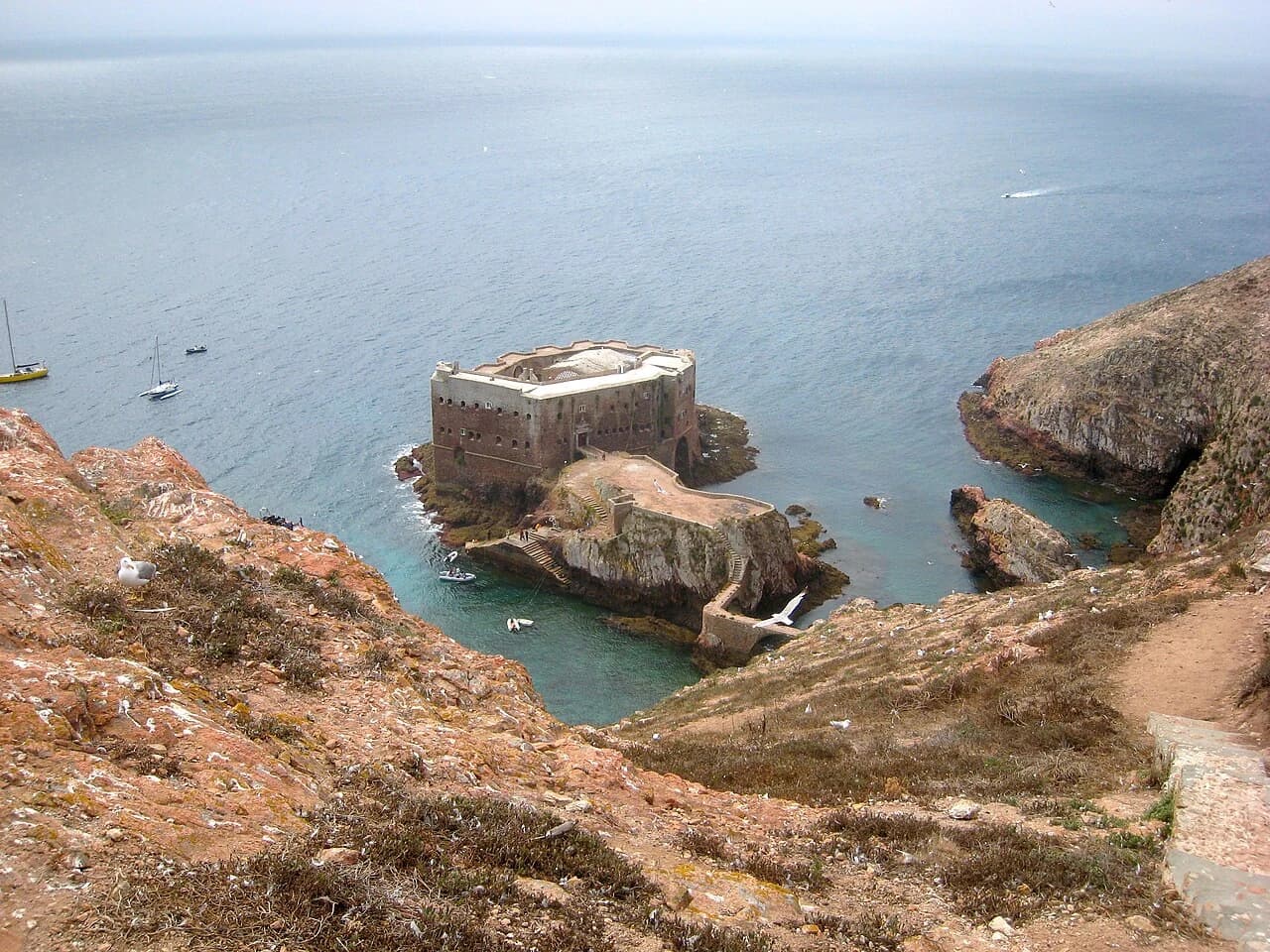
Constructed in the 17th century on the Berlengas archipelago, this fort was built to protect the coast from pirate and enemy invasions. It is a prominent example of 17th-century military architecture, currently functioning as a tourist landmark and seasonal accommodation.
Forte de São João Baptista das Berlengas is also known as Fort of São João Baptista, Mosteiro da Misericórdia da Berlenga, Mosteiro das Berlengas, Fortaleza das Berlengas, and 7 other names in various languages.
This self-guided audio tour features 10 narrated stops organized across 6 sections, including The Stone Causeway, The Main Gate and Heptagonal Walls, The Central Courtyard, Internal Corridors and Barracks, The Sea-Facing Ramparts and the 1666 Siege, The Fortress in the Atlantic. As a fort, Forte de São João Baptista das Berlengas offers a unique cultural experience in the heart of Peniche, Portugal.
The Stanza audio guide is available in 15 languages and works entirely offline — download the complete tour including audio narration, maps, and images before your visit. As you walk through Forte de São João Baptista das Berlengas, GPS-triggered narration plays automatically at each point of interest.
Last updated:
What you will hear
The Stone Causeway
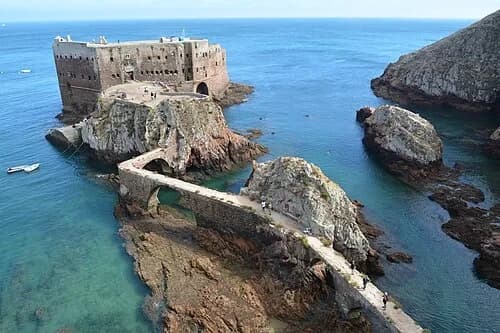
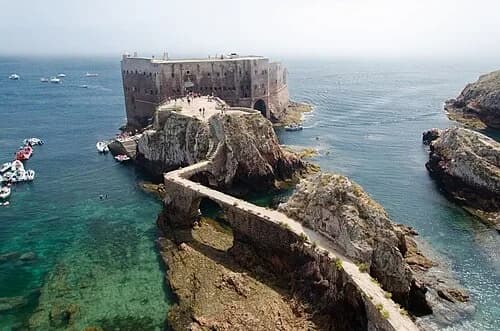
The dramatic entrance sequence beginning with the narrow, arched stone bridge that connects the main island to the fort's rocky islet.
The Stone Causeway
Welcome to one of Portugal's most secluded coastal defenses, an irregular heptagonal fortress rising directly from the Atlantic waters on the Berlengas archipelago. Accessible only by a narrow, arched stone bridge from the main island, this site was strategically chosen to repel pirate raids and foreign naval incursions. Construction on this current structure began in 1651, replacing earlier fortifications that had fallen into disrepair. The isolation of the islet provided a natural advantage, making it a formidable obstacle for any approaching enemy fleet. This bridge serves as the vital link between the safety of the main landmass and the sheer isolation of the military outpost. The drama of the approach highlights the precariousness of life on these windswept islands during the 17th century, where the sea offered both the only means of escape and the most constant threat. Every stone in this walkway represents the effort to anchor human presence on this remote rocky outcrop.
The Main Gate and Heptagonal Walls
Exploring the unique seven-sided defensive perimeter and the main entrance that protected the garrison from naval and pirate threats.
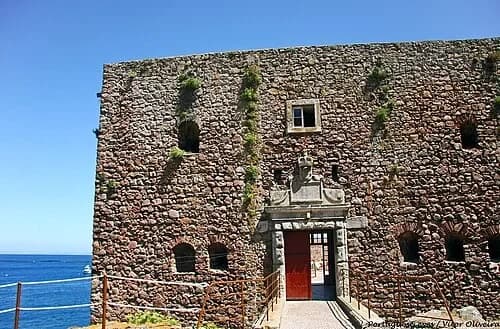
The Main Gate
Rugged masonry textures define these walls, where irregular stones are tightly packed to endure centuries of salt spray and the battering of Atlantic storms. Above the heavy red door of the main entrance, you can see a decorative royal coat of arms carved into the stone, signaling the fortress's status as a crown property. This massive defensive project was a significant undertaking that spanned twenty-seven years, finally reaching completion in 1678. The work was overseen by the Marquês da Fronteira, who ensured the defenses were robust enough for the treacherous maritime environment. The sheer thickness of these walls served a dual purpose: they absorbed the shock of incoming cannon fire and protected the garrison from the damp, relentless sea air. The craftsmanship here reflects a purely functional military aesthetic, where durability was prioritized over ornamentation. Even the entryway is designed to be easily barricaded, turning the simple act of entering into a reminder of the fort's primary defensive purpose.
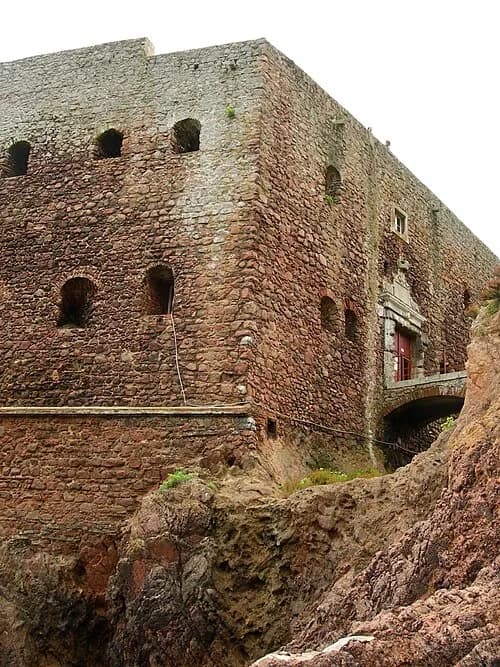
Sea-Beaten Walls
The fortress appears almost as a natural extension of the island, with its foundations built directly into the jagged contours of the rocky islet. This integration of architecture and geology was a deliberate defensive choice, utilizing the steep cliffs as an additional layer of protection against landing parties. Since 1938, the site has been officially classified as a National Monument of Portugal, a designation that ensures its unique silhouette remains preserved for the future. Looking at the bridge again, you can see how it expertly spans the treacherous gap between the primary island and the fortress’s perch. This engineering feat allowed the garrison to retreat or receive supplies even during rough seas, provided the waves didn't overtop the walkway. This allows for a clear view of where the natural cliffs meet the base of the man-made fortifications. The site stands as one of the best-preserved examples of maritime defense along the western Iberian Peninsula, shaped by both human hands and the erosive power of the ocean.
The Central Courtyard
The heart of the fort, built over the site of the original 1513 Hieronymite monastery.
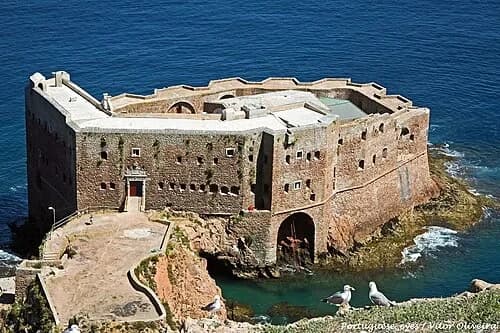
Defensive Geometry
From this elevated perspective, the irregular heptagonal floor plan of the fort becomes clear, revealing a complex design tailored to the shape of the islet. Having seven sides allowed the defenders to position artillery and lookouts to cover nearly every possible angle of approach by sea. Inside the massive stone shell, the interior is divided into twelve main service compartments, which once functioned as command quarters, storage, and barracks for the soldiers. In addition to these central areas, eight smaller rooms were hollowed out directly within the thickness of the external walls. These specialized spaces maximized the utility of the limited footprint while providing maximum protection during a naval bombardment. This geometric precision demonstrates the advanced military engineering concepts applied in the late 17th century to secure the Portuguese coastline. The layout reflects a period when fortress design shifted toward angled walls that could better deflect projectile impacts while eliminating blind spots where an enemy could hide beneath the ramparts.
Internal Corridors and Barracks
The functional interior of the fort, featuring vaulted stone hallways and twelve service compartments for soldiers.
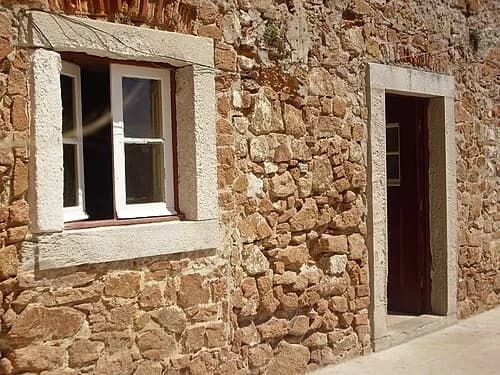
The Inner Quarters
The central courtyard is surrounded by windows and doorways that lead into the garrison's living spaces. Long before the stone fort was built, this exact spot was home to a Hieronymite monastery established in 1513. The monks who lived here had a noble mission: they dedicated their lives to rescuing and caring for shipwrecked sailors caught in the dangerous currents around the islands. However, the isolation that suited their religious life also made them vulnerable. Relentless pirate raids, particularly from North African corsairs, eventually made the location untenable. The monks were forced to abandon their sanctuary, leaving the site vacant until the military recognized its strategic value. Today, the courtyard serves as an open-air hub for visitors, though it once echoed with the prayers of monks and later the shouts of a stationed garrison. The transition from a place of religious mercy to one of military strength is a common theme in coastal history, where strategic geography often overrides peaceful pursuits.
The Sea-Facing Ramparts and the 1666 Siege
The defensive upper level where a tiny garrison famously held off a massive Spanish fleet.
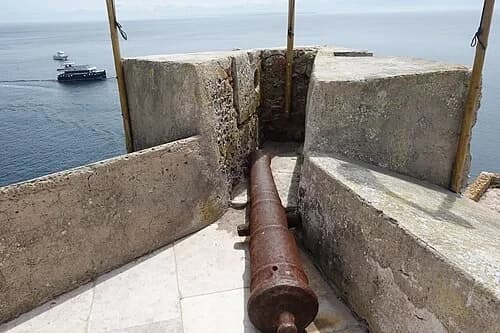
The Great Siege
In 1666, this spot was the site of an extraordinary military feat during a Spanish siege. A tiny garrison of only twenty Portuguese soldiers, led by Cabo António Avelar Pessoa, faced a massive Spanish fleet consisting of fifteen ships and over 1,500 men. Despite the overwhelming odds, the defenders utilized the fort's eleven embrasures to devastating effect. These narrow openings, like the one framing the cannon here, were specifically positioned to rake ships with fire as they attempted to drop anchor in the sheltered cove below. The garrison held out for two days, sinking one ship and damaging several others before their ammunition finally ran dry. The position of this cannon shows exactly how the defenders could control the waters from behind the safety of several meters of solid masonry. The weathered metal of the remaining artillery pieces still points toward the most likely path of an approaching enemy. This localized defense was a crucial part of larger territorial disputes that shaped the modern borders of the region.
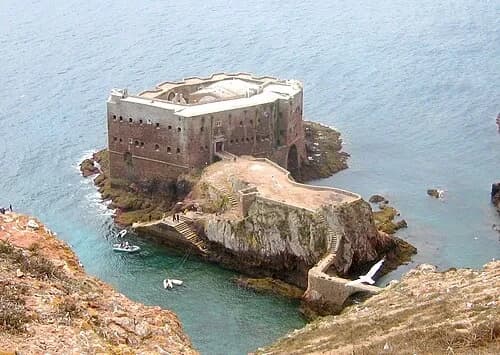
Battle of the Berlengas
Follow the path as it winds and rises in a series of stone stairs, leading from the bridge toward the upper levels of the fort. This uneven, rocky terrain reflects the difficult conditions the soldiers faced daily while moving supplies or rushing to their battle stations. During the Peninsular War in the early 19th century, this rugged outcrop took on a new strategic role as a base for British guerrilla troops. These forces used the fortress's isolation to their advantage while operating against French Napoleonic armies on the mainland. The steep, narrow stairs were easily defensible, turning every corner into a potential choke point for an intruder. Moving along these steps today, you can appreciate the logistical struggle of maintaining a military presence on such a remote and vertical landscape. Each step was carved or placed to ensure that even a small number of defenders could hold the high ground against a larger force attempting to ascend from the landing area below.
The Fortress in the Atlantic
A final look at the fort's relationship with the sea, including the natural caves and its status as a National Monument.
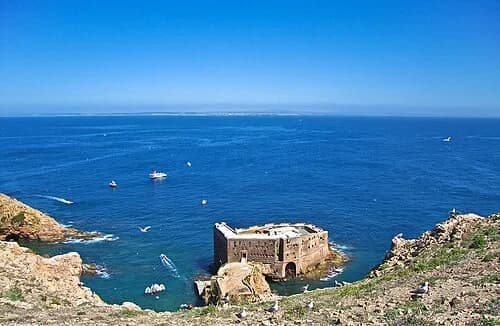
Fortress of the Atlantic
Looking out over the vast expanse of the ocean, the sheer logistical challenge of constructing this fortress becomes apparent. Every single piece of stone, every barrel of lime, and every timber beam had to be painstakingly hauled across the water from the port of Peniche and winched up the cliffs. The fort stands as a massive watchtower at the entrance to the coastal waters, intended to alert the mainland of any incoming threats. Its scale is impressive, yet it appears dwarfed by the massive limestone cliffs of the main Berlenga island nearby. This contrast was intentional, as the fort was designed to be a low-profile target from the sea while maintaining an unobstructed view of the horizon. Its presence ensured that no hostile vessel could approach the vital port of Peniche without being spotted and engaged. For centuries, this rocky sentinel provided a critical early warning system for the mainland, serving as the first line of defense against maritime threats arriving from the north.
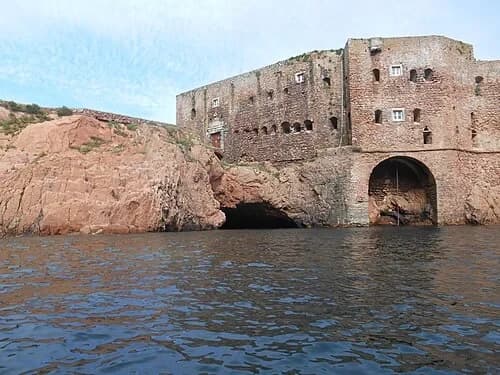
The Sea Cave Arch
Just at the water level, a large, dark archway reveals a natural sea cave that the builders cleverly integrated into the fort's overall design. The sea itself functioned as a permanent, shifting moat, creating a formidable barrier against anyone attempting to scale the islet from a boat. There is a striking visual contrast between the straight, man-made masonry of the walls above and the jagged, erosion-carved hollows of the natural rock below. Over centuries, the relentless pounding of the Atlantic has hollowed out these caves, which the military used for added concealment or storage when conditions allowed. The builders didn't fight the geography; they embraced it, letting the volatile nature of the ocean and the hardness of the granite islet do much of the defensive work for them. This integration of the natural landscape into the fortification meant that any attacker would have to navigate both military firepower and the treacherous, unpredictable currents that surge through these sea-worn hollows.
Guardian of the Coast
While the fort's military significance eventually faded, its legacy as a protector of the Berlengas continues in a different form. Since the mid-20th century, the structure has been repurposed as a guesthouse and historical site, offering a rare chance for travelers to stay within its ancient walls. Looking down at the clear turquoise water, you will often see a cluster of small boats and divers. This area, once a forbidden military zone filled with the smoke of cannons, is now part of a protected nature reserve and a popular destination for eco-tourism. The transition from a site of violent conflict to one of tourism and ecological preservation marks the latest chapter in the fort's long history. The stone walls no longer face naval broadsides, but instead host visitors who come to explore the remote beauty of the archipelago. You can often see modern navigational markers and buoys floating just beyond the old firing range of the cannons, marking a shift from defense to safe navigation.
Frequently Asked Questions
How long does the Forte de São João Baptista das Berlengas audio tour take?
The Forte de São João Baptista das Berlengas audio guide includes 10 narrated stops. Most visitors spend 45 minutes to 1.5 hours exploring the complete tour, though you can listen at your own pace and skip or revisit any stop.
Is the Forte de São João Baptista das Berlengas audio guide available in my language?
Stanza supports 15 languages: English, Spanish, French, German, Italian, Portuguese, Russian, Japanese, Chinese, Korean, Arabic, Hindi, Polish, Dutch, Hebrew. Check the guide in the app to confirm the languages currently available for this tour.
Can I use the audio guide offline at Forte de São João Baptista das Berlengas?
Yes! Download the complete Forte de São João Baptista das Berlengas tour — including all audio, maps, and images — before your visit. The Stanza app works completely offline, so you don't need WiFi or mobile data at the venue.
How much does the Forte de São João Baptista das Berlengas audio guide cost?
The Stanza app is free to download. Free and paid audio guides are available; current prices are shown in the app.
How do I use the Stanza audio guide at Forte de São João Baptista das Berlengas?
Download the free Stanza app, search for "Forte de São João Baptista das Berlengas", and download the tour. When you arrive at the venue, the app uses GPS to detect your location and automatically plays the relevant narration as you move between points of interest — completely hands-free.
What makes the Stanza audio guide different from other Forte de São João Baptista das Berlengas tours?
Stanza offers GPS-triggered narration that plays automatically as you walk through Forte de São João Baptista das Berlengas — no need to manually select stops. The tour is available in 15 languages, works fully offline, and includes 10 expertly narrated stops with images and historical context.
What other audio guides are available near Forte de São João Baptista das Berlengas?
Stanza offers multiple audio guides in Peniche, Portugal and nearby areas. After downloading the app, browse the map to discover all available tours near Forte de São João Baptista das Berlengas. Each guide can be downloaded for offline use.