Languages
15Biblioteca Joanina Audio Guide
Biblioteca Joanina is a landmark in Coimbra, Portugal. Explore it with Stanza's GPS-triggered offline audio guide — available in 15 languages.
Quick Facts
15
Stops
15
Languages
100%
Offline
📍 Coimbra, Portugal · 40.2071°N, -8.4265°E
About Biblioteca Joanina
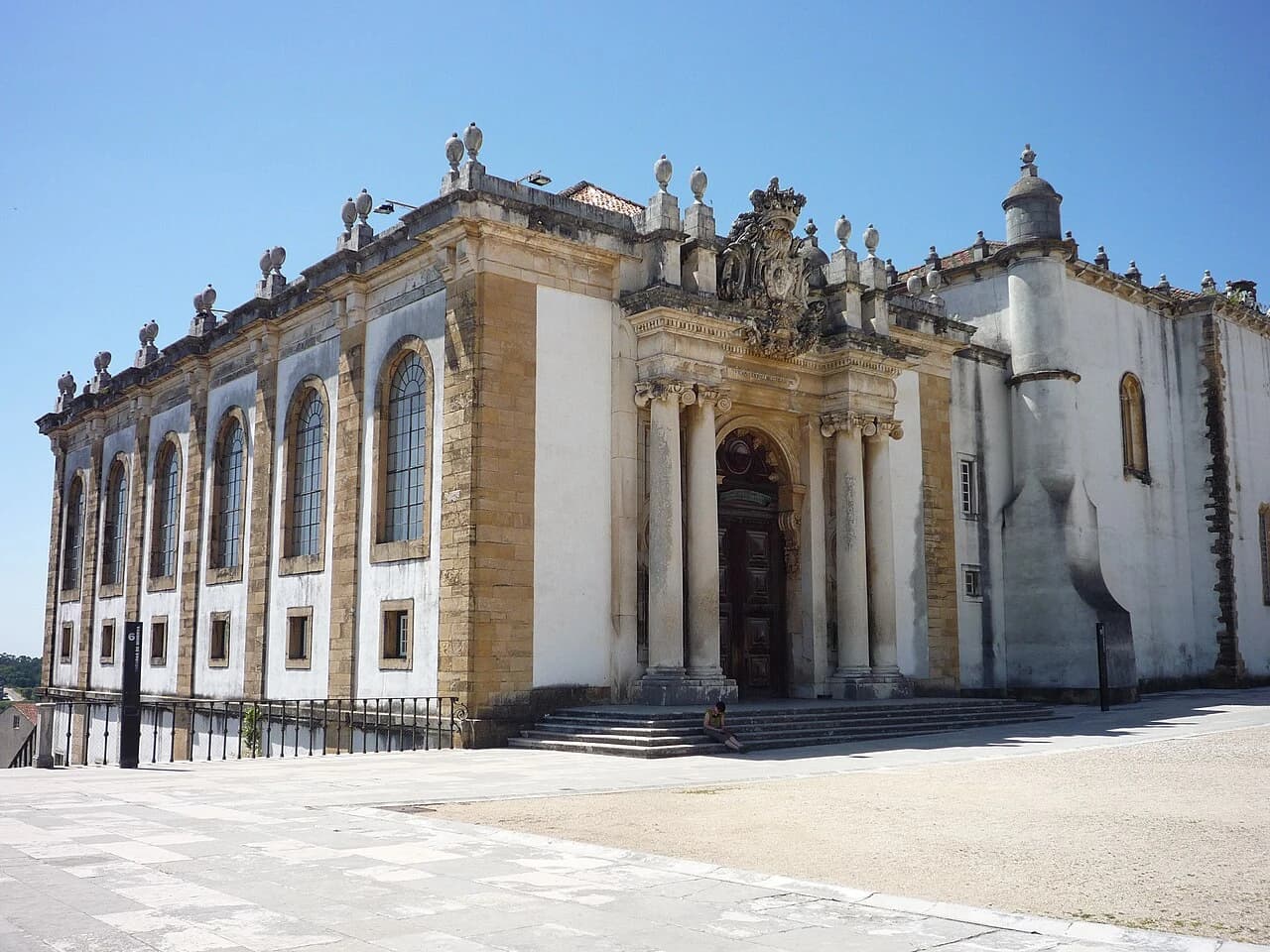
The Biblioteca Joanina is a baroque library located at the heart of the University of Coimbra. It is renowned for its ornate decorations and its significant collection of historical books.
This self-guided audio tour features 15 narrated stops organized across 6 sections, including The Baroque Portal and National Crest, The Middle Floor and Academic Prison, The First Room: Gold on Green, The Second Room: The Red Gallery, The Third Room and the Bat Colony, Chapel of São Miguel. As a historic library, Biblioteca Joanina offers a unique cultural experience in the heart of Coimbra, Portugal.
The Stanza audio guide is available in 15 languages and works entirely offline — download the complete tour including audio narration, maps, and images before your visit. As you walk through Biblioteca Joanina, GPS-triggered narration plays automatically at each point of interest.
Last updated:
What you will hear
The Baroque Portal and National Crest
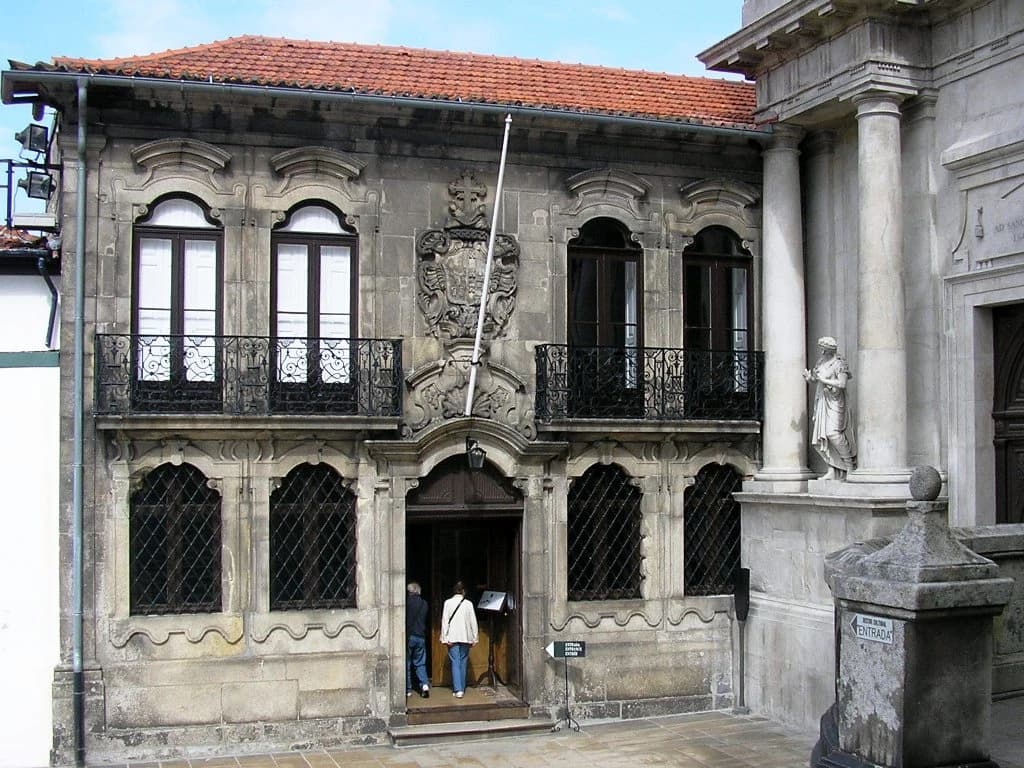
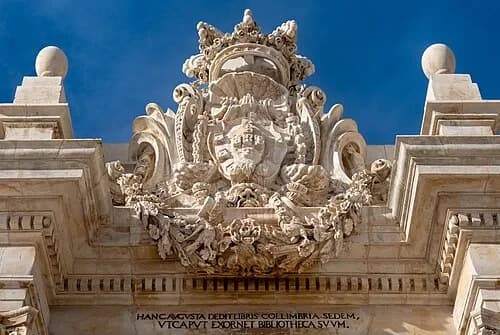
Focus on the monumental entrance and the Portuguese coat of arms, which signifies the royal patronage of King John V.
The Royal Coat of Arms
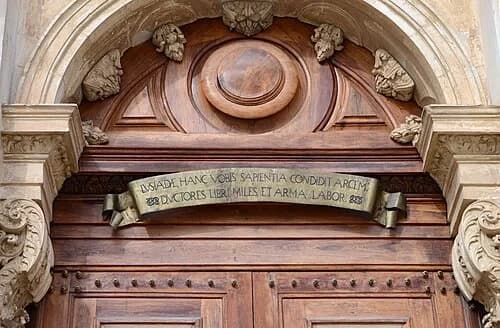
Above the main entrance, the intricate carving of the Portuguese national crest serves as a reminder of the library's royal origins. This entire project was a grand statement of authority and cultural ambition by King John V. Known as the 'Magnanimous,' John V utilized the vast wealth flowing into Portugal from the gold mines and diamond fields of colonial Brazil to fund spectacular architectural works across the country. This library is a direct result of that colonial prosperity. Just below the crest, look for the Latin inscription carved into the stone. It translates to: 'The Great University dedicated this seat to books, so that the library may adorn its head.' This phrase characterizes the library not merely as a storage space, but as a crowning achievement for the entire university. Every detail of this facade, from the royal arms to the elegant lettering, was designed to impress upon visitors the prestige of the institution and the generosity of the monarch who oversaw its creation.
The Library Entrance Inscription
As you approach the heavy wooden doors, notice the brass inscription that details the rules of entry. These regulations have been in place for centuries, reflecting the university's commitment to protecting the 70,000 volumes housed within. Access to the library is not restricted simply for crowd management, but for the fundamental preservation of the collection itself. Each person who enters brings in humidity and heat, while the opening of the doors allows in damaging sunlight. By strictly controlling the flow of visitors and keeping the doors closed, the staff can maintain the delicate balance required to prevent the ancient paper and bindings from deteriorating. This entrance marks a significant change in atmosphere. You are leaving the bright, expansive, and often noisy courtyard for the quiet, dim, and temperature-controlled world of the interior. The air inside is noticeably cooler and more still, a deliberate effect designed to ensure that these centuries-old texts remain in pristine condition for future scholars to study and appreciate.
The Middle Floor and Academic Prison
Before entering the gilded halls, explore the functional lower level which houses the 'Academic Prison' and demonstrates the 2.11-meter thick walls used for climate control.
The Middle Floor Storage
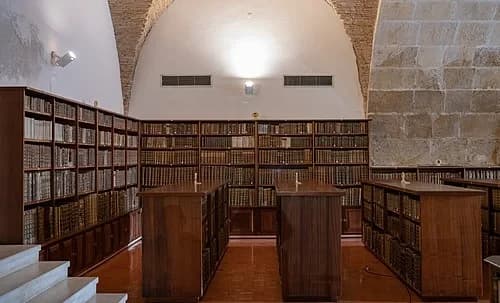
This level, appropriately called the Middle Floor, offers a stark visual contrast to the gilded rooms above. With its simple wooden shelving and unadorned stone walls, it functions primarily as a transition zone for the building's sophisticated climate control system. By acting as a buffer between the ground and the ornate main floor, it helps regulate the interior environment. However, this level also served a much grimmer purpose in the university's past. This is the site of the Academic Prison. Until the 19th century, the university held its own judicial power, meaning students and staff were subject to internal discipline rather than civil law. Those caught committing infractions, such as skipping classes, fighting, or academic dishonesty, were held here in small cells. The presence of a prison within a library might seem contradictory today, but it highlights the absolute authority the university once held over every aspect of its members' lives. It is a sober reminder of the strict discipline that governed academic pursuits in the 18th century.
The Stone Vaults
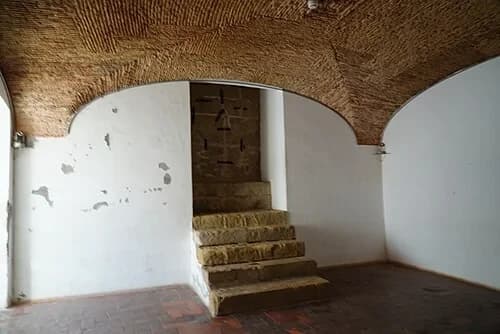
The massive stone archways and staircases in this area are central to the library's survival. They function as a natural refrigerator, utilizing the thermal mass of the stone and the building's specific orientation to keep the internal temperature remarkably consistent. Regardless of the heat of a Portuguese summer or the chill of winter, the temperature inside these vaults remains between 18 and 20 degrees Celsius. This stability is the primary reason the books have survived so well for over two and a half centuries. Interestingly, although construction on the building was completed in 1728, it remained empty for over two decades. The first books did not actually arrive and fill these shelves until 1750. This delay allowed the structure to fully settle and the humidity levels to stabilize before the precious collection was introduced. The engineering was so successful that it continues to function today without the need for modern electrical systems. As you pass through these stone corridors, you are experiencing an 18th-century solution to a perennial problem: the long-term preservation of organic materials in a changing world.
The First Room: Gold on Green
Enter the first of the three grand rooms, characterized by its green and gold color scheme and intricate Baroque carvings.
Baroque Archway Detail
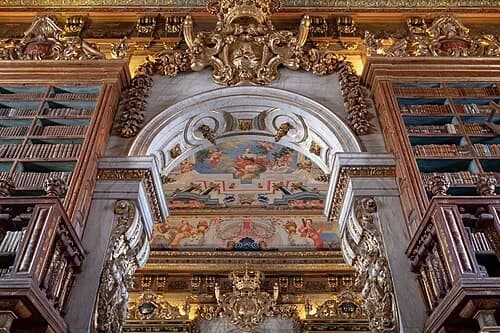
Moving into the upper rooms, the atmosphere changes instantly from the utilitarian stone vaults to a world of opulent Baroque splendor. Notice the intricate carvings that adorn every archway and shelf. High above, the ceilings feature spectacular examples of 'trompe l'oeil' painting. This French term, meaning 'to deceive the eye,' refers to a technique where flat surfaces are painted to look three-dimensional. These paintings create the illusion of soaring, vaulted domes where there are only flat wooden panels. Throughout these ceiling murals, you will see allegorical figures. These represent the four continents known to Europeans at the time of the library's construction: Europe, Asia, Africa, and America. Each continent is depicted with specific attributes and symbols intended to show the global reach of knowledge and the university's place in a connected world. This artistic program was carefully designed to elevate the status of the library from a mere room of books to a monumental 'temple of wisdom.' The combination of real carving and painted illusions creates a space that feels far larger than its physical dimensions.
The Second Room: The Red Gallery
Move into the middle room, where the gold leaf is set against a vibrant red background, highlighting the exotic Brazilian woods used for the shelves.
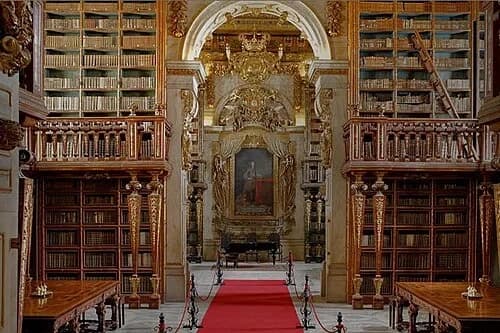
Perspective of the Three Rooms
Standing at the entrance to the galleries, the view looking through the three interconnected rooms is one of the most famous sights in the university. This layout was intentionally designed to create a perspective effect that makes the space appear to stretch on forever, symbolizing the infinite nature of knowledge. Each of the three rooms—traditionally decorated in green, red, and black—served a specific organizational purpose. In the 18th century, these colors helped librarians and students categorize the vast collection by subject matter. Specific rooms were dedicated to different branches of learning, such as Civil Law, Canon Law, or Theology. This color-coded system was a sophisticated way to manage 70,000 volumes in an age before modern digital cataloging. The architectural rhythm of the repeated archways reinforces this sense of order and hierarchy. As you look down this central axis, you are seeing a physical manifestation of the Baroque ideal: a world where everything has its place within a grand, visually stunning system. The journey through these rooms was meant to be an intellectual progression leading toward the library's most important symbols.
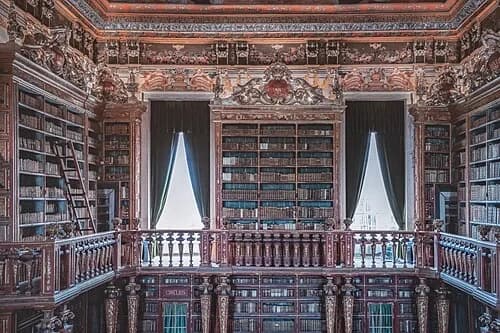
The Red Gallery
The middle room, known as the Red Gallery, is perhaps the most vibrant of the three. Its palette of crimson and gold creates a warm, regal atmosphere. Here, you can clearly see the library's two-story shelving system. The upper balconies are not just decorative; they are fully functional, providing access to thousands of books stored high above the floor. If you look closely at the corners of the shelving units, you might spot the small, discreet doors that hide narrow, winding staircases. These allowed librarians to move quickly and quietly between levels without disrupting the grand aesthetic of the room. This practical design combined with such extraordinary beauty led 'The Telegraph' newspaper to name this the most spectacular library in the world in 2013. The craftsmanship visible in the gilded wood and the perfectly aligned balconies represents the peak of Portuguese Baroque interior design. This room was intended to inspire awe in anyone who entered, reinforcing the idea that learning was a noble pursuit. The vibrant red color was a particularly expensive pigment at the time, further emphasizing the immense royal budget.
The Third Room and the Bat Colony
In the final room (Gold on Black), explain the famous resident colony of bats that protects the 70,000 volumes from insects.
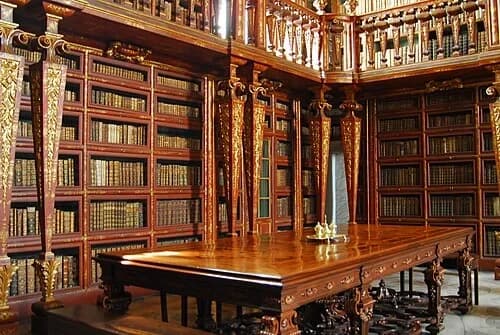
The Bat Colony Tables
The large wooden tables you see in the center of the rooms hold a fascinating secret related to the library's preservation. This is one of only two libraries in the entire world that houses a permanent colony of resident bats. While many buildings try to keep bats out, here they are welcome guests. These small bats emerge at night to feed on insects that would otherwise eat the old paper and glue of the book bindings. They serve as a highly effective, non-toxic form of pest control that has been in place for centuries. However, their presence does require a specific daily routine. Every evening, before the library closes, staff members carefully cover these large tables with heavy leather protective covers. This is done to prevent the wood and the books from being damaged by bat guano during the night. In the morning, the covers are removed and the tables are cleaned, ready for the day's visitors. This unusual ecological partnership is a testament to the creative ways 18th-century builders solved the problems of long-term conservation. The bats remain an essential, if rarely seen, part of the library's maintenance team.
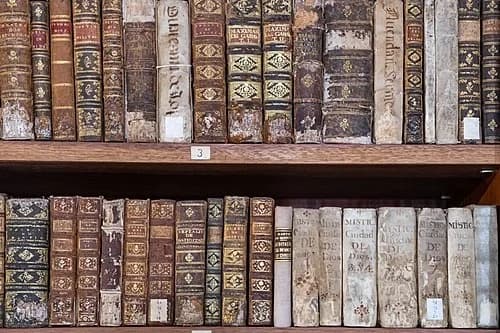
The Ancient Volumes
The shelves around you hold approximately 70,000 volumes, some of which date back as far as the 16th century. If you look closely at the spines, you can see the different materials used for binding. Many of the oldest books are bound in parchment, which is made from processed animal skin. Parchment is incredibly durable and has helped these texts survive for hundreds of years. Others are bound in thick, handmade paper or leather. This collection has been granted 'Bibliographical Heritage' status, recognizing its immense cultural and historical value. Although it looks like a museum, this is still a functioning research library. These ancient books are available for consultation by scholars and researchers, but the process is highly restricted and closely monitored to prevent any damage to the fragile materials. The books cover a vast array of topics, from early medical treatises and law to theology and philosophy, providing a comprehensive snapshot of the intellectual world of the 18th century and earlier. Each volume is a unique artifact, containing the handwritten notes and marks of many generations of students and professors.
Chapel of São Miguel
Conclude the tour by stepping outside to the adjacent Chapel of São Miguel, a Manueline masterpiece often visited alongside the library.
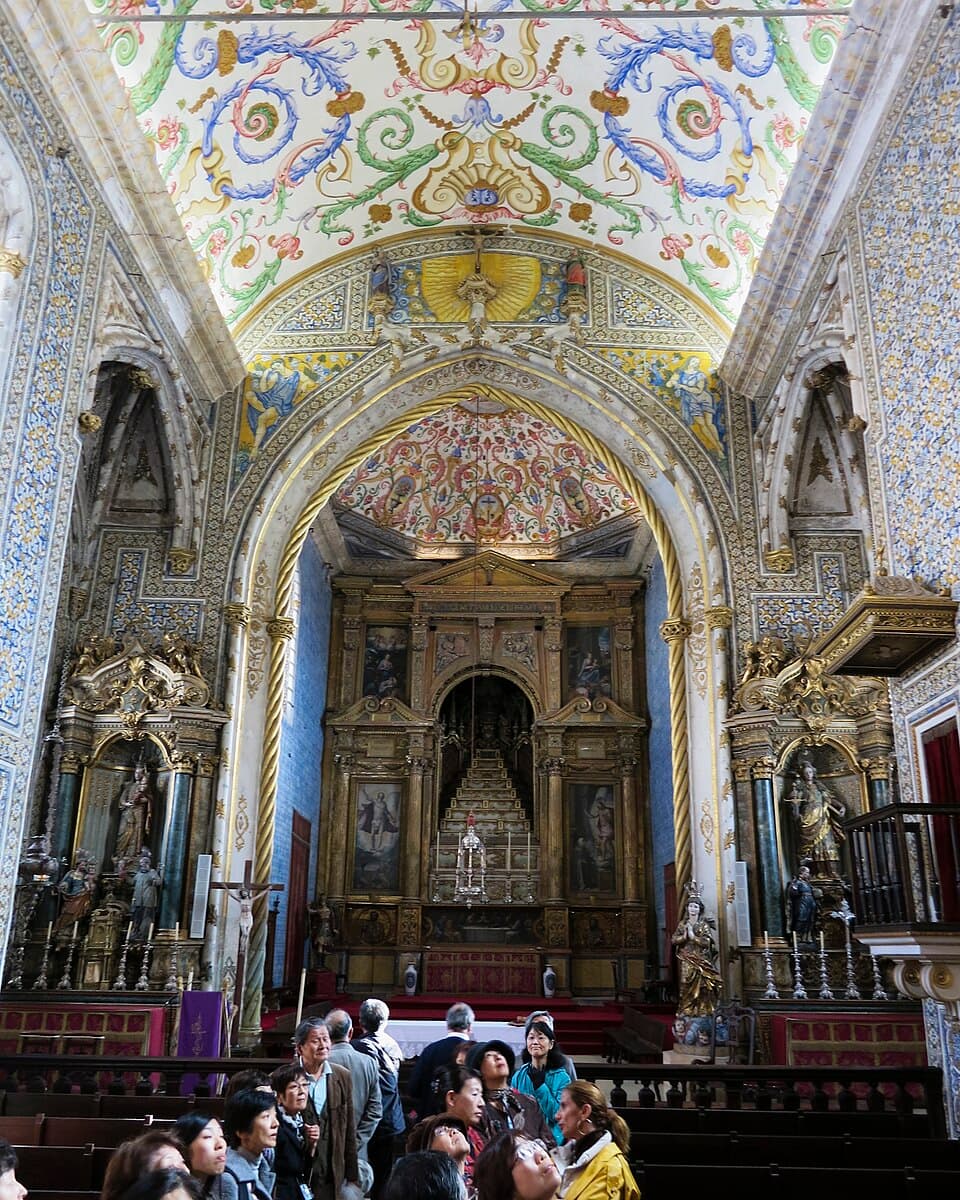
Chapel of Saint Michael
To conclude your tour, take a moment to look at the adjacent Chapel of São Miguel. It offers a fascinating contrast to the library you just visited. While the library is a monument to 18th-century Baroque splendor, parts of this chapel date back much earlier and feature the distinct 'Manueline' or Portuguese Gothic style. You will notice the walls are covered in colorful, patterned 17th-century tiles, known as azulejos, which provide a different aesthetic from the heavy gilding and dark woods of the library rooms. Together, this chapel and the Biblioteca Joanina represent the two historical pillars of the University of Coimbra: the spiritual and the intellectual. In centuries past, life for a student here was defined by both rigorous study and religious devotion. The close proximity of these two buildings shows how deeply intertwined faith and learning were in the traditional university structure. As you leave this area, the shift from the ornate tilework of the chapel back to the open air of the courtyard marks the end of your journey through the university's most sacred and scholarly spaces. This combination of architecture continues to define the character of this historic institution.
Want to hear the rest?
Download the Stanza app to unlock all 15 stops and full GPS-guided navigation.
Frequently Asked Questions
How long does the Biblioteca Joanina audio tour take?
The Biblioteca Joanina audio guide includes 15 narrated stops. Most visitors spend 45 minutes to 1.5 hours exploring the complete tour, though you can listen at your own pace and skip or revisit any stop.
Is the Biblioteca Joanina audio guide available in my language?
Stanza supports 15 languages: English, Spanish, French, German, Italian, Portuguese, Russian, Japanese, Chinese, Korean, Arabic, Hindi, Polish, Dutch, Hebrew. Check the guide in the app to confirm the languages currently available for this tour.
Can I use the audio guide offline at Biblioteca Joanina?
Yes! Download the complete Biblioteca Joanina tour — including all audio, maps, and images — before your visit. The Stanza app works completely offline, so you don't need WiFi or mobile data at the venue.
How much does the Biblioteca Joanina audio guide cost?
The Stanza app is free to download. Free and paid audio guides are available; current prices are shown in the app.
How do I use the Stanza audio guide at Biblioteca Joanina?
Download the free Stanza app, search for "Biblioteca Joanina", and download the tour. When you arrive at the venue, the app uses GPS to detect your location and automatically plays the relevant narration as you move between points of interest — completely hands-free.
What makes the Stanza audio guide different from other Biblioteca Joanina tours?
Stanza offers GPS-triggered narration that plays automatically as you walk through Biblioteca Joanina — no need to manually select stops. The tour is available in 15 languages, works fully offline, and includes 15 expertly narrated stops with images and historical context.
What other audio guides are available near Biblioteca Joanina?
Stanza offers multiple audio guides in Coimbra, Portugal and nearby areas. After downloading the app, browse the map to discover all available tours near Biblioteca Joanina. Each guide can be downloaded for offline use.