Languages
15Palácio da Bolsa Audio Guide
Palácio da Bolsa is a landmark in Porto, Portugal. Explore it with Stanza's GPS-triggered offline audio guide — available in 15 languages.
Quick Facts
19
Stops
15
Languages
100%
Offline
📍 Porto, Portugal · 41.1414°N, -8.6157°E
About Palácio da Bolsa
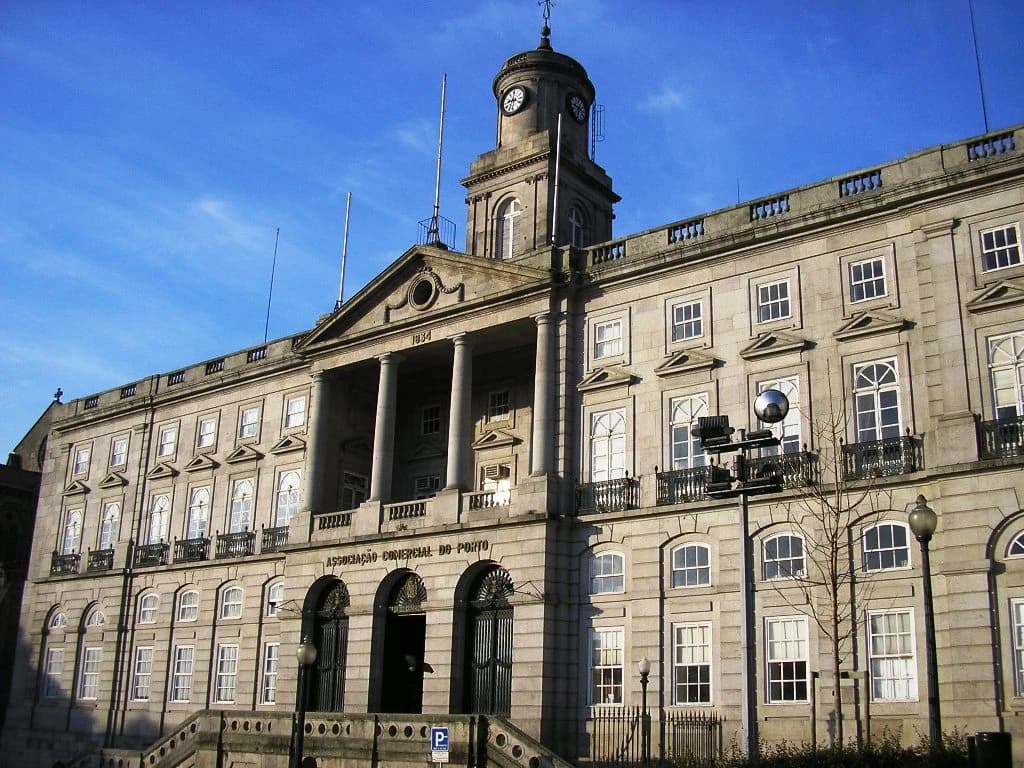
The Palácio da Bolsa is a 19th-century neoclassical building in Porto that served as the city's stock exchange and assembly hall. It is famous for its opulent interiors, most notably the Arab Room.
Palácio da Bolsa is also known as Palacio da Bolsa, Stock Exchange Palace, Palácio da Associação Comercial do Porto, Palacio da Bolsa, and 1 other names in various languages.
This self-guided audio tour features 19 narrated stops organized across 8 sections. As a palace, Palácio da Bolsa offers a unique cultural experience in the heart of Porto, Portugal.
The Stanza audio guide is available in 15 languages and works entirely offline — download the complete tour including audio narration, maps, and images before your visit. As you walk through Palácio da Bolsa, GPS-triggered narration plays automatically at each point of interest.
Last updated:
What you will hear
The Neoclassical Facade and Merchant Origins
Establishing the exterior and the reason for the palace's construction—merchants trading in the open air.
The Square of Discovery
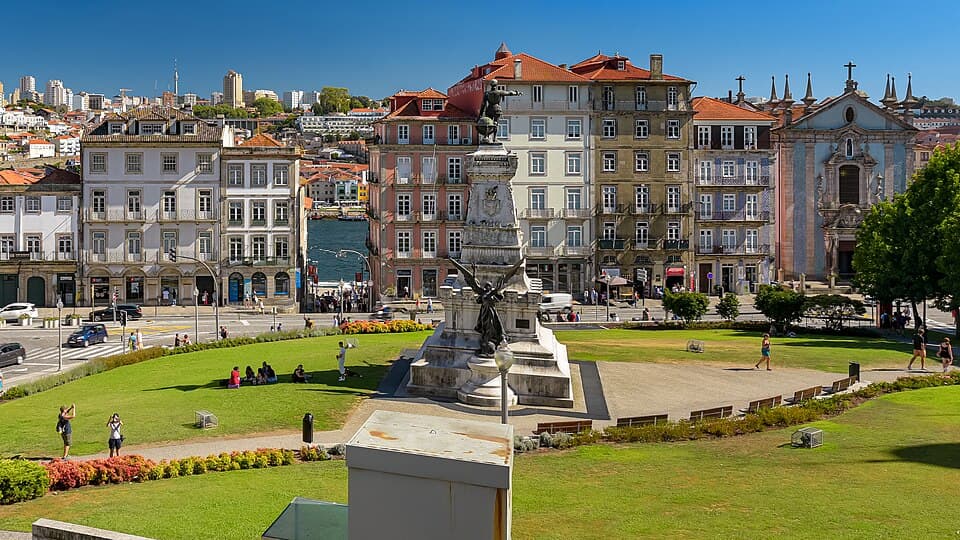
The open space surrounding the palace is known as the Square of Discovery, a location that is deeply significant to Porto’s identity. At the center of the square stands a statue of Prince Henry the Navigator, the figure who anchored Portugal’s age of maritime exploration. This square serves as more than just a decorative entrance; it highlights a crucial evolution in the city's history. The positioning of the Palácio da Bolsa here reflects the transition of Porto's wealth from the era of risky maritime discovery to the establishment of institutional trade and finance. While the early wealth of the city was won on the high seas, the palace represents the era when that wealth was managed, regulated, and grown within the walls of a formal institution. The broad, paved expanse allows the palace to stand in prominence, framed by the surrounding historical buildings. Looking across the square, you can see how the architecture of the palace anchors the space, symbolizing the merchant class's successful claim to the most prestigious ground in the city center.
The Nations' Courtyard
The central hub featuring the massive glass dome and international coats of arms.
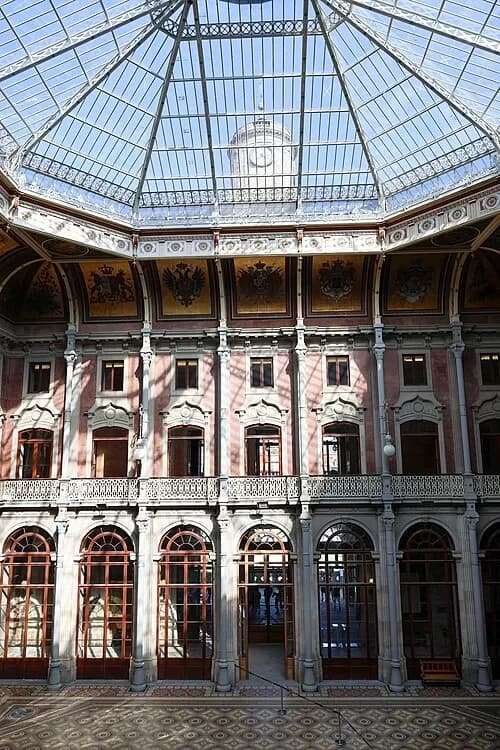
The Nations' Courtyard
Inside the palace, we find ourselves in the heart of the building, known as the Nations’ Courtyard. This central space is defined by its massive octagonal dome, a feat of 19th-century engineering made of metal and glass. This structure was designed to flood the interior with natural light, a stark contrast to the thick stone walls of the exterior. While the main shell of the building was largely finished by 1850, the complex interior details of this courtyard took several more decades to perfect. Look up at the rhythmic arches of the upper gallery that surround the space, creating a sense of height and openness. The scale of the courtyard was intended to be impressive, serving as a hub where merchants from different backgrounds would cross paths. The use of iron in the dome reflects the industrial advancements of the period, signaling that the Commercial Association was modern and forward-thinking. This space acted as the primary circulation area for the palace, connecting the public-facing lower levels with the more exclusive administrative rooms located on the floors above.
The Grand Staircase
A masterpiece of stone carving by Gonçalves e Sousa, leading to the upper floors.
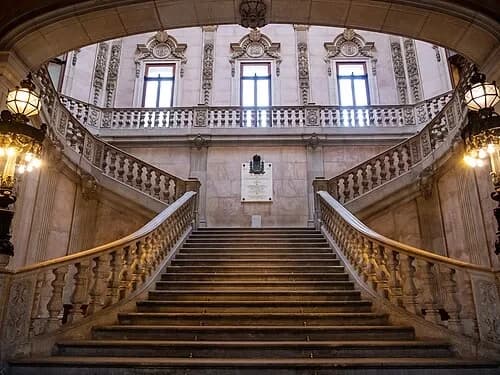
The Grand Staircase
Leaving the public courtyard, we move toward the upper floors via the Grand Staircase. This granite masterpiece was designed by the architect Gonçalves e Sousa and serves as a major transition point within the building. As you begin the ascent, you will notice the staircase branches off in two directions, creating a sense of drama and scale. It was designed to move people efficiently while also making a strong visual statement. At the base, two bronze lamps stand as guardians of the passage, their warm light reflecting off the smooth, polished stone. This staircase acts as a threshold, separating the busy, public-facing courtyard from the more private and exclusive administrative rooms on the second floor. The weight and solidity of the granite provide a feeling of permanence, echoing the architectural style of the facade. It is a space designed for slow, dignified movement, allowing those arriving for important meetings to adjust to the more formal atmosphere of the rooms above. The layout ensures that anyone reaching the top has a clear view back down into the heart of the palace, emphasizing the building's interconnected design.
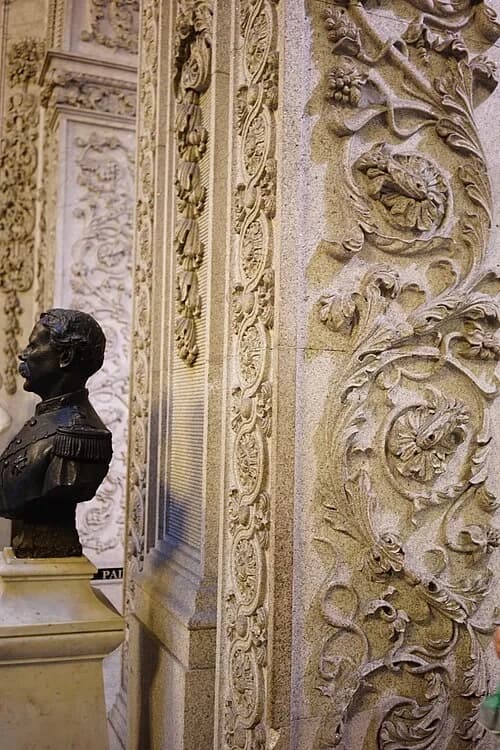
Carved Granite Detail
Focusing on the architectural details surrounding the staircase reveals the high level of craftsmanship involved in the building's construction. The granite pillars are decorated with intricate floral and scrollwork carvings, showing how even the hardest stone could be shaped into delicate patterns by skilled artisans. Flanking the stairs are several bronze busts, which were created by prominent artists such as Soares dos Reis and Teixeira Lopes. These sculptures represent key figures in Portuguese culture and politics, placed here to provide a sense of historical and intellectual weight to the palace. The combination of carved stone and cast metal creates a rich texture that invites closer inspection. These busts weren't just decorative; they served to remind the merchants and visitors of the national identity and the great minds that helped shape the country. The choice of granite, a locally abundant but difficult-to-carve material, was a point of pride for Porto, showing that the city possessed both the natural resources and the artistic talent to create a world-class institutional interior. These details demonstrate that the palace was intended to be a work of art as much as a place of business.
The Library
The intellectual heart of the Commercial Association, housing historic records.
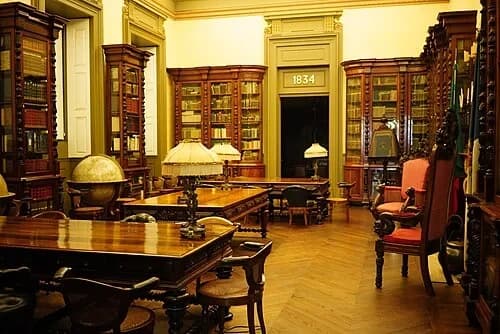
The Association Library
The Association Library served as the intellectual foundation for Porto’s merchants, housing the records and resources needed to manage international trade. Above the door, you can see the inscription '1834,' which marks the year the Commercial Association of Porto was founded. Inside, floor-to-ceiling bookshelves are filled with volumes that document centuries of economic activity. Among the most notable items in the room are the historic globes, which symbolize the international reach and global ambitions of the association's members. The library was a place for quiet study and the careful recording of trade laws, shipping manifests, and economic theory. It represents the transition of commerce from a purely physical activity to a professional and intellectual pursuit. The wood-paneled walls and structured shelving create an atmosphere of serious inquiry. Because trade relied heavily on accurate information, this library was one of the most critical rooms in the building. It ensured that the association’s members were well-informed and capable of navigating the complex world of 19th-century global finance. The presence of these records even today provides a window into how Porto maintained its status as a leading European port.
The Portrait Room and the Masterpiece Table
Home to royal portraits and the famous carved table by Zeferino José Pinto.
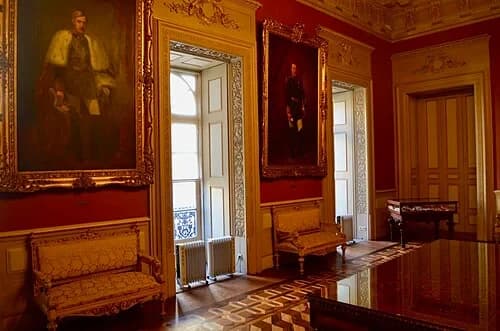
The Portrait Room
The Portrait Room functions as a hall of honor, bridging the world of the merchant class with that of the Portuguese state. The walls are lined with red silk, providing a rich, regal backdrop for the large portraits of Portugal’s last monarchs. These paintings represent the link between the commercial success of the city and the national government, illustrating the palace's role as a site of political and economic importance. The room is furnished with period pieces that match the formal atmosphere, making it one of the most dignified spaces in the building. It was often used for hosting official visitors and high-ranking dignitaries. The presence of the royal portraits served to legitimize the Commercial Association, showing that they operated with the approval and under the protection of the crown. The atmosphere here is hushed and respectful, intended to evoke the grandeur of a royal court rather than a simple place of business. It serves as a reminder that the merchants of Porto were not just traders, but influential figures who played a key role in the broader national narrative of the 19th century.
The Tribunal Room
Where commercial disputes were settled, featuring massive historical murals.
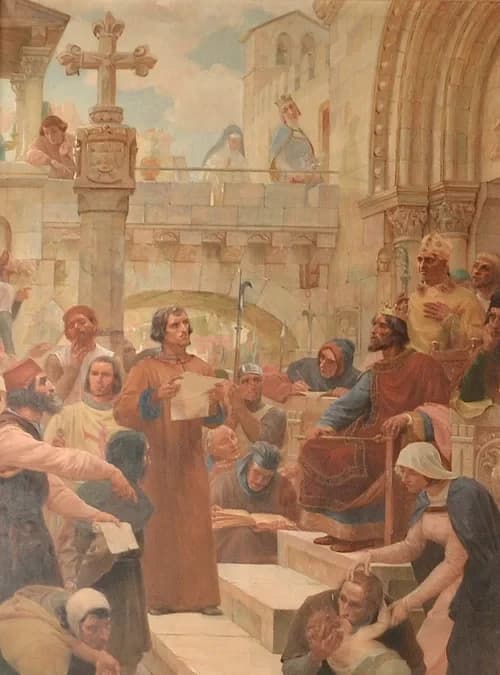
King Dinis Practicing Justice
Veloso Salgado · 1899
Among the murals in the Tribunal Hall, the scene depicting King Dinis practicing justice is particularly significant. Known as 'The Farmer King' for his efforts to improve Portuguese agriculture and trade, Dinis is shown here sitting on his throne, listening to and judging his subjects. This historical reference was a deliberate choice by the palace's designers. By featuring a monarch renowned for his fairness and his support of the country’s development, the Commercial Association sought to legitimize its own merchant tribunal. It suggested that the justice handed down within these walls was part of a long and honorable Portuguese tradition dating back to the Middle Ages. The painting is rich in detail, showing various members of the public seeking the King's wisdom, which mirrored the merchants seeking resolution to their modern commercial conflicts. This connection to the past helped build trust in the tribunal’s decisions. The mural serves as a moral anchor for the room, reminding those who worked here that the pursuit of economic success must always be balanced by the fair and consistent application of the law.
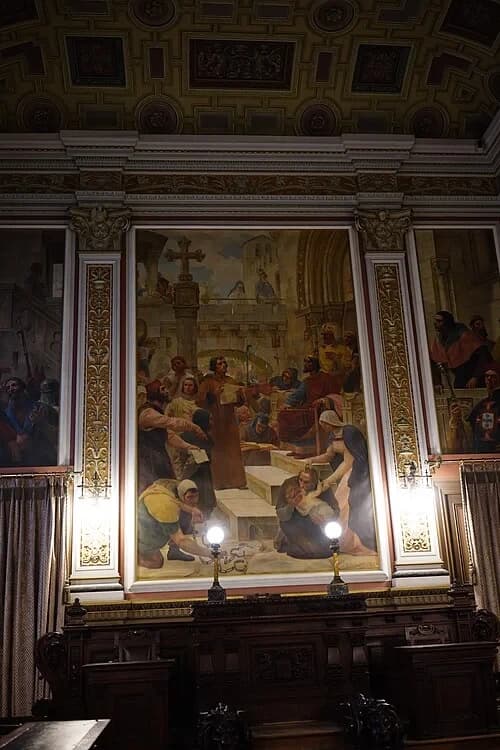
The Tribunal Hall
The Tribunal Hall highlights the unique judicial role that the Palácio da Bolsa once played. This was the space where commercial disputes between merchants were settled, functioning as a specialized court for trade matters. The room is dominated by massive murals painted by Veloso Salgado, which cover the walls and depict the historical evolution of justice. These paintings were intended to provide a backdrop of moral and legal authority for the proceedings that took place here. Notice the seating arrangement, which is formal and somewhat reminiscent of a church choir. The judges would sit in these elevated, structured benches to oversee the cases. This layout emphasized the solemnity of the law and the fairness of the merchant tribunal. By handling their own disputes internally, the Commercial Association could ensure that cases were decided by those who understood the complexities of trade, rather than general civil judges. The combination of the grand murals and the formal furniture makes the hall feel like a temple of justice, reinforcing the idea that honesty and fair dealing were the cornerstones of Porto’s commercial success.
The General Assembly Room
A neoclassical hall where major decisions for the Commercial Association were made.
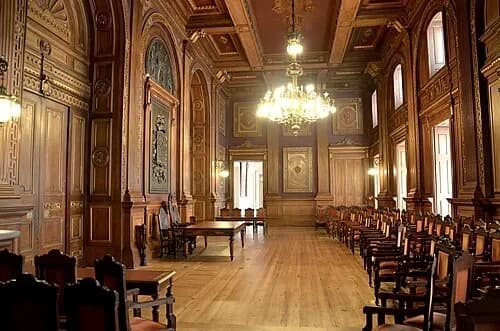
The General Assembly Room
The General Assembly Room is characterized by its strict Neoclassical order, but it contains a clever architectural secret. While the walls appear to be covered in intricate plaster moldings and stone-like details, they are actually made of wood. The surfaces were painted using a technique called 'trompe-l'œil,' or 'trick of the eye,' to make the wood resemble carved plaster. This technique allowed for a highly decorative finish that was lighter and easier to install than heavy masonry. This room served as the meeting place for the full membership of the Commercial Association. It was here that the merchants would gather to vote on major policies, elect their leaders, and discuss the association’s future. The formal, ordered design of the room was intended to foster a sense of serious, democratic debate among the city's commercial elite. The contrast between the simulated materials and the real function of the room reflects the 19th-century love for architectural illusion. As you look around, it is difficult to tell where the real carving ends and the painted detail begins, a testament to the skill of the decorative painters who worked on the palace’s interior.
The Arab Room
The palace's crown jewel, a Moorish Revival masterpiece used for state receptions.
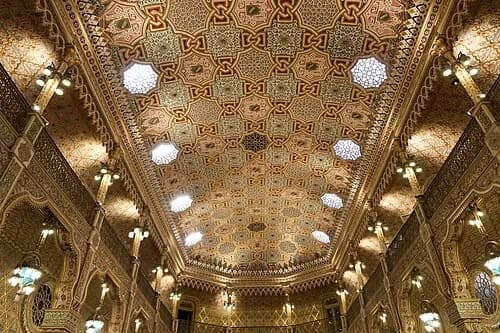
Moorish Revival Ceiling
Raising your eyes to the ceiling reveals the most complex part of the Arab Room's Moorish Revival design. The surface is a dizzying array of geometric shapes and interlocking patterns that seem to shift as you move across the room. Notice the three-dimensional stucco carvings hanging down at specific points; these are known as muqarnas, or stalactite vaulting. This technique is a hallmark of Islamic architecture, designed to break up flat surfaces and create a sense of infinite depth. The entire ceiling is unified by a rich color palette of gold, blue, and red, applied with meticulous precision. Within these patterns, you can find repeating Arabic inscriptions. These stylized phrases typically translate to "Glory to God," a common feature of the original Alhambra designs that were copied by European architects during the era of Exoticism. In the 1800s, incorporating these Eastern elements was seen as a mark of cultural prestige and global awareness. The way the light from the chandeliers plays off these raised surfaces and gilded edges was intended to impress the foreign merchants and heads of state who were once entertained beneath this roof.
Want to hear the rest?
Download the Stanza app to unlock all 19 stops and full GPS-guided navigation.
Frequently Asked Questions
How long does the Palácio da Bolsa audio tour take?
The Palácio da Bolsa audio guide includes 19 narrated stops. Most visitors spend 45 minutes to 1.5 hours exploring the complete tour, though you can listen at your own pace and skip or revisit any stop.
Is the Palácio da Bolsa audio guide available in my language?
Stanza supports 15 languages: English, Spanish, French, German, Italian, Portuguese, Russian, Japanese, Chinese, Korean, Arabic, Hindi, Polish, Dutch, Hebrew. Check the guide in the app to confirm the languages currently available for this tour.
Can I use the audio guide offline at Palácio da Bolsa?
Yes! Download the complete Palácio da Bolsa tour — including all audio, maps, and images — before your visit. The Stanza app works completely offline, so you don't need WiFi or mobile data at the venue.
How much does the Palácio da Bolsa audio guide cost?
The Stanza app is free to download. Free and paid audio guides are available; current prices are shown in the app.
How do I use the Stanza audio guide at Palácio da Bolsa?
Download the free Stanza app, search for "Palácio da Bolsa", and download the tour. When you arrive at the venue, the app uses GPS to detect your location and automatically plays the relevant narration as you move between points of interest — completely hands-free.
What makes the Stanza audio guide different from other Palácio da Bolsa tours?
Stanza offers GPS-triggered narration that plays automatically as you walk through Palácio da Bolsa — no need to manually select stops. The tour is available in 15 languages, works fully offline, and includes 19 expertly narrated stops with images and historical context.
What other audio guides are available near Palácio da Bolsa?
Stanza offers multiple audio guides in Porto, Portugal and nearby areas. After downloading the app, browse the map to discover all available tours near Palácio da Bolsa. Each guide can be downloaded for offline use.