Languages
15Torre dos Clérigos Audio Guide
Torre dos Clérigos is a landmark in Porto, Portugal. Explore it with Stanza's GPS-triggered offline audio guide — available in 15 languages.
Quick Facts
22
Stops
15
Languages
100%
Offline
📍 Porto, Portugal · 41.1457°N, -8.6146°E
About Torre dos Clérigos
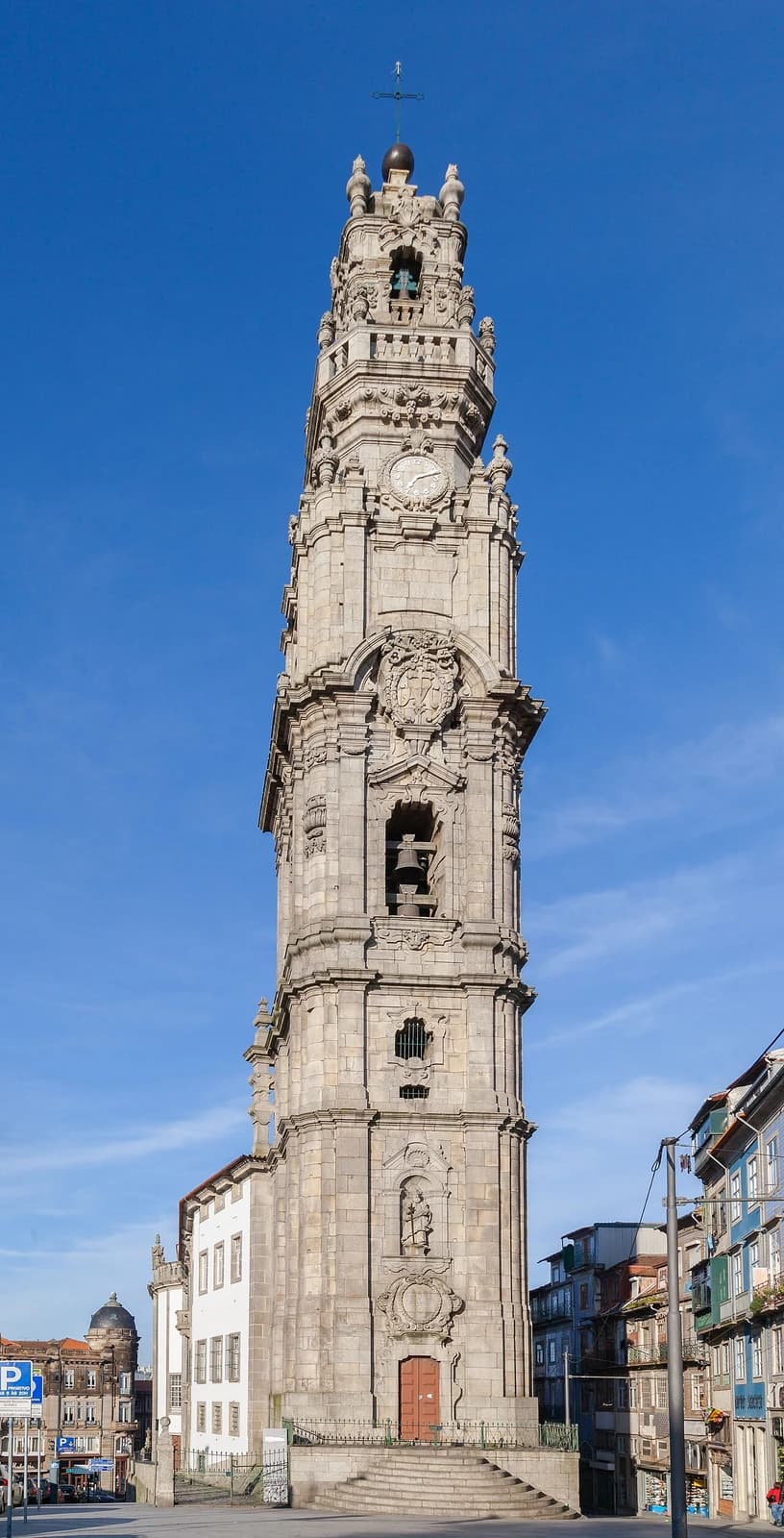
The Clérigos Tower is a prominent baroque bell tower that serves as one of the most iconic landmarks in the city of Porto. It is part of the Clérigos Church complex and offers panoramic views of the historic city center.
Torre dos Clérigos is also known as Torre dos Clerigos, Torre dos Clérigos.
This self-guided audio tour features 22 narrated stops organized across 8 sections. As a tower, Torre dos Clérigos offers a unique cultural experience in the heart of Porto, Portugal.
The Stanza audio guide is available in 15 languages and works entirely offline — download the complete tour including audio narration, maps, and images before your visit. As you walk through Torre dos Clérigos, GPS-triggered narration plays automatically at each point of interest.
Last updated:
What you will hear
The Iconic Baroque Silhouette
Beginning at the exterior to establish the tower's scale and its history as the 'Yard of the Hanged'. Includes the primary POI image and a historical shot for context.
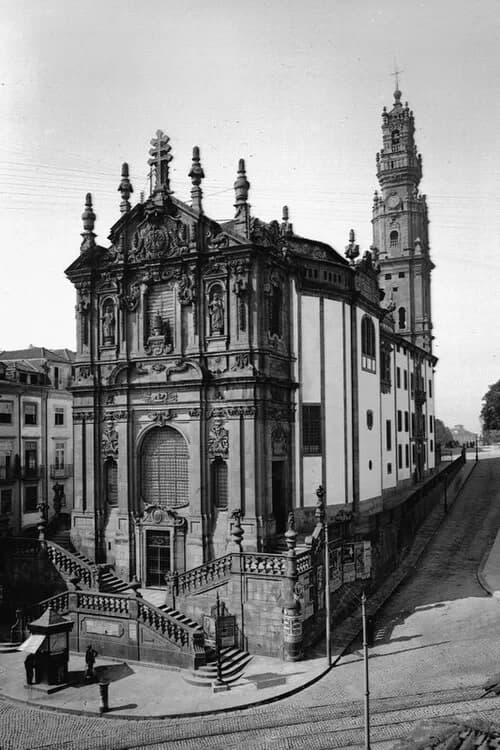
The Yard of the Hanged
The ground beneath the Clérigos complex carries a heavy history. Before the first stone was laid, this area was known as the 'Adro dos Enforcados,' or the 'Yard of the Hanged.' It was here that the city of Porto carried out death sentences, making it a place of somber significance for centuries. The Brotherhood of the Clérigos deliberately chose this site for their new headquarters, perhaps to reclaim and sanctify a place associated with death. The transformation began in 1732 when work started on the church. The construction was a massive undertaking that spanned several decades, reflecting the complexity of Nasoni’s design. While the church was finished earlier, the entire ensemble, including the soaring bell tower, was not completed until 1763. This thirty-year timeline saw the site evolve from a bleak execution ground into a center for religious life and social charity. Today, the bustling atmosphere of the surrounding square stands in stark contrast to the dark events that once took place here, though the name remains in the city’s historical records as a reminder of the site’s origins and its dramatic evolution over the centuries.
The Church of the Brotherhood
Focusing on the church building and the Brotherhood's mission. Uses the verified church POI image.
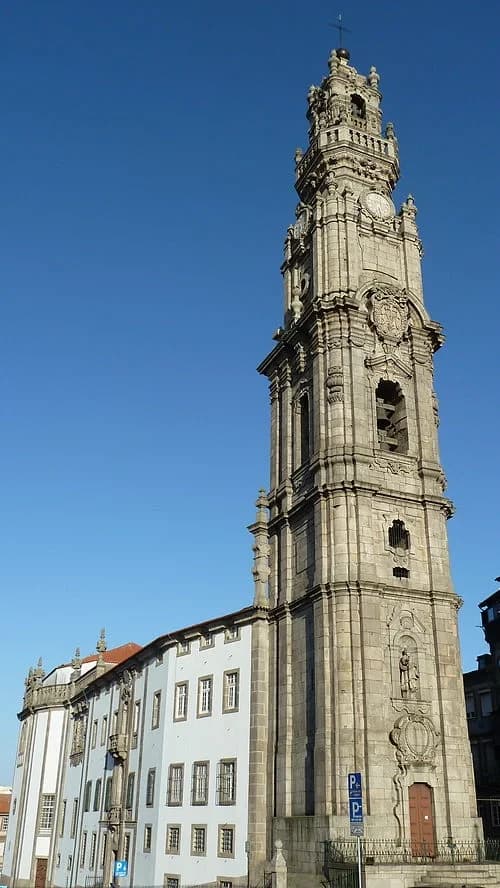
Nasoni's Masterpiece
For Nicolau Nasoni, the Clérigos project was more than just a commission; it was the work of a lifetime. He spent over thirty years overseeing every detail of the construction, from the layout of the church to the final spire of the tower. His bond with the Brotherhood was so strong that he requested to be buried within the complex he created. For centuries, the exact location of his remains was a mystery, leading to various legends and theories among local historians. However, during a major renovation and conservation project in recent years, researchers and archaeologists identified a small crypt beneath the floor. While not a lavish monument, the evidence suggests this is indeed the final resting place of the Italian master. It is a fitting end for a man who shaped so much of the city's character. By choosing to be buried here, Nasoni ensured he would always be part of his greatest architectural achievement. His presence remains woven into the very granite of the building, a silent witness to the millions of people who come to admire his masterpiece long after his death in the city he helped design.
The Architect's Entrance
At the base of the tower where visitors begin the climb. This area highlights the Saint Paul statue and the architect Nicolau Nasoni's connection to the site.
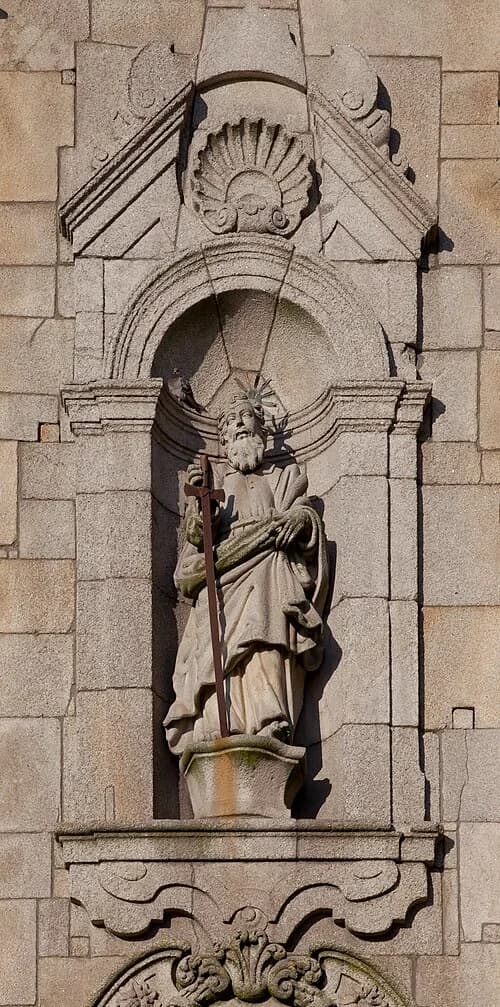
The Statue of Saint Paul
Just above the main entrance to the tower sits a carved figure of Saint Paul. In religious art, saints are often identified by specific attributes or symbols associated with their lives; for Paul, this is the sword he holds. This weapon represents his martyrdom, but it also serves as a symbol of the 'sword of the Spirit,' a reference to his theological writings. The niche housing the statue is surrounded by exuberant stonework, featuring deep carvings and flowing architectural lines that characterize the late Baroque period. The way the stone seems to fold and curve around the figure is typical of Nasoni’s style, making even the hard granite appear somewhat fluid. This statue is one of many decorative layers that add to the tower's prestige. While the tower’s primary function was to house bells and act as a landmark, these artistic additions ensured it was also a monument to faith. The placement of a prominent apostle at the very start of the ascent reminds every visitor of the religious purpose of the Brotherhood who built this impressive structure. The intricate carvings around the niche demonstrate the high level of masonry achieved by the local artisans.
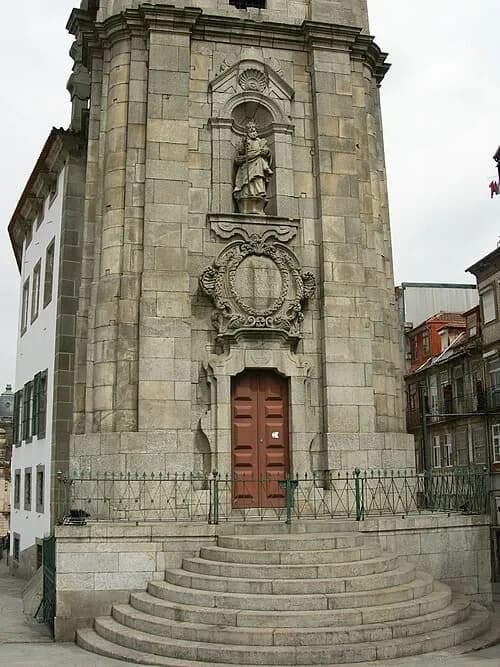
The Tower Base
To begin the climb, one must pass through a heavy wooden door set into the massive granite foundations. At this level, the walls are at their thickest, designed to support the immense weight of the seventy-five-meter structure pressing down from above. The granite used here is a hallmark of northern Portuguese architecture, prized for its durability but incredibly difficult to carve and move. From this entrance, a total of 225 steps lead to the upper balconies. Unlike modern skyscrapers with steel skeletons, this tower relies entirely on the strength of these interlocking stone blocks. As you enter, the transition from the bright, open square to the enclosed interior of the tower is immediate. The air becomes cooler, and the sounds of the city begin to fade, replaced by the echoes of footsteps on stone. This base serves as the anchor for the entire spire, rooted deep into the hillside. It is the starting point for a journey that takes you from the bustling street level to a height that, for nearly two centuries, was unmatched by any other man-made structure in the country. The weight of the stone here is a testament to the endurance of the materials.
The Bell Chamber
Exploring the massive carillon of 49 bells and the tower's history as the city's timekeeper via the 'Noon Signal'.
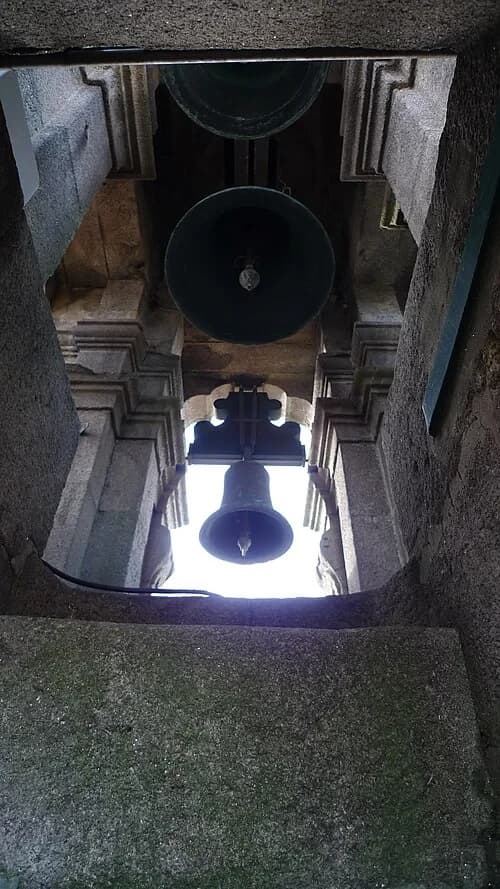
The Carillon Chamber
Reaching the bell level brings you into the musical heart of the tower. While the tower has always held bells, the massive carillon you see today, consisting of 49 distinct bells, was acquired in 1995. This addition transformed the tower into a sophisticated musical instrument capable of playing complex melodies across several octaves. In earlier centuries, ringing the bells was a grueling physical task. Professional ringers would use heavy ropes to swing the enormous bronze castings, signaling the time of day, religious festivals, or even emergencies like fires. Today, the carillon is played via a keyboard or programmed electronically, but the role of the tower remains the same: to communicate with the entire city through sound. The largest bells are positioned to project their deep tones across the Douro River, while the smaller ones provide the intricate notes of the carillon melodies. This tradition of public sound was vital before the age of personal watches and smartphones, keeping the rhythm of daily life in sync. Standing here, surrounded by the silent giants of bronze, you get a sense of the acoustic power they hold when they are finally set into motion over the rooftops.
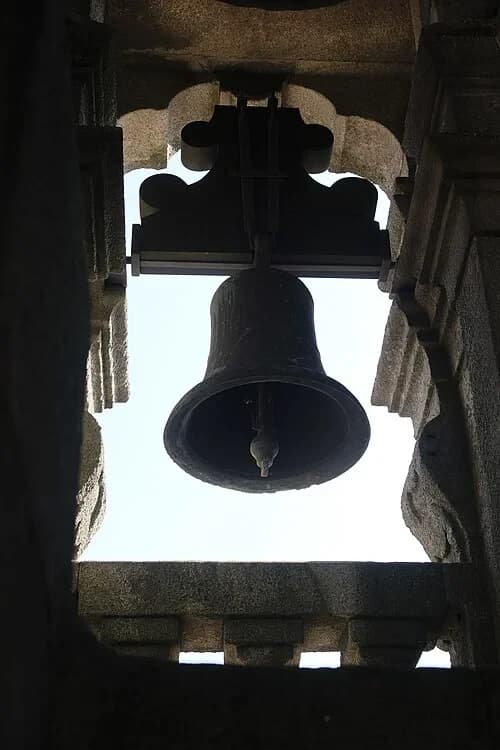
The Noon Signal
In a tradition that lasted for decades, the tower was responsible for synchronizing the lives of the city's citizens. At exactly mid-day, a specialized signal was fired from the tower—not by a bell, but by a daily shot of dry gunpowder. This 'Noon Signal' was visible and audible across the urban landscape, allowing shopkeepers, workers, and ship captains on the river to set their clocks accurately. It was a vital public service in an era when precise timekeeping was essential for trade and navigation. From this close-up perspective, you can see the dark, weathered patina on the surface of the bells. This greenish-black coating is a natural layer of oxidation that forms on bronze over time, protecting the metal from further corrosion. It is a visual record of the bells' long exposure to the salty Atlantic air that drifts up the river valley. While the daily gunpowder shot is a thing of the past, the bells still perform their duty as timekeepers. The marks of history on their surfaces, along with the story of the noon signal, highlight how this tower was once much more than a landmark; it was a functional piece of essential urban technology.
Reaching the Summit
The upper levels of the tower, showing the clock and the final architectural details before the viewpoint.
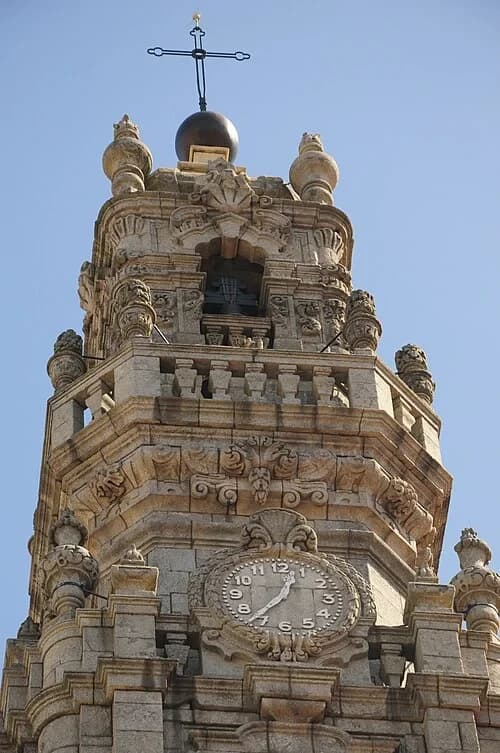
The Tower Clock
Visible from almost anywhere in the city, the tower’s clock has guided the schedule of the residents for over two hundred years. The clock face itself is framed by a decorative stone wreath, a common Baroque motif that adds a layer of elegance to this functional feature. Above the clock, the spire culminates in a large iron cross, a symbol of the Brotherhood’s faith that reaches toward the sky. Interestingly, the tower’s height and prominent position served a more practical, secular purpose in the 18th century: it functioned as a lighthouse. Ships navigating the treacherous mouth of the Douro River used the silhouette of the tower by day and lanterns placed in its upper windows by night to guide their way toward the city docks. This made the tower a vital part of the local maritime economy, helping sailors avoid the dangerous sandbars and rocks of the river entrance. Today, while it no longer guides ships, it remains a central point of reference for everyone in the city. The combination of the time-keeping clock, the guiding light, and the religious cross encapsulates the various ways this structure has served the community throughout its long history.
Overlooking the Nave
A unique perspective from the tower looking down at the elliptical roof of the church, highlighting Nasoni's unusual design.
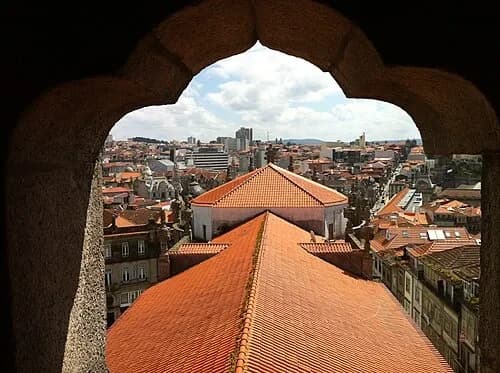
View Over the Nave
From this height, you have a unique perspective on the roof of the church, which reveals a shape that is impossible to fully appreciate from the street. Instead of a traditional rectangular or cross-shaped floor plan, Nasoni designed the church with an elliptical nave. This was a daring choice in the 18th century, as elliptical buildings are significantly more difficult to engineer and roof than those with straight walls. For Nasoni, the curve was essential to the Baroque experience. Inside the church, the oval shape creates a sense of continuous movement and drama, drawing the eye toward the altar without the interruption of sharp corners. From up here, the red-tiled roof traces this graceful curve perfectly, showing how the building sits harmoniously on its hillside plot. This architectural trick makes the interior feel much more spacious and dynamic than its external footprint suggests. It is a hallmark of Nasoni’s genius, using complex geometry to create a theatrical atmosphere that reflects the exuberant spirit of the age. Looking down, you can see how the church acts as a bridge between the city’s streets and the soaring tower where you now stand.
The 360-Degree Panorama
The primary visitor experience: the panoramic view of Porto's historic center and the Douro River.
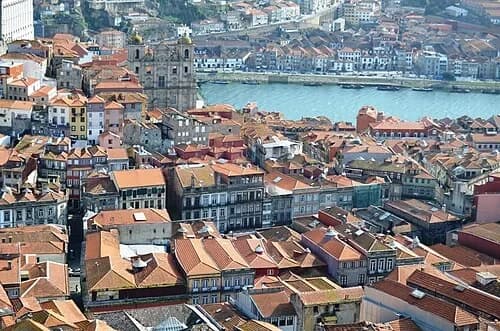
The 360-Degree Panorama
Reaching the highest accessible point of the tower offers a perspective that few other locations in Porto can match. At 75 meters above ground level, the sensory experience is distinct; the constant coastal wind often whips around the granite balustrades, and the bustling noise of the city streets is muted, arriving as a distant hum. Looking toward the south, the Douro River comes into sharp focus, its dark waters snaking through the valley toward the Atlantic Ocean. Along its banks, the Ribeira district stands out with its colorful facades and riverside promenades. This area was once the commercial gateway of Porto, where ships laden with wine and textiles would dock. The sheer height of the tower allows you to appreciate the topographical challenges the city's inhabitants have navigated for generations, with roads winding and dipping following the natural contours of the land. The balcony provides a full circular walk, ensuring that no part of the surrounding landscape remains hidden. From here, the relationship between the city, the river, and the ocean beyond becomes immediately clear.
Back to the Streets
Concluding the tour by descending and exiting into the historic Rua de Trás, grounding the visitor back in the city center.
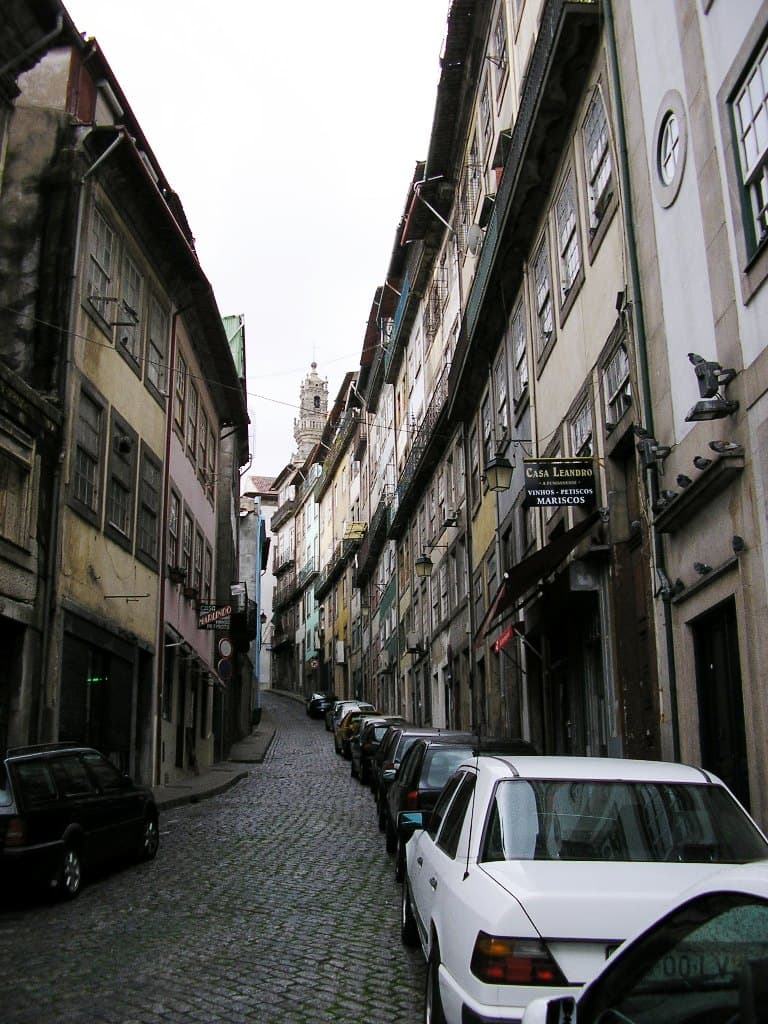
The View from Rua de Trás
As you move back toward street level and wander into the surrounding neighborhoods like Rua de Trás, the perspective of the tower shifts dramatically. In these narrow, medieval corridors, the tall granite structure becomes a recurring landmark, visible through gaps between tall, thin buildings. For generations of Porto's inhabitants, the tower has functioned as an essential urban beacon. Even without a map, one could find their way back to the city center by simply looking up and locating Nasoni's spire above the rooftops. The streets here follow ancient patterns, often too narrow for modern vehicles, creating a sense of being enclosed by history. From these low angles, the tower seems even more immense, its carved details standing out against the clear blue sky. It provided a sense of orientation for merchants returning from the docks or residents navigating the city after dark. The relationship between the towering height of the spire and the intimate, cramped scale of the medieval streets is a defining characteristic of Porto's urban experience. The dark, weathered stone at the base of the tower anchors these nearby lanes, acting as a fixed point in a constantly changing city.
Want to hear the rest?
Download the Stanza app to unlock all 22 stops and full GPS-guided navigation.
Frequently Asked Questions
How long does the Torre dos Clérigos audio tour take?
The Torre dos Clérigos audio guide includes 22 narrated stops. Most visitors spend 45 minutes to 1.5 hours exploring the complete tour, though you can listen at your own pace and skip or revisit any stop.
Is the Torre dos Clérigos audio guide available in my language?
Stanza supports 15 languages: English, Spanish, French, German, Italian, Portuguese, Russian, Japanese, Chinese, Korean, Arabic, Hindi, Polish, Dutch, Hebrew. Check the guide in the app to confirm the languages currently available for this tour.
Can I use the audio guide offline at Torre dos Clérigos?
Yes! Download the complete Torre dos Clérigos tour — including all audio, maps, and images — before your visit. The Stanza app works completely offline, so you don't need WiFi or mobile data at the venue.
How much does the Torre dos Clérigos audio guide cost?
The Stanza app is free to download. Free and paid audio guides are available; current prices are shown in the app.
How do I use the Stanza audio guide at Torre dos Clérigos?
Download the free Stanza app, search for "Torre dos Clérigos", and download the tour. When you arrive at the venue, the app uses GPS to detect your location and automatically plays the relevant narration as you move between points of interest — completely hands-free.
What makes the Stanza audio guide different from other Torre dos Clérigos tours?
Stanza offers GPS-triggered narration that plays automatically as you walk through Torre dos Clérigos — no need to manually select stops. The tour is available in 15 languages, works fully offline, and includes 22 expertly narrated stops with images and historical context.
What other audio guides are available near Torre dos Clérigos?
Stanza offers multiple audio guides in Porto, Portugal and nearby areas. After downloading the app, browse the map to discover all available tours near Torre dos Clérigos. Each guide can be downloaded for offline use.