Languages
15Palácio Nacional de Queluz Audio Guide
Palácio Nacional de Queluz is a landmark in Queluz, Portugal. Explore it with Stanza's GPS-triggered offline audio guide — available in 15 languages.
Quick Facts
13
Stops
15
Languages
100%
Offline
📍 Queluz, Portugal · 38.7504°N, -9.2582°E
About Palácio Nacional de Queluz
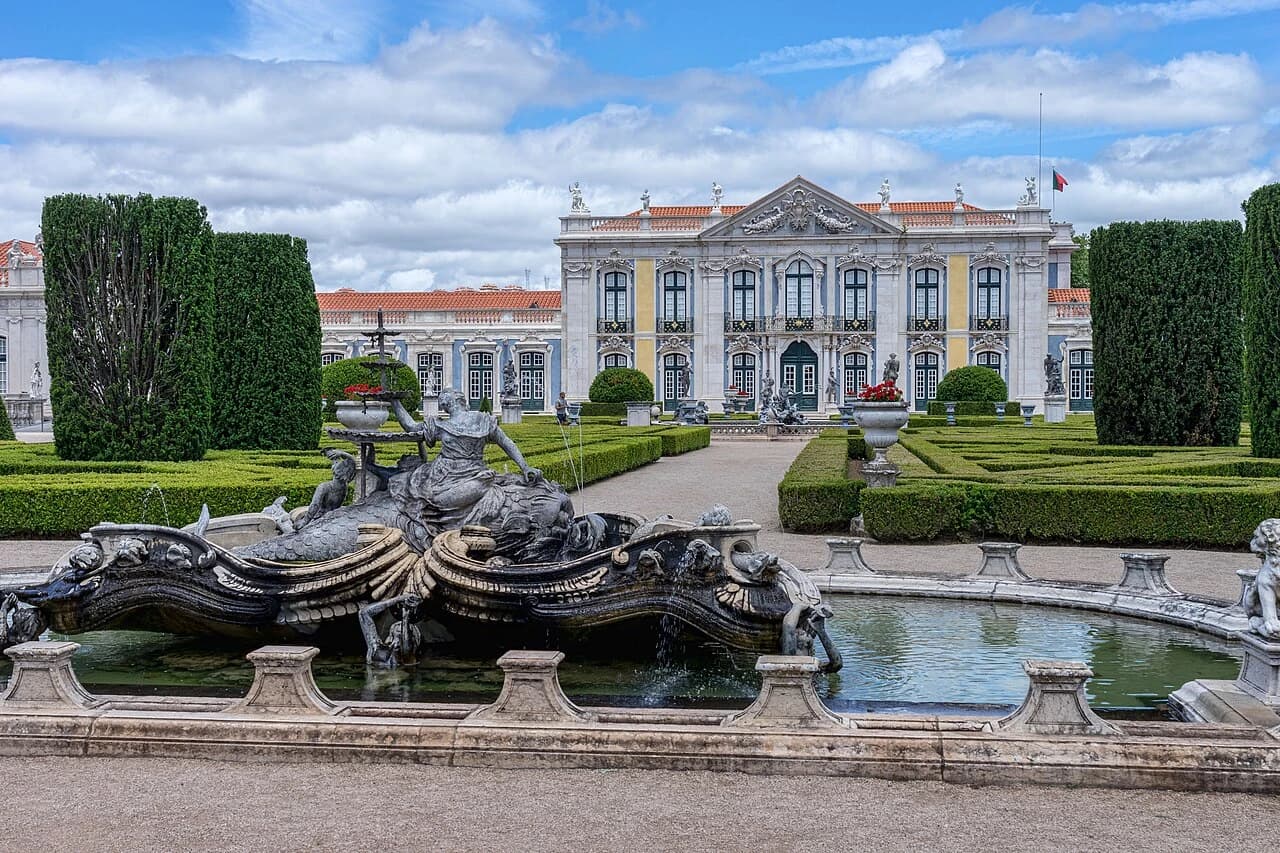
The Palace of Queluz is an 18th-century royal palace that served as the official residence of the Portuguese royal family. It is renowned for its Rococo architecture and extensive formal gardens.
Palácio Nacional de Queluz is also known as Queluz National Palace, Palácio de Queluz, Palácio Real de Queluz, Palácio Nacional de Queluz.
This self-guided audio tour features 13 narrated stops organized across 9 sections. As a royal palace, Palácio Nacional de Queluz offers a unique cultural experience in the heart of Queluz, Portugal.
The Stanza audio guide is available in 15 languages and works entirely offline — download the complete tour including audio narration, maps, and images before your visit. As you walk through Palácio Nacional de Queluz, GPS-triggered narration plays automatically at each point of interest.
Last updated:
What you will hear
Cour d'honneur and the Ceremonial Façade
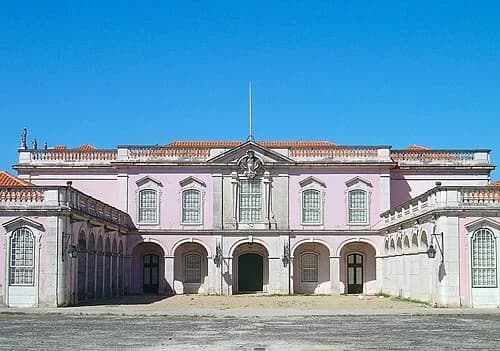
Start the tour at the main entrance courtyard to establish the palace's public face and the history of its residents. Use the verified POI for Maria I and a wide shot of the pink Rococo facade.
The Ceremonial Façade
The Ceremonial Façade often draws comparisons to the great royal estates of Europe, earning it the nickname the 'Portuguese Versailles.' Construction on this grand residence began in 1747 under the direction of architect Mateus Vicente de Oliveira. He was tasked with creating a summer retreat that balanced royal elegance with the practical needs of the Portuguese court. One of the most striking features is the characteristic 'Queluz pink' of the exterior walls, a shade that has become synonymous with the palace’s identity. If you observe the layout, you will see that the wings are relatively low and spread out across the landscape. This was not merely an aesthetic choice; it was a deliberate architectural response to the 1755 Great Lisbon Earthquake. By keeping the structures low to the ground, the builders aimed to provide greater stability against future seismic activity. This façade was designed to impress visiting dignitaries, serving as the formal entrance to a world of Rococo luxury that was shielded from the public world.
The Palace Chapel
Visit the first part of the palace to be completed, emphasizing its central role in court life.
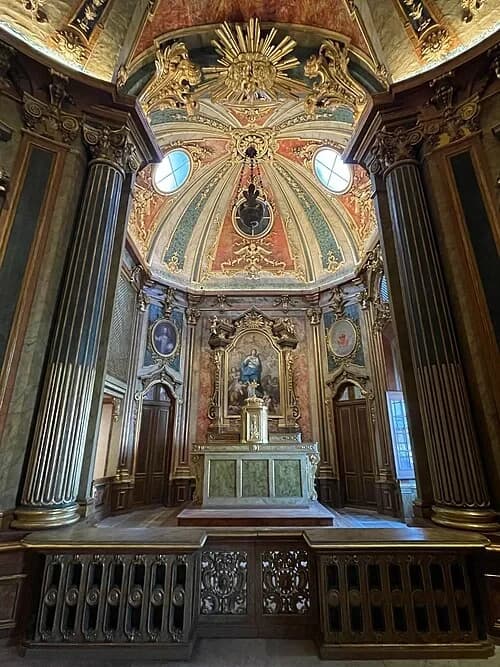
The Palace Chapel
The Palace Chapel was the first part of the complex to be completed, and it serves as a stunning introduction to the internal opulence of Queluz. While the exterior remains relatively modest, the interior offers a dramatic transition into an explosion of gold leaf and intricate Rococo carving. This decorative intensity reflects the deep religious devotion of the Portuguese court during the 18th century. The large onion-domed ceiling draws the eye upward, complementing the ornate altar that dominates the space. Every surface is detailed with gilded woodwork, a style that would eventually spread to the rest of the palace's state apartments. For the royal family, this was not just a place for formal ceremonies, but a space for daily prayer and spiritual reflection. The chapel stood as a constant reminder of the divine authority that supported the monarchy, blending religious tradition with the high-fashion artistic styles of the era. The craftsmanship here set the standard for the grand renovations that followed throughout the century.
The Throne Room
Enter the first of the great state rooms to showcase the opulence of the Portuguese court.
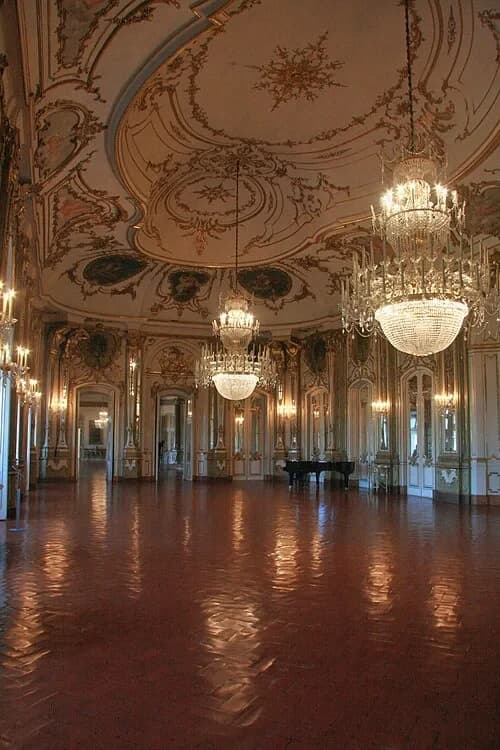
The Throne Room
The Throne Room is the largest and most magnificent of the state apartments at Queluz. Designed specifically for grand receptions and balls, the room is meant to overwhelm guests with its scale and detail. The walls are lined with mirrors and mirrors designed to reflect the light from massive crystal chandeliers, which would have sparkled brilliantly during evening candlelit events. Much of the incredible wealth displayed here, particularly the intricate gilded carvings, was generated by gold brought back from the Portuguese colony of Brazil. This wealth funded the artisans who spent years finishing the ornate wood and plasterwork. Beneath your feet, the red-tiled floor provides a warm contrast to the heavy gold of the walls. In this space, the monarchy could perform its most important public duties, surrounded by the physical evidence of their empire's reach. The room's architecture and decor were carefully coordinated to ensure that any visitor would immediately understand the power and prosperity of the Portuguese crown at its height.
The Music Room and the Mad Queen
Use this room to bridge the gap between grand court entertainment and the personal tragedy of Queen Maria I.
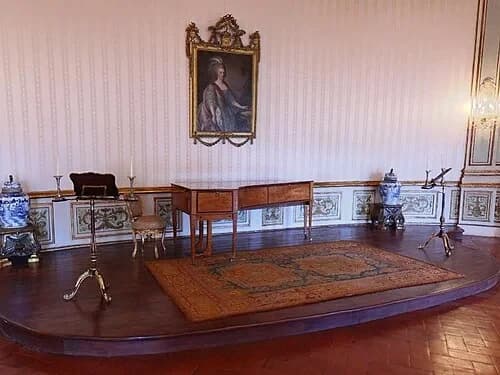
The Music Room
The Music Room reflects the deep passion the 18th-century Portuguese court had for opera and chamber music. This room was frequently filled with the sounds of court musicians performing for the royal family and their guests. You can see a fortepiano here, a precursor to the modern piano, which was central to these intimate performances. However, the story of this room changed as Queen Maria I’s mental health began to decline. The space transitioned from a site of public spectacle to a place of personal tragedy. Reportedly, the Queen would retreat here for hours of silence and prayer, away from the demands of the court. The portrait of the Queen overlooking the room serves as a reminder of her presence during those difficult years. For Maria, music and the familiar surroundings of this room provided a rare form of comfort as her condition worsened. This transition from a lively social hub to a quiet place of solitude mirrors the broader shift of the palace itself, which moved from a summer party house to a place of royal confinement.

Portrait of Queen Maria I
Giuseppe Troni · 1783 · oil paint
This portrait allows us to look past the royal titles at the woman behind the monarchy. Maria I is depicted in elaborate 18th-century attire, with pearls woven into her hair, symbolizing her high status and the wealth of her era. She was the first woman to rule Portugal in her own right, a historic achievement that was eventually overshadowed by the mental illness that defined her later life. Her decline into what was then called 'madness' was exacerbated by a series of profound personal losses, including the deaths of her husband, King Pedro III, and her eldest son, the heir to the throne. These tragedies, combined with the political pressures of the time, took a heavy toll on her. Despite her rank, she spent her final years at Queluz hidden from the public eye, living in a world of religious devotion and seclusion. This painting captures her during a time of formal authority, yet the history of the palace tells the story of the quiet, secluded life she was eventually forced to lead within these very walls.
The Hall of Ambassadors
Highlight the diplomatic heart of the palace, noted for its unique architectural features.
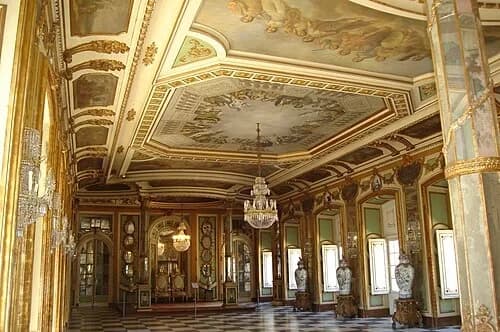
Hall of Ambassadors
The Hall of Ambassadors served as the diplomatic heart of the palace, where foreign dignitaries were formally received by the monarch. The room is characterized by its striking black-and-white marble chequerboard floor, which leads the eye toward the throne dais set within an apse at the end of the hall. The architecture here is designed to emphasize the authority and dignity of the crown. This room is also the site of one of the most pivotal moments in Portuguese history. In 1807, as Napoleon’s armies advanced across Europe toward the border, the royal family gathered here for a fateful meeting. It was in this hall that they made the unprecedented decision to flee to Brazil, effectively moving the seat of the empire across the Atlantic. This move changed the course of both Portuguese and Brazilian history forever. Standing in this space, you are at the site where a centuries-old European monarchy chose to abandon its home to preserve its lineage, leaving this grand palace behind as the French invaders approached.
The Tiled Corridor
Explore the Sala das Mangas, a transition space famous for its Portuguese azulejos.
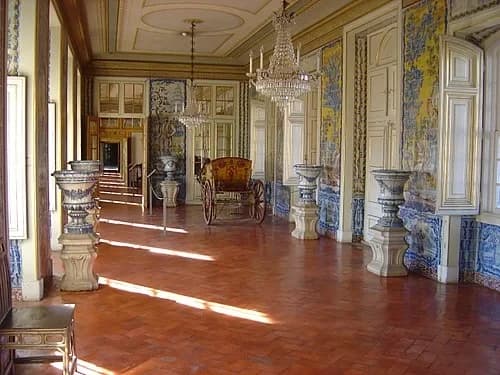
Corridor of Sleeves
The 'Sala das Mangas,' or Corridor of Sleeves, is famous for its extensive collection of blue-and-white azulejos, the traditional glazed tiles of Portugal. These 18th-century tiles are not merely decorative; they serve as a visual narrative of the kingdom. As you walk through, you can find scenes depicting the four seasons, traditional royal hunts, and landscapes representing Portugal's distant overseas colonies. The unusual name of the corridor comes from the 'mangas,' or glass sleeves, that were once used to protect the wall candles. In an era before electricity, these glass protectors were essential for preventing drafts from blowing out the candles, ensuring the long corridor remained lit during the evening. The combination of the reflective tiles and the candlelight would have created a bright, impressive passage for members of the court. These tiles are a prime example of the high level of artistry achieved by Portuguese tile-makers, blending domestic traditions with themes of international exploration and the natural world, all within the private hallways of the royal residence.
The Don Quixote Room
Visit the King's Bedroom, famous for its circular design and royal history.
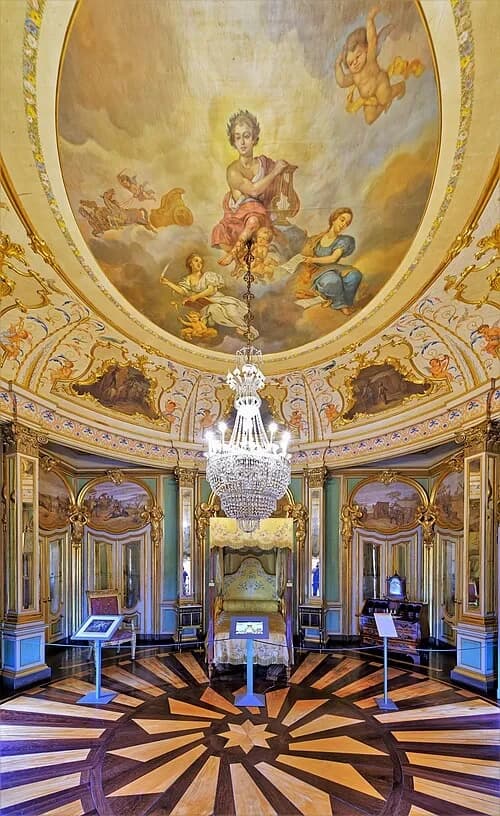
King Pedro IV Bedchamber
The bedchamber of King Pedro IV is one of the most architecturally unique spaces in the palace. It is famous for a clever circular illusion created by mirrored columns that make the room appear far larger and more perfectly symmetrical than it is. Looking up, you will see ceiling murals depicting scenes from the legendary story of Don Quixote, adding a literary and whimsical element to the royal quarters. Beyond its visual tricks, the room holds great historical significance due to a rare symmetry of life: King Pedro IV was both born and died in this exact space. Pedro was a monumental figure in 19th-century history, serving as King of Portugal and becoming the first Emperor of Brazil after declaring its independence. His life bridged two continents, yet it both began and ended within these walls at Queluz. The mirrors and murals witness the cycle of a man who transformed an empire, returning to his childhood home for his final days. The room remains a quiet place of reflection on the circular nature of history and the personal life of a trans-Atlantic ruler.
The Hanging Garden and Neptune Fountain
Transition to the exterior to see the grandest of the palace's garden features.
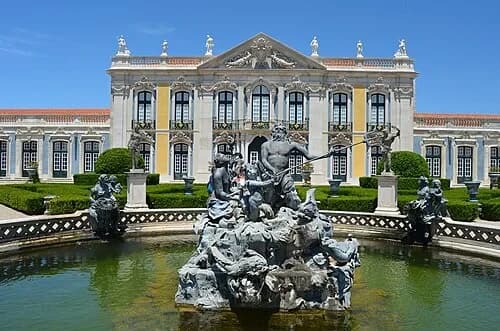
The Neptune Fountain
Stepping outside, we find the Neptune Fountain, the centerpiece of what is known as the 'Hanging Garden.' This garden is an engineering feat of its time, as it is actually constructed on top of a massive vaulted structure rather than directly on the ground. At the heart of the fountain stands a large lead sculpture of Neptune, the Roman god of the sea, crafted by the renowned artist John Cheere. To make this fountain and the others on the grounds functional, a complex system of water engineering was required. This network of pipes and reservoirs was the crowning glory of the outdoor 'rooms' used for grand royal summer parties. Guests would gather around the fountain to enjoy the cool mist and the sound of falling water, which provided a refreshing escape from the Portuguese sun. These gardens were designed to be extensions of the palace rooms, where the court could continue their social life outdoors. The presence of Neptune, holding his trident over the water, reinforced the theme of Portuguese maritime power and the crown's control over the elements, blending art, power, and high-level 18th-century technology.
The Robillon Wing and Garden Grotto
Conclude the tour by viewing the architectural masterpiece of Jean-Baptiste Robillon.
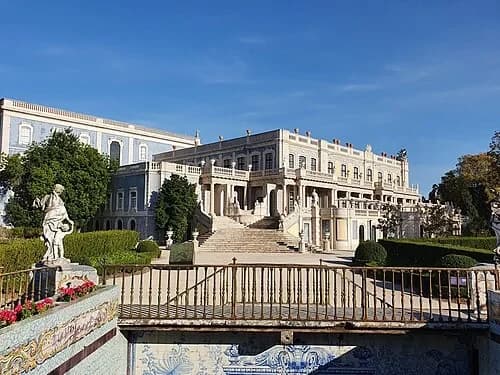
The Lions’ Staircase
Our tour concludes at the Robillon Wing, named after the French architect Jean-Baptiste Robillon who designed it. This wing is famous for the 'Lions' Staircase,' which features an ingenious use of 'forced perspective.' If you look at the steps, you will notice they are graduated in size. This architectural trick was intended to make the staircase, and the entire wing, appear significantly longer and more imposing than they actually are, creating a grander sense of scale for those approaching from the gardens. Robillon’s work here represents the final major phase of the palace’s construction, moving toward a more monumental style. The wing was designed to house the royal family's private apartments and offer direct access to the lower gardens. As you look back at the palace from this vantage point, you can see how the different styles—from the early 'Queluz pink' wings to this more formal French-inspired addition—come together to tell the story of a monarchy in transition. The forced perspective of the stairs is a fitting final detail, reminding us that in the world of 18th-century royalty, appearance and prestige were carefully crafted elements of everyday life.
Want to hear the rest?
Download the Stanza app to unlock all 13 stops and full GPS-guided navigation.
Frequently Asked Questions
How long does the Palácio Nacional de Queluz audio tour take?
The Palácio Nacional de Queluz audio guide includes 13 narrated stops. Most visitors spend 45 minutes to 1.5 hours exploring the complete tour, though you can listen at your own pace and skip or revisit any stop.
Is the Palácio Nacional de Queluz audio guide available in my language?
Stanza supports 15 languages: English, Spanish, French, German, Italian, Portuguese, Russian, Japanese, Chinese, Korean, Arabic, Hindi, Polish, Dutch, Hebrew. Check the guide in the app to confirm the languages currently available for this tour.
Can I use the audio guide offline at Palácio Nacional de Queluz?
Yes! Download the complete Palácio Nacional de Queluz tour — including all audio, maps, and images — before your visit. The Stanza app works completely offline, so you don't need WiFi or mobile data at the venue.
How much does the Palácio Nacional de Queluz audio guide cost?
The Stanza app is free to download. Free and paid audio guides are available; current prices are shown in the app.
How do I use the Stanza audio guide at Palácio Nacional de Queluz?
Download the free Stanza app, search for "Palácio Nacional de Queluz", and download the tour. When you arrive at the venue, the app uses GPS to detect your location and automatically plays the relevant narration as you move between points of interest — completely hands-free.
What makes the Stanza audio guide different from other Palácio Nacional de Queluz tours?
Stanza offers GPS-triggered narration that plays automatically as you walk through Palácio Nacional de Queluz — no need to manually select stops. The tour is available in 15 languages, works fully offline, and includes 13 expertly narrated stops with images and historical context.
What other audio guides are available near Palácio Nacional de Queluz?
Stanza offers multiple audio guides in Queluz, Portugal and nearby areas. After downloading the app, browse the map to discover all available tours near Palácio Nacional de Queluz. Each guide can be downloaded for offline use.