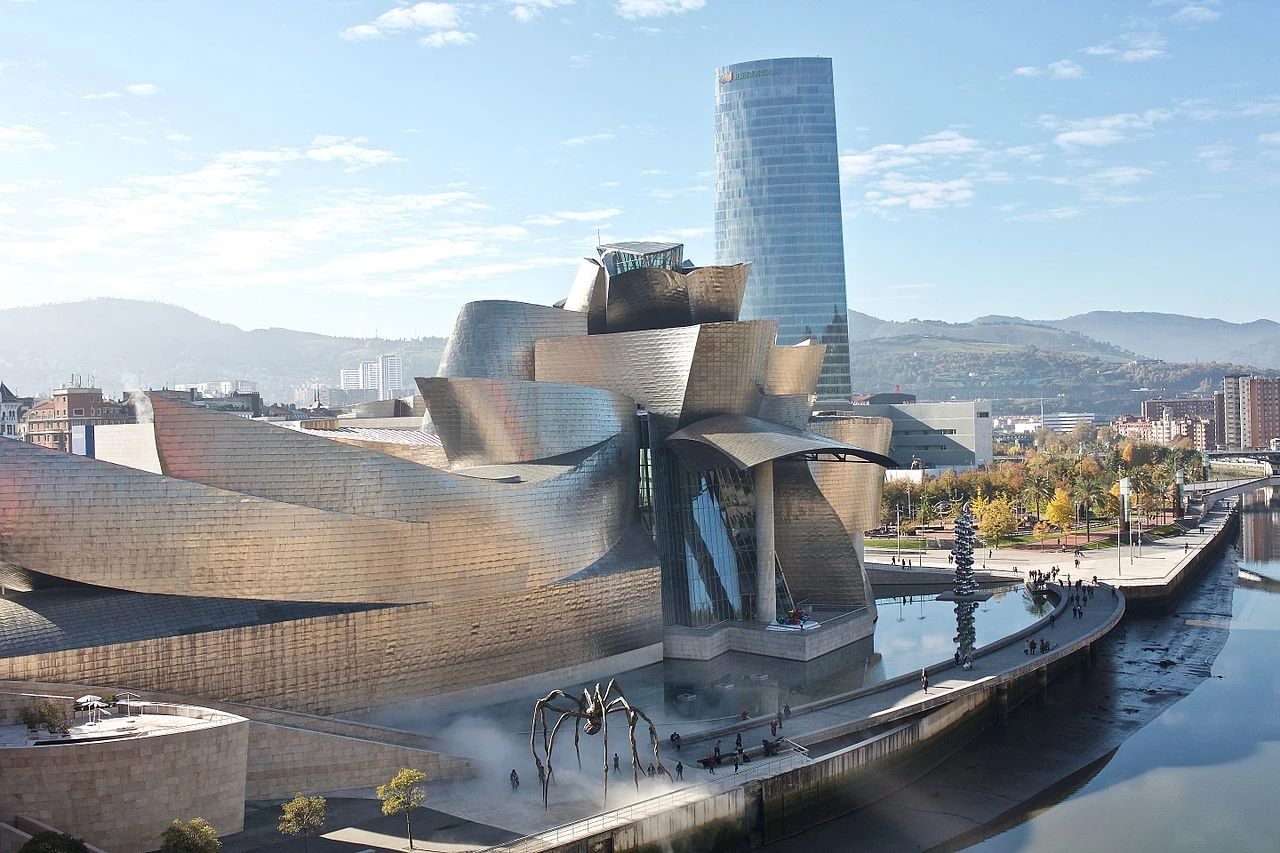
Stanza · Audio guide
Guggenheim Museum Bilbao Audio Guide
A place to remember. A story to take with you.
The Guggenheim Museum Bilbao is a museum of modern and contemporary art. It is located in Bilbao, Spain.
Download Stanza, then search for “Guggenheim Museum Bilbao”.
About the tour
One guide. Your kind of visit.
The Guggenheim Museum Bilbao is a museum of modern and contemporary art. It is located in Bilbao, Spain.
Ready when you are.
- 01Get the free Stanza app.
iOS & Android
- 02Find your guide.
“Guggenheim Museum Bilbao”
- 03Download before you go.
Works offline
Audio guide / 19 narrated stops
Inside the guide
Get to know a few of the stories before you go. Open a stop to read more.
01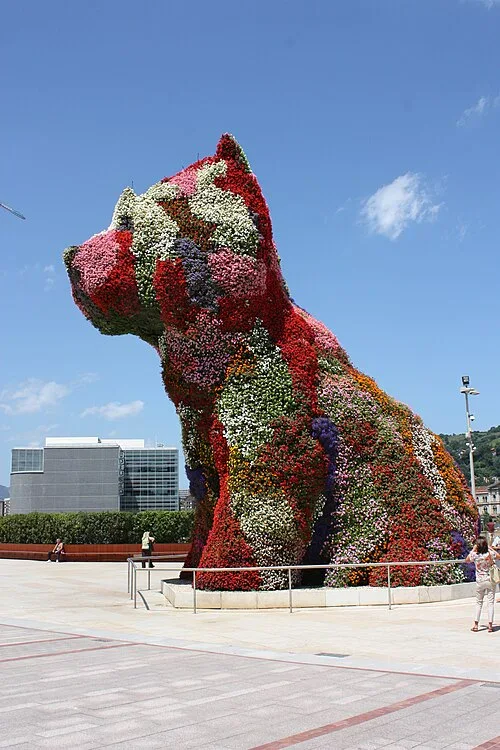 Plaza Txema Agirre & The Floral Guardian
Jeff Koons' Puppy
A giant dog made of living flowers stands at the museum's front door. Jeff Koons built Puppy in 1992, a stainless-steel frame planted with blooming plants in the shape of a West Highland terrier. It arrived here as a temporary exhibition, and Bilbao liked it too much to let it go, so the museum made it permanent. The square around it carries a sadder story in its name. On 13 October 1997, five days before the museum opened, two ETA militants hid grenade launchers in flowerpots, ready to attack the ceremony. A Basque policeman interrupted them, and they shot him dead. The plaza is named for that officer, Txema Agirre. The flowering dog has stood watch over it ever since.
Photo: Ardfern · CC BY-SA 3.0
02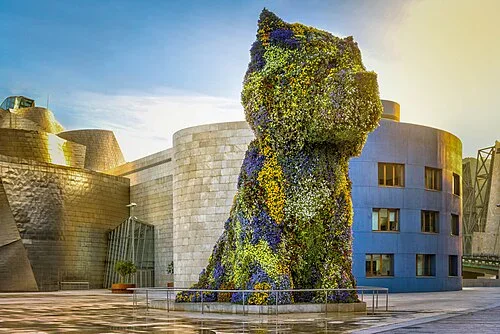 Plaza Txema Agirre & The Floral Guardian
The Museum Behind the Dog
Behind the dog rises Frank Gehry's building, and it exists because of a bargain struck in 1991. The Basque Government offered to fund a Guggenheim in Bilbao's run-down port district, once the city's main source of income. It agreed to cover the construction cost of about one hundred million dollars, to build an acquisitions fund, to pay the foundation a one-time fee, and to subsidize the museum's yearly budget. In exchange, the Guggenheim Foundation would manage the institution and rotate its collection through Bilbao. The foundation's director, Thomas Krens, first imagined the museum inside the Alhóndiga, an old municipal wine warehouse. Gehry, chosen for his skill with existing buildings, pushed instead for something entirely new on the derelict riverfront docks. The result was inaugurated on 18 October 1997 by King Juan Carlos the First of Spain, with 250 contemporary works on display.
Jesús Ignacio Bravo Soler · CC BY 3.0
03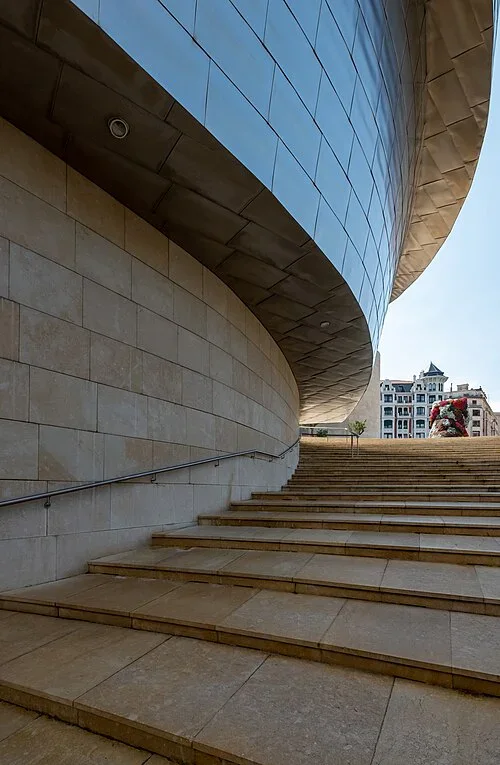 The Monumental Descent & Deconstructivist Facade
The Descent: Stone Against Metal
The long stone staircase on the museum's flank sets up its central contrast. The base of the building is sheathed in beige limestone from the Huéscar quarries near Granada, cut into slabs about five centimetres thick. That stone was genuinely hard to find; its colour was chosen to match the limestone of the University of Deusto across the river. Above it rise the curved metal volumes, and the two materials mark out two families of galleries. Ten of them are straight, classical rooms that announce themselves outside by their stone faces. The other nine are irregular, swirling forms in metal. From the street the building stays oddly modest. Seen from the river it unfolds, and the stairs down to the walkway between the estuary and a pond reveal the projections of the straight blocks against the curved walls.
Listen in the appJules Verne Times Two · CC BY-SA 4.0
04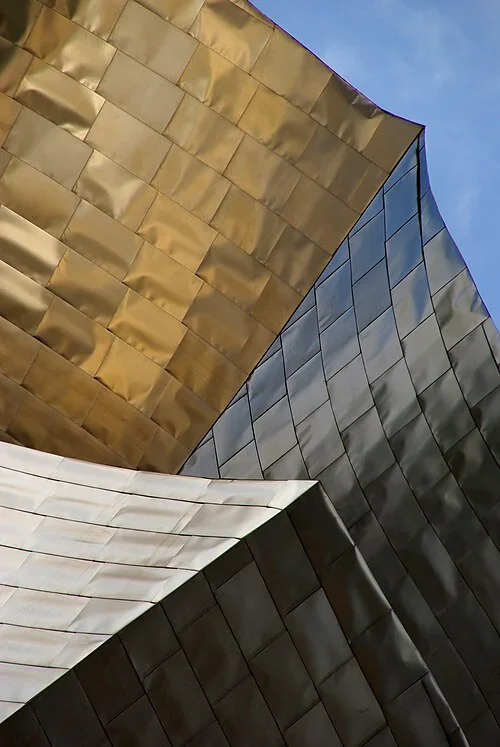 The Monumental Descent & Deconstructivist Facade
The Titanium Skin
The skin above the stone is made of roughly thirty-three thousand titanium plates. Each one is shaped for its own place on the building, and they overlap like scales over a galvanized steel structure. Gehry had studied the feathers and scales of animals, fascinated by the systems nature uses to cover curved surfaces like the museum's. He chose rigid scales, mounted one over another. The difference is that animal skin is built to move, and this skin is not. Titanium itself won its place through testing. Samples were tried out until the right treatment emerged, one that could withstand heat and bad weather while keeping its sheen. It replaced copper or lead, metals now avoided for their toxicity. The plates were given a quilted rather than undulated shape, so they would resist the wind and avoid vibrating in storms.
Listen in the appkarstensfotos from Leiden, The Netherlands · CC BY-SA 2.0
05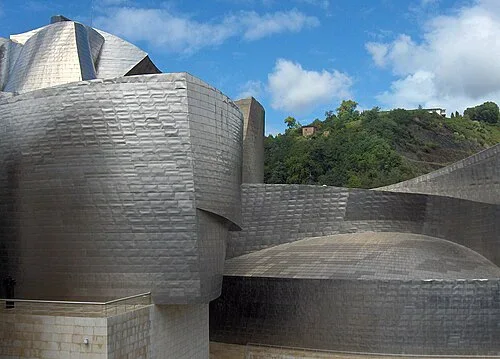 The Monumental Descent & Deconstructivist Facade
Curves That Could Not Be Drawn
Curves like these defeat pencil and paper. From the autumn of 1993, Gehry's team modelled the whole exterior on CATIA, a three-dimensional program built by Dassault Systèmes for the aerospace industry. The software calculated, point by point, the stresses on the materials. Its model showed the tensions across the steel structure, the cladding and the foundations, and let engineers size each element. It also automated the cutting of the stone blocks and the titanium plates, every one of them different. The critic Paul Goldberger said the building could not have been constructed without CATIA, and that it was the first building where the software played a role in nearly every stage of design and construction. Gehry added his own discipline: he kept what he called the organization of the artist in charge, insisted on a realistic cost estimate, and worked closely with the building trades. The museum was finished on time and on budget, a rarity for architecture of this kind.
Listen in the appGeorges Jansoone · CC BY 2.5
06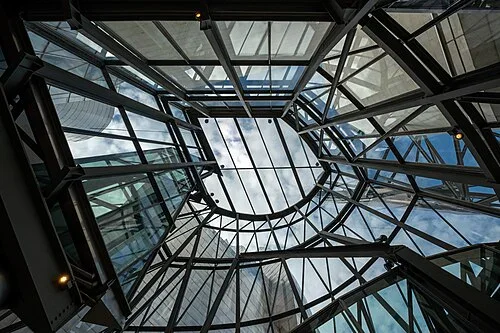 The Central Atrium ('The Flower')
The Flower
Inside, everything bends toward one hall. Gehry nicknamed the atrium The Flower, for the petal shape of the skylight crowning it. It is the organising centre of the museum, the room every route returns to. Light pours down through that glass crown, and the space opens onto views of Bilbao's estuary and the hills of the Basque country. The apparent randomness of the curves outside was deliberate. Gehry said the randomness was designed to catch the light. The Flower is what all that caught light was for.
Listen in the appPhoto: Ardfern · CC BY-SA 3.0
07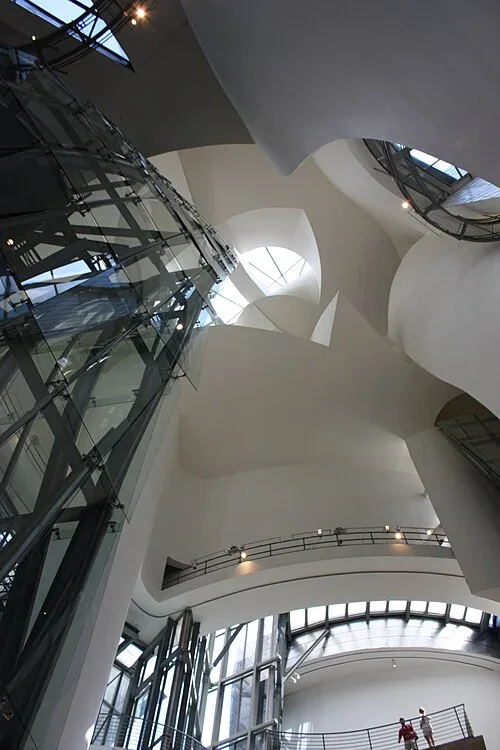 The Central Atrium ('The Flower')
Under the Petals
The atrium is a machine for visiting. Curved plaster volumes rise through it, glass curtain walls face the river, and suspended walkways connect three levels of galleries. The glass is not ordinary window glass. It has been specially treated to keep sunlight from damaging the exposed works, and the walls are treated too, to shield the interior from the sun. The whole building stands on ground with a tricky base: clay from the bed of the nearby estuary, held up by 665 pilings driven in by boring machines. Not everyone was won over indoors. The critic Brian O'Doherty admired the approach to the building but found the interior spaces too vast, so that paintings by Braque, Picasso and Rodchenko looked tiny, even absurd, on the walls.
Listen in the appPhoto: Ardfern · CC BY-SA 3.0
08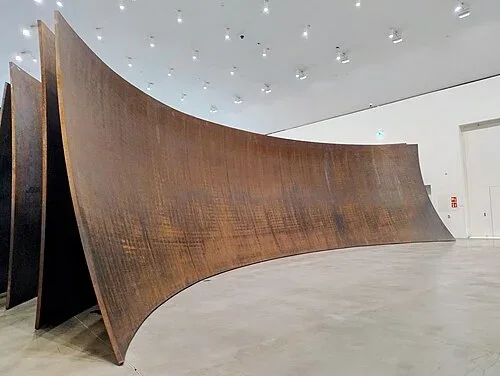 The Arcelor Gallery: Richard Serra's 'The Matter of Time'
The Matter of Time
A permanent installation fills the museum's biggest room. The gallery runs about 130 metres long and 30 wide, once known as the Fish Gallery and renamed in 2005 for Arcelor, the steel manufacturer that sponsored the project. In it stands Richard Serra's The Matter of Time, a series of seven monumental sculptures in weathering steel. They join an earlier work, Snake, which Serra made for the museum's inauguration. In 2005 the whole installation entered the permanent collection as the museum's own. The critic Robert Hughes called it courageous and sublime.
Listen in the appPhoto: KenSwe72 · CC0
09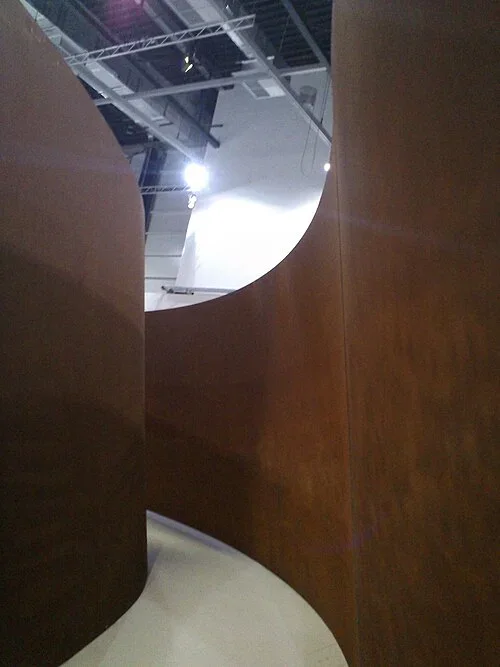 The Arcelor Gallery: Richard Serra's 'The Matter of Time'
Inside the Steel Ribbons
Serra's sculptures are not made for looking at from a distance. They are made for walking through. Walls of weathering steel curve overhead and lean as they rise, compressing space in one passage and opening it wide in the next. The experience changes with every step, which is why the work needed a hall of this size. Snake, the piece that started it all, is a little over thirty metres long.
Listen in the appPaul Trafford · CC BY 2.0
10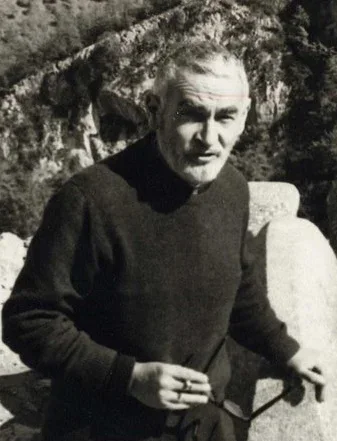 Upper Galleries: Modern Masterworks & Basque Identity
Jorge Oteiza, the Skeptic Won Over
Jorge Oteiza was the Basque country's great sculptor, and for years the museum's fiercest enemy. In 1992, while the project was still being planned, he attacked it in print. It was, he said, a genuine soap opera, something out of Disney, totally anti-Basque, and it would cause gravely serious damage and paralyse every cultural activity in the region. His voice carried weight, because the question cut deep: was a foreign art brand on Bilbao's docks an affront to Basque culture, or a stage for it? Oteiza answered that himself in 1998. After seeing the finished building, he signed a formal collaboration agreement with the museum, and with it an end to the insults and the attacks.
Listen in the appPaul Signac · Public domain
- 11
A Museum of the Modern
A Signac pointillist harbour scene that opens onto how the collection actually works — loans that rotate, new purchases, and a taste for installation over easel painting.
- 12
Installation for Bilbao
Jenny Holzer's columns of red and blue light, commissioned for the opening, where language itself becomes the sculpture.
- 13
Tall Tree & The Eye
Anish Kapoor's tower of mirror spheres, doubling the museum, the sky and the water in every curve.
- 14
Fog on the Water
Fujiko Nakaya's fog sculpture, veils of man-made mist that soften titanium and stone before dissolving.
- 15
Tulips
Jeff Koons' giant balloon tulips in mirror polish, a playful counterpoint to the steel and stone around them.
- 16
Maman
Louise Bourgeois' monumental bronze spider Maman, the mother standing guard over the estuary.
- 17
Under Maman
Seen from beneath, the spider becomes shelter and menace at once — sacs overhead, ribbed legs rising.
- 18
La Salve Bridge and the New Bilbao
The red arch the museum embraced, and the economics that made 'Bilbao effect' a phrase.
- 19
The City Reflected
Across the water, the museum at its most impressive — and the critics who agreed on almost nothing else.
Guggenheim Museum Bilbao
Frequently asked questions
How much does the guide cost?
Free app download. Listed guide price: $1.99. Guide price shown in the app. Audio guide only. Venue admission is separate.
Can I listen without internet?
Yes. Download the guide’s audio, images, and maps in the app before your visit. Your downloaded content is then available offline.
Can I listen in my language?
This audio guide is available in 15 languages, including English.
Do I need to follow a schedule?
No. This is a self-guided experience. Choose your stops, pause whenever you like, and return to a story at your own pace.
At your own pace
Explore Guggenheim Museum Bilbao.
Download Stanza, then search for “Guggenheim Museum Bilbao”.
Free app download · Guide price shown in the app
Keep exploring
Nearby audio guides
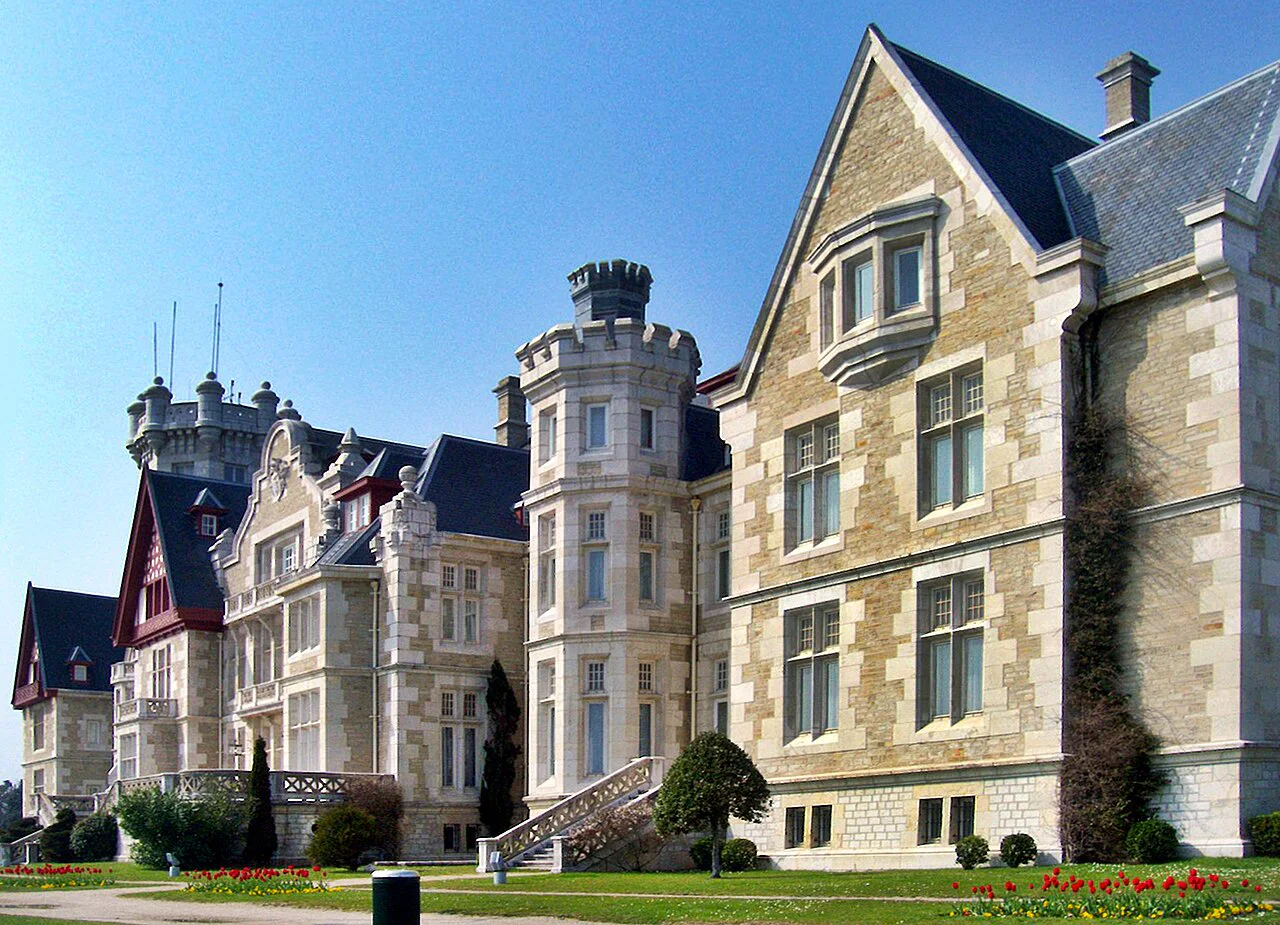
Santander · 71 km
Palacio de la Magdalena
Content & sources
Photo: Fernandopascullo · CC BY 3.0
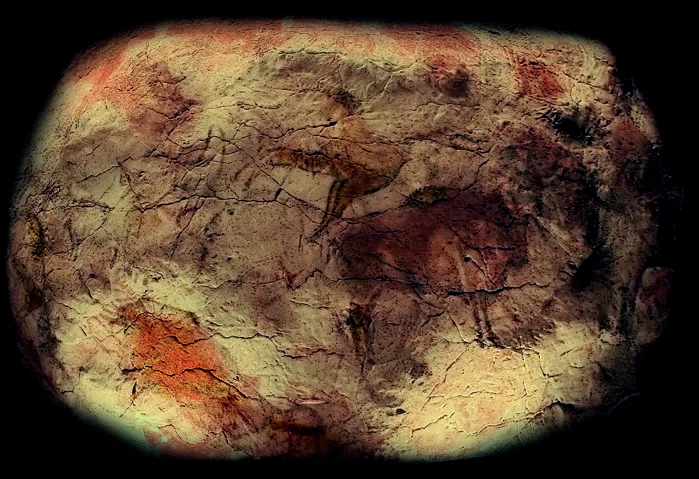
Santillana del Mar · 97 km
Cueva de Altamira
Content & sources
José-Manuel Benito · Public domain
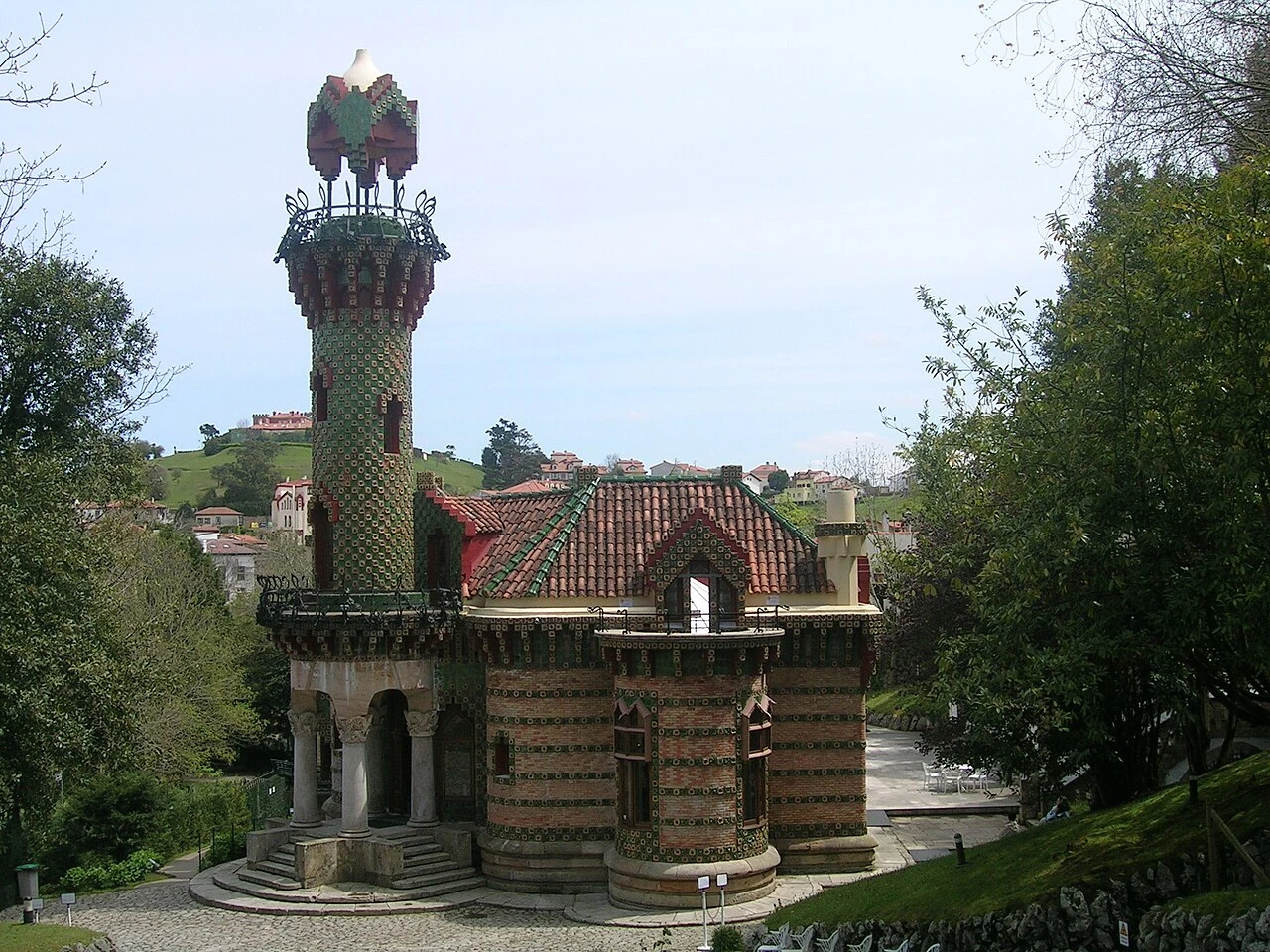
Comillas · 111 km
El Capricho de Gaudí
Content & sources
Photo: Cotarelo75 · CC BY-SA 3.0
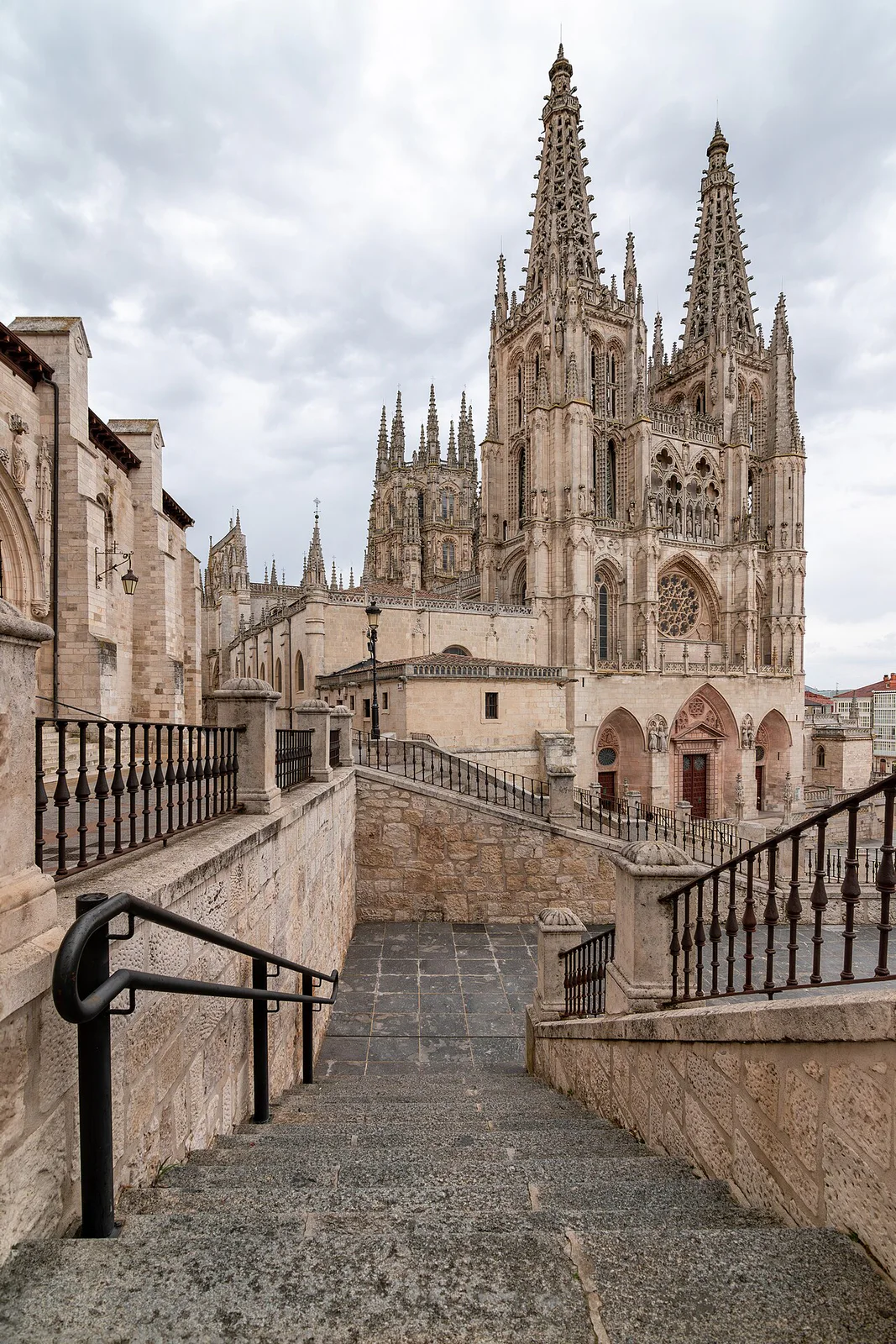
Burgos · 121 km
Catedral de Burgos
Content & sources
José Ligero Loarte · CC BY-SA 4.0