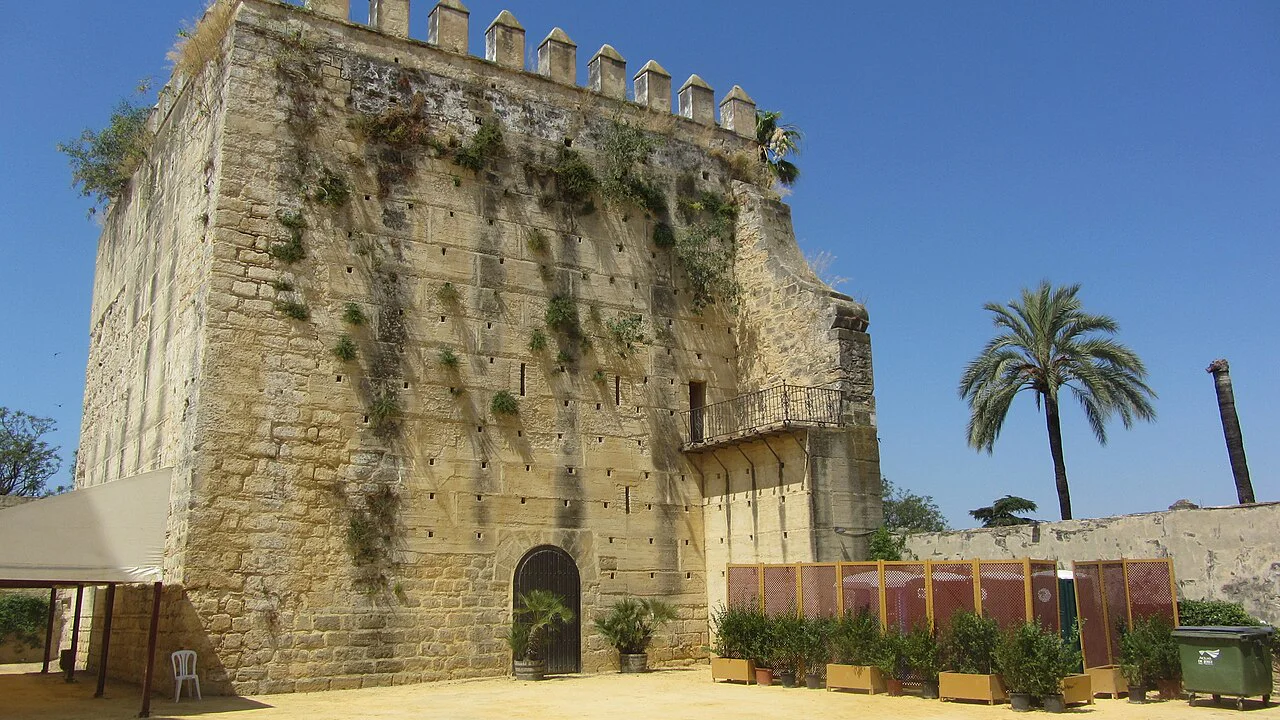
Stanza · Audio guide
Alcázar de Jerez de la Frontera Audio Guide
A place to remember. A story to take with you.
The Alcázar of Jerez de la Frontera is a former Moorish alcázar that now houses a park. It was declared a Bien de Interés Cultural in 1931.
Download Stanza, then search for “Alcázar de Jerez de la Frontera”.
About the tour
One guide. Your kind of visit.
The Alcázar of Jerez de la Frontera is a former Moorish alcázar that now houses a park. It was declared a Bien de Interés Cultural in 1931.
Ready when you are.
- 01Get the free Stanza app.
iOS & Android
- 02Find your guide.
“Alcázar de Jerez de la Frontera”
- 03Download before you go.
Works offline
Audio guide / 13 narrated stops
Inside the guide
Get to know a few of the stories before you go. Open a stop to read more.
01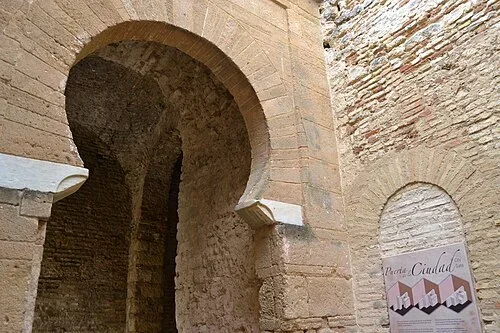 City Gateway and Almohad Defensive Walls
The City Gate of the Alcázar
Welcome to the Alcázar of Jerez, a fortified palace whose mosque, baths, towers and Baroque residence all fit inside one enclosure. The horseshoe arch of this gate opens onto the oldest part of that story. In the eleventh century, when Jerez belonged to the small taifa kingdom of Arcos de la Frontera, a first fortress rose on this spot. It was built to serve as both residence and stronghold, the seat of power in Islamic Jerez. In the twelfth century the Almohads rebuilt it on a grander scale, and their work is what survives most clearly today. The hill beneath it is far older than any of that. It is the highest point of the old town, and people have lived on it since the Copper Age. Excavations in 2009 uncovered the floors of huts and the traces of ancient silos, from a settlement some five thousand years old. So the gate stands over layers of habitation reaching back long before the fortress, long before Jerez had walls at all.
Emilio J. Rodríguez Posada · CC BY-SA 2.0
02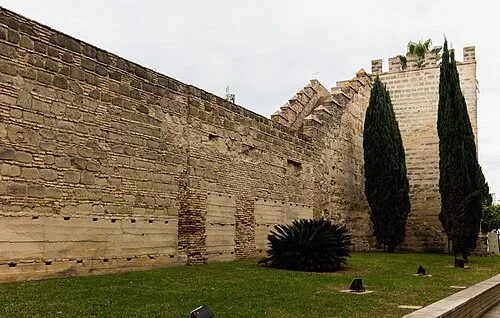 City Gateway and Almohad Defensive Walls
The Almohad Walls
Fortresses like this were built to survive a siege, and the walls show it. The defensive line here is really two walls. The outer one rises about four metres and is crowned with battlements. It stands four metres clear of the inner wall behind it. An attacker who crossed the first wall would be trapped in a narrow lane, exposed to the defenders above. The inner wall carries towers at regular intervals, and seven of the originals still stand. Most of the work is rammed earth and brick, packed into moulds layer by layer. In places the builders also reused cut stone brought from sites nearby. The whole enclosure follows a roughly quadrangular line, with a perimeter of some four thousand metres. That is the shell around everything else in this story.
Diego Delso · CC BY-SA 4.0
03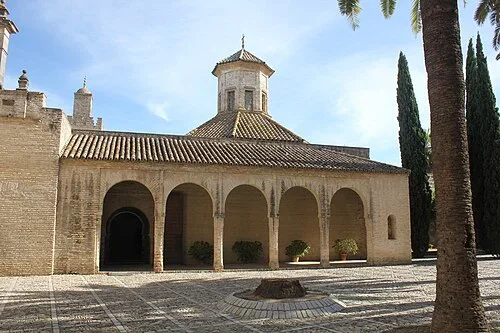 The Almohad Mosque and Minaret
The Mosque and Its Minaret
Of the eighteen mosques that once stood in Islamic Jerez, this is the only one left. Its survival has a simple reason: it stopped being a mosque. After the Christian conquest of the fortress in 1261, the building became a church dedicated to the Virgin Mary, under King Alfonso X of Castile. The minaret, which still stands, was turned into a bell tower. Both faiths can be read in one silhouette: the octagonal dome over the prayer hall, the arched portico, and the tower that once called the faithful to prayer and later rang for Christian services. Inside, the prayer hall keeps the elements of Muslim ritual almost intact, and that is what the next stop shows.
Listen in the appPhoto: El Pantera · CC BY-SA 3.0
04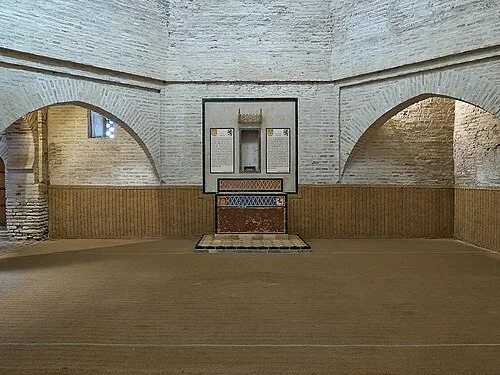 The Almohad Mosque and Minaret
The Prayer Hall
The prayer hall of the mosque has been restored, and its ritual geography is intact. Worshipers washed first in a small room of ablutions that precedes this hall. Then they passed under horseshoe arches, the classic form of Islamic Jerez, into the prayer space. At the far end, the mihrab marks the direction of Mecca, the focus of every prayer once offered here. Above, a rib vault rises to a circular window at its crown, letting a thin light fall into the room. There is a Christian layer too. An altar stands here, recalling that the first chapel of Santa María del Alcázar was created in this very hall, after the mosque became a church.
Listen in the appPhoto: Jl FilpoC · CC BY-SA 4.0
05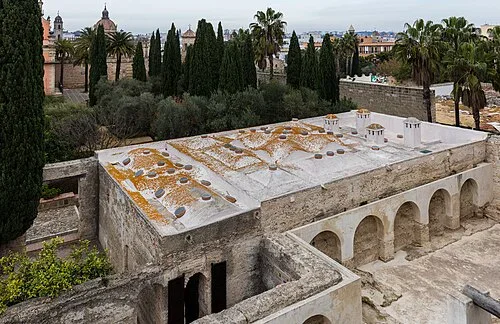 The Arab Baths (Hammam)
The Arab Baths from Above
Seen from above, the Arab baths read like a map of a slow ritual. The roofline is a sequence of domes and light-wells over the rooms below. A bather entered through a hall for undressing, then moved through the cold room into the warm one, which was the largest in the whole complex. The last room was the hot room, and part of its heating system can still be made out. Baths like these were one of the essentials of life inside the fortress, alongside the mosque and the living quarters. The people who lived within these walls needed washing as much as defending, and the Almohads provided for both.
Listen in the appDiego Delso · CC BY-SA 4.0
06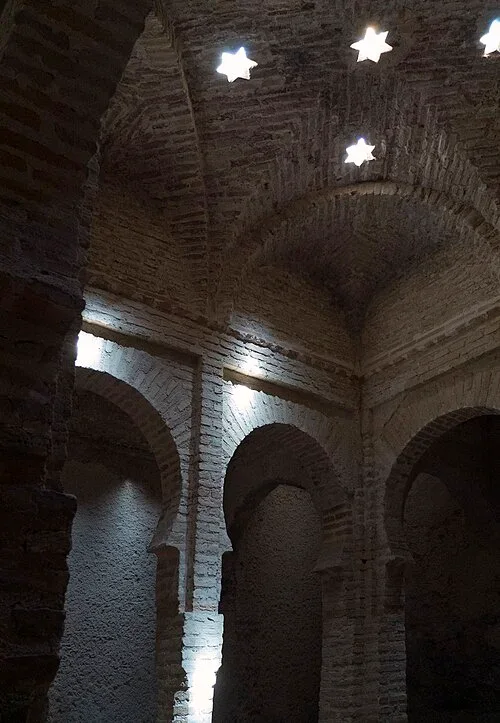 The Arab Baths (Hammam)
Inside the Arab Baths
Inside the bathhouse, the light is the engineering. The vaults are built of solid brick, and set into their ceilings are star-shaped skylights, the lucernas. They admit a dim, intimate glow, exactly the privacy these rooms were designed for, and they let the steam breathe. Star after star pierces the brickwork overhead, casting beams that shift with the sun. Bathing here was meant to feel enclosed and shaded, not bright and open.
Listen in the appPedro M. Martínez Corada [www.martinezcorada.es] · CC BY-SA 3.0 es
07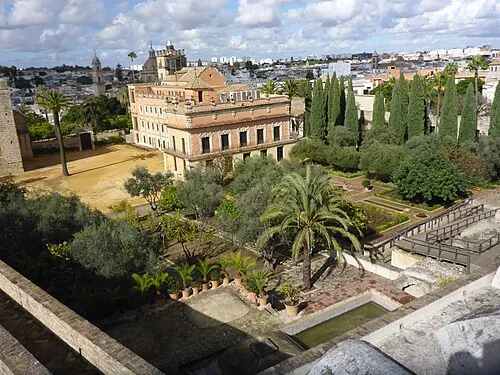 The Parade Ground and Subterranean Cistern
The Parade Ground and Gardens
This compound was designed as a fortified city inside a fortified city. Within its walls were living quarters, baths, mosques, supply warehouses and water tanks. The open ground and gardens give little hint of how crowded that interior once was. The twentieth century treated the place roughly. Under the Franco regime it served as a military barracks. Then a hotel was begun inside the grounds, its modern structure rising among the old walls. In 1981 that hotel structure was finally demolished.
Listen in the appPhoto: El Pantera · CC BY-SA 4.0
08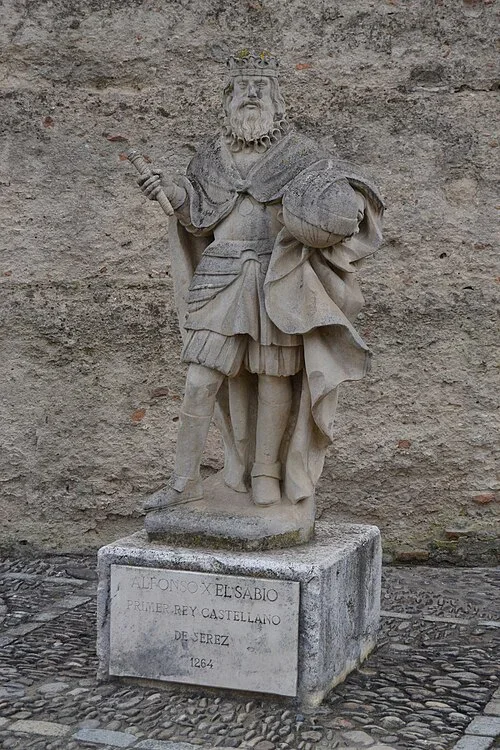 The Parade Ground and Subterranean Cistern
Alfonso X and the Rebellion of 1264
The stone figure here is Alfonso X, called El Sabio, the Learned, and the plaque names him the first Castilian king of Jerez. He took the fortress in the thirteenth century, when Ibn Abit, the last Andalusi king of the city, handed the alcázar over to him. A Christian garrison moved in under Nuño González de Lara. In 1264 the Muslims of Jerez rose against Castilian rule, in step with revolts in Murcia and other Andalusi towns. The old Book of the Alcázar says they broke in through a mine, a tunnel dug beneath the walls. Another tradition says they came over the battlements. Either way the fortress changed hands again, and the garrison was put to the sword. Its standard-bearer, Fortún de Torres, the city's alférez mayor, held the royal banner aloft through the whole fight, and died from the mutilations he suffered rather than surrender it. Alfonso answered with a five-month siege, and Jerez surrendered; its Muslim inhabitants left for nearby towns or across to Africa. The Cantigas de Santa María, the song collection of King Alfonso's court, tell of these events, including the burning of the chapel of Santa María in the old mosque.
Listen in the appEmilio J. Rodríguez Posada · CC BY-SA 2.0
09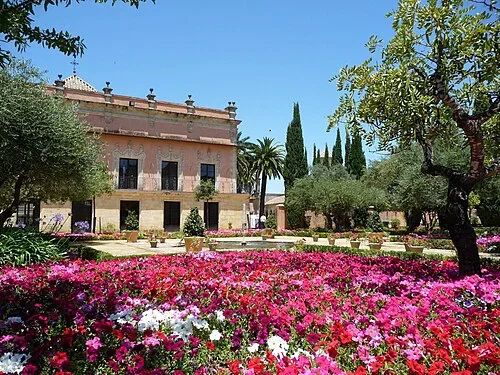 Palacio de Villavicencio and Municipal Pharmacy
The Palace of Villavicencio
By the sixteenth and seventeenth centuries the alcázar had sunk into deepening ruin, and reports from 1588 onward record the decay. What rose from it was Baroque. In 1664 Lorenzo Fernández de Villavicencio, one of the first alcaides of the city, began this palace over the remains of earlier Arab constructions. It served as a residence for him and for the governors and public representatives who followed. The facade above the gardens is Baroque Jerez at its most confident, a lordly front grafted onto an Islamic fortress. The palace's main tower is the tallest in the city, and it hides a curious instrument. The Cámara Oscura works with simple lenses and mirrors. It projects a live, bird's-eye view of the city at this very moment, from the church bell towers and palace rooftops to the far ploughed lands of the countryside.
Listen in the appPhoto: El Pantera · CC BY-SA 4.0
10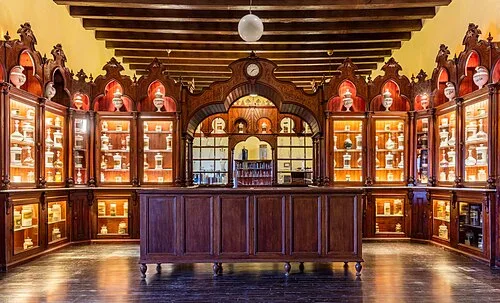 Palacio de Villavicencio and Municipal Pharmacy
The Old Municipal Pharmacy
Inside the palace waits a room carried here from somewhere else entirely. This is what was saved of Jerez's municipal pharmacy, originally the apothecary's shop of the Convento de la Merced. The carved wooden fittings survived in perfect condition: banks of cabinets, glazed doors, jars and vessels ranked shelf above shelf. To complete the room, it was furnished with pieces of its own period, the nineteenth century. What began as a convent pharmacy, then served the town as its official dispensary, now sits preserved inside a Baroque palace.
Listen in the appDiego Delso · CC BY-SA 4.0
- 11
The Octagonal Tower
An albarrana tower joined to the wall by arches, and a claim to great Almohad age.
- 12
The Tower of Homage
A square Gothic keep raised by the Ponce de León lords, beside the older Islamic tower.
- 13
The Old Oil Mill
An eighteenth-century oil mill, the gardens of the old Teatro Eslava, and the man who bought the Alcázar to save it.
Alcázar de Jerez de la Frontera
Frequently asked questions
How much does the guide cost?
Free app download. Listed guide price: $0.99. Guide price shown in the app. Audio guide only. Venue admission is separate.
Can I listen without internet?
Yes. Download the guide’s audio, images, and maps in the app before your visit. Your downloaded content is then available offline.
Can I listen in my language?
This audio guide is available in 15 languages, including English.
Do I need to follow a schedule?
No. This is a self-guided experience. Choose your stops, pause whenever you like, and return to a story at your own pace.
At your own pace
Explore Alcázar de Jerez de la Frontera.
Download Stanza, then search for “Alcázar de Jerez de la Frontera”.
Free app download · Guide price shown in the app
Keep exploring
Nearby audio guides
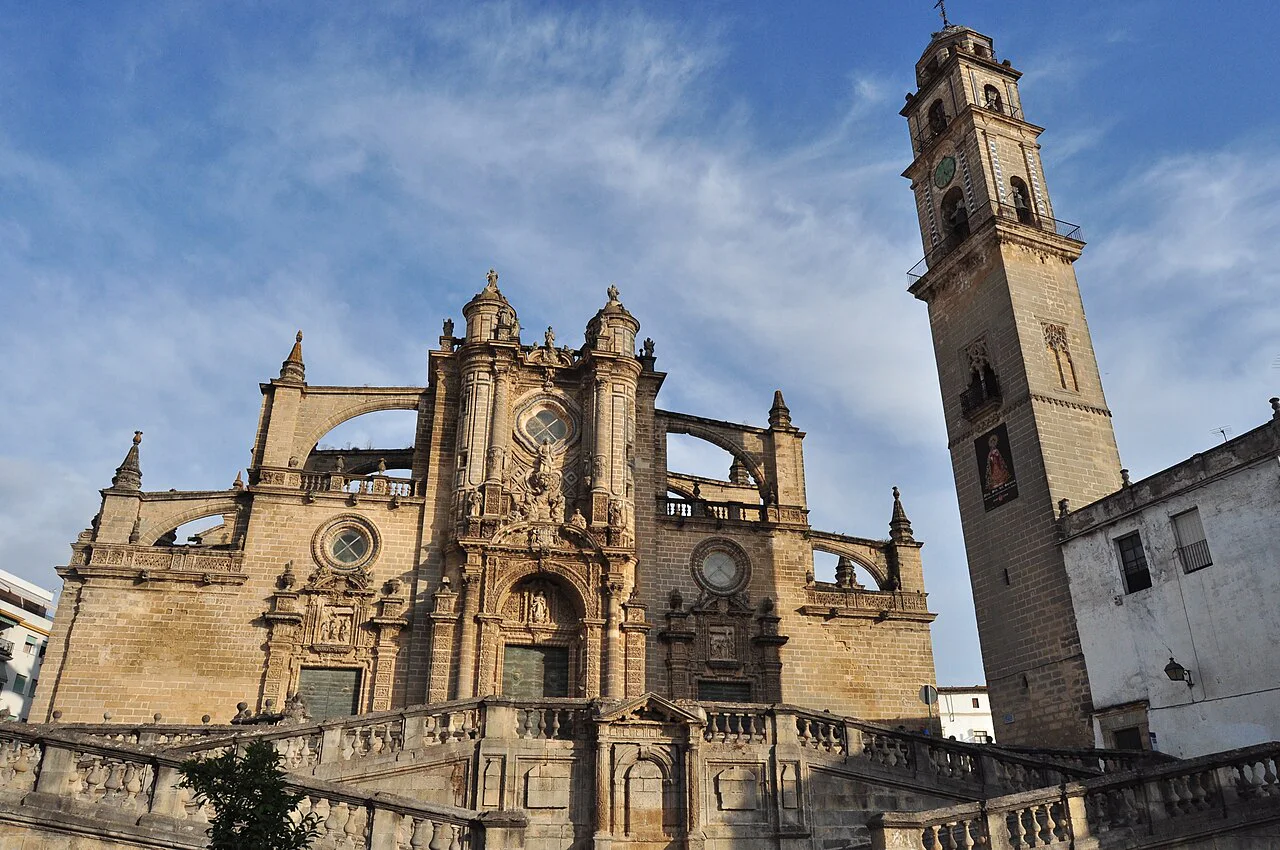
Jerez de la Frontera · 1 km
Catedral de Jerez de la Frontera
Content & sources
Luis Rogelio HM · CC BY-SA 2.0
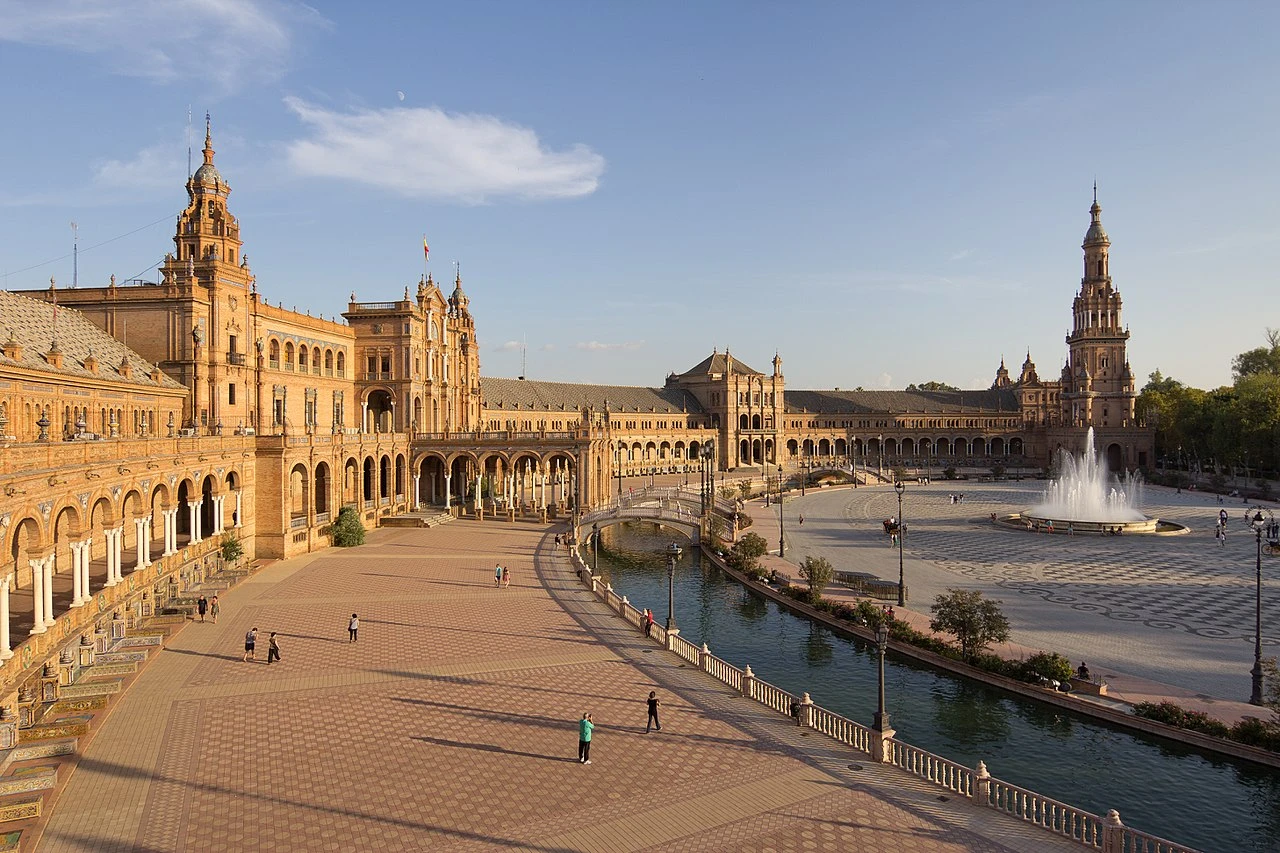
Seville · 79 km
Plaza de España
Content & sources
Carlos Delgado · CC BY-SA 4.0
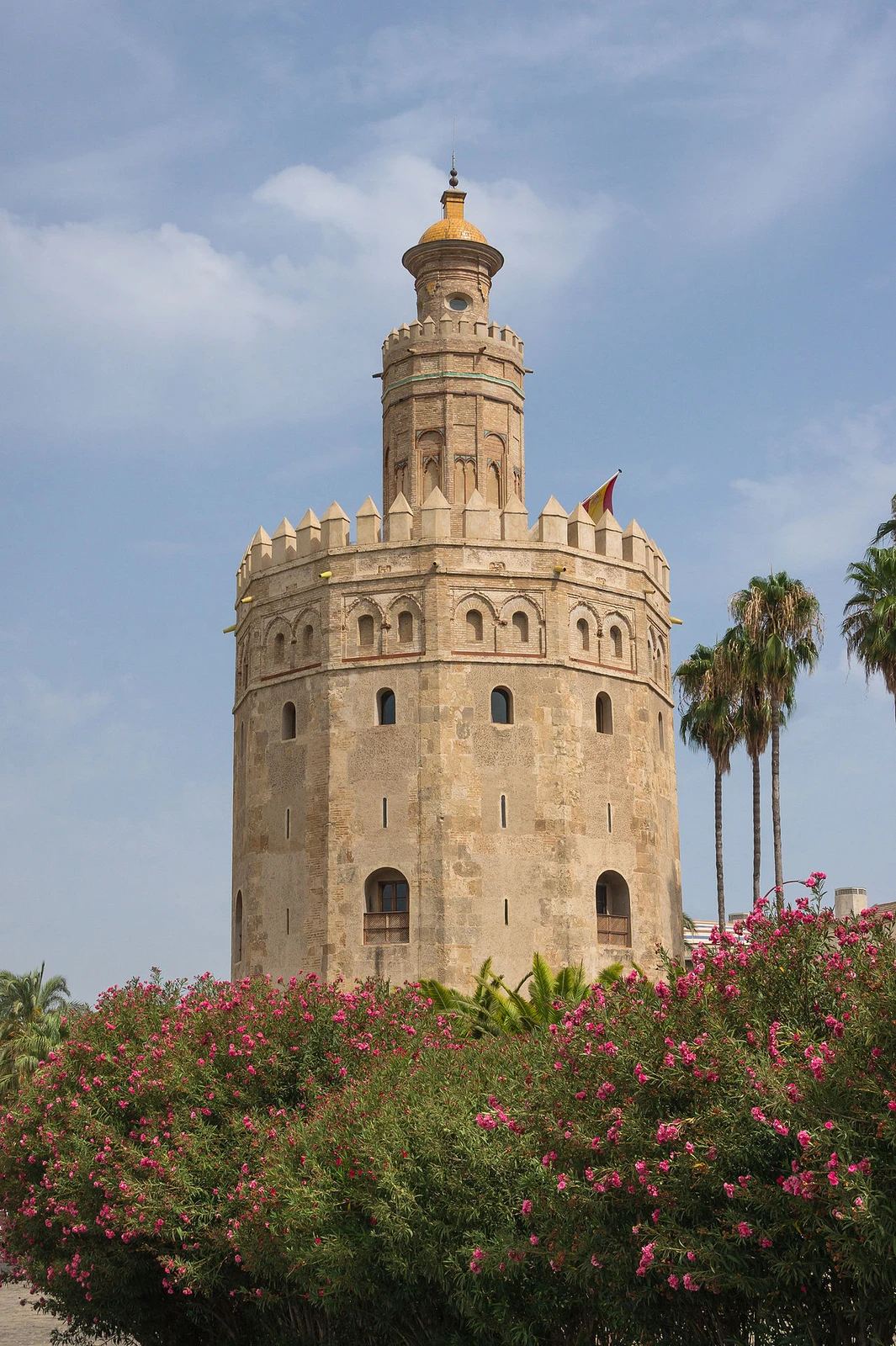
Seville · 79 km
Torre del Oro
Content & sources
Photo: Jebulon · CC0
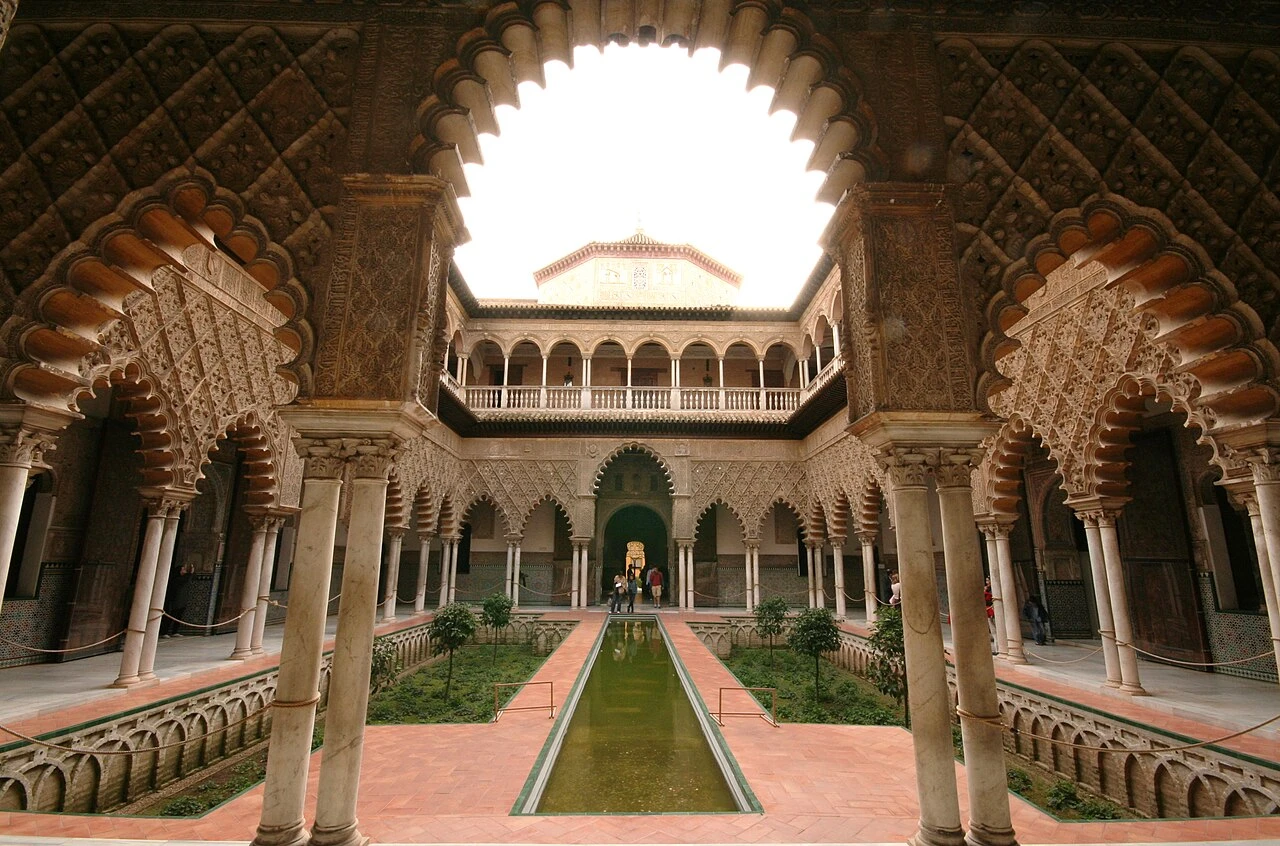
Seville · 79 km
Royal Alcázar of Seville
Content & sources
Cat from Sevilla, Spain · CC BY 2.0