Stanza · Audio guide
Catedral de Jerez de la Frontera Audio Guide
A place to remember. A story to take with you.
The Cathedral of the Holy Saviour is a Catholic cathedral located in Jerez de la Frontera, Andalusia. It serves as the seat of the Roman Catholic Diocese of Asidonia-Jerez and was declared a Bien de Interés…
Download Stanza, then search for “Catedral de Jerez de la Frontera”.
About the tour
One guide. Your kind of visit.
The Cathedral of the Holy Saviour is a Catholic cathedral located in Jerez de la Frontera, Andalusia. It serves as the seat of the Roman Catholic Diocese of Asidonia-Jerez and was declared a Bien de Interés Cultural in 1931.
Ready when you are.
- 01Get the free Stanza app.
iOS & Android
- 02Find your guide.
“Catedral de Jerez de la Frontera”
- 03Download before you go.
Works offline
Audio guide / 11 narrated stops
Inside the guide
Get to know a few of the stories before you go. Open a stop to read more.
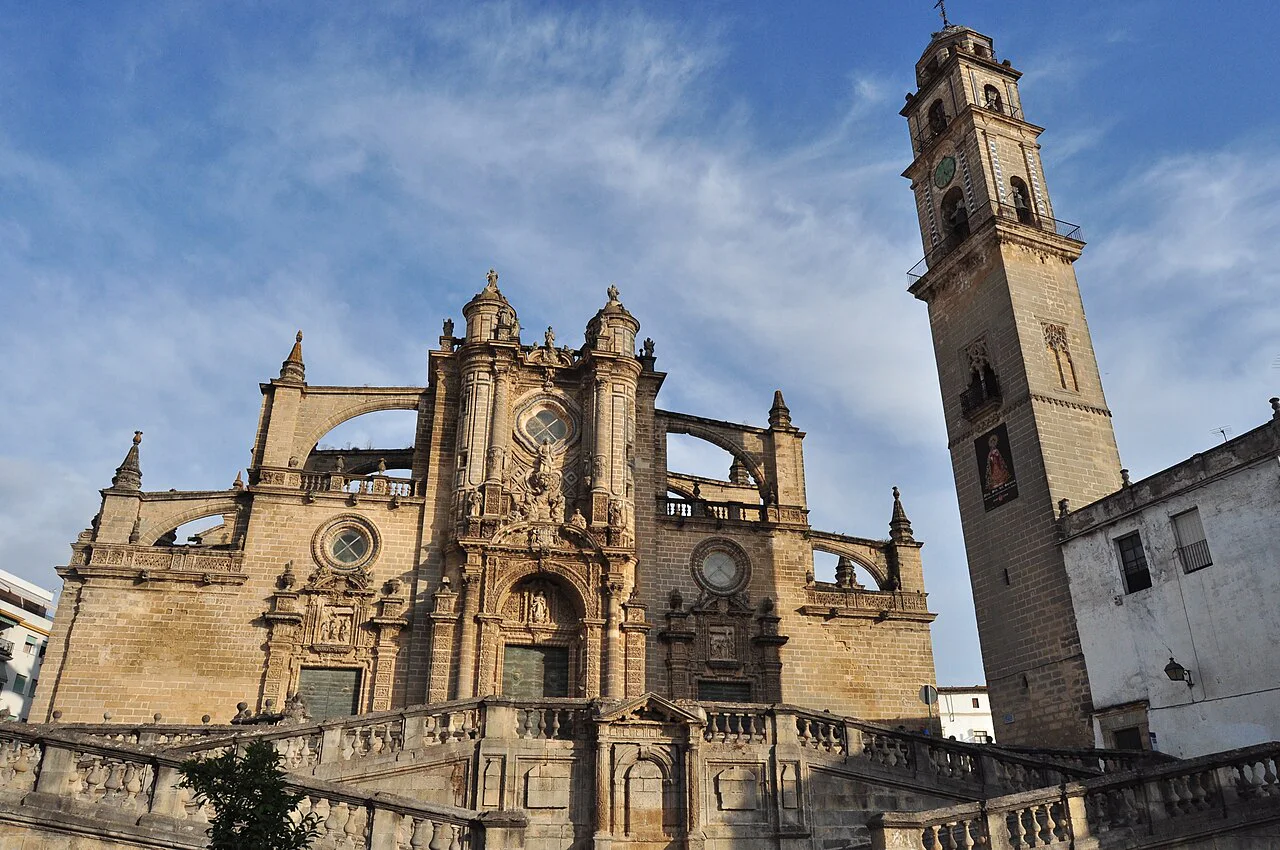
01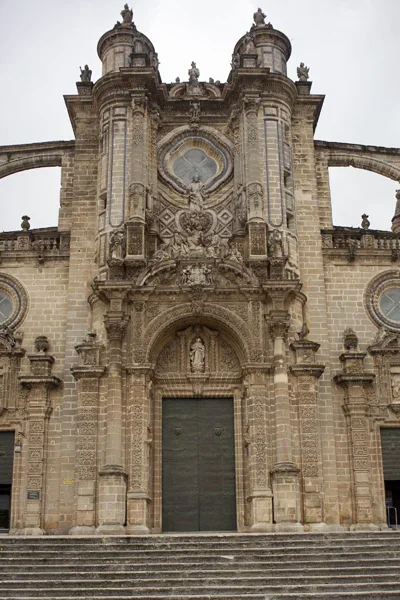 Main Facade and Plaza de la Encarnación
Main Baroque Facade and Plaza de la Encarnación
Welcome to Jerez de la Frontera, and to the church its people built to be a cathedral before the city had one. This tour follows that long patience, from the fallen dome to the tower that stands apart. The triple-door facade with its crowd of carved saints was the proud face of that ambition. When work began in 1695, Jerez already had handsome churches like San Miguel and Santiago. The new temple had to match them, and be worthy of a bishop one day. Twice the city petitioned the Crown for its own bishopric, in 1580 and again in 1781. The canons of the collegiate chapter carried the work for more than eighty years, at cost to themselves, helped by the goods of Cardinal Arias and by royal and papal aid. A tax on sherry wine, approved by the Crown, also paid for the build. Half the church opened for worship in 1756. The whole temple was blessed on 6 December 1778. The ground beneath it is older still. Remains of the city's Great Mosque came to light around the building, which rose over part of that sacred site.
Photo: PMRMaeyaert · CC BY-SA 4.0
02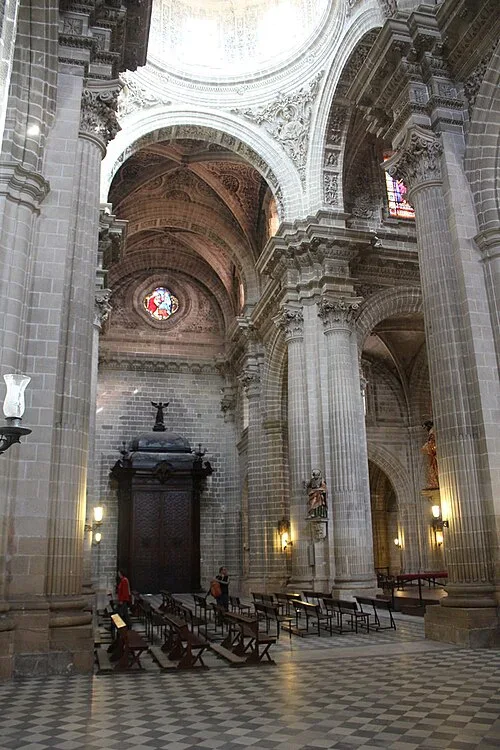 The Five Naves and the Central Crossing
The Five Naves
The inside works differently from most great churches. Instead of a single hall with two aisles, there are five naves of unequal heights, rising in steps toward the light. The central nave and the crossing reach twenty metres. The collateral aisles drop to thirteen, and the outermost pair to just eight. The structure is Gothic, yet it was raised in the Baroque and Neoclassical age, and the difference shows in the details. The arches are semicircular, not pointed, as true Gothic arches would be. Over the central nave and the crossing, the vaults are carved stone, richly ornamented. Over the side aisles they are plain brick, left bare. Heavy buttresses brace the walls from outside. Strictly speaking there is only one side chapel, the Sagrario, in neoclassical style. Everything else belongs to that stepped, rising space.
Photo: El Pantera · CC BY-SA 3.0
03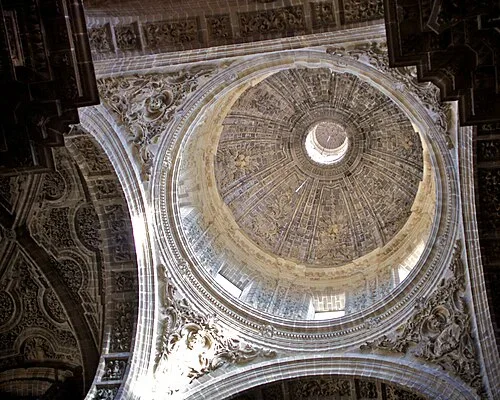 The Five Naves and the Central Crossing
The Octagonal Dome and the Eight Doctors
At the crossing, the dome rises forty metres above the floor. It is octagonal, and each of its eight corners carries a stone statue of a Doctor of the Church. Four of them are the great Latin teachers: Augustine, Ambrose, Gregory the Great and Jerome. Facing them stand four from the Greek East, among them Athanasius and John Chrysostom. The dome visitors see is not the first one. The original fell during construction, a structural disaster for the builders. To carry the weight of its replacement, they added flying buttresses outside, a solution already old-fashioned in the eighteenth century. That collapse also touched one treasure inside. By tradition, a wooden beam saved a crucifix, and its story has its own stop on this tour.
Listen in the appTony Bowden from Tallinn, Estonia · CC BY-SA 2.0
04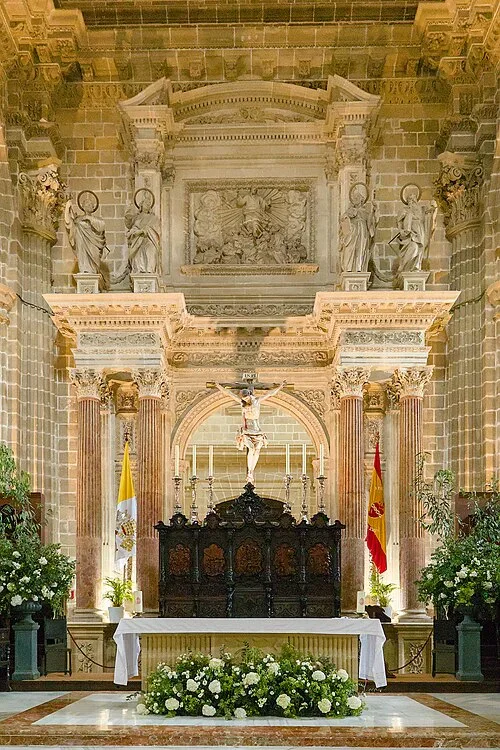 The High Altar and Cristo de la Viga
The High Altar and the Cathedral's Living Role
The high altar is the liturgical heart of the building, and the place where its long wait ended. The temple was consecrated on 10 December 1978 by Cardinal José María Bueno Monreal, on the second centenary of its inauguration. A little over a year later, on 3 March 1980, Pope John Paul II raised it to cathedral dignity with the bull Archiepiscopus Hispalenses. Jerez at last had the cathedral it had asked for since the sixteenth century. The church became the seat of the new Diocese of Asidonia-Jerez, and that June the bull creating the diocese was promulgated here as its first bishop took possession. Since then the building has lived a full diocesan life. Two bishops received their ordination at this altar, one in 2000 and one in 2009, alongside countless priestly ordinations and celebrations.
Listen in the appBenjamin Smith · CC BY-SA 4.0
05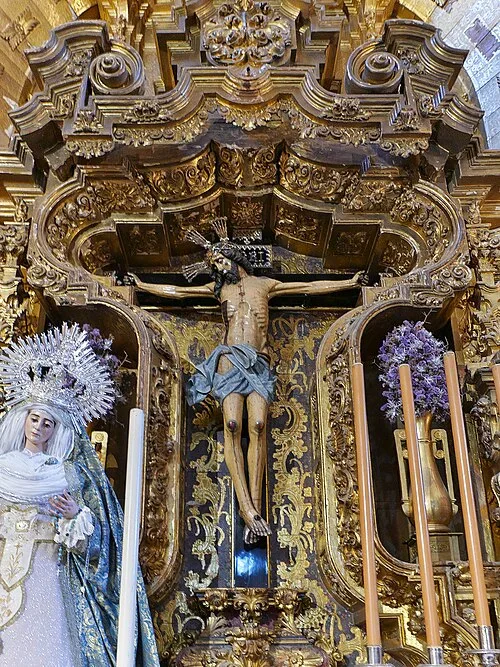 The High Altar and Cristo de la Viga
The Cristo de la Viga
Within a gilded altarpiece by Agustín de Medina y Flores hangs the Cristo de la Viga, a late Gothic crucifix from the end of the fifteenth century. When the first dome collapsed, tradition holds that a wooden beam shielded the image from the falling masonry. From that beam, viga in Spanish, the crucifix took its name. Whether it was chance or miracle, the people of Jerez made the story their own. The Cristo de la Viga is the oldest image that processes in the city's Holy Week. Candles and fresh flowers still stand at its altar, and local devotion has never left it.
Listen in the appPhoto: Jl FilpoC · CC BY-SA 4.0
06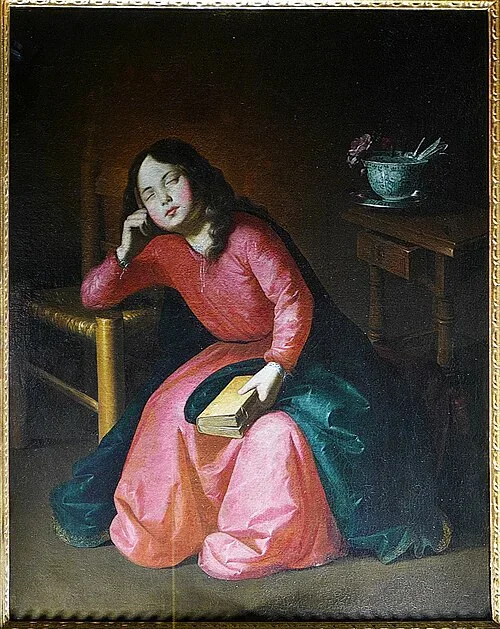 The Cathedral Museum
La Virgen Niña by Zurbarán
A small girl sleeps, her head heavy on her hand, a book open in her lap. She is the child Mary, painted by Francisco de Zurbarán, one of the great masters of Spain's Golden Age. The picture, La Virgen Niña, dates from the 1630s. Beside her, a sewing basket rests on the table, and the room is dark and still. Zurbarán turned the mother of God into a child at her lessons, drowsy over her book. That intimate, domestic touch is rare, and it anchors the cathedral museum's permanent exhibition.
Listen in the appPhoto: Jl FilpoC · CC BY-SA 4.0
07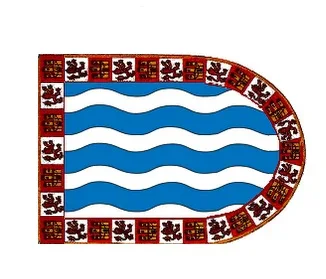 The Cathedral Museum
The Pendón of Jerez
Blue and white waves run across this banner, framed by a border of castles and lions. It is the pendón of Jerez, the heraldic banner tied to the city's conquest by Alfonso X the Wise on 9 October 1264. From that moment dates the collegiate chapter that governed the old church. By 23 September 1265, Alfonso had granted it its endowment privilege. For centuries the cathedral kept the historic city banner, a cloth dated to the fourteenth century. Then its custody passed to the city hall, and the banner disappeared without a trace. Nobody has ever explained what became of it.
Listen in the appPhoto: Caraballomolina · CC BY-SA 3.0
08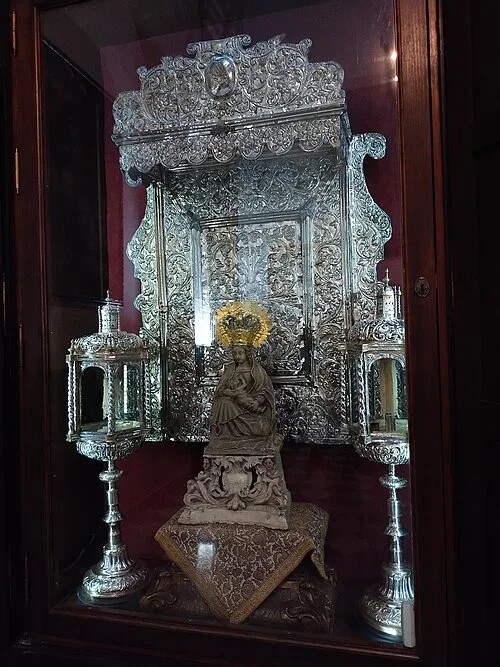 The Cathedral Museum
The Cathedral Treasury
Behind glass, the cathedral keeps its silver. The cases hold sacred plate and ornaments from the eighteenth and nineteenth centuries, gathered across the church's long life as Jerez's principal church. The standout piece is the processional Custodia del Corpus, worked in silver to a design by Aurelio Gómez Millán and made in 1951. It still leaves the building each year for the Corpus Christi procession, as it was made to do.
Listen in the appPhoto: Luistxo · CC BY-SA 4.0
09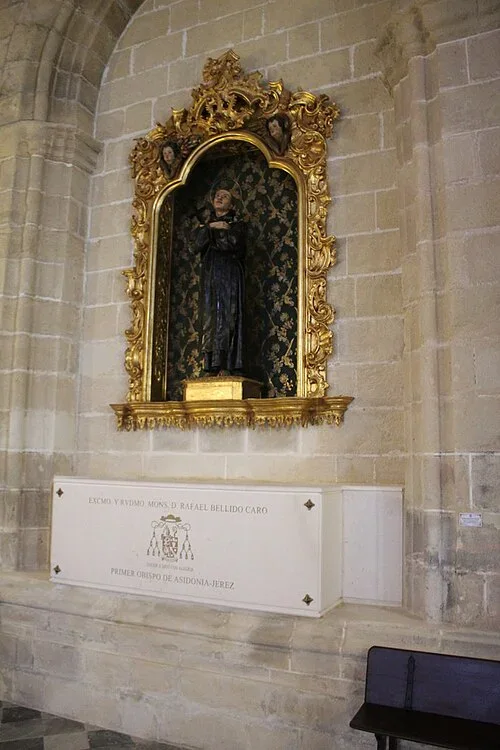 The Crypt and Bishop's Tombs
The Crypt and Bishop Bellido Caro
Among the illustrious citizens of Jerez buried in this church is its first bishop. Monsignor Rafael Bellido Caro led the Diocese of Asidonia-Jerez from its very beginning. He rests here, beneath the niche of San Juan Grande, patron saint of the diocese, with a plaque recording his name. The church that generations of canons raised now keeps the memory of those who served it, bishop and citizen alike.
Listen in the appPhoto: El Pantera · CC BY-SA 3.0
10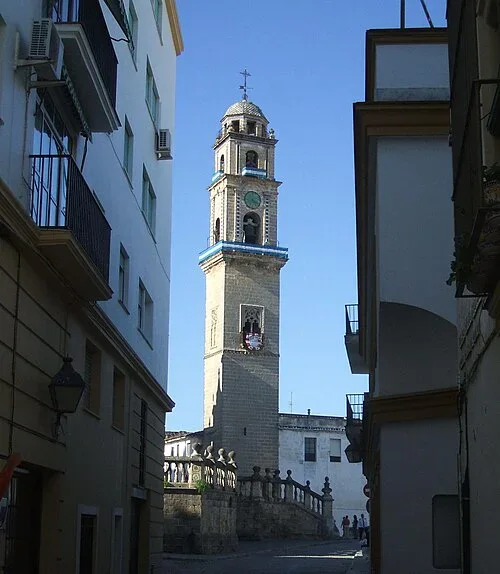 The Detached Bell Tower
The bell tower stands a few metres apart from the main building, one of the cathedral's defining oddities. Its lower part is Gothic-Mudéjar, its upper stages Baroque. Quite probably it rose over the minaret of the city's old Muslim-era mosque, though that remains an intriguing speculation rather than a settled fact. Its crowning dome is tiled in the colours of the city's pendón, and a cross weathervane tops the whole. Time took a heavy toll on the fabric. Restoration began in late 2017, and the tower opened to visitors in January 2019. Inside is kept the matraca, a wooden box shaped like a bell, fitted with metal hammers that strike as it turns. Nothing else like it exists in Spain, for size or form. It sounds only from Holy Thursday to Holy Saturday, the days when tradition forbids the ringing of bells.
Listen in the appPhoto: Marbregal · CC BY-SA 3.0
- 11
The Climb and the Bells
Up the spiral stair to eight bells, led by the giant La Gorda.
Catedral de Jerez de la Frontera
Frequently asked questions
How much does the guide cost?
Free app download. Listed guide price: $0.99. Guide price shown in the app. Audio guide only. Venue admission is separate.
Can I listen without internet?
Yes. Download the guide’s audio, images, and maps in the app before your visit. Your downloaded content is then available offline.
Can I listen in my language?
This audio guide is available in 15 languages, including English.
Do I need to follow a schedule?
No. This is a self-guided experience. Choose your stops, pause whenever you like, and return to a story at your own pace.
At your own pace
Explore Catedral de Jerez de la Frontera.
Download Stanza, then search for “Catedral de Jerez de la Frontera”.
Free app download · Guide price shown in the app
Keep exploring
Nearby audio guides
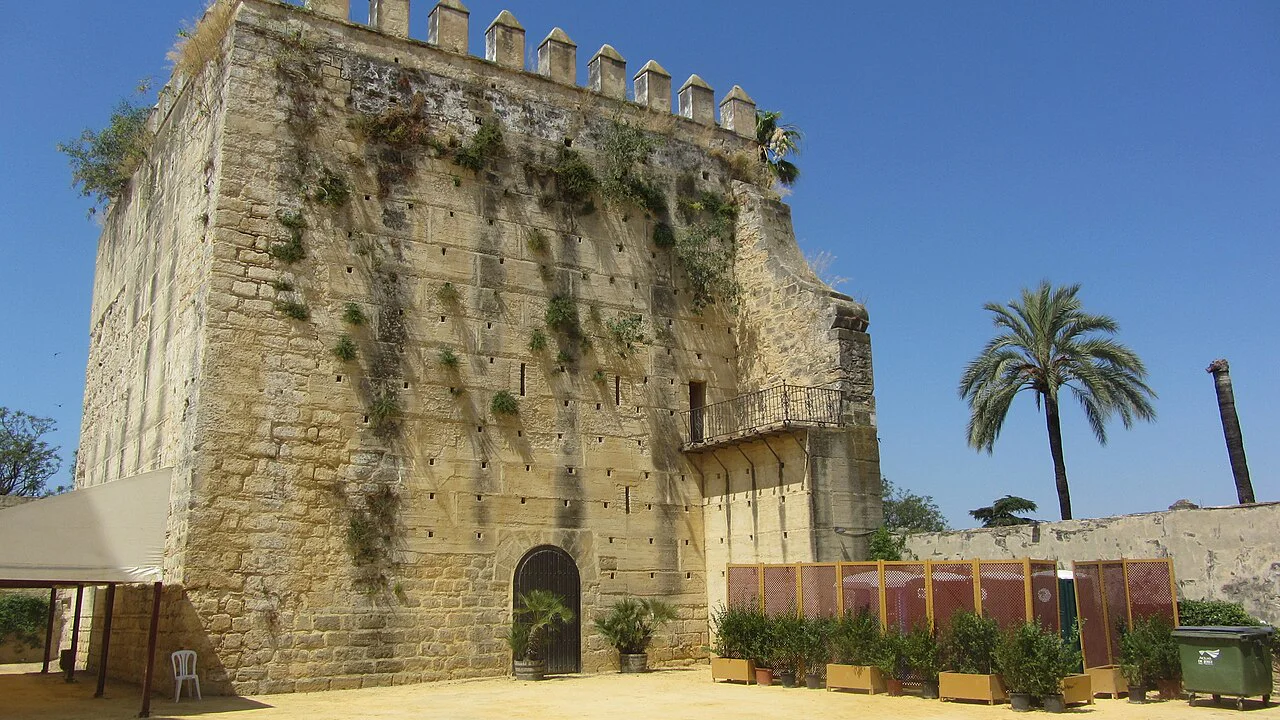
Jerez de la Frontera · 1 km
Alcázar de Jerez de la Frontera
Content & sources
Photo: Giel358 · CC BY-SA 4.0
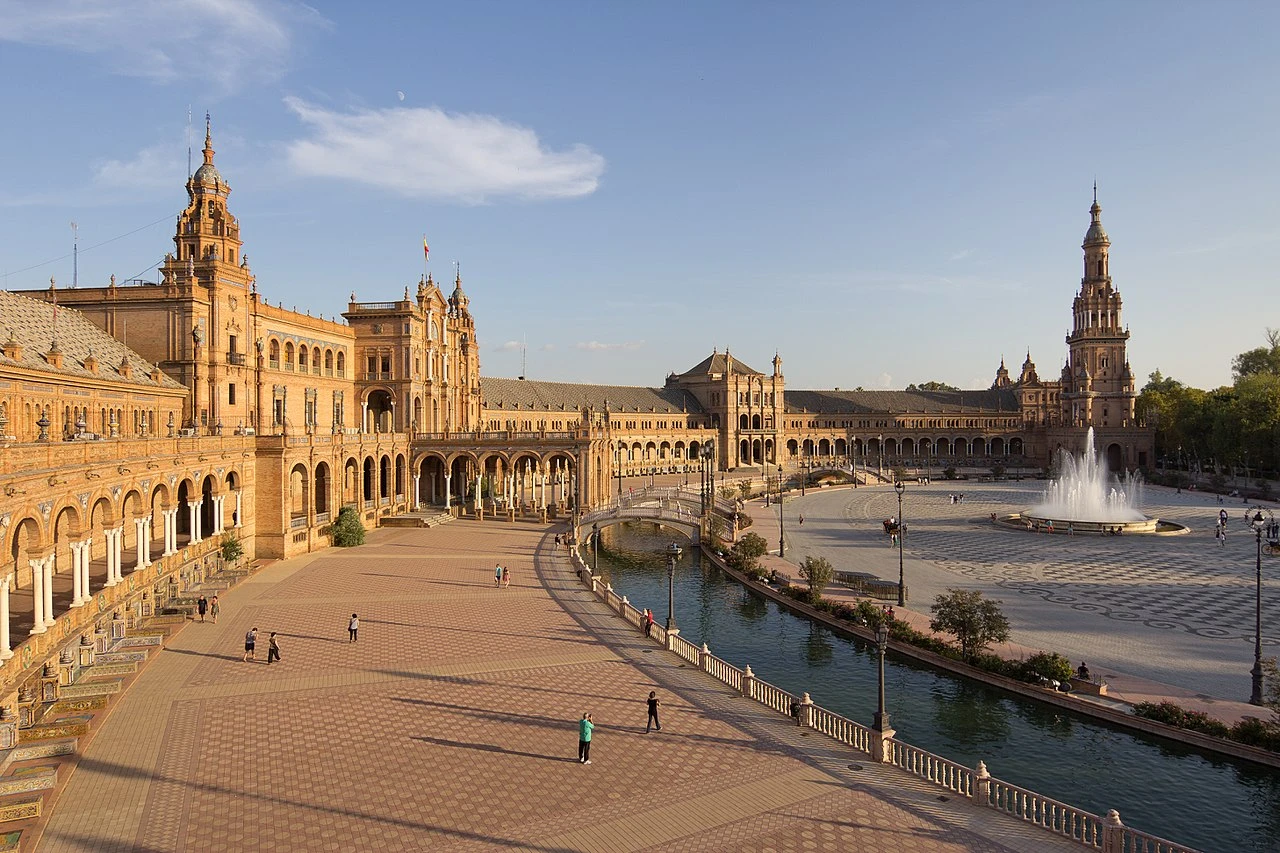
Seville · 78 km
Plaza de España
Content & sources
Carlos Delgado · CC BY-SA 4.0
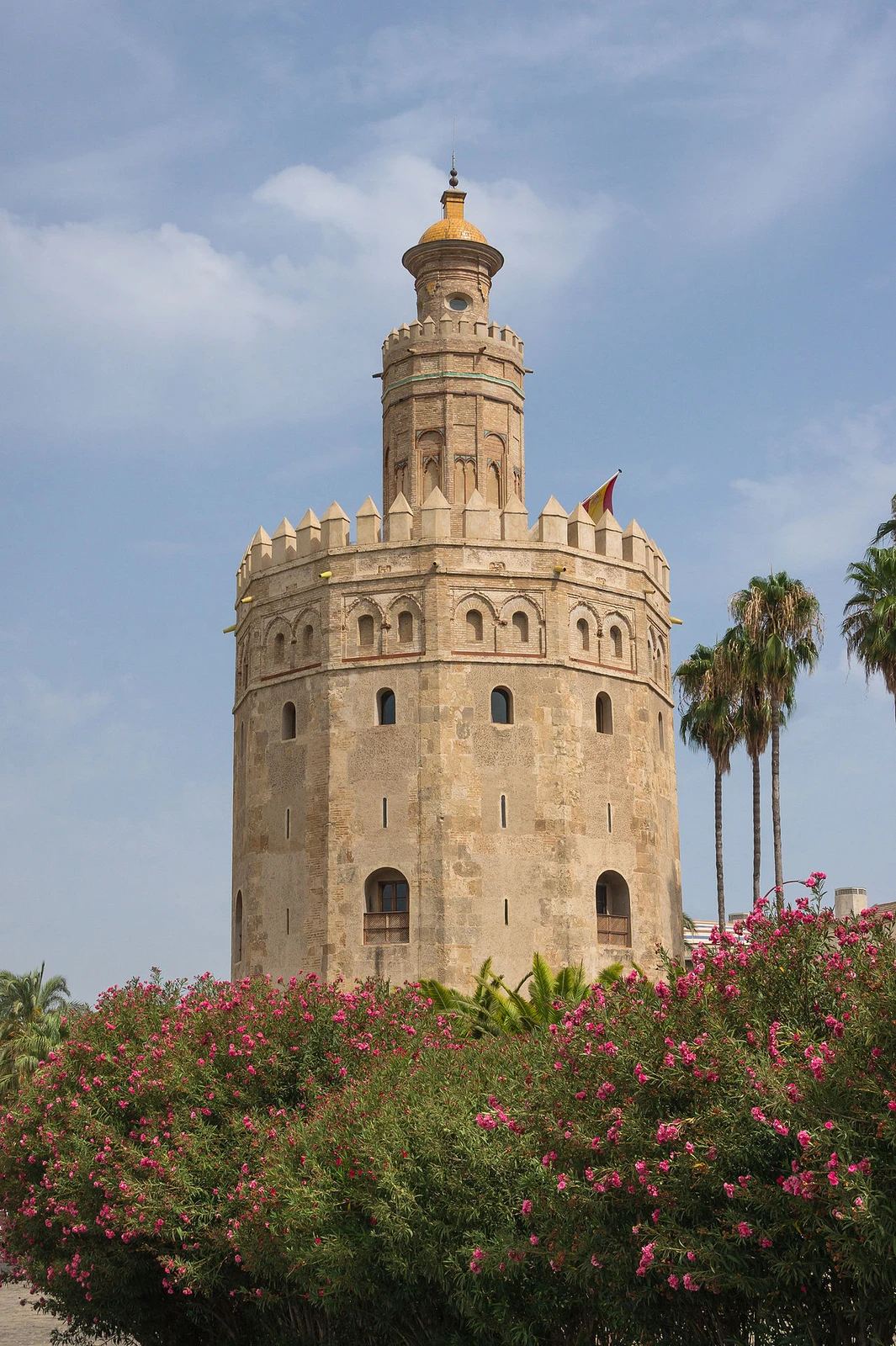
Seville · 79 km
Torre del Oro
Content & sources
Photo: Jebulon · CC0
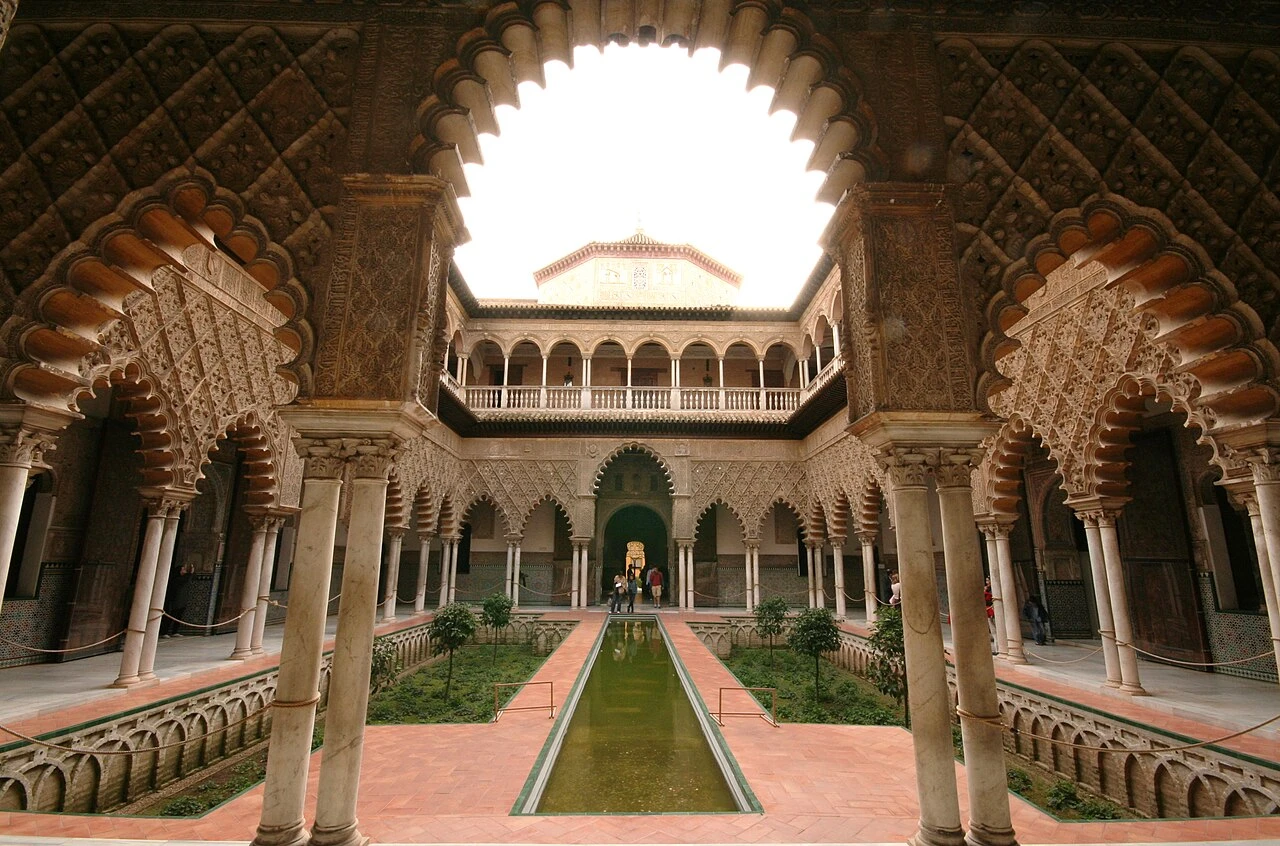
Seville · 79 km
Royal Alcázar of Seville
Content & sources
Cat from Sevilla, Spain · CC BY 2.0