Stanza · Audio guide
Torre del OroAudio guide
A place to remember. A story to take with you.
The Torre del Oro is a 13th-century military watchtower located on the banks of the Guadalquivir River in Seville. It originally served as a defensive structure to control access to the city via the river and…
Download Stanza, then search for “Torre del Oro”.
About the tour
One guide. Your kind of visit.
The Torre del Oro is a 13th-century military watchtower located on the banks of the Guadalquivir River in Seville. It originally served as a defensive structure to control access to the city via the river and currently houses a maritime museum.
Ready when you are.
- 01Get the free Stanza app.
iOS & Android
- 02Find your guide.
“Torre del Oro”
- 03Download before you go.
Works offline
Audio guide / 14 narrated stops
Inside the guide
Get to know a few of the stories before you go. Open a stop to read more.
01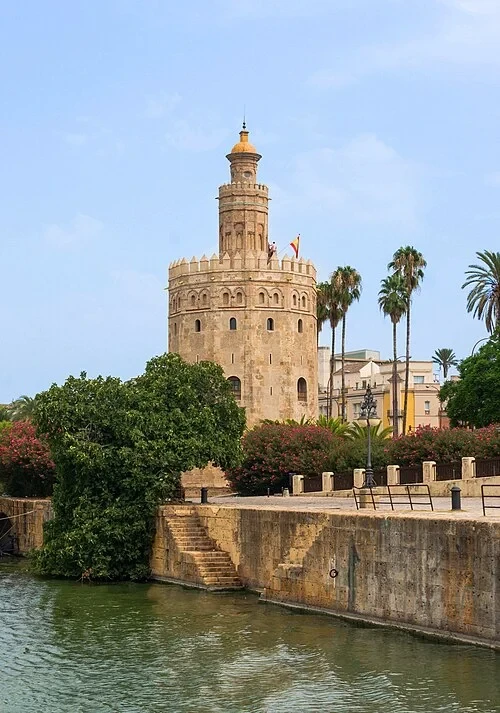 The Riverbank and Almohad FoundationsThe Almohad Watchtower
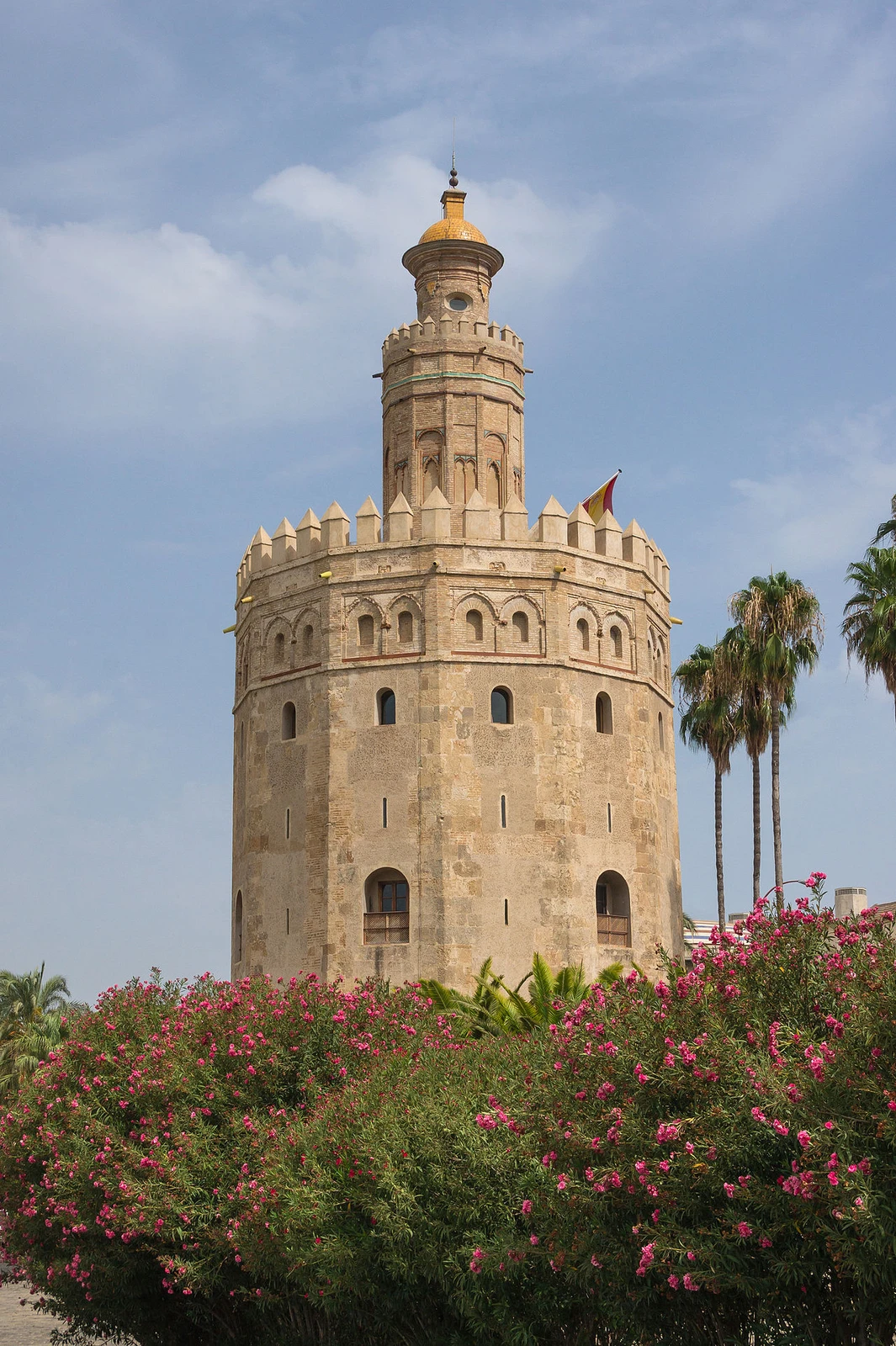
Work on this military watchtower began in 1220 and reached completion in 1221, ordered by the Almohad governor Abu l-Ulà to strengthen the city's river defenses. Rising to a total height of 36.75 meters, the tower's first level features a substantial diameter of 15.20 meters. Its most striking architectural feature is its twelve-sided, or dodecagonal, shape. This multi-faceted design was not merely decorative. By constructing twelve flat faces rather than a simple cylinder, the Almohad military engineers significantly improved the defensive capabilities of the structure. The twelve angles maximized the viewing and shooting angles for soldiers stationed inside, eliminating blind spots as they monitored the river traffic and guarded against potential invaders. From this vantage point, archers and scouts could keep watch across the water with a clear line of sight in almost every direction. Today, this distinctive twelve-sided silhouette continues to dominate the riverbank, rising directly from the modern stone quay.
Photo: Jebulon · CC0
02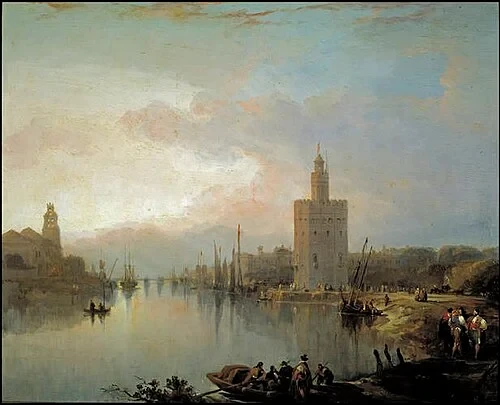 The Riverbank and Almohad FoundationsThe Guadalquivir River and the Golden Tower
David Roberts, a prominent nineteenth-century British artist, captured the atmospheric beauty of the Guadalquivir in this romantic landscape painting. His work frequently depicted the tower, highlighting its famous moniker, the Torre del Oro, or Tower of Gold. For centuries, local legends suggested the name originated because the tower served as a storage house for imported treasures or was once clad in glittering tiles. However, modern archaeological analyses solved the mystery, proving that the brilliant shimmer on the water had a far more practical source. The golden luster was actually a visual effect caused by the building materials used in the tower's original mortar. A specific mixture of pressed hay, lime, and sand reflected the bright Andalusian sun, giving the stonework a metallic, gilded appearance when viewed from the river. In this painted scene, Roberts emphasized this warm glow across the sky and water, depicting historic masted sailing vessels gently moored along the shoreline during a quiet, amber-tinted sunset.
Photo: Electron · Public domain
03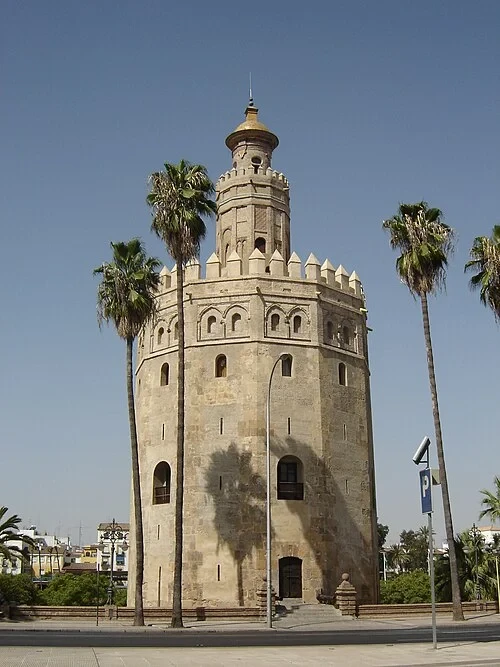 Maritime Museum EntranceSeville Maritime Museum
Constructing a massive stone military tower on the soft, muddy banks of a tidal river presented immense engineering challenges for medieval builders. To prevent the immense weight of the tower from sinking or sliding into the flowing Guadalquivir, builders constructed a deep, specialized foundation system. They packed lime concrete over a dense network of pine wood piles driven deep into the riverbed clay. Over the centuries, successive generations reinforced these hidden underground footings to ensure the structure remained stable. Looking closely at the landward exterior, you can spot several narrow vertical slits cut into the thick masonry walls. These openings functioned as defensive loopholes, allowing archers to target attackers while remaining safely protected behind feet of solid stone. Originally, the tower did not stand isolated on the modern promenade as it does today. It was physically connected to Seville's extensive defensive city walls by an elevated stone walkway, forming a vital corner bastion of the municipal defense system.
Listen in the appNo machine-readable author provided. Morinpat assumed (based on copyright claims). · CC BY 2.5
04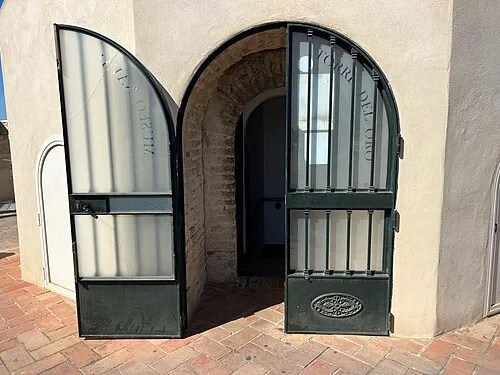 Maritime Museum EntranceMaritime Museum Entrance
Step through the arched entrance to find the Seville Maritime Museum, which has occupied the interior chambers of this watchtower since 1944. Many stories associate this entrance with King Pedro the First of Castile, who ruled in the fourteenth century. Popular myths claimed the king used the secure lower vaults of the tower to hoard his personal collections of gold, silver, and precious jewels. Historical records, however, completely debunk this tale. During the era of Spanish transatlantic trade, the tower never functioned as a storehouse for royal treasures. All precious metals returning from the Americas were legally bound to go directly to the Casa de la Contratación, or House of Trade. This official regulatory institution lay a short walk away from the riverbank, situated securely near the cathedral complex where royal officers could meticulously catalog and tax every ounce of imported silver and gold.
Listen in the appPhoto: Chabe01 · CC BY-SA 4.0
05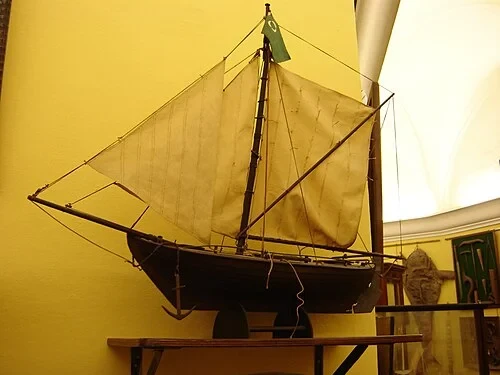 Ground Floor Naval ExhibitsThe Galleon Model
Hanging against the bright yellow plaster wall inside the museum is an intricate model of a historic sailing ship. This miniature vessel represents the types of cargo carriers and armed galleons that dominated the Guadalquivir during the sixteenth century. At that time, Seville served as the exclusive port of entry for all trade with the Spanish territories in the Americas, holding a strict economic monopoly. These massive, multi-decked ships carried manufactured goods from Europe across the Atlantic, returning loaded with valuable natural resources. Navigating these deep-drafted vessels back to Seville was a perilous task. The Guadalquivir is a tidal river with dangerous, shifting sandbars and shallow channels, particularly near the mouth of the river at Sanlúcar de Barrameda. Experienced local pilots had to guide the heavy ships carefully along the winding waterways, constantly measuring water depths to avoid running aground before reaching the safety of the city docks.
Listen in the appLobillo, (España) · Public domain
06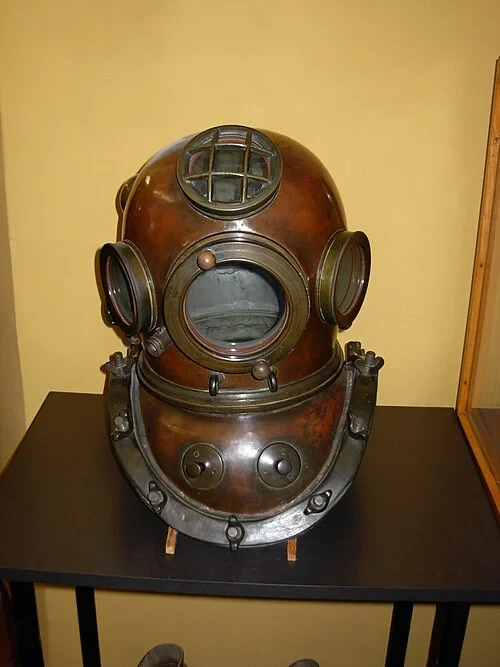 Ground Floor Naval ExhibitsThe Historic Diving Helmet
Featuring thick circular glass viewports and a wide collar ring, the heavy metal diving helmet on display represents the hazardous world of deep-water salvage. Equipment like this played a critical role in the underwater history of the Guadalquivir. Over centuries of heavy commercial shipping, cargo frequently fell overboard during unloading operations at the busy stone quays, and several vessels sank in the river channel. Specialized salvage divers went down into the water to recover lost goods and inspect damaged ship hulls. Performing this work was incredibly dangerous. The river water was almost entirely opaque due to suspended silt, leaving divers to operate in near-total darkness. They had to fight against powerful, unpredictable river currents while wearing extremely heavy gear, relying entirely on a manual air pump operated by crew members on a boat above, who pushed fresh air down through a long rubber hose.
Listen in the appPhoto: Agamemnus · Public domain
07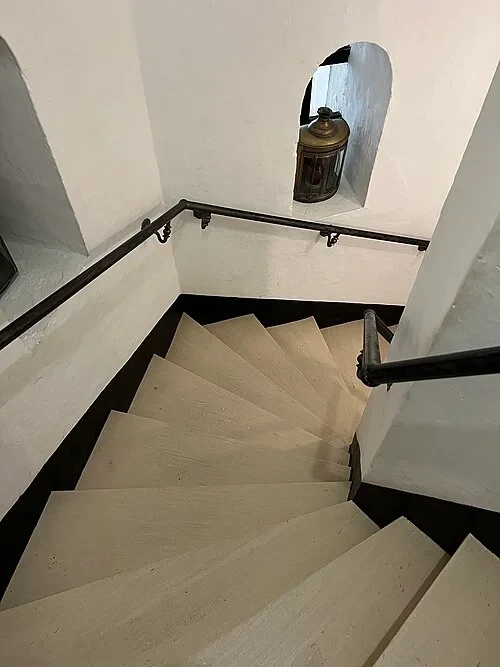 The Spiral Staircase and Medieval PrisonThe Noble's Prison Staircase
Winding steeply between the thick masonry walls, these narrow stone stairs lead to the upper levels of the tower. During the Middle Ages, this defensive structure served a secondary purpose as a highly secure prison. Unlike the damp, common dungeons elsewhere in Seville, these chambers were reserved exclusively for high-ranking members of the nobility who had fallen out of favor with the Crown. The architecture of the tower made it an exceptionally effective jail. Because of the tight, spiraling layout of the staircase, guards could easily control movement up and down the tower, making any physical escape attempt virtually impossible. Confined within these thick stone walls, noble captives spent their days in relative isolation. Their only connection to the outside world came through the narrow defensive arrow slits, which allowed just a tiny sliver of direct daylight and a restricted view of the river below to penetrate the dim chambers.
Listen in the appPhoto: Chabe01 · CC BY-SA 4.0
08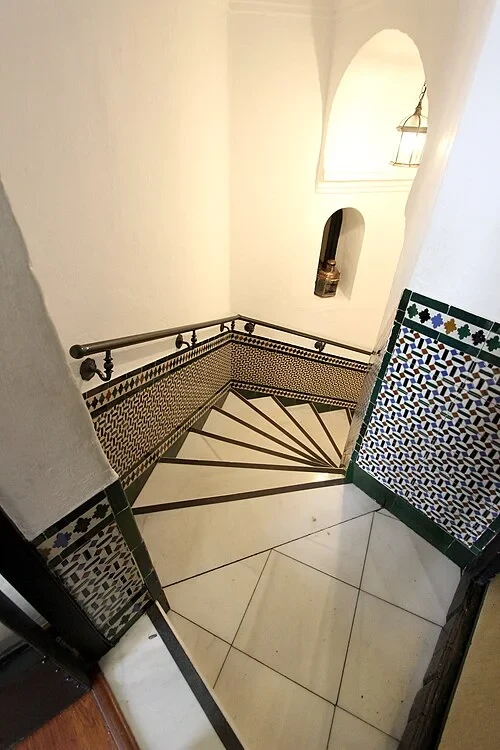 The Spiral Staircase and Medieval PrisonThe Mudejar Stairway
Bright geometric patterns of colorful ceramic tiles decorate the walls alongside this section of the staircase. This intricate decoration showcases the classic Mudéjar style, an architectural movement unique to the Iberian Peninsula that blended traditional Islamic geometry with Christian structural forms. Following the Christian conquest of Seville, local Moorish craftsmen continued to apply their sophisticated design techniques to public works. These glazed tiles, featuring interlocking star shapes and repeating borders, add a sophisticated artistic element to the otherwise utilitarian military interior. During a major municipal restoration project completed in 2005, specialists carefully preserved these delicate tile installations. The multi-year conservation effort focused on stabilizing the ancient Almohad brickwork and protecting these decorative features from humidity, ensuring that the visual interface between Islamic craftsmanship and medieval military defense remains clearly visible to modern visitors ascending the tower steps today.
Listen in the appPhoto: Colling-architektur · CC BY-SA 3.0
09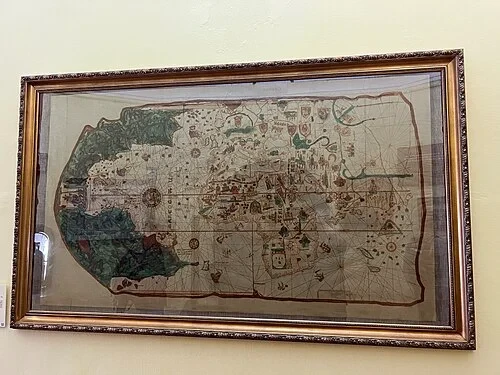 First Level Charts and InstrumentsThe Chart of the New World
Framed on the museum wall is an early chart depicting the maritime routes and territories of the expanding Spanish Empire. Maps like this guided the fleets that sailed past the tower, but the waters below also inspired famous historical legends. One enduring story of the 1248 Siege of Seville claims that defenders stretched a massive, heavy iron chain across the river from the base of this tower to the Triana shore to physically block invading Christian fleets. Historical evidence shows that this giant chain is a myth, as the tower itself was built decades before the siege and no such chain mechanism existed here. Instead, a floating bridge constructed of wooden boats linked by iron chains blocked the waterway. Despite being historically inaccurate, the legend of the broken chain remains highly influential, appearing prominently on the official coats of arms of several Spanish coastal cities whose sailors participated in the siege, including Santander and Castro Urdiales.
Listen in the appPhoto: Chabe01 · CC BY-SA 4.0
10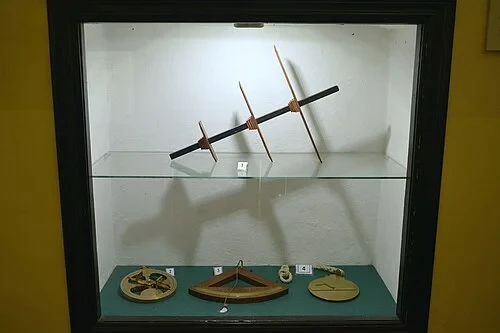 First Level Charts and InstrumentsNavigational Instruments
Displayed inside this glass exhibit case are several essential tools that made the hazardous voyages of the Age of Discovery possible. On the upper shelf rests a wooden cross-staff, an early navigational instrument used by ship pilots to determine latitude at sea. To use the device, a navigator held the long staff to their eye, sliding the vertical crossbar until its lower edge aligned with the ocean horizon and the upper edge met the sun or the North Star. By reading the scale marked on the main staff, they could calculate their ship's position north or south of the equator. On the green shelf below, you can see circular brass astrolabes, which used rotating discs to track celestial bodies. These simple mathematical instruments allowed Spanish fleets to navigate open ocean waters without landmarks, establishing the reliable trade routes that linked the bustling docks of Seville to the distant ports of the Americas.
Listen in the appPhoto: Alberto-g-rovi · CC BY 4.0
Torre del Oro
Frequently asked questions
How much does the guide cost?
Free app download. Listed guide price: $3.99. Guide price shown in the app. Audio guide only. Venue admission is separate.
Can I listen without internet?
Yes. Download the guide’s audio, images, and maps in the app before your visit. Your downloaded content is then available offline.
Can I listen in my language?
Stanza supports 15 languages. Check the app for the languages available for this guide.
Do I need to follow a schedule?
No. This is a self-guided experience. Choose your stops, pause whenever you like, and return to a story at your own pace.
At your own pace
Explore Torre del Oro.
Download Stanza, then search for “Torre del Oro”.
Free app download · Guide price shown in the app
Keep exploring
Nearby audio guides
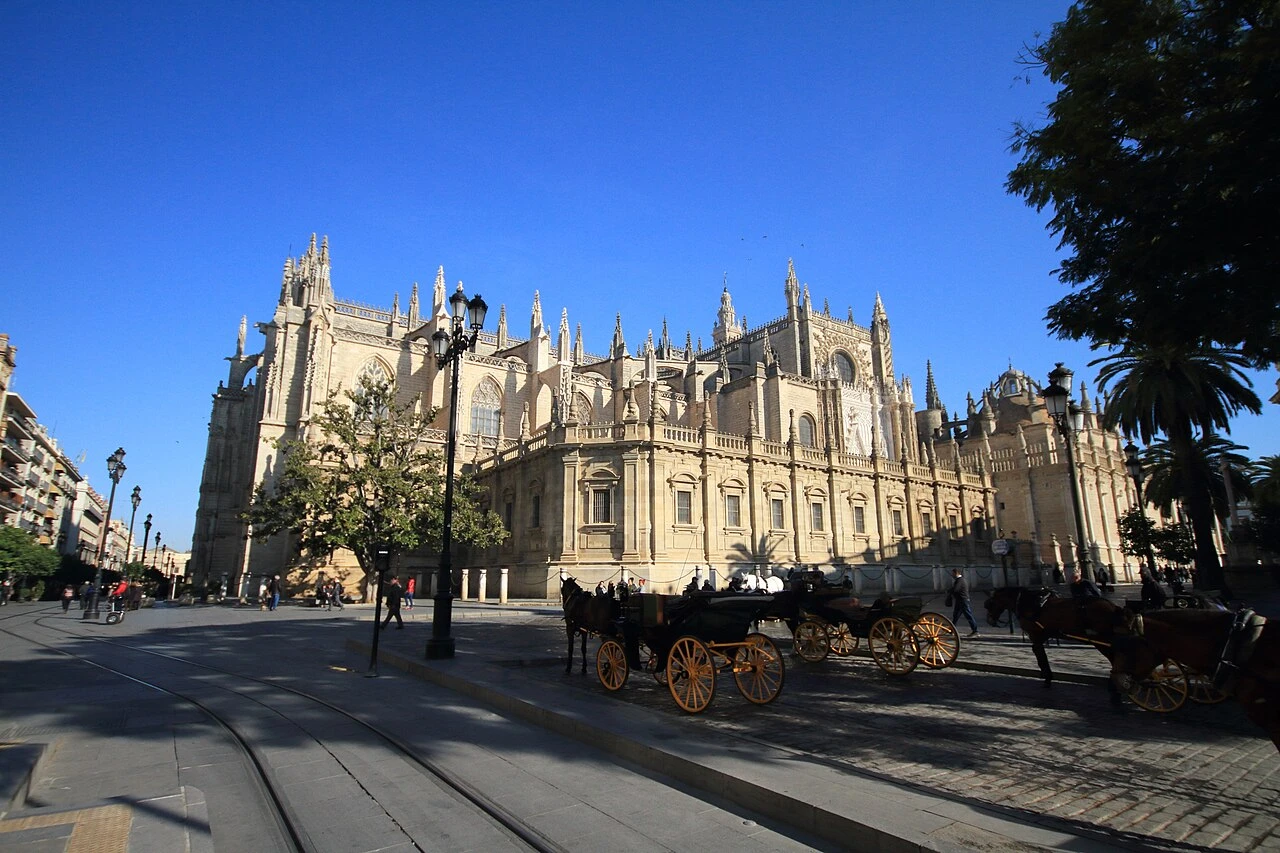
Seville
Catedral de Sevilla
Content & sources
Photo: PEPE GADEIRAS · CC BY-SA 4.0
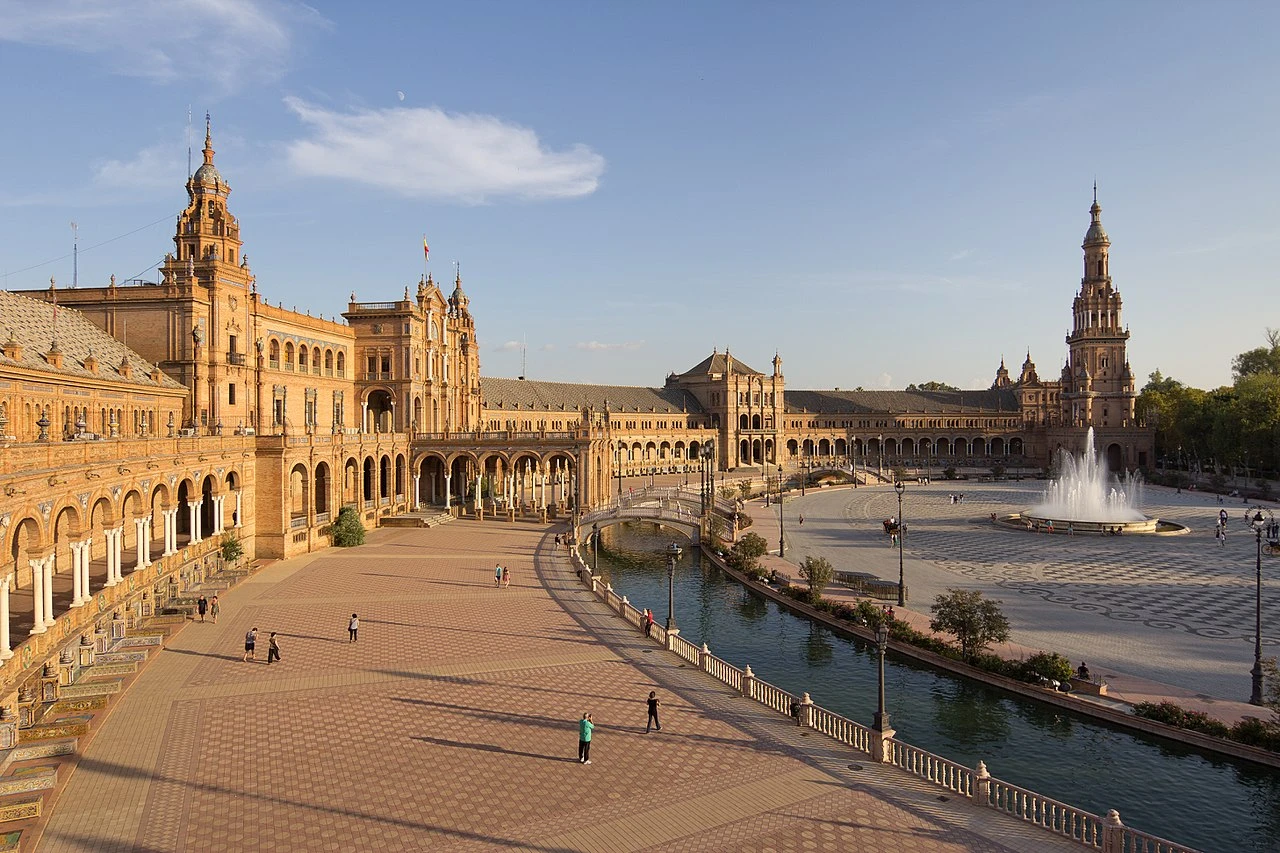
Seville
Plaza de España
Content & sources
Carlos Delgado · CC BY-SA 4.0
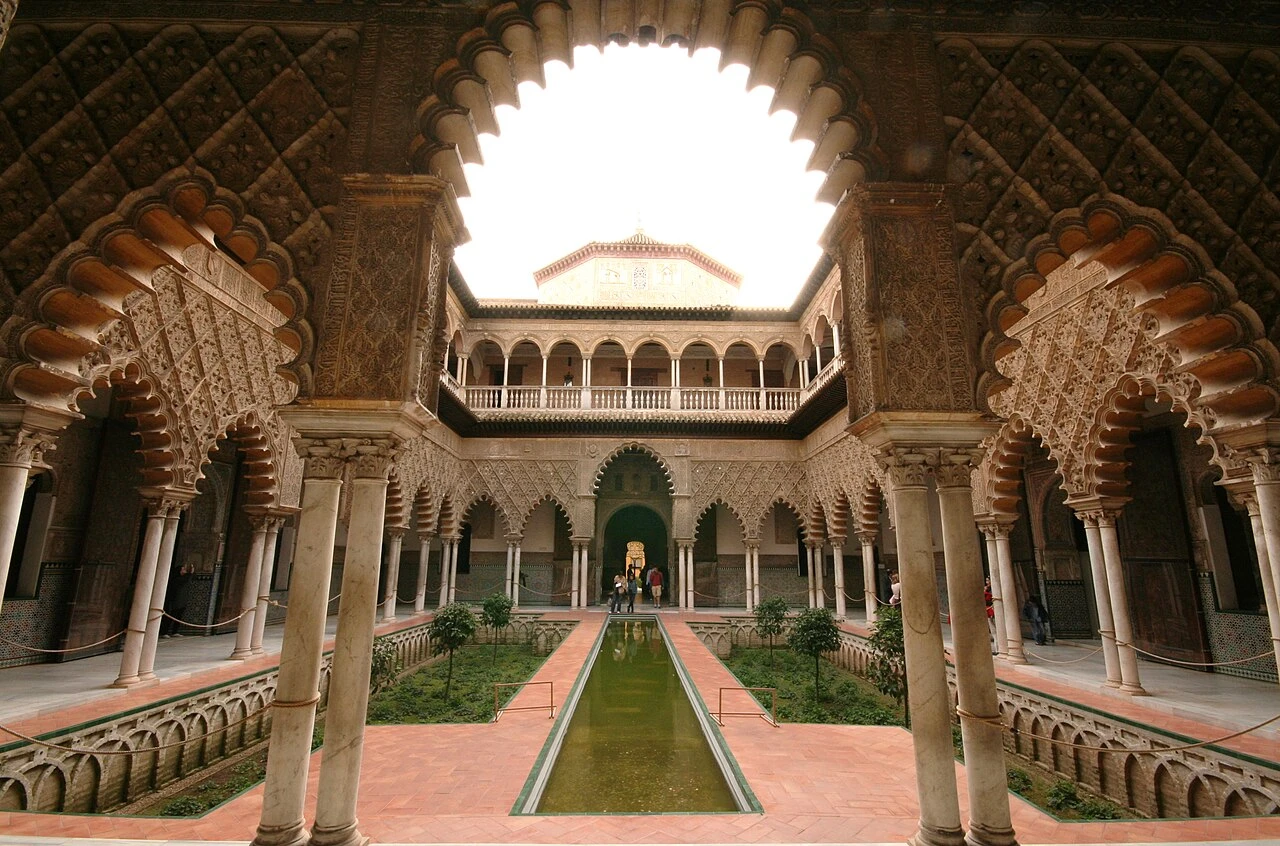
Seville
Reales Alcázares de Sevilla
Content & sources
Cat from Sevilla, Spain · CC BY 2.0
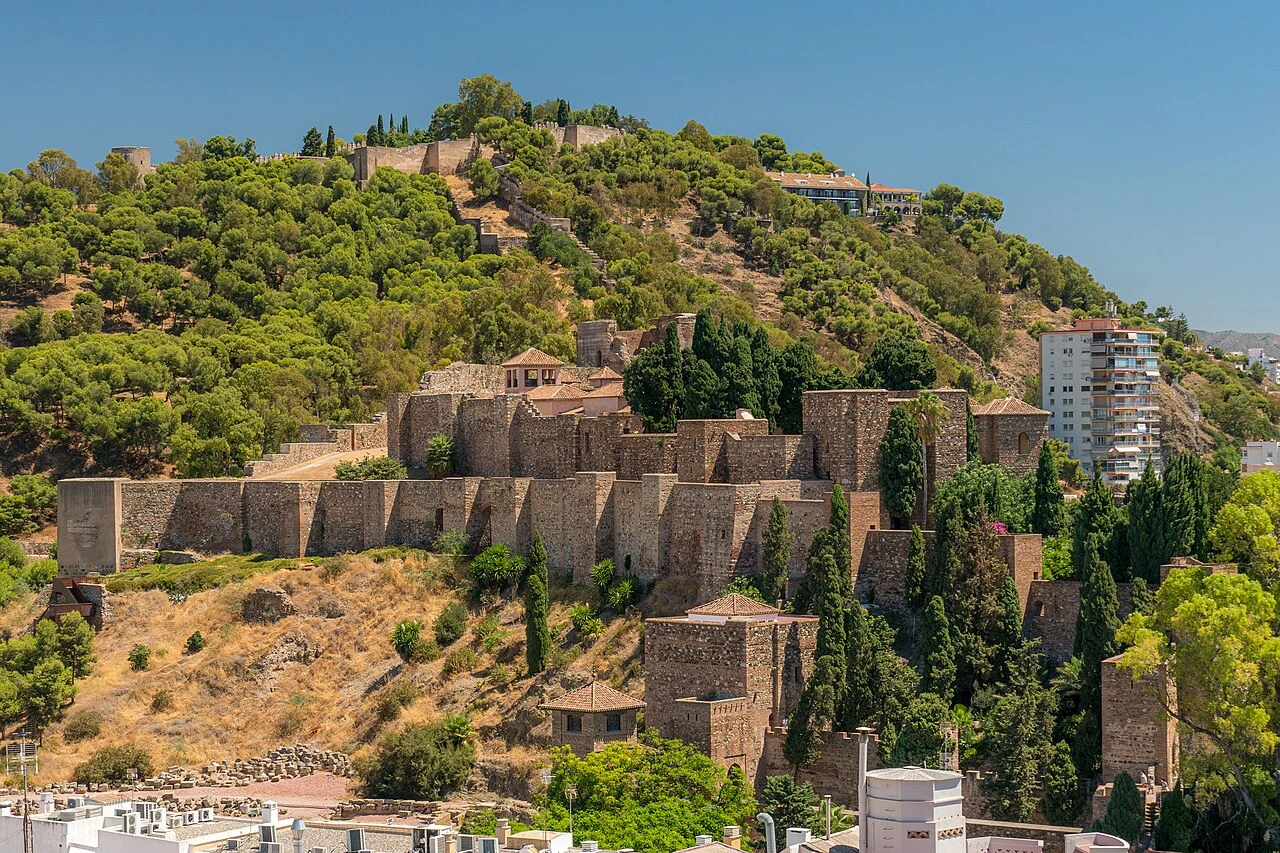
Málaga
Alcazaba de Málaga
Content & sources
Photo: Fernando · CC BY-SA 4.0