Languages
15Real Monasterio de San Lorenzo de El Escorial Audio Guide
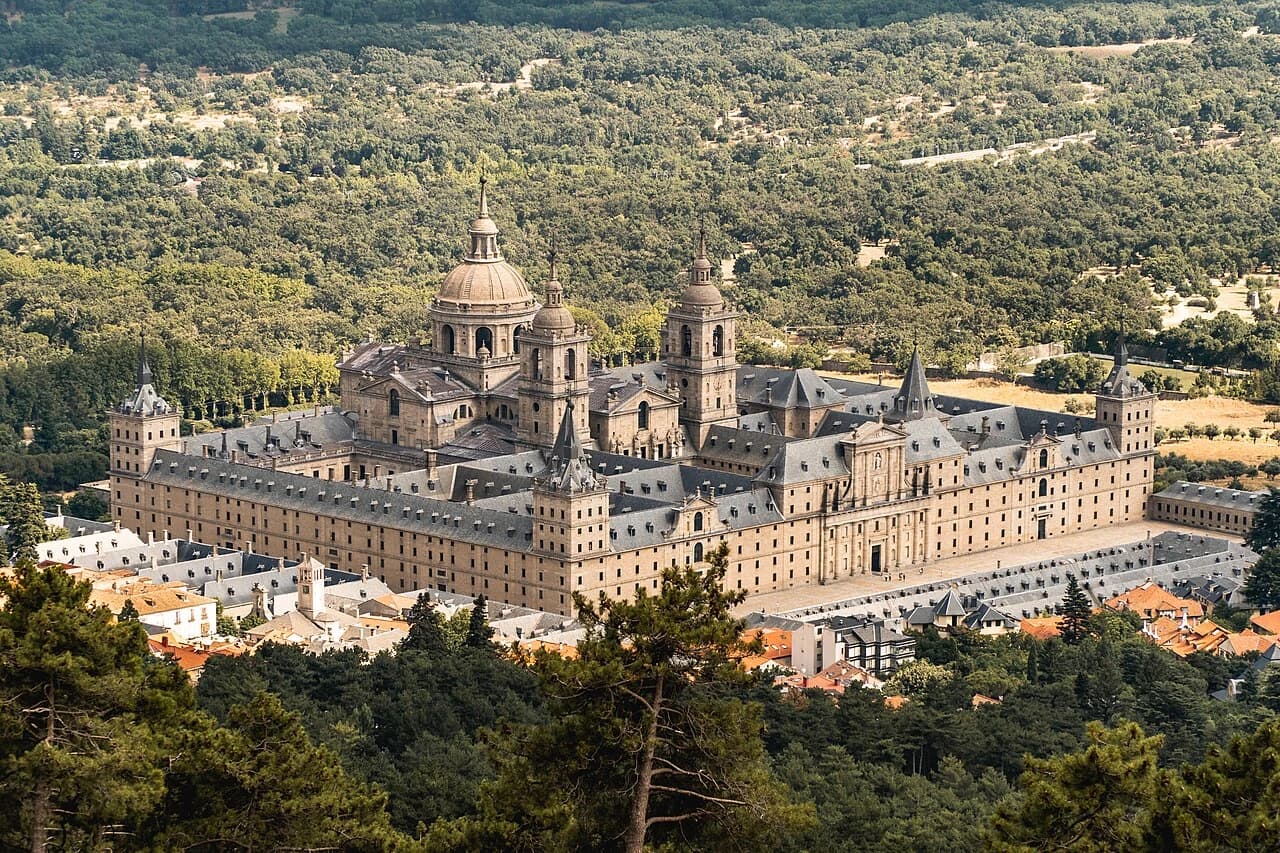
Real Monasterio de San Lorenzo de El Escorial is a landmark in San Lorenzo de El Escorial, Spain. Explore it with Stanza's GPS-triggered offline audio guide — available in 15 languages.
Quick Facts
25
Stops
15
Languages
100%
Offline
📍 San Lorenzo de El Escorial, Spain · 40.5892°N, -4.1478°E
About Real Monasterio de San Lorenzo de El Escorial
The Royal Monastery of San Lorenzo de El Escorial is a vast complex comprising a palace, basilica, pantheon, library, and museum. It served as a historical residence for the King of Spain and is a significant example of Spanish Renaissance architecture.
Real Monasterio de San Lorenzo de El Escorial is also known as Royal Seat of San Lorenzo de El Escorial, Royal Palace, El Escorial, Monastery of El Escorial, Escurial, and 12 other names in various languages.
This self-guided audio tour features 25 narrated stops organized across 7 sections. As a monastery, Real Monasterio de San Lorenzo de El Escorial offers a unique cultural experience in the heart of San Lorenzo de El Escorial, Spain.
The Stanza audio guide is available in 15 languages and works entirely offline — download the complete tour including audio narration, maps, and images before your visit. As you walk through Real Monasterio de San Lorenzo de El Escorial, GPS-triggered narration plays automatically at each point of interest.
Last updated:
What you will hear
The West Facade and the Gridiron Legacy
Establishes the scale and the 'Eighth Wonder' reputation. Includes the aerial view for context, the severe West Facade, and the statue of St. Lawrence to explain the gridiron design.
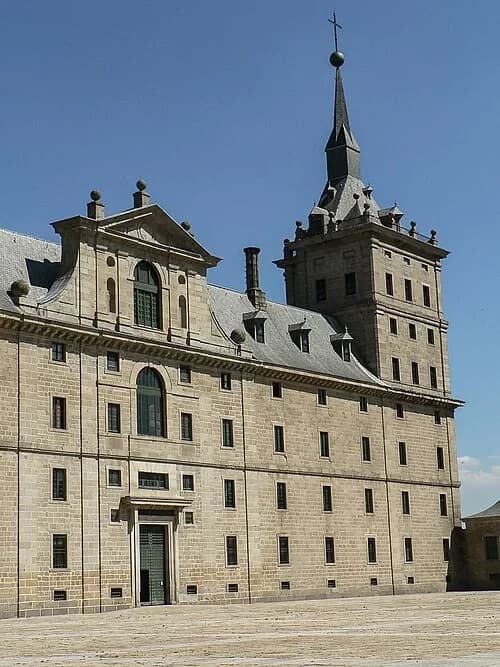
The West Facade
Looking at the main entrance, the starkness of the architecture is immediately apparent. This is the Herrerian style, named after architect Juan de Herrera, who took over the project and stripped away the ornate decorations typical of earlier Spanish architecture. This 'desornamentado' or unadorned look was a deliberate choice. The gray granite, quarried from the nearby mountains, provides a sense of permanence and strength. Instead of using sculptures or intricate carvings to impress, Herrera relied on geometric proportions and the sheer volume of the stone. This severity was intended to reflect the religious sobriety of the Counter-Reformation and the immense power of the Spanish monarchy under Philip II. By choosing such a restrained aesthetic, the builders emphasized order, discipline, and the gravity of the functions contained within these walls. It remains one of the most influential examples of Spanish Renaissance architecture, emphasizing clean lines and raw stone over artistic ornamentation.
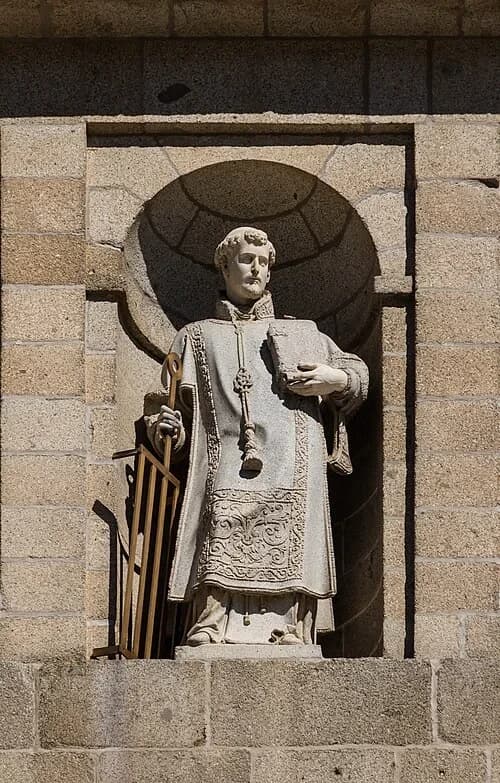
Statue of Saint Lawrence
The presence of Saint Lawrence throughout the complex is no coincidence. In August 1557, Spanish forces under Philip II achieved a decisive victory against the French at the Battle of San Quintín. Because this victory occurred on August 10th, the feast day of Saint Lawrence, the king credited the saint with the success and vowed to build a monumental structure in his honor. This statue represents that promise. Notice the saint holds a gridiron, which is the instrument of his martyrdom. Tradition states he was burned alive on such a device. By placing this figure prominently, Philip II transformed a military triumph into a spiritual commitment. The monument serves as a permanent architectural thank-you note for the survival and expansion of the Spanish empire. It anchors the entire history of El Escorial to that single day of conflict and the religious devotion that followed. This saint remains the primary patron of the entire building.
The Courtyard of the Kings
Focuses on the transition from the secular to the sacred. The Kings of Judah statues link the Spanish monarchy to the biblical Temple of Solomon.
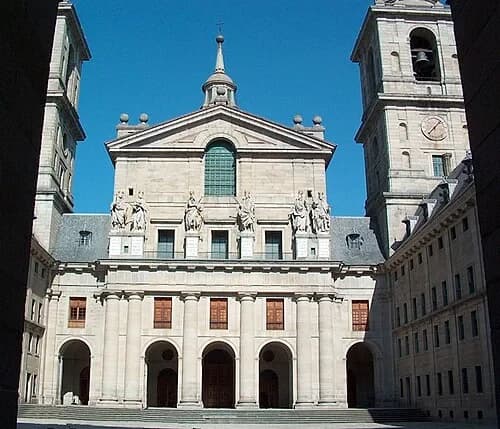
The Courtyard of the Kings
This grand open space serves as a ceremonial vestibule. As you move through it, you are transitioning from the administrative and residential areas of the palace into the spiritual domain of the church. The architecture here is designed to prepare the visitor for the solemnity of the Basilica. Looking toward the church entrance, you will see a row of six colossal statues perched high above the facade. These figures are the Kings of Judah, selected for their biblical significance. Their placement suggests that the Spanish monarchs are the legitimate successors to the divinely appointed kings of the Old Testament. The courtyard acts as a buffer, using scale and symbolism to shift the mood from the temporal to the eternal. It is the architectural equivalent of a deep breath before entering a holy place. Every element, from the paving stones to the towering walls, directs your focus toward the church. Its rigid geometry reflects the order demanded by the king.
The Heart of the Monastery: The Basilica
Explores the spiritual center. Includes the nave, the massive dome (the highest point), and the monumental high altar.
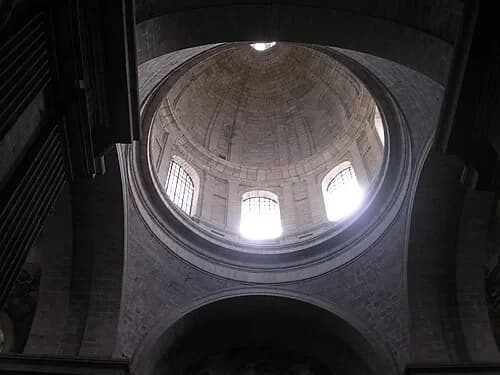
The Central Dome
Look up toward the highest point of the entire complex. The cross sitting atop the lantern of this massive dome reaches a height of 95 meters from the ground. Building such a heavy structure entirely out of stone required sophisticated 16th-century engineering to manage the outward thrust. The dome is supported by four enormous piers, which distribute the weight down into the foundations. A series of windows encircling the base of the dome, known as the drum, allows natural light to flood the center of the church, creating a brilliant contrast with the darker naves. This light was seen as a symbol of divine presence. The interior of the dome is left with the exposed pattern of the stone masonry, a testament to the skill of the craftsmen who fit each block with precision. From the outside, the dome serves as the primary landmark for the monastery, visible from miles away across the Spanish landscape. Its design influenced numerous other churches built during the Baroque era.
The Royal Pantheons: Crypts of Kings and Princes
Descends into the royal burial chambers. Explains the 'Pudridero' process and shows the final resting places of the Spanish monarchs.
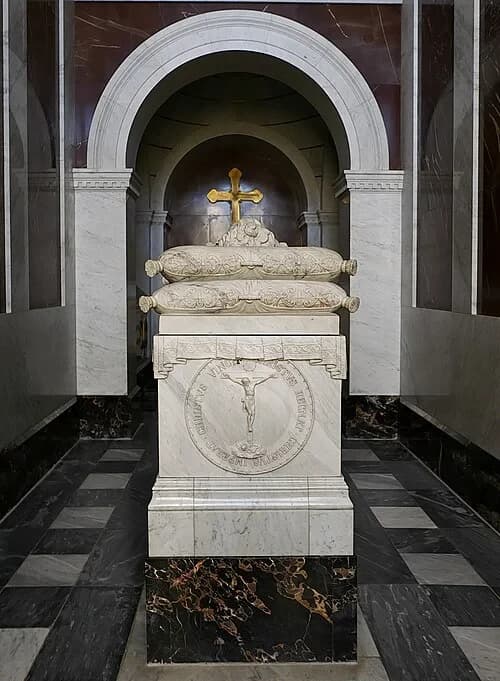
Tomb of John of Austria
Among the many royal tombs, this one stands out for the specific historical figure it honors. John of Austria was the illegitimate half-brother of Philip II and the supreme commander of the Holy League fleet. His greatest triumph came in 1571 at the Battle of Lepanto, where he led the Christian forces to a decisive victory over the Ottoman Empire. The effigy shows him lying in state, dressed in incredibly detailed armor that reflects his status as a master of warfare. Notice the sword he carries, a symbol of his career on the battlefield. Unlike the kings who are often shown in prayer or ceremonial robes, John is remembered primarily as a warrior. The fine carving of the marble captures the textures of the metal and leather, making it one of the most lifelike monuments in the crypt. His gauntlets and helmet are resting on the slab near his feet, completing his military image.
The Palace of the Austrias: Philip II's Private Rooms
Contrasts royal power with extreme austerity. Includes the King's deathbed and his portrait in old age.
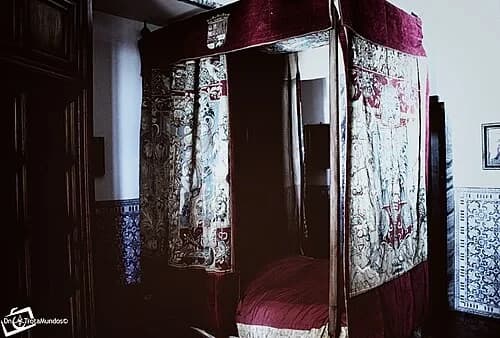
The Bedroom of Philip II
After walking through grand courtyards and gilded chapels, the simplicity of the king's private quarters is startling. This bedroom features basic brick floors and modest wooden furniture, reflecting Philip II's personal preference for austerity. The most significant feature is the small interior window set into the wall. As the king's health declined toward the end of his life, he became bedridden. This window allowed him to look directly down onto the high altar of the Basilica from his bed. He could hear the monks chanting their daily prayers and observe the celebration of the mass even when he was too weak to move. He died in this room in September 1598, surrounded by his personal collection of religious relics and books. The original furniture, including the king's bed and simple chairs, is still in its original location, providing a rare look at the private life of the 'Prudent King'.
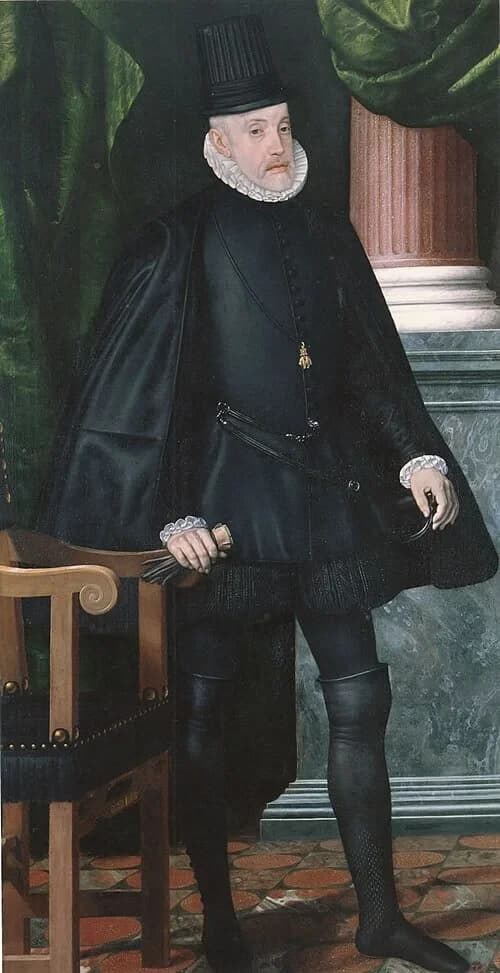
Portrait of Philip II in Old Age
Juan Pantoja de la Cruz · 1590s · canvas, oil paint
This portrait of Philip II captures the monarch in his final years, offering a stark look at the man who directed the Spanish Empire from these very walls. He is depicted in the traditional black clothing favored by the Spanish court, a color that signaled both sobriety and immense wealth, as high-quality black dye was extremely expensive. Around his neck hangs the distinctive collar of the Order of the Golden Fleece, the most prestigious chivalric order in Christendom. Notice the king’s pale, almost translucent skin and his weary, somber expression. By this stage of his life, Philip was often confined to his small bedroom, yet he remained deeply involved in every administrative detail of his global territories. This painting does not aim for the typical flattery found in royal portraiture; instead, it emphasizes his role as the 'Prudent King.' His steady, unflinching gaze suggests a ruler who viewed his power as a heavy, divinely-appointed duty. This image serves as a human contrast to the massive, rigid granite walls of the monastery that he spent decades building and refining.
The Main Staircase: Glory of the Monarchy
Features the architectural masterpiece of the grand staircase and the spectacular Luca Giordano ceiling fresco.
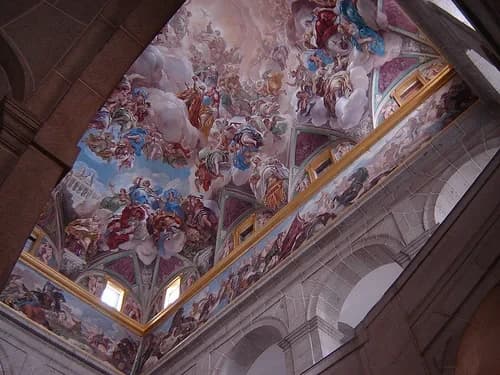
The Grand Staircase
The Grand Staircase is one of the most significant architectural achievements within the monastery. Its design focuses on a sense of gradual, impressive ascent. There are 52 steps in total, and remarkably, each one is carved from a single, massive piece of gray granite. This required incredible precision in both quarrying and placement, as any error would have ruined the symmetry of the climb. As you move upward, you are transitioning from the lower, more public areas of the complex toward the private royal apartments. The staircase was specifically designed to handle the movement of the court while maintaining a sense of grandeur. The heavy, somber stone of the lower walls eventually gives way to the open, light-filled space at the top. This vertical journey was meant to be symbolic, moving the visitor away from the weight of the earthly structure and toward the vibrant, colorful ceiling above. The sheer volume of the space, combined with the echoing sounds of footsteps on the solid granite, creates an atmosphere of permanence and strength that is characteristic of the entire building’s design.
The Royal Library: Temple of Knowledge
Visits one of the world's most beautiful libraries. Highlights the frescoed ceiling, the unique book storage, and scientific instruments.
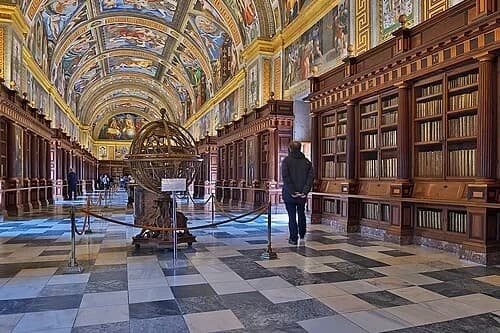
The Royal Library
The Royal Library is one of the most visually stunning and intellectually significant rooms in El Escorial. The hall stretches 54 meters in length and is topped by a magnificent barrel vault ceiling. The frescoes overhead represent the Seven Liberal Arts, divided into the Trivium—grammar, rhetoric, and dialectic—and the Quadrivium—arithmetic, geometry, astronomy, and music. This was intended to show that the library was a temple of all human knowledge. The room houses a collection of more than 40,000 volumes, including rare medieval codices and manuscripts in various languages, such as Greek, Arabic, and Hebrew. Philip II was a dedicated bibliophile who sought to create a repository of wisdom that could rival the great libraries of antiquity. The library was designed not just as a storage space, but as a place of study and research, reflecting the humanistic ideals of the Renaissance. The floor is paved with marble, and the light from the large windows was carefully managed to illuminate the workspace without damaging the precious books. It remains a remarkably well-preserved example of 16th-century library design, where art and architecture were used to elevate the status of learning and literature.
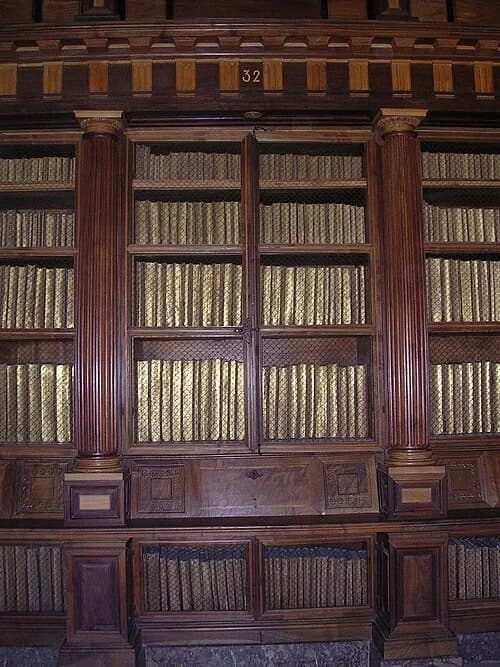
The Library Shelves
The bookcases lining the Royal Library were designed by Juan de Herrera, the same architect responsible for the monastery's overall structure. These shelves are crafted from rich, dark wood and feature a unique characteristic: the books are shelved with their spines facing inward. This was done for two primary reasons. First, it allowed the parchment and paper of the volumes to 'breathe' more easily in the mountain climate, helping to prevent rot and deterioration. Second, it creates a striking visual effect. The edges of the pages are coated in gold leaf, so when you look at the shelves, you see a shimmering wall of gold rather than a patchwork of leather spines. This added to the overall opulence and prestige of the room. The titles of the books were often written directly onto the golden edges of the pages so they could still be identified. The shelves themselves are integrated into the architecture of the room, mirroring the rhythmic layout of the windows and the vaulted ceiling. This careful organization reflects the Renaissance desire for order and symmetry, ensuring that even the storage of knowledge was a highly structured and beautiful endeavor.
Want to hear the rest?
Download the Stanza app to unlock all 25 stops and full GPS-guided navigation.
Frequently Asked Questions
How long does the Real Monasterio de San Lorenzo de El Escorial audio tour take?
The Real Monasterio de San Lorenzo de El Escorial audio guide includes 25 narrated stops. Most visitors spend 45 minutes to 1.5 hours exploring the complete tour, though you can listen at your own pace and skip or revisit any stop.
Is the Real Monasterio de San Lorenzo de El Escorial audio guide available in my language?
Stanza supports 15 languages: English, Spanish, French, German, Italian, Portuguese, Russian, Japanese, Chinese, Korean, Arabic, Hindi, Polish, Dutch, Hebrew. Check the guide in the app to confirm the languages currently available for this tour.
Can I use the audio guide offline at Real Monasterio de San Lorenzo de El Escorial?
Yes! Download the complete Real Monasterio de San Lorenzo de El Escorial tour — including all audio, maps, and images — before your visit. The Stanza app works completely offline, so you don't need WiFi or mobile data at the venue.
How much does the Real Monasterio de San Lorenzo de El Escorial audio guide cost?
The Stanza app is free to download. The current listed price for the Real Monasterio de San Lorenzo de El Escorial audio guide is $3.99; app-store region and currency may affect the final price.
How do I use the Stanza audio guide at Real Monasterio de San Lorenzo de El Escorial?
Download the free Stanza app, search for "Real Monasterio de San Lorenzo de El Escorial", and download the tour. When you arrive at the venue, the app uses GPS to detect your location and automatically plays the relevant narration as you move between points of interest — completely hands-free.
What makes the Stanza audio guide different from other Real Monasterio de San Lorenzo de El Escorial tours?
Stanza offers GPS-triggered narration that plays automatically as you walk through Real Monasterio de San Lorenzo de El Escorial — no need to manually select stops. The tour is available in 15 languages, works fully offline, and includes 25 expertly narrated stops with images and historical context.
What other audio guides are available near Real Monasterio de San Lorenzo de El Escorial?
Stanza offers multiple audio guides in San Lorenzo de El Escorial, Spain and nearby areas. After downloading the app, browse the map to discover all available tours near Real Monasterio de San Lorenzo de El Escorial. Each guide can be downloaded for offline use.