 Stanza / Audio guide
Content & sources
Stanza · Audio guide
Itálica Audio Guide
A place to remember. A story to take with you.
Italica was an ancient Roman city founded in 206 BC in Hispania. It is historically significant as the birthplace of the Roman emperors Trajan and Hadrian.
Download Stanza, then search for “Itálica”.
About the tour
One guide. Your kind of visit.
Italica was an ancient Roman city founded in 206 BC in Hispania. It is historically significant as the birthplace of the Roman emperors Trajan and Hadrian.
Ready when you are.
- 01Get the free Stanza app.
iOS & Android
- 02Find your guide.
“Itálica”
- 03Download before you go.
Works offline
Audio guide / 15 narrated stops
Inside the guide
Get to know a few of the stories before you go. Open a stop to read more.
01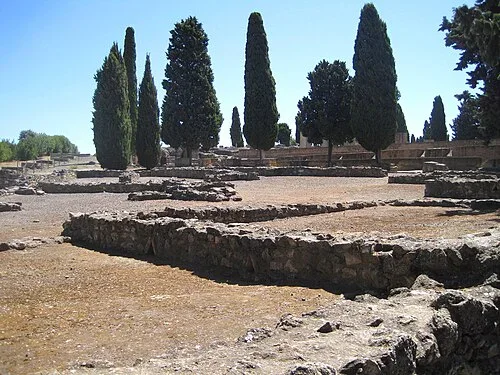 The Cardo Maximus and Roman Urban Grid
The Cardo Maximus: A City Born from a War
Welcome to Italica, the first Roman settlement in Spain. Its founding is a story from war. In 206 BC, during the Second Punic War against Carthage, the general Publius Cornelius Scipio had soldiers who could fight no longer. His Italic veterans, sick and wounded, needed somewhere to settle. He planted them here beside a native town of the Turdetani, and called the place Italica, after Italy. A Greek historian later wrote that Scipio left behind a small peacetime garrison, and that from then on Rome sent a governor to Spain every year. The city grew rich on that beginning. The old city was laid out on a Hippodamian plan, straight streets crossing at right angles around a central forum, and it lies today beneath the town of Santiponce. The street here, the cardo maximus, belongs to the newer city that Hadrian added later, and the cypresses now stand along its line.
Photo: Roberto Chamoso G · CC BY-SA 3.0 es
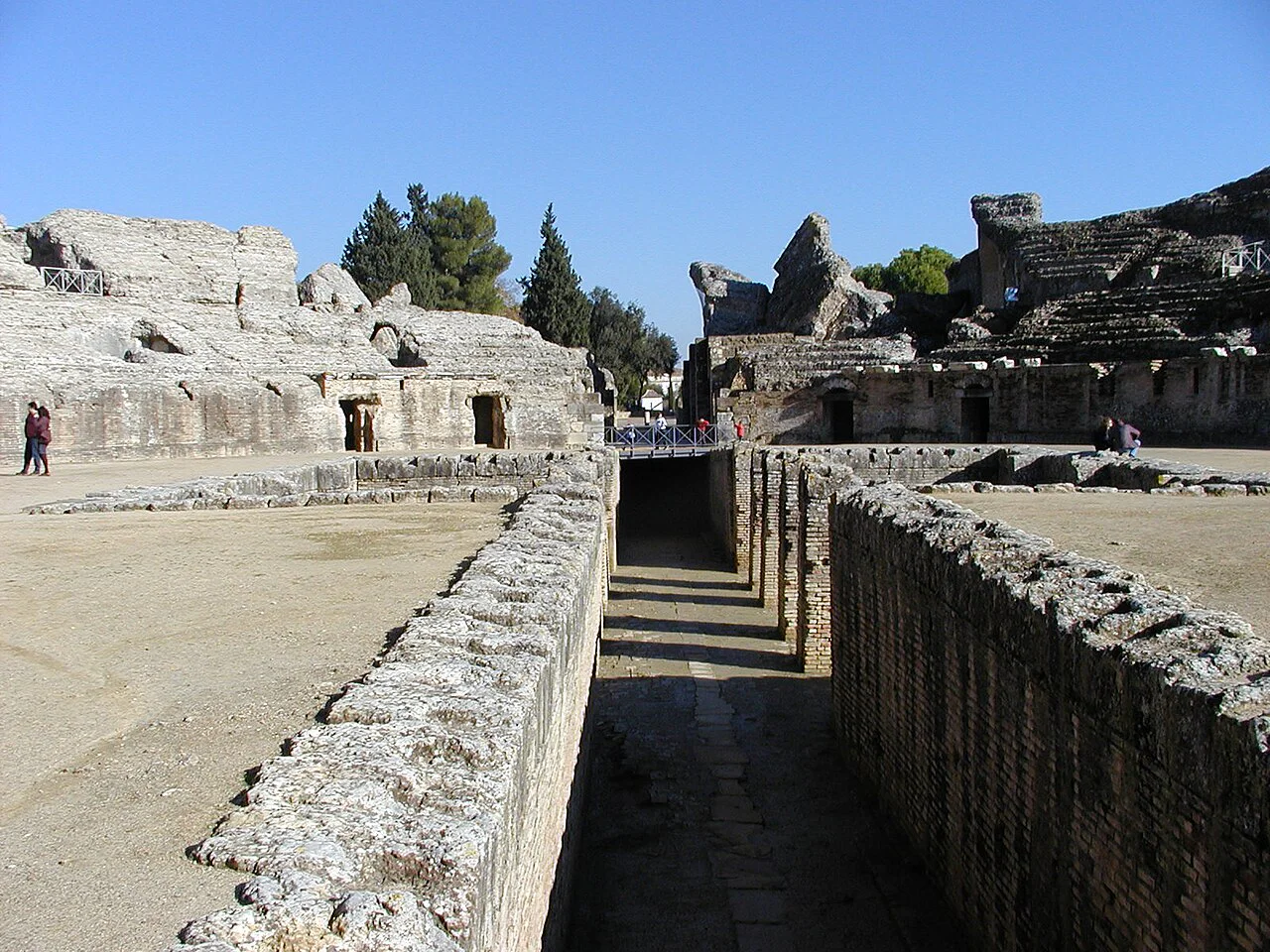
02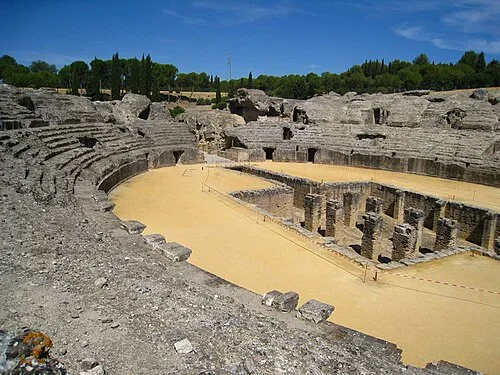 The Colossal Roman Amphitheater
The Amphitheater Arena: Built for Twenty-Five Thousand
Twenty-five thousand spectators filled this amphitheatre, on three tiers of seating. At the time it was built, it was the third largest in the Roman Empire, a little bigger than the amphitheatre at Tours in France. Half the size of the Colosseum in Rome. The strange part is the city it served, because Italica's population is estimated at only about eight thousand. The seats were for the whole region, not just the town. Local magistrates and public officials paid for the games out of their own ambition. The size of the crowd advertised their standing far beyond Italica itself. In the middle of the arena, a sunken trench runs beneath where the wooden floor once lay. It was the service pit for the spectacles of gladiators and wild beasts.
Photo: Pufacz · Public domain
03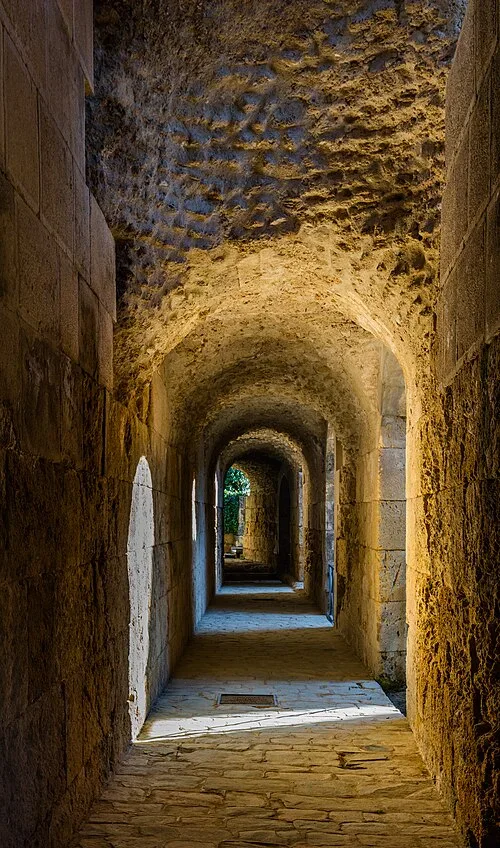 The Colossal Roman Amphitheater
Under the Stands: Vaults, Quarries and a Dam
Under the seating, the amphitheatre is a honeycomb of arched corridors like this one. Vaulted passages of this kind carried spectators to their places in a Roman arena, with services running beneath them. Some scholars add animals and machinery to that traffic, though the exact work of each passage here is not settled. What is certain is the building's later fate. Italica's fame did not protect it, and for centuries the ruins served as a permanent quarry for building stone. In 1740 the city of Seville ordered the amphitheatre's outer walls torn down, so the stone could go into a dam on the Guadalquivir. The vaults survived because they stood inside. The great outer ring that once rose above them is gone.
Listen in the appDiego Delso · CC BY-SA 4.0
04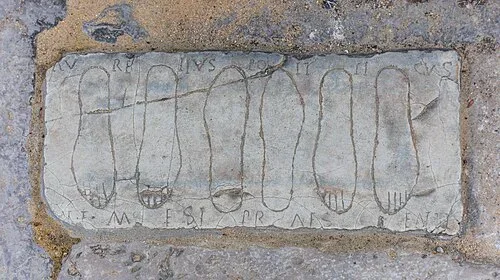 The Colossal Roman Amphitheater
Carved Footprints: A Stone of Unanswered Questions
Five pairs of bare feet are carved into this stone slab, toe by toe, framed by a line of Latin letters. No one knows for certain what the stone was for. Scholars have offered readings that range from ritual marking to simple commemoration, and none has settled the matter. Whoever cut the feet, and why, is still being argued over.
Listen in the appDiego Delso · CC BY-SA 4.0
05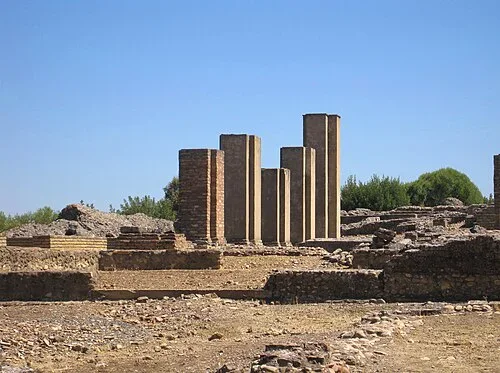 The House of the Exedra
: Hadrian's New City Rises
The emperor Hadrian was born in this city, and he repaid it on a grand scale. He extended Italica northwards as a new quarter, the nova urbs, laid out fresh on its own grid of straight streets. He added temples and rebuilt public buildings. He also granted the city the rank of colonia, something it had asked for itself. As the writer Aulus Gellius tells it, the request went against Hadrian's own advice, since Italica already held the advantageous rights of a municipality. But colonia meant prestige, a declared mirror of Rome, and the city took the new name Colonia Aelia Augusta Italica. This mansion rose in the elite quarter that filled the new city, block after block of grand houses with splendid mosaics. Its brick pillars were made to carry real weight, probably upper floors joined by arches, more than an ordinary house would ever need.
Listen in the appPhoto: Roberto Chamoso G · CC BY-SA 3.0 es
06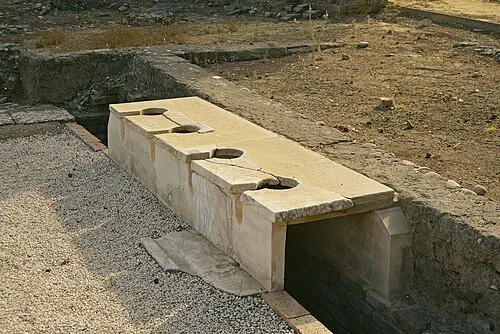 The House of the Exedra
Marble Comfort: The Latrine of a Great House
Roman comfort went all the way down to the smallest rooms. This carved stone bench, with its keyhole-shaped seats, is a household latrine, and the channel beneath it carried running water to wash the whole arrangement clean. In houses of this quarter, private sanitary installations with water flowing through them were part of what separated a great mansion from an ordinary dwelling. Comfort, like the mosaics, was a way of stating rank.
Listen in the appPhoto: Alberto-g-rovi · CC BY 4.0
07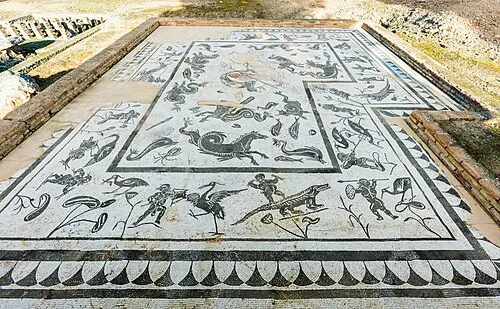 The House of the Neptune Mosaic
The Neptune Mosaic: Floors That Stayed Home
Neptune's sea teems across this floor in black and white, sea creatures and little figures cut from tiny stone cubes. Floors like this are why Italica matters to anyone who cares about Roman mosaics. No modern town ever grew over the new city, so its streets and pavements still lie where the Roman layers set them, mosaic floors in place after two thousand years. Not every floor stayed. Excavation intensified late in the nineteenth century, and some of the finest pavements were acquired by the Countess of Lebrija and lifted away to pave her palace in Seville. The archaeologist of the day, Rodrigo Amador de los Ríos, protested, calling it robbery rather than conservation. The countess did not indulge his complaints. The floors here stayed in the ground, and that is what makes this sea so rare.
Listen in the appDiego Delso · CC BY-SA 4.0
08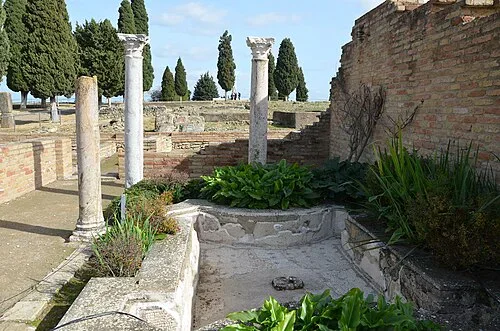 The House of the Birds
House of the Birds: How a Roman House Worked
A rich Roman house was built around one idea, the courtyard. The way into the House of the Birds ran from the street through a vestibule and a narrow entry passage. Beyond them opened the peristyle, a colonnaded courtyard with a well at its heart, the hinge of the whole home. A covered corridor ringed the courtyard on columns, and the doors of the rooms opened off it. At the far end lay the dining room, the triclinium, flanked by two open courts, one with a fountain and one with a pool. The wings held the working side of the house, servants' rooms, kitchens and drains. Along the street front, shops opened to passers-by, one of them with its own oven, run as part of the residence. This was the first house excavated in full at Italica. Such houses belonged to a small minority, and most of the city's people lived far worse.
Listen in the appCarole Raddato from FRANKFURT, Germany · CC BY-SA 2.0
09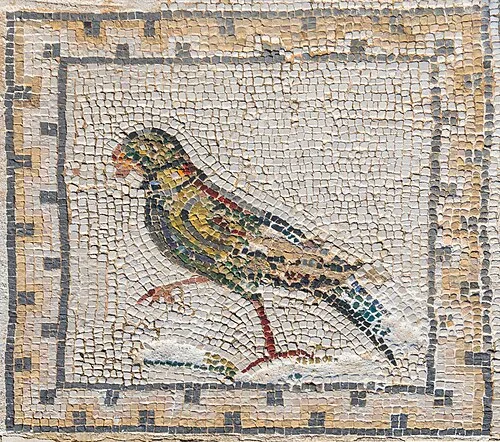 The House of the Birds
The Bird Mosaic: Thirty-Three Species in a Bedroom
The mosaic that named this house shows a single bird, built cube by cube in greens, reds and ochres. It paves the sleeping room, the cubiculum, in the left wing of the House of the Birds. The full floor carries many such birds, each one drawn individually, traditionally counted as thirty-three distinct species. Whoever ordered it wanted a garden of the air underfoot. The floor proved memorable enough to give the whole house its modern name.
Listen in the appDiego Delso · CC BY-SA 4.0
10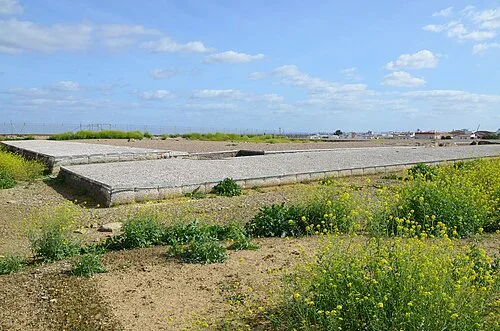 The Traianeum
: A Temple for a God Who Was Once Mayor's Neighbour
At the highest point of the new city stood its most imposing building. Hadrian raised a temple there for his predecessor and adoptive father, Trajan, who had been declared a god. Its identification as Trajan's temple rests on supposition since the excavations around 1980, and no conclusive proof has come to light. The temple fills a double city block, a hundred and eight metres by eighty. Around it runs a porticoed square, its alternating rectangular and semicircular exedras built to hold sculptures. More than a hundred columns of Cipollino marble, shipped from Euboea in Greece, decorated the precinct, together with fountains. Cipollino was among the most expensive marbles in the Empire. What remains now is the low skeleton of platforms and foundations. The colonnades above them have to be rebuilt in the mind.
Listen in the appCarole Raddato from FRANKFURT, Germany · CC BY-SA 2.0
- 11
Cradle of Emperors
Two Roman emperors born in a veterans' colony, and the statue that shows one of them as a god.
- 12
The House of the Planetarium: The Week Written in Stone
Seven planetary gods in a ring of medallions, the Roman week written underfoot.
- 13
The Major Baths: Water for a City of Millions of Bricks
The great baths of the new city, and the thirty-seven-kilometre aqueduct that kept them running.
- 14
The Roman Theater: Italica's Oldest Monument
The oldest civil monument at Italica, built into the hillside long before Hadrian's new city.
- 15
The Buried Theater: How a City Became Memory
How the river abandoned Italica, the old city sank under Santiponce, and the ruins were finally protected.
Itálica
Frequently asked questions
How much does the guide cost?
Free app download. Listed guide price: $1.99. Guide price shown in the app. Audio guide only. Venue admission is separate.
Can I listen without internet?
Yes. Download the guide’s audio, images, and maps in the app before your visit. Your downloaded content is then available offline.
Can I listen in my language?
This audio guide is available in 15 languages, including English.
Do I need to follow a schedule?
No. This is a self-guided experience. Choose your stops, pause whenever you like, and return to a story at your own pace.
At your own pace
Explore Itálica.
Download Stanza, then search for “Itálica”.
Free app download · Guide price shown in the app
Keep exploring
Nearby audio guides
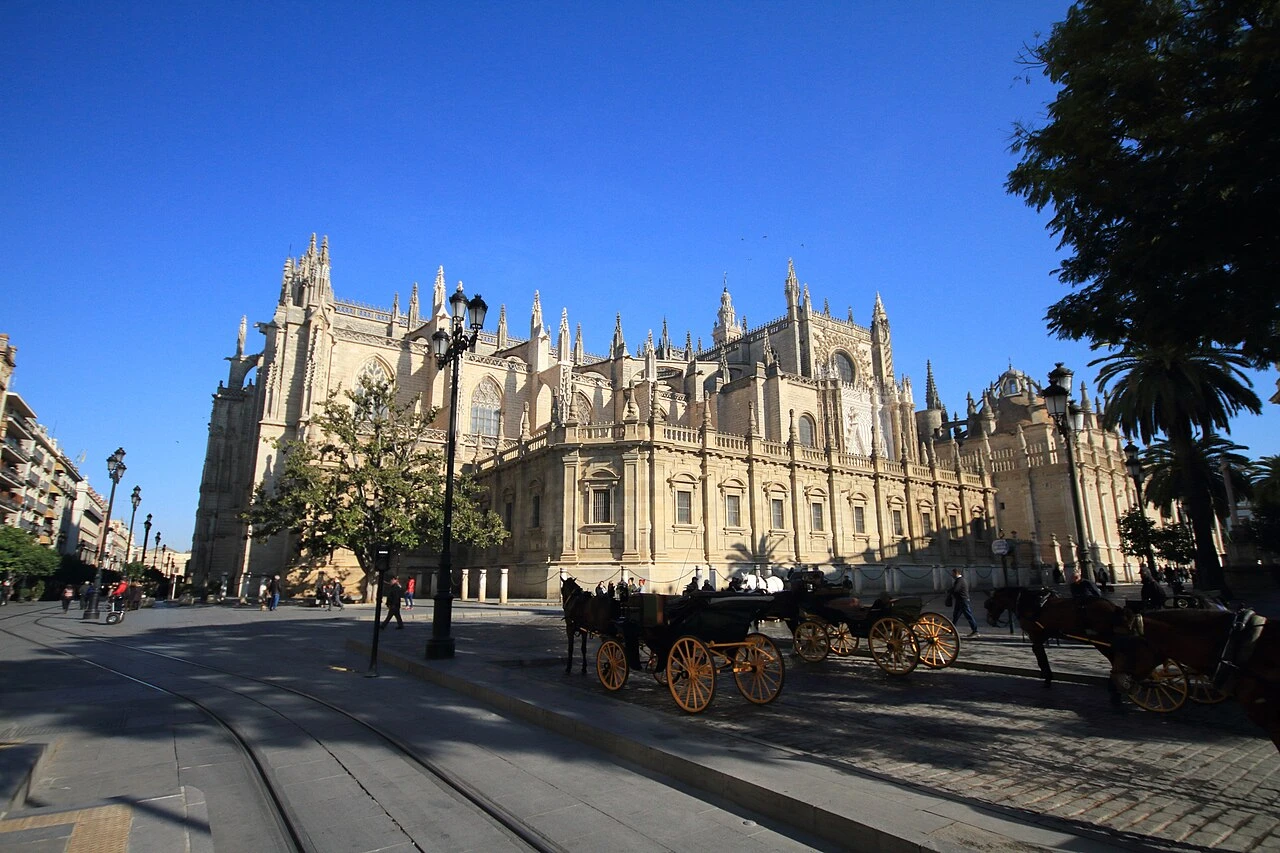
Seville · 8 km
Seville Cathedral
Content & sources
Photo: PEPE GADEIRAS · CC BY-SA 4.0
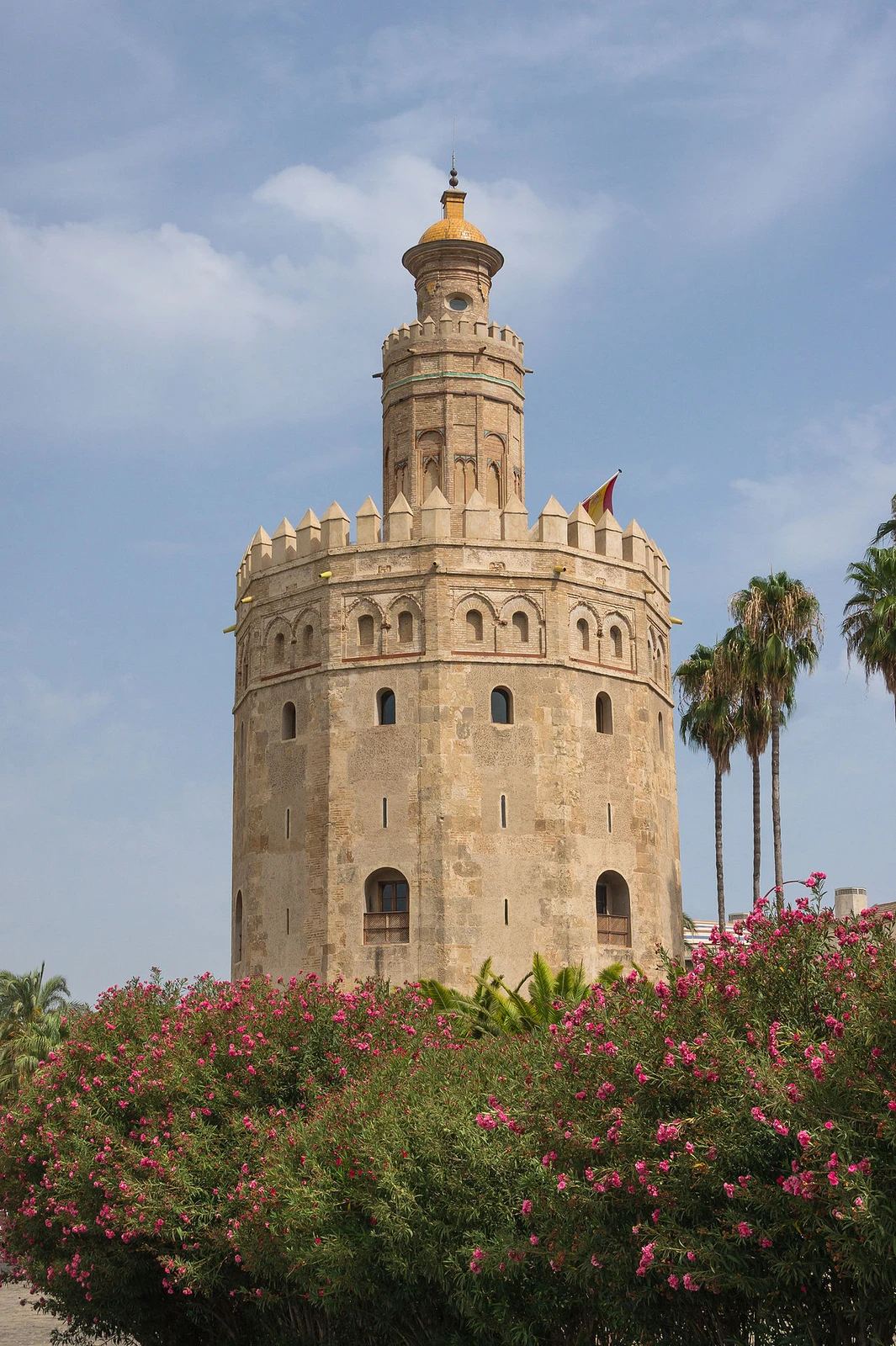
Seville · 8 km
Torre del Oro
Content & sources
Photo: Jebulon · CC0
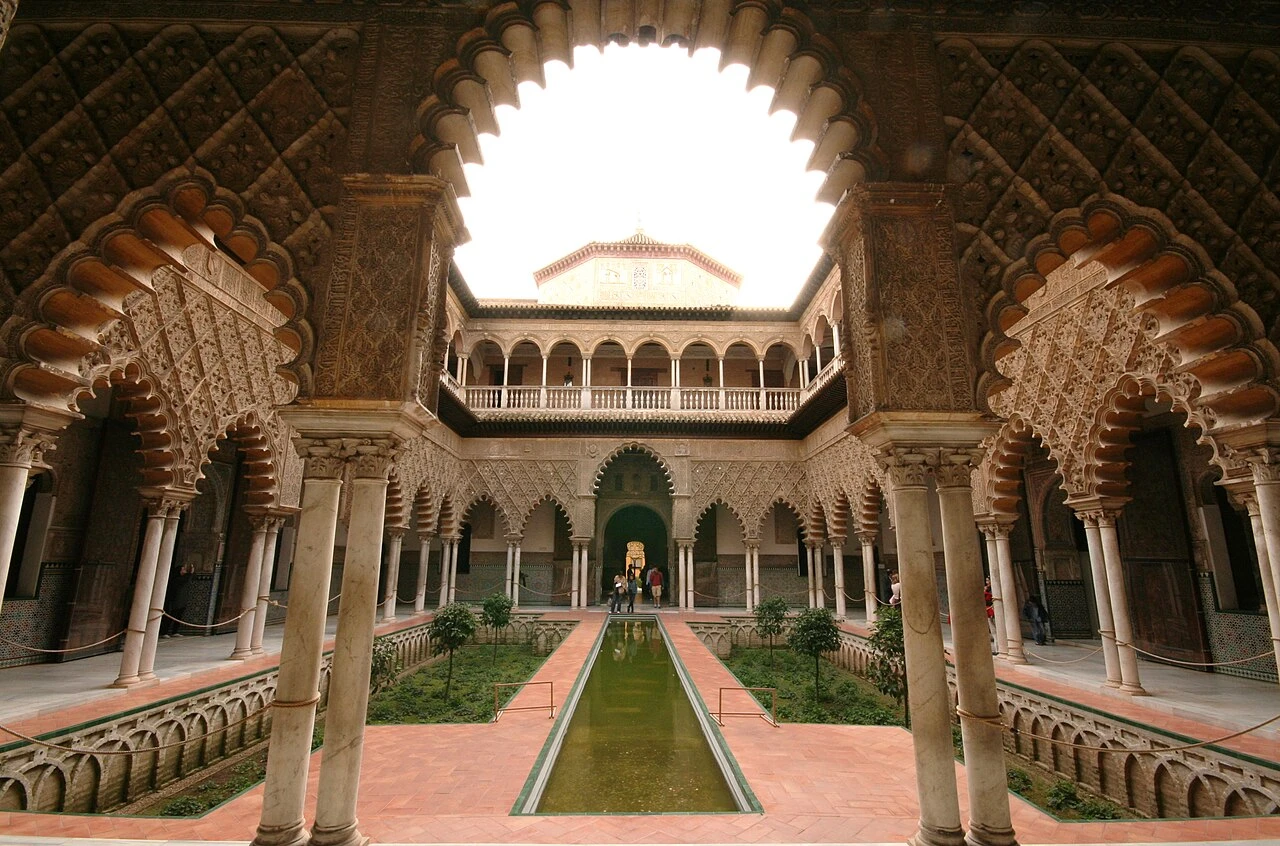
Seville · 8 km
Royal Alcázar of Seville
Content & sources
Cat from Sevilla, Spain · CC BY 2.0
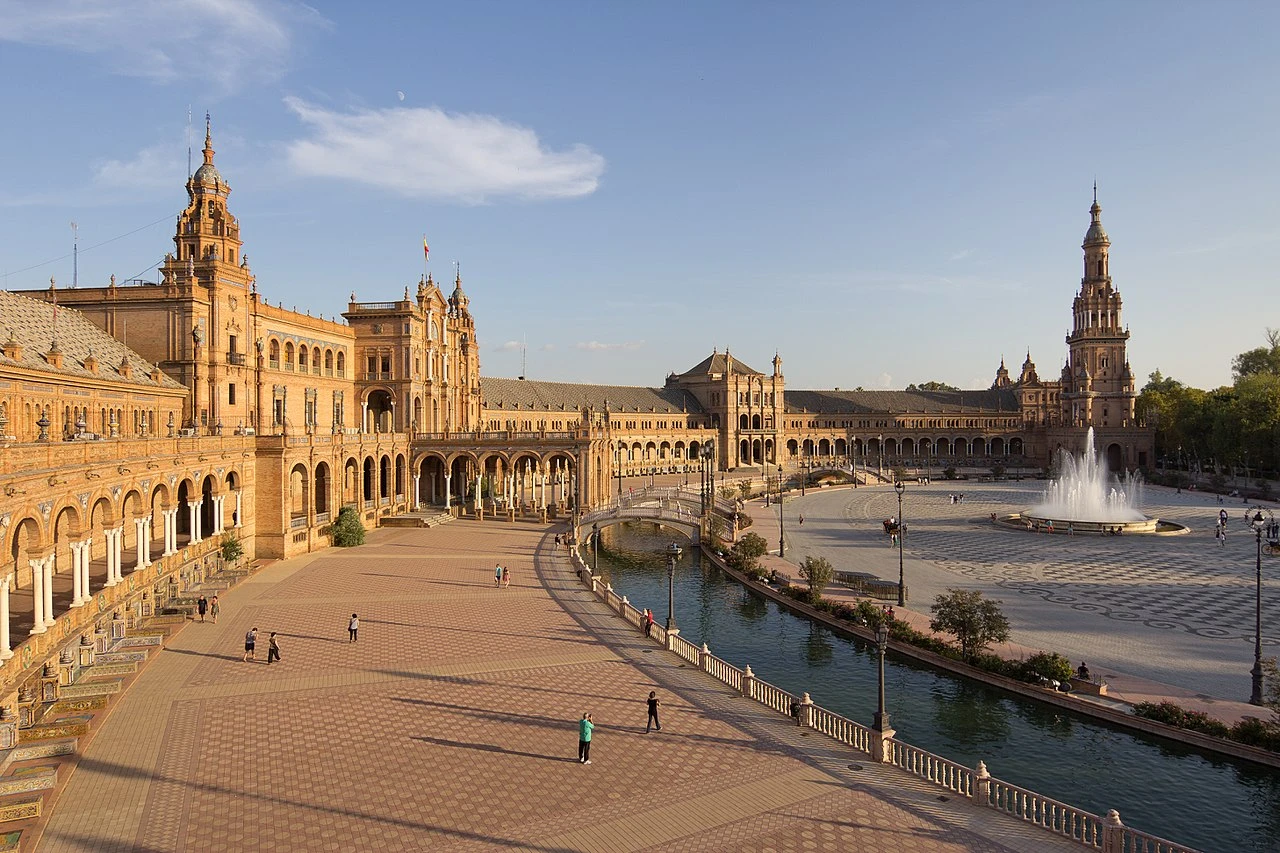
Seville · 9 km
Plaza de España
Content & sources
Carlos Delgado · CC BY-SA 4.0