Stanza · Audio guide
La Aljafería, Palacio de la AljaferíaAudio guide
A place to remember. A story to take with you.
The Aljafería is a fortified medieval Islamic palace built during the second half of the 11th century in Zaragoza, Spain. It served as a residence for Muslim rulers, then a royal palace for Aragonese kings…
Download Stanza, then search for “La Aljafería, Palacio de la Aljafería”.
About the tour
One guide. Your kind of visit.
The Aljafería is a fortified medieval Islamic palace built during the second half of the 11th century in Zaragoza, Spain. It served as a residence for Muslim rulers, then a royal palace for Aragonese kings, and currently houses the Aragonese regional parliament.
Ready when you are.
- 01Get the free Stanza app.
iOS & Android
- 02Find your guide.
“La Aljafería, Palacio de la Aljafería”
- 03Download before you go.
Works offline
Audio guide / 16 narrated stops
Inside the guide
Get to know a few of the stories before you go. Open a stop to read more.
01 Arrival at the CitadelPalace Entrance and Plaza
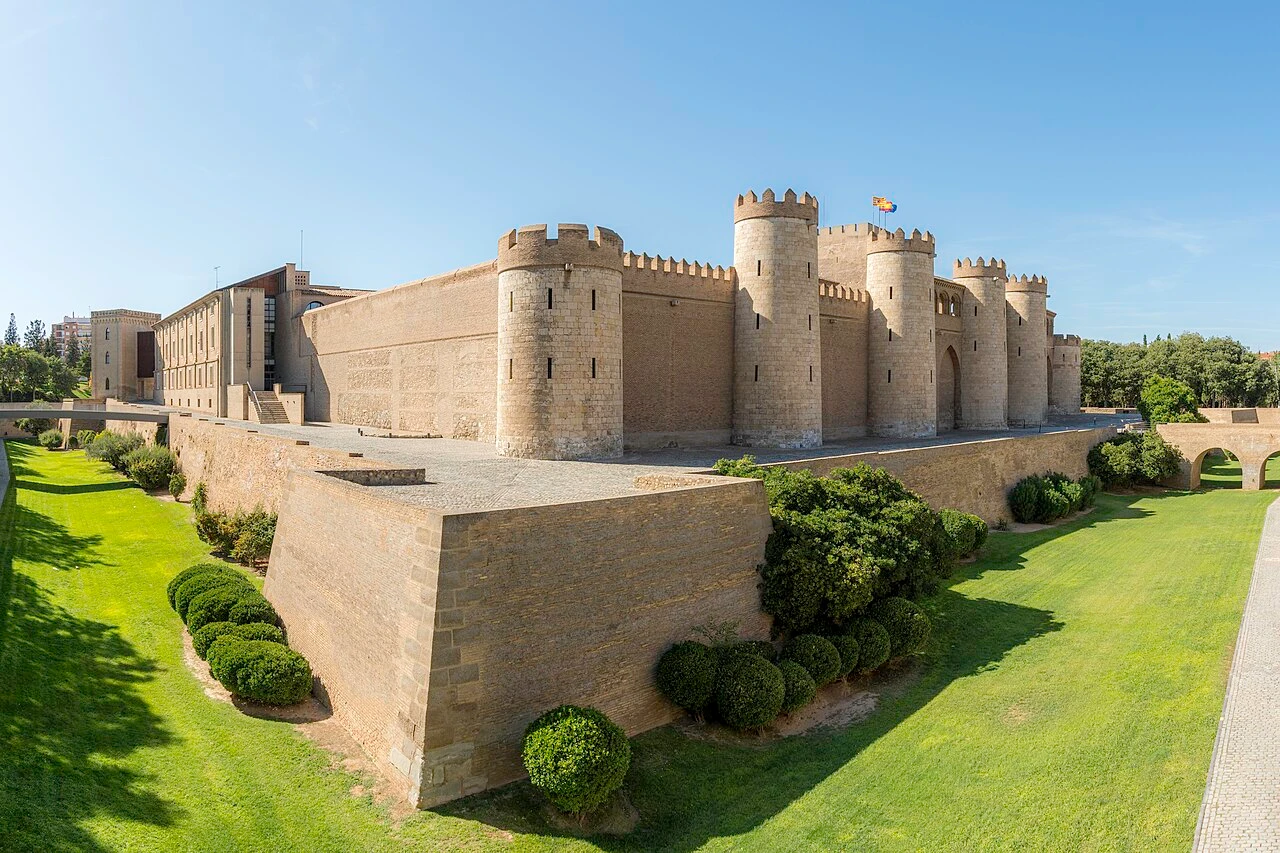
Welcome to the Aljafería, an extraordinary complex that has served as a royal residence, military fortress, and seat of power for nearly a millennium. This structure represents the best-preserved example of 11th-century Islamic architecture from the Taifa period in Spain. Construction began around 1065 under the reign of Abu Jaffar Al-Muqtadir, the ruler of the Taifa of Zaragoza, and took approximately 16 years to complete. While the outer appearance resembles a grim medieval fortress, it was originally conceived as the 'Qasr al-Surur,' or 'Palace of Joy.' The rectangular plan was originally reinforced by sixteen semicircular towers distributed along the perimeter, designed to project an image of strength and stability. As you stand in the plaza, you are looking at a building that once rivaled the splendor of the Umayyad palaces in Syria. Over the following stops, we will explore how this site evolved through the Christian conquest and the reign of the Catholic Monarchs, ultimately becoming the home of the regional parliament today.
Héctor Ochoa · CC BY-SA 3.0
02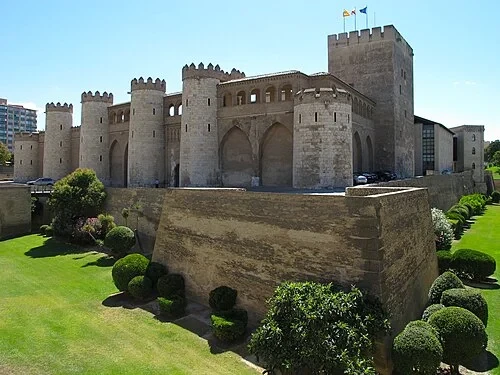 Arrival at the CitadelThe Exterior Walls
The robust exterior of the Aljafería showcases centuries of engineering aimed at defense. Notice the massive blocks of alabaster ashlar masonry used for the lower sections of the walls; this stone provided both stability and a distinctive visual finish to the original structure. While the palace started as a royal residence, its role shifted dramatically in the 16th century. King Philip II ordered the Italian engineer Tiburzio Spannocchi to modernize the defenses, resulting in the addition of the moat and the pentagonal bastions you see today. These features transformed the palace into a military citadel. This fortress became a site of local resistance in 1591, when the people of Zaragoza assaulted the building to rescue Antonio Pérez, the former secretary to Philip II. Pérez had sought protection under the local 'fueros' or laws of Aragon to escape the Inquisition, which operated inside these walls. The struggle between royal authority and local rights is etched into the very stones of these fortifications, marking the transition from an independent kingdom to a centralized Spanish state.
Photo: Misburg3014 · CC BY-SA 3.0
03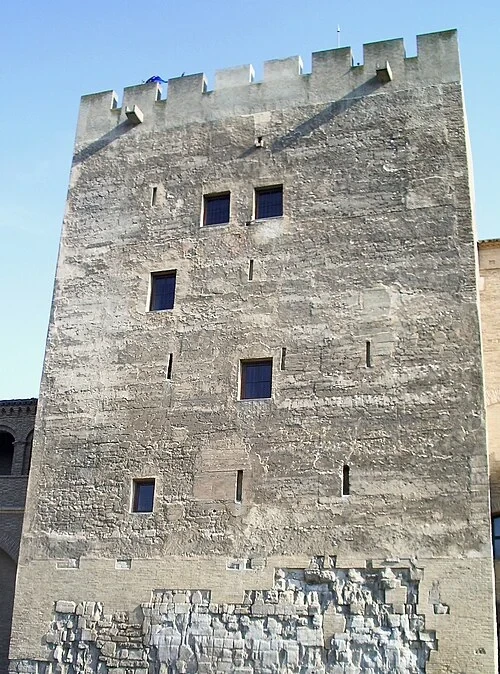 The Troubadour TowerThe Troubadour Tower
Rising above the surrounding walls, the Troubadour Tower is the oldest standing structure in the entire complex, with its foundations dating back to the late 9th century. Its construction predates the rest of the Islamic palace by nearly two centuries. The tower is built across five distinct levels, and if you look closely at its profile, you might notice that the walls actually decrease in thickness as the tower gains height to ensure structural stability. The lower levels feature defensive embrasures, which were narrow slits used by archers to defend the perimeter. The tower gained its romantic name from the 1836 drama 'El trovador' by Antonio García Gutiérrez, which was later adapted into Giuseppe Verdi's famous opera 'Il Trovatore.' However, its real history is far more somber. For centuries, the tower served as a prison for the Inquisition, housing those awaiting trial or punishment. The stark, windowless masonry of the lower floors provided a secure and isolated environment for prisoners, a sharp contrast to the ornate luxury found in the palace rooms nearby.
Listen in the appPhoto: Escarlati · Public domain
04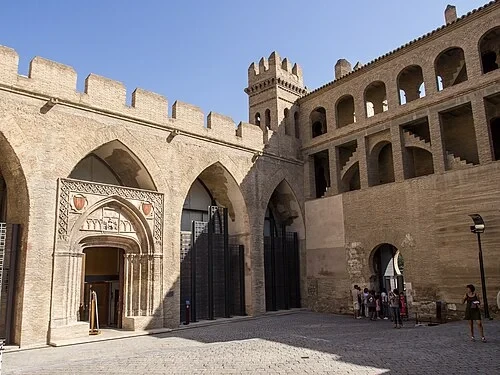 The Courtyard of Saint MartinThe Courtyard of Saint Martin
Stepping into this courtyard brings you into a different era of the palace's history. This space represents the major 14th-century Christian adaptation of the site under King Peter IV of Aragon. After the Reconquista, the palace became a favorite residence for the Kings of Aragon, who added their own artistic and architectural layers. Here, you can see the emergence of the Gothic-Mudéjar style, characterized by the use of intricate brickwork and ribbed vaults. The courtyard is anchored by the Chapel of San Martín, which was constructed during the 14th century. Interestingly, this Christian chapel was built directly over a portion of the older Islamic site, repurposing the sacred space for new religious traditions. This layering of cultures is a recurring theme throughout the Aljafería. The use of brick as both a structural and decorative element was a specialty of the Mudéjar artisans—Muslim craftsmen who remained in the region after the Christian conquest. Their influence ensured that even as the function of the palace changed, its aesthetic link to its Islamic roots remained intact.
Listen in the appFRANCIS RAHER · CC BY 2.0
05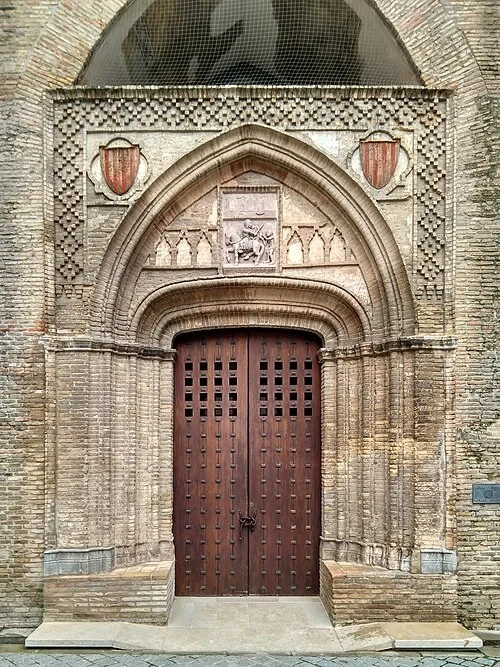 The Courtyard of Saint MartinThe Portal of Saint Martin
The Portal of Saint Martin is a prime example of the sophisticated craftsmanship of Mudéjar artisans. The term 'Mudéjar' refers to the Muslim population that continued to live in territory conquered by Christians, bringing their unique architectural and decorative skills to Christian commissions. Look at the upper portion of the doorway to see the interlocking geometric patterns created entirely from brick. This material was favored for its versatility and was often used to create complex, tapestry-like textures on flat surfaces. Above the arch, you can identify the carved shields representing the Kingdom of Aragon, signaling the royal ownership of the palace during the 14th century. The entrance utilizes ribbed arches, a hallmark of Gothic design, yet the execution of the patterns remains deeply rooted in Islamic geometric traditions. This portal served as a formal entry point, designed to communicate both the religious identity and the political power of the Aragonese monarchs. The transition between the sharp angles of the brickwork and the curved lines of the arches demonstrates the successful fusion of two very different artistic worlds.
Listen in the appAmérico Toledano · CC BY-SA 4.0
06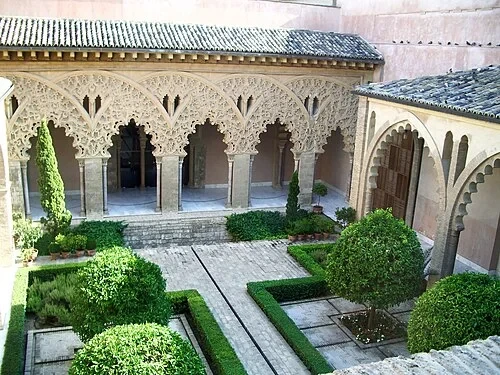 The Courtyard of Santa IsabelThe Courtyard of Santa Isabel
You are now at the architectural heart of the 11th-century Taifal palace. The Courtyard of Santa Isabel served as the central organizing axis for the royal apartments of Al-Muqtadir. What makes this space truly remarkable are the iconic polylobed arches that surround the patio. These arches are characterized by their multiple small, rounded lobes, creating a complex and delicate silhouette that seems almost weightless. The surfaces are covered in intricate plasterwork designed to catch the light at different angles throughout the day. This play of light and shadow was a deliberate choice by the architects, intended to mimic the organic forms found in nature, such as branching trees or foliage. By integrating these natural patterns into the stone and plaster, the builders created an environment that felt alive and ever-changing. This courtyard was not just a passage but a place of gathering and reflection, where the monarch could enjoy the open air while remaining within the secure, private confines of the royal quarters. The delicate nature of the arches suggests that this area was intended for peace and pleasure rather than defense.
Listen in the appPhoto: Escarlati · Public domain
07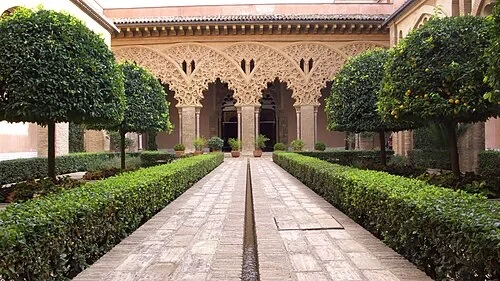 The Courtyard of Santa IsabelThe Garden of Joy
In the Islamic world, a palace garden was often conceived as a 'Paradise on Earth,' a physical representation of the celestial gardens described in religious texts. This area, known as the 'Qasr al-Surur' or Palace of Joy, utilized water and greenery to create a distinct micro-climate in the arid landscape of Zaragoza. The central reflecting pool served several purposes: it cooled the surrounding air through evaporation and acted as a mirror, doubling the visual impact of the ornate architecture above. Notice the orange trees, which provided shade and filled the courtyard with the sweet scent of citrus blossoms. Water channels were carefully integrated into the floor design to ensure the constant, gentle sound of running water. In Islamic palace design, water was much more than a utility; it was a potent symbol of life, wealth, and spiritual purity. The sound was intended to soothe the residents and provide a sense of tranquility that contrasted with the administrative and military activities occurring elsewhere in the complex. This sensory experience was a vital component of royal life in the 11th century.
Listen in the appJosé Luis Filpo Cabana · CC BY-SA 4.0
08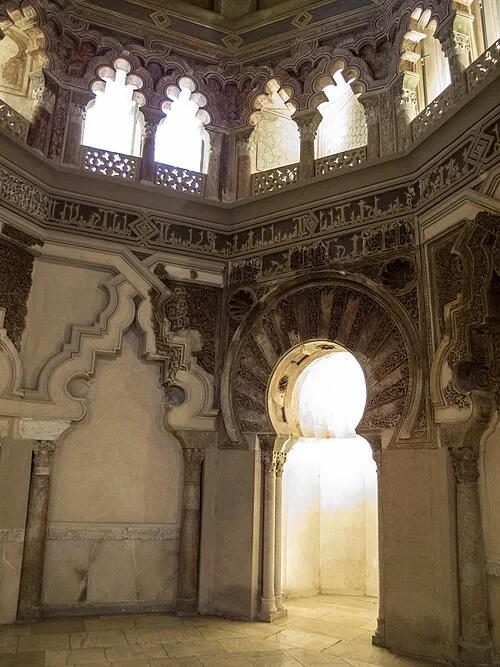 The Islamic Palace: Golden Hall and MosqueThe Private Mosque
The Private Mosque is one of the most significant spiritual spaces within the Aljafería, intended for the exclusive use of the monarch and his immediate court. Despite its small size, it is considered a masterpiece of Hispano-Muslim art. The focal point of the room is the mihrab, the prayer niche that indicates the direction of Mecca. It is framed by a classic horseshoe arch, a defining feature of Islamic architecture in the Iberian Peninsula. If you look at the upper gallery, you will see a series of interlocking polylobed arches that create a dense, sculptural effect. Every inch of the wall surface is covered in intricate geometric yeserías, or carved stucco work. These patterns avoid the depiction of human or animal figures, focusing instead on infinite geometric repetitions that represent the eternal nature of the divine. The transition from the bright, open courtyard to this intimate, richly decorated interior was intended to focus the mind on prayer. The complexity of the carvings and the harmony of the proportions make this tiny oratory one of the high points of 11th-century artistic achievement.
Listen in the appFRANCIS RAHER · CC BY 2.0
09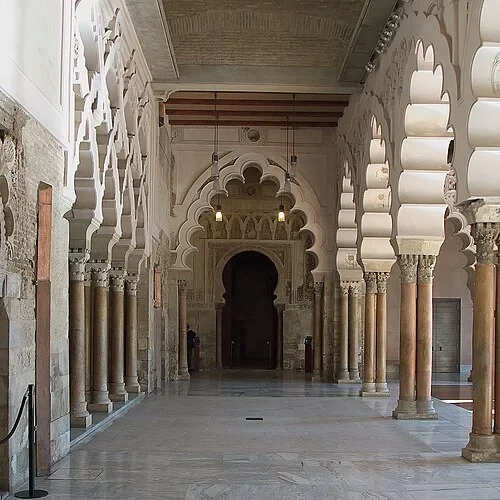 The Islamic Palace: Golden Hall and MosqueThe Golden Hall Portico
The portico leading to the Golden Hall showcases the pinnacle of architectural sophistication during the Taifa period. This design is credited to the architect Al-Halifa Zuhayr, who used mixtilinear arches to create a grand entrance for the throne room. These arches, which combine straight and curved lines in complex arrangements, represent an important evolutionary step in Islamic art. They bridge the gap between the earlier architectural traditions of Syrian desert palaces and the later, more famous Nasrid style seen in the Alhambra of Granada. When this portico was first built, the walls were not the monochromatic stone color you see today; they were originally polychromed in vibrant blues, reds, and golds, which would have shimmered in the sunlight. This hall was the site of official receptions and the display of royal power. The height and complexity of the arches were designed to impress visitors as they approached the monarch's presence. Today, the surviving plasterwork still reveals the extraordinary detail and precision that the 11th-century craftsmen achieved using relatively humble materials like plaster and wood.
Listen in the appJosé Luis Filpo Cabana · CC BY 3.0
10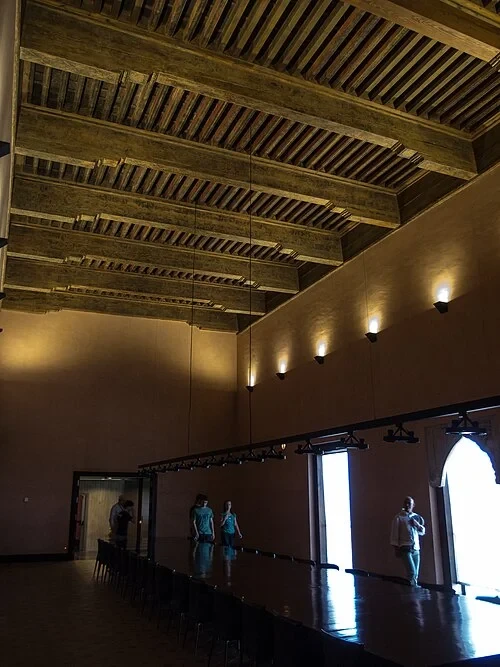 The Palace of Peter IVThe Interior Palace Chambers
As you move through the interior chambers, you are witnessing the transition from the 11th-century Islamic palace to the 14th-century royal residence of the Christian monarchs. These rooms were used by the Kings of Aragon for centuries, and each ruler left an artistic mark on the space. One of the most striking features of these chambers is the wooden artesonado ceilings. These coffered structures are built from interlocking pieces of wood, often featuring geometric stars or heraldic symbols. The rooms themselves are designed to be large and light-filled, a shift from the more intimate and enclosed spaces favored in the earlier Islamic period. Large windows were added to provide better views and more natural light, reflecting changing tastes in royal domestic life. Despite these renovations, the underlying structure of the Islamic palace was often preserved. The Kings of Aragon respected the beauty of the existing building and chose to build upon it rather than destroy it. This created a unique architectural dialogue where Gothic windows sit alongside Islamic arches, representing the long and complex history of the Crown of Aragon.
Listen in the appFRANCIS RAHER · CC BY 2.0
La Aljafería, Palacio de la Aljafería
Frequently asked questions
How much does the guide cost?
Free app download. Listed guide price: $1.99. Guide price shown in the app. Audio guide only. Venue admission is separate.
Can I listen without internet?
Yes. Download the guide’s audio, images, and maps in the app before your visit. Your downloaded content is then available offline.
Can I listen in my language?
Stanza supports 15 languages. Check the app for the languages available for this guide.
Do I need to follow a schedule?
No. This is a self-guided experience. Choose your stops, pause whenever you like, and return to a story at your own pace.
At your own pace
Explore La Aljafería, Palacio de la Aljafería.
Download Stanza, then search for “La Aljafería, Palacio de la Aljafería”.
Free app download · Guide price shown in the app
Keep exploring
Nearby audio guides
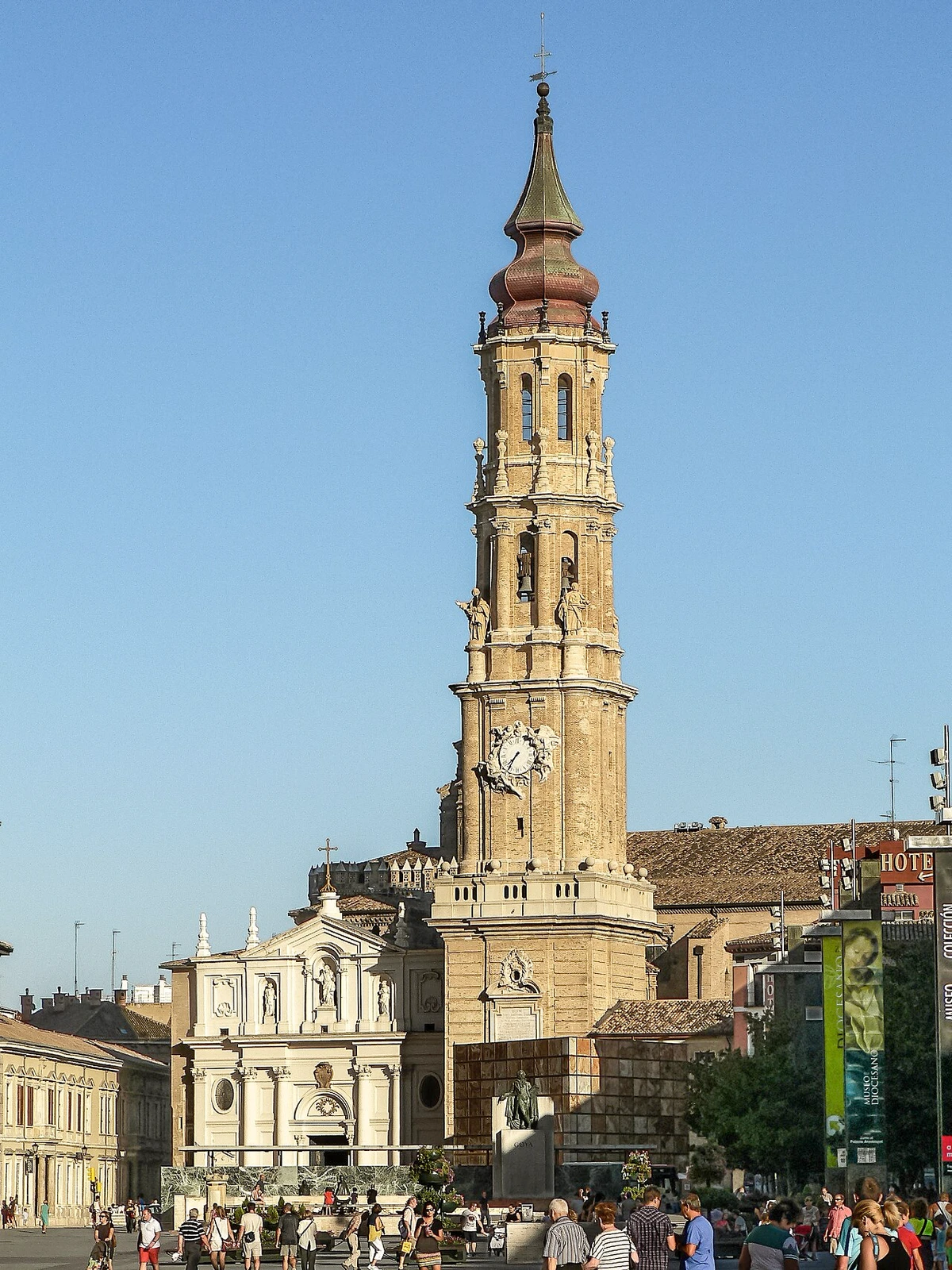
Zaragoza
La Seo de Zaragoza
Content & sources
FRANCIS RAHER · CC BY 2.0
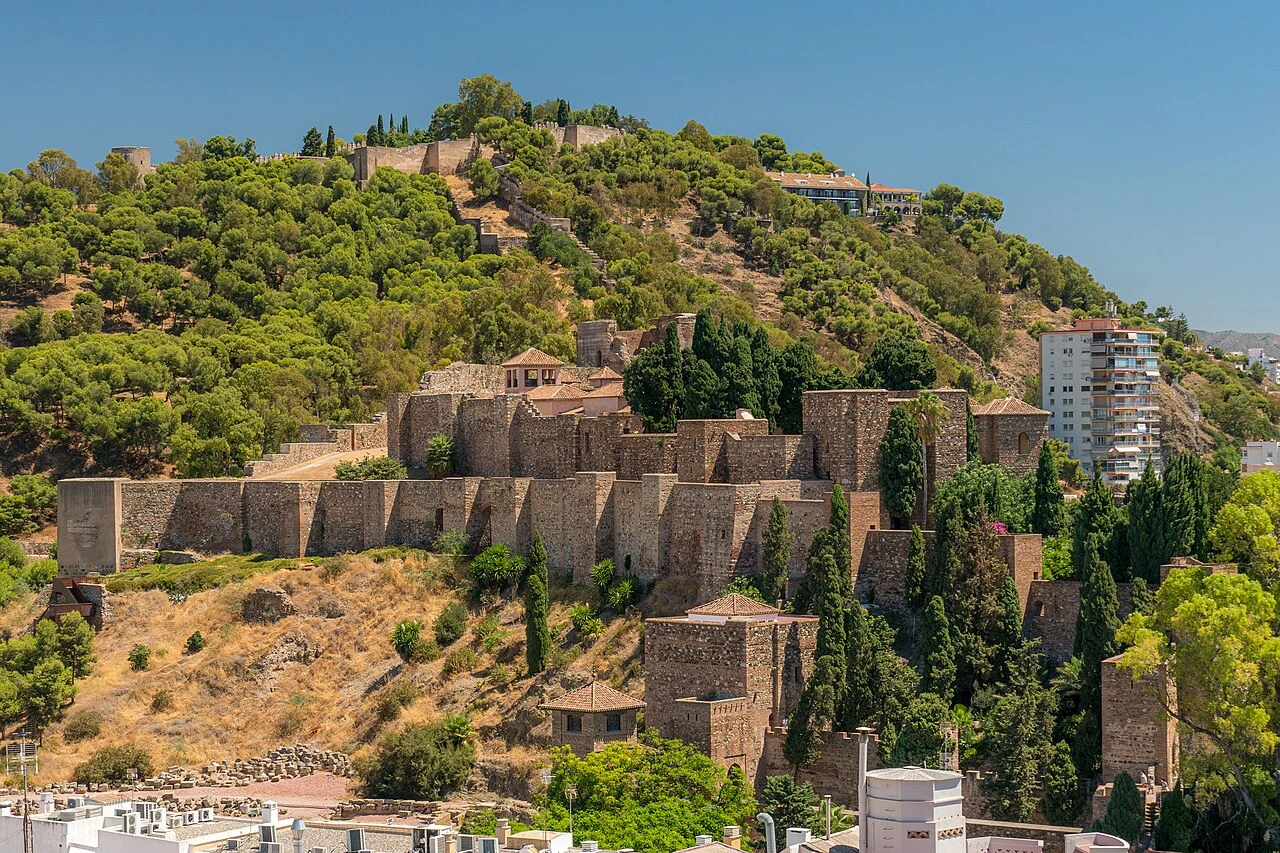
Málaga
Alcazaba de Málaga
Content & sources
Photo: Fernando · CC BY-SA 4.0
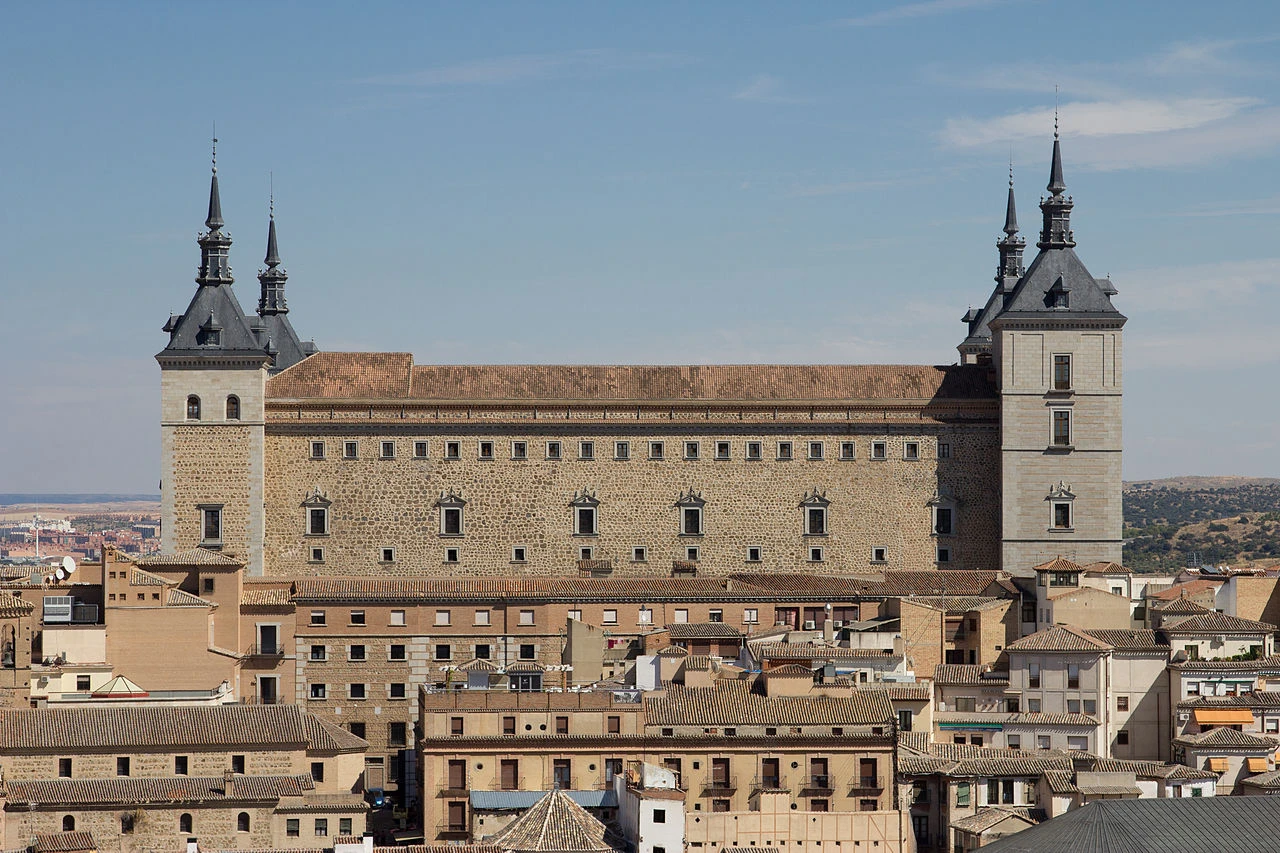
Toledo
Alcázar de Toledo
Content & sources
Carlos Delgado · CC BY-SA 3.0 es
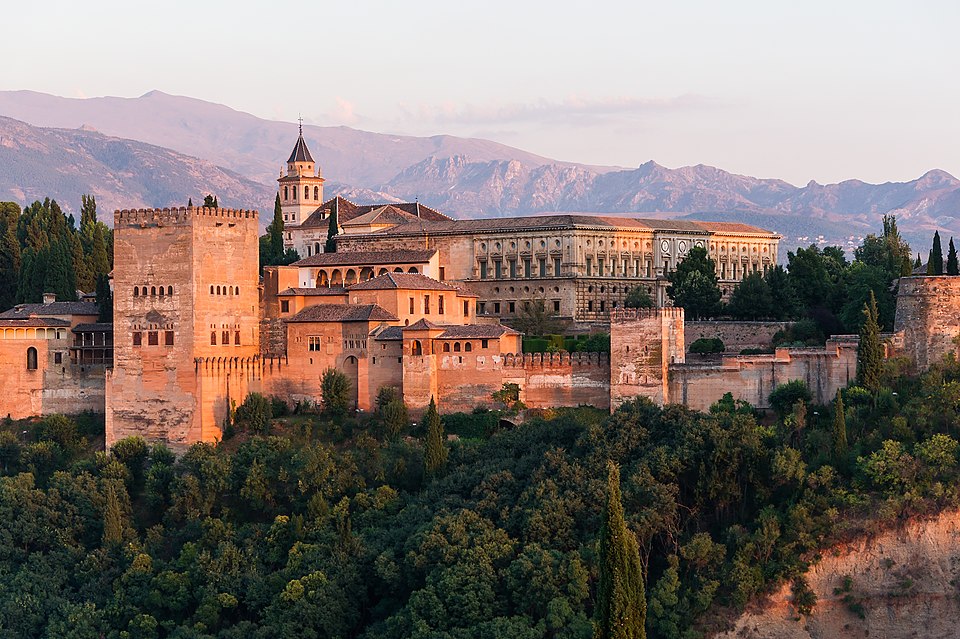
Alhambra
Content & sources
Photo: Jebulon · CC0