Stanza · Audio guide
Wat Chaiwatthanaram Audio Guide
A place to remember. A story to take with you.
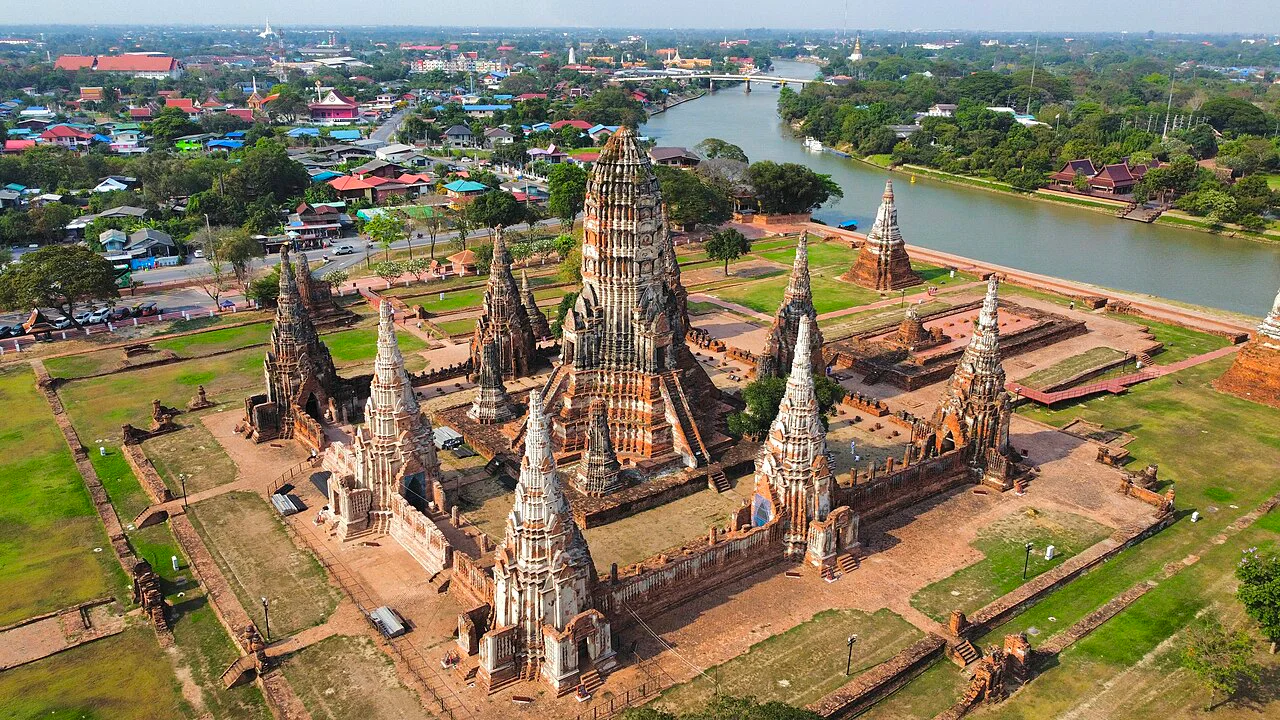
Wat Chaiwatthanaram is a Buddhist temple located in the Ayutthaya Historical Park in Thailand. It is situated on the west bank of the Chao Phraya River and is one of the best known temples in the area.
Download Stanza, then search for “Wat Chaiwatthanaram”.
About the tour
One guide. Your kind of visit.
Wat Chaiwatthanaram is a Buddhist temple located in the Ayutthaya Historical Park in Thailand. It is situated on the west bank of the Chao Phraya River and is one of the best known temples in the area.
Ready when you are.
- 01Get the free Stanza app.
iOS & Android
- 02Find your guide.
“Wat Chaiwatthanaram”
- 03Download before you go.
Works offline
Audio guide / 12 narrated stops
Inside the guide
Get to know a few of the stories before you go. Open a stop to read more.
01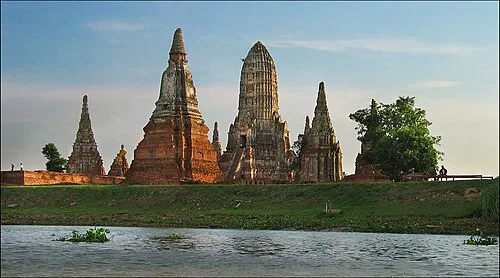 The East Riverfront & Chao Phraya Approach
Wat Chaiwatthanaram from the River
Welcome to Wat Chaiwatthanaram, one of the best known temples of old Ayutthaya. Its towers rise on the west bank of the Chao Phraya River, just outside the old city island. In 1630 it became the first great temple project of a new king, Prasat Thong. He built in the Khmer style, after the temple mountains of Angkor: a cluster of prangs, those ribbed corn-cob towers, standing together on one broad platform. Royal barges once came down the river to this shore. We will follow the temple's story from its founding gift, through its galleries and towers, to its fall and its return. Boats still pass the towers on the river today.
Fotograf / Photographer: Heinrich Damm (User:Hdamm, Hdamm at de.wikipedia.org) · CC BY 2.0
02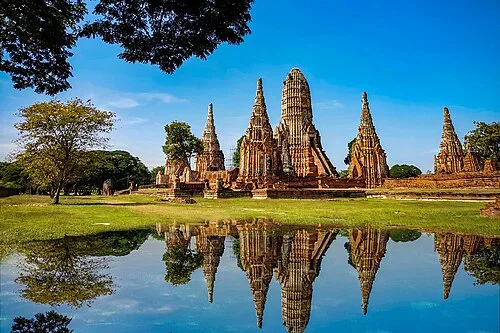 The East Riverfront & Chao Phraya Approach
The King's Gift to His Mother
King Prasat Thong raised this temple on the ground where his mother had once lived. She died before he took the throne, and the temple dedicated merit to her. Its name, Chaiwatthanaram, means the Temple of long reign and glorious era. Personal grief and royal ambition sit together in that name. Not everyone reads it as a son's memorial, though. Prince Damrong, a great Thai historian, believed it celebrated Ayutthaya's victory over Longvek. Historians have kept both readings alive ever since.
Photo: Athichitra · CC BY-SA 4.0
03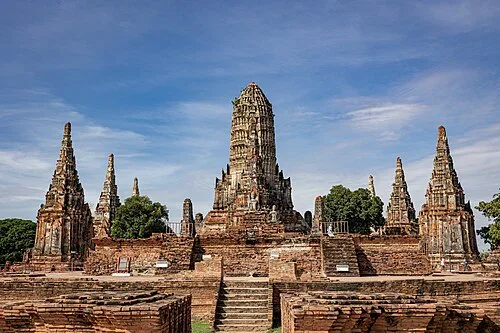 The Ordination Hall Ruins & Royal Memorials
The Ordination Hall by the River
The low brick foundations belonged to the Phra Ubosot, the temple's ordination hall. Here the king and his successors performed the great religious ceremonies of state. Its position is the puzzle: it stands east of the main prang, close to the river. The scholar Pitchaya Soomjinda reads that as a break with the convention of the day. In her view, it began a new pattern in which the ordination hall, rather than a great stupa, became the heart of a temple. She connects the change to Prasat Thong himself. A eulogy probably written in his time or soon after says he claimed to have been a bodhisatta in a past life, and a future buddha. Other scholars explain the layout more plainly, by function or by the practice of temporary ordination. The debate is still open.
Listen in the appPhoto: Mastertongapollo · CC BY-SA 4.0
04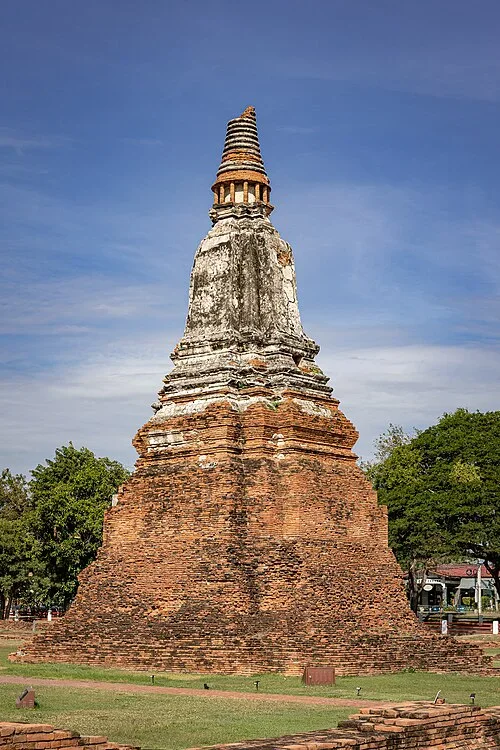 The Ordination Hall Ruins & Royal Memorials
The Twelve-Cornered Chedis
North and south of the ordination hall stand two chedis with twelve indented corners. Inside them the king laid the ashes of his mother. The dedication told earlier ends here, in brick and ash. The temple went on serving the royal dead for generations. Princes and princesses were cremated at Wat Chaiwatthanaram. Among them was Chaofa Thammathibet, a son of King Boromakot.
Listen in the appPhoto: Mastertongapollo · CC BY-SA 4.0
05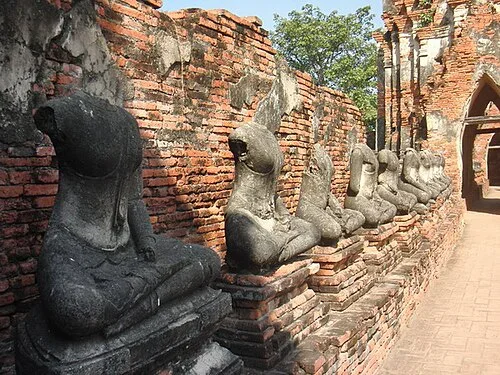 The Cloister of Seated Buddhas
The Seated Buddhas of the Gallery
Along the gallery wall runs a row of seated Buddhas, many of them headless. There were once 120 of these statues, made of plaster, probably lacquered black and touched with gold. The missing heads are evidence in themselves. After the old capital fell, beheading the Buddha images and carrying off pieces of the ruins became common. What remains here is what thieves and centuries left behind.
Listen in the appสารัช โภคพลากรณ์ · CC BY-SA 3.0
06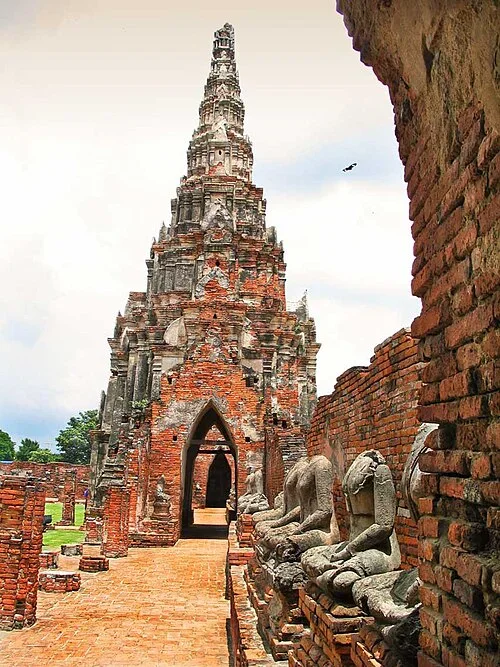 The Cloister of Seated Buddhas
The Phra Rabieng Gallery
The gallery itself is called the Phra Rabieng, a rectangular passage with a cross-shaped plan. It was once roofed and opened inward, with many side entries. Today only the pillar foundations and the outer wall are left. In the temple's cosmic scheme this passage marked the outer border of the world, the Iron Mountains that enclose the universe. To walk its length was to trace the edge of creation.
Listen in the appFotograf / Photographer: Heinrich Damm (User:Hdamm, Hdamm at de.wikipedia.org) · CC BY 2.0
07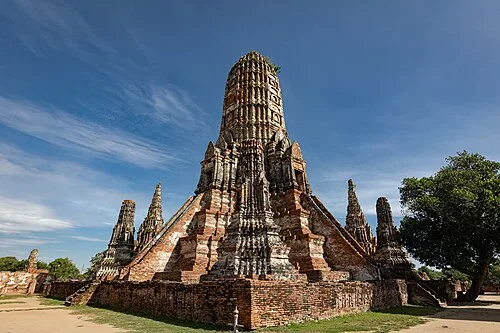 The Central Prang & Sacred Axis
The Central Prang - Mount Meru
The tall prang at the center rises about thirty-five metres. It stands for Mount Meru, the mountain at the axis of the traditional world. The plan follows the Traiphum Phra Ruang, a Thai cosmology of the three worlds written in the fourteenth century. Around Meru, that text says, lie four continents floating in a world sea. The four smaller prangs at the corners are those continents. Humans live on one of them, Chomphutawip. The whole temple is a map of the universe, drawn in brick on a single raised platform.
Listen in the appPhoto: Mastertongapollo · CC BY-SA 4.0
08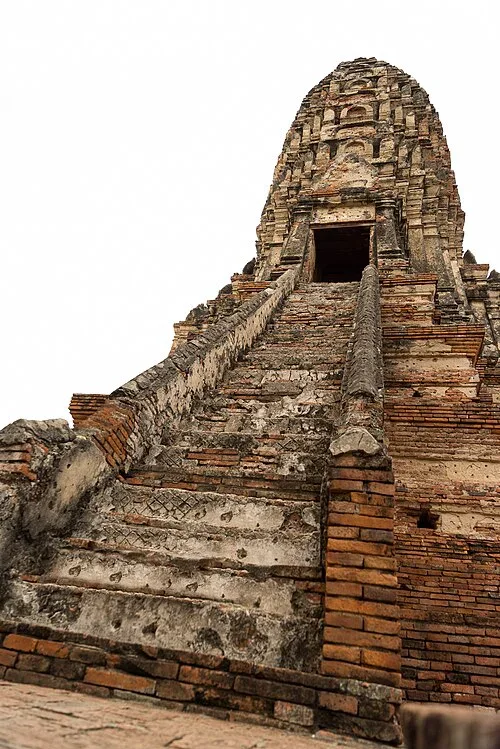 The Central Prang & Sacred Axis
Climbing the Prang
Halfway up the central prang, hidden entrances open onto steep stairs. The steps climb sharply toward a dark doorway set into the tower's face. The main prang follows early Ayutthaya models, though its porches project more strongly than in older towers. It may once have been crowned by a small chedi, evoking the Chulamani, the legendary stupa at the summit of Mount Meru. If that crown existed, it is gone now.
Listen in the appPhoto: DooFah · CC BY-SA 4.0
09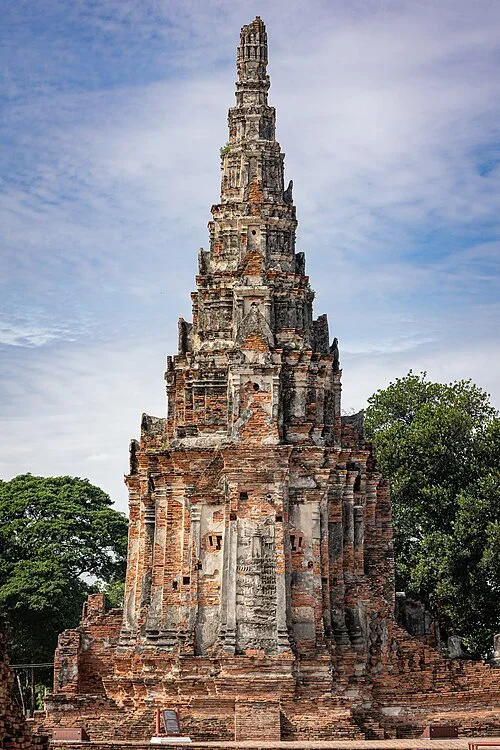 The Eight Cosmic Tower Chapels
Meru Thit and Meru Rai
Eight chedi-shaped chapels ring the central prang, joined to one another by the gallery. Their Thai name, Meru Thit Meru Rai, comes from the Meru. That was the great cremation structure on which Ayutthaya's kings were burned, itself conceived from Mount Meru symbolism. Each chapel rises like a tiered prasat, a tower of seven storeys. Their outer walls carried twelve stucco reliefs of scenes from the life of the Buddha. The panels were meant to be read clockwise, circling the tower. Only fragments survive.
Listen in the appPhoto: Mastertongapollo · CC BY-SA 4.0
10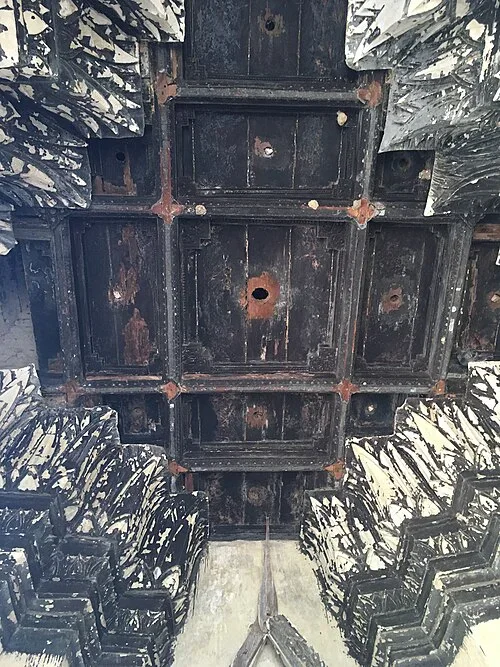 The Eight Cosmic Tower Chapels
Inside a Chapel - the Star Ceiling
Inside each rectangular chapel stood two seated Buddha statues, lacquered in black and gold. Each of the four middle chapels held one large seated Buddha instead. Over them stretched a wooden ceiling of black lacquer, dotted with golden stars. It was a night sky, hung above the sacred statue. Faint traces of wall painting survive in places, in flame-shaped motifs. Most of the colour went with the centuries.
Listen in the appPhoto: Peppermania00 · CC BY-SA 4.0
- 11
A Stucco Relief up Close
A weathered relief of the Buddha preaching to his mother, fading year by year.
- 12
Fall, Silence and Return
The fall of 1767, the long silence, and the restoration that brought the temple back.
Wat Chaiwatthanaram
Frequently asked questions
How much does the guide cost?
Free app download. Listed guide price: $0.99. Guide price shown in the app. Audio guide only. Venue admission is separate.
Can I listen without internet?
Yes. Download the guide’s audio, images, and maps in the app before your visit. Your downloaded content is then available offline.
Can I listen in my language?
This audio guide is available in 15 languages, including English.
Do I need to follow a schedule?
No. This is a self-guided experience. Choose your stops, pause whenever you like, and return to a story at your own pace.
At your own pace
Explore Wat Chaiwatthanaram.
Download Stanza, then search for “Wat Chaiwatthanaram”.
Free app download · Guide price shown in the app
Keep exploring
Nearby audio guides
Ayutthaya · 2 km
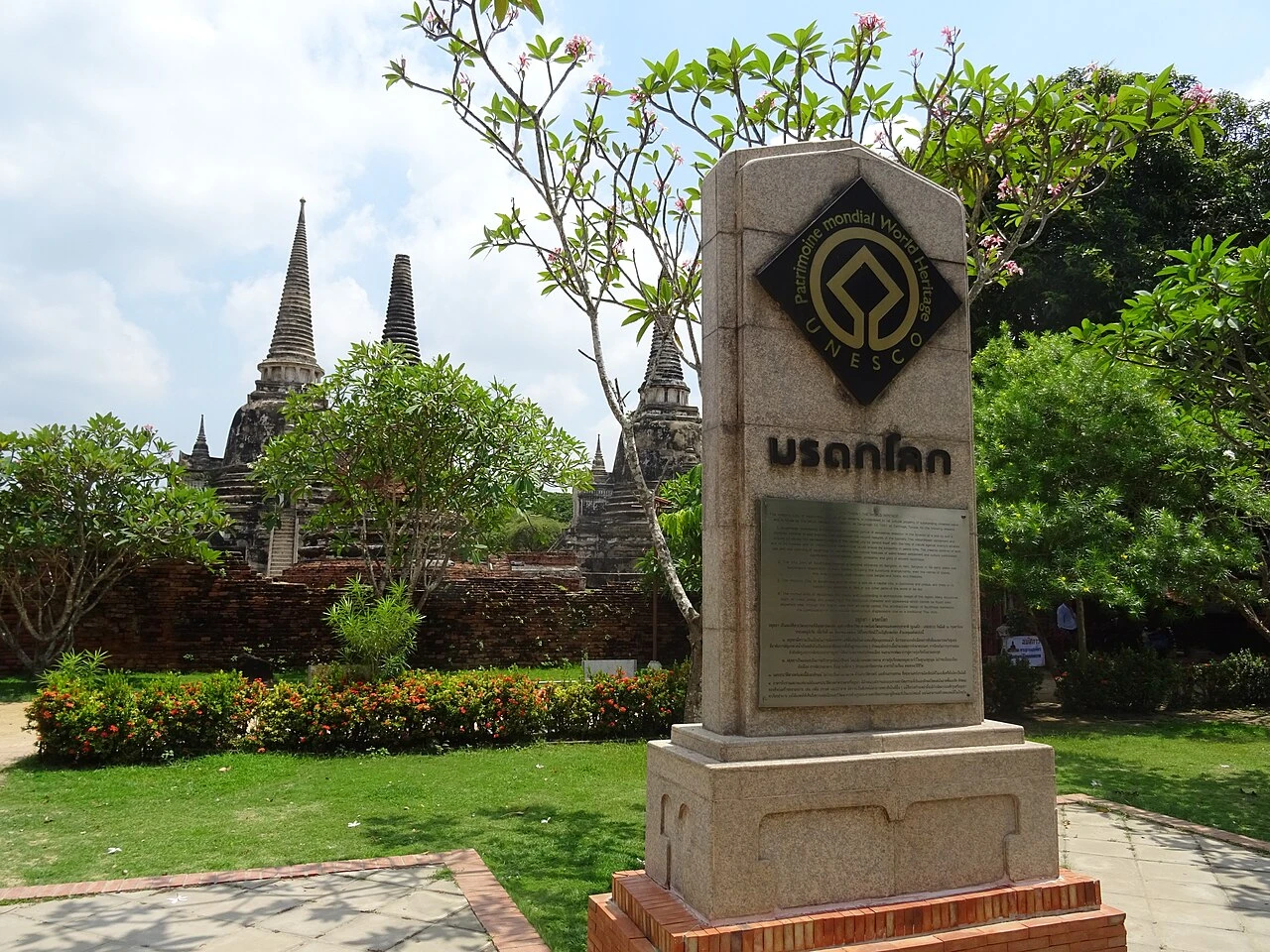
Ayutthaya Historical Park
Content & sources
Photo: Christophe95 · CC BY-SA 4.0
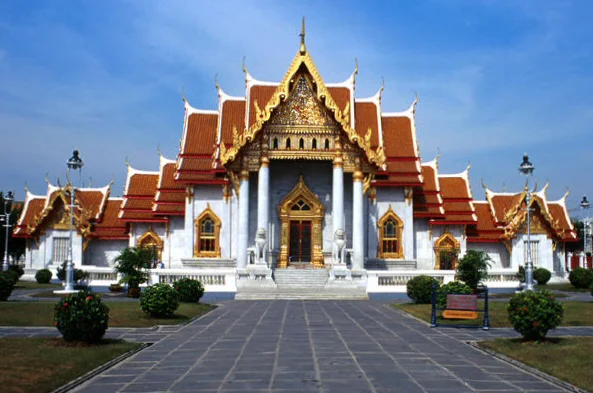
Bangkok · 64 km
Wat Benchamabophit
Content & sources
The original uploader was NamKhaeng at French Wikipedia. · CC BY-SA 3.0
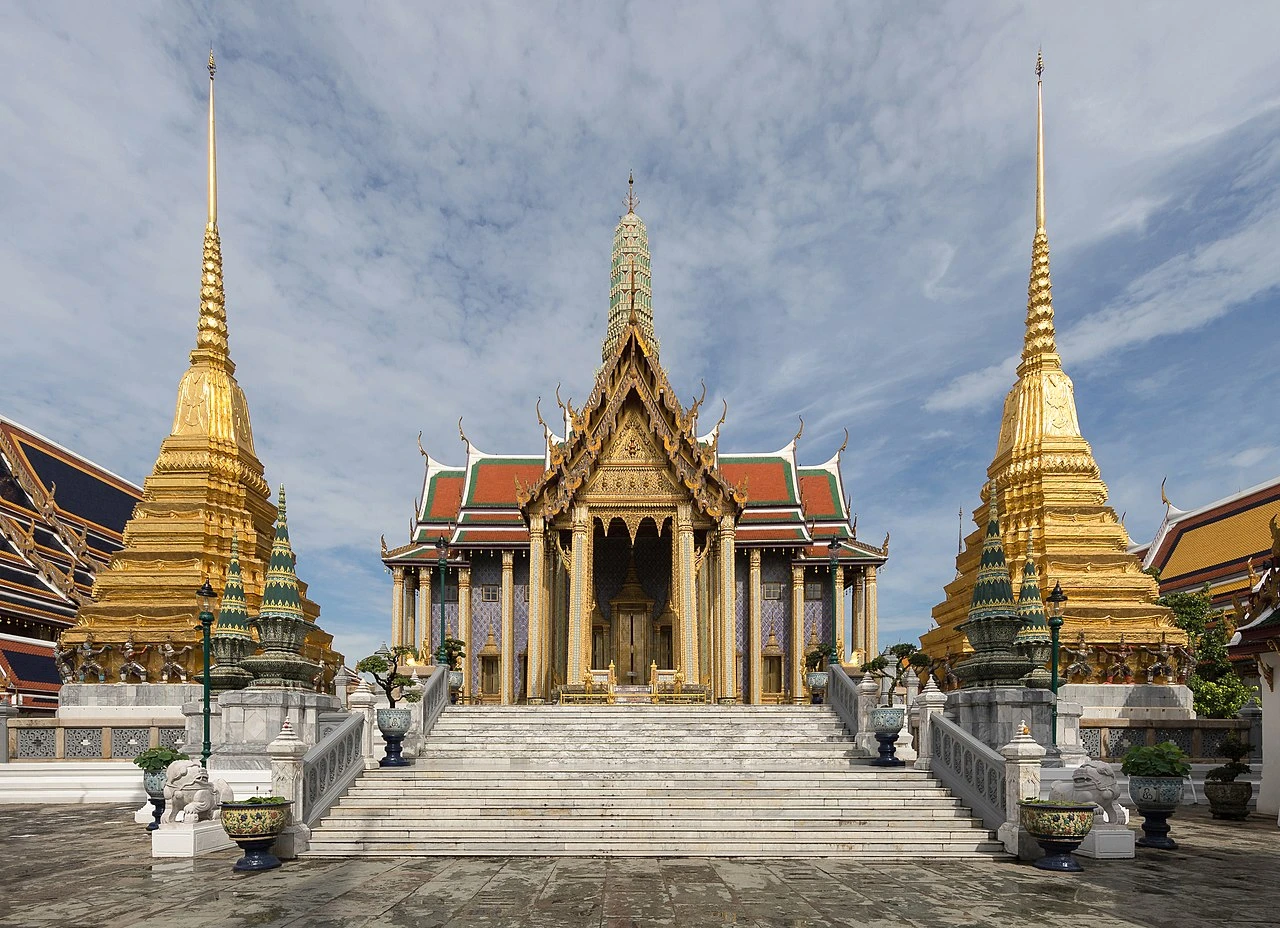
Bangkok · 66 km
Wat Phra Kaew
Content & sources
Photo: Basile Morin · CC BY-SA 4.0
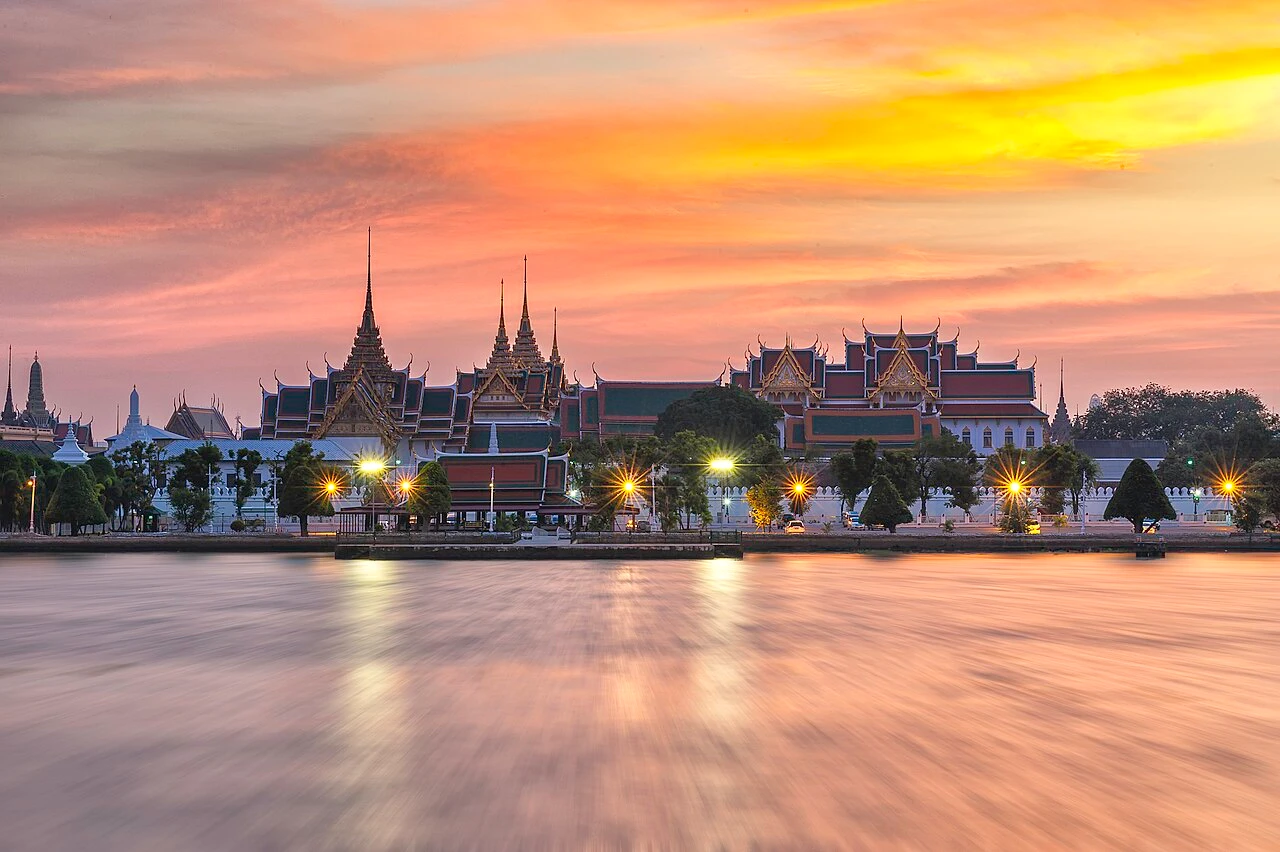
Bangkok · 66 km
Grand Palace
Content & sources
Photo: Preecha.MJ · CC BY-SA 4.0