Stanza · Audio guide
Wat Rong Khun Audio Guide
A place to remember. A story to take with you.
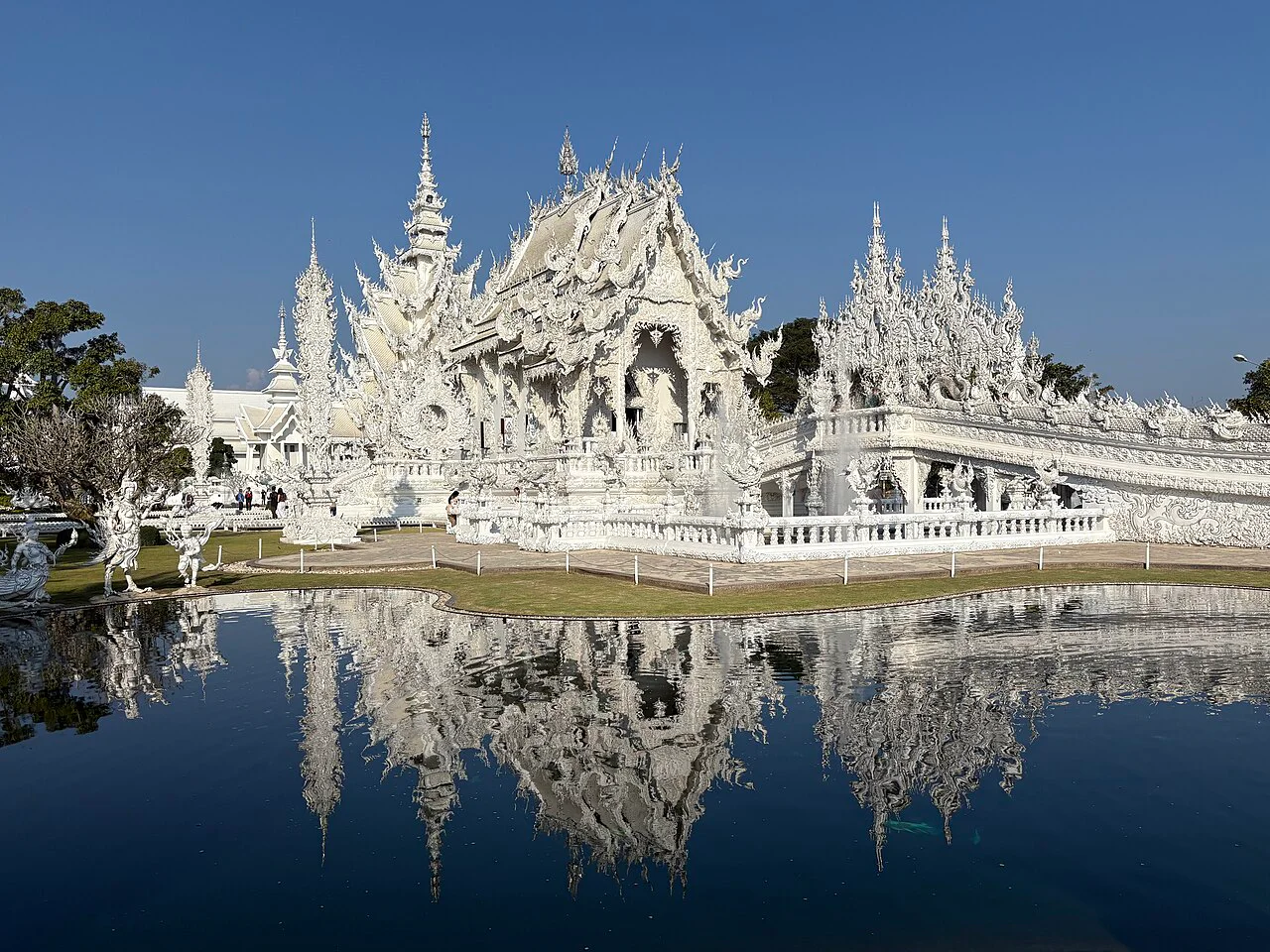
Wat Rong Khun is a contemporary, privately owned art exhibit in the style of a Buddhist temple located in Chiang Rai province. Created by artist Chalermchai Kositpipat, it is one of the most visited…
Download Stanza, then search for “Wat Rong Khun”.
About the tour
One guide. Your kind of visit.
Wat Rong Khun is a contemporary, privately owned art exhibit in the style of a Buddhist temple located in Chiang Rai province. Created by artist Chalermchai Kositpipat, it is one of the most visited attractions in the area.
Ready when you are.
- 01Get the free Stanza app.
iOS & Android
- 02Find your guide.
“Wat Rong Khun”
- 03Download before you go.
Works offline
Audio guide / 8 narrated stops
Inside the guide
Get to know a few of the stories before you go. Open a stop to read more.
01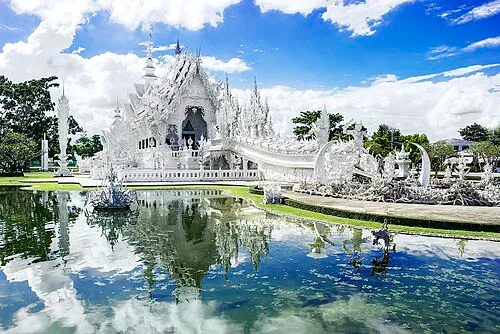 Plaza and Reflecting Lake Approach
The White Temple Across the Lake
Welcome to Wat Rong Khun, better known as the White Temple, just outside the city of Chiang Rai in northern Thailand. By the end of the twentieth century, the old village temple here stood in bad repair, and there was no money to renovate it. A local artist named Chalermchai Kositpipat decided to rebuild the whole thing himself, at his own expense. He has since poured more than forty million baht of his own money into the project. He calls the temple an offering to Lord Buddha, and believes the work will grant him immortal life. It opened to visitors in 1997. From a distance, the building seems to be crafted from sparkling porcelain. Up close, the dazzle comes from whitewash blended with chips of transparent mirrored glass. The white stands for the Buddha's purity. The mirrored glass stands for the radiance of wisdom. Chalermchai intends the grounds to be a centre of learning and meditation, where people can gain benefit from Buddhist teaching.
Photo: Chowwart · CC BY-SA 3.0
02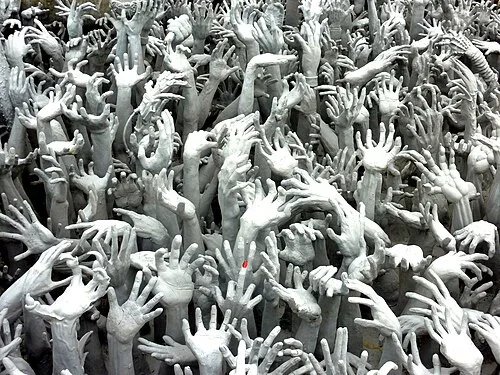 Pit of Reaching Hands
The Pit of Reaching Hands
In front of the bridge path, the ground seethes with hands. Hundreds of sculpted arms reach upward from the pit, fingers spread, straining toward the walkway above. In the artist's scheme, these hands embody unrestrained desire. The scene reads as a purgatorial multitude, souls caught in craving and greed. The hands cluster thickest around and beneath the bridge, the one route across the pit. There is no walking that route without passing over them.
Photo Dharma from Sadao, Thailand · CC BY 2.0
03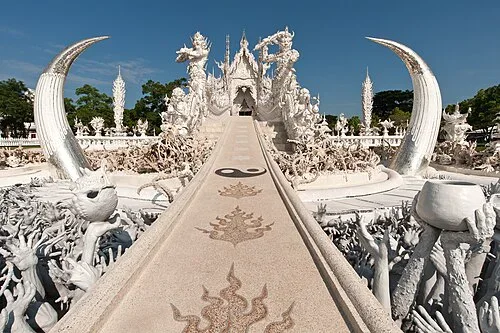 Bridge of the Cycle of Rebirth
The Bridge of the Cycle of Rebirth
This causeway is called the Bridge of the Cycle of Rebirth. It crosses a small lake, and the crossing stands for the passage from the cycle of rebirth toward happiness. The teaching built into it is that happiness comes by foregoing temptation, greed and desire. The reaching hands below the path are the wanting that the crossing leaves behind. The walk itself is strictly one-way. Visitors cross in one direction only, and are asked not to stop or turn back. Once across, the only way is onward, toward the gate ahead.
Listen in the appPhoto: Hans-Jürgen Neubert · CC BY-SA 4.0
04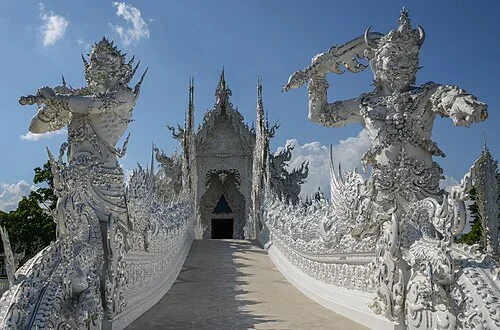 Gate of Heaven and Mythical Guardians
The Gate of Heaven
At the end of the bridge stands the gate of heaven. Two figures flank the approach, and neither looks welcoming. One represents Death. The other is Rahu, who in the artist's scheme decides the fate of the dead. Both guardians bristle with ornament, weapons raised, every surface gleaming white. Between them, the open causeway narrows into the enclosed precinct of the temple. Beyond them waits the ubosot, the temple's principal building.
Listen in the appJorge Láscar from Melbourne, Australia · CC BY 2.0
05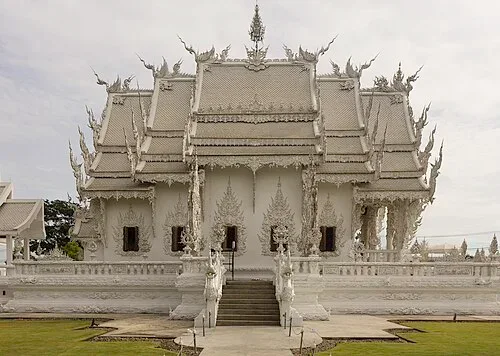 White Ubosot Prayer Hall
The White Ubosot
The principal building, the ubosot, carries classic Thai temple architecture in a modern skin. Its roof rises in three tiers, edged with the curled serpent figures called Naga. Ornate gables crown the ends of the roofline. Beneath the ornament sits a basic concrete frame, topped by a wooden roof. The ubosot remains an active prayer hall, not only an artwork. Meditative Buddha images stand before it.
Listen in the appStefan Fussan · CC BY-SA 3.0
06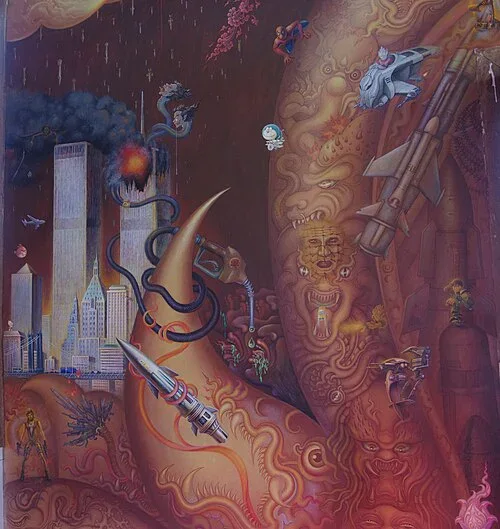 White Ubosot Prayer Hall
Inside the Ubosot: The Murals
Inside, the decor changes abruptly. The pristine white gives way to fiery orange, swirling flames and demon faces. Painted into the flames are figures from modern popular culture: Michael Jackson, Neo from The Matrix, Freddy Krueger, a T-800 series Terminator. Planes strike the World Trade Center. Nuclear warfare spreads across the walls, and oil pumps hammer away. Harry Potter, Superman and Hello Kitty appear too, which muddles the message a little. But the overall moral is plain: people are wicked, and their destructiveness is wrecking the earth. Photography is not allowed inside the ubosot, so the murals go unseen by any camera.
Listen in the appPhoto: E2v · CC BY-SA 3.0
07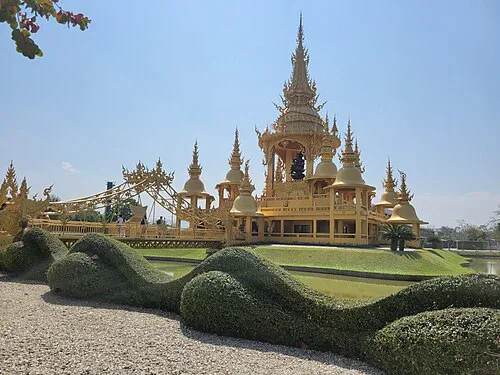 The Golden Restroom Building
The Golden Building
The most richly decorated golden building on the grounds is, of all things, the restroom. Chalermchai calls it his signature on the work. The gold is a deliberate provocation. It represents the body, and how people fixate on worldly desire and money. The white temple beside it represents the mind, and the making of merit over material things. The same thinking shapes the money behind the place. Donations are welcome, but capped at ten thousand baht. Chalermchai refuses to be influenced by big donors.
Listen in the appPhoto: Welcome to Thailand · CC0
08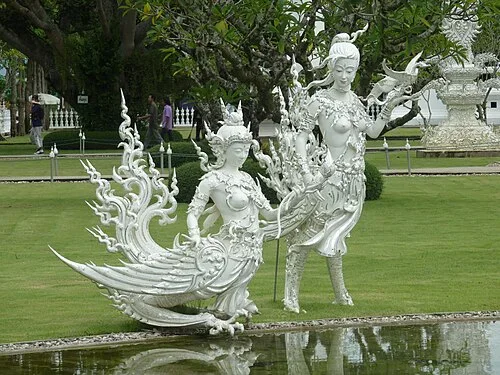 Art Gallery and Compound Grounds
The Grounds and the Unfinished Work
Beside the water stand two Kinnaree, creatures from Buddhist mythology, half human and half bird. They belong to a compound that is still growing. When finished, Wat Rong Khun is meant to hold nine buildings, among them a hall of relics, a meditation hall, an art gallery and quarters for monks. Completion is not expected until around 2070. The work nearly ended in 2014. On the fifth of May, the Mae Lao earthquake damaged the temple, and Chalermchai announced he would demolish the structures and not rebuild. Two days later, engineers confirmed that every building was structurally sound. He changed his mind at once, pledging to restore the temple within two years and to devote his life to the work. It remains a temple still under construction, decades after it first opened its gates.
Listen in the appPhoto Dharma from Sadao, Thailand · CC BY 2.0
Wat Rong Khun
Frequently asked questions
How much does the guide cost?
Free app download. Listed guide price: $0.99. Guide price shown in the app. Audio guide only. Venue admission is separate.
Can I listen without internet?
Yes. Download the guide’s audio, images, and maps in the app before your visit. Your downloaded content is then available offline.
Can I listen in my language?
This audio guide is available in 15 languages, including English.
Do I need to follow a schedule?
No. This is a self-guided experience. Choose your stops, pause whenever you like, and return to a story at your own pace.
At your own pace
Explore Wat Rong Khun.
Download Stanza, then search for “Wat Rong Khun”.
Free app download · Guide price shown in the app
Keep exploring
Audio guides — Thailand
Chiang Mai City Municipality · 141 km
Wat Chedi Luang
Content & sources
Vyacheslav Argenberg · CC BY 4.0
Chiang Mai · 144 km
Wat Phra That Doi Suthep
Content & sources
ผู้สร้างสรรค์ผลงาน/ส่งข้อมูลเก็บในคลังข้อมูลเสรีวิกิมีเดียคอมมอนส์ - เทวประภาส มากคล้าย · CC BY 3.0
Phimai
Phimai Historical Park
Content & sources
Photo: Ahoerstemeier · CC BY-SA 3.0
Ayutthaya
Ayutthaya Historical Park
Content & sources
Photo: Christophe95 · CC BY-SA 4.0