 Stanza / Audio guide
Stanza · Audio guide
Wat Phra That Doi Suthep Audio Guide
A place to remember. A story to take with you.
Wat Phra That Doi Suthep is a Theravada Buddhist temple located in Chiang Mai Province, Thailand. It is a sacred site to many Thai people and offers views of downtown Chiang Mai.
Download Stanza, then search for “Wat Phra That Doi Suthep”.
About the tour
One guide. Your kind of visit.
Wat Phra That Doi Suthep is a Theravada Buddhist temple located in Chiang Mai Province, Thailand. It is a sacred site to many Thai people and offers views of downtown Chiang Mai.
Ready when you are.
- 01Get the free Stanza app.
iOS & Android
- 02Find your guide.
“Wat Phra That Doi Suthep”
- 03Download before you go.
Works offline
Audio guide / 12 narrated stops
Inside the guide
Get to know a few of the stories before you go. Open a stop to read more.
01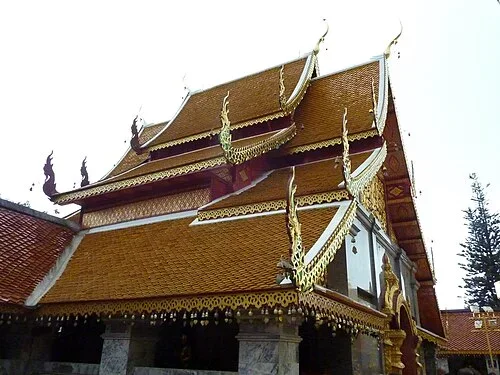 Lower Mountain Base and Gateway
Gateway to the Mountain Temple
Welcome to Wat Phra That Doi Suthep. This guide follows the pilgrim's path up the mountain, from the road to the golden chedi and the view over Chiang Mai. The temple is one of the most sacred pilgrimage sites in Thailand, a Theravada shrine built to house a relic of the Buddha. It sits on the mountain called Doi Suthep, about fifteen kilometres west of the city, more than a thousand metres above sea level. The rooflines here introduce the region's own style, Lanna: tiered roofs, gilded ornament, and the pointed finials at each peak called chofas. For centuries the summit was hard to reach. In 1935 a monk named Khruba Siwichai changed that. He was a beloved figure in the north, known for his devotion and for the building projects he took on. He also spoke against Bangkok's attempts to fold the region's Buddhist leaders into a national hierarchy, and became a symbol of northern religious freedom. Siwichai mobilized volunteers to cut the first road up Doi Suthep. Decades later, in the nineteen-eighties, the government proposed a cable car instead. Locals protested that a ride to the top would rob the pilgrimage of its meaning, and after a long battle the plan was dropped.
Photo Dharma from Sadao, Thailand · CC BY 2.0
02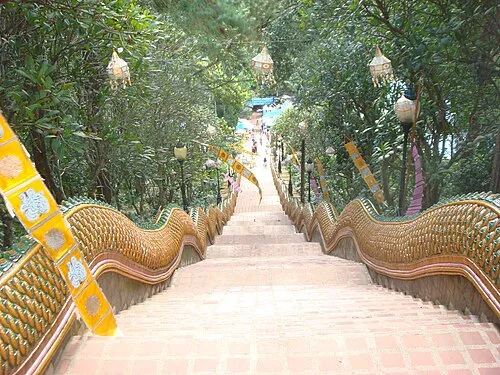 The Great Naga Staircase
The great staircase climbs roughly three hundred steps through the trees, longer than any other naga balustrade in Thailand. Its railings are serpents, tiled in green and gold, running the whole length of the flight. A monk named Phra Maha Yana Mongkol Pho had the stairs built in 1547. The climb was meant as more than a way up a hill. Crossing it marks a passage from the everyday world into sacred ground, step by step, with the serpent's body rising alongside. At the top stand the temple and its golden chedi.
Millevache · CC BY-SA 3.0
03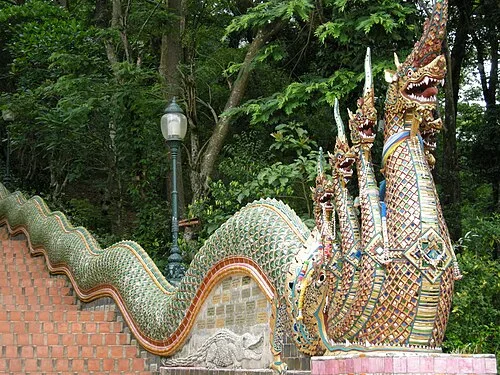 The Great Naga Staircase
The Naga Balustrade Up Close
The serpent's head rises in a flared fan of several faces, each with wide eyes and a tall crown. Its long body is covered scale by scale in small glazed tiles, green and gold catching the light. The naga is a protective being of the old stories, a guardian set along a stair or a doorway. Here the guardian runs the full length of the flight, its heads flaring out where the climb ends.
Listen in the app天上的雲彩 與我對話 06:50, 10 June 2009 (UTC) · CC BY-SA 3.0
04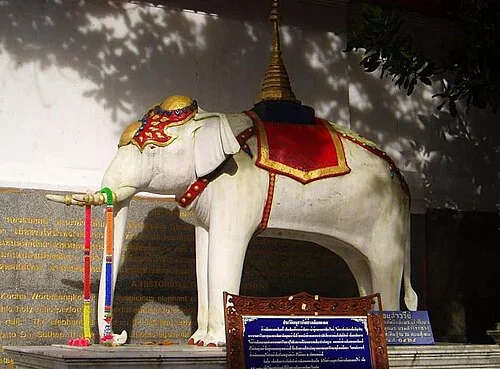 The White Elephant Shrine
A life-sized white elephant stands nearby, wearing a red and gold saddle with a tiny spire on its back. The statue keeps alive the story that decided where this temple would be built. In the fourteenth century, the story goes, King Kue Na of the Lanna kingdom set a sacred relic on the back of a white elephant and turned it loose into the jungle. The animal is said to have climbed this mountain, which was then called Doi Aoy Chang, Sugar Elephant Mountain. At the top it stopped, trumpeted three times, and dropped dead. That was read as an omen, and the king ordered a temple built on the spot.
Listen in the appKyle sb at English Wikipedia · CC BY-SA 3.0
05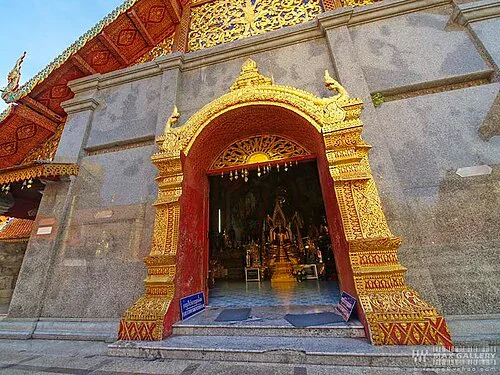 Inner Courtyard Entrance Gate
Entering the Inner Courtyard
Through the gilded archway lies the temple's most sacred precinct. The gateway is a deep red curve heavy with gold ornament in the Lanna manner, built to signal that the ground beyond is different. Custom asks two things of those who enter: modest dress, and shoes left at the door. This is a living temple, not a monument, and the courtyard inside is its holiest ground. The golden chedi at its centre is the most sacred area of the whole site.
Listen in the appb. inxee · CC BY-SA 3.0
06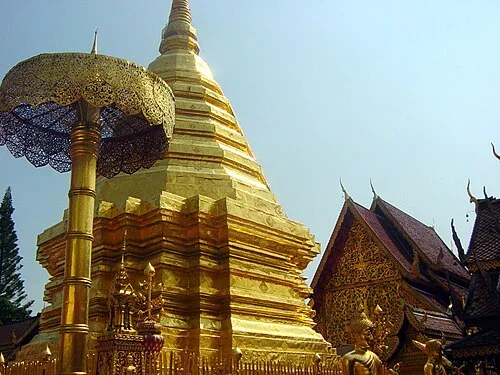 The Central Golden Stupa and Chatra
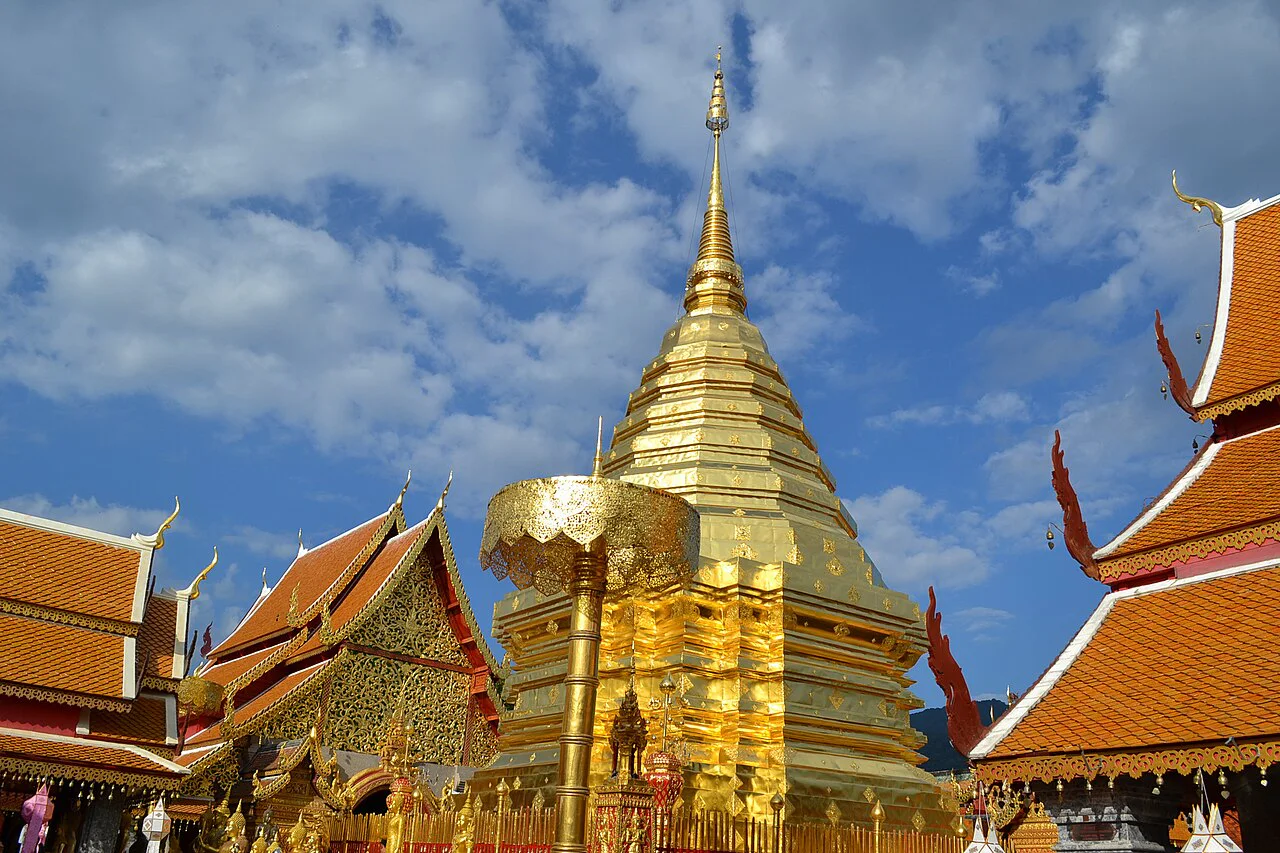
The Central Golden Chedi
The golden chedi is the heart of the temple, rising twenty-four metres above the courtyard. Its story begins with a dream. A monk named Sumanathera, from the Sukhothai kingdom, was told in a vision to seek out a relic. He found a bone that many say was the Buddha's shoulder bone. The relic was said to glow, to vanish, to move, and to copy itself. Sumanathera brought it to King Lue Thai of Sukhothai, but at the welcoming ceremony it showed nothing at all. The doubtful king told him to keep it. Word reached King Kue Na of Lan Na, who asked for the relic. In 1368, at Lamphun, it broke into two pieces. The smaller piece was enshrined at Wat Suan Dok. The other was carried up this mountain, and a temple was founded here to house it. The first stupa is said to date from 1383. The chedi was later enlarged, in 1538. By tradition, the relic rests beneath it, a sacred pillar for the city below.
Listen in the appRlevse · Public domain
07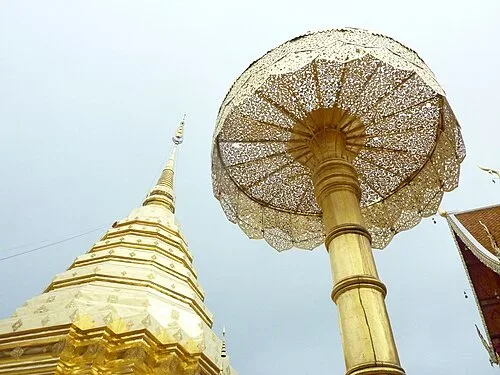 The Central Golden Stupa and Chatra
The Chedi's Architecture and Parasol
The chedi's form is Chiang Saen style, the classic shape of a northern Thai stupa. Its base is octagonal, ringed with deep notched grooves called redenting that step inward level by level. Layers of gold cover the whole body, and the form shows the influence of Sukhothai art. The umbrella at the top is another matter. The tiered parasol, the chatra, is not a Thai invention. It came out of two centuries of Burmese occupation of the north. Its tiers carry meaning, standing for the levels of heaven a soul must ascend to reach Nirvana. Thai architects also wanted the chedi to look light. A plain octagon and triangle would seem dense and static. The notched base, the near-parabolic slope, and the golden cover give the whole mass a feeling of weightlessness, as if it were floating upward.
Listen in the appPhoto Dharma from Sadao, Thailand · CC BY 2.0
08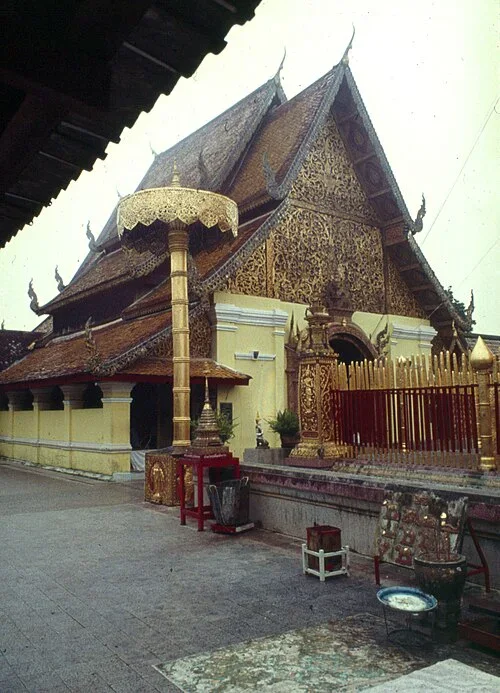 Main Viharn Assembly Halls
The Viharn and the Plan of the Complex
The assembly halls, the wihans, are arranged with care around the chedi. The complex is symmetrically planned on two axes, with the main and smaller wihans set just off the east–west line. Buddhist convention says that where no body of water lies nearby, the main wihan should face the rising sun. That is why it stands on the west side of the courtyard, its doorway turned toward the dawn. The wooden wihan and the monks' residence further down the hill both run north–south, pointing at the chedi. Everything on the mountaintop aims inward at the golden spire. The roofs do their own teaching. This one rises in two tiers at different angles, the lower flatter and tense, the upper steep and relaxed. The separation is meant to express freedom from attachment, the ultimate goal of Buddhist practice. Flat ornamental nagas sit at the roof corners, and the pointed tips at each peak are the chofas.
Listen in the appPhoto: Gerd Eichmann · CC BY-SA 4.0
09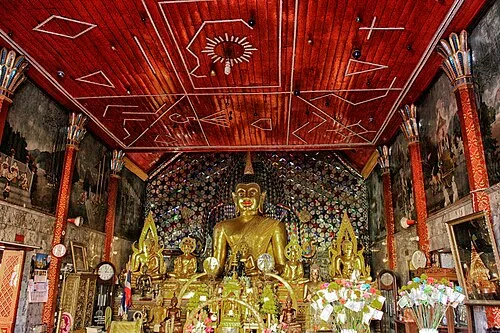 Main Viharn Assembly Halls
Inside the Viharn
Inside, the wihan is built to feel like an ascent. The walls and columns all slant inward toward the centre of the room, bracing the structure and lifting the eye as it travels. The windows are narrow trapezoids, wider at the base than at the top, shaped that way for strength and for that same rising feeling. Little light enters, so the hall stays dim, and the murals covering the walls are painted in dark colours. They retell the life of the Buddha and his travels, with Hindu figures woven in among them. A great golden Buddha sits at the far end, and the hall holds many more images in all styles and materials. Overhead, the red ceiling is patterned with white lines and small geometric figures.
Listen in the appPhoto: Kittipong khunnen · CC BY-SA 3.0
10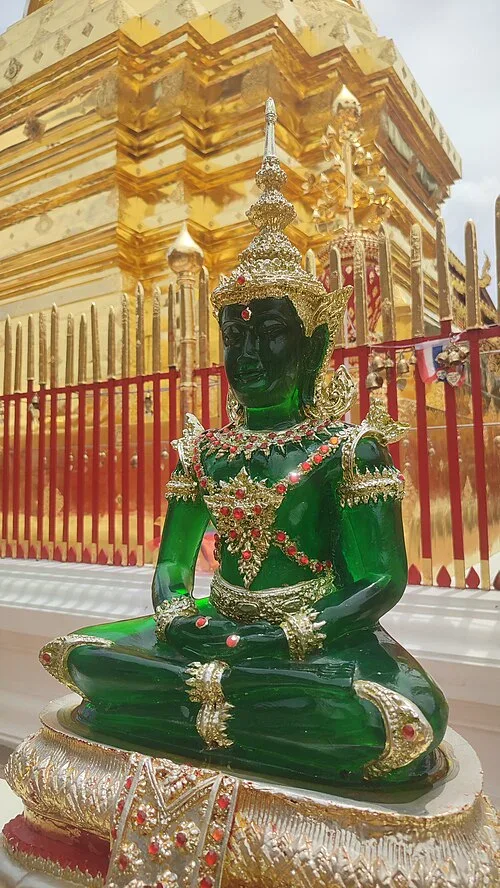 Emerald Buddha Replica Shrine
Emerald Buddha Replica
The temple's name explains itself: Phra is an honorific for a Buddha image, and That means a relic. In a side shrine sits a small Buddha of deep green glass, crowned and dressed in gold regalia, seated in meditation against the gleam of the golden chedi. This is a model of the Emerald Buddha, the most revered image in Thailand, kept in Bangkok. Copies of it appear at temples across the country, a mark of reverence and of each temple's connection to that sacred original. Here the figure wears full royal dress, its green body set with gilded ornaments and red jewels.
Listen in the appPhoto: Deepak-nsk · CC0
- 11
Bells of the Cloister
Bronze bells and living pilgrimage: a hundred and twenty thousand visitors a month, and one night each year spent on the esplanade.
- 12
The View over Chiang Mai
From the mountain terrace, the whole city below, and the old idea of a relic guarding it.
Wat Phra That Doi Suthep
Frequently asked questions
How much does the guide cost?
Free app download. Listed guide price: $0.99. Guide price shown in the app. Audio guide only. Venue admission is separate.
Can I listen without internet?
Yes. Download the guide’s audio, images, and maps in the app before your visit. Your downloaded content is then available offline.
Can I listen in my language?
This audio guide is available in 15 languages, including English.
Do I need to follow a schedule?
No. This is a self-guided experience. Choose your stops, pause whenever you like, and return to a story at your own pace.
At your own pace
Explore Wat Phra That Doi Suthep.
Download Stanza, then search for “Wat Phra That Doi Suthep”.
Free app download · Guide price shown in the app
Keep exploring
Audio guides — Thailand
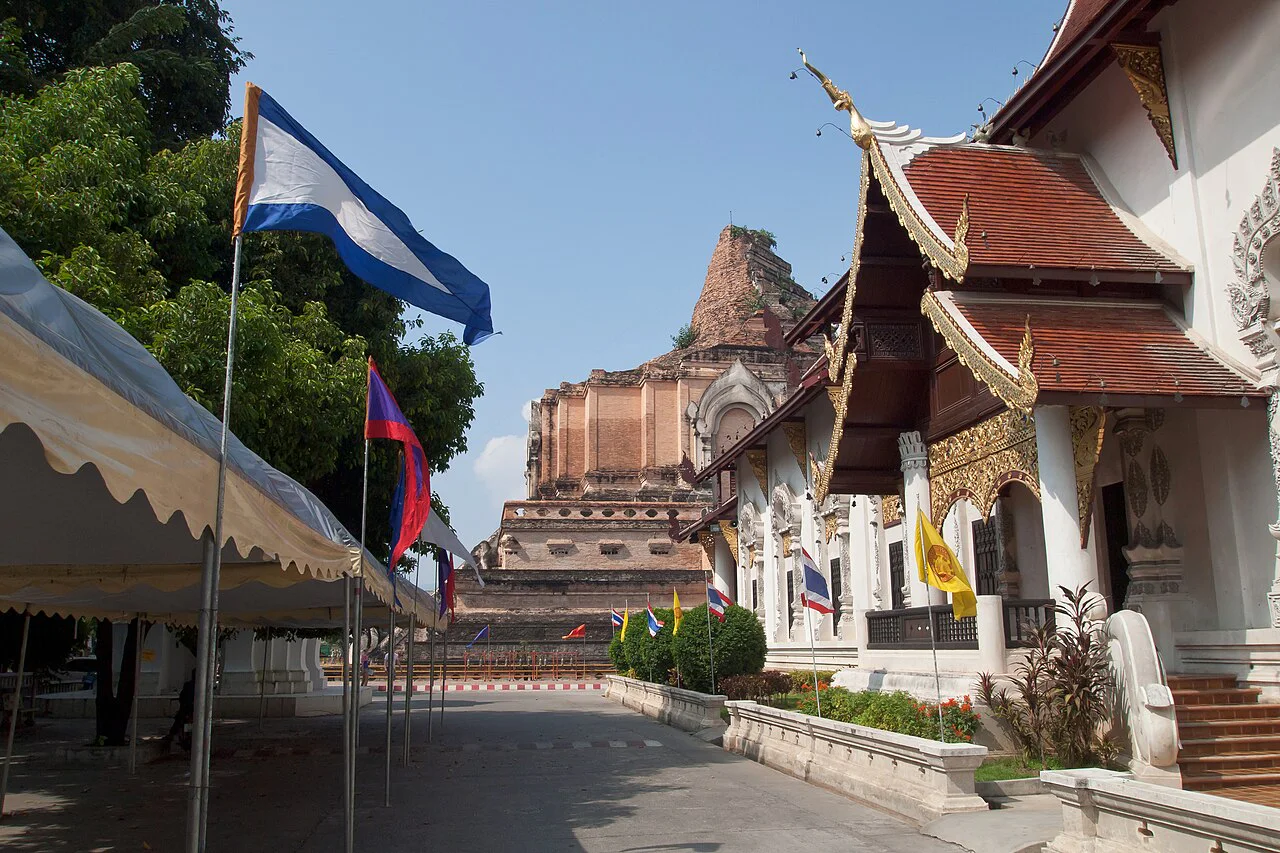
Chiang Mai City Municipality · 7 km
Wat Chedi Luang
Content & sources
Vyacheslav Argenberg · CC BY 4.0
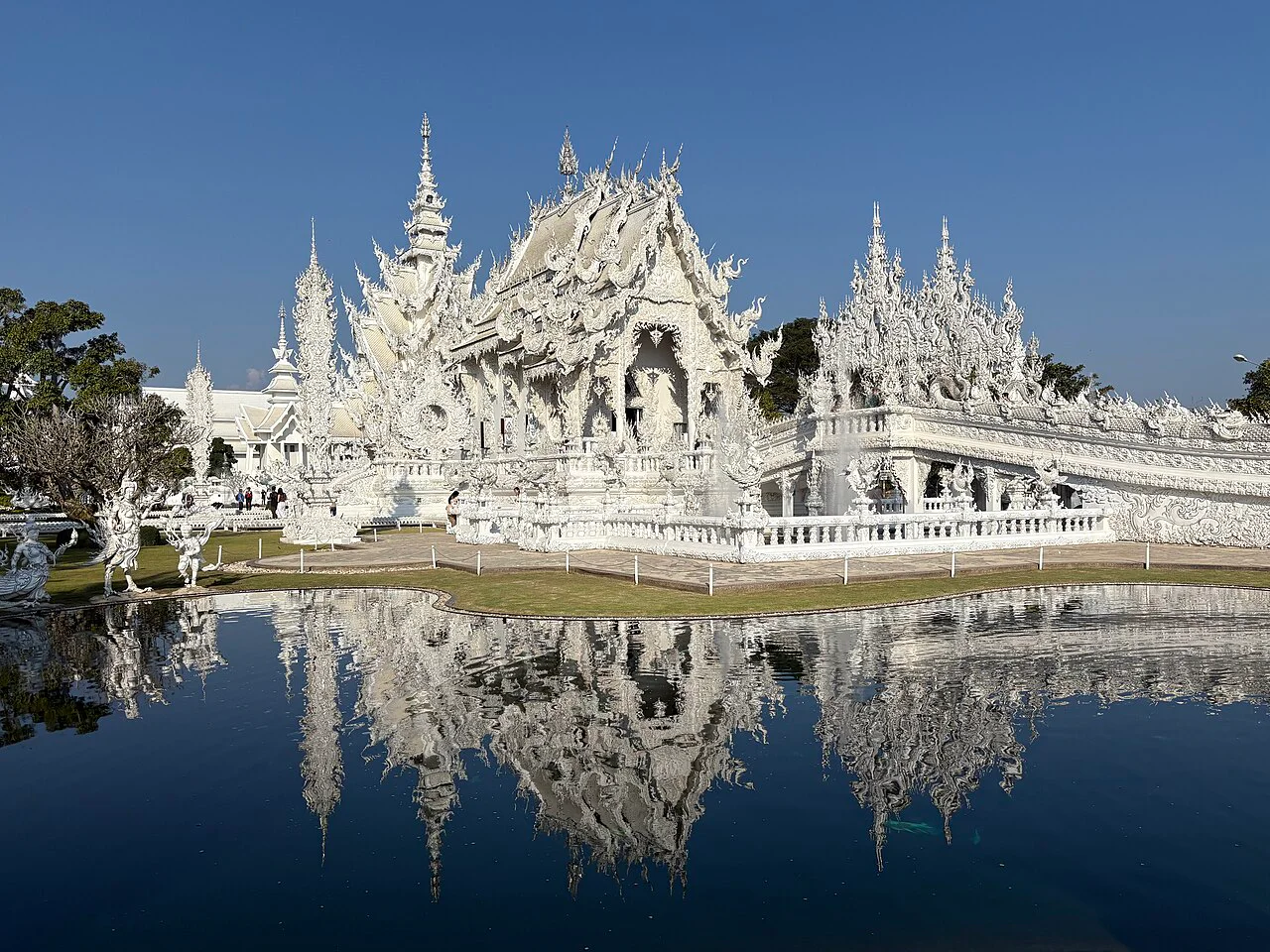
Ban Rong Khun · 144 km
Wat Rong Khun
Content & sources
Photo: Chainwit. · CC BY 4.0
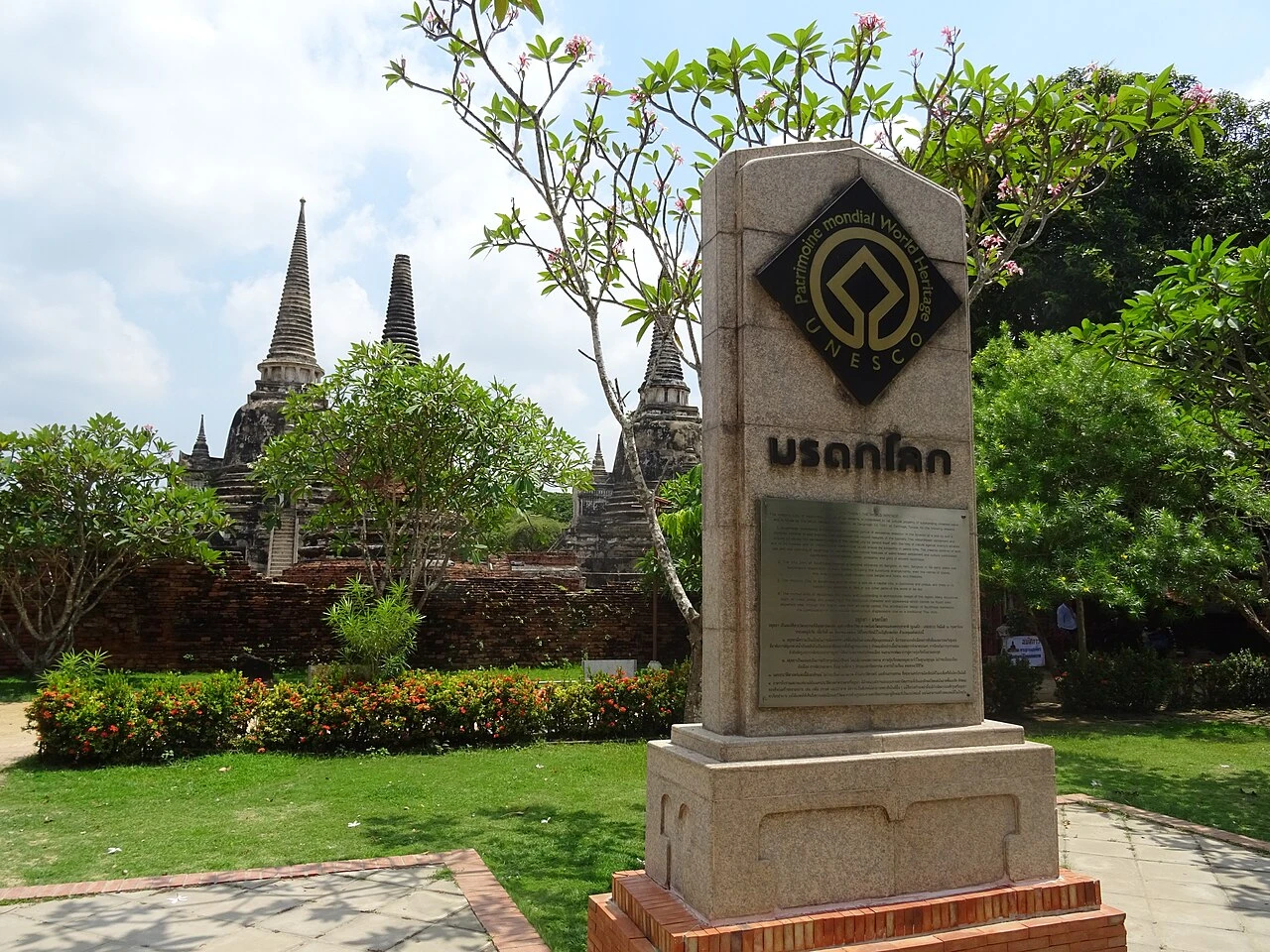
Ayutthaya
Ayutthaya Historical Park
Content & sources
Photo: Christophe95 · CC BY-SA 4.0
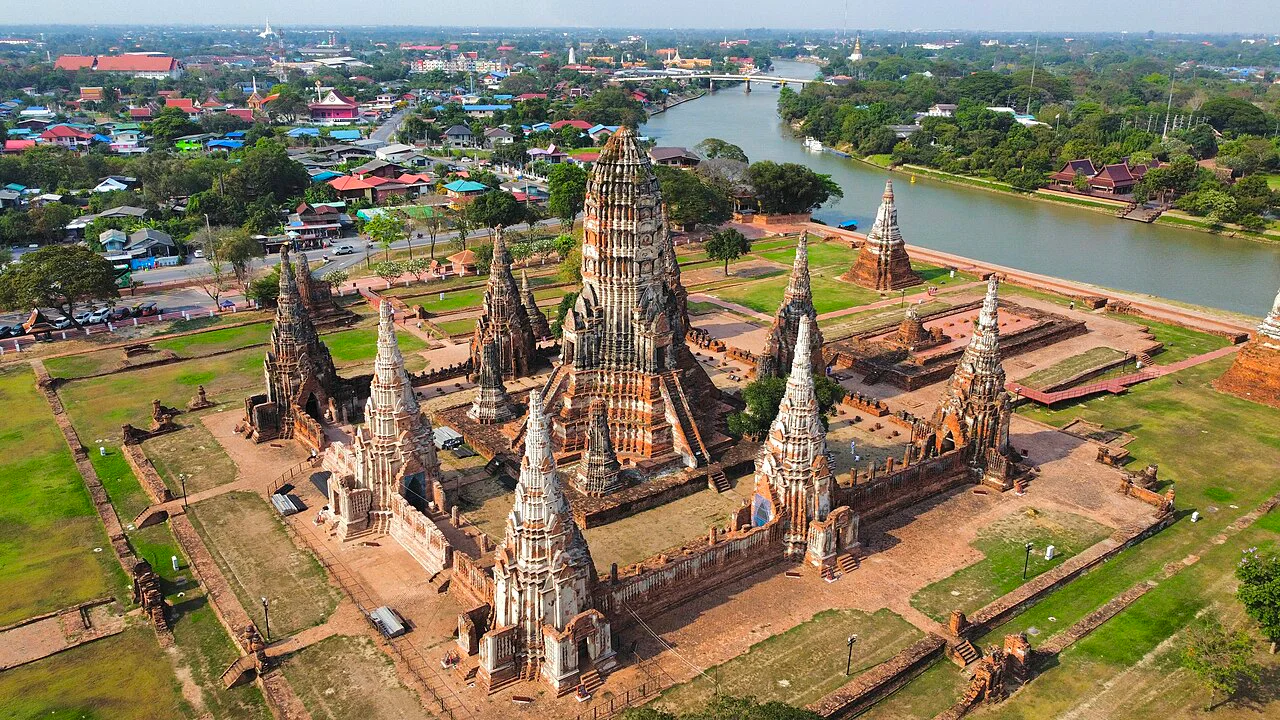
Ban Pom Subdistrict
Wat Chaiwatthanaram
Content & sources
Photo: Average trinmo · CC BY-SA 4.0