Stanza · Audio guide
Erawan Shrine Audio Guide
A place to remember. A story to take with you.
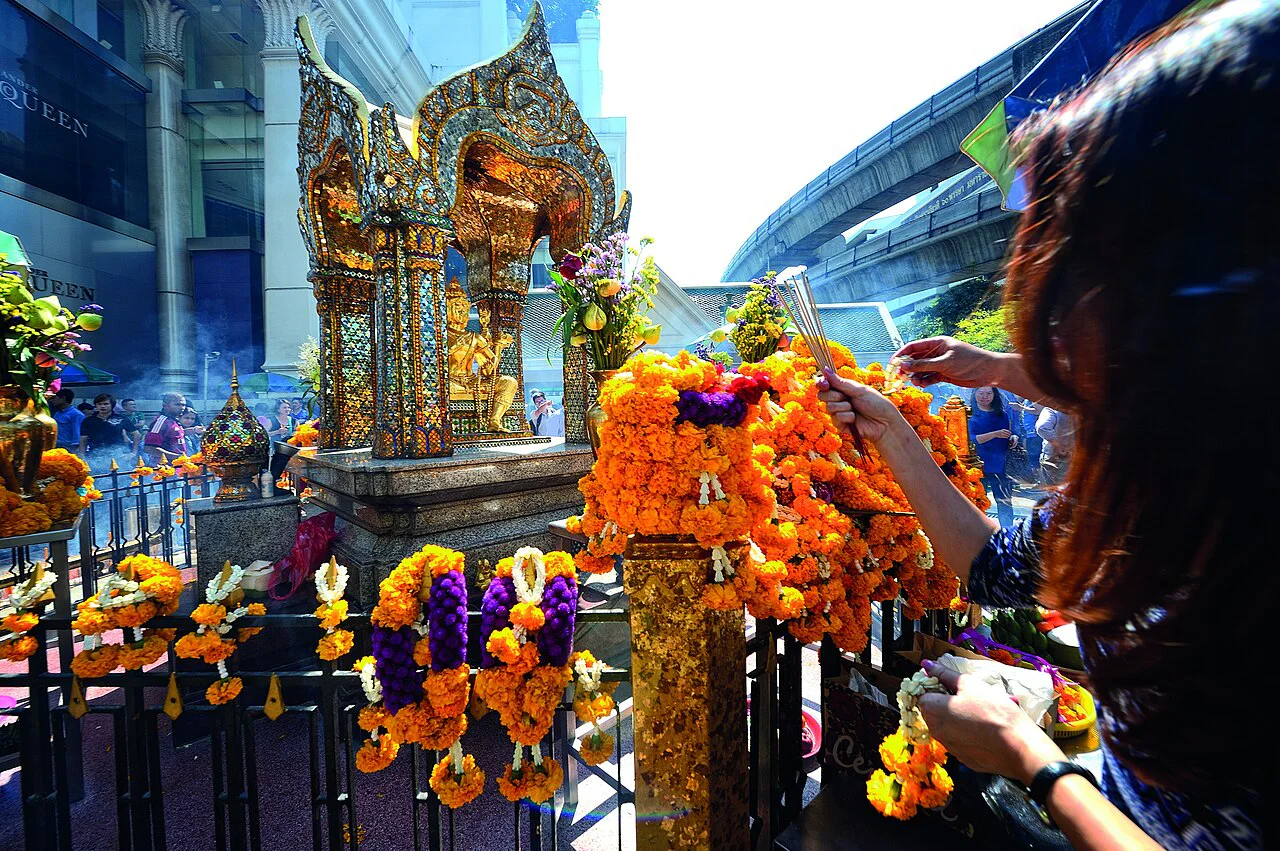
The Erawan Shrine is a shrine in Bangkok, Thailand, that houses a statue of Phra Phrom. It is dedicated to Brahma, the Hindu god of creation.
Download Stanza, then search for “Erawan Shrine”.
About the tour
One guide. Your kind of visit.
The Erawan Shrine is a shrine in Bangkok, Thailand, that houses a statue of Phra Phrom. It is dedicated to Brahma, the Hindu god of creation.
Ready when you are.
- 01Get the free Stanza app.
iOS & Android
- 02Find your guide.
“Erawan Shrine”
- 03Download before you go.
Works offline
Audio guide / 5 narrated stops
Inside the guide
Get to know a few of the stories before you go. Open a stop to read more.
01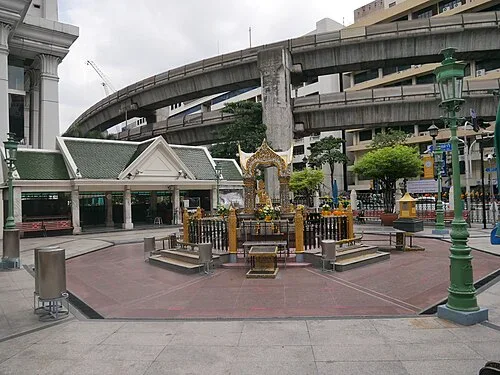 Ratchaprasong Plaza Entrance
Ratchaprasong Corner Plaza
Bangkok has spirit houses on almost every corner, but few sit in the middle of the traffic like this one. The Erawan Shrine, formally the Thao Maha Phrom Shrine, occupies the Ratchaprasong intersection where Ratchadamri Road crosses the city's shopping heart. The Grand Hyatt Erawan stands beside it, and the BTS Skytrain's Chit Lom Station is close by, with an elevated walkway that passes over the shrine. Gaysorn, CentralWorld and Amarin Plaza all crowd the same few blocks. Yet in the middle of it all stands a gilded shrine to Phra Phrom, the Thai representation of Brahma, the Hindu god of creation. The worship here blends three traditions at once: a Hindu deity, honored in Buddhist cosmology as Mahabrahma, ruler of the Brahma realm, and approached like a guardian spirit in Thai animist belief. And this is not the only shrine of its kind in the district. Five more nearby honor Hindu deities: Lakshmi, Trimurti, Ganesha, Indra, and Narayana riding his garuda. Together they make Ratchaprasong a corner of old faith inside a district of glass and commerce.
Photo: กสิณธร ราชโอรส · CC BY-SA 4.0
02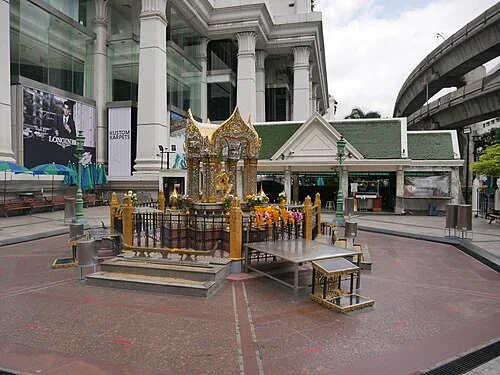 Erawan Hotel & Astrological Origins
The Erawan Hotel's Troubled Foundations
In 1956 the Thai government was building the Erawan Hotel on this corner, and the project was going badly. Costs ran over budget. Laborers were injured on the site. Then a shipload of Italian marble, meant for the building, was lost at sea. Someone counted the troubles and found the cause in the calendar. The foundation stone, it was believed, had been laid on the wrong date, and the bad karma from that mistake hung over the whole project. An astrologer advised building a shrine to Brahma to counter the negative influences. The Fine Arts Department designed and built the statue, and it was enshrined on 9 November 1956. From that day on, the hotel's construction went ahead without further incident. The hotel itself lasted three decades. In 1987 it was demolished, and the Grand Hyatt Erawan Bangkok rose on the same ground, with the shrine kept in its place.
Photo: กสิณธร ราชโอรส · CC BY-SA 4.0
03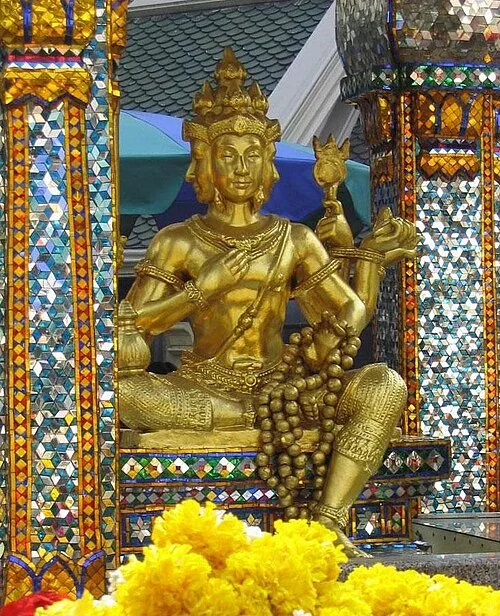 Central Pavilion & Four-Faced Phra Phrom
Phra Phrom, the Four-Faced God
The seated figure at the heart of the shrine is gilded from head to foot, and he carries more than one face. His four faces gaze out in all four directions at once. Worshippers treat him less as a distant creator and more as a grantor of wishes, a guardian spirit who listens. The original image from 1956 came from the Fine Arts Department, the same workshops that made the Brahma installed around then at the rooftop shrine of Government House's Thai Khu Fa building. The two were cast and consecrated in the same period, in the same ceremonial context. One went to the seat of government, the other to a hotel corner, and this one became the famous one.
Listen in the appTerence Ong · CC BY 2.5
04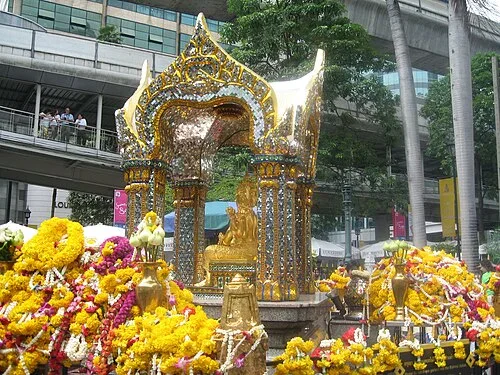 Central Pavilion & Four-Faced Phra Phrom
Fragments and the Zenith Hour
The garlands piled around this pavilion mark a shrine that has been through a great deal. In the early hours of 21 March 2006, a young man named Thanakorn Pakdeepol climbed onto the statue's base and smashed it with a large hammer. The hollow image broke apart, the four-faced head, the torso, the six arms and the weapons all fragmenting, with only part of the lap and the base left intact. Bystanders beat him to death at the scene, and two street sweepers were charged with the killing. His father, Sayant Pakdeepol, said his son had been treated for psychiatric problems, and called the beating an overreaction. Murder, he told a newspaper, is not the act of people with real faith in Brahma. Days later the Prime Minister visited the site, where a white cloth concealed the statue's absence and photographs stood in for the image itself. The repair came two months on. On 21 May 2006, at 11:39, the moment the sun stood directly over the shrine, a new statue was enshrined, made of plaster mixed with gold, bronze and other precious metals, along with fragments of the original. A duplicate cast entirely of metal, from the very same mold, waits in the National Museum for safety.
Listen in the appTerence Ong · CC BY 2.5
05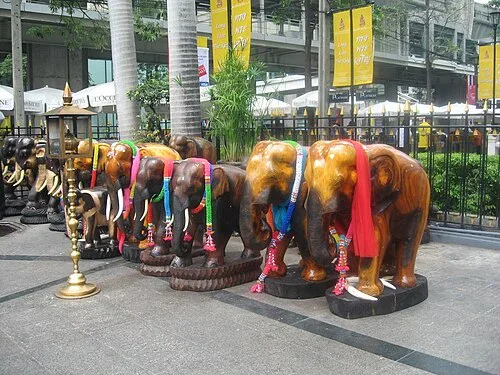 Offering Corner & Chatri Performance Stage
Elephant Offerings and the Dance Troupe
The carved wooden elephants lined up here are not decoration. Devotees donate them as votive gifts, each one draped in bright cloth, each one a prayer made solid. When a prayer is answered, the same worshipper may hire one of the Thai dance troupes that perform inside the shrine precinct, dancing to live traditional music as an act of thanksgiving. That custom runs daily, and it fills the corner with drums and gold-lacquered costume. The shrine has also changed with the times. From March 2020, incense and candles were no longer allowed to be lit here, on health and environmental grounds. The city's attachment was tested once more on 17 August 2015, when a bomb exploded near the shrine, killing twenty people and injuring many more. The statue itself was only slightly damaged. Within two days the repairs were finished and the shrine reopened. A shrine raised in 1956 to end a builder's bad luck has become a place where millions bring their hopes and their gratitude.
Listen in the appTerence Ong · CC BY 2.5
Erawan Shrine
Frequently asked questions
How much does the guide cost?
Free app download. Listed guide price: $0.99. Guide price shown in the app. Audio guide only. Venue admission is separate.
Can I listen without internet?
Yes. Download the guide’s audio, images, and maps in the app before your visit. Your downloaded content is then available offline.
Can I listen in my language?
This audio guide is available in 15 languages, including English.
Do I need to follow a schedule?
No. This is a self-guided experience. Choose your stops, pause whenever you like, and return to a story at your own pace.
At your own pace
Explore Erawan Shrine.
Download Stanza, then search for “Erawan Shrine”.
Free app download · Guide price shown in the app
Keep exploring
Nearby audio guides
Bangkok · 4 km
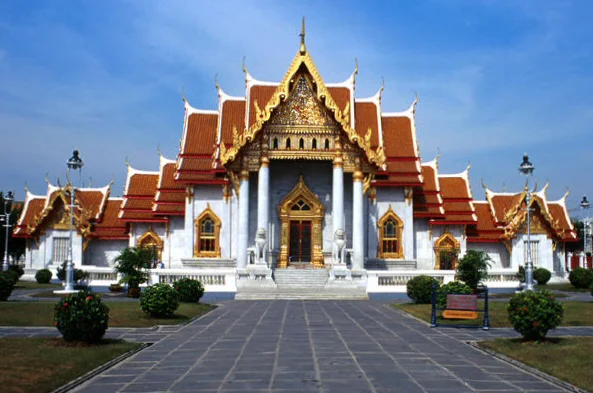
Wat Benchamabophit
Content & sources
The original uploader was NamKhaeng at French Wikipedia. · CC BY-SA 3.0
Bangkok · 5 km
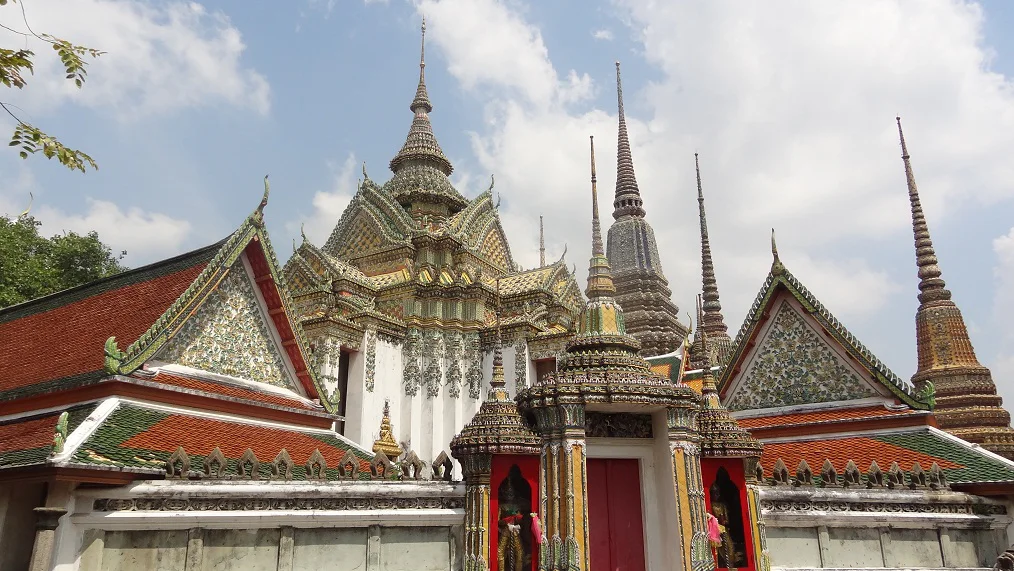
Wat Pho
Content & sources
Photo: Emielwiki · CC BY-SA 3.0
Bangkok · 5 km
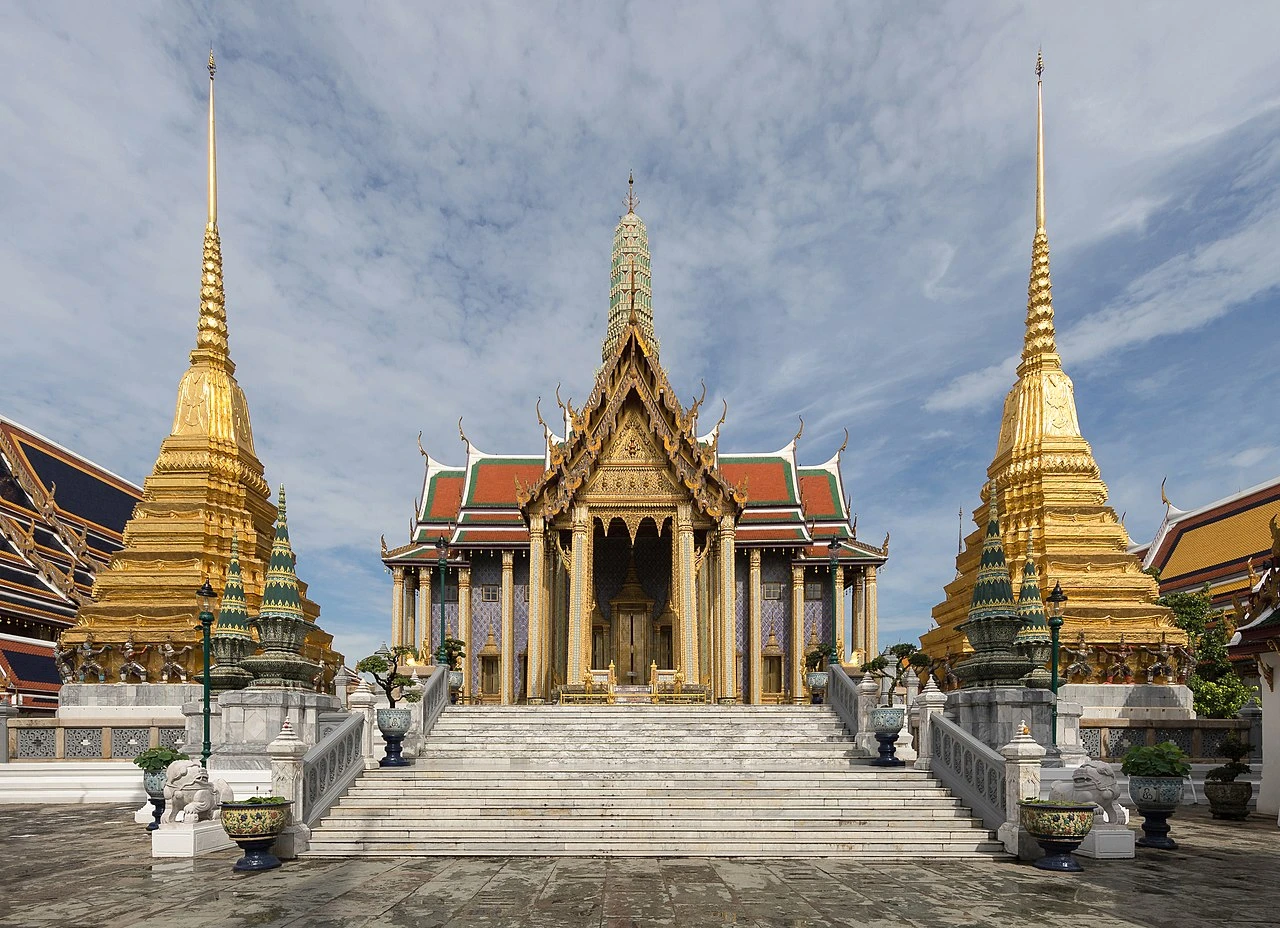
Wat Phra Kaew
Content & sources
Photo: Basile Morin · CC BY-SA 4.0
Bangkok · 5 km
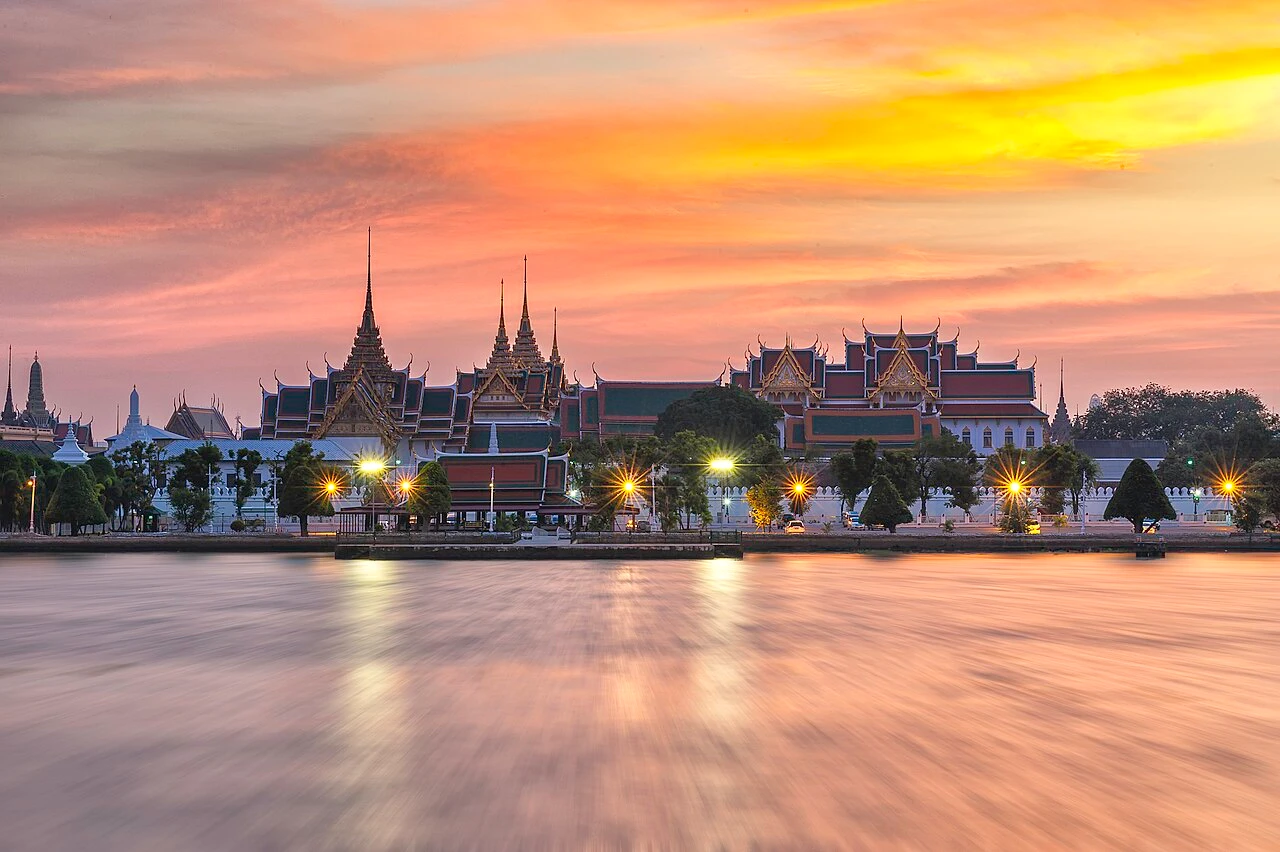
Grand Palace
Content & sources
Photo: Preecha.MJ · CC BY-SA 4.0