Stanza · Audio guide
Wat Pho Audio Guide
A place to remember. A story to take with you.
Wat Pho is a Buddhist temple complex located in Bangkok, Thailand. It is known as the Temple of the Reclining Buddha and is situated directly south of the Grand Palace.
Download Stanza, then search for “Wat Pho”.
About the tour
One guide. Your kind of visit.
Wat Pho is a Buddhist temple complex located in Bangkok, Thailand. It is known as the Temple of the Reclining Buddha and is situated directly south of the Grand Palace.
Ready when you are.
- 01Get the free Stanza app.
iOS & Android
- 02Find your guide.
“Wat Pho”
- 03Download before you go.
Works offline
Audio guide / 13 narrated stops
Inside the guide
Get to know a few of the stories before you go. Open a stop to read more.
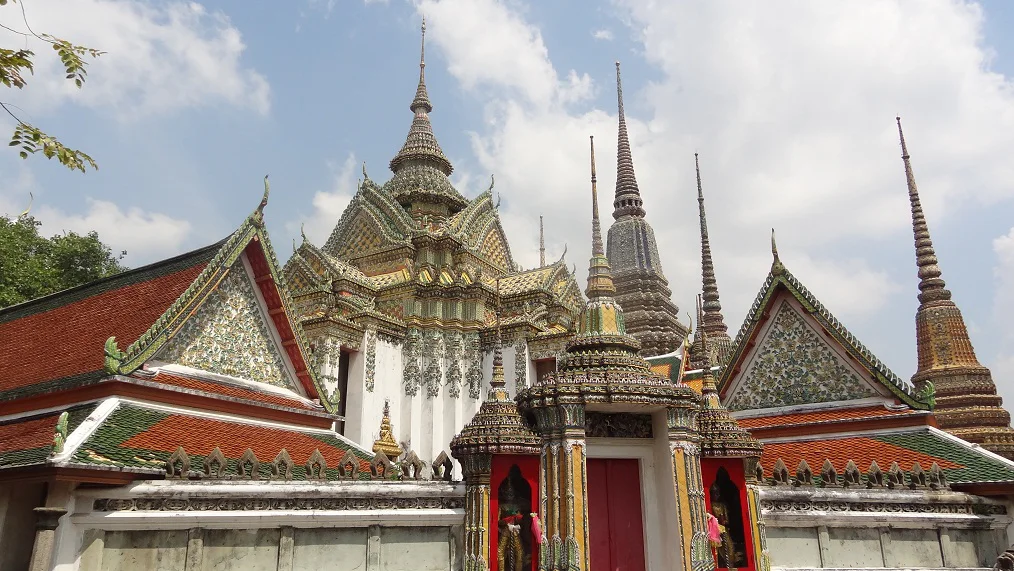
01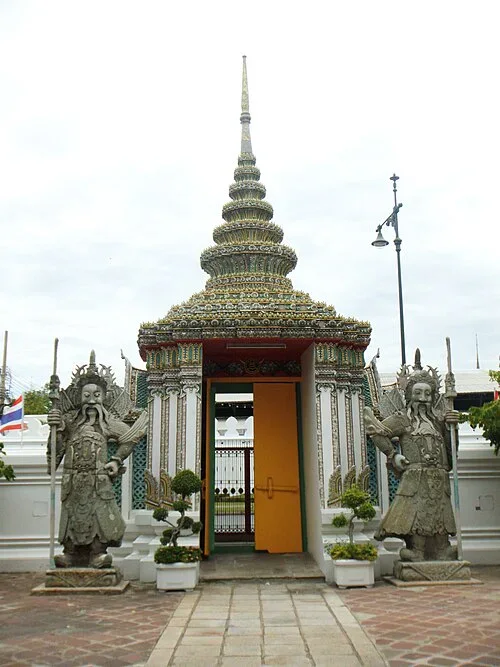 Entrance Gates and Chinese Stone Guardians
Main Gateway of Wat Pho
Welcome to Wat Pho, a royal temple older than the city around it. Long before Bangkok became the capital, this was a monastery called Wat Photaram, built sometime in the Ayutthaya period. Its founder's name has been lost, and a story linking the site to King Phetracha in the late 1600s is tradition rather than record. In 1782 King Rama I moved his capital across the river to Bangkok and built the Grand Palace next door. Six years later he ordered the dilapidated old temple rebuilt. The ground here was marshy and uneven, so it was drained and filled before a single building rose. The work took over seven years. In 1801 the new complex was renamed Wat Phra Chetuphon, and it became Rama I's own main temple, ranked first among Thailand's first-class royal temples. The grounds are vast, two walled compounds divided by Chetuphon Road, the northern one holding the finest halls. The perimeter wall has sixteen gates, and only two of them open to the public.
Thanakrit Panyarachun · CC BY-SA 3.0
02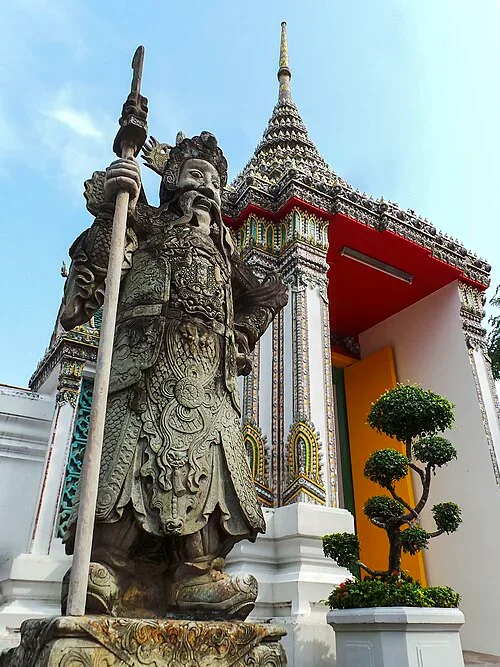 Entrance Gates and Chinese Stone Guardians
Chinese Stone Guardian at the Gate
The stone warriors at the temple gates came here by sea. Large Chinese statues, some carved with European faces, were shipped as ballast in trading vessels, and once unloaded they were set up as guardians. They stand stiff and fierce, weapons in hand, weathered grey by the decades. Visitors often take one of them for Yak Wat Pho, the temple's giant of legend, though the real Yak Wat Pho figures stand by the scripture library. The legend tells how that giant fought a rival giant from Wat Arun across the river. The battle raged until Lord Shiva ended it, punishing both giants to stand guard over their own temples from then on. The flattened battleground by the river, people said, gave the Tha Tien neighbourhood its name, the cleared pier. It is folklore, not chronicle, but it ties two temples on opposite banks together through a pair of stone enemies.
Thanakrit Panyarachun · CC BY-SA 3.0
03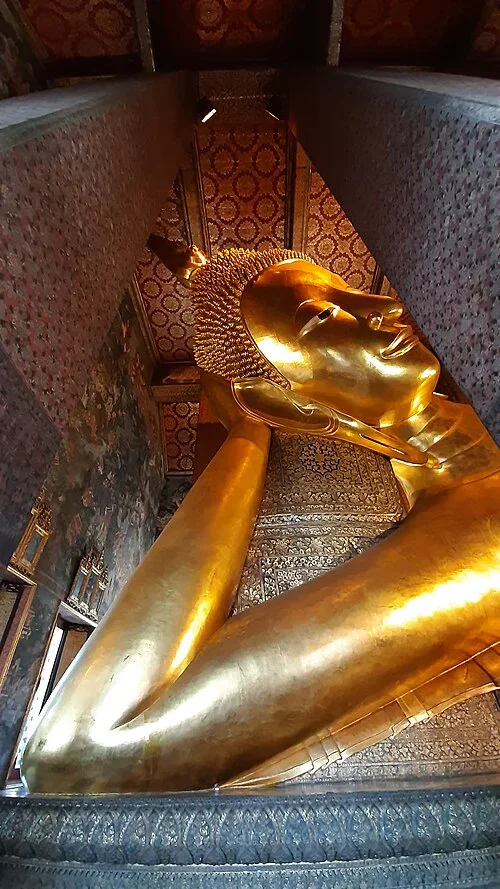 Chapel of the Reclining Buddha
The Reclining Buddha (Phra Buddhasaiyas)
Behind the walls of the northern compound lies the temple's most famous image, a gilded Buddha lying on his side. The figure stretches forty-six metres from end to end. At its highest it stands fifteen metres tall, which makes it one of the largest Buddha statues in Thailand. King Rama III had it built in 1832, in a hall modelled on the Ayutthaya style. The posture has a name, sihasaiyas, the pose of a reclining lion, and it represents the Buddha entering nirvana, the end of all reincarnations. The figure is not solid gold. A brick core was shaped with plaster and then gilded, and the head rests on two box-pillows encrusted with glass mosaics, the tight curls catching the light. Though it is not a pilgrimage destination, the image remains an object of popular piety. Each year around Songkran, the Thai new year in April, a celebration is held for it, which also raises funds for the temple's upkeep.
Listen in the appBoonlert Aroonpiboon · CC0
04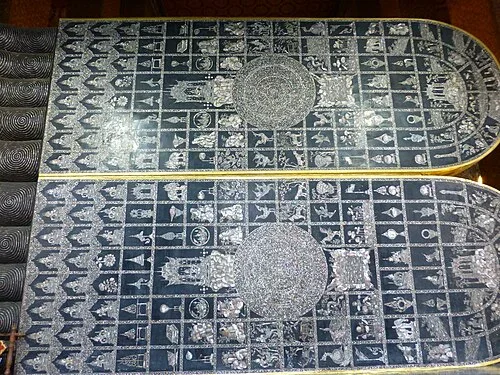 Chapel of the Reclining Buddha
Mother-of-Pearl Inlaid Feet
The soles of the Reclining Buddha's feet carry their own artwork. Each foot measures about three metres high and four and a half long, and both are inlaid with mother-of-pearl. The soles are divided into 108 arranged panels, each holding one of the auspicious symbols by which the Buddha can be identified. Flowers, dancers, white elephants, tigers, altar accessories, the panels read like a catalogue of sacred signs. At the centre of each foot sits a circle marking a chakra, an energy point. This is detail meant for slow looking, because no single glance can hold 108 panels at once.
Listen in the appPhoto Dharma from Sadao, Thailand · CC BY 2.0
05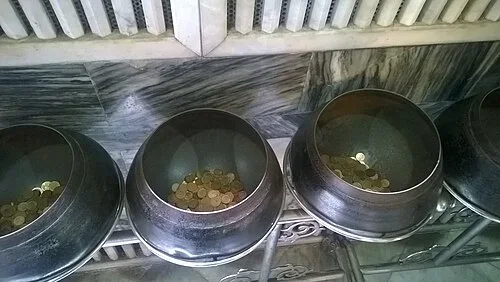 Chapel of the Reclining Buddha
Corridor of the 108 Bronze Bowls
Along the corridor behind the great image stand 108 bronze bowls, one for each auspicious character of the Buddha. Dropping a coin into the bowls is believed to bring good fortune. The coins do practical work too, helping the monks maintain the wat. It is a quiet, living ritual, merit-making with small change, running the whole length behind the Buddha's back.
Listen in the appPhoto: Ovedc · CC BY-SA 4.0
06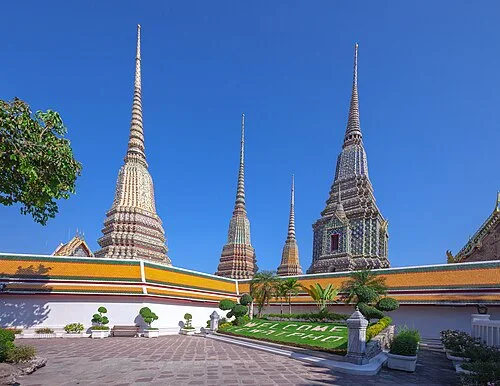 The Four Great Royal Stupas (Phra Maha Chedi Si Ratchakan)
The Four Great Stupas (Phra Maha Chedi Si Ratchakan)
Four great stupas rise from this courtyard, each forty-two metres tall, dedicated to the first four kings of the Chakri dynasty. The story of the green one begins in Ayutthaya, before that city fell to the Burmese in 1767. Its great bronze standing Buddha, Phra Phuttha Sanphet, was said to have been scorched by Burmese troops to strip off nearly two tons of gold covering. When the hall sheltering it collapsed, the image broke apart. King Rama I brought the fragments to Wat Pho, and rather than remelt the sacred metal, he encased the remnants inside a chedi faced with green mosaic tiles. Rama III later added two more, white for his father Rama II and yellow for himself. Rama IV built the fourth in blue, then enclosed the whole group so that no successor could add a fifth.
Listen in the appThis Photo was taken by Supanut Arunoprayote. Feel free to use any of my images, but please mention me as the author and may send me a message. (สามารถใช้ภาพได้อิสระ แต่กรุณาใส่เครดิตผู้ถ่ายและอาจส่งข้อความบอกกล่าวด้วย) Please do not upload an updated image here without consultation with the Author. The author would like to make corrections only at his own source. This ensures that the changes are preserved.Please if you think that any changes should be required, please inform the author.Otherwise you can upload a new image with a new name. Please use one of the templates derivative or extract. · CC BY 4.0
07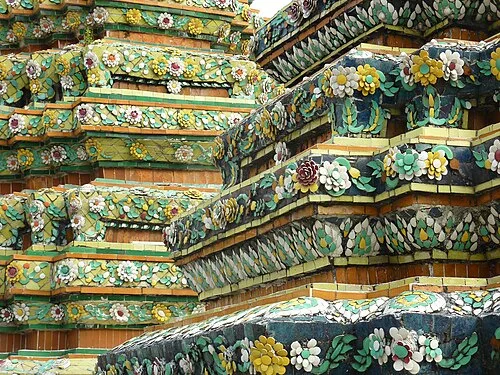 The Four Great Royal Stupas (Phra Maha Chedi Si Ratchakan)
Chedi Mosaic Detail
The chedi tiers up close are all flowers, blossoms and leaves in ceramic mosaic, packed edge to edge in green, white, yellow and blue. That richness belongs to the reign of Rama III, who began renovating and enlarging Wat Pho in 1832. The work took sixteen years and seven months. The complex grew to fifty-six rai, and most of the structures here today were built or rebuilt under him, including the chapel that holds the Reclining Buddha.
Listen in the appPhoto Dharma from Sadao, Thailand · CC BY 2.0
08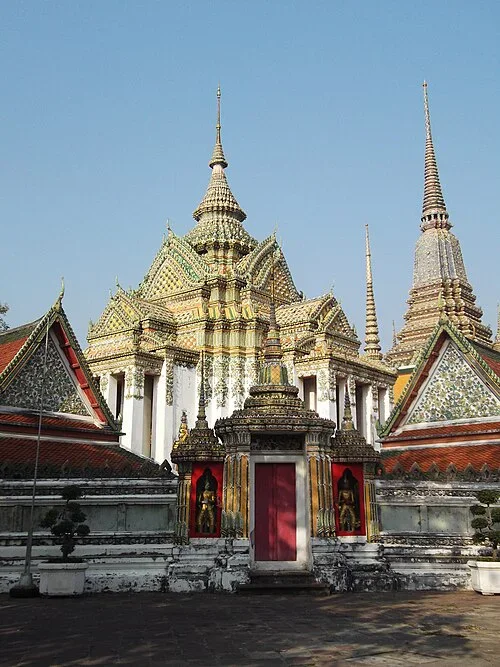 Phra Mondop Scripture Library
Phra Mondop, the Scripture Library
Phra Mondop is the temple's library, built by Rama III to hold the Buddhist scriptures. The texts are inscribed on palm leaves, and palm leaves need a controlled environment to survive. That is why the doors stay shut; the distance between visitor and manuscript is what keeps the collection safe. In niches beside the gates stand the figures known as Yak Wat Pho, the temple's giants. Around the library run three pavilions, their murals painting the beginning of the Ramayana.
Listen in the appPhoto: กสิณธร ราชโอรส · CC BY-SA 3.0
09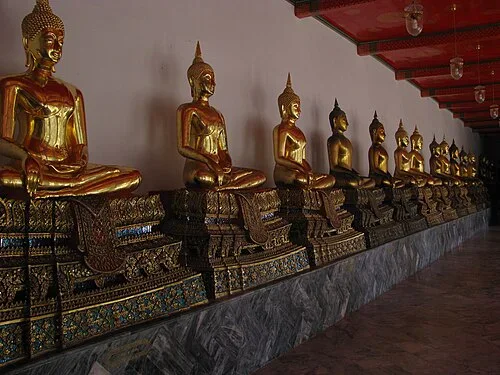 Phra Rabiang Double Cloisters
The Double Cloister (Phra Rabiang)
The double cloister around the ordination hall courtyard holds row upon row of gilded Buddhas, seated and standing on matching pedestals. King Rama I gathered them from abandoned temples at Ayutthaya, Sukhothai and other old sites, some twelve hundred images in all. About four hundred were chosen for the cloister. A hundred and fifty stand on the inner side of the double gallery. Another two hundred and forty-four line the outer. They come from different eras of Siamese history, Chiangsaen, Sukhothai, U-Thong and Ayutthaya among them. But Rama I had them renovated with stucco and gold leaf until they all looked alike, a deliberate uniformity imposed across centuries of styles.
Listen in the appPhoto: Aimaimyi · CC BY-SA 3.0
10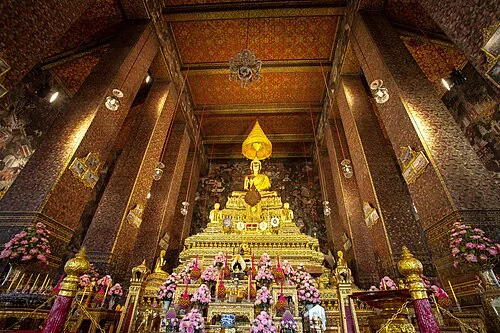 Phra Ubosot Ordination Hall and Ramakien Reliefs
Phra Ubosot: The Ordination Hall
The ordination hall is the most sacred building in the complex. Rama I built it in the Ayutthaya style and dedicated it in 1791, before the temple's rebuilding was even finished. Rama III later enlarged it in the newer Rattanakosin style. Inside stands the principal image, Phra Buddha Theva Patimakorn, thought to date from the Ayutthaya period. Rama I moved it here from Wat Sala Si Na in Thonburi. It sits gilded on a three-tiered pedestal, beneath a nine-tiered umbrella that stands for royal authority. Rama IV later placed some ashes of Rama I beneath the pedestal itself, so that worshippers honour the Buddha and the dynasty's founder in a single act. Ten images of the Buddha's disciples flank the hall, Moggalana on the left and Sariputta on the right. One scholar, Chatri Prakitnonthakan, has argued that the whole cloistered plan reproduces the Enlightenment Throne at the centre of the Buddhist cosmos, though that reading remains one interpretation among several.
Listen in the appPhoto: Supanut Arunoprayote · CC BY 4.0
- 11
Ramakien Marble Bas-Reliefs
152 marble panels of the Ramakien epic, carved in 1831 and ending mid-story.
- 12
Hermit Statues and the Rock Garden
Hermit figures in stretching postures, part of an open-air textbook that made Wat Pho Thailand's first university.
- 13
The Body Diagrams: Massage Inscriptions and Living Legacy
Painted body maps and massage plaques, inscribed by the court of Rama III and honoured by UNESCO.
Wat Pho
Frequently asked questions
How much does the guide cost?
Free app download. Listed guide price: $0.99. Guide price shown in the app. Audio guide only. Venue admission is separate.
Can I listen without internet?
Yes. Download the guide’s audio, images, and maps in the app before your visit. Your downloaded content is then available offline.
Can I listen in my language?
This audio guide is available in 15 languages, including English.
Do I need to follow a schedule?
No. This is a self-guided experience. Choose your stops, pause whenever you like, and return to a story at your own pace.
At your own pace
Explore Wat Pho.
Download Stanza, then search for “Wat Pho”.
Free app download · Guide price shown in the app
Keep exploring
Nearby audio guides
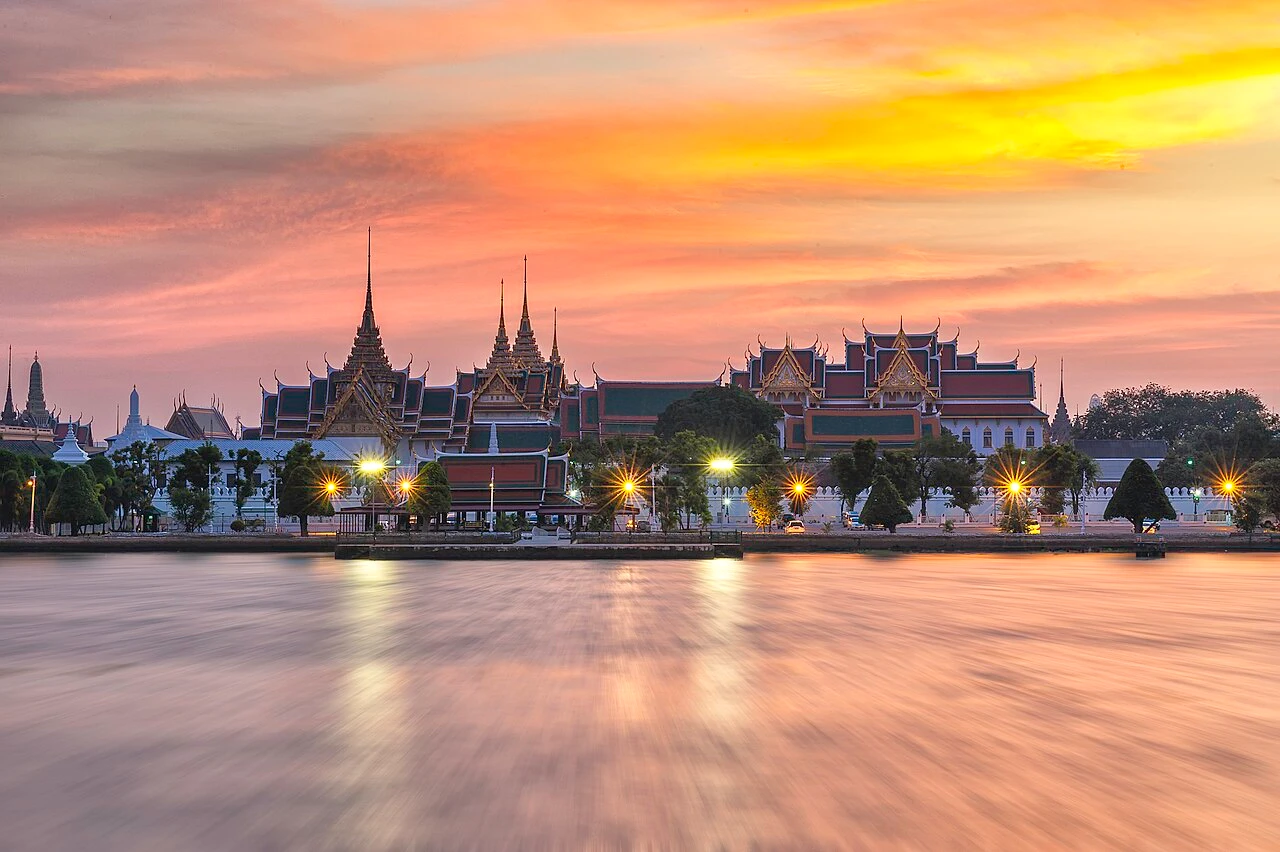
Bangkok · 1 km
Grand Palace
Content & sources
Photo: Preecha.MJ · CC BY-SA 4.0
Bangkok · 1 km
Wat Phra Kaew
Content & sources
Photo: Basile Morin · CC BY-SA 4.0
Bangkok · 1 km
Wat Arun
Content & sources
Photo: Mastertongapollo · CC BY-SA 4.0
Bangkok · 3 km
Wat Benchamabophit
Content & sources
The original uploader was NamKhaeng at French Wikipedia. · CC BY-SA 3.0