Stanza · Audio guide
Aizanoi Audio Guide
A place to remember. A story to take with you.
Aizanoi was an Ancient Greek city located in western Anatolia. It served as an important political and economic centre in Roman times and features a well-preserved Temple of Zeus.
Download Stanza, then search for “Aizanoi”.
About the tour
One guide. Your kind of visit.
Aizanoi was an Ancient Greek city located in western Anatolia. It served as an important political and economic centre in Roman times and features a well-preserved Temple of Zeus.
Ready when you are.
- 01Get the free Stanza app.
iOS & Android
- 02Find your guide.
“Aizanoi”
- 03Download before you go.
Works offline
Audio guide / 23 narrated stops
Inside the guide
Get to know a few of the stories before you go. Open a stop to read more.
01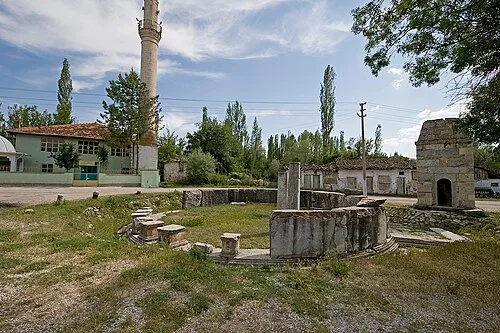 Aizanoi Macellum
The Macellum and the Price Edict
An emperor's economic policy, carved into the stone of a provincial market. In 301 the emperor Diocletian issued his Price Edict, an attempt to halt runaway inflation. The trouble began with the money itself. Emperors kept debasing the coinage, mixing in less and less precious metal, and prices climbed year after year. Diocletian's answer was to fix maximum prices for the whole empire at once. Copies of the edict were set up in Latin and Greek wherever people traded. Here at Aizanoi a copy of the edict went onto the walls of the round market building, in the fourth century. Aizanoi was an important economic centre in Roman times. The stone still carries that attempt to command prices, in a town on the far edge of Phrygia.
Photo: Dosseman · CC BY-SA 4.0
02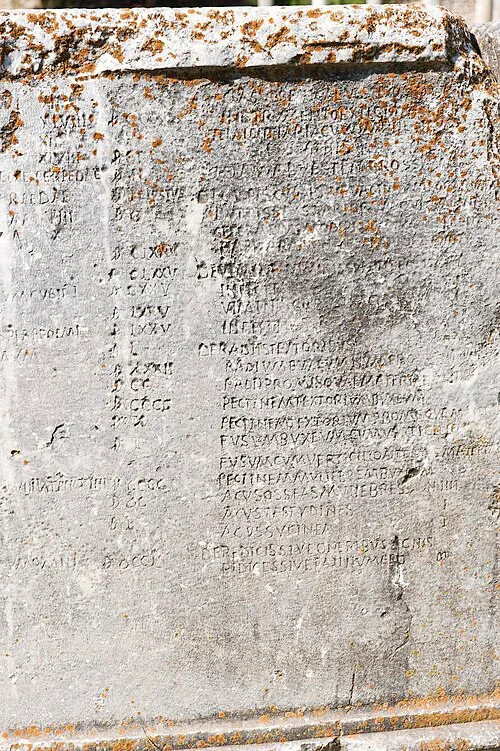 Aizanoi Macellum
The Carved Price List
The carved Latin columns on these blocks are a price list for everyday life. The edict set a ceiling: the highest price any seller could charge. Food had its maximum, goods had theirs, and labor had a lawful rate as well. The idea was that a buyer and a seller could both know the top price in advance, in the market and in the workshop. A seller who asked more was breaking the emperor's law. The list runs commodity after commodity, carved in tall columns down the stone. Enough of it survives here to read.
Photo: Dosseman · CC BY-SA 4.0
03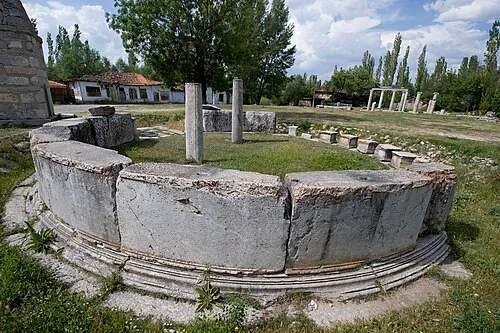 Aizanoi Macellum
The Circular Market Building
The ring of low walls and scattered column stumps is a macellum, a Roman market building, probably for selling food. It dates to the second half of the second century, well before the imperial price edict that later covered its walls. A macellum of this type was purpose-built for trade, a proper market hall rather than open stalls. This one is circular, which makes it easy to pick out among Aizanoi's ruins. The building only came to light in recent memory. A mosque stood on top of it, and after the 1970 Gediz earthquake the mosque was taken down, uncovering the ancient walls beneath.
Listen in the appPhoto: Dosseman · CC BY-SA 4.0
04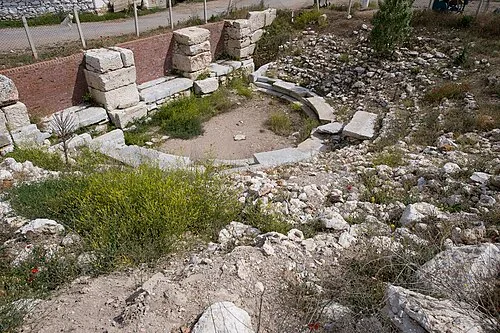 Aizanoi Bouleuterion
The Bouleuterion
A Roman provincial town ran much of its own daily business, and this small covered building is where Aizanoi's did it. The city council met here. Its members were the town's leading citizens, and they took the decisions a city like this needed: decrees, spending, honors for benefactors. The building had a second life as well. With its rows of seats it served as an odeon, a hall for recitals and performances. That is why scholars use both names for it, bouleuterion and odeon, and the two labels are still argued over. Either way it was the intimate civic room, quite distinct from the big open-air theater elsewhere on the site.
Listen in the appPhoto: Dosseman · CC BY-SA 4.0
05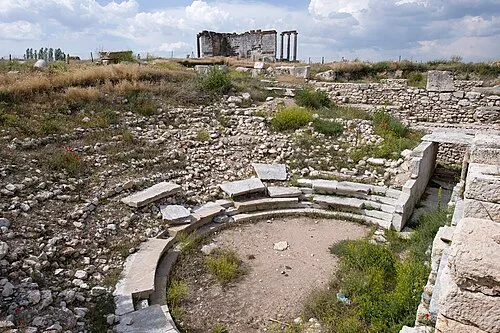 Aizanoi Bouleuterion
The City's Name and Horizon
From this spot the ruins line up plainly: the seating of the small civic hall in the foreground, and the Temple of Zeus on its hill beyond. The city's name carries a legend of its own. The story goes that Aizanoi takes its name from Azan, one of the three sons of Arcas and the nymph Erato. Those sons were counted as the legendary ancestors of the Phrygians, the people of this region. That makes the name a claim of deep local roots, told as legend rather than history. The temple hill, the market building and the theater-stadium together mark out a city that once filled this valley.
Listen in the appPhoto: Dosseman · CC BY-SA 4.0
06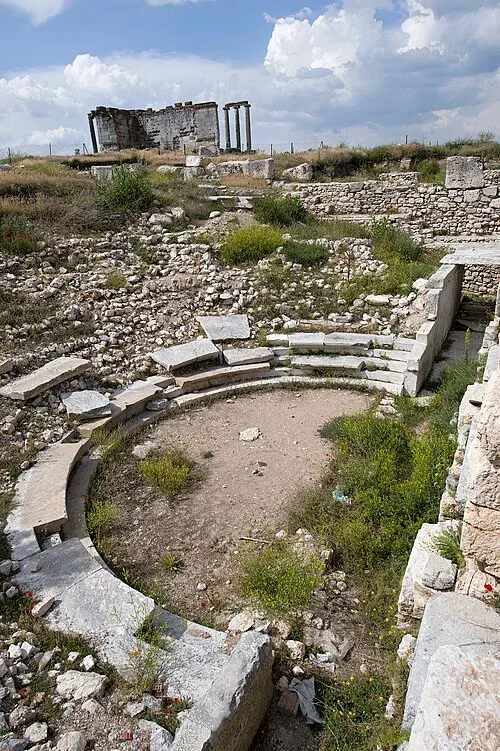 Aizanoi Bouleuterion
The Orchestra in Ruin
The curved row of seats is what remains of the hall's seating, ringing the open floor called the orchestra. Grass and rubble have taken over much of it, but the shape of the room is still easy to trace. Work on the building has not stopped. In the 2017 season archaeologists dug trial pits here, a sounding known as a sondage, as preparation for restoring the odeon and bouleuterion. That kind of careful digging comes before any rebuilding, so that the structure's condition is understood first. The Temple of Zeus still watches from its hill in the distance.
Listen in the appPhoto: Dosseman · CC BY-SA 4.0
07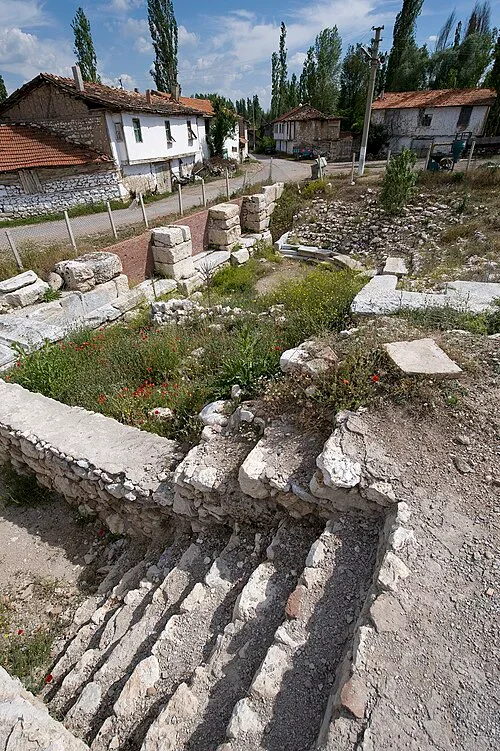 Aizanoi Bouleuterion
The Village and the Rediscovery
The red-tiled houses beyond the ruins belong to Çavdarhisar, a village that lives side by side with the ancient city it grew from. The ruins were noted by European travellers in 1824, and the site entered written history from there. Survey work followed in the 1830s and 1840s, as scholars measured and drew what stood above ground. Systematic excavation began in 1926, conducted by the German Archaeological Institute. It was resumed in 1970 and continues today. In 2012 the site was submitted for the UNESCO World Heritage List. So the digging has run, with a long interruption, for a century, and the village has watched it all from next door.
Listen in the appPhoto: Dosseman · CC BY-SA 4.0
08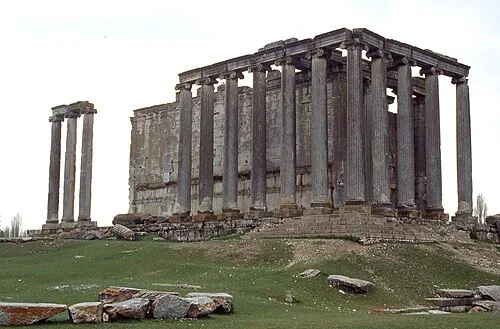 Temple of Zeus
 - Aizanoi Opening View
Aizanoi was an Ancient Greek city in western Anatolia, in the region of Phrygia, straddling both banks of the Penkalas river. People had lived in this area since the Bronze Age. In Hellenistic times the city changed hands between the kingdoms of Pergamum and Bithynia, and in 133 BC Pergamum bequeathed it to Rome. Aizanoi kept minting its own coins, a sign of its standing. Under Roman rule it grew into an important political and economic centre. Its great monuments all date from the early Empire to the third century: this Temple of Zeus, the combined theater and stadium, and the round market building inscribed with Diocletian's price edict.
Listen in the appMark Landon · CC BY 4.0
09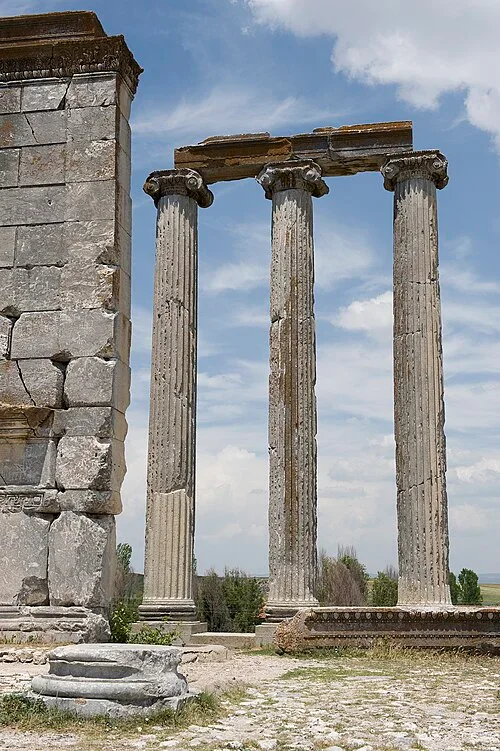 Temple of Zeus
Ionic Colonnade of the Zeus Temple
The temple is Ionic, and its plan is called pseudodipteral: a single ring of columns stands a full bay clear of the inner wall, leaving a covered passage all the way round. There are eight columns at each end and fifteen along the sides. The whole building measures about 35 by 53 metres. A recent reading of the inscription on the eastern architrave dates the temple's dedication to the reign of Domitian, in either AD 92 or AD 94 to 95. It rises on a mound whose oldest settlement goes back to 3000 BC. The temple was damaged in the 1970 Gediz earthquake and has since been restored.
Listen in the appPhoto: Dosseman · CC BY-SA 4.0
10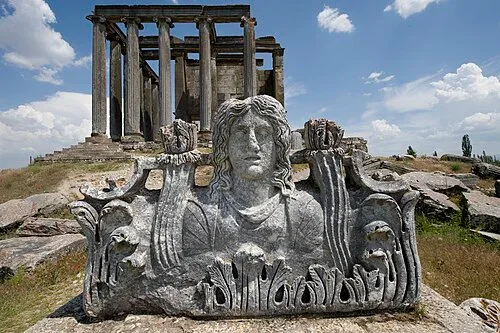 Temple of Zeus
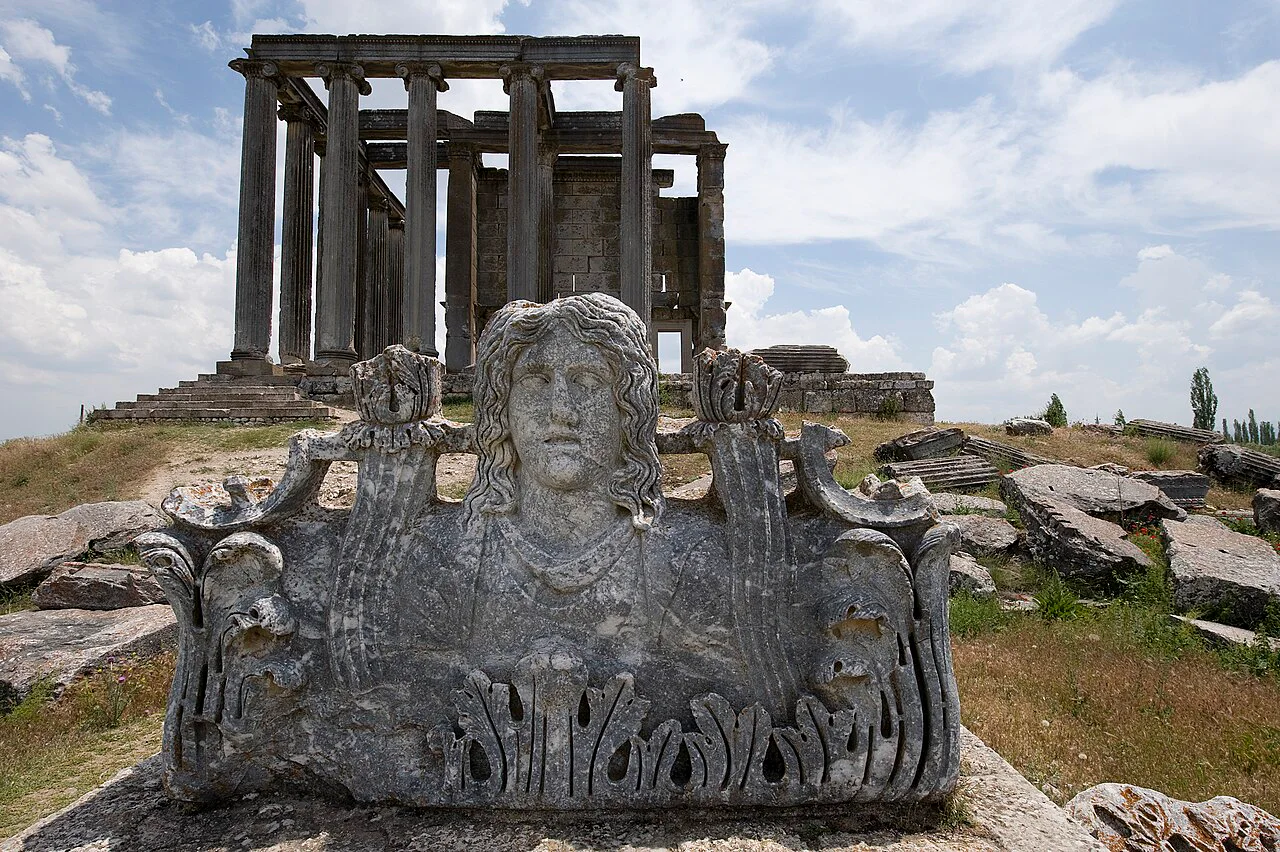
West Acroterion and the Benefactors
This sculpted figure is an acroterion, an ornament that once crowned the roofline of the temple, with the colonnade rising behind it. Inscriptions from the sanctuary record the people who paid for all this. One is the emperor Hadrian, who gave imperial assistance in recovering unpaid rents owed to the temple, money the sanctuary apparently struggled to collect itself. The other is Marcus Apuleius Eurykles, a local magnate whose generosity, what the Greeks called euergetism, funded the city's monuments. The same benefactor is named again at the theater-stadium complex across the site. A city's marble usually had a patron, and here the patrons left their names in stone.
Listen in the appPhoto: Dosseman · CC BY-SA 4.0
- 11
The Vaulted Chamber Beneath the Cella
The vaulted chamber under the temple, and the strong case that it served the Mother Goddess Cybele.
- 12
Inside the Vault - Open Questions
How the underground chamber is built, and why scholars still disagree about what it was for.
- 13
Carved Relief on the Temple Walls
How a Roman temple became a Turkish castle, and why the town is still named after the warriors who held it.
- 14
Penkalas Bridge
Why a city split by a river needed stone bridges, and how the arches of this Roman crossing still do their work.
- 15
Penkalas Bridge from the Bank
A jug buried by the riverbank held 651 Roman coins, some bearing the faces of Caesar, Brutus and Mark Antony.
- 16
Northeast Roman Baths
Mosaics of a satyr and maenad, and the strange journey of a bath house that ended as a Christian bishop's seat.
- 17
Carved Relief at the Northeast Baths
A framed relief from the bath walls, with a spread-winged bird and carved objects no one has fully explained.
- 18
Second-Century Roman Baths
The city's first bath complex: an exercise yard, marble rooms, and the Roman routine of heat, water and gossip.
- 19
Vaulted Substructure of the Baths
The sturdy arches beneath the baths, and the Roman trick of carrying a building on vaults of stone and brick.
- 20
The Roman Stadium Track
Standing on the track of a Roman stadium built for athletics and crowds in their many thousands.
- 21
Stadium West Entrance
The stadium's vaulted entrance, and the quiet centuries after Aizanoi slipped into decline.
- 22
The Roman Theater
How a Roman theater worked: masked voices, a flat orchestra, and seats rising in a great sweep above the stage.
- 23
Theater Seen from the Stadium
The theater and stadium built back to back, an arrangement said to be unique in the ancient world.
Aizanoi
Frequently asked questions
How much does the guide cost?
Free app download. Listed guide price: $2.99. Guide price shown in the app. Audio guide only. Venue admission is separate.
Can I listen without internet?
Yes. Download the guide’s audio, images, and maps in the app before your visit. Your downloaded content is then available offline.
Can I listen in my language?
This audio guide is available in 15 languages, including English.
Do I need to follow a schedule?
No. This is a self-guided experience. Choose your stops, pause whenever you like, and return to a story at your own pace.
At your own pace
Explore Aizanoi.
Download Stanza, then search for “Aizanoi”.
Free app download · Guide price shown in the app
Keep exploring
Audio guides — Turkey
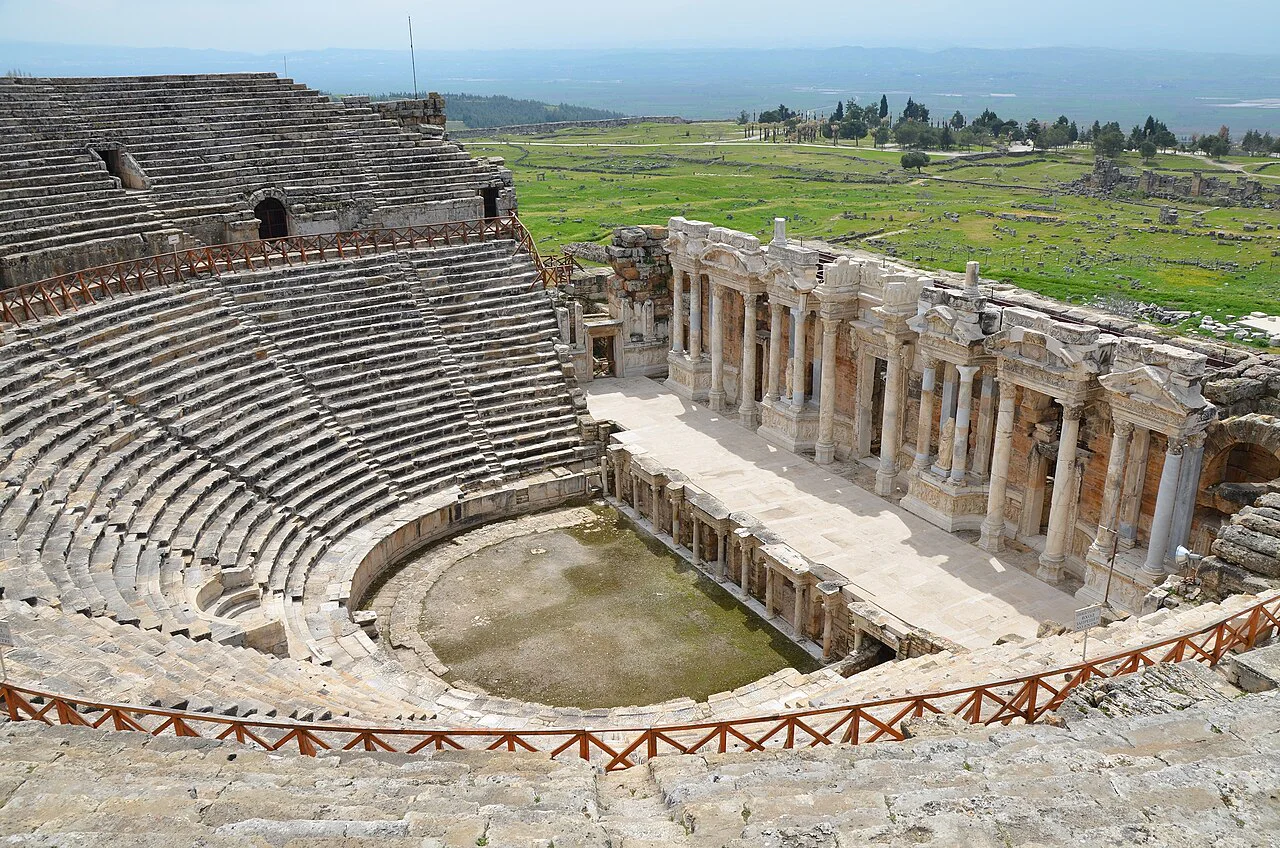
Pamukkale district · 148 km
Hierapolis
Content & sources
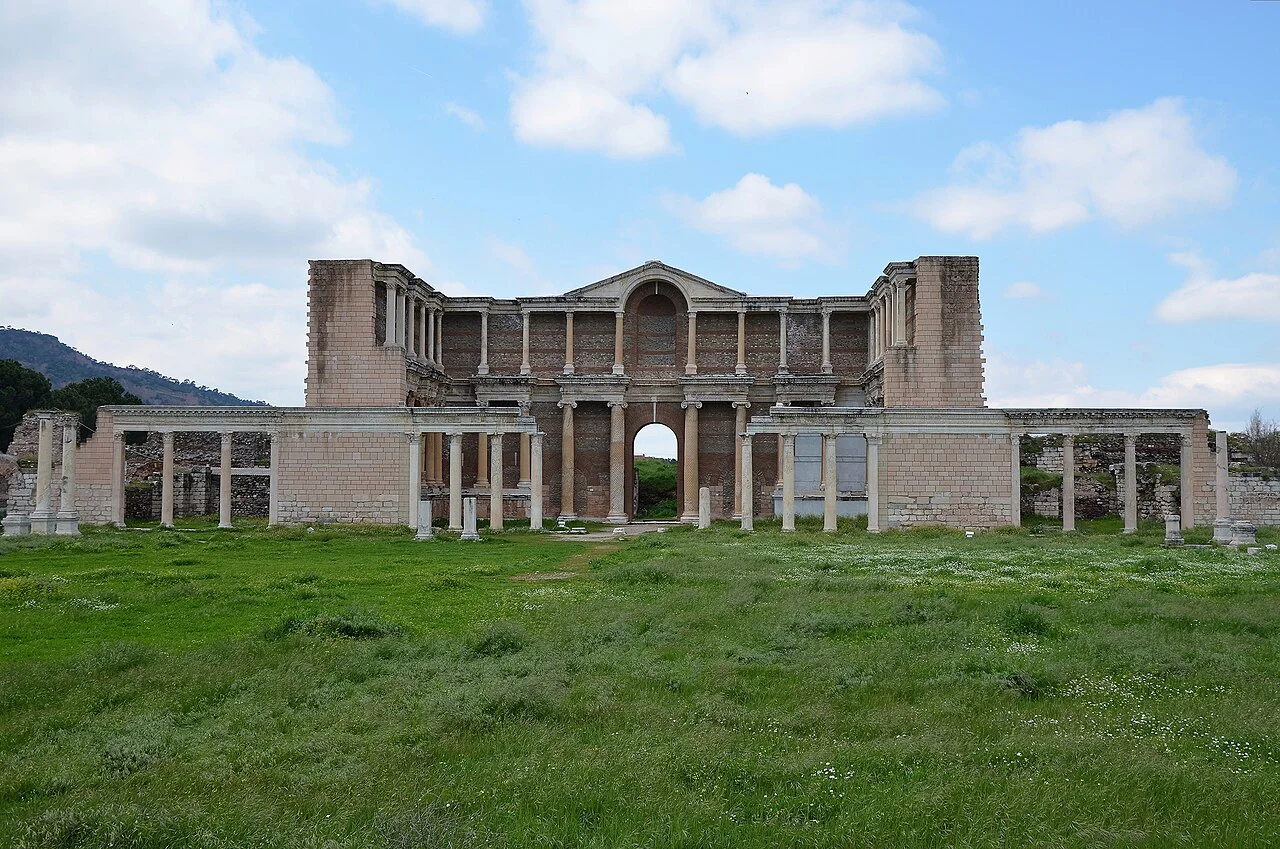
Carole Raddato · CC BY-SA 2.0
Salihli
Sardis
Content & sources
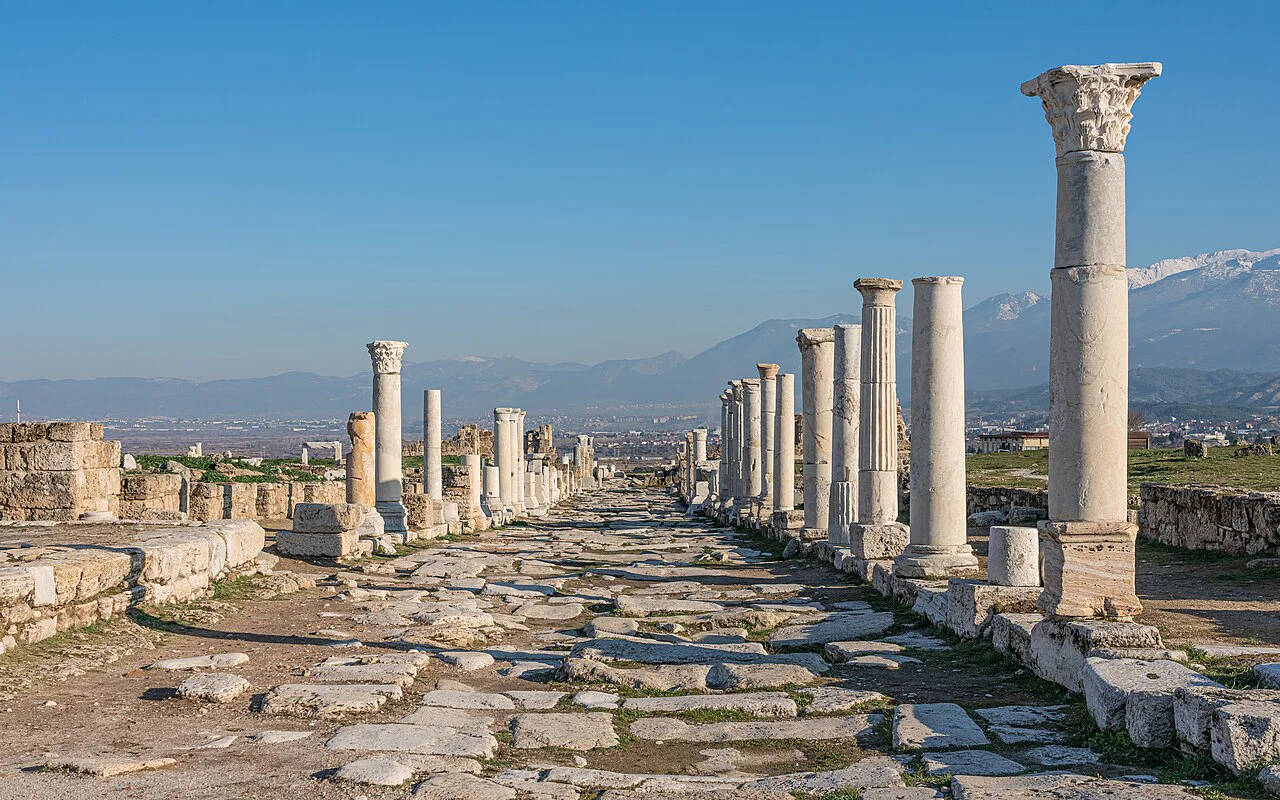
Carole Raddato from FRANKFURT, Germany · CC BY-SA 2.0
Merkezefendi
Laodikya
Content & sources
Photo: A.Savin · FAL
Yalvaç
Antioheia
Content & sources
Maderibeyza at Turkish Wikipedia · CC BY-SA 3.0