Stanza · Audio guide
Antioheia Audio Guide
A place to remember. A story to take with you.
Antioch in Pisidia was an ancient city located in the Turkish Lakes Region at the crossroads of the Mediterranean, Aegean, and Central Anatolian regions. The site is situated on a hill approximately 1 km…
Download Stanza, then search for “Antioheia”.
About the tour
One guide. Your kind of visit.
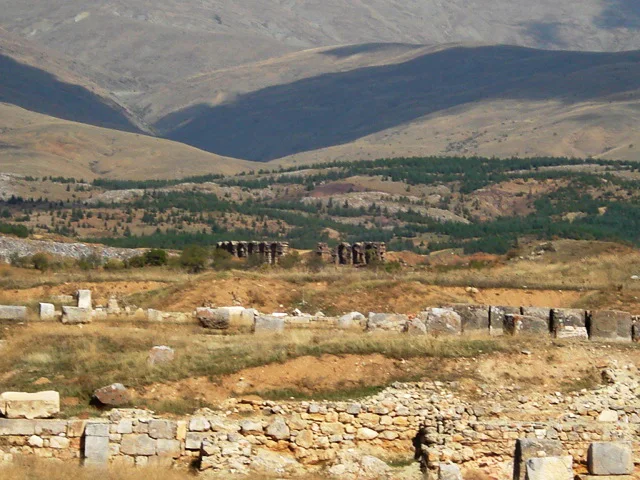
Antioch in Pisidia was an ancient city located in the Turkish Lakes Region at the crossroads of the Mediterranean, Aegean, and Central Anatolian regions. The site is situated on a hill approximately 1 km northeast of the modern town of Yalvaç.
Ready when you are.
- 01Get the free Stanza app.
iOS & Android
- 02Find your guide.
“Antioheia”
- 03Download before you go.
Works offline
Audio guide / 22 narrated stops
Inside the guide
Get to know a few of the stories before you go. Open a stop to read more.
01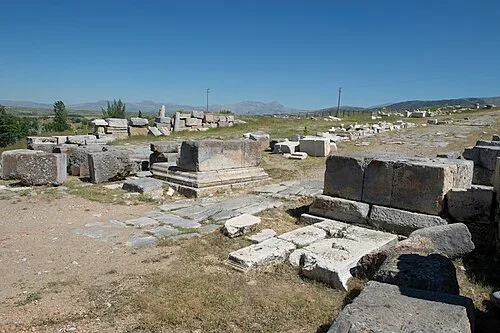 The Western Gate
Antioch in Pisidia Western Gate
Several ancient roads met at this western entrance, which most likely made it the main way into the city. Pisidian Antioch stood on a hill about a kilometre northeast of the modern town of Yalvaç, its highest point more than twelve hundred metres up. Under the emperor Augustus the city was refounded as a home for retired legionaries from Italy. They were settled here to pacify the rugged highlands. Of the colonies established in Pisidia, only Antioch was honoured with the title Caesarea, and given the Ius Italicum, the legal standing of an Italian town. Perhaps that was because of its strategic position. The city rose to be the capital of the region under the name Colonia Caesarea. It was divided into seven districts, each founded on one of seven hills, deliberately echoing the seven hills of Rome. Peace and fertile land helped the veterans and the local people live and work together. The monumental gate itself came to light in 1924, when a team from the University of Michigan dug here with over two hundred local workmen.
Photo: Dosseman · CC BY-SA 4.0
02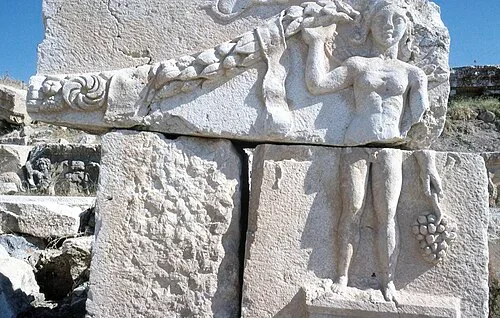 The Western Gate
Western Gate Relief Fragment
A carved woman holds up a garland, with grapes and vines beside her, ornamental work whose exact meaning is now lost. Her stones carry the story back to the time before Rome. The most reasonable view is that Antioch was founded by Antiochus the First as a military base, on the border between Pisidia and Phrygia, to control Galatian attacks. That would place the founding in the first half of the third century BC. Finds at the Sanctuary of Men Askaenos reach back to the fourth century BC, so earlier cultures were already living here. The founding legend is a good one. In 270 BC Antiochus fought the Galatians in the passes of the Taurus Mountains, and defeated them with the help of war elephants, animals the Galatians had never seen before. The writer Lucian recorded the king's dry comment: 'It's a great shame that we owe our liberation to 16 elephants.' When he returned home in triumph, Antiochus took the title Soter, which means Saviour.
Photo: Dosseman · CC BY-SA 4.0
03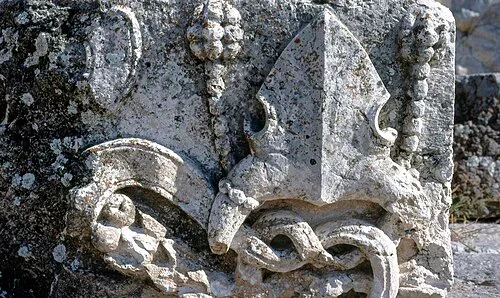 The Western Gate
Western Gate Carved Fragment
Weapons and trophy shapes are carved into this stone, and they suit the building they came from. The Western Gate was a victory arch with three vaults, a form shared by roughly forty percent of the monumental gates of Anatolia. In its structure and ornament it followed the Propylon, the older ceremonial entrance to the Imperial Sanctuary higher up the hill. The gate also faced a road with a military job. Antioch stood at the centre of the Via Sebaste, begun by the governor of Galatia, Cornutus Arrutius Aquila. The road split in two, running southwest and southeast to encircle the Homonadesians, a mountain people who resisted Roman rule. Secondary roads linked the two branches. Publius Sulpicius Quirinius brought their resistance to an end in 3 BC, and the survivors were resettled in the surrounding country. Latin stayed the city's formal language until the end of the third century.
Listen in the appPhoto: Dosseman · CC BY-SA 4.0
04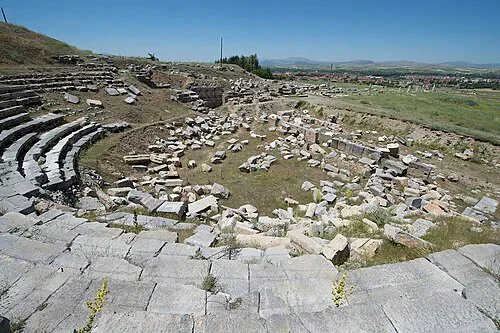 The Ancient Theater
Antiochia Theater
Curving rows of broken seats wrap around a hollow in the hill. This is the theater of Antioch, built in the Greek manner, semicircular and set into the slope beside the city's main street, and later adapted by the Romans. In cities across the Roman world, the theater served as a gathering place for the whole civic community, a space the entire city shared. When this one was first built is not settled. Its original architecture may date to the founding of the colony, or it may go back to the Hellenistic age, and further excavation is needed to decide. Much of the building has disappeared. The blocks of the auditorium, the dividing corridor, the climbing steps and the orchestra were all carried away for later construction in Antioch and in Yalvaç. The traveller Arundell, who identified the theater in 1833, already remarked on how many blocks had gone.
Listen in the appPhoto: Dosseman · CC BY-SA 4.0
05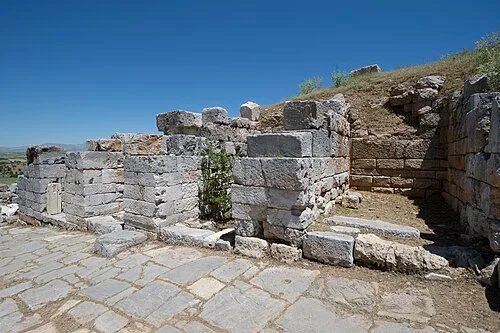 The Ancient Theater
Street Along the Theater
The stone-paved street runs along the foot of the theater, and it holds a piece of quiet engineering. In the years AD 311 to 313 the theater was enlarged, with new building rising above the Decumanus Maximus, the city's main east-west street. To keep the road open, it was taken through a tunnel five metres wide and fifty-five metres long. An inscription at the entrance to the tunnel dates the work. It is worth pausing on what that means. In the early fourth century, this city was still spending heavily on spectacle, and rebuilding its principal street to match. Evidence from the late fourth century, like a new agora and stronger fortifications, shows Antioch entering one of the most brilliant eras of its long life.
Listen in the appPhoto: Dosseman · CC BY-SA 4.0
06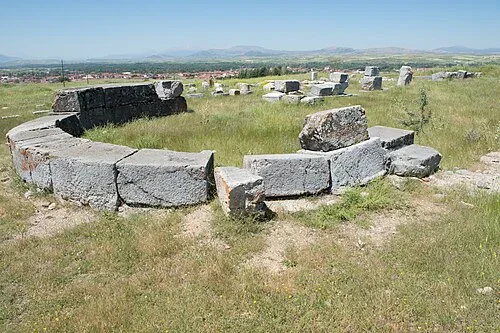 Byzantine Central Church
Low walls and a curved foundation mark a church at the very centre of the ruins. By the end of the third century Antioch had become the metropolis, the capital city, of the province of Pisidia. It kept that rank through the whole Byzantine period. As a metropolitan see it stood at the head of a wide network of dependent bishoprics across the region. This church was built on a central plan, and it stands in the city's religious core, evidence of how the sacred heart of Antioch stayed in continuous use. Exactly when it was built is not known. The building was excavated in 1924 and studied again later, and the unsystematic digging of early campaigns is why even its full plan is hard to make out.
Listen in the appPhoto: Dosseman · CC BY-SA 4.0
07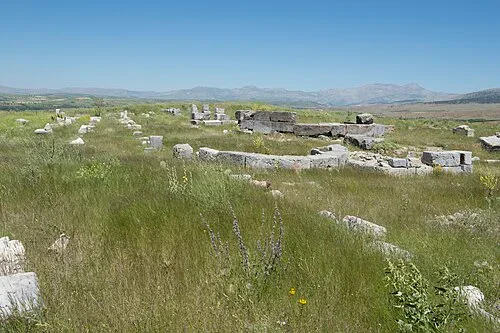 Byzantine Central Church
Central Church, View over the Ruins
Grass grows through these low foundations, and the view opens over the whole quiet hill. The end of ancient Antioch came slowly, then suddenly. From the eighth century, Arab raids on Anatolian cities increased, and many places began to be abandoned. The fiercest attack of all against Antioch was carried out in 713 by the Umayyad prince al-Abbas ibn al-Walid, son of the Caliph al-Walid the First. Antioch never recovered, and centuries of glory vanished. The city's history can still be traced until the thirteenth century, after which the hill was left empty. Life did not end in the region. It simply moved down to the plain, where the town of Yalvaç stands today.
Listen in the appPhoto: Dosseman · CC BY-SA 4.0
08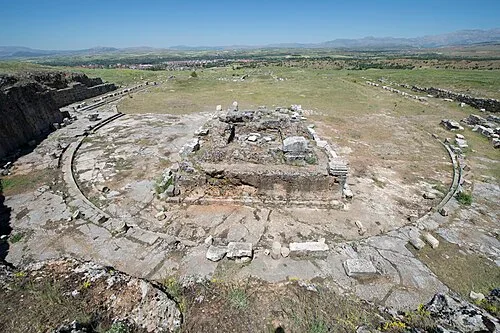 Imperial Temple of Augustus
Temple of Augustus in Antioch in Pisidia
This sanctuary was cut straight out of the mountain. The builders sliced away the mound to form a great semicircular area, about a hundred by eighty-five metres, and ringed it with a portico on two floors. In the middle they left a huge block of rock standing, fourteen by twenty-eight metres and two and a half metres high. That block became the podium of the temple, and its interior was carved out to form the cult room, the naos. Reconstruction studies suggest about 150 columns held up the whole complex. The lower order was Doric, without bases, and the upper floor used fine Ionic columns. One-storey stoas with Doric columns ran along the north and south sides. Current thinking is that construction began while Augustus was still alive, and that the temple was dedicated to him after his death. Traces on the rock hint the spot may have served another cult before, though what that cult was nobody knows.
Listen in the appPhoto: Dosseman · CC BY-SA 4.0
09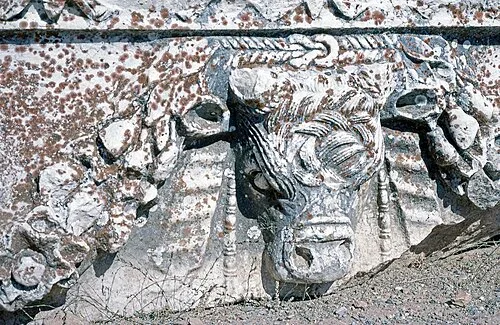 Imperial Temple of Augustus
Augusteum Frieze Fragment
A carved garland hangs across this block, tied above the head of a bull. The pairing of garlands and bull's heads, called bucrania, was a classic frieze device of the Augustan age, and it ran along the architrave of the temple here. It was this ornamental and architectural richness that gave the sanctuary its stunning first effect on visitors. Callander, a member of the team that first dug the Augusteum in 1913, wrote about their work here with real emotion. Where exactly this particular block sat in the building cannot be said.
Listen in the appPhoto: Dosseman · CC BY-SA 4.0
10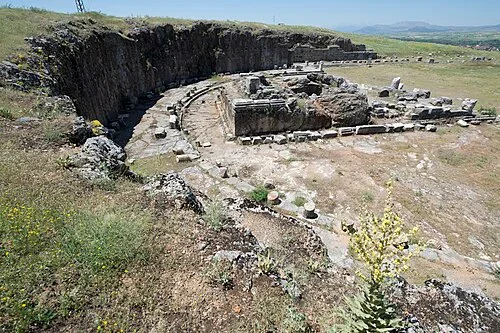 Imperial Temple of Augustus
Temple of Augustus — The Rock-Cut Sanctuary
From this height the carved semicircle of the sanctuary opens out below, at the highest point of the city. The temple honoured the imperial cult of Augustus. It also carried one of the most famous inscriptions of the Roman world. One of only three surviving copies of the Res Gestae Divi Augusti, the record of the emperor's deeds, was found in front of the Augusteum in 1914. The original was carved on bronze tablets and set up before the Mausoleum of Augustus in Rome, but it has not survived. The Antioch copy was cut into stone in Latin, a sign of the city's importance as a Roman military and cultural base in Asia. The dedication reads: 'For the emperor Caesar Augustus, son of a god, pontifex maximus, consul for the 13th time, with tribunician power for the 22nd time, imperator for the 14th time, father of the country.' That last title, Pater Patriae, had been his since the fifth of February, 2 BC.
Listen in the appPhoto: Dosseman · CC BY-SA 4.0
- 11
Antioch in Pisidia Nymphaeum
The monumental fountain that gathered mountain water and pushed it uphill to every corner of the city.
- 12
Nymphaeum — Street Pavement
The paved square by the great fountain, where 1924 excavations revealed shops that worked like little restaurants and bars.
- 13
Antioch in Pisidia Northern Church
A second basilican church, and a stadium hidden in a valley until recently.
- 14
Northern Church — Apse
The semicircular apse, the focal point of every basilican church, still readable in these ruins.
- 15
Antioch in Pisidia Roman Bath
The great vaulted complex at the city's northwest corner, most likely the public bath, and what Roman baths meant to a city.
- 16
Roman Bath — Vaulted Chamber
Inside a vaulted chamber of the bath, where a broken crown lets daylight fall straight to the floor.
- 17
Roman Bath — Stone-Vaulted Passage
A passage roofed without a single arch, and the massive drafted blocks that make the bath's stonework exceptional.
- 18
Pisidia Antiokheia Aqueduct
How Roman engineers tamed a steep mountain descent to deliver water gently to the city, for centuries.
- 19
Aqueduct on the Yalvaç Hillside
Ruined arches above the almond blossom, in the mountain-watered landscape that fed both the plain and the city.
- 20
Antioch in Pisidia Great Basilica
Paul and Barnabas in the synagogue of Antioch, the sermon that turned the Christian mission toward the Gentiles.
- 21
Great Basilica — Apse Interior
A mosaic naming Bishop Optimus, and the earlier phases hidden beneath the floor of the Great Basilica.
- 22
Great Basilica — Outer Walls
The rediscovery of Antioch: Ramsay's camp, the Michigan expedition of 1924, and the quarrel that stopped it all.
Antioheia
Frequently asked questions
How much does the guide cost?
Free app download. Listed guide price: $2.99. Guide price shown in the app. Audio guide only. Venue admission is separate.
Can I listen without internet?
Yes. Download the guide’s audio, images, and maps in the app before your visit. Your downloaded content is then available offline.
Can I listen in my language?
This audio guide is available in 15 languages, including English.
Do I need to follow a schedule?
No. This is a self-guided experience. Choose your stops, pause whenever you like, and return to a story at your own pace.
At your own pace
Explore Antioheia.
Download Stanza, then search for “Antioheia”.
Free app download · Guide price shown in the app
Keep exploring
Audio guides — Turkey
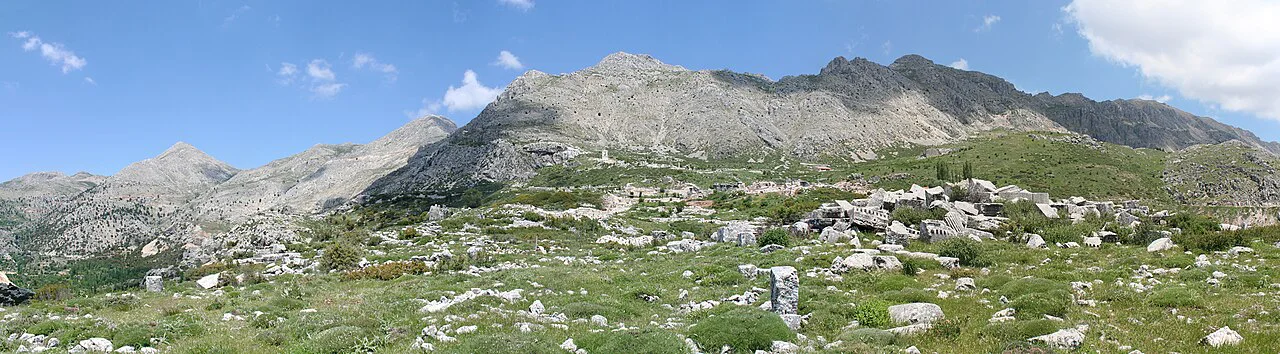
Ağlasun · 91 km
Sagalassos
Content & sources
Ingo Mehling · CC BY-SA 3.0
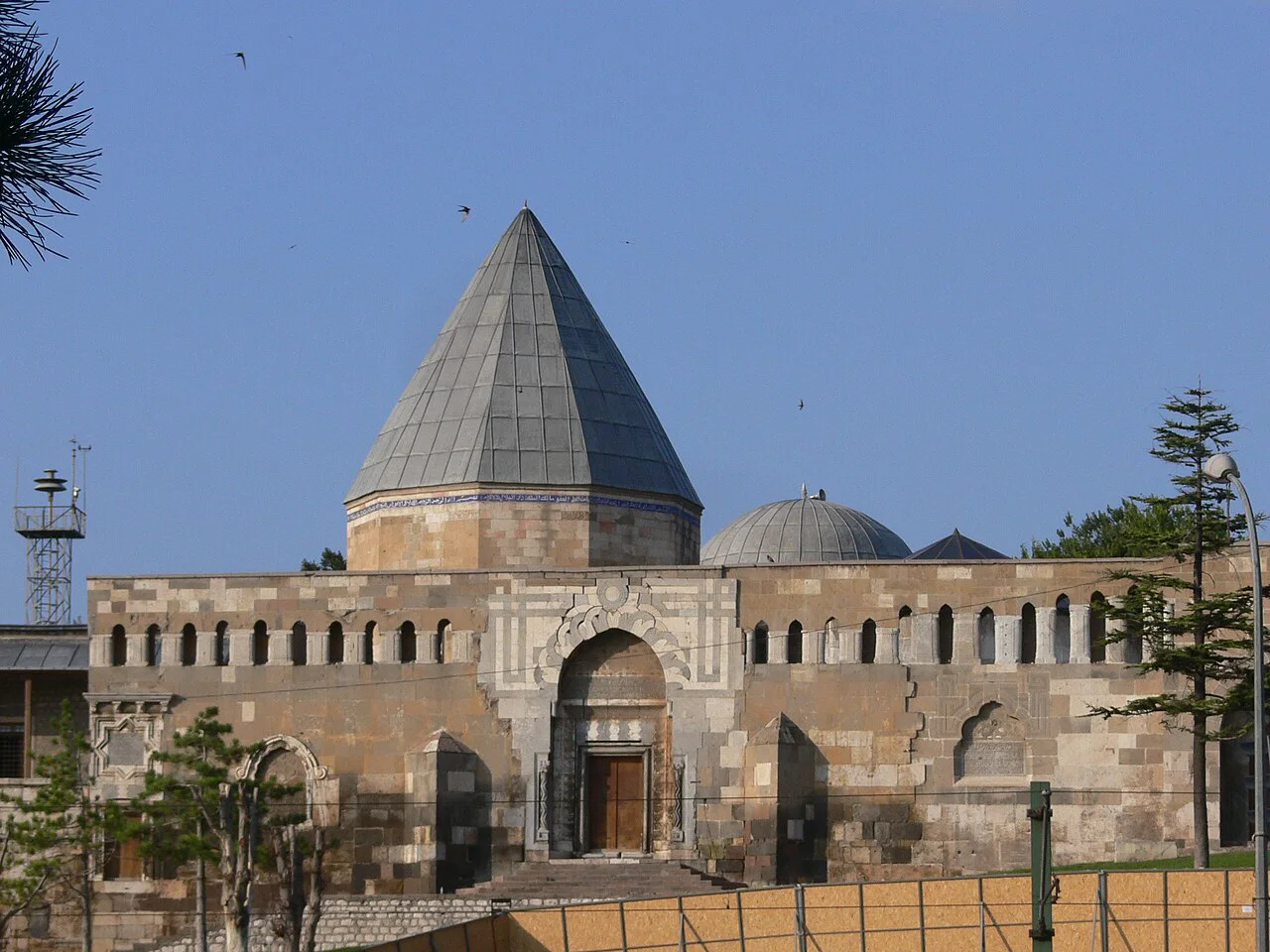
Konya · 124 km
Alâeddin Camii
Content & sources
Photo: Christian Mathis · CC BY-SA 3.0
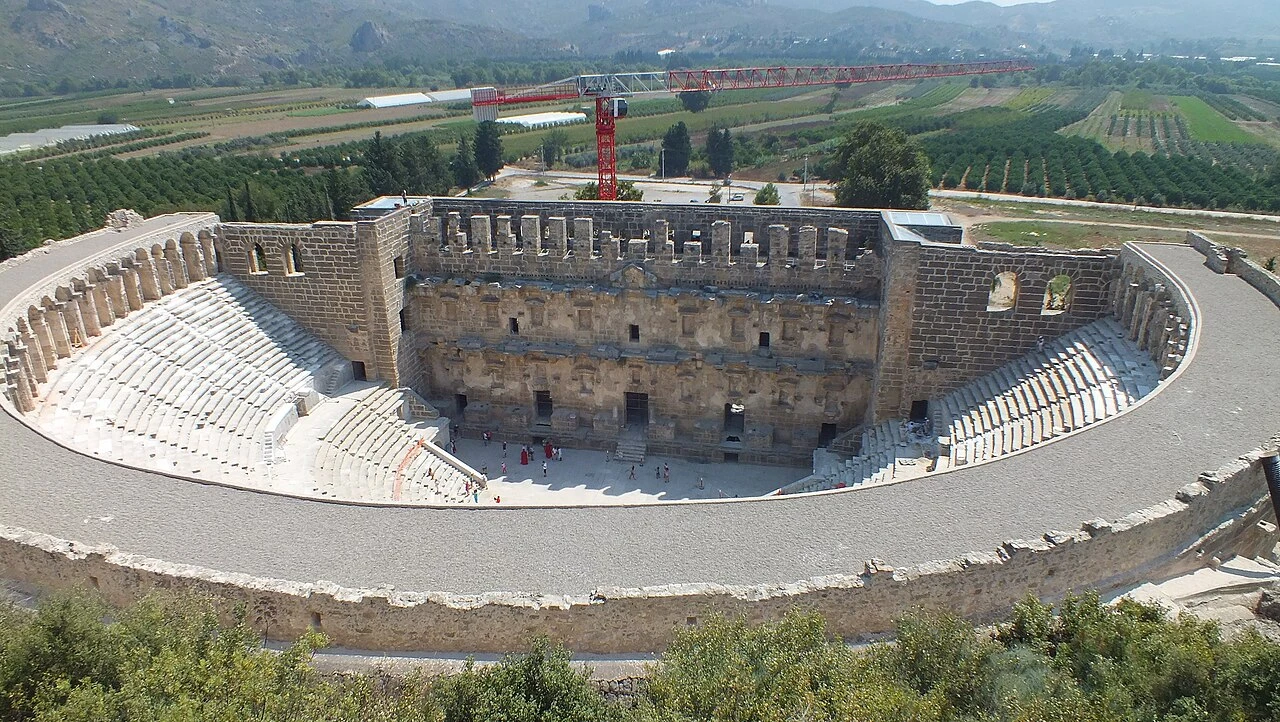
Serik
Aspendos Theatre
Content & sources
Nicola Feola · CC BY 3.0
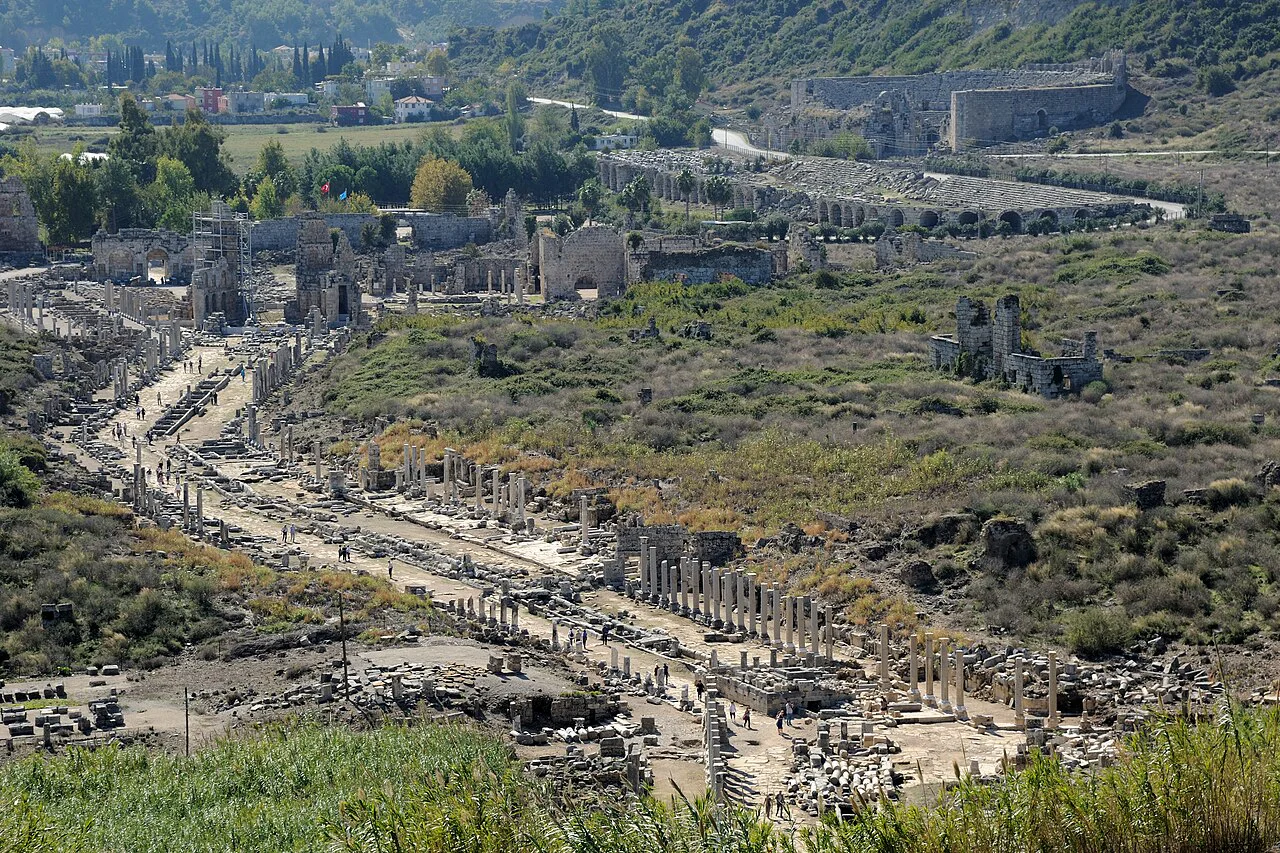
Aksu
Perge
Content & sources
Photo: Saffron Blaze · CC BY-SA 3.0