Stanza · Audio guide
Perge Audio Guide
A place to remember. A story to take with you.
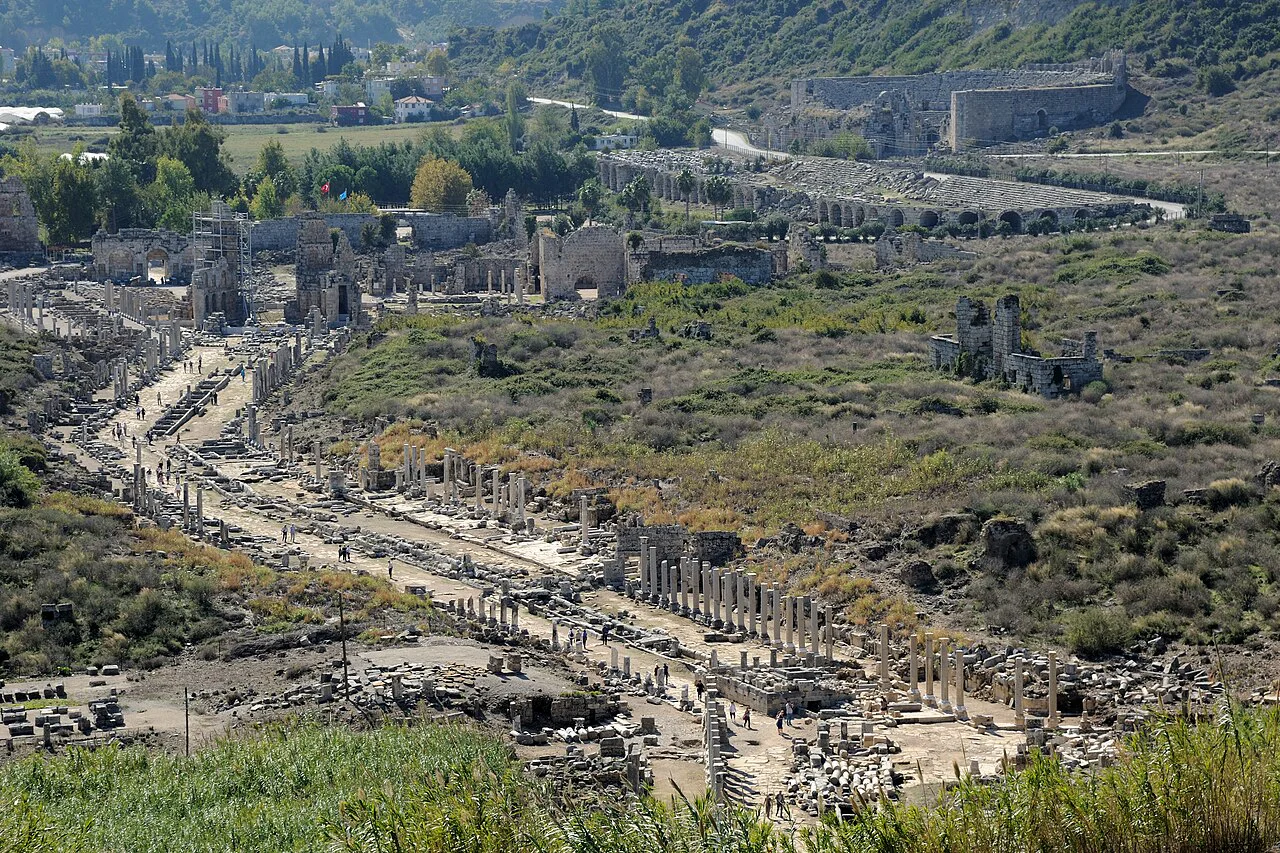
Perga was an ancient Lycian settlement that later became a Greek city in Pamphylia. It served as the capital of the Roman province of Pamphylia Secunda.
Download Stanza, then search for “Perge”.
About the tour
One guide. Your kind of visit.
Perga was an ancient Lycian settlement that later became a Greek city in Pamphylia. It served as the capital of the Roman province of Pamphylia Secunda.
Ready when you are.
- 01Get the free Stanza app.
iOS & Android
- 02Find your guide.
“Perge”
- 03Download before you go.
Works offline
Audio guide / 15 narrated stops
Inside the guide
Get to know a few of the stories before you go. Open a stop to read more.
01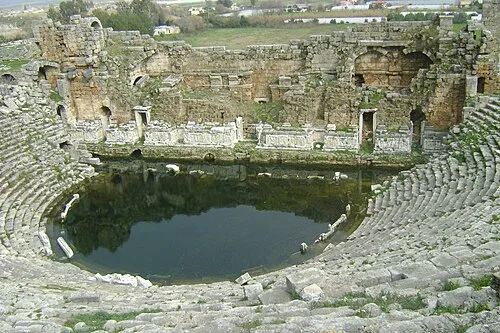 The Roman Theatre
Roman Theatre of Perge
Welcome to Perge, once the capital of the Roman province of Pamphylia Secunda. By the second century AD it was counted among the most beautiful towns of Anatolia, competing with Side for the title of most important city in Pamphylia. This theatre stood outside the city walls, near the stadium, and it was larger than the theatres of Myra and Patara. About thirteen thousand spectators could fill its seats. The stage building facing them was the wonder of the place. Its facade was carved with marble reliefs telling the life of Dionysos, god of wine and of the theatre. The scenes run across the front in framed panels, almost like the stills of a film. When the stage building later collapsed, many of the panels were badly damaged. The Dionysos scenes, though, can still be followed almost episode by episode. The orchestra below was once ringed with railings, a sign that the shows here changed with the times.
Photo: 07özlem arlı · CC BY-SA 3.0
02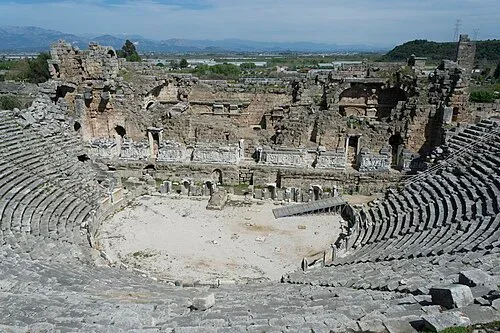 The Roman Theatre
Theatre Cavea and Orchestra
The seating tells its own story here. The cavea, the great fan of stone benches, rose in two tiers. Nineteen rows sat below, and twenty-three more above, climbing away from a half-round orchestra that was a little wider than a semicircle. Railings enclosed that orchestra, and the railings change how the building reads. In theatres across the Roman East, spaces like this could be adapted for gladiator fights and combats with wild animals, spectacles popular in this era. The barriers kept the fighters apart from everyone else. So the same floor that held a chorus could be cleared for combat, with the crowd watching from these same benches. The railings are the evidence that such games were staged at Perge, alongside the plays.
Photo: Dosseman · CC BY-SA 4.0
03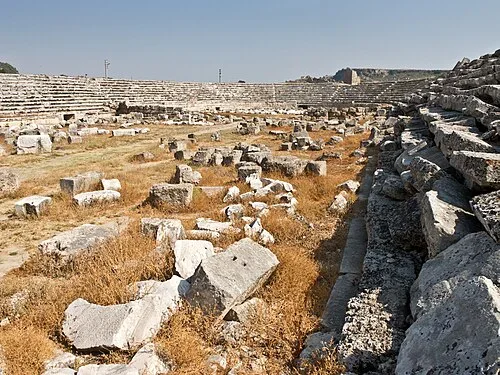 The Ancient Stadium and Vaulted Shops
The Ancient Stadium
Athletes had their own arena. This stadium is one of the best preserved to survive from the ancient world, a long narrow rectangle built of the local conglomerate stone. It runs about two hundred and thirty-four metres from end to end. Across, it measures thirty-four. The northern short end curves round in a horseshoe, and the southern end stands open. Work on it probably began in the second half of the first century AD. Around twelve thousand spectators could find a place on its stone benches. The whole structure rests on seventy vaulted chambers beneath the seating. Thirty of those vaults lined each long side, with ten more at the closed north curve. They were not storerooms. They served as shops, and inscriptions above them named the shopkeeper and the goods on sale. Athletics and commerce shared a single building here, the crowd spending between the events.
Listen in the appCarlos Delgado · CC BY-SA 3.0
04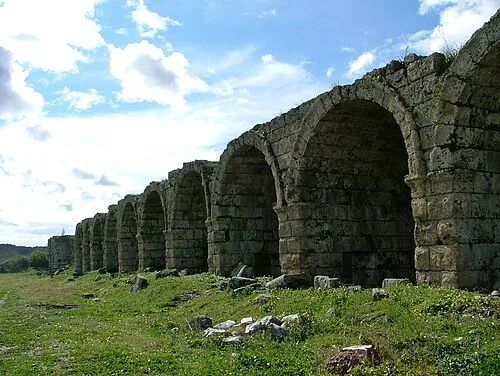 The Ancient Stadium and Vaulted Shops
Arches of the Water Supply
None of this city worked without water, and Rome engineered its supply on a grand scale. In the Roman era, Perge was fed by two aqueducts. One ran eleven kilometres from near the Kursunlu waterfall, probably built to supply the baths. A later line stretched twenty-one kilometres, drawing a greater flow from the Düden river. Arched water-supply structures like this one stood in the open country around the site, carrying the channels on their backs. The builders' task was the slope. Water flows only downhill, so an aqueduct had to descend steadily and gently, kilometre after kilometre, across valleys and open ground. Every fountain, bathhouse and channel in Perge began with lines like these.
Listen in the appPaul VanDerWerf from Brunswick, Maine, USA · CC BY 2.0
05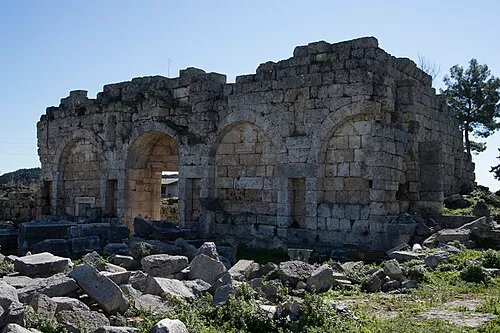 The Late Roman City Gate
Late Roman City Gate
This late Roman gate led into the walled city, and the story of Perge's most famous visitors begins at such a gate. In the year forty-six, according to the Acts of the Apostles, Paul and Barnabas came here on their first missionary journey. It was at Perge that John Mark left them and turned back for Jerusalem. The city stood on the Via Sebaste, a Roman road built after twenty-five BC to link Perge with Pisidian Antioch. That made it a natural staging point for journeys into the interior. When Paul returned from Pisidia, he preached at Perge. Christianity took root here. In the fourth century, under Constantine the Great, Perge became an important Christian centre, and it kept that standing through the fifth and sixth centuries. One of its own saints, Matrona of the sixth century, had fled an abusive husband by disguising herself as a monk named Babylos. Once she was found out, she was sent to a women's monastery, and in time she headed a convent in Constantinople. She was remembered for her gift of miraculous healing, and she died at the age of one hundred.
Listen in the appPhoto: Dosseman · CC BY-SA 4.0
06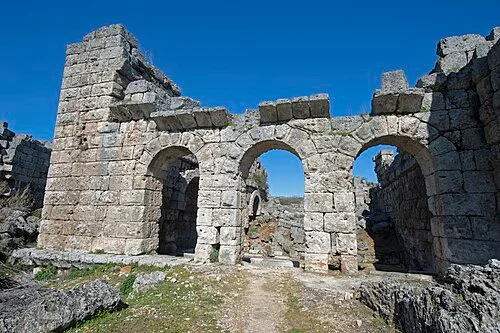 The South Baths Complex
South Baths Complex
Bathing at Perge was civic luxury on a grand scale. The south baths, created in the first century AD, are among the best-preserved buildings in the city. They are remarkable for their size and monumentality, and for the large collection of sculptures found inside them. A Roman bath was a sequence, not a single room. Bathers began in the changing rooms, moved through warm rooms that eased them toward the heat, and finished in the caldarium, the hot room whose tall arches still stand here. The whole building was designed around that progression from cool to hot. Next to the baths stood the southern nymphaeum, a monumental fountain whose hydraulic system supplied the water for them.
Listen in the appPhoto: Dosseman · CC BY-SA 4.0
07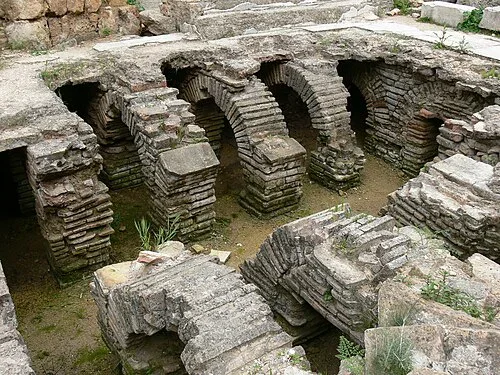 The South Baths Complex
Hypocaust of the Caldarium
The heat of the caldarium was made underneath the floor. Roman builders raised it on small brick piers, joined by arches like the ones exposed here. A furnace burned outside the hot rooms, and its hot air circulated freely through the space beneath the raised floor. Brick flues carried the heat up inside the walls as well, so a bather felt the warmth from below and from the sides at once. This is the machinery behind the caldarium's heat.
Listen in the appWolfgang Sauber · CC BY-SA 3.0
08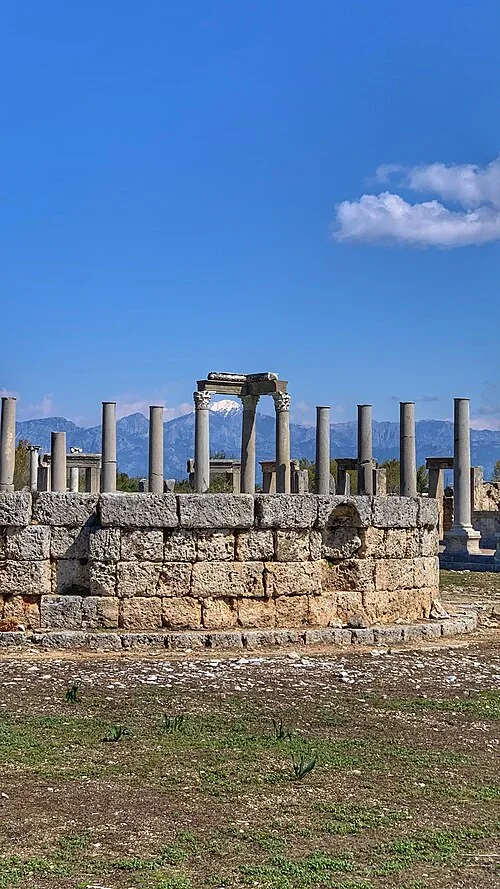 The Agora and Market Square
The Agora
The agora was the commercial and political heart of Perge, a square of roughly seventy-six metres on each side. Shops ringed the open courtyard on all four sides. Some of their floors were covered in mosaic. Each shop had two doors, one opening into the agora, the other onto the streets around it. On the southern side, where the land sloped away, the shops rose to two storeys. In the middle of the square stood the round structure visible here, a fountain building about thirteen and a half metres across. Water at the centre of a marketplace was both ornament and necessity. Centuries later, the square changed with the city. In the Byzantine period, all the main entrances except the western one were walled up. The north entrance probably served as a chapel. The market square had become part of the Christian city.
Listen in the appPhoto: The7bab · CC BY-SA 4.0
09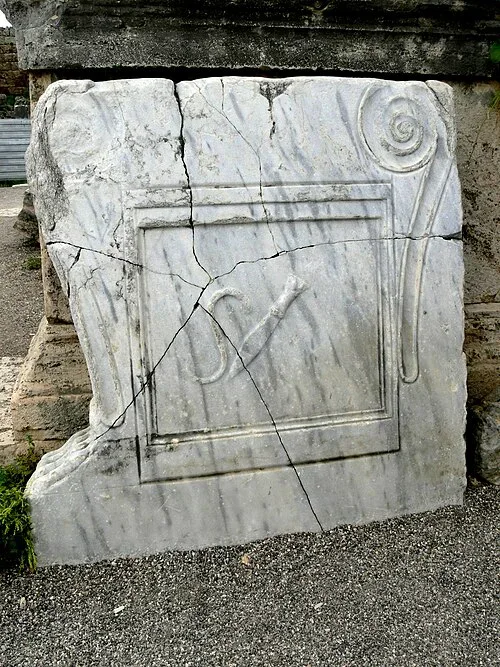 The Agora and Market Square
The Butcher's Shop Sign
A butcher's knife, carved in marble, once told customers everything they needed to know. This cracked panel is a shop sign, a tradesman's emblem cut in stone. Many customers in a Roman town could not read, so a sign had to declare its business at a glance. The knife meant meat, and other trades had their own emblems in the same style. Traders across Perge advertised themselves this way, in the market square and in the shops set into the vaults beneath the stadium seating.
Listen in the appWolfgang Sauber · CC BY-SA 3.0
10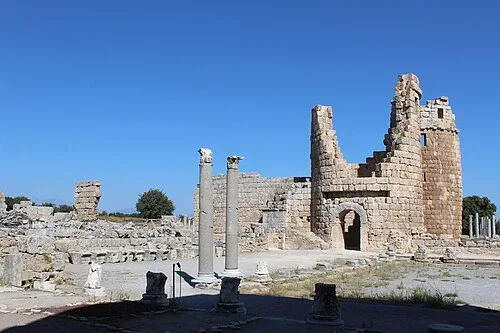 The Hellenistic Gate and Plancia Magna's Courtyard
Hellenistic Gate Towers
Before Rome, Perge was a fortress. The Hellenistic walls, raised in the third century BC, had three gates, and the southern one was especially monumental. Two round towers, three storeys high and once crowned with conical roofs, flanked the entrance. Behind them lay a horseshoe-shaped courtyard. These towers watched over an age of conquest and war. In three hundred and thirty-four BC, Alexander the Great was welcomed here with his army as he moved down the coast. The city had reason to fortify. Work on the walls of the lower city began from two hundred and twenty-three BC, and these towers were the face Perge showed to a dangerous world. They still rise at the city's southern entrance.
Listen in the appPhoto: Interfase · CC BY-SA 4.0
- 11
Plancia Magna's Ceremonial Courtyard
How a benefactor named Plancia Magna turned a fortress gate into a marble courtyard of emperors and legendary founders.
- 12
The Colonnaded Street and Water Channel
A two-metre water channel with cascading pools ran straight down the middle of the main street.
- 13
Artemis Relief Column
Artemis Pergaia, the goddess whose temple, coins and festivals made Perge renowned.
- 14
Hadrian's Nymphaeum
The great fountain of Hadrian, where the river god Cestrus poured the water that fed the whole city.
- 15
Acropolis Panorama: Four Thousand Years
From the acropolis hill: a Bronze Age settlement, a Hittite treaty, and a city that faded when its river silted up.
Perge
Frequently asked questions
How much does the guide cost?
Free app download. Listed guide price: $1.99. Guide price shown in the app. Audio guide only. Venue admission is separate.
Can I listen without internet?
Yes. Download the guide’s audio, images, and maps in the app before your visit. Your downloaded content is then available offline.
Can I listen in my language?
This audio guide is available in 15 languages, including English.
Do I need to follow a schedule?
No. This is a self-guided experience. Choose your stops, pause whenever you like, and return to a story at your own pace.
At your own pace
Explore Perge.
Download Stanza, then search for “Perge”.
Free app download · Guide price shown in the app
Keep exploring
Nearby audio guides
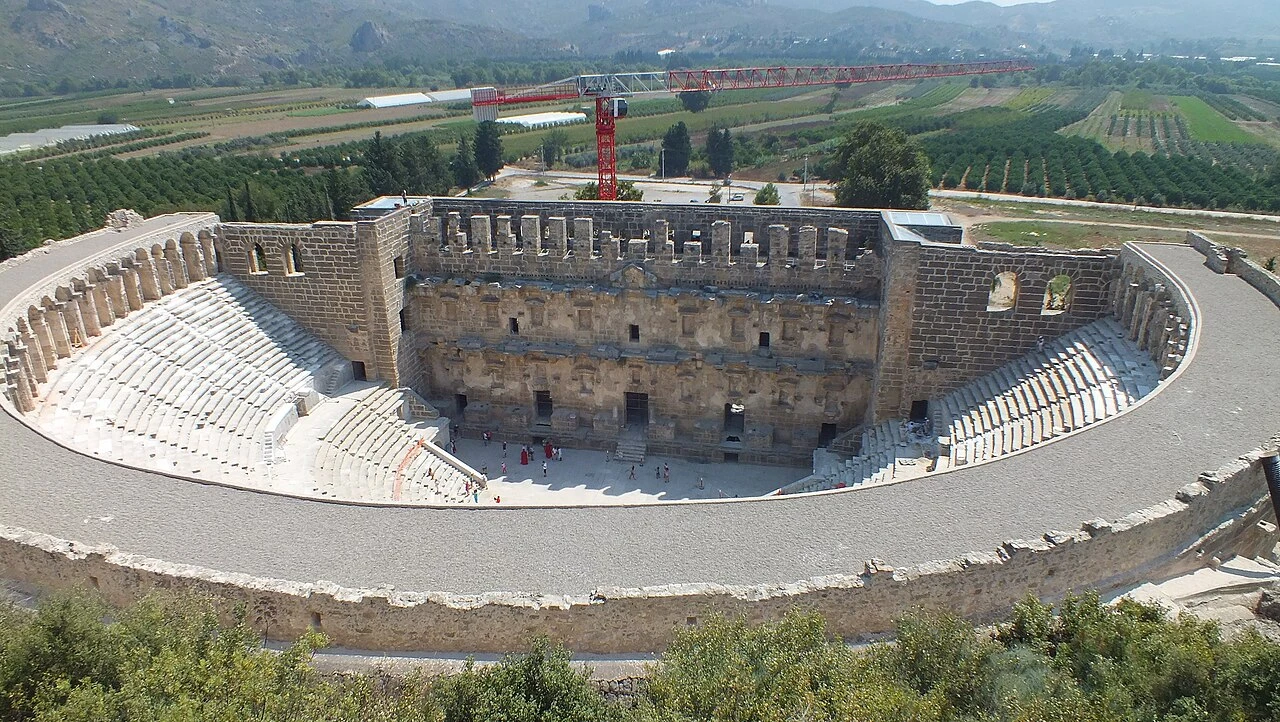
Serik · 28 km
Aspendos Theatre
Content & sources
Nicola Feola · CC BY 3.0
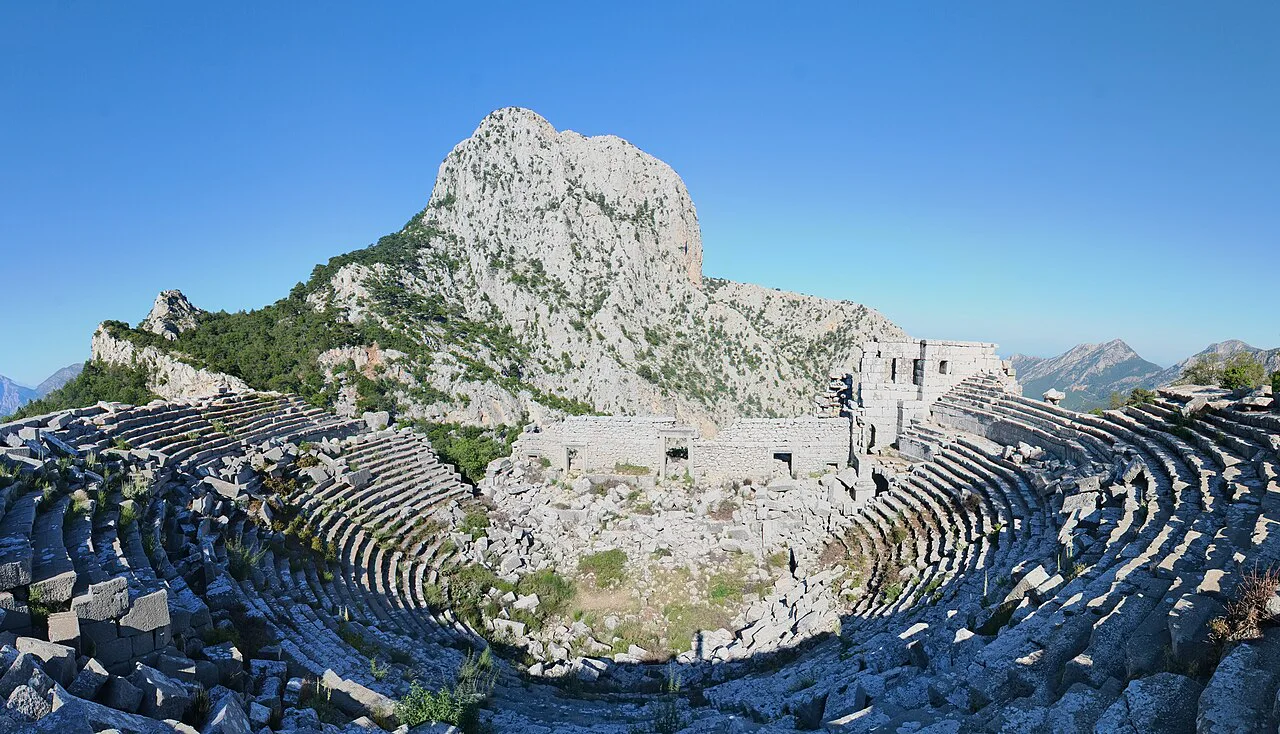
Döşemealtı · 35 km
Termessos
Content & sources
Ingo Mehling · CC BY-SA 3.0
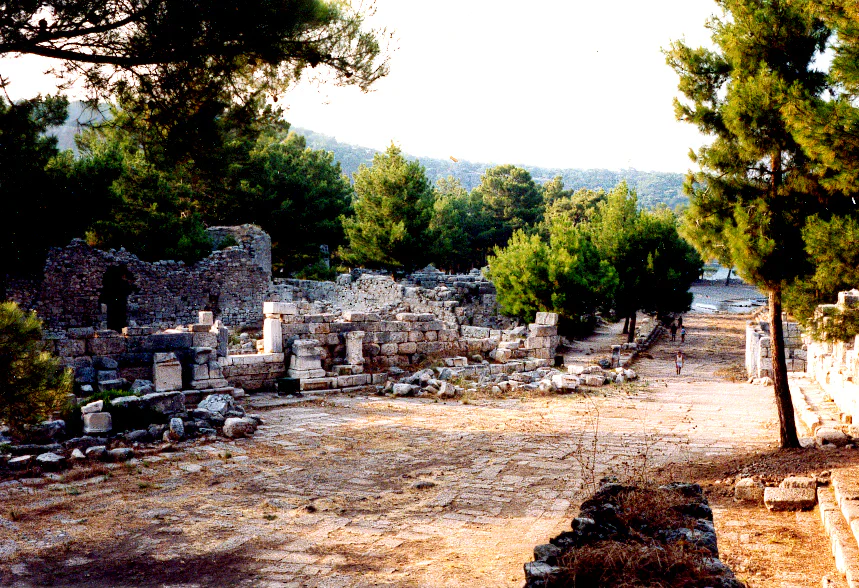
Kemer · 55 km
Faselis
Content & sources
Alexander Buschorn at de.wikipedia · CC BY-SA 3.0
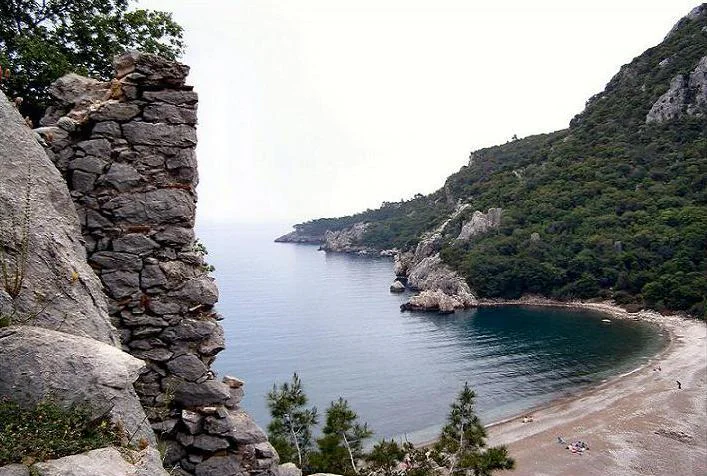
Kumluca · 71 km
Olimpos, Kumluca
Content & sources
Hilmi Ayhan · CC BY 2.5