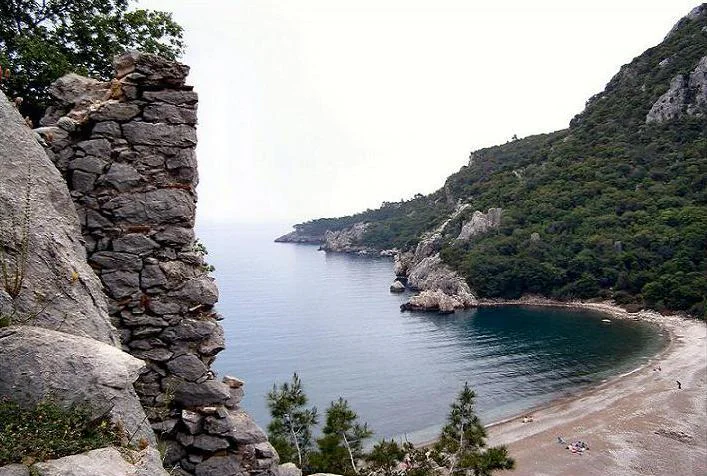
Stanza · Audio guide
Olimpos, Kumluca Audio Guide
A place to remember. A story to take with you.
Olympus is an ancient city in Lycia that served as a port city with a significant role in the Lycian League. The site features urban structures spread along a creek valley and was once a flourishing bishopric…
Download Stanza, then search for “Olimpos, Kumluca”.
About the tour
One guide. Your kind of visit.
Olympus is an ancient city in Lycia that served as a port city with a significant role in the Lycian League. The site features urban structures spread along a creek valley and was once a flourishing bishopric in the 5th century.
Ready when you are.
- 01Get the free Stanza app.
iOS & Android
- 02Find your guide.
“Olimpos, Kumluca”
- 03Download before you go.
Works offline
Audio guide / 14 narrated stops
Inside the guide
Get to know a few of the stories before you go. Open a stop to read more.
01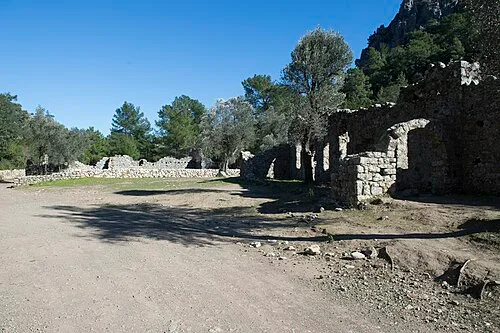 The Valley Entrance and Gateway Complex
Entrance to the Olympos Valley
Welcome to Olympos, an ancient city in Lycia on Turkey's Mediterranean coast. Olympos is thought to have been founded around 300 BC, in the Hellenistic period, and what kind of city it became was decided by its setting. A creek runs through a deep, wooded valley here, flowing down to the Mediterranean. The buildings of the city spread out along both banks of that creek, instead of gathering on a single hilltop. That shape reflects how people reached Olympos, by water, and how it lived, through trade with the sea. It takes its place among the known port cities of Lycia, alongside Patara, Myra and Phaselis. People settled here and rebuilt the town through Hellenistic, Roman and Byzantine times, roughly twelve hundred years in all. Near the entrance, ruined stone walls and arches stand among the trees. What these buildings were for, the ruins no longer tell.
Photo: Dosseman · CC BY-SA 4.0
02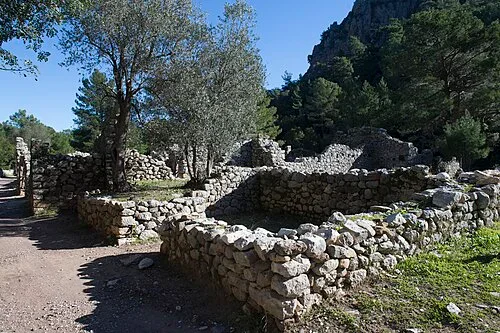 The Valley Entrance and Gateway Complex
The Protected Valley Today
Olympos lies inside the Beydağları Coastal National Park, and that fact shapes the whole valley today. The beach at the mouth of the creek is a nesting ground for Caretta caretta sea turtles, so the shore is protected as a conservation site. Building stays low, and the ruins sit in pine and greenery rather than behind hotel walls. Modern Olympos has become known for a different kind of lodging. Treehouses and open campsites line the valley, drawing university students and backpackers more than resort crowds. The long-distance Lycian Way walking trail passes through here too, so many visitors arrive on foot. The low stone walls nearby are the foundations of an entrance complex of small rooms.
Photo: Dosseman · CC BY-SA 4.0
03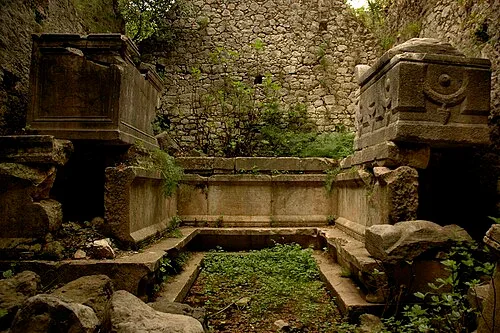 The Northern Necropolis and Lycian League Tombs
Tombs of the Northern Necropolis
The earliest written mention of Olympos comes from Strabo, the Greek geographer. Drawing on Artemidorus of Ephesus, he lists it among six cities of the Lycian League with the top voting rank. Each of those cities held three votes in the federal assembly, the maximum the League allowed. That status is recorded for Olympos until the second half of the second century BC. For a medium-sized town, it was elite company, and the city spent on it. The grandest evidence is its burial ground. In the northern part of the valley, monumental stone tombs gather in courtyards, built of dressed blocks and made to impress. League prestige showed itself here in stone, for the dead as much as for the living. The people laid in these particular tombs are unnamed in what has been found so far.
Listen in the appFlickr user: Camera on autopilot Tallinn, Estonia/Kranj, Slovenia https://www.flickr.com/people/ganbei/ · CC BY 2.0
04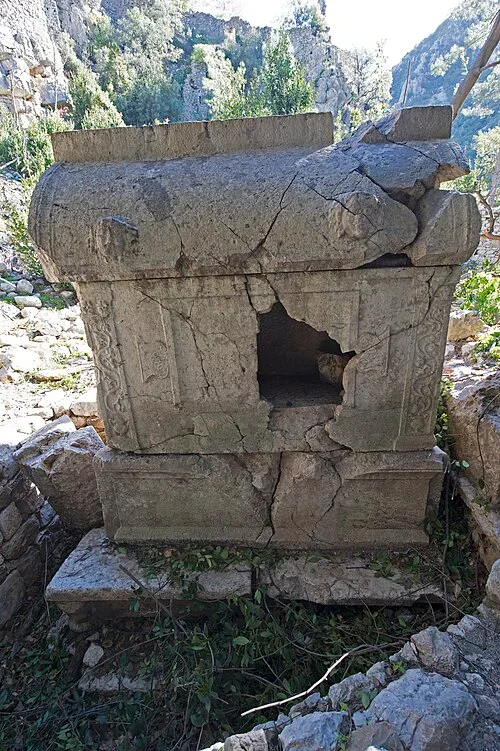 The Northern Necropolis and Lycian League Tombs
Sarcophagus of Antimachos
The excavations at Olympos have brought up more than fifty inscriptions, studied by the epigraphists on the digging team. Nearly all of them name people as Olympenos, Olympene or Olympenoi, the people of Olympos. Together these stones work as the city's written memory. One of them, on a tomb, belongs to Marcus Aurelius Archepolis, who held the Lyciarchate, the highest office of the Lycian League. His tomb shows that Olympos still stood in the League's elite rank in the second century AD. This sarcophagus carries the name of Antimachos, though who he was beyond the name, the stone does not say. Its great lid has slipped and cracked, and a hole has been broken into the panel over the burial chamber.
Listen in the appPhoto: Dosseman · CC BY-SA 4.0
05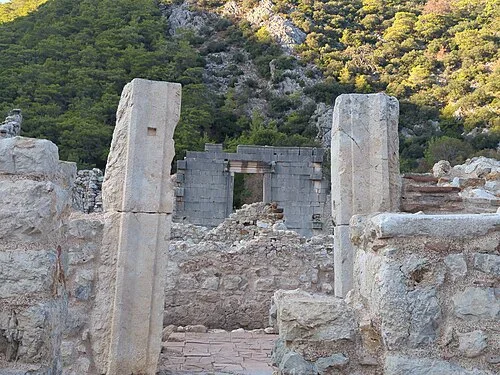 The Sacred Precinct and Ionic Temple
The Temple Precinct
Roman Olympos was a city reorganized. Under imperial administration the town was laid out again on a regular, planned pattern, and recent investigations have added much about its baths, its temple, its main street and its bridge. The plan had a logic to it. Public buildings like the baths gathered in the southern half of the city, while the tombs and the temples concentrated in the northern section. This precinct belongs to that sacred northern half. Two standing pillars frame the temple facade, built of large, neatly fitted blocks of grey stone around a tall doorway. Even in ruin, the rank of the building is clear. Which god it honoured, the remains have not recorded.
Listen in the appPhoto: Magurale · CC BY-SA 4.0
06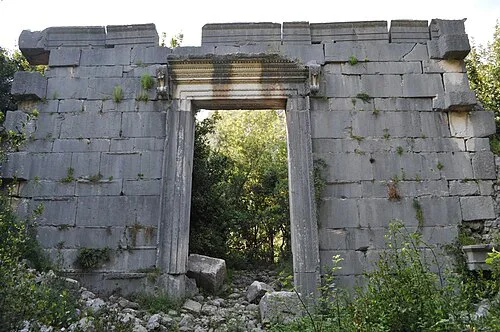 The Sacred Precinct and Ionic Temple
The Temple Doorway
A story attaches to this valley, and it concerns Alexander the Great. During his campaign he wintered at Phaselis, the port city next door to Olympos, and that part is known. Some historians give him a visit to Olympos as well, holding that he came south to secure the town's allegiance. That visit rests on tradition rather than a settled account, so it is legend, not history. The temple doorway itself is solid enough. Its frame and lintel still stand in place, making it one of the most complete faces in the valley. Trees now grow through the middle of it, filling the doorway where the cult image once faced out.
Listen in the appPhoto: Gunthram · CC BY-SA 3.0
07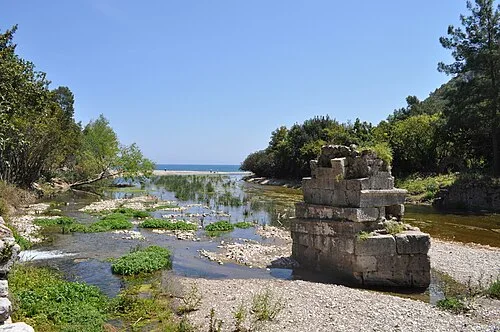 The Ancient Harbor and Roman Bridge
Bridge Pier in the Creek
The creek running past this stone pier was the heart of Olympos. It gave the city its harbour and its trade, and it split the town in two, a northern half and a southern half, joined by a bridge of three arches. One pier of that bridge still stands in the streambed, and the sea shows beyond the trees where ships once came in. That hidden sea access had a dark side. In the first century BC, the written sources speak of Olympos mainly in connection with piracy. The pirate leader Zeniketes held power here, until Rome had enough. Rome feared for its merchants' trade in the region, and the Lycian League's own fleet was too weak to act. So Rome sent the general Publius Servilius Vatia against the eastern Lycian cities. He besieged Zeniketes' fortress around Olympos. When resistance became hopeless, Zeniketes burned himself, together with his family, rather than be taken alive. The city paid for his rising. It was expelled from the Lycian League, the lands of his supporters were confiscated, and Olympos was readmitted only in the first century AD.
Listen in the appPhoto: Gunthram · CC BY-SA 3.0
08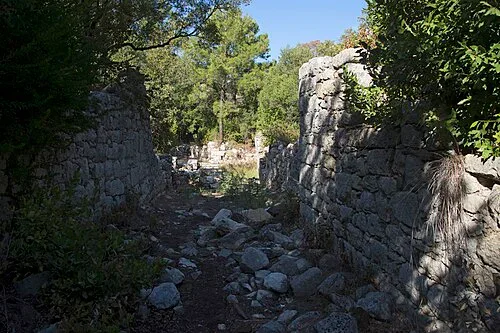 The Ancient Harbor and Roman Bridge
Bridge Street
This stony lane is Bridge Street, laid out in the Roman Imperial period, and it explains how the city was put together. It ran north to south, crossing the main east-west artery, Harbor Street, and leading across the bridge toward a large square in the southern city. Olympos followed a hippodamic plan, its streets and alleys meeting at right angles like a grid. Excavations along this whole stretch turned up something unexpected. The fortification wall here is older than the street. Its gate was partly torn down when Bridge Street was built through it. The walls are the earliest architectural remains known in the city, put up in polygonal masonry, and they can be dated no earlier than 76 BC.
Listen in the appPhoto: Dosseman · CC BY-SA 4.0
09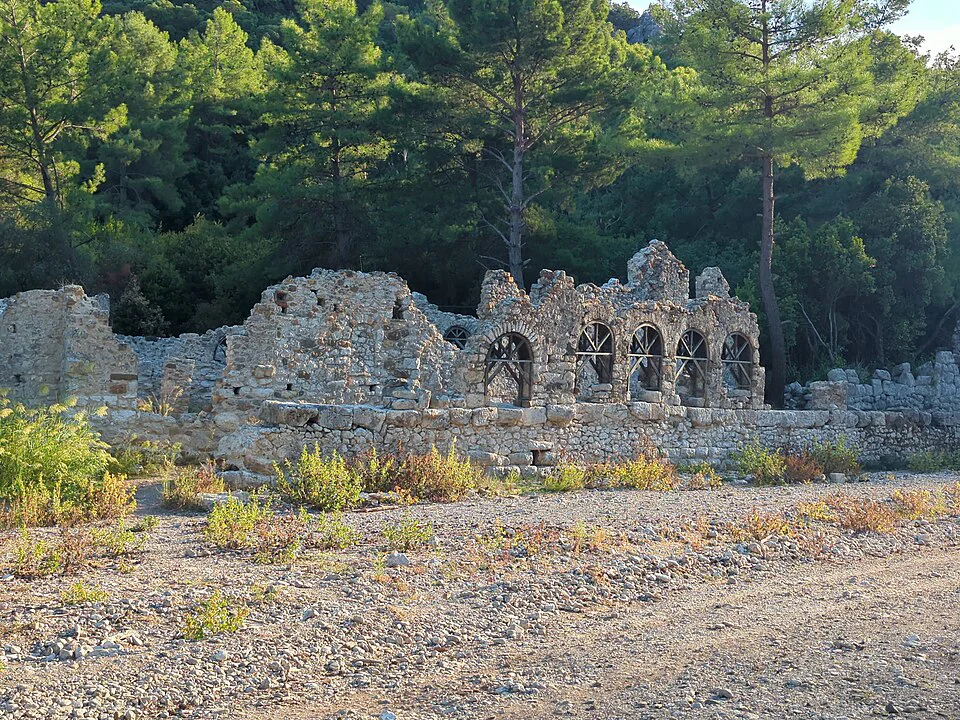 The Southern Hillside and Vespasian Bathhouse
Southern Hillside Houses
The southern side of the valley was Olympos's residential ground, and the terrain forced its builders to be clever. The houses stand on steep terraces, one above the other, each level held up by a retaining wall of stone. East-west passages run between the terraces, and stairways connect them, so neighbours moved between levels on foot, up steps set into the slope. Those stairways can still be climbed today. Building on a narrow valley side meant stacking life vertically, with homes rising up the hillside and the creek running along the valley floor below. Who lived in these particular houses, and how well, the ruins do not say.
Listen in the appPhoto: Magurale · CC BY-SA 4.0
10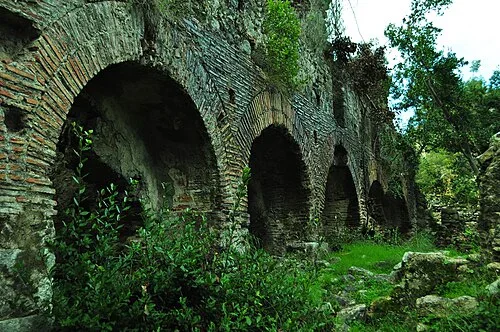 The Southern Hillside and Vespasian Bathhouse
Vespasian Bath
The biggest ruin on this side of the creek is the bathhouse known as the Vespasian Bath. The name comes from the emperor Vespasian, carried by the site's long tradition rather than any carved claim. It belongs to the Roman plan of the city, in which public buildings like baths were gathered into the southern half, while the north kept the tombs and temples. What survives most strikingly is the arches. Great arches of brick and stone rise in rows, their feet lost in shrubs and ivy, and they show how tall a Roman bath building could be. Roman bathing was a public affair, an afternoon institution. The baths of the era were typically heated by hot air moving beneath floors raised on pillars. Whether this building worked that way has not been confirmed on the evidence so far.
Listen in the appPhoto: Seckinevcim · CC BY-SA 4.0
- 11
Church A
Methodius of Olympus, the bishop whose writings defended Christianity and who died a martyr's death around 312.
- 12
Byzantine Church Mosaic Floor
Nine Byzantine basilicas in one medium-sized town, mosaic floors everywhere, and no room in the valley for an atrium and a narthex together.
- 13
Sarcophagus of Captain Eudemos
The sarcophagus of Captain Eudemos, carved with a merchant ship and a Medusa head, near the creek's mouth.
- 14
Olympos Beach and River Mouth
The end of the story at the shore: a Byzantine boom, Arab raids, a name fading out in the ninth century.
Olimpos, Kumluca
Frequently asked questions
How much does the guide cost?
Free app download. Listed guide price: $0.99. Guide price shown in the app. Audio guide only. Venue admission is separate.
Can I listen without internet?
Yes. Download the guide’s audio, images, and maps in the app before your visit. Your downloaded content is then available offline.
Can I listen in my language?
This audio guide is available in 15 languages, including English.
Do I need to follow a schedule?
No. This is a self-guided experience. Choose your stops, pause whenever you like, and return to a story at your own pace.
At your own pace
Explore Olimpos, Kumluca.
Download Stanza, then search for “Olimpos, Kumluca”.
Free app download · Guide price shown in the app
Keep exploring
Nearby audio guides
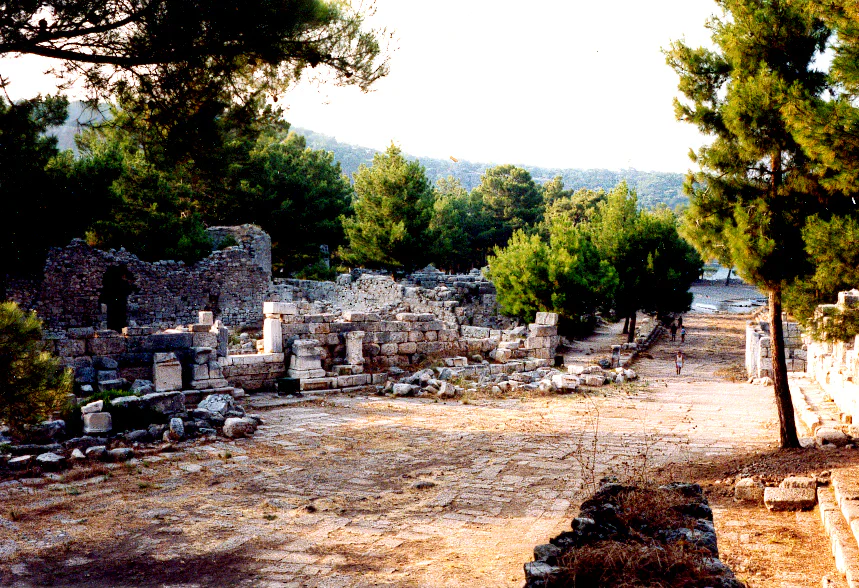
Kemer · 16 km
Faselis
Content & sources
Alexander Buschorn at de.wikipedia · CC BY-SA 3.0
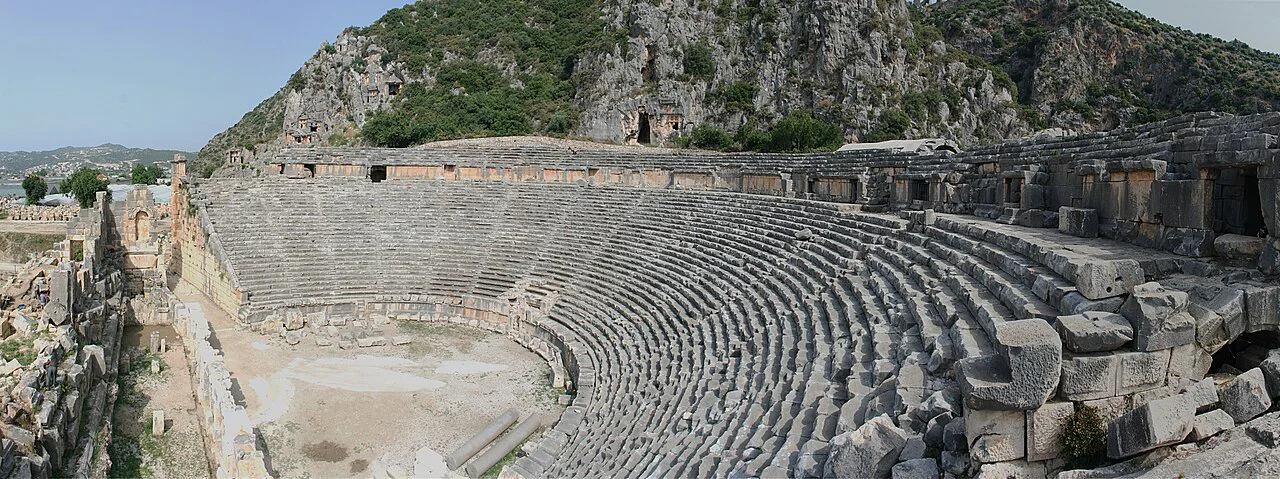
Demre · 46 km
Mira
Content & sources
Ingo Mehling · CC BY-SA 3.0
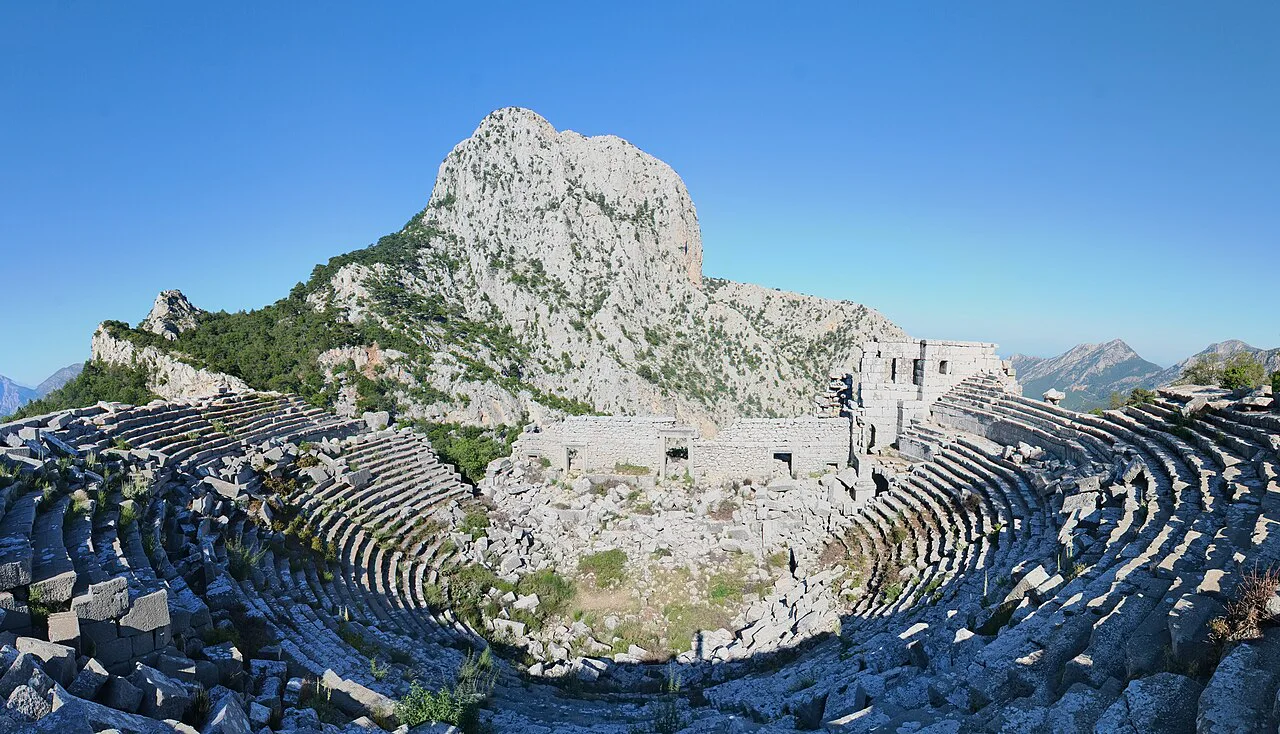
Döşemealtı · 65 km
Termessos
Content & sources
Ingo Mehling · CC BY-SA 3.0
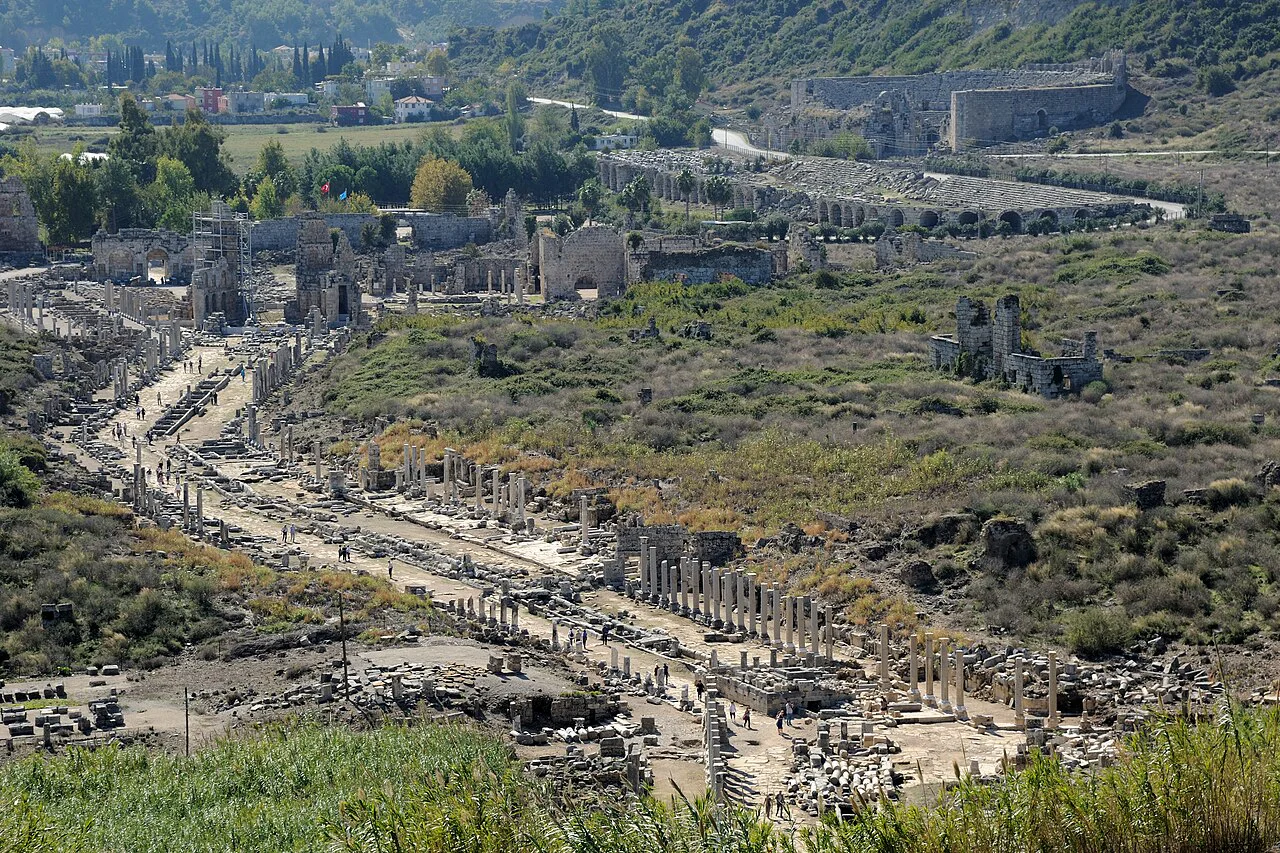
Aksu · 71 km
Perge
Content & sources
Photo: Saffron Blaze · CC BY-SA 3.0