Stanza · Audio guide
Termessos Audio Guide
A place to remember. A story to take with you.
Termessos was a Pisidian city built at an altitude of about 1000 metres on the slopes of Güllük Dağı in the Taurus Mountains. It is an ancient city of Pamphylia located 17 kilometres to the north-west of…
Download Stanza, then search for “Termessos”.
About the tour
One guide. Your kind of visit.
Termessos was a Pisidian city built at an altitude of about 1000 metres on the slopes of Güllük Dağı in the Taurus Mountains. It is an ancient city of Pamphylia located 17 kilometres to the north-west of Antalya.
Ready when you are.
- 01Get the free Stanza app.
iOS & Android
- 02Find your guide.
“Termessos”
- 03Download before you go.
Works offline
Audio guide / 29 narrated stops
Inside the guide
Get to know a few of the stories before you go. Open a stop to read more.
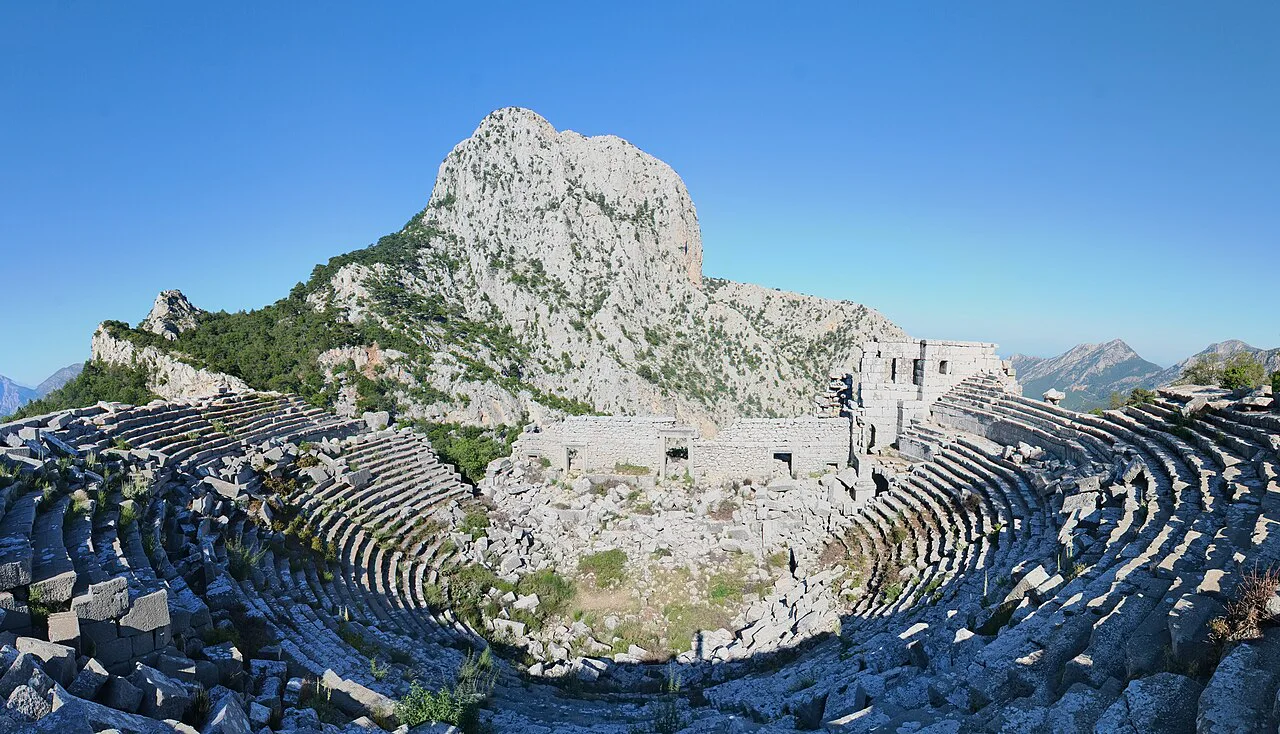
01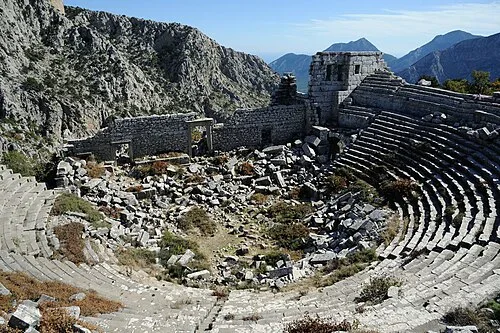 Mount Güllük-Termessos National Park
Termessos Overview – Mount Güllük-Termessos National Park
High in the Taurus Mountains, about thirty kilometres north-west of Antalya, a whole ancient city sits on a natural platform roughly a thousand metres above the sea. The mountain above it, Güllük Dağı, climbs to sixteen hundred and sixty-five metres, and the city clings to its south-western slopes. Its founders were the Solymi, an indigenous Pisidian people, and they took their name from Solymeus, an Anatolian god later identified with Zeus. So the city worshipped Zeus Solymeus, and his name appears on its coins. The Solymi are old enough to appear in Homer's Iliad, in the legend of Bellerophon. This was a stronghold first and a city second, and few enemies ever managed to storm it. Alexander the Great himself gave up on it. Rome later recognised the city's independence by law. Today formal excavation has begun here, inside the national park that carries its name, one of the best preserved ancient cities in Turkey.
Photo: Saffron Blaze · CC BY-SA 3.0
02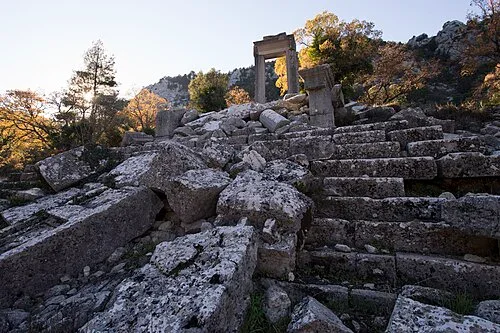 Hadrian's Monumental Gate
Among the remains of Termessos stands a monumental Roman gateway carrying Hadrian's name. It belongs to a family of grand entrances the Romans built across their provinces, ceremonial arches raised to mark the passage from the open road into a city. Here it served as the majestic entry to the lower city, with a broad stairway leading up to it. It ranks among the city's known monuments alongside the walls, the cisterns, the theatre, the gymnasium, the agora, the odeon and the heroon. The gate is often called a triumphal arch, and gateways of this kind were usually built to honour an emperor, whether or not he ever came. Scattered blocks lie all around it, tumbled from the structure above. What stands now gives only a hint of how imposing the full monument once was, framed against the bare rock of the mountain.
Photo: Dosseman · CC BY-SA 4.0
03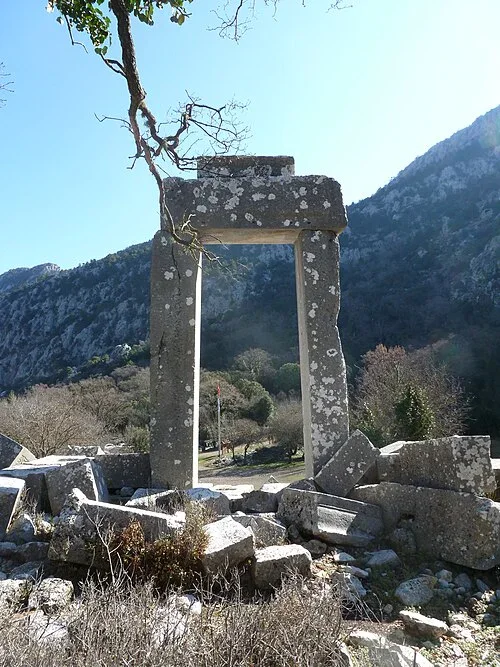 Hadrian's Monumental Gate
 – The Standing Portal
A single rectangular door frame still stands upright here, rising from a sea of fallen masonry. The blocks around it lie where they fell, lichen-grey and weathered. That standing frame is the best measure of the scale the finished gate had. Each jamb is a towering slab of dressed stone, and the whole portal once rose far above it. Set against the slope and the scattered ruins, the lone doorway shows how much of the monument has vanished, and how much still holds.
Listen in the appPhoto: Zythème · CC BY-SA 3.0
04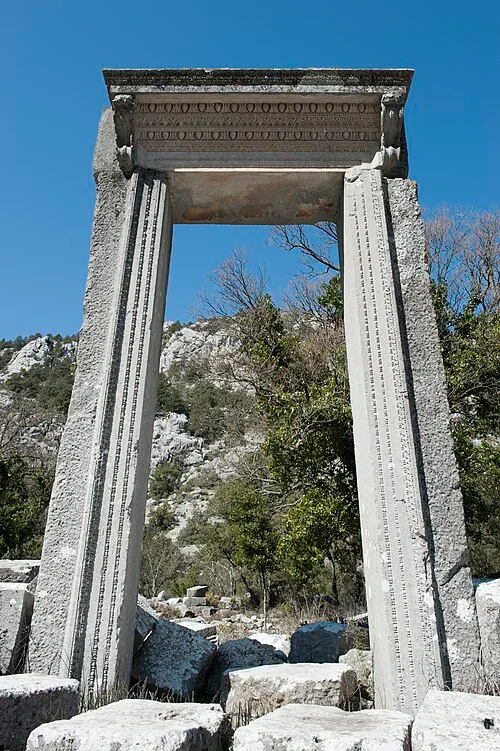 Hadrian's Monumental Gate
 – Carved Architrave
Over the gateway runs a carved entablature, the horizontal band of stone that carried the gate's decoration. Its surface is worked with repeating moulded patterns, the kind of ornament Roman masons used to give ceremonial buildings their richness. The fluted columns flanking the opening are cut with the same care. All of this has stood exposed to mountain weather for centuries, through frost, sun and rain, and the carving is still legible. It is a reminder of how skilled the stonemasons of a Roman provincial city were, working hard local limestone with chisels and no machinery. The blocks were shaped to interlock precisely, and the ones that stayed joined have outlasted the ones that fell.
Listen in the appPhoto: Dosseman · CC BY-SA 4.0
05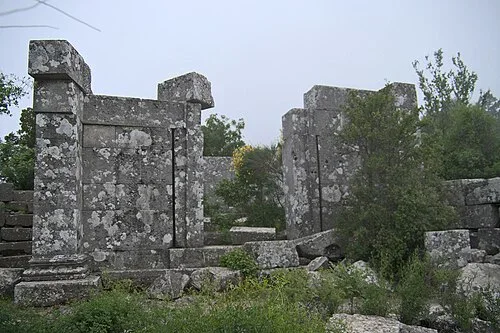 Temple of Artemis
A woman named Aurelia Armasta built a temple here, and made sure everyone knew it. An inscription on the entrance, which survives complete, records that the temple was dedicated to Artemis, and that both the building and the cult statue inside were paid for by Aurelia and her husband, using their own money. Private wealth funding a public cult was a familiar act of generosity in Roman cities, and a costly one. The temple is small and elegant, of the prostylos type, with columns across its front, and its inner chamber measures about five and a half metres on each side. Stylistically it belongs to the end of the second century AD. Beside the entrance, on the other side, a statue of Aurelia's uncle stands on an inscribed base, keeping the family's name attached to the gift. The temple now stands roofless and overgrown, but the inscription that tells her story is still in place.
Listen in the appVadimph · CC BY-SA 3.0
06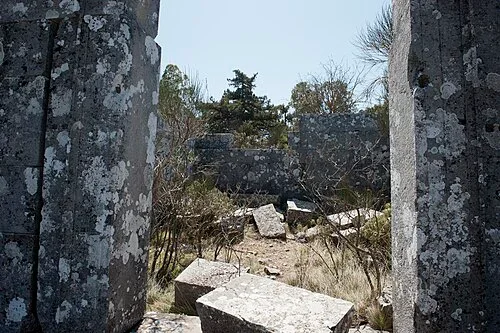 Temple of Artemis
 – Walls in the Undergrowth
Through the great doorway blocks of the Artemis temple, the view is of trees and tangled scrub growing where the goddess's statue once stood. The stone walls are thick with pale lichen, and fallen blocks lie among the bushes inside. Little here has been cleared or tidied. This is the normal state of Termessos, a city that was never fully excavated, where ancient structures and wild vegetation have grown into each other over centuries. The temple's mass is still easy to make out, the walls and the entrance framing the hillside beyond. It is a ruin that the mountain has been quietly reclaiming.
Listen in the appPhoto: Dosseman · CC BY-SA 4.0
07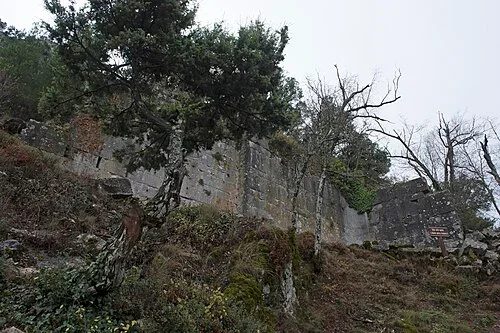 The City Gate
 and the Dice Oracles
In the walls east of the city gate, inscriptions offer a strange service to anyone arriving: answers from the gods, by dice. Each inscription runs about four or five lines. It gives the numbers to be thrown, the name of the god being consulted, such as Zeus or Apollo, and the counsel that god gives for that throw. A traveller would roll, match the numbers to the text, and read the prediction waiting for them. Beliefs of this kind, in sorcery, magic and superstition, were widespread across the Roman Empire, and the Termessians were probably keen on fortune-telling. What makes this place remarkable is that the oracle was carved into the city's own defences, at the very point where every traveller passed in. The gods, apparently, were consulted on the way in.
Listen in the appPhoto: Dosseman · CC BY-SA 4.0
08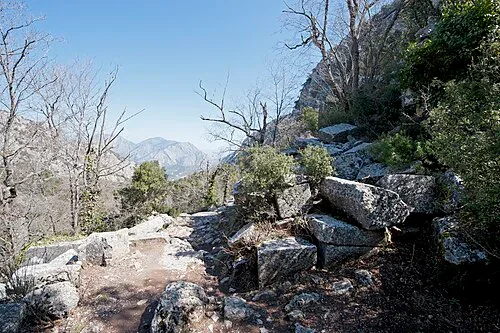 The City Gate
 – The Climb to the Pass
The city gate stands high on the steep climb where the ancient approach road finally reaches the walls. From this road, the famous Yenice pass can be seen, the gap in the mountains through which the old highway wound. The climb itself was part of the city's design. Along the way up stand Hellenistic fortification walls, cisterns hollowed to hold water, and many other remains, so an arriving traveller met the city's defences long before meeting its gate. The road climbs through bare rock and sparse trees, and the views open out over the lower mountains behind. It is a hard, high approach, exactly what you would expect for a city that lived behind its ramparts.
Listen in the appPhoto: Dosseman · CC BY-SA 4.0
09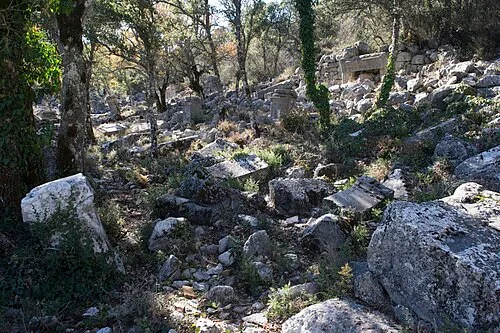 King's Street
King's Road (Kral Yolu)
In 333 BC, Alexander the Great marched to force the pass that runs by Termessos, the route between Pamphylia and Phrygia. The Termessians closed it against him. He wasted much time and effort trying to break through, then turned on the city in anger and surrounded it. He likened it to an eagle's nest. But knowing he could not take it, he never assaulted it, and instead marched north to unleash his fury on Sagalassos. Why he chose the steep Yenice pass at all, when much lower and easier passes existed, is still disputed. It is even said that his hosts in Perge sent him up the wrong path. The road the Termessians called King Street came later, built in the second century AD by contributions from the people of Termessos. It passes through the city walls higher up and runs in a straight line all the way to the centre of the city.
Listen in the appPhoto: Dosseman · CC BY-SA 4.0
10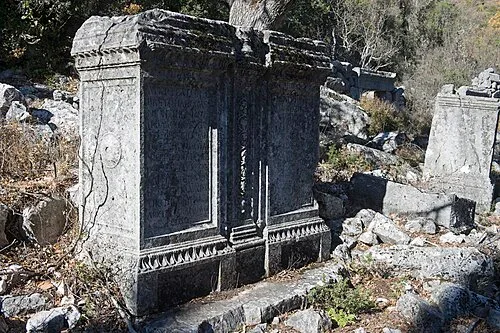 King's Street
King's Road – Carved Monument
Beside the old main street stands a single monument of richly worked stone, its panels carved with mouldings and bearing inscriptions. Monuments like this lined the great streets of Roman-era cities, honouring individuals whose names the carvings recorded, a public form of civic display where generosity to the city was rewarded with stone. Termessos was a thriving provincial city by the turn of the second and third centuries AD, and its citizens marked their main road accordingly. What this particular monument originally held, and whom its inscriptions praised, cannot be said for certain now. Its craftsmanship, though, is intact enough to show the standard the street was built to.
Listen in the appPhoto: Dosseman · CC BY-SA 4.0
- 11
The Gymnasium and Baths
The gymnasium and baths, the amenities of a city grown rich under Roman rule.
- 12
Gymnasium – Carved Arch and Doorway
A finely cut arch in the gymnasium wall, stonework fitted with almost no margin for error.
- 13
Upper City Wall
The wall that made Termessos unassailable, and why Alexander chose not to test it.
- 14
Upper City Wall – Rampart in the Forest
The upper wall built to follow the mountain's own contours, rock and masonry working together.
- 15
Tomb of Alcetas
The tomb of the general Alcetas, who chose death over surrender, and the city's youth who buried him with honour.
- 16
Tomb of Alcetas – The Horseman Relief
A carved horseman on the tomb's wall, and the chain of clues that points to Alcetas himself.
- 17
Tomb of Alcetas – Eagle Relief
An eagle with a serpent in its talons, carved where a general's memorial would want it.
- 18
The Rock-Cut Tombs
Whole cemeteries of tombs cut directly into the cliff, where the mountain became the burial ground.
- 19
A Tomb with a View
A lone sarcophagus on a high outcrop, placed where its occupants would gaze over the mountains.
- 20
Rock Tombs – Facade Details
Pediments, arches and doorways: the variety of tomb architecture cut into one panel of cliff.
- 21
Corinthian Temple
One of six known temples in the city, built in fine Corinthian style for a god whose name is lost.
- 22
Corinthian Temple – Surviving Masonry
Tall stretches of coursed masonry still standing, held up by the fit of their own blocks.
- 23
Odeon (Bouleuterion)
A small covered hall of the finest masonry, with a roof whose engineering still puzzles archaeologists.
- 24
Odeon – Side Wall and the Temple of Zeus Solymeus
Behind the odeon's wall, the proposed sanctuary of Zeus Solymeus, god of the city's founding people.
- 25
Greek Theatre of Termessos
How a law of the Roman Senate made Termessos free, and the theatre that freedom built.
- 26
Theatre Panorama – Theatre on the Mountain Crest
Rows of seats on the very crest of the mountain, with the landscape dropping away behind the stage.
- 27
Theatre – Roman Stage Details
Vaulted entrances, an enlarged stage and hidden animal pens: the Roman layer of a Greek theatre.
- 28
Western Necropolis
Sarcophagi in the trees, buried with their jewels, and curses backed by fines paid to Zeus Solymeus.
- 29
Solymos Mountain – The City Given Back to the Forest
How an earthquake and a broken aqueduct emptied the city, and why the forest has kept it ever since.
Termessos
Frequently asked questions
How much does the guide cost?
Free app download. Listed guide price: $2.99. Guide price shown in the app. Audio guide only. Venue admission is separate.
Can I listen without internet?
Yes. Download the guide’s audio, images, and maps in the app before your visit. Your downloaded content is then available offline.
Can I listen in my language?
This audio guide is available in 15 languages, including English.
Do I need to follow a schedule?
No. This is a self-guided experience. Choose your stops, pause whenever you like, and return to a story at your own pace.
At your own pace
Explore Termessos.
Download Stanza, then search for “Termessos”.
Free app download · Guide price shown in the app
Keep exploring
Nearby audio guides
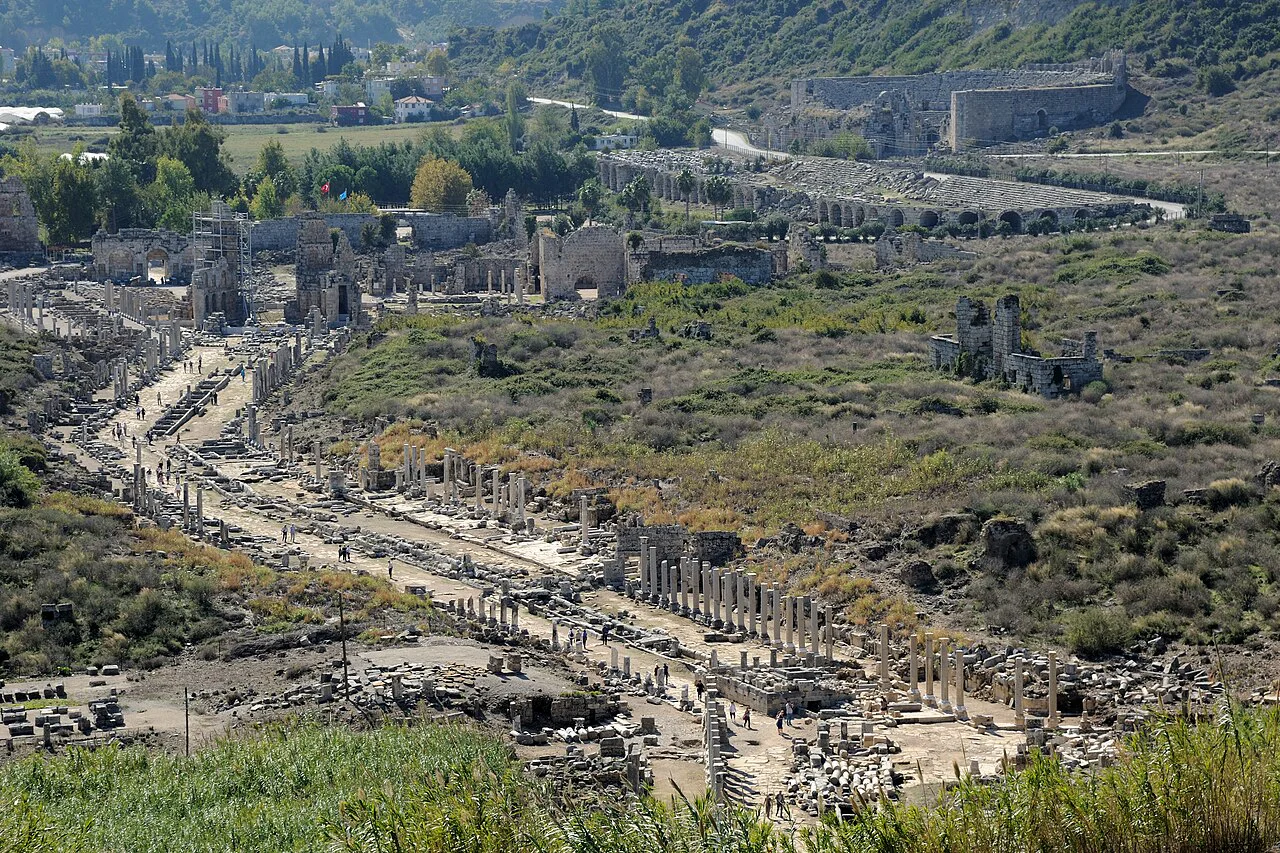
Aksu · 35 km
Perge
Content & sources
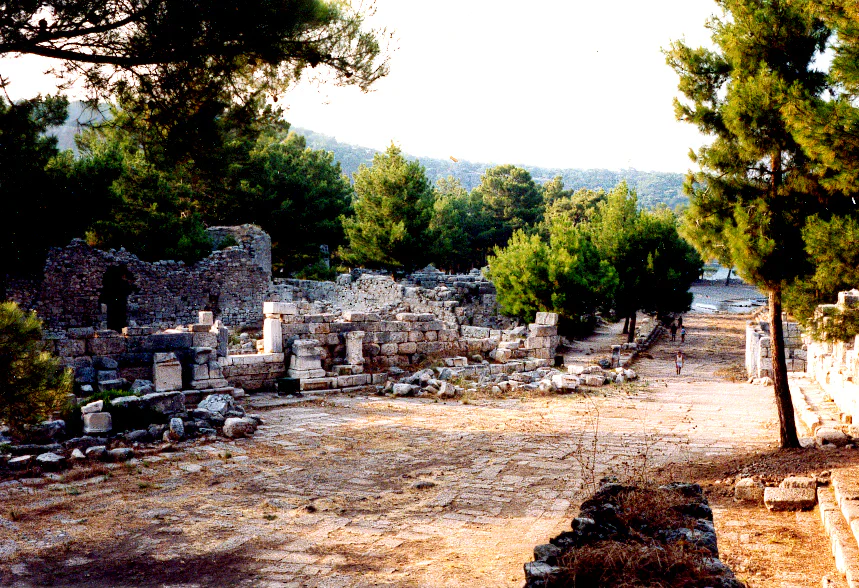
Photo: Saffron Blaze · CC BY-SA 3.0
Kemer · 52 km
Faselis
Content & sources
Alexander Buschorn at de.wikipedia · CC BY-SA 3.0
Serik · 63 km
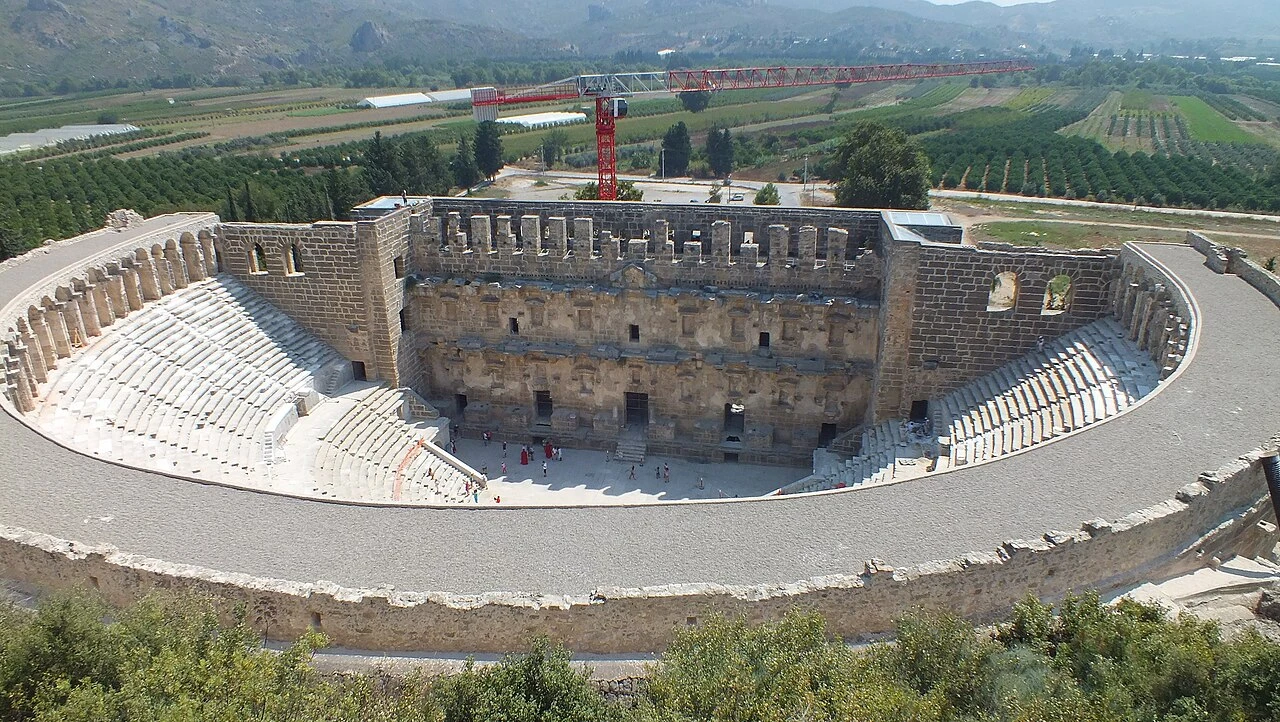
Aspendos Theatre
Content & sources
Nicola Feola · CC BY 3.0
Kumluca · 65 km
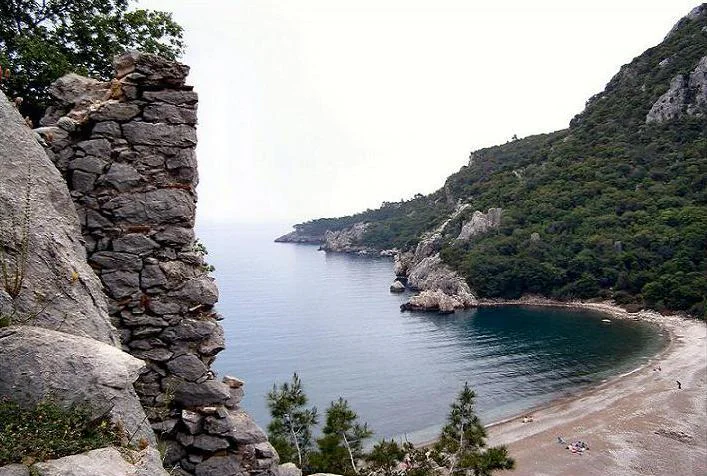
Olimpos, Kumluca
Content & sources
Hilmi Ayhan · CC BY 2.5