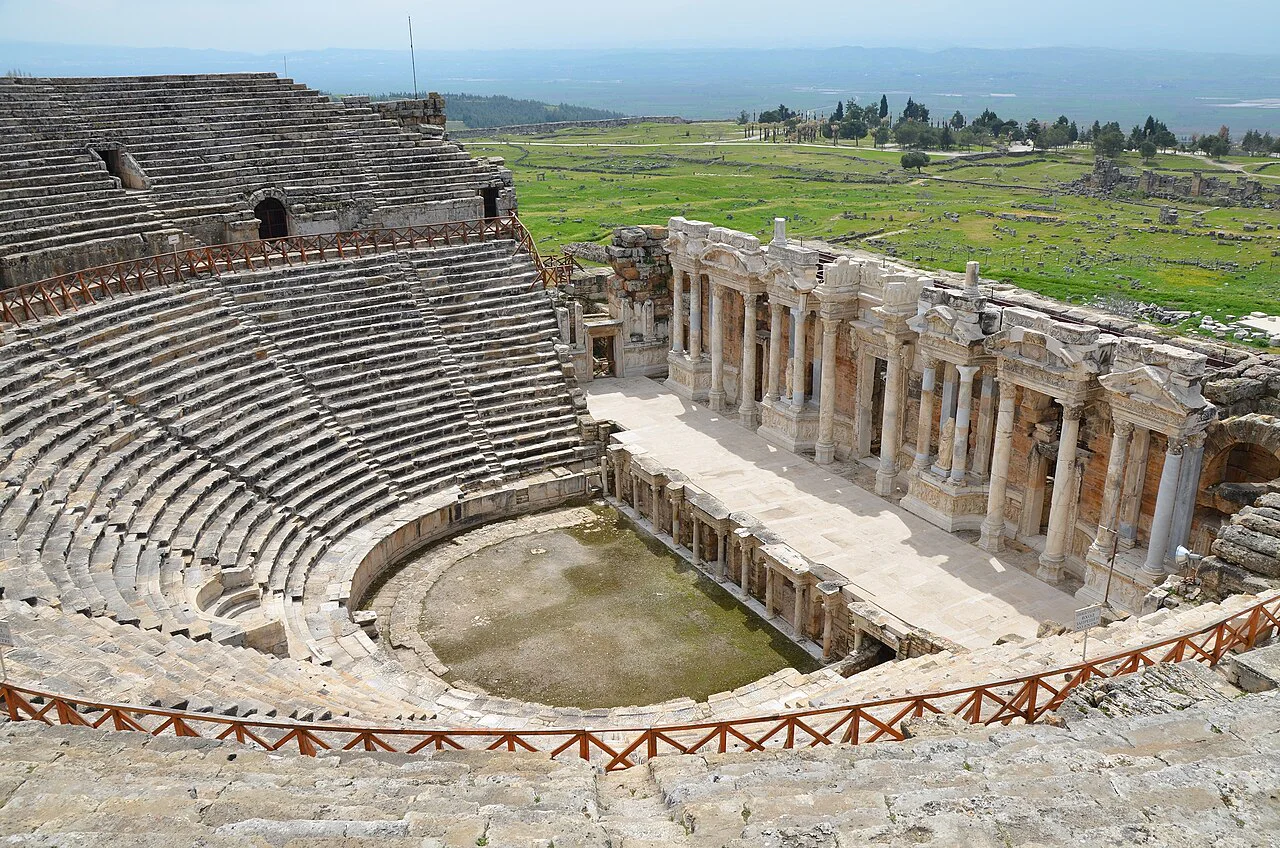
Stanza · Audio guide
Hierapolis Audio Guide
A place to remember. A story to take with you.
Hierapolis was a Hellenistic Greek city in Phrygia founded in the 3rd century BC. It was famous for its hot springs, high quality wool fabrics, and as the birthplace of the philosopher Epictetus.
Download Stanza, then search for “Hierapolis”.
About the tour
One guide. Your kind of visit.
Hierapolis was a Hellenistic Greek city in Phrygia founded in the 3rd century BC. It was famous for its hot springs, high quality wool fabrics, and as the birthplace of the philosopher Epictetus.
Ready when you are.
- 01Get the free Stanza app.
iOS & Android
- 02Find your guide.
“Hierapolis”
- 03Download before you go.
Works offline
Audio guide / 53 narrated stops
Inside the guide
Get to know a few of the stories before you go. Open a stop to read more.
01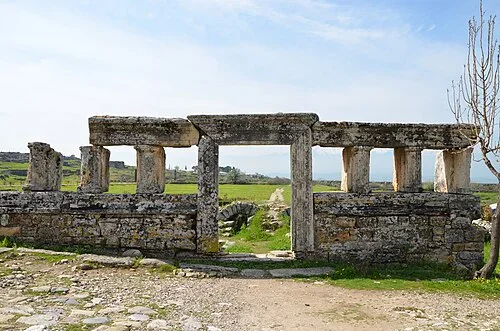 Tomb 176 (House-Shaped Tomb)
A family tomb built in the shape of a house, with window-like openings punched into its stone facade. Tomb 176 went up in the second or third century AD, when wealthy families here raised burial monuments that copied the homes they had lived in. The message was about standing: this family owned a house in life and expected one after death. Poorer families simply cut their graves into the rock. Around the finer tombs, low walls enclosed small gardens planted with flowers and cypress. A long Greek inscription preserves the name of the man this tomb was built for: Tiberius Claudius Talamos.
Carole Raddato from FRANKFURT, Germany · CC BY-SA 2.0
02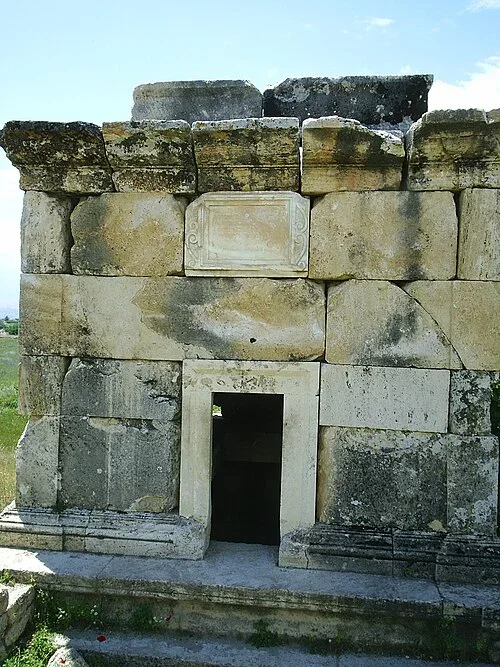 Tomb 170
Few graves in this necropolis have kept their shape as completely as this one. Tomb 170 was raised in the second or third century AD as a closed stone chamber, its blocks squared and fitted in the classical Roman manner. The masons worked chiefly in local limestone, though marble appears on some tombs here as well. The doorway stands framed and whole, with a plain carved panel set above it. No name survives on the stone to say who was buried inside.
Photo: Mach · CC BY-SA 3.0
03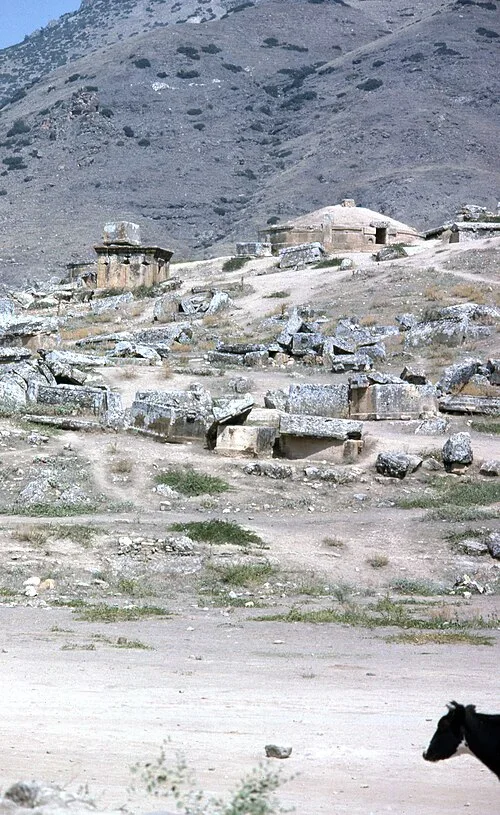 Hierapolis Tumulus Tombs
The oldest graves at Hierapolis are the round mounds on the eastern slope of the foothill. They belong to the Hellenistic period, the first and second centuries BC, long before the Roman spa town. Each tumulus is a circle of carefully cut stone forming a drum over the burial chamber, with the mound rising above it. A narrow passageway, the dromos, runs through to the vaulted chamber where the dead were laid. Most of the tombs here date from the late Hellenistic age onwards, which makes these mounds the burial ground's founding layer. From a distance they read as gentle hills, easy to mistake for the landscape itself.
Listen in the appPhoto: Sailko · CC BY-SA 3.0
04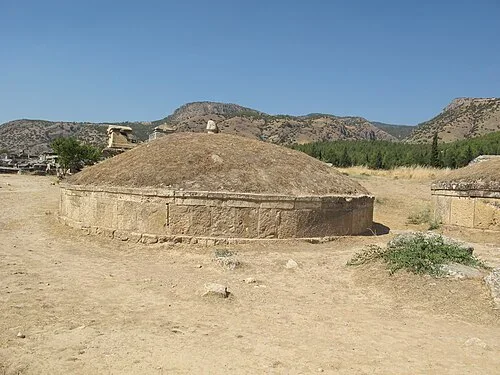 Hierapolis Tumulus Tombs
Round (Tholos) Tomb, Northern Necropolis
Death here had a catalogue. The tombs of Hierapolis fall into four main types, and this round tholos shows how far the variety went. There were circular mounds of earth and stone. There were sarcophagi, some raised on substructures, others hollowed out of the rock, many covered with a double-pitched roof like a little gabled lid. Larger family graves took the shape of small temples, and others copied houses, sometimes stacking two or more sarcophagus lids one above the other. A family chose its form by tradition and by means, so the necropolis reads like a survey of how people wished to be remembered.
Listen in the appPhoto: Sailko · CC BY-SA 3.0
05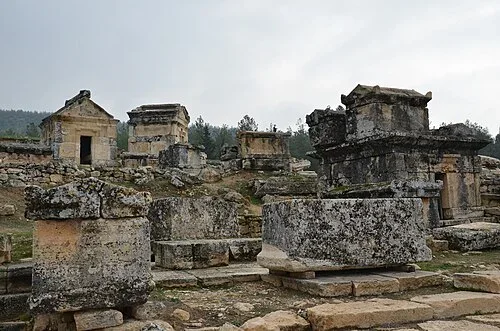 Northern Necropolis
A burial ground stretches for more than two kilometres along the roads leading out of the city, towards Phrygian Tripolis and Sardis. It runs from the northern edge of Hierapolis around to the east and south, and most of its tombs have been excavated. Counts differ, but well over a thousand tombs have been recorded, and the necropolis ranks among the best preserved in Turkey. Locals were buried here alongside people who had travelled to Hierapolis for medical treatment at the hot springs. Some of those visitors recovered and went home. Others retired here, or died here, and took their place among the tombs. Each was buried according to family tradition and means, which is why the ground holds everything from plain rock-cut graves to walled garden tombs.
Listen in the appshankar s. from Dubai, united arab emirates · CC BY 2.0
06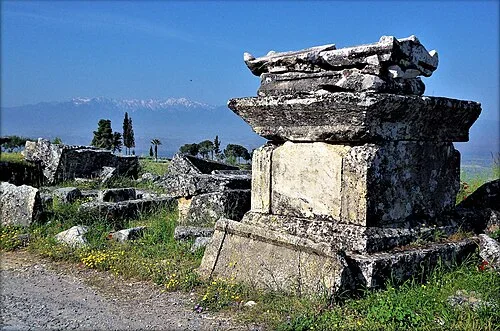 Northern Necropolis
Travertine Tomb Monument (Lahid)
Plenty of these travertine coffins still speak. Their lids and sides carry Greek epitaphs, some carved more than two thousand years ago, and a Greek word, Soros, turns up again and again at the end of the lines. The inscriptions name the dead, record their professions, and praise their good deeds. Read together, they tell us a great deal about who lived here and how they made their living. The monuments themselves fared worse: most of the sarcophagi were plundered over the centuries. What the robbers wanted is gone. The carved words stayed where the masons left them.
Listen in the appRolf Dietrich Brecher from Germany · CC BY-SA 2.0
07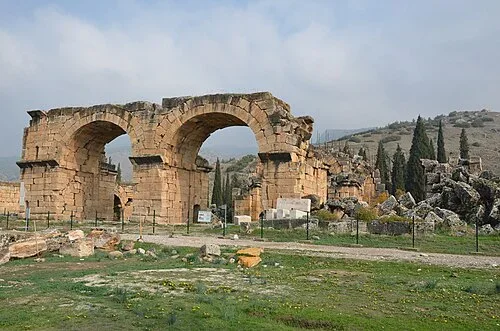 Bath Basilica (North Baths)
Roman Baths (Basilica Therma), far view
The hot springs made Hierapolis a place of healing, and bathing became the industry built around them. Under the Roman Empire the city was a health centre where doctors prescribed the thermal waters to their patients. Thousands of visitors came, and the city answered with more than fifteen sets of baths. The great bath complex was centred on the natural thermal pools and ranked among the biggest buildings of Hierapolis. The spring water reaches the surface at between 36 and 57 degrees Celsius, already hot enough for bathing.
Listen in the appshankar s. from Dubai, united arab emirates · CC BY 2.0
08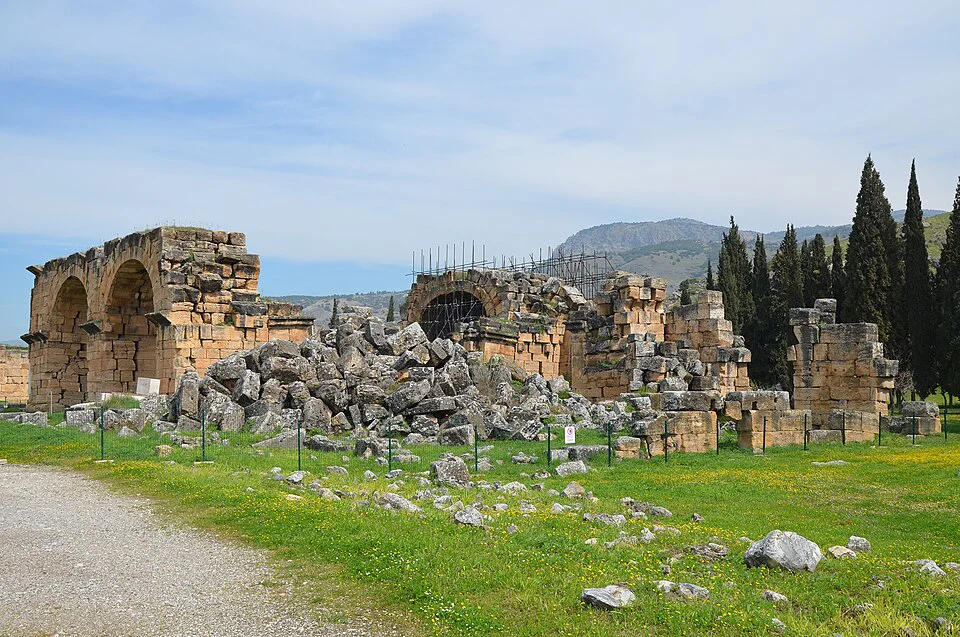 Bath Basilica (North Baths)
This building has lived two very different lives. It began as a Roman bath complex, raised in travertine blocks at the beginning of the third century AD. Its halls had vaulted ceilings coated in stucco, and their walls were faced with slabs of marble. Centuries later, in the early Christian era, the baths were converted into a basilica church, sometime in the fifth century. The conversion is visible evidence of the city's own turn, from a pagan spa town to a Christian one. The great arches still stand; the rubble of the fallen vaults lies heaped at their feet.
Listen in the appCarole Raddato from FRANKFURT, Germany · CC BY-SA 2.0
09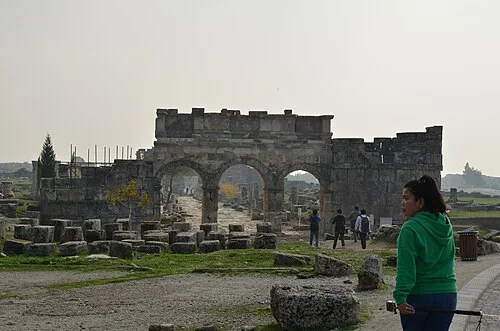 Frontinus Gate (Gate of Domitian)
Three arches in carefully squared travertine, flanked by two round towers, formed the ceremonial northern entrance to the Roman city. The round towers echo older Hellenistic gate designs, such as the gate at Perge near Antalya. Through it ran the plateia, a street about fourteen metres wide that crosses the whole settlement and leaves at the far gate towards Laodicea on the Lykos and then Colossae.
Listen in the appshankar s. from Dubai, united arab emirates · CC BY 2.0
10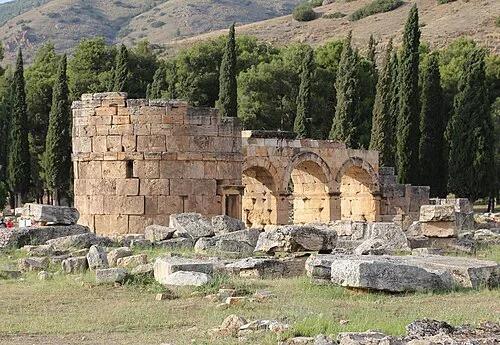 Frontinus Gate (Gate of Domitian)
Domitian Gate, Hierapolis
This triumphal arch has a known builder and a known dedication. Julius Frontinus, the proconsul governing the province of Asia, had it built in the years 84 to 86 AD. A frieze inscription on the arch dedicates the gate to the emperor Domitian, and it was carved twice over, once in Latin and once in Greek. That dedication is where the gate's name comes from: the Domitian Gate, though many call it simply the Roman Gate.
Listen in the appBernard Gagnon · CC BY-SA 3.0
- 11
Public Latrines (Latrinae)
Communal Roman plumbing: a stone bench for many, flushed by water that never stopped running.
- 12
Colonnaded Frontinus Street
The city's fifteen-hundred-metre spine, gridded in Hellenistic times and lined with arcades.
- 13
Shops and Porticoes of Frontinus Street
Wool, dyes and the road to Ephesus: the trade that made the holy city wealthy.
- 14
North Byzantine Gate
A late-Roman city wall built from demolished monuments, guarded by a Gorgon's head.
- 15
Nymphaeum of the Tritons
A Roman public fountain dressed in carved sea gods, where even drinking water came with a touch of myth.
- 16
Agora of Hierapolis (Eastern Basilica-Stoa)
The vast marketplace of a spa town, where trade in goods ran alongside the business of healing.
- 17
Agora of Hierapolis (West Side)
How imperial visits turned a spa town into one of the most prominent cities of the empire in the arts, philosophy and trade.
- 18
Byzantine Cathedral (Basilica)
The cathedral of a Christian city, built from the marble of its pagan past.
- 19
Agiasma (Sanctuary Fountain)
The holy fountain where pilgrims washed and drank before climbing to the apostle's shrine.
- 20
Aghiasma Fountain
How the same waters stayed sacred, from an underworld gate to a Christian holy fountain.
- 21
Church of the Sepulchre
A church built to hold the crowds who came to the apostle's grave.
- 22
Re-erected Marble Colonnade
White marble columns, raised again, showing how the city's grand buildings once outshone its native stone.
- 23
Tomb of Saint Philip
A Roman tomb that archaeologists believe may hold the apostle Philip, though the question is not settled.
- 24
Tomb of the Apostle Philip (Facade)
The apostle Philip's last years in Hierapolis, and the family said to have served the church here.
- 25
Martyrion of St. Philip the Apostle
The hilltop martyrium where the apostle Philip is said to have died, an octagonal church of imperial design.
- 26
Aghiasma Fountain on the Pilgrim Path
A fountain with an arched niche, a way-station on the ancient road climbing to the Martyrion.
- 27
Church of the Sepulchre (Annexes)
How a sacred quarter grew in stages around a single grave on the hill.
- 28
Travertine Facade of the Apostle's Tomb
The apostle's shrine, built of the same white travertine as the hills around it.
- 29
Carved Cross at the Martyrion
A cross cut into the stone over the arches, the mark of a city that had changed its faith.
- 30
Roman Castellum Aquae (Water Reservoir)
The hidden heart of a spa city: a reservoir that collected the springs and piped them across town.
- 31
Ancient Theatre of Hierapolis
How an earthquake levelled Hierapolis, and how the theatre rose from the rubble in Roman grandeur.
- 32
Theatre Scaenae Frons and Cavea
The emperor's grateful gift: how a local tutor earned his city a marble stage facade on three storeys.
- 33
Temple Nymphaeum
A fountain raised like a temple, serving the gods' quarter and the street at once.
- 34
Sanctuary of Apollo
Apollo Lairbenos, the fused god of Hierapolis, and the sanctuary built over living rock that never rests.
- 35
Temple of Apollo (Rebuilt)
The quake of AD 17, and a temple rebuilt from the blocks of its own predecessor.
- 36
Ploutonion (Gate of Pluto)
The cave that killed, the priests who survived it, and the money made from the gate of the dead.
- 37
Plutonium (Pluto's Gate), Entrance
What ancient writers wrote about the gate of the dead, and how Christians shut it with stones.
- 38
Ancient Pool (Cleopatra's Pool)
Swimming among real ruins: the spring pool where an earthquake dropped a marble portico into the water.
- 39
Sacred Basin of the Thermal Springs
Cleopatra's bath, the gift of Mark Antony, and the small problem that none of it is true.
- 40
Pamukkale Archaeology Museum
The museum in the baths: a spa city's gods, tombs and treasures gathered under one vaulted roof.
- 41
Apollo Frieze from the Theatre Stage Building
The god in marble on the stage facade: Apollo watching over the theatre as well as his sanctuary.
- 42
Relief of Hades Abducting Persephone
Hades seizes Persephone on his chariot, the underworld myth this city carved into its own stone.
- 43
Statue of Attis
The pensive companion of the mother goddess Cybele, from a cult older than the city itself.
- 44
Colossal Statue of Hadrian (Fragment)
A headless emperor in carved armour, several times life size, with a defeated enemy at his foot.
- 45
Section of Hierapolis Theatre Findings
How the theatre's scattered carved decoration was dug up, reassembled and brought under a roof.
- 46
Theatrical Mask Relief from the Theatre
A grotesque stone mask from the theatre, the signature face of Roman stage buildings.
- 47
Section of Sarcophagi and Statues
The sarcophagus relief of a local miller showing the earliest known crank-and-rod machine.
- 48
Pamukkale Archaeology Museum, Gallery Hall
The gods a healing city kept: fortune, fertility and the god of medicine among them.
- 49
Garlanded Roman Sarcophagus (Detail)
Why Roman coffins for the wealthy were dressed in carved garlands of fruit and foliage.
- 50
Figured Sarcophagus Relief (Detail)
The people carved on a sarcophagus front, shown as their families wanted them remembered.
- 51
Gymnasium Portico
The gymnasium where the city's young trained, its collapse and its burial under limestone.
- 52
Re-erected Columns with Greek Inscription
Fallen columns raised again, with Greek letters that may spell the end of 'gymnasion'.
- 53
South Byzantine Gate
The southern gate of the late Roman walls, and the shrunken town that lived behind them after Persian raids and earthquake.
Hierapolis
Frequently asked questions
How much does the guide cost?
Free app download. Listed guide price: $4.99. Guide price shown in the app. Audio guide only. Venue admission is separate.
Can I listen without internet?
Yes. Download the guide’s audio, images, and maps in the app before your visit. Your downloaded content is then available offline.
Can I listen in my language?
This audio guide is available in 15 languages, including English.
Do I need to follow a schedule?
No. This is a self-guided experience. Choose your stops, pause whenever you like, and return to a story at your own pace.
At your own pace
Explore Hierapolis.
Download Stanza, then search for “Hierapolis”.
Free app download · Guide price shown in the app
Keep exploring
Nearby audio guides
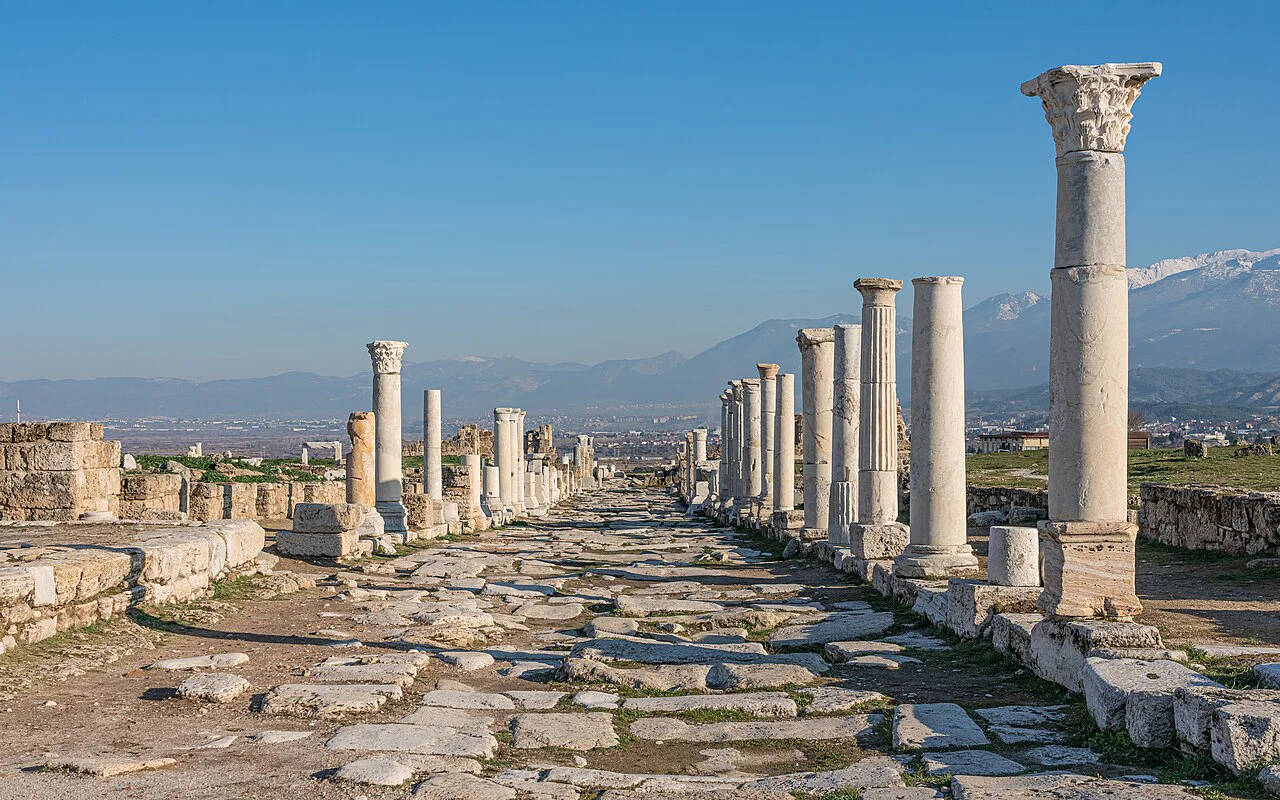
Merkezefendi · 10 km
Laodikya
Content & sources
Photo: A.Savin · FAL
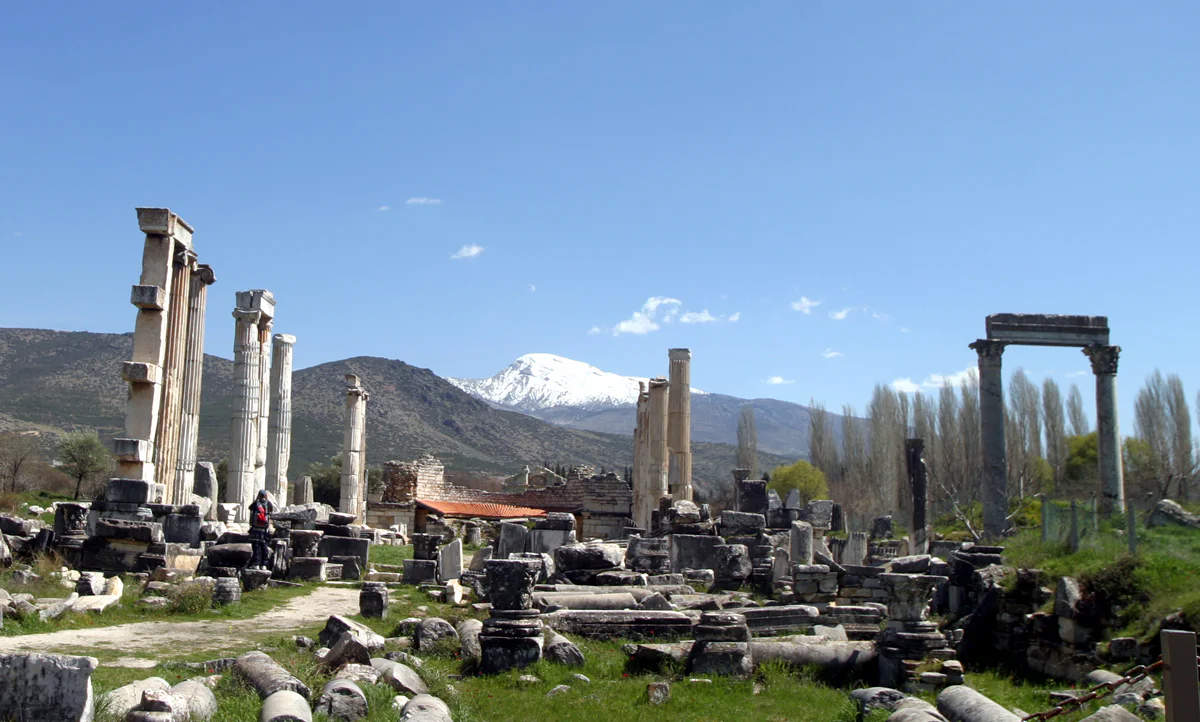
Geyre · 43 km
Afrodisias
Content & sources
Brocken Inaglory · CC BY-SA 4.0
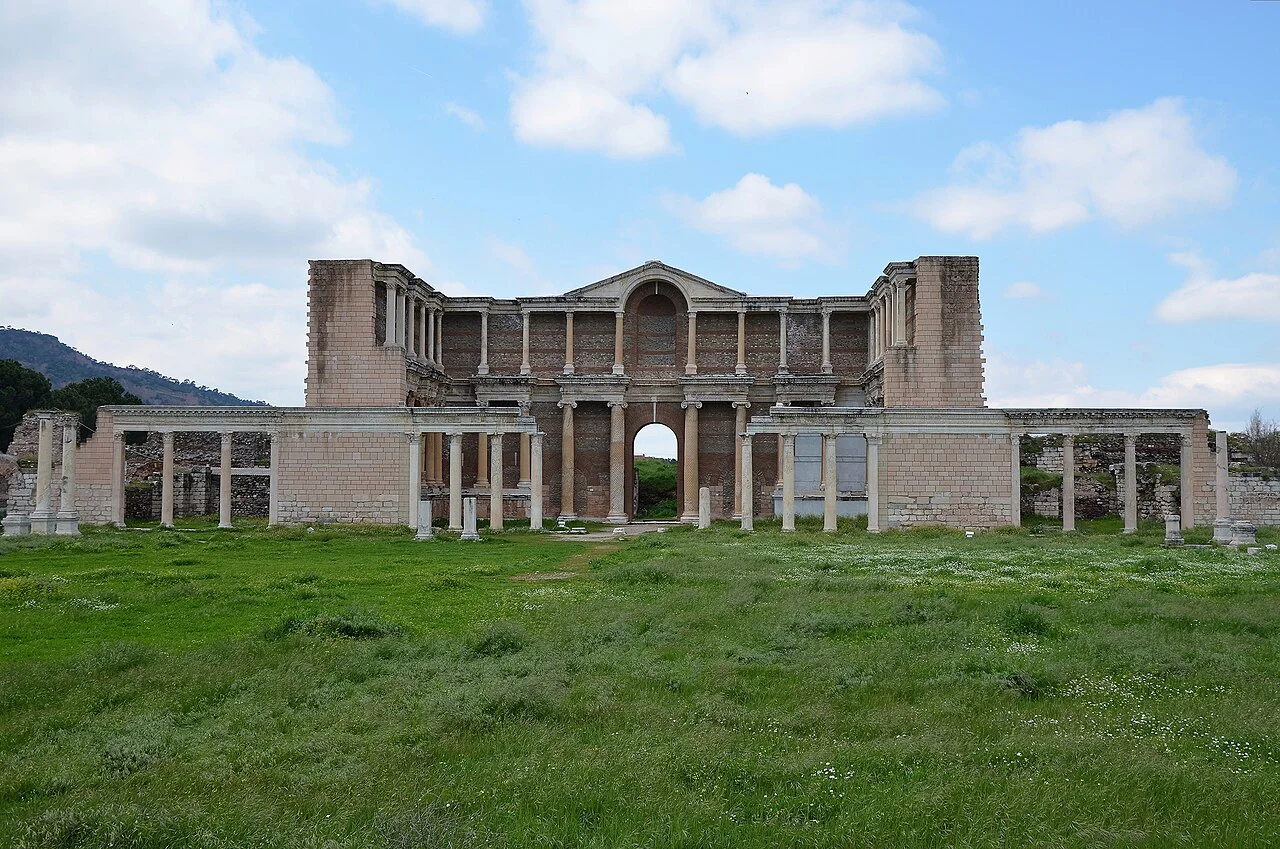
Salihli · 114 km
Sardis
Content & sources
Carole Raddato from FRANKFURT, Germany · CC BY-SA 2.0
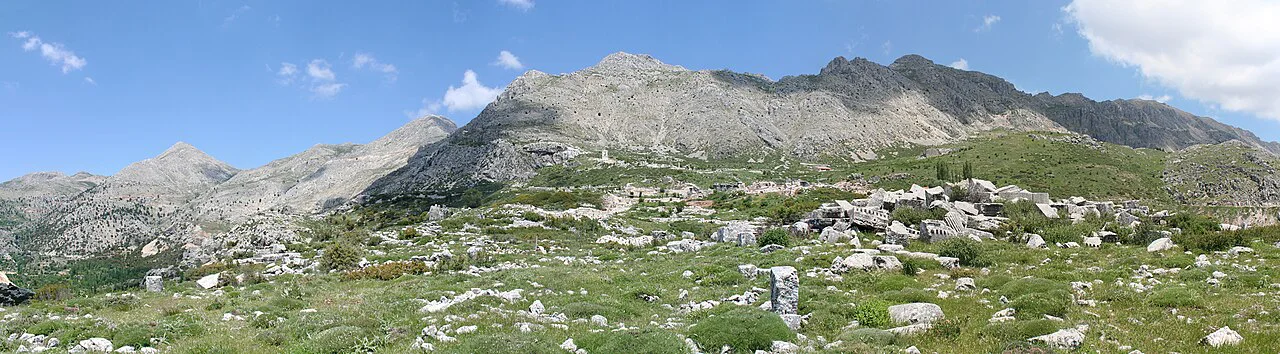
Ağlasun · 125 km
Sagalassos
Content & sources
Ingo Mehling · CC BY-SA 3.0